
You’re probably seeing the same pattern everywhere. You search for r programming jobs, open a promising listing, and find it has vague requirements, no hiring manager, and a pile of applicants already queued up. Then the recruiter messages start. Half of them are for roles that barely use R, and the rest lead to stale listings that should’ve been taken down days ago.
That frustration is rational. The remote job market rewards timing, specificity, and signal. Most candidates spend too much time on noisy platforms and not enough time getting clear on which R roles fit their experience and where serious employers post them. If your search feels random, your results will too.
R still opens strong career paths because it sits at the intersection of statistics, reproducible analysis, and domain-heavy work. Teams in healthcare, finance, research, tech, and pharma still hire people who can clean data, build models, explain results, and ship work that other people can rerun. That combination matters more in remote environments, where your code and documentation have to stand on their own.
A key edge isn’t just “learn more R.” It’s knowing which employers value R enough to hire for it directly, which skills they screen for, and how to position yourself before a role gets flooded. That’s the difference between sending applications into a crowd and getting into a hiring process where your background is a close match from day one.
Introduction
You find a remote R role that looks promising. The title fits, the stack fits, and the company sounds legitimate. Ten minutes later you notice the post is copied across three job boards, the description barely mentions the actual work, and there is no signal that the team is actively hiring. That is a significant problem with r programming jobs right now. Qualified candidates waste time sorting through noise.
Strong applicants miss good roles for predictable reasons. They search broad platforms where stale listings stay up too long, they present themselves as generalists when the team needs a very specific kind of R user, or they apply after a posting has already been flooded. Remote hiring rewards precision. Clear fit, fast timing, and credible proof of work matter more than sending another batch of applications into a crowded board.
Treat R as part of a hiring signal, not the whole search strategy.
The better approach is to target the work behind the job title. A biostatistics team hiring a statistical programmer is screening for a different profile than a product team hiring an analyst who happens to use R. A research-oriented data scientist role asks for different evidence than a reporting-heavy operations role. If you search only for the language, you pull in all of it. If you search for the business problem, team type, and hiring channel, you get closer to roles that are worth your time.
Remote teams also judge your work differently. They cannot rely on office presence or whiteboard chemistry to fill in gaps, so they look for clean code, readable analysis, sensible documentation, and examples that show how you communicate decisions. I have seen a small, well-scoped portfolio beat a messy collection of half-finished notebooks many times.
The payoff is still real. Employers continue to pay well for people who can use R to produce reliable analysis, explain trade-offs, and ship work other people can rerun. The candidates who do best are usually not the ones applying the most. They are the ones using better sourcing methods, including direct-source remote job tools such as Remote First Jobs, to find verified openings before the spam and applicant volume get out of control.
If you want a high-quality remote R role, start there. Choose the right job family, show proof that matches it, and use channels that surface active, credible hiring instead of recycled listings.
The Modern Landscape of R Programming Jobs
R hiring is wider and more segmented than a basic job board search suggests. Search only for “R programmer” and you will pull in everything from clinical reporting roles to product analytics jobs to research-heavy modeling positions. Those jobs may share a language, but they do not share the same day-to-day work, hiring bar, or interview process.
That distinction matters even more in remote hiring. Verified remote openings are usually written with more specificity because distributed teams need people who can contribute with less hand-holding. If a posting is vague, recycled across multiple boards, or stuffed with every analytics buzzword, it is often a poor use of your time. Direct-source tools such as Remote First Jobs help filter for real remote demand, but you still need to know which role family fits your background.
The main role families
A strong R job search starts by sorting roles into the work they require.
Data Analysts use R to answer business questions, clean and reshape data, build recurring reports, and explain findings to non-technical stakeholders. Expect a mix of SQL, dplyr, ggplot2, and presentation work. In many teams, the hard part is not the code. It is choosing the right level of detail and producing analysis that leads to a decision.
Data Scientists are usually hired for experimentation, forecasting, model development, and causal or predictive analysis. R shows up in modeling workflows, statistical testing, feature work, and reproducible research. Good candidates explain why they chose a method, what they ruled out, and where the model can fail.
Statistical Programmers work in regulated or documentation-heavy environments, especially in clinical research and pharma. These roles reward consistency, validation, traceability, and clean outputs. If you like careful review and process discipline, this path can be a strong fit.
Bioinformaticians use R in life sciences and research settings where scientific context matters as much as coding skill. Common work includes genomic analysis, specialized statistical workflows, visualization, and publication-ready reporting. Hiring managers usually expect evidence that you understand the domain, not just the tooling.
Quantitative Analysts use R in research, simulation, and time-series work across finance, insurance, and risk teams. Some employers build production systems in other languages, but R remains useful for exploratory analysis and research workflows where statistical iteration matters more than deployment polish.
Comparison of common R programming job roles
| Job Role | Primary Focus | Core R Skills | Salary Profile | Top Industries |
|---|---|---|---|---|
| Data Analyst | Reporting, exploration, stakeholder analysis | dplyr, ggplot2, reporting, SQL integration |
Often solid mid-career pay, with compensation tied closely to SQL depth, business context, and communication skill | Tech, healthcare, finance, operations |
| Data Scientist | Predictive modeling and advanced analytics | modeling workflows, inference, feature engineering, reproducible analysis | Usually the highest ceiling in this group, but also the noisiest applicant pool and the toughest screening process | Tech, healthcare, finance, research |
| Statistical Programmer | Structured statistical analysis and validated outputs | reproducible scripts, reporting, regulated workflows | Often strong in regulated industries where accuracy and auditability carry real business value | Pharmaceuticals, clinical research, healthcare |
| Bioinformatician | Scientific data analysis in biology and medicine | statistical analysis, visualization, research reporting | Compensation varies widely with research funding, employer type, and scientific specialization | Biotech, research labs, healthcare |
| Quantitative Analyst | Financial and risk modeling | time-series analysis, simulation, statistical modeling | Can pay very well, especially where domain expertise in markets or risk is hard to replace | Finance, trading, risk, insurance |
A lot of candidates blur these categories and then wonder why interviews feel inconsistent.
A hiring manager for a remote analytics role may care about stakeholder judgment, reporting habits, and SQL fluency. A hiring manager for a statistical programming role may spend far more time probing documentation standards, reproducibility, and error prevention. Both roles can ask for R. They are still screening for different evidence.
What the work actually feels like
Analyst roles tend to reward speed, business judgment, and communication. You will often deal with incomplete requests, shifting stakeholder priorities, and pressure to simplify. Candidates who over-index on fancy methods can struggle here because the actual work is often clarifying the question and delivering an answer people can use.
Data science roles ask for more methodological depth. Interviewers often test whether you can defend assumptions, choose among imperfect options, and explain trade-offs clearly in writing. In remote teams, that last part carries extra weight because your work will be reviewed asynchronously.
Statistical programming and bioinformatics are less forgiving about sloppiness. Small mistakes can create downstream problems in regulated or research settings, so teams often favor candidates with a careful, documented style over candidates who move fast but leave gaps.
The practical move is to pick one lane and search like a specialist. Use title filters, but do not stop there. Read for team type, reporting structure, domain, and tool expectations. Then prioritize verified remote roles from direct-source channels over mass-market listings that attract a flood of low-fit applicants. That shift alone usually improves application quality more than sending fifty more resumes.
Why R Skills Still Command Premium Salaries in 2026
A hiring manager at a remote biotech company opens two take-home submissions at 7 a.m. One is a loose notebook with scattered code and charts pasted into slides. The other is a clean R project with documented assumptions, versioned scripts, and a report that can be rerun without guesswork. The second candidate usually gets the interview.
R keeps paying well because it maps to work where accuracy, reviewability, and statistical judgment matter. That combination shows up in industries that do not tolerate sloppy analysis, including healthcare, pharma, insurance, public policy, and research-heavy product teams.

Where R still wins
R stays valuable in workflows where the output needs to be statistically defensible and easy for another analyst to audit later. That matters even more on remote teams, where your code and reporting style carry part of the communication burden. Clean handoff is part of the job.
R is still a strong choice for:
- Statistical analysis that goes beyond basic dashboards: regression, mixed effects models, survival analysis, experimental design, and other methods that appear often in regulated or research settings
- High-clarity visualization:
ggplot2still gives teams fine control when charts need to explain a decision, not just decorate a deck - Reproducible reporting: R Markdown and Quarto make it easier to tie code, narrative, tables, and figures into one reviewable artifact
- Domain-specific packages: healthcare, epidemiology, biostatistics, and social science teams often rely on mature R libraries that fit their workflows well
Python is still the broader general-purpose option in many engineering-heavy teams. That does not reduce R’s value. It raises the value of candidates who know where R is the better tool and can explain that choice clearly.
Why the pay stays strong
Premium compensation usually follows business risk. If a team uses R for clinical reporting, policy analysis, pricing models, or experiment readouts, bad work creates real cost. Employers pay more for people who can produce analysis that holds up under scrutiny.
Specialization matters too. A candidate who lists R on a resume is easy to find. A candidate who has used R to build validated reports, support regulated decisions, or maintain a reproducible analytics workflow is much harder to replace.
Remote work adds another filter. Teams hiring across time zones put extra weight on written reasoning, documented code, and clean project structure because managers cannot rely on constant live meetings to fill in gaps. Good R practitioners often stand out here because the language and its tooling reward habits that support improving team communication, especially in asynchronous environments.
The best-paid R roles are rarely paying for syntax alone. They are paying for trust.
That is also why high-quality remote R jobs are worth sourcing carefully. Verified, direct-source listings tend to come from teams that already know why they need R and what good work looks like. Those employers are usually clearer about scope, tools, and expectations than the spam-heavy posts on mass-market job boards. That makes it easier to target roles where your R background is treated as a revenue or risk-management asset, not just another keyword match.
Core Technical and Soft Skills for R Programmers
A lot of candidates lose strong remote r programming jobs before the interview starts because their skill set reads like a package list instead of a work system. Hiring managers want proof that you can clean messy inputs, choose the right method, document decisions, and hand off results in a form another person can trust.
The technical stack that hiring managers screen for
For most professional R roles, the baseline starts with the Tidyverse. dplyr, tidyr, readr, and ggplot2 should be familiar enough that you use them without friction. Teams expect analysts to move from import to cleaning to visualization quickly, with code that another analyst can review and extend.
SQL matters almost as much as R. A large share of real analysis starts in a warehouse or production database, and remote employers notice quickly when a candidate can only work from exported CSVs. If you can write clear queries, pull only the data you need, and finish the analysis in R, you become much easier to place on a distributed team.
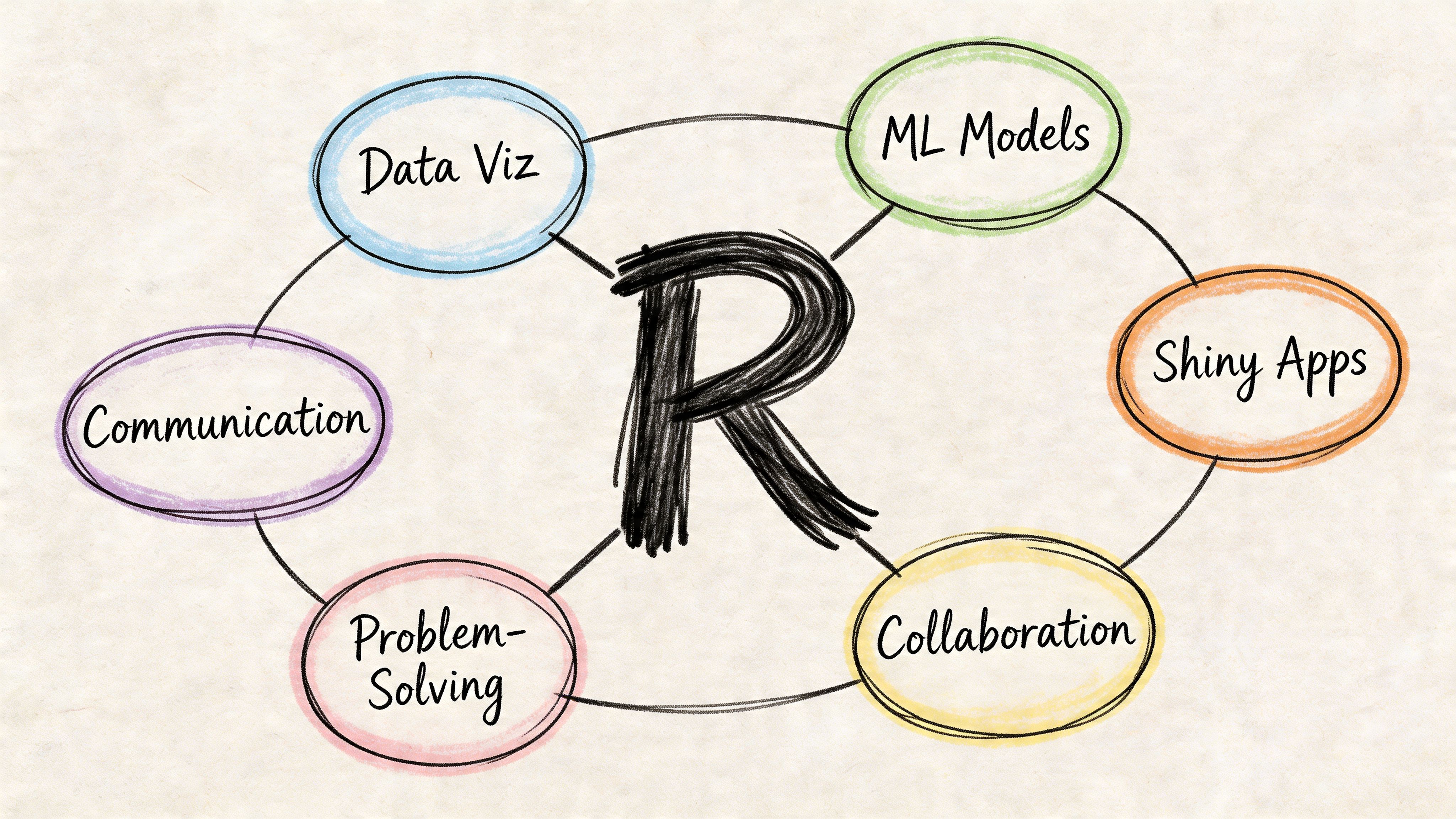
A practical checklist for mid-tier and top-tier roles looks like this:
- Data manipulation:
dplyr, joins, grouped summaries, reshaping, string and date handling - Visualization:
ggplot2, chart selection, annotation, and outputs that are ready to share - Reporting: R Markdown or Quarto for reproducible reports, analysis memos, and stakeholder updates
- Apps and demos:
shinyfor internal tools, lightweight dashboards, or portfolio projects - Performance awareness:
data.table, efficient imports, and basic memory discipline on larger datasets - Version control: Git and GitHub, with readable commits, sensible branches, and clean project structure
- Modeling basics: regression, classification, validation, and clear interpretation of results
- Database fluency: moving cleanly between SQL extraction and R analysis
One nuance matters here. High-quality remote roles often screen less for niche package trivia and more for whether your stack reflects production habits. Clean repos, reproducible reporting, and readable code beat a long list of libraries every time.
What separates strong remote candidates
Remote teams hire for output they can trust without constant supervision. That changes the soft-skill bar.
The common failure mode is not weak coding. It is technically sound work with poor context. An analyst sends a chart without assumptions, a model without caveats, or a notebook nobody else can rerun. In a colocated office, a manager might fix that in conversation. In a remote team, it slows decisions and creates doubt about your reliability.
The soft skills that matter most are:
- Asynchronous communication: concise updates that explain progress, blockers, and the decision needed
- Stakeholder translation: turning a statistical result into a recommendation a product, finance, or operations lead can use
- Scope control: recognizing when a fast descriptive cut is enough and when a deeper model is worth the time
- Ownership: flagging data quality issues, edge cases, and risks before they become rework
- Documentation: leaving behind enough context that another analyst can pick up the project without guessing
PeakPerf’s guide to improving team communication is useful here because many remote R jobs go to the candidate who reduces coordination cost, not the candidate with the flashiest notebook.
A remote analyst who writes clearly, documents assumptions, and keeps work reproducible will often beat a stronger coder who creates confusion.
What to build if you have skill gaps
Build fewer projects, but make them look like real work.
A good portfolio piece usually solves one business question from start to finish. It starts with messy or imperfect data, shows the cleaning logic, explains the method choice, and ends with a recommendation. That format maps well to the kind of verified remote roles you find through direct-source platforms such as Remote First Jobs, where employers care more about how you work than how many keyword matches your resume can trigger.
Useful project formats include:
- A business-facing analysis in R Markdown or Quarto with a short executive summary.
- A Shiny app that helps a non-technical user explore a dataset or monitor a metric.
- A repo that begins with SQL extraction, moves into R transformation and analysis, and finishes with visualization and written interpretation.
That combination shows hiring teams something that generic applicants often miss. You can complete the whole analytical loop and leave behind work that is easy to review, easy to trust, and easy to use.
Navigating the R Job Hiring Process
The hiring process for R roles is usually less mysterious than people think. It’s just uneven. Some companies run a disciplined, relevant process. Others throw generic interviews at specialized candidates and hope for the best.
The strongest candidates prepare for both.
What a good application looks like
Start with the resume. For R roles, generic bullets waste space. “Analyzed data” says almost nothing. A better bullet names the dataset type, the workflow, the tools, and the business or research outcome. If a job asks for R, SQL, statistical modeling, dashboards, or reproducible reporting, those terms should appear naturally where they’re truthful.
Your portfolio carries more weight than many candidates expect. There are over 332 junior R listings available, and a strong portfolio with GitHub Shiny apps is a key differentiator for entry-level candidates, especially for remote roles that attract a high volume of applicants, according to Turing’s overview of remote R developer hiring. The same principle applies at mid-level too. Hiring teams want evidence.
A useful portfolio repo includes:
- A short README: what question you answered and why it matters
- Clean project structure: data, scripts, outputs, and documentation separated logically
- Commented code: enough to clarify reasoning, not so much that it becomes noise
- Interpretation: a conclusion written for humans, not just a notebook full of code
How hiring teams evaluate you
A typical funnel includes resume screening, recruiter conversation, technical screen, take-home or live exercise, and final interviews. The exact format varies, but the evaluation pattern is consistent.
First, they test fit. Does your background resemble their problem space?
Then they test execution. Can you work with data, choose sensible methods, and explain what you did?
Finally, they test trust. Would they feel comfortable giving you ambiguous work in a remote setting?
Don’t treat a take-home as a coding contest. Treat it like a sample of how you’d work if hired.
The take-home assignment and interview
Most take-homes aren’t designed to see whether you know the most advanced statistics. They’re designed to see whether you can think clearly under realistic constraints. Hiring managers usually care about data hygiene, code readability, methodology, and interpretation.
Common mistakes are predictable:
- submitting cluttered notebooks with no narrative,
- overmodeling when a simpler approach fits the prompt,
- skipping assumptions,
- and failing to explain business implications.
In interviews, expect some mix of technical and behavioral questions. “How would you handle missing data?” is partly technical and partly about judgment. “Tell me about a time your analysis changed a decision” tests whether you understand impact, not just tools.
A strong answer usually has a simple shape. State the context, explain your approach, mention the trade-off, and end with the result or lesson. That format works because it sounds like the way strong colleagues communicate.
Finding Verified Remote R Jobs Without the Spam
Most advice about remote job hunting is built around large job boards. That’s exactly where many strong candidates lose time.
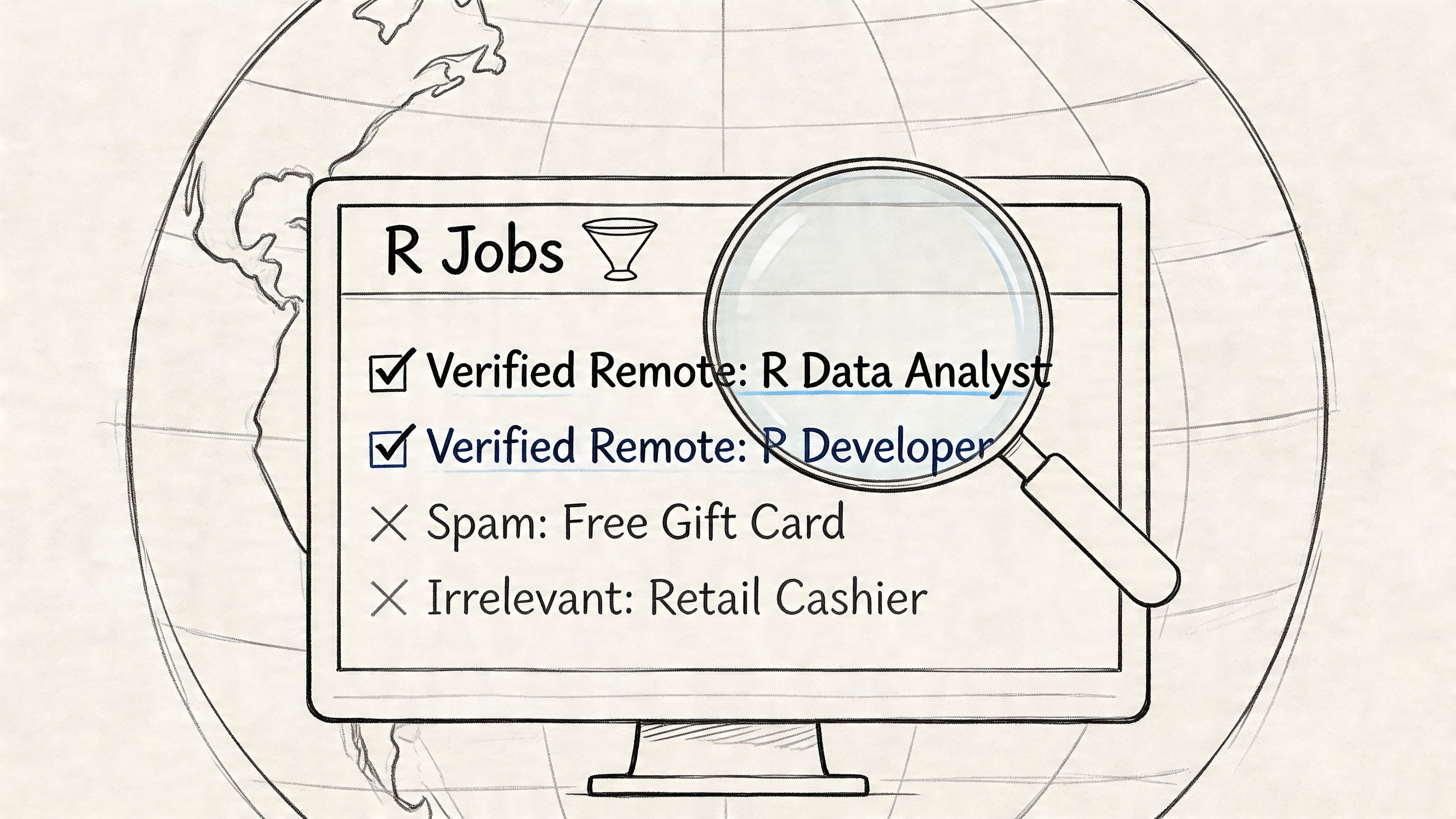
The problem isn’t that those platforms never have useful listings. The problem is that they bury good listings in noise. You end up sorting through recycled posts, third-party recruiter funnels, and roles that are technically open but no longer active in practice.
Why mainstream boards create bad search behavior
Large boards encourage volume. Candidates apply fast, often with weak tailoring, because they assume the numbers game is the only game. That creates a feedback loop. Employers get flooded. Candidates get ignored. Recruiters step in and add another layer between you and the company.
R roles suffer even more from this because the title market is messy. A company may need someone who does heavy statistical analysis in R, but the listing title might be “Data Scientist,” “Analyst,” “Biostatistician,” or “Research Data Specialist.” A broad board search often hides the best-fit roles behind inconsistent taxonomy.
There’s another issue. Most content on R jobs focuses on common roles but fails to address the scarcity of dedicated remote R developer listings on major platforms, a gap that direct-sourcing engines fill by detecting roles from 21,000+ remote-first companies’ ATS systems daily, according to Indeed-based market commentary on R job visibility.
That matters because a role doesn’t need the title “R Developer” to be a strong R job. But if you rely on crowded aggregators, you’ll often discover those roles late.
What better search discipline looks like
A stronger process starts with direct-to-company applications and verified openings. That doesn’t mean manually checking hundreds of career pages. It means using a search tool that pulls from company ATS pages rather than recycling board content.
If you want a cleaner way to search verified remote openings, use a direct-sourcing engine such as Remote First Jobs. The practical advantage is simple: you’re looking closer to the source, with less recruiter clutter and less dead inventory.
A useful search pattern looks like this:
- Search by workflow, not title: try combinations like “statistical programming,” “biostatistics,” “analytics engineer,” “clinical data,” or “research analyst” alongside R
- Filter for evidence of true remote work: look for distributed teams, async communication norms, and direct application paths
- Prioritize fresh listings: timing matters more in remote hiring than most candidates think
- Inspect the stack: roles that mention R with SQL, reporting, experimentation, or domain datasets are often stronger than listings that throw in every language under the sun
Here’s a broader discussion of remote job search tactics worth watching before you rebuild your search habits:
The first-mover advantage is real
Early applications aren’t magic, but they help. Hiring teams often review in batches. If your application arrives while the role is fresh and your resume aligns tightly with the posting, you have a much better chance of being read before the process turns into backlog management.
Direct sourcing beats passive browsing. You’re not trying to outshout hundreds of people on the same recycled listing. You’re trying to reach the actual opening earlier, with a tighter fit, through a cleaner channel.
If a remote R job looks perfect and already feels crowded, it usually is. The better opportunity is often the similar role you found earlier through a less noisy path.
The practical shift is small but important. Stop measuring effort by number of applications. Measure it by relevance, freshness, and directness of the route to the employer.
Your Action Plan for Landing a Top Remote R Job
Individuals often don’t need a brand-new career strategy. They need a more disciplined version of the one they already have.
The path to a strong remote R role is usually straightforward when you strip away noise. Choose the right target, show evidence, and apply through cleaner channels. That sounds simple because it is. What makes it hard is inconsistency.
A focused weekly plan
Use this as your working checklist.
Pick one target role family
Decide whether you’re pursuing analyst, data scientist, statistical programming, bioinformatics, or quant-style work. Your resume, portfolio, and interview stories should all point in the same direction.Critically audit your stack
If you want analyst roles, your R, SQL, and reporting workflow must be tight. If you want modeling roles, your inference and validation explanations must be credible. Don’t hide gaps from yourself. Name them and fix them.Build one flagship portfolio project
Choose a realistic problem. Use clean data structure, clear documentation, and a concise conclusion. If possible, include a small Shiny interface or a polished R Markdown report. One finished project that feels job-relevant beats a pile of half-built notebooks.
Tighten your application materials
Once your target is clear, your materials get easier to improve.
- Resume alignment: mirror the language of the role where it’s accurate. If a posting emphasizes statistical modeling, reproducible analysis, stakeholder communication, or SQL, show those through concrete bullets.
- GitHub hygiene: pin your best repositories. Add READMEs. Remove abandoned experiments that make your profile look scattered.
- Work samples: keep one or two links ready that show how you think, not just how you code.
Candidates often overinvest in credentials and underinvest in clarity. Hiring managers don’t need to be impressed by complexity. They need to trust your process.
The best application packet makes the hiring manager’s job easier. They can see the fit in minutes.
Improve your search process
Many strong candidates underperform in this regard. They spend hours searching and very little time refining how they search.
A better approach:
- Set alerts for relevant role patterns: not just “R programmer,” but also adjacent titles that match your workflow
- Favor direct applications: reduce dependence on recruiter-mediated routes unless the recruiter is clearly specialized
- Track applications in a simple sheet: role, date, source, follow-up, outcome, and notes on fit
- Review your hit rate every week: if you aren’t getting screens, the issue is usually positioning, not effort
You don’t need to apply everywhere. You need to apply where your background makes immediate sense.
What to do over the next month
Keep the cadence manageable so you can sustain it.
In the first week, choose your role family and clean up your resume. In the second, finish one portfolio project and make sure it’s presentable on GitHub. In the third, rebuild your search filters and alerts around verified remote roles and direct applications. In the fourth, review responses and adjust your positioning based on what the market is telling you.
A good target is a small number of well-matched applications each week, sent early, with customized materials and a clear story. That’s the process that consistently works better than mass-applying into crowded listings.
The remote R market still rewards depth, precision, and communication. If you can demonstrate those qualities clearly, you won’t need to win a popularity contest on a giant job board. You’ll just need to show the right team that you already solve the kind of problems they have.
If you’re tired of ghost listings, third-party recruiter spam, and arriving late to good openings, Remote First Jobs gives you a cleaner path. It surfaces verified remote roles directly from employer career pages, which helps you find serious opportunities earlier and apply with less noise between you and the hiring team.