
Not too long ago, a remote HR job felt like a rare perk. Now, it’s a core part of how modern companies operate, especially those building distributed teams. This isn’t just a minor tweak; it’s a fundamental career shift for Human Resources professionals, moving them from office-based administrators to the strategic architects of a global workforce.
Why Remote Work Is Reshaping HR Careers

The classic picture of HR—a department tucked away in a corner office—is quickly becoming a thing of the past. As more businesses go all-in on remote work, the HR function has evolved from a local administrative hub into the company’s strategic global nerve center.
This is about more than just letting HR managers work from home. It’s a complete reimagining of the role.
Think about it. When your team is scattered across different states, countries, and time zones, the old HR playbook gets tossed out the window. HR professionals are now the ones drawing the new maps for this borderless world of work.
The New Role of Remote HR
With this new territory comes a whole new set of responsibilities. It demands a different skillset and a truly global perspective. Suddenly, HR is tasked with building a strong, unified culture without a water cooler or a shared office space to anchor it. That’s a challenge that takes real creativity and a knack for digital communication.
The shift to remote has elevated HR from a support function to a critical business driver. Companies need leaders who can build trust, engagement, and compliance across a borderless workforce, making skilled remote HR professionals more valuable than ever.
This evolution has sparked a huge demand for experienced HR leaders who get it. Companies are actively hunting for professionals who can confidently navigate the tricky waters of a distributed workforce.
These specialists are absolutely essential for:
- Global Talent Management: Sourcing, hiring, and onboarding top talent from anywhere on the planet.
- Digital Employee Experience: Creating a genuine sense of belonging and support through virtual channels.
- Remote Compliance and Operations: Juggling the legal and payroll complexities that come with a team in multiple jurisdictions.
- Asynchronous Communication: Making sure teams collaborate effectively even when they aren’t online at the same time.
For any mid-to-senior level HR professional, this new landscape is a massive opportunity. The market for remote jobs in hr is booming, offering a clear path away from the endless, low-quality listings you find on mainstream job boards. It’s a chance to land a meaningful, high-impact role at a company that actually values strategic HR leadership. This guide will show you exactly how to find them.
A Look Inside the Top-Paying Remote HR Roles
When you think of Human Resources, you might picture someone down the hall, handling paperwork and mediating office disputes. But in the world of remote work, that picture has been completely redrawn. The walls have come down—literally—and HR has gone global.
These aren’t just your standard office jobs transplanted to a home setting. They’re highly specialized roles that require a totally different set of skills to manage a workforce spread across continents and time zones. Let’s pull back the curtain on the most in-demand remote HR jobs and what they actually involve day-to-day.
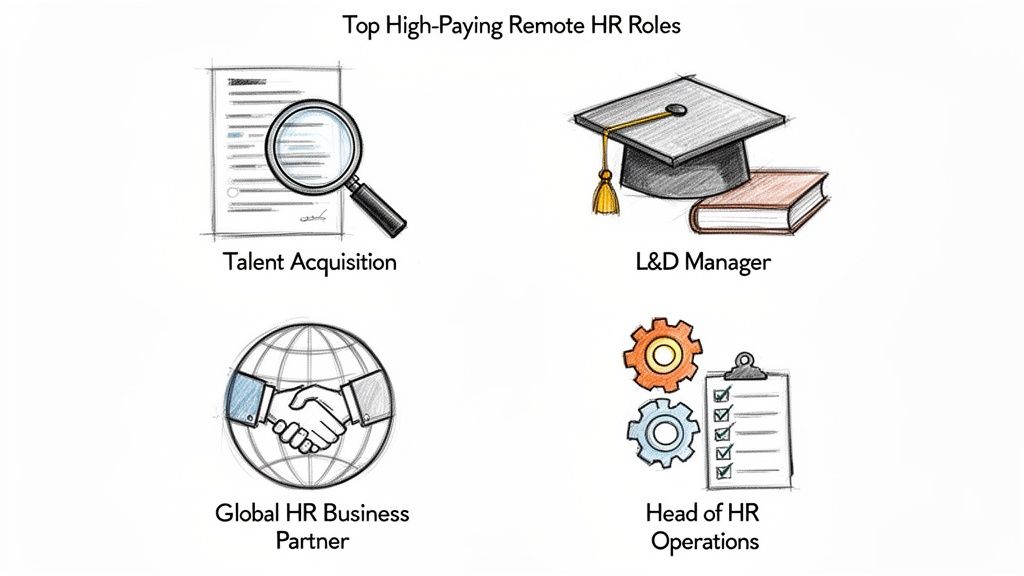
To better understand how these roles operate in a distributed company, here’s a quick breakdown of their main responsibilities.
Key Remote HR Roles and Their Focus
| HR Role | Primary Focus in a Remote Setting | Example Key Responsibility |
|---|---|---|
| Talent Acquisition | Sourcing and hiring the best talent globally, regardless of location. | Building and managing a diverse, international candidate pipeline using remote-friendly tools. |
| Learning & Development | Creating scalable, asynchronous training programs for a distributed team. | Designing a self-paced virtual onboarding experience for new hires across different time zones. |
| HR Business Partner | Aligning HR strategy with business goals across multiple regions and cultures. | Advising leadership on international labor laws and cultural norms for a new market expansion. |
Each of these positions is critical for building and sustaining a healthy remote company. Now, let’s explore what makes each one unique.
Remote Talent Acquisition Specialist
Think of a remote Talent Acquisition (TA) specialist as a company’s global talent scout. While a traditional recruiter might focus on a single city, a remote TA pro has the entire world as their recruiting ground. Their job is to find the absolute best person for the role, whether they’re in Berlin or Bali.
This means they live and breathe technology. They’re masters of Applicant Tracking Systems (ATS), global job boards, and professional networks like LinkedIn, using them to build a pipeline of incredible candidates from every corner of the globe. It’s a role that demands incredible organization and a knack for cross-cultural communication.
One day, they might be sourcing engineers in Eastern Europe, and the next, they’re coordinating virtual interviews with marketing candidates in Southeast Asia. It’s a fast-paced, high-impact job that directly shapes the company’s future.
Virtual Learning and Development Manager
The remote Learning and Development (L&D) Manager is the architect of a distributed company’s growth. Their challenge is a big one: How do you train, develop, and upskill a team that never meets in person? The answer isn’t just to host a few more webinars.
This role is all about building a culture of continuous, self-directed learning that works for everyone, no matter their time zone.
The best remote L&D managers don’t just upload old PowerPoint slides. They build engaging, asynchronous learning experiences from the ground up, empowering employees to grow their skills on their own schedule.
This involves some very specific skills and responsibilities:
- Designing Asynchronous Onboarding: They create self-guided onboarding programs that make new hires feel welcome and prepared from day one, without needing to sync up for live training.
- Managing a Learning Management System (LMS): They curate a digital library of courses, workshops, and resources on an LMS, giving employees on-demand access to professional development.
- Fostering a Coaching Culture: They train managers on how to give great feedback and run virtual mentorship programs to keep the team connected and growing together.
Global HR Business Partner
The HR Business Partner (HRBP) is a strategic advisor who connects HR initiatives directly to the company’s business goals. In a remote setting, this role becomes global by default, making them absolutely essential for any company with a distributed workforce.
These professionals are the ultimate navigators of international business. They guide leadership through the complexities of global labor laws, regional compensation benchmarks, and the cultural nuances of managing teams across different countries. They’re the glue that holds a global team together.
For instance, a remote HRBP might help leadership understand the legal and cultural landscape before expanding into a new country or design a performance review process that is fair and effective for employees in both New York and Nairobi. This is easily one of the most strategic remote jobs in hr out there, as it ensures the entire global operation runs smoothly and compliantly.
The Skills You Need to Secure a Remote HR Job

Think your HR skills will transfer seamlessly to a remote role? Not so fast. While the core principles of great HR don’t change, how you execute them absolutely does. It’s like being an incredible chef who suddenly finds themselves in a high-tech, automated kitchen instead of their familiar restaurant. Your core recipes are the same, but you have to master a whole new set of tools to create that five-star experience.
Remote-first companies aren’t just looking for someone who knows HR. They need professionals who are already fluent in the language of distributed work—people who have both the technical chops to manage digital systems and the soft skills to build real human connection across screens.
Mastering the Remote HR Tech Stack
In a distributed company, technology is the central nervous system. HR pros who can confidently navigate this system are incredibly valuable. You don’t need to be a software developer, but you do need a deep, hands-on understanding of the platforms that keep a remote organization running.
Your resume must show you’re comfortable with key systems like these:
- HRIS and ATS: Expertise in Human Resource Information Systems (like BambooHR or Workday) and Applicant Tracking Systems (like Lever or Greenhouse) is table stakes. These are your digital filing cabinets and recruiting command centers.
- Asynchronous Tools: You have to be a pro at project management tools like Asana or Trello and communication hubs like Slack or Microsoft Teams. In a remote company, this is where work actually happens.
- Payroll and Compliance Software: Experience with platforms that handle global payroll and compliance is a huge plus. It shows you can manage the complexities that come with a team spread across different countries and legal jurisdictions.
The Soft Skills That Set You Apart
While tech skills might get you in the door, it’s the nuanced soft skills that will truly help you thrive and lead in a remote environment. These are the abilities that build and sustain a healthy distributed culture when you can’t rely on hallway chats.
The most effective remote HR leaders act as digital community builders. They understand that fostering connection and trust requires intentional effort when you can’t rely on hallway conversations or team lunches.
For instance, success often comes down to digital empathy. This is the subtle art of reading emotional cues through text and video, allowing you to build psychological safety without being in the same room. Another game-changer is data-driven storytelling—the ability to take raw employee data and weave it into a compelling story that guides leadership decisions. A big part of this is managing remote teams effectively, a skill that demands a unique blend of these hard and soft abilities.
To really stand out, reframe your experience on your resume. Don’t just say you “managed employee relations.” Instead, describe how you “resolved team conflicts across three time zones using asynchronous communication and virtual mediation techniques.” That small shift proves you don’t just know HR—you know remote HR.
How Companies Approach Remote HR Salaries
Figuring out what a company might pay for a remote HR role can feel like trying to hit a moving target. There isn’t one single playbook everyone follows. Instead, companies lean on a few different models to decide on salary.
Getting a handle on these approaches is your key to negotiating a fair salary and zeroing in on the roles that actually meet your financial goals. The two most common methods are location-based and location-agnostic pay, and the difference between them can have a huge impact on your paycheck.
Location-Based Pay: The Most Common Model
Most companies, especially the big, established ones, stick to a location-based pay strategy. Think of it as a built-in cost-of-living adjustment. Your salary is directly tied to the geographic area where you live, with pay bands adjusted for major, expensive metro areas.
So, a Senior HR Business Partner living in San Francisco will almost certainly get a higher offer than someone in the exact same role who lives in a lower-cost city like St. Louis. The company’s rationale is simple: it costs more to live in certain places, so your compensation should reflect that reality. It’s a way for them to manage their payroll and keep salaries internally consistent across different regions.
Location-Agnostic Pay: The Remote-First Ideal
On the other hand, a growing number of progressive, often remote-first companies are embracing a location-agnostic approach. In this model, the company pays the same salary for a role no matter where the employee is based. The focus shifts entirely to the value of the position and the skills you bring to the table, not your zip code.
This model is gaining traction as a powerful way to attract the best talent from anywhere in the world. If you live in a lower-cost area, this can be a massive financial win, potentially landing you a salary that’s way above what your local market offers.
A location-agnostic pay model signals that a company truly values talent over geography. It prioritizes paying for impact and expertise, making it a powerful differentiator in the hunt for skilled remote professionals.
This shift is happening for a reason. The demand for remote talent is exploding, with recent data showing a 20% spike in remote job postings—and HR roles are a huge part of that growth. For professionals aiming for high-paying opportunities, like a senior HR position earning over $100,000, this trend gives you serious negotiating power. You can dig deeper into this data by checking out the latest reports from FlexJobs on the current state of the remote work economy.
Knowing these pay structures helps you target the right companies from the start. Always check the fine print in the job description. Seeing “Work from Anywhere” versus “Remote in [Country]” will tell you a lot about whether the role aligns with your life and financial plans.
Find Verified Remote HR Jobs Before They Go Viral
If you’ve ever hunted for a job on the big, mainstream boards, you know the feeling. You spot a great-looking role, click on it, and see that it already has 500+ applicants. It’s deflating.
Even worse is when you pour your energy into a perfect application only to be met with complete silence. You’re left wondering if you just sent your resume into a black hole—a “ghost job” that was never really open in the first place.
This process is broken, especially for experienced professionals. The minute a high-quality remote HR job gets posted on a massive platform, it’s instantly buried under an avalanche of applications. Your carefully crafted resume becomes just one in a thousand.
The Power of the First-Mover Advantage
Think of it like being at a concert. If you’re one of the first people through the doors, you get a perfect spot right up front. Everyone who shows up later is stuck in the back, struggling to see the stage. That’s the “first-mover advantage” in your job search.
When you apply for a role within the first 24-48 hours, your odds of getting noticed shoot way up. Recruiters are most dialed-in right at the start. Your resume lands on their desk when they’re fresh, engaged, and the candidate pile is still small and manageable.
But on the big job boards, getting there first is almost impossible. By the time a job post gets scraped, aggregated, and finally shows up in your search, it’s often hours—or even days—old. The concert has already started, and you’re stuck in the parking lot.
Bypassing the Noise with Direct Sourcing
So, how do you get that front-row seat? The trick is to skip the crowded arenas and go straight to the source. This is where direct-sourcing job engines are completely changing the game for finding remote jobs in HR.
These platforms don’t just recycle old listings from other job boards. Instead, they tap directly into company career pages, constantly scanning thousands of them for new openings the second they go live.
This direct-from-the-source method gives you three massive advantages:
- Speed: You see jobs almost immediately after they’re posted, not days later. This gives you that critical first-mover advantage.
- Verification: These jobs are real. Since they’re pulled directly from a company’s own systems, you can say goodbye to ghost jobs and recruiter spam.
- Quality: The focus is on legitimate, direct-hire roles at companies that are actively building their remote teams, cutting through all the low-quality noise.
The smartest job seekers don’t try to out-shout the crowd; they get there before the crowd even forms. By using verified listings pulled directly from the source, you stop being one of a thousand applicants and become one of the first.
For mid-to-senior HR pros who are tired of the LinkedIn ghost-job grind, specialized platforms are a secret weapon. A direct-sourcing engine like Remote First Jobs, for example, gives you access to a curated pool of over 44,000+ verified remote jobs pulled straight from company career sites. This approach uncovers roughly 200,000 new opportunities every month, giving you a chance to apply long before they hit the mainstream and get swamped.
Answering Your Top Remote HR Job Questions
Thinking about a remote HR career? You’ve probably got a few questions running through your mind. How do you get your foot in the door? What are virtual interviews really like? Is this a sustainable career path?
Let’s cut through the noise. We’ll break down the answers to these common questions so you can focus on landing that perfect remote role.
Are There Entry-Level Remote Jobs in HR?
Yes, absolutely—though you might have to look a bit harder for them. Most of the fully remote HR roles you see target mid-to-senior professionals who can work with a high degree of autonomy.
But entry-level spots do exist, usually with titles like HR Coordinator, Recruiting Coordinator, or HR Assistant. These are fantastic launchpads. You’ll get direct experience with the core systems (like HRIS and ATS) and communication tools (think asynchronous chat and constant video calls) that make a distributed company tick.
Your best bet is to target larger, remote-first organizations. They tend to have the structured training and onboarding programs needed to set junior team members up for success.
How Is the Interview Process Different for Remote Roles?
Get ready for your close-up. The remote interview process is all about technology and often includes a hands-on assignment to see how you really work. Expect a few rounds of interviews over video on platforms like Zoom or Google Meet. This is your moment to prove you’re a pro at digital communication.
A remote interview isn’t just a Q&A session. It’s a live demo of how you communicate, collaborate, and handle yourself in a digital world. Your comfort with the tech is just as important as your answers.
It’s also pretty common for companies to give you a “take-home” project. You might be asked to draft a mini-onboarding plan for a new hire or analyze a small set of employee data. It’s their way of seeing if you can work independently and deliver quality work without someone looking over your shoulder.
What Is the Future Outlook for Remote HR Careers?
The future for remote HR pros is incredibly bright. As more companies stick with distributed work, the need for HR leaders who can navigate global compliance, build a thriving virtual culture, and master remote hiring is only going to grow. HR is shifting from an administrative function to a core strategic partner.
If you can build the skills for a remote-first world, you’ll be in high demand. We’re already seeing more specialized roles pop up, like “Head of Remote” or “Global Mobility Specialist.” This isn’t just a trend; it’s a solid, dynamic career path with huge potential for growth and impact.
Stop wasting time on crowded job boards full of ghost jobs. Remote First Jobs gives you a first-mover advantage by sourcing over 44,000+ verified remote jobs directly from company career pages. Find your next role before it goes viral. Start your search on Remote First Jobs today.