
Don’t let the headlines fool you. While the broader tech market might be tightening, the demand for specialized machine learning talent is a completely different story. It’s not just holding steady; it’s booming, and the shift toward remote work is undeniable.
Right now, a whopping 0.7% of all US job postings explicitly require machine learning skills. That’s a huge number, and it’s driven by companies in hot sectors like healthcare, fintech, and e-commerce who’ve realized they can build world-class AI teams without being tied to a single zip code.
Decoding the Remote Machine Learning Job Market
This shift creates an incredible opportunity, but it also changes the game. You’re no longer just competing with talent in your city—you’re up against a global pool of experts.

The best remote ML jobs can pull in hundreds of applications in just a few days. This means your job search needs to be fast, strategic, and laser-focused. It’s less about blanketing the internet with your resume and more about understanding where the real action is.
To get a clearer picture of what’s happening, let’s break down the key market dynamics you need to know.
Key Trends Shaping Your Remote ML Job Search
| Trend | Impact on Your Job Search |
|---|---|
| Industry-Specific Demand | General “ML” roles are rare. Focus on high-growth sectors like healthcare, fintech, and e-commerce where AI has clear use cases. |
| Global Talent Pool | Your competition is no longer local. You need a standout portfolio and resume that can compete on an international level. |
| Emphasis on Autonomy | Companies need self-starters. Your ability to communicate clearly and work asynchronously is as important as your technical skills. |
| Rapid Hiring Cycles | Top remote roles fill quickly. You must have a polished application package ready to go at a moment’s notice. |
Understanding these trends is the first step. The next is knowing exactly where to point your search.
Where the Opportunities Are Hiding
The biggest mistake I see job seekers make is searching for vague “machine learning” titles. The real gold is in the niche, industry-specific roles where companies have a burning problem that AI can solve.
Get specific. Tailor your resume and portfolio to speak directly to these industries:
- Healthcare and MedTech: Think diagnostic imaging, predictive patient modeling, and personalized medicine. Companies are scrambling for ML engineers to build these systems.
- Fintech and Insurtech: This is a hotbed for roles in algorithmic trading, sophisticated fraud detection, and automated risk scoring.
- E-commerce and Retail: It’s all about recommendation engines, dynamic pricing, and predicting customer behavior. If you can optimize a supply chain with an algorithm, you’re in demand.
- SaaS and B2B Tech: Businesses want to bake ML into their products. This means NLP for smarter chatbots, computer vision for workflow automation, and forecasting for BI tools.
And this isn’t just a Silicon Valley thing. The demand is global. A recent Stanford analysis found that US job postings for AI roles are growing 3.5 times faster than all other jobs combined. This surge is mirrored worldwide, with net employment for AI and Machine Learning Specialists jumping by +176% in India and +151% in the UK. It’s a borderless talent market.
The New Rules of Engagement
In a remote-first world, your technical chops are just the entry ticket. What really sets you apart is your ability to work effectively without someone looking over your shoulder.
Success in a remote ML role isn’t about being glued to your desk from 9-to-5. It’s about proactive communication, crystal-clear documentation, and the drive to push projects forward independently. Your skill in asynchronous collaboration is just as critical as your mastery of TensorFlow or PyTorch.
This new reality requires a different mindset. It’s not enough to be a great engineer; you have to be a great remote engineer. To get ahead, you have to truly understand the culture. I highly recommend checking out these essential resources for understanding remote work culture to get up to speed.
Ultimately, you need to show a hiring manager that you’re a reliable, effective team member who can deliver results from day one, no matter where you are.
Pinpointing Your Ideal Remote ML Role
Just searching for “remote machine learning jobs” is like fishing with a giant net. Sure, you’ll catch something, but it’s probably not what you’re really looking for. To find a role that genuinely fits your skills and where you want to go in your career, you have to dig deeper than generic titles.
Let’s be honest, not all remote ML roles are the same. Understanding the differences is your first real strategic advantage in a crowded market.
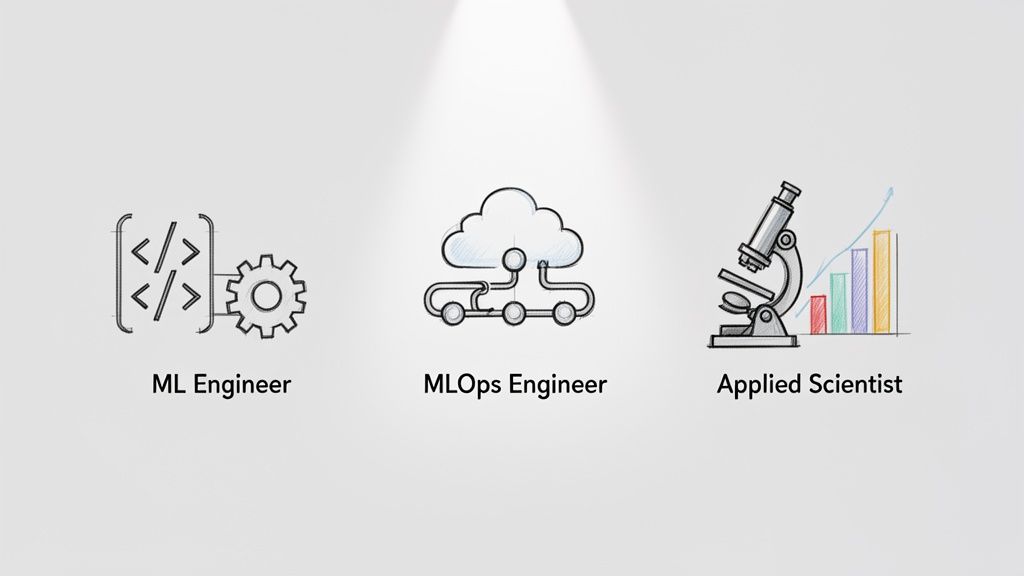
The market has matured in a big way. Companies are shifting from speculative AI research projects to hiring for roles that directly build products and drive revenue. This has completely changed the job titles you see.
Broad, vague “AI/Data Science” positions are fading out, replaced by hyper-specific roles like ML Engineer, MLOps Engineer, and Applied Scientist. A recent UK‑centric hiring analysis confirmed this trend is happening everywhere as companies build leaner, more product-focused teams. This is actually great for you—it means clearer expectations. But it also means more competition, especially for remote jobs that can easily pull in hundreds of applicants. You can get more details on these evolving AI and machine learning job trends to get a better feel for the landscape.
Dissecting the Core Remote ML Roles
To really sharpen your search, you need to get what makes these common remote ML titles different. Each one tackles a distinct piece of the machine learning lifecycle and calls for a unique mindset and tech stack.
Here’s a quick rundown of what hiring managers actually mean when they post these jobs:
Machine Learning Engineer: This is the most common one you’ll see. Think of yourself as a software engineer first, but one who specializes in building, training, and deploying ML models into live environments. Your day-to-day is all about Python, TensorFlow/PyTorch, Docker, and cloud platforms like AWS or GCP.
MLOps Engineer: You’re the one who keeps the whole ML operation running smoothly. Your job is to build solid, automated pipelines for everything from model training and deployment to monitoring and retraining. You’re comfortable with CI/CD, Kubernetes, Terraform, and monitoring tools like Prometheus.
Applied Scientist (or Research Scientist): This role leans closer to traditional data science, but with a serious focus on practical results. You’ll spend your time experimenting with new algorithms, digging into data to find new product opportunities, and prototyping models before handing them off to an ML engineer to productionalize.
Knowing these distinctions is crucial. It lets you filter out the noise and tailor your resume to scream, “I’m the right person for this specific job.”
I see this mistake all the time: someone applies for an MLOps role with a resume that’s all about research. While the skills do overlap, a remote hiring manager for an MLOps position is looking for one thing above all else: proof you can build automated, scalable, and production-ready systems. Model accuracy is secondary.
To help you target your search, here’s a quick comparison of the most popular remote machine learning roles. Think of it as your cheat sheet for decoding job descriptions.
Common Remote ML Roles and Their Core Focus
| Role Title | Primary Focus | Common Tech Stack Keywords |
|---|---|---|
| ML Engineer | Building and deploying production-ready models. | Python, TensorFlow, PyTorch, Scikit-learn, Docker, AWS SageMaker, SQL |
| MLOps Engineer | Automating the entire machine learning lifecycle. | Kubernetes, Terraform, Airflow, CI/CD, Jenkins, Prometheus, GitOps |
| Applied Scientist | Experimentation, prototyping, and applying research. | Python, R, SQL, Jupyter, Statistical Modeling, Deep Learning, NLP |
| LLM Engineer | Specializing in fine-tuning and deploying large language models. | Hugging Face, LangChain, Vector DBs, Prompt Engineering, OpenAI API |
Each of these paths requires a different focus, so spend some time thinking about which one aligns best with what you enjoy doing and what you’re good at.
How Seniority Changes in a Remote Context
When it comes to remote ML roles, seniority isn’t just about how many years you’ve been working. It’s about autonomy. Companies hiring remotely need to have complete trust that you can own complex projects from start to finish with very little hand-holding.
For Senior ML Engineers, this means you’re expected to take ownership of a model’s entire journey, from the initial whiteboard sketch to keeping it healthy in production for the long haul. You’ll also be mentoring junior engineers, leading architecture decisions, and communicating clearly across different time zones.
For Mid-Level roles, it’s all about solid execution. Can you take a well-defined problem, build a high-quality solution, and document your process so an asynchronous team can easily follow along? Your ability to work independently within an established framework is what gets you hired.
By zeroing in on the role and seniority level that matches your proven ability to work autonomously, you’ll be able to create a highly targeted job search that gets you much better results.
Finding Top Jobs Before Everyone Else
In the race for the best remote machine learning jobs, speed is your secret weapon. A really good remote ML role can easily pull in hundreds of applicants within the first 48 hours on major platforms. If you’re just finding jobs on LinkedIn a day after they’ve gone live, you’re already playing catch-up.
The trick isn’t to just search more; it’s to search smarter. You need a game plan that lets you bypass the crowded front gates and get a direct line to brand-new opportunities. This means shifting away from the usual job boards and taking a much more direct, targeted approach.
Go Straight to the Source
Honestly, the most effective way to get ahead of the pack is to find jobs the moment they hit a company’s own career page. Standard job boards often have a serious delay because they have to scrape, gather, and then re-post the listings. During that lag, the early birds are already getting their resumes in front of hiring managers.
To close that gap, specialized job search engines are your best bet. Platforms like Remote First Jobs, for example, directly monitor thousands of company career pages. They can spot new roles within hours, not days. This direct-sourcing method cuts out the middleman and the delay that comes with it, making sure you see the freshest jobs first.
By focusing your search here, you dodge two huge headaches:
- Application Overload: You get your application in before the role gets blasted across massive platforms and buried under a mountain of candidates.
- “Ghost Jobs”: You avoid wasting time on stale or expired listings that just hang around on aggregator sites long after the position has been filled.
Master Advanced Search with Boolean Operators
Just typing “remote machine learning engineer” into a search bar is a recipe for getting lost in a sea of mediocre results. To really uncover those hidden gems, you need to take command of the search bar using Boolean operators. These simple commands—AND, OR, NOT, and parentheses ()—let you build super-specific queries that weed out all the irrelevant roles.
Think of it like building a precision-guided system for your job hunt. Instead of casting a wide, clumsy net, you’re using a laser to pinpoint exactly what you’re looking for.
The point of an advanced search isn’t just to find more jobs; it’s to find the right jobs, faster. A well-crafted Boolean query can bring a perfect-fit role to the surface that a generic search would have buried under hundreds of mismatched listings.
Practical Boolean Search Examples
Let’s make this real. Say you’re an MLOps engineer who specializes in AWS and Kubernetes. You want to avoid roles that are too research-heavy or require experience in the finance industry.
Here’s how you could build your search, step by step:
Broadening Your Scope with OR:
("MLOps Engineer" OR "Machine learning Operations")- This finds jobs using either title, immediately widening your pool of relevant results without adding junk.
Narrowing with AND:
("MLOps Engineer" OR "Machine learning Operations") AND (Kubernetes OR K8s) AND AWS- Now, your query demands that any result must contain keywords for MLOps, Kubernetes, and AWS.
Excluding Noise with NOT:
("MLOps Engineer" OR "Machine learning Operations") AND (Kubernetes OR K8s) AND AWS NOT (Fintech OR "Applied Scientist" OR Research)- This final version is incredibly powerful. It finds exactly what you want while actively filtering out jobs in finance or those geared toward research, saving you a ton of time.
This level of precision is your edge. While everyone else is scrolling through pages of irrelevant listings on general job boards, you’re targeting and applying to the best-fit remote machine learning jobs before most people even know they exist.
Crafting a Standout Remote Application
Sending out a generic resume is the fastest way to get ignored, especially in the hyper-competitive world of remote machine learning jobs. Think about it from the hiring manager’s perspective: they’re drowning in applications. Your job is to make their decision easy by proving you’re not just a skilled engineer, but someone who thrives in a distributed team. It’s all about showing you’ve got the autonomy, communication chops, and focus on impact they need.
Remember, your resume has two audiences: the machine and the human. You have to impress both.
Designing an ATS-Friendly Resume for Remote Roles
Before a human ever sees your application, it has to get past the Applicant Tracking System (ATS). With over 90% of large companies using an ATS to do the initial screening, you can’t afford to get this wrong. Getting past the bots means building a clean, keyword-rich resume that speaks the language of remote work.
Start by mirroring the language in the job description. If the posting mentions “asynchronous communication,” “CI/CD pipelines,” or “AWS SageMaker,” get those exact phrases into your skills or experience sections. This simple trick is often the difference between getting filtered out and moving on.
From there, it’s all about structure and formatting. Keep it simple.
- Use a Single-Column Layout: Fancy, multi-column designs might look cool, but they often trip up ATS parsers. A clean, top-to-bottom format is your safest bet.
- Avoid Images and Graphics: Your photo, custom charts, and logos can cause parsing errors, meaning the ATS might skip over your most important qualifications.
- Stick to Standard Fonts: Use something boring and reliable like Calibri, Arial, or Times New Roman to ensure your resume is readable on any system.
- Label Sections Clearly: Don’t get cute with your headings. Use standard titles like “Professional Experience,” “Skills,” and “Education” that the software will definitely recognize.
By getting the ATS optimization right, you give your carefully crafted resume a fighting chance to be seen by an actual person.
Showcasing Impact Over Responsibilities
Once your resume lands in front of a human, their goal changes. They aren’t looking for a laundry list of your duties; they’re looking for proof that you get things done. This is doubly true for remote roles, where managers need to trust you can deliver results without someone looking over your shoulder.
It’s time to transform your experience section from a passive list of tasks into an active showcase of your achievements. A great way to do this is with the “Problem-Action-Result” framework for every bullet point.
Instead of just saying what you did, quantify the outcome.
Don’t just write: “Developed a recommendation engine.” That’s a responsibility. Instead, show the impact: “Engineered and deployed a content recommendation engine using collaborative filtering, resulting in a 15% increase in user engagement and a 5% uplift in session duration.”
This tiny shift in framing shows you’re not just a coder—you’re someone who understands business goals and connects your technical work to real-world value. That’s an absolute must-have for any high-performing remote employee.
Building a Portfolio That Screams Remote-Ready
For anyone in machine learning, your GitHub is your best sales tool. For remote jobs, it needs to do more than just host your code. It needs to prove you can manage projects from start to finish, document everything clearly, and build things that are ready for production.
Your portfolio projects should tell a story of self-sufficiency. Make sure they demonstrate that you can handle the entire ML lifecycle on your own.
- Problem Framing: Your project should start with a killer
README.md. Explain the business problem you’re solving, the dataset you used, and what success looks like. This shows you can think like a product owner, not just an engineer. - End-to-End Implementation: Go beyond a simple Jupyter Notebook. Package your model into an API using a framework like FastAPI or Flask and stick it in a Docker container. This is concrete proof of your deployment skills.
- Clear Documentation and Testing: Your code should be clean and well-commented, the project structure should be logical, and you absolutely need unit tests. This is your chance to show a hiring manager that your work is high-quality and won’t require constant hand-holding.
A portfolio built this way doesn’t just show what you know. It proves you’re a self-sufficient engineer who can take an idea from a concept to a deployed solution—the perfect candidate for any distributed team.
Acing Remote Interviews and Take-Home Tasks
Interviewing for remote machine learning jobs is a whole different ballgame. It’s not just about what you know; it’s about how well you can articulate and demonstrate that knowledge through a screen. Every interaction, from the first recruiter chat to a grueling system design session, is testing your technical chops and your ability to communicate clearly in a distributed team.
Honestly, success here just boils down to solid preparation. You have to get your environment dialed in, get comfortable thinking out loud, and show them you have the collaborative spirit that thrives without a physical office.
Setting the Stage for Virtual Success
Your physical setup makes a bigger impression than you think. A bad connection or terrible audio is far more distracting than a slightly off-the-mark answer. Do a quick tech check before any call to iron out the kinks.
- Test Your Tech: Check your internet speed. Make sure your camera is at eye level. Please, use a decent microphone or headset for clear audio. There’s nothing worse than an interview derailed because the candidate sounds like they’re in a wind tunnel.
- Curate Your Background: Find a quiet spot with good lighting and a simple, uncluttered background. It just shows you’re taking this seriously.
- Prep Your Digital Whiteboard: Have a tool like Miro or Excalidraw ready to go. Even just a clean screen-sharing setup works. Practice with it beforehand so you aren’t fumbling with the UI when you’re trying to solve a complex problem.
Getting familiar with key remote meeting etiquette guidelines is a small step that pays off big, making you look like a polished, remote-ready pro from the start.
Communicating Your Thought Process
In a real room, an interviewer can read your body language while you puzzle through a problem. Remotely, all those non-verbal cues vanish. That means you have to narrate everything. Silence is the enemy.
As you tackle a coding challenge or a system design question, talk through your steps. Start by restating the problem to confirm you understand it. Voice your assumptions. Discuss the trade-offs you’re considering. This verbal play-by-play shows the interviewer how you think, which is frankly more valuable than just spitting out the perfect answer.
A classic mistake is to just jump into the code. A much better approach sounds something like this: “Okay, my first instinct is to use a simple linear regression model to get a baseline. Before I write any code, let me walk you through why I’m starting here and what limitations I already see.”
This simple shift turns the interview from a one-sided test into a collaborative problem-solving session. That’s exactly what hiring managers are looking for.
Dominating the Take-Home Assignment
The take-home project is where you prove you can deliver high-quality, independent work. Think of it less as a coding challenge and more as a simulation of what it’s like to work with you asynchronously. Your goal is to submit something so clean and well-documented that another engineer could pick it up and run with it, no questions asked.
To really nail it, focus on these three things:
- Code Quality and Structure: Write clean, modular code that follows best practices. Use a logical folder structure, add some unit tests, and always include a
requirements.txtorenvironment.ymlfile. - Thorough Documentation: Your
README.mdis critical. It needs to explain the problem, detail your solution, and provide dead-simple instructions for setting up the environment and running your code. - Deployment Readiness: If you really want to stand out, containerize your solution with Docker. Maybe even add a simple API endpoint with Flask or FastAPI. This shows you think about the entire ML lifecycle, not just what happens in a notebook.
When you treat the take-home like a professional project, you send a clear signal: you’re a self-sufficient, detail-oriented engineer who’s ready to hit the ground running on day one.
Frequently Asked Questions
When you get to the final stages of your job search, the questions tend to get more specific. Let’s tackle some of the most common ones that come up when you’re zeroing in on a remote machine learning role.
How Should I Negotiate Salary for a Remote Role?
This is where the game changes a bit. When you get an offer for a remote ML job, your negotiation power isn’t tied to the cost of living in your city. It’s all about the value you deliver, no matter your zip code.
Start with data. Before you even think about a counteroffer, dive into sites like Levels.fyi to see what the market is paying for your specific skills and experience level. You’re not looking for local rates; you’re benchmarking against the industry standard for the role. Frame your negotiation around your track record and what top talent is commanding.
But don’t stop at the base salary. This is your chance to negotiate for benefits that make remote life genuinely better. Think about asking for things like:
- A home office stipend to cover a great chair and monitor setup.
- A co-working space membership if you need a change of scenery.
- Truly flexible work hours, not just the illusion of them.
And always, always ask how the company handles performance reviews and salary bumps for remote employees. You need to see a clear path for growth.
A classic mistake is letting a company lowball you based on your location. A true remote-first company pays for the role, not the address. Your value as an ML engineer is the same whether you’re in Silicon Valley or a small town in Idaho.
What Are the Biggest Red Flags in a Job Listing?
In a hot market like remote machine learning jobs, you have to be able to spot the duds quickly to avoid wasting your time. A legitimate remote-first company is going to be professional and transparent right from the start.
Be wary of job descriptions that are super vague. If they can’t clearly articulate the tech stack, the problems you’ll be solving, or what your day-to-day will look like, it’s a hint that the role is poorly defined or the team is chaotic.
A few other warning signs to watch for:
- Unprofessional Communication: If they’re asking you to apply through weird channels or using a generic Gmail address, that’s a huge red flag.
- Unrealistic Promises: An offer for a $300,000 salary for an entry-level position? It’s almost certainly a scam.
- No Mention of Remote Culture: If the listing doesn’t talk about their remote policies, communication tools, or how they support their distributed team, they probably haven’t figured it out yet.
Stick to curated job boards that vet their listings. It’s the easiest way to filter out the noise and focus on real opportunities.
How Can I Prove My Communication Skills?
For a remote role, great communication isn’t about being a chatterbox in meetings. It’s about clarity, precision, and being proactive. Hiring managers are looking for proof that you can keep everyone in the loop without needing constant hand-holding.
Your application is the first test. Your resume, cover letter, and portfolio need to be flawless—no typos, no grammatical errors. When you submit a take-home project, remember that your documentation and the clarity of your code comments are just as important as the model’s accuracy.
In the interview, structure your answers. Walk them through your thought process step-by-step. Make complex ideas sound simple. You can also proactively mention your experience with async tools like Slack, Jira, or Confluence. For instance, you could bring up a past project where you kept a team aligned across multiple time zones through detailed write-ups and consistent status updates.
Stop wasting time on stale job listings and ghost applications. Remote First Jobs gives you a critical speed advantage by sourcing jobs directly from over 21,000 company career pages, letting you apply before the roles go viral. Find your next remote machine learning job today.