
So, what can you actually expect to earn in a remote marketing job? On average, salaries fall somewhere between $70,000 and $118,000 a year. Of course, that’s just a starting point. Once you factor in senior-level experience and in-demand skills, those numbers can climb significantly higher.
This guide is designed to give you a realistic, no-fluff look at what you should be earning based on your role, your experience, and the kind of company you work for.
Your 2026 Remote Marketing Salary Benchmark
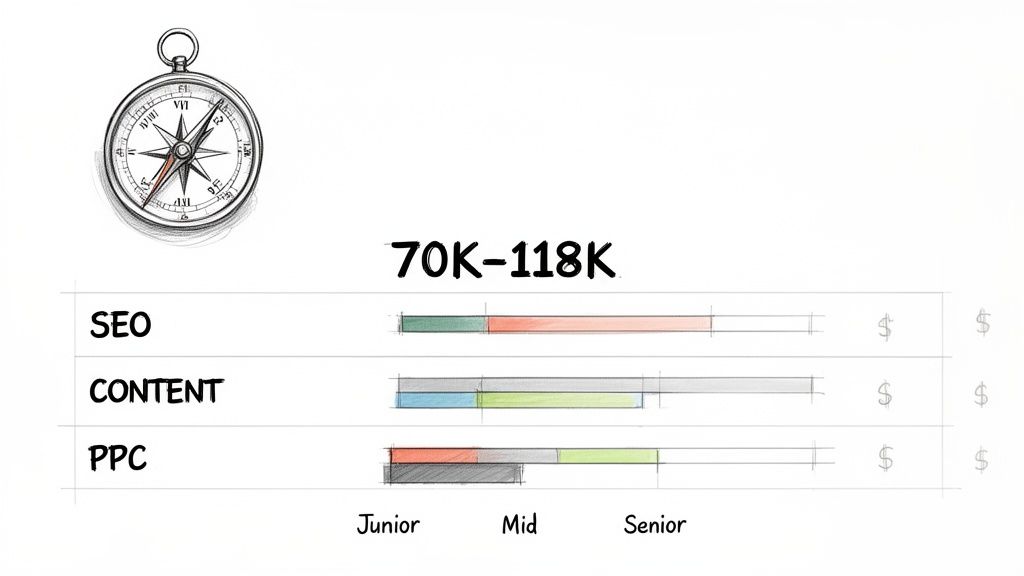
Trying to figure out remote job salaries can feel like chasing a moving target. The big job boards are often a mess of old listings, underpaid roles, and “ghost jobs” that make it impossible to get a straight answer on what you’re worth. I’m cutting through all that noise with fresh data to give you a solid benchmark for 2026.
Think of this as your personal salary compass. It’s here to help you quickly see where you fit in the current market and what kind of salary you can realistically and confidently ask for in your next role. We’ll dive into the numbers for different specializations and experience levels, giving you a clear map of your potential earnings.
Breaking Down Salaries By Role And Seniority
Let’s start with the basics. Your salary is fundamentally tied to two things: your specific role and how many years you’ve been doing it. It just makes sense that a senior-level PPC specialist will have a different pay scale than a content writer who’s just starting out. Getting a handle on these differences is the first real step to knowing your market value.
To give you a concrete starting point, here’s a table outlining the typical annual salary ranges for the most common remote marketing roles in the U.S. market.
2026 Remote Marketing Salary Ranges by Role and Experience
This table provides a quick reference for expected annual salary ranges for various remote marketing roles in the U.S. market, segmented by seniority level.
| Marketing Role | Entry-Level (0-2 Years) | Mid-Level (3-5 Years) | Senior-Level (5+ Years) |
|---|---|---|---|
| Content Marketing | $55,000 - $70,000 | $70,000 - $95,000 | $95,000 - $125,000+ |
| SEO Specialist | $60,000 - $75,000 | $75,000 - $105,000 | $105,000 - $140,000+ |
| PPC/Performance | $65,000 - $80,000 | $80,000 - $110,000 | $110,000 - $150,000+ |
| Social Media Manager | $50,000 - $65,000 | $65,000 - $90,000 | $90,000 - $120,000+ |
| Marketing Manager | $75,000 - $90,000 | $90,000 - $120,000 | $120,000 - $165,000+ |
These ranges are based on current U.S. market data and are meant to serve as a strong baseline as you evaluate opportunities.
What This Looks Like In The Real World
These aren’t just abstract numbers; they reflect genuine demand in the remote job market. For instance, recent reports analyzing 2025 Glassdoor data show that remote marketing managers earn a median salary of $118,000 per year. That’s a solid 10% premium over the national average for similar in-office roles.
Top performers in the 75th percentile can see that number jump to $166,000. And if you look at director-level positions at well-known remote companies like Gusto, salaries can range from $153,000 to $180,000.
Knowing these benchmarks changes the game entirely. You stop being a passive applicant and become an informed negotiator, walking into conversations with the data to back up your value and secure the pay you’ve earned.
To see how these marketing roles stack up against other high-paying remote careers, it’s worth exploring the highest paid remote jobs to target. It’ll give you a broader perspective on where your skills can take you in the remote-first economy.
How Your Marketing Specialty Shapes Your Salary
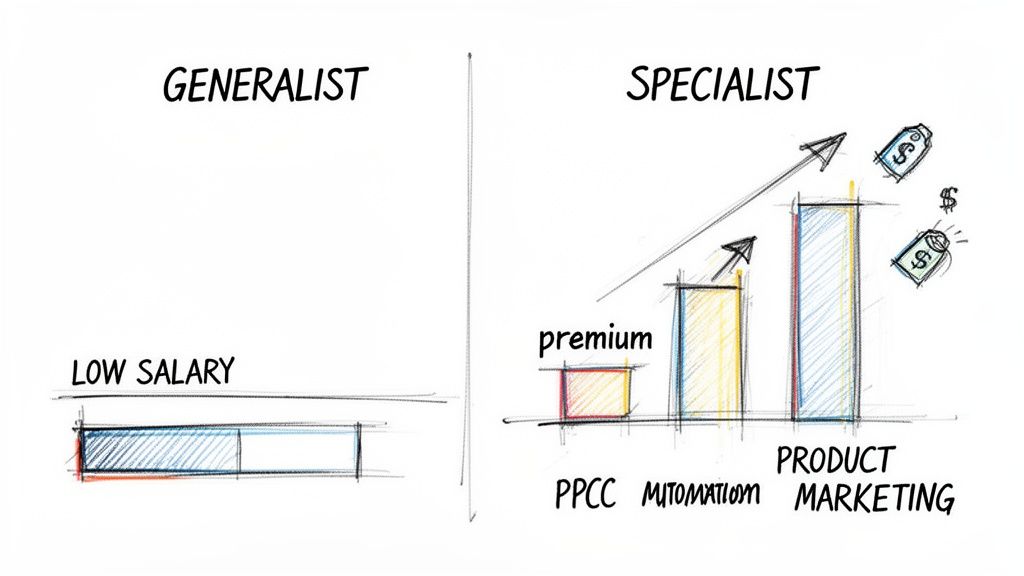
Let’s be honest: not all marketing roles are created equal, especially when it comes to your paycheck. While broad salary averages give you a ballpark figure, your specific area of expertise is what really drives your earning potential.
Think of it like being a doctor. A general practitioner earns a very respectable living, but a cardiac surgeon commands a massive premium for their highly specialized, high-stakes skills. The world of marketing works the same way.
A “marketing generalist” who juggles a bit of everything—social media, email, some content—is useful, no doubt. But a specialist who has mastered a complex, high-impact discipline can draw a straight line from their work to the company’s revenue. That direct connection to the bottom line makes them incredibly valuable. This is the single biggest key to unlocking a top-tier remote marketing salary.
The Specialist Premium in High-Demand Fields
Some marketing disciplines consistently pay more. It’s not because they’re trendy; it’s because they are complex, often technical, and have a clear, measurable impact on growth.
These are a few of the specializations that come with a significant salary bump:
- Performance Marketing (PPC/SEM): You’re managing huge ad budgets and are directly responsible for leads and sales. Your success is measured in dollars and cents, making your value undeniable.
- Marketing Automation & Operations: Specialists who can build and tame complex systems like HubSpot or Marketo are the architects of a company’s growth engine. It’s a technical skill set that’s essential for any business looking to scale.
- Product Marketing: This role lives at the critical intersection of product, marketing, and sales. A great product marketer can make or break a launch, and companies will pay handsomely for that.
- Technical SEO: We’re talking way beyond basic keywords. Technical SEOs dig into site architecture, Core Web Vitals, and schema. This deep expertise can unlock massive organic growth and is a rare, highly sought-after skill.
Mastering one of these fields changes how a company sees you. You’re no longer just a line item on a budget; you’re a direct contributor to the profits.
The Startup Salary Divide
Nowhere is the generalist vs. specialist pay gap more obvious than in the fast-paced startup world. While some early-stage companies might offer lower base salaries, the potential for top earners is huge—if you have the right skills.
For job seekers using a focused platform like Remote First Jobs, which cuts through the clutter of over 44,000 verified listings, the data tells a powerful story. Exclusive 2026 data from Wellfound on U.S.-based startups shows the average remote marketing salary is $62,042. But here’s the kicker: the top earners are pulling in $157,833.
That massive gap isn’t random. It’s the premium for experience and specialization. Marketers with over 10 years of experience command an average of $125,000, especially in lucrative sectors like FinTech. You can dive deeper into the salary data for remote startup roles to see the full breakdown.
This data proves a crucial point: in the startup world, being average gets you an average salary. Being a specialist in a high-impact field is what gets you into that top tier, where you can literally double your income.
Ultimately, your career is a series of strategic choices. By going deep in a high-demand specialty, you’re not just getting better at your job—you’re building a foundation for serious, long-term financial growth. Choose your path wisely.
How Company Size and Stage Shape Your Pay
When you’re looking at a remote marketing job offer, the base salary is just the headline. The real story is often told by the company writing the check. A salary from a scrappy five-person startup means something entirely different than the same number from a 10,000-employee tech giant, and it dramatically impacts what that compensation package means for your career and your wallet.
Think of it this way: every company, from seed-stage to publicly traded, has its own philosophy on pay, risk, and reward. To find the right fit, you need to understand their playbook. You’re not just picking a job; you’re picking a compensation strategy that needs to align with your own financial goals.
The Startup Gamble: High Risk, High Reward
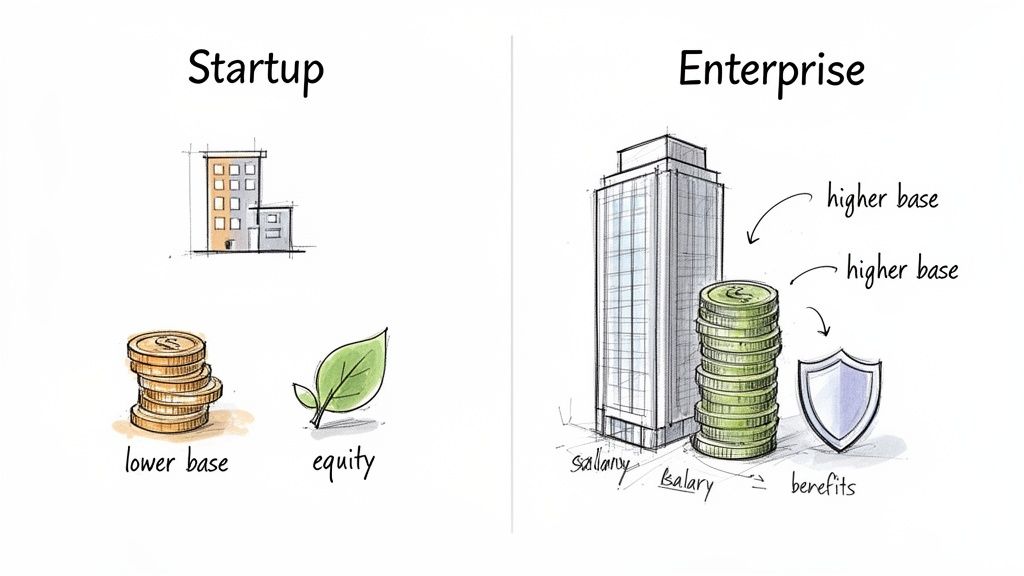
Let’s be blunt: early-stage startups are usually strapped for cash. It’s their number one constraint. This means they often can’t go head-to-head with big corporations on base salary. So, how do they attract top talent? They offer a different kind of currency: equity.
This is the classic startup deal. You agree to a lower salary today for a slice of ownership that could be worth a life-changing amount of money if the company hits it big. It’s a bet on the future. If the company takes off, your stock options could be a windfall. If it fizzles out, they’re just digital paper.
Working at a startup usually means:
- A Lower Base Salary: Cash flow is tight, and every dollar is scrutinized.
- Significant Equity: This is the main draw. It’s your stake in the potential upside.
- Bare-Bones Benefits: Don’t expect top-tier health plans or generous 401(k) matching right out of the gate.
- Massive Impact: You’ll wear a lot of hats and see your work directly move the needle.
This path is really built for marketers who have a high tolerance for risk and get fired up by the idea of building something from the ground up. You’re betting on the team, the vision, and yourself.
The Corporate Fortress: Stability and Structure
On the other end of the spectrum, you have the established corporate players. These companies have predictable revenue, deep pockets, and compensation systems that have been refined for years. They can’t offer the 100x growth potential of a startup, so they compete on stability, security, and a rock-solid benefits package.
A role at a large enterprise almost always comes with a bigger base salary. Their entire model is built to minimize risk—for themselves and for you. They attract talent with a secure, well-defined career path and a safety net of benefits that’s hard to ignore.
Here’s what you can generally expect from a large corporation:
- A Higher Base Salary: They have the cash to pay at or above the market rate.
- Comprehensive Benefits: Think excellent health insurance, robust 401(k) matching, and real parental leave.
- Bonuses and RSUs: Instead of risky stock options, you’ll often get annual bonuses and Restricted Stock Units (RSUs), which have immediate cash value.
- Specialized Roles: Your job will be more focused, and your career ladder will be clearly defined.
Choosing between a startup and a corporation isn’t just a financial decision; it’s a lifestyle choice. It’s about deciding whether you want to be a builder with skin in the game or a specialist within a stable, well-resourced system.
Ultimately, every salary tells a story about the company offering it. A young startup is selling a dream backed by equity, while a corporate giant is offering a reliable career backed by cash. The “better” offer is the one that aligns with where you are in your life and what you’re willing to bet on.
Looking Beyond Base Salary to Total Compensation
It’s easy to get excited by a big, bold base salary on an offer letter. But that number is just the first chapter of the story. Zeroing in on base pay alone is like judging a car by its paint job without ever popping the hood to check the engine.
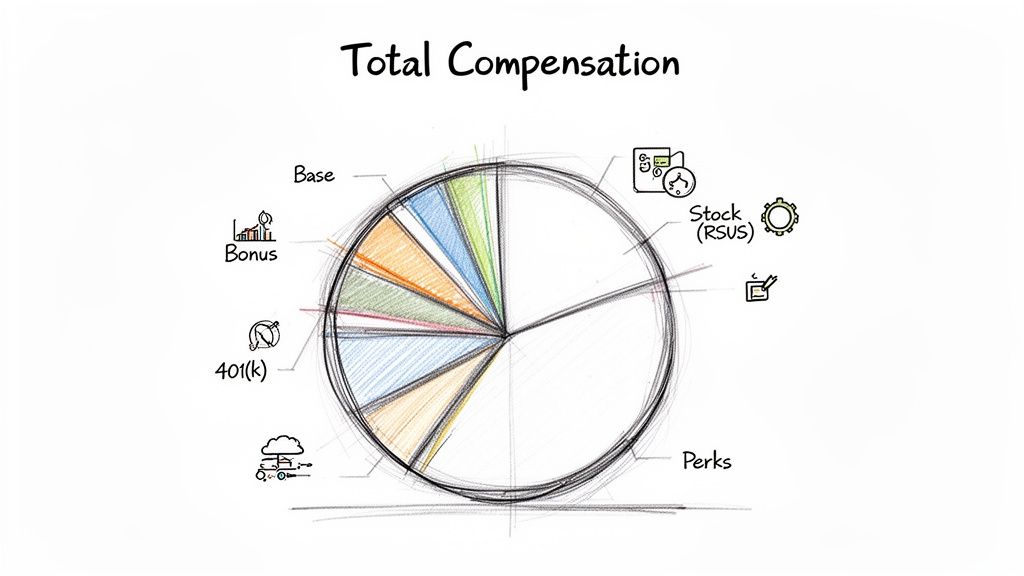
To get the full picture, you need to look at total compensation. This is the complete package—the salary, yes, but also all the benefits, bonuses, and perks that add up to what you actually earn.
Imagine getting two offers for a remote marketing role. Offer A boasts a $120,000 salary, but the health insurance is bare-bones and there’s no 401(k) match. Offer B comes in at $110,000, but it includes fantastic health coverage, stock options, and a 6% 401(k) match. The first offer looks better on paper, but the second one is almost certainly going to build more wealth in the long run.
This is why understanding the components of total compensation is a non-negotiable skill. It elevates you from a standard applicant to a savvy professional who can weigh offers like a seasoned pro.
Deconstructing the Total Compensation Pie
Think of your total compensation package as a pie made of several different slices. Each one adds a unique flavor—and a different value—to your overall financial health. Knowing what these pieces are is crucial when you’re comparing remote marketing job salaries.
Here are the most common ingredients you’ll find:
- Performance Bonuses: These are extra payments tied to how well you or the company performs. They can be a few thousand dollars or even 15-20% of your base salary, giving your annual income a serious boost.
- Equity and Stock Options: Startups and tech companies love offering these. Equity gives you a slice of ownership in the company, often as Restricted Stock Units (RSUs) or Incentive Stock Options (ISOs). Each has its own tax rules, but both hold the potential for a huge payday if the company does well.
- Retirement Contributions: A 401(k) is pretty standard, but the real prize is the company match. A 6% match on a $100,000 salary is literally an extra $6,000 of free money going straight toward your future each year. Don’t leave that on the table.
- Health and Wellness Benefits: Top-notch medical, dental, and vision insurance can save you thousands of dollars a year in out-of-pocket costs. And don’t forget to look for extras like mental health support or wellness stipends.
The Hidden Value of Remote-Specific Perks
In the world of remote work, perks are so much more than free coffee in the breakroom. These benefits are designed to cover the real costs of working from home, and they can add serious, tangible value to your package.
Think of it this way: a $100 per month stipend for your internet and phone bills is an extra $1,200 in your pocket every year, and it’s often tax-free.
A home office stipend isn’t just a nice-to-have; it’s a direct subsidy for your workspace. A one-time $1,000 stipend to buy a quality chair and desk is a significant financial benefit that improves your daily comfort and productivity.
In some places, like California and Illinois, companies are actually required by law to reimburse employees for necessary home office expenses. Even where it’s not mandated, smart companies offer these perks to attract the best remote talent. When you’re looking at an offer, be sure to factor these stipends into your math—they represent real money.
Comparing Two Real-World Offers
Let’s walk through a concrete example to see how this all plays out. You’ve received two offers for a senior remote marketing position:
| Component | Company A (Startup) | Company B (Enterprise) |
|---|---|---|
| Base Salary | $120,000 | $110,000 |
| Annual Bonus | Performance-based (0-10%) | Guaranteed 15% |
| 401(k) Match | None | 6% of salary |
| Health Insurance | High-deductible plan | Premium plan (low cost) |
| Remote Stipend | $50/month internet | $1,000 one-time office |
At first glance, Company A’s higher salary looks like the clear winner. But let’s do the math.
Company B’s guaranteed $16,500 bonus (15% of $110k) and $6,600 401(k) match (6% of $110k) immediately add $23,100 to the package. That brings the predictable cash compensation to $133,100, and that’s before we even account for the better health insurance and home office stipend.
This simple breakdown shows that the biggest number isn’t always the best deal. To truly understand what a remote marketing job is worth, you have to look past the base salary and add up every single piece of the puzzle.
Let’s Talk Money: Salary Negotiation Scripts That Actually Work
Negotiating your salary for a remote job can feel like you’re playing a high-stakes game with a new set of rules. You can’t rely on in-person cues or body language, so every single word you say (or type) carries a ton of weight. The secret isn’t being aggressive; it’s walking into the conversation prepared, confident, and with a solid, data-backed case for why you’re worth what you’re asking.
With the right approach, you can turn a potentially awkward conversation into a professional dialogue that significantly boosts your final offer.
The Dreaded First Question: “What Are Your Salary Expectations?”
It almost always comes up early, and it’s a tricky one. A recruiter asks for your salary expectations right out of the gate, and if you give a number too soon, you could box yourself in and leave money on the table. Your goal here is to gracefully sidestep the question until you have a firm offer and a much better understanding of the role’s true scope.
Try pivoting the conversation back to your value with a script like this:
“That’s a great question. At this stage, I’m really focused on learning more about the role and the team to make sure it’s a perfect fit for both of us. Based on my research and my experience driving [mention a key skill, e.g., organic growth or user acquisition], I’m confident we can land on a number that’s fair and competitive once we get to that point.”
This response does a few things beautifully. It shows you’re a serious candidate who cares about the fit, not just the paycheck. It also frames the salary talk as a collaborative final step, not a screening test.
How to Present a Data-Backed Counteroffer
Okay, you’ve got an offer in hand. Now it’s your move. This is where all that research on salary benchmarks and total compensation becomes your superpower. A strong counteroffer is never just a random, higher number—it’s a well-reasoned proposal.
Let’s imagine they offer you $105,000, but your research shows the going rate for your experience and skills is closer to the $115,000–$125,000 range.
Here’s a simple, three-step script to make your case:
- Start with Enthusiasm: “Thank you so much for the offer! I’m really excited about the chance to join the team and help with [mention a specific company goal].”
- State Your Counter: “After reviewing the responsibilities and looking at the current market rates for senior-level marketers with a proven track record in [your specialty], I was really expecting a salary in the $120,000 range.”
- Justify It: “My experience in [mention a specific achievement, e.g., ‘scaling a paid search budget by 40% while maintaining ROAS’] aligns perfectly with the goals you’ve laid out, and I believe that figure better reflects the value I can bring from day one.”
This approach anchors your request in cold, hard data and ties it directly to the company’s own needs. That makes it much, much harder to dismiss. For more examples, this Ultimate Salary Negotiation Script is an excellent resource for a ton of different scenarios.
Remote Salary Negotiation Scripts
Navigating salary talks can be tricky. Having a few phrases ready can help you stay confident and professional. Here are a few examples for common situations you’ll likely encounter.
| Scenario | What to Say (Example Script) |
|---|---|
| Deflecting the first salary question | “I’d prefer to focus on the value I can bring to the team first. I’m confident we can agree on a fair number if we both feel it’s a great fit.” |
| Making a data-backed counteroffer | “Thank you for the offer! Based on my research for similar roles at companies of this size, and my 8 years of experience in SEO, I’m seeking a base salary of $115,000.” |
| The company says they can’t meet your number | “I understand if the base salary is fixed. Would you be open to discussing a $5,000 signing bonus or an extra week of vacation to help bridge the gap?” |
| Asking for a non-monetary benefit | “Since this is a fully remote role, would it be possible to include an annual $1,500 stipend for home office equipment and internet costs?” |
| Confirming the final deal in writing | “I’m thrilled to accept! To confirm our discussion, the final terms are a $120,000 base salary and a $5,000 signing bonus. I look forward to seeing the updated letter.” |
Remember, the goal is to keep the conversation going and explore all the options available. Be polite, firm, and always back up your requests with a reason.
What to Do If They Can’t Meet Your Number
Sometimes, a company’s budget is truly set in stone. If they tell you they can’t meet your desired base salary, don’t take it as a final “no.” Instead, pivot the negotiation toward the other valuable parts of your total compensation package.
Here’s how you can shift the conversation:
“I understand that the base salary might have limited flexibility. With that in mind, could we explore other parts of the compensation package? A one-time signing bonus, a higher performance bonus, or even an additional week of PTO could help bridge that gap for me.”
This shows you’re flexible and still genuinely interested in the role. You’re just looking for creative ways to get to a “yes” that works for everyone. You could also negotiate for things like a guaranteed salary review after six months or a bigger home office stipend.
Finalizing the Agreement with Confidence
Once you’ve shaken hands on the deal (virtually, of course!), the last step is to get everything in writing. A simple, professional email is all it takes to lock it in and make sure there are no misunderstandings down the road.
Just send a quick follow-up that sounds something like this:
“This is fantastic news! I’m so excited to officially accept the offer. To recap our conversation, we agreed to a base salary of $120,000, a $5,000 signing bonus, and an annual home office stipend of $1,200. I’m looking forward to receiving the updated offer letter and can’t wait to get started.”
This simple email confirms all the numbers and creates a clear paper trail, protecting both you and your new employer. By following these scripts, you can take control of the negotiation and confidently advocate for the salary you’ve earned.
Getting to the Best Remote Jobs Before Everyone Else
Knowing your worth is one thing, but actually landing a job offer that reflects it? That’s the real challenge. The typical job search feels like a grind—endless scrolling through massive job boards, firing off applications for “ghost jobs” that might not even be real, or competing with hundreds of other people for the same role. It’s a reactive game, and it rarely gets you the best results.
The secret is to get a first-mover advantage. Think about it: you want to find and apply to the best jobs—the ones sourced directly from a company’s own career page—hours, or even days, before they hit the big platforms like LinkedIn or Indeed. When you get your application in before the floodgates open, you massively increase your chances of actually being seen by a real person.
How to Hunt for Jobs Smarter, Not Harder
Instead of spending your days manually checking hundreds of company websites, what if you could automate the whole discovery process? This frees you up to spend your valuable time crafting standout applications for fresh, real openings, rather than getting lost in the noise of stale, overcrowded listings.
Here’s a simple system to have the best jobs come directly to you:
- Get Specific About Your Role: Don’t just search for “marketing.” Use a precise title that fits your experience, like “Senior Product Marketing Manager.”
- Set Your Salary Floor: Using the data in this guide, decide on your absolute minimum. For example, filter for roles paying >$150,000.
- Build Your Own Job Alerts: Use a job search tool that plugs directly into company career pages. Set up an alert that combines your exact title and salary requirements.
This completely flips the script. Instead of you chasing down jobs, the highest-paying, best-fit opportunities land right in your inbox. It gives you a crucial head start.
When you put this simple system in place, you stop being a passive scroller and become one of the first in line. You’ll apply with the confidence that you’re among the first to see a real, high-quality job that meets your exact salary needs.
This is exactly what we built at Remote First Jobs. Our platform is designed around this very idea. We constantly scan over 21,000 company career pages to pull in the best remote roles before they go mainstream. Stop fighting the crowds and be the first to find the opportunities you deserve at https://remotefirstjobs.com/.