
Think you need a long sales resume to land a great remote job? That’s one of the biggest myths out there. The reality is, remote sales jobs with no experience are popping up everywhere because smart companies have figured something out: it’s easier to teach sales than it is to teach resilience.
This shift is a golden opportunity for anyone motivated to start a new career, no matter their background.
Why Remote Sales Is a Huge Opportunity for Beginners
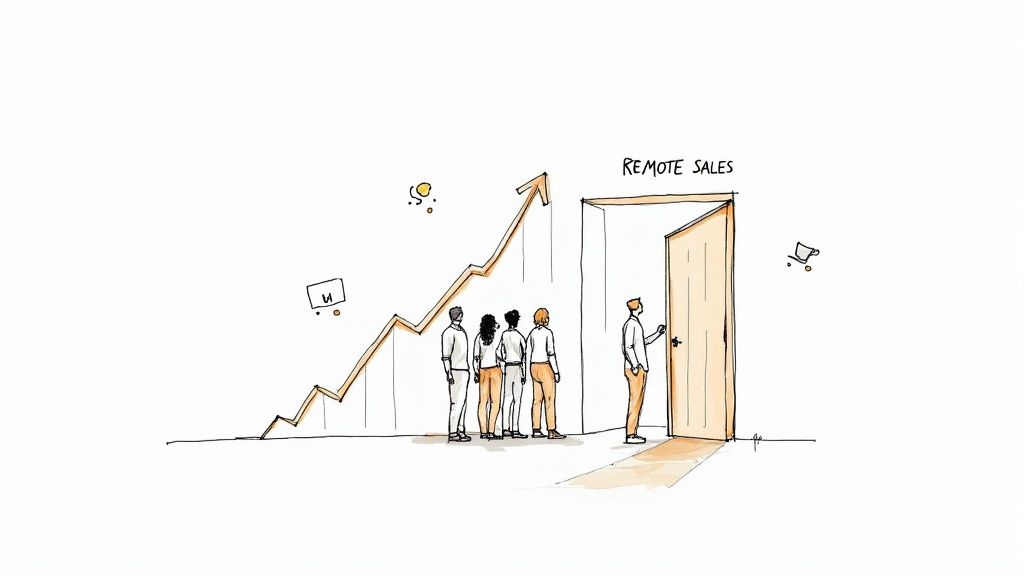
If you’re worried that not having “Sales Associate” on your resume is a dealbreaker, let me put your mind at ease. The old rules are out. Companies are now betting on potential, not just pedigree—especially when hiring for remote roles.
Think about it. That time you managed a difficult customer at a cafe or organized a community fundraiser? You were building the exact skills modern sales teams are desperate for.
The New Rules of Hiring
In a remote setup, a manager can’t just walk over to your desk to see if you’re working. They need to trust that you’re a self-starter who is driven, communicative, and can roll with the punches. This has totally changed what they look for in a new hire.
Instead of a laundry list of past sales quotas, forward-thinking companies are hunting for candidates who can show them:
- Resilience: How do you handle rejection? Can you hear “no” and bounce back without missing a beat?
- Empathy: Can you actually listen to a customer’s problems and understand what they need?
- Coachability: Are you open to feedback? Are you genuinely eager to learn and get better?
- Curiosity: Do you ask good questions and have a natural desire to understand things on a deeper level?
You don’t learn these things in a sales training manual; you learn them through life. Your non-sales background isn’t a weakness. To many hiring managers, it’s a blank slate they’re excited to build on. They can teach you about their product and their sales process. They can’t teach you grit.
The rise of remote work has forced companies to rethink hiring. They’re now on the lookout for raw talent and core skills, knowing the rest can be taught. This blows the doors wide open for career-changers and beginners to get in and prove themselves.
The Remote Work Boom Is Fueling Demand
This entire trend has been put on hyperdrive by the global shift to remote work. Today, 28% of the global workforce is fully remote—a massive leap from just 7% back in 2020.
This explosion has created a ton of new roles, especially in sales, where your performance is measured by results, not by the time you spend in an office chair. Companies are no longer limited to their local talent pool, which means beginners from anywhere can compete for high-paying jobs without having to move. Get more insights on these trends over at SalesCareerHub.com.
For anyone just starting out, this is the perfect storm. You have high demand for motivated people mixed with a new focus on transferable skills. The barrier to entry has never been lower. And sales is just one of many fields opening up—check out our guide on the best remote jobs for beginners for even more ideas.
Translating Your Existing Experience into Sales Skills
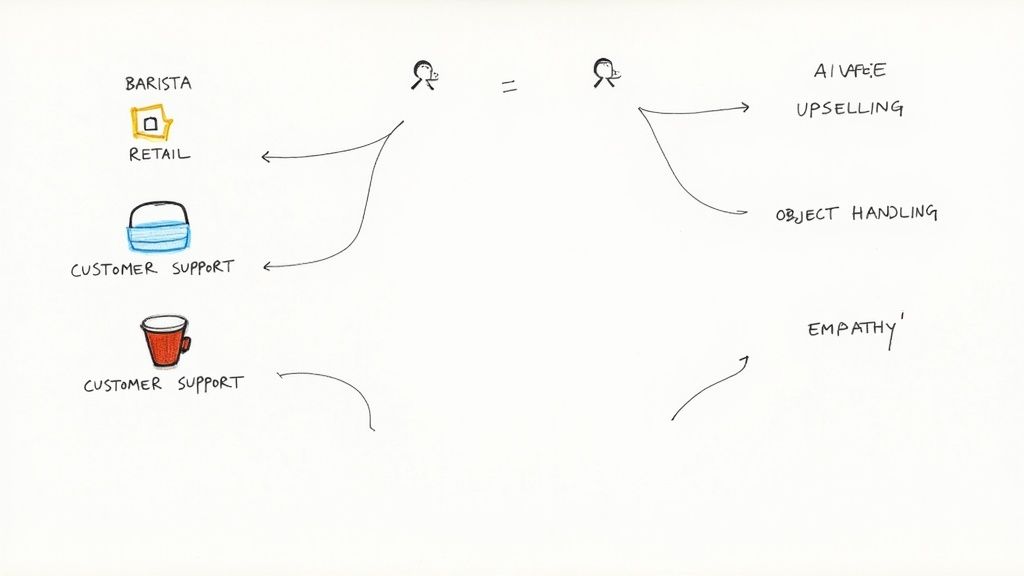
Here’s a secret: you probably already have a ton of sales skills, you just don’t call them that. The biggest hurdle to landing remote sales jobs with no experience isn’t a lack of ability; it’s a lack of the right language to describe what you’ve already done.
So, let’s stop thinking of your background as a disadvantage. That customer service gig, retail job, or even your time in the service industry? That was your unique training ground. You’ve been developing core sales competencies this whole time.
From Everyday Tasks to Sales Competencies
Think about it. Ever had to de-escalate a situation with an angry customer? That’s not just “customer service.” In the sales world, that’s objection handling and conflict resolution under extreme pressure.
Ever convinced a diner to try the dessert special or add an espresso to their order? You were identifying customer needs, creating value, and upselling—all fundamental sales activities.
These aren’t just minor accomplishments. They are concrete, real-world examples of your ability to persuade, empathize, and deliver results. The trick is simply connecting the dots between those experiences and what a sales manager is desperately looking for in a new hire. To see what else modern companies are looking for, check out our guide on the best skills for remote work.
Mapping Your Past to Your Future
To really make this click, let’s break down exactly how you can translate common experiences into resume bullet points that scream “sales potential.” This isn’t about fluffing up your history; it’s about accurately framing the value you’ve already proven you can provide.
Your past isn’t something to hide—it’s your story. Learning to tell that story in a way that resonates with sales recruiters is the single most important step you can take in your job search.
I’ve put together a table to help you build this new narrative. Use it as a framework to find the sales gold in your own background.
Mapping Your Past Roles to Core Sales Competencies
This table is your cheat sheet for turning past jobs into future opportunities. Look for parallels in your own experience and borrow the language to describe your achievements.
| Your Past Experience (Example) | The Core Skill You Developed | How to Frame It on Your Sales Resume |
|---|---|---|
| Worked as a barista during the morning rush. | Time Management & Efficiency | “Managed a high-volume queue of over 50 customers per hour, prioritizing orders to maintain a 3-minute average ticket time.” |
| Handled customer complaints at a call center. | Objection Handling & Problem-Solving | “Resolved an average of 20+ customer escalations daily, achieving a 92% satisfaction rate by actively listening to concerns.” |
| Tutored students in a difficult subject. | Communication & Needs Assessment | “Simplified complex topics for diverse learners, resulting in a 30% average grade improvement for my students.” |
| Organized a local community fundraiser. | Lead Generation & Persuasion | “Secured $5,000 in donations by proactively reaching out to local businesses and clearly articulating our mission’s value.” |
| Waited tables at a busy restaurant. | Upselling & Building Rapport | “Increased average check size by 15% through insightful menu recommendations and building strong customer relationships.” |
See the shift? By making these connections, you change your resume from a simple list of past duties into a powerful argument for why you’re the perfect candidate.
You’re no longer just someone without sales experience. You’re a proactive problem-solver with a proven track record of skills that directly lead to sales success. This change in perspective is what gets you noticed—and gets you the interview.
Building a Resume That Stands Out
Let’s be real: your resume has about six seconds to make an impression. That’s it. For an entry-level remote sales job, recruiters are scanning for potential, not just a list of things you’ve done. If your resume reads like a passive job description, it’s going straight to the ‘no’ pile.
Think of your resume as your first sales pitch. It needs to grab attention immediately.
You can start by ditching the old-school, generic objective statement. Instead, write a punchy, three-sentence professional summary right at the top. This is your chance to immediately connect your best skills with what a sales team actually needs.
For example, a strong summary could look something like this: “Highly motivated professional with a background in high-volume customer service, skilled in de-escalating conflicts and driving customer satisfaction. Eager to apply strong communication and problem-solving abilities to a sales development role. Proficient with remote collaboration tools like Slack and Zoom.”
From Passive Duties to Powerful Results
Now for the most important part: the experience section. This is where you need to do some real work. Stop listing tasks and start showcasing achievements. Every single bullet point should highlight a result, and if you can slap a number on it, even better.
Think about the difference. “Answered customer questions” is a task. It’s boring. But “Achieved a 95% customer satisfaction score by resolving over 40 inquiries per day”? That’s an accomplishment. It proves you’re not just showing up—you’re getting things done.
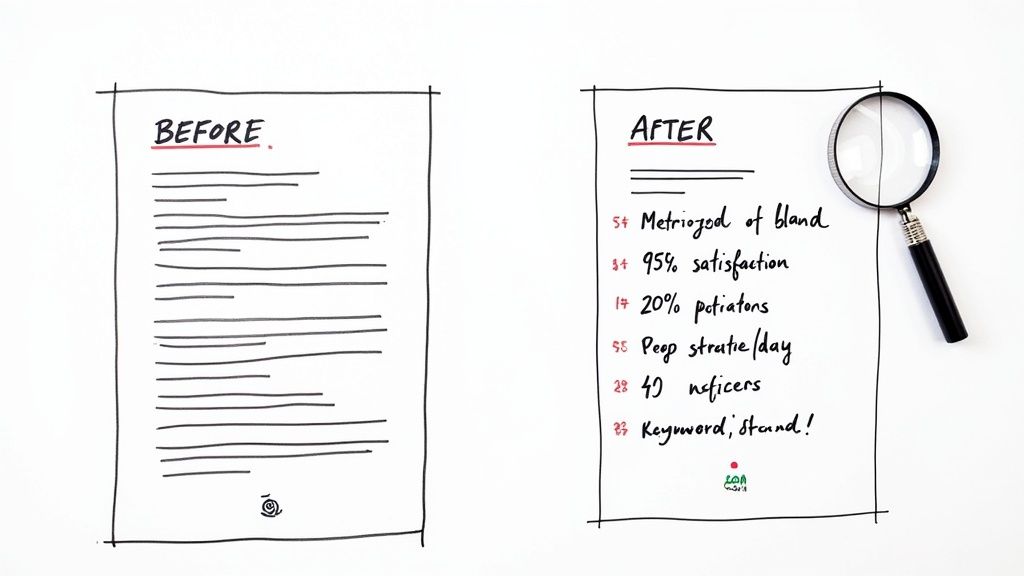
Here’s a quick before-and-after that really drives the point home:
- Before: Responsible for store inventory.
- After: Reduced inventory discrepancies by 15% through meticulous weekly audits and process improvements.
See the difference? One is a chore, the other is a win.
Your resume is your first sales document. Don’t just list features (what you did); sell the benefits (the results you delivered). This mindset shift is critical for anyone seeking remote sales jobs with no experience.
Weave in Keywords and Remote-Ready Skills
Before a human ever lays eyes on your resume, it’s probably going through an Applicant Tracking System (ATS). These bots are programmed to scan for specific keywords, and if your resume doesn’t have them, you’re out.
So, how do you beat the bots? Simple. Read the job description for the role you want and pull out the key terms.
Look for words and phrases related to:
- Sales Activities: Things like “lead generation,” “prospecting,” “client relationships,” or “CRM.”
- Soft Skills: Don’t forget essentials like “communication,” “resilience,” “problem-solving,” and “negotiation.”
- Remote Work Tools: You absolutely have to mention any experience with platforms like Slack, Zoom, Microsoft Teams, Asana, or any CRM you’ve touched, even if it wasn’t in a sales role.
Sprinkle these terms naturally throughout your summary and experience bullet points. This shows you get the lingo and are ready to contribute in a remote setting. For anyone starting from scratch, mastering the art of writing a resume with no experience is the first, most crucial step.
Building a killer resume takes practice, especially for remote roles. For a deeper dive, check out our complete guide on crafting the perfect resume for remote jobs to make sure you’ve covered all your bases.
How to Find Legitimate Entry-Level Remote Jobs
Diving into the world of online job postings can feel like navigating a maze, especially when you’re on the hunt for remote sales jobs with no experience. The trick is to know where to focus your energy and how to spot the difference between a golden opportunity and a total waste of time.
Forget the giant job aggregators for a minute. Your best bet is to start with platforms that specialize in verified, high-quality remote roles. Niche sites dedicated to remote work or sales careers do a much better job of filtering out the noise, which saves you a ton of time and frustration.
Where to Focus Your Search
Instead of the “spray and pray” approach of applying to everything, get strategic. A targeted search using a mix of the right platforms will give you the best shot at landing a solid role.
Remote-First Job Boards: This is your first stop. Platforms like Remote First Jobs are built from the ground up for remote work. They actually verify their listings, so you know you’re applying to legitimate, remote-friendly companies.
Sales-Specific Communities: Websites and online groups focused on sales careers can be an absolute goldmine. They often have curated job boards and, just as importantly, give you real insights into different company cultures.
Company Career Pages: Got a dream list of companies you’d love to work for? Head straight to their websites. Applying directly through their career pages is the most direct route and shows you’re genuinely interested in them, not just any job.
This targeted strategy is more crucial than ever. The demand for remote work is exploding—fully remote jobs are projected to make up 28% of the workforce in 2025, a massive leap from just 7% in 2020. This is great news for entry-level talent, but it also means there’s a lot more junk to sift through.
I see this all the time—people apply everywhere without a plan. Trust me on this: focus on quality over quantity. A handful of well-researched, personalized applications will always outperform a hundred generic ones.
Spotting Red Flags in Job Postings
Knowing what to avoid is just as important as knowing where to look. Scams and shady offers are out there, but they usually have a few things in common. Once you know the warning signs, you can easily sidestep the dead-end opportunities.
Keep an eye out for these classic red flags:
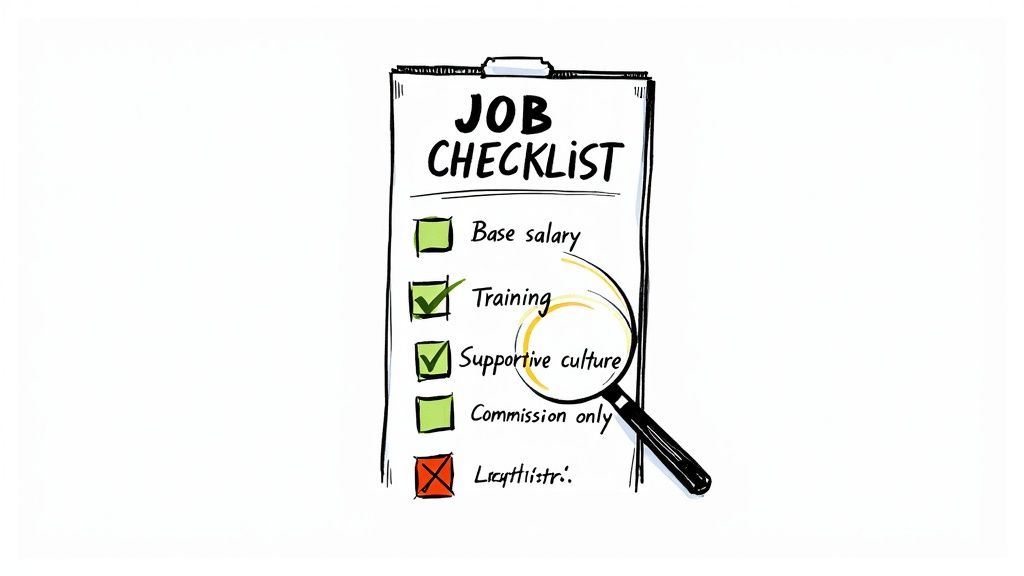
- Vague Job Descriptions: If the posting is fuzzy on what you’ll actually be doing day-to-day, what your responsibilities are, or even what product you’ll be selling, that’s a bad sign.
- “100% Commission” Only: A legitimate entry-level sales job will almost always offer a base salary. A commission-only setup puts all the financial risk squarely on your shoulders.
- Pressure to Pay for Training: A real employer invests in its people. You should never, ever have to pay for your own training or equipment.
- Unprofessional Communication: Be wary of emails filled with typos, generic “Dear Sir/Madam” greetings, or requests for sensitive personal information way too early in the process.
For a deeper dive into how to vet opportunities, check out our guide on finding legitimate work from home jobs. And for even more in-depth advice on breaking into the job market, this premium career guide is a fantastic resource. Your goal is to find a role that gives you a solid foundation—a base salary, real training, and a supportive team—to kickstart your career the right way.
A Proactive Strategy for Getting Noticed
In a sea of digital résumés, just hitting the “Apply” button is like sending a message in a bottle and hoping for the best. If you really want to stand out for remote sales jobs with no experience, you have to get proactive. This means looking beyond the application portal to make a real, human connection.
This isn’t about being pushy. It’s about being prepared, thoughtful, and strategic. Your goal is to show the hiring manager you’re a motivated problem-solver, not just another file in their “to-review” folder. A little bit of proactive outreach can seriously boost your chances of landing an interview.
Your Cover Letter Is Your Story
First things first, your cover letter can’t just be a rehash of your résumé. Think of it as your chance to connect the dots for the recruiter. Tell a quick story that ties your best transferable skill directly to a problem you think the company is trying to solve.
For instance, don’t just say you have “great communication skills.” Instead, describe that one time you calmed down a furious customer and completely turned the situation around. Then, bridge that experience to how you’d handle tough conversations with their potential clients. This instantly shows you’ve been thinking about their specific needs.
The best outreach doesn’t focus on what you want; it focuses on how you can solve their problems. Show them you’ve done your homework and understand their challenges, and you’ll immediately stand out from the crowd.
Making a Genuine Connection on LinkedIn
LinkedIn is going to be your best friend for this approach. After you’ve submitted your application, it’s time to do a little digging. Your mission is to find the hiring manager for the role or even someone who would be a future teammate on the sales team.
Once you’ve identified the right person, send a connection request—but make it personal. Generic requests are easy to ignore, so put a little effort in.
Here’s a simple, genuine template you can adapt:
- “Hi [Name], I recently applied for the Sales Development Representative role at [Company]. I was really impressed by [mention something specific, like a recent project or a value they promote]. My experience in [mention a transferable skill, e.g., customer service] has taught me the importance of resilience, and I’m excited about the chance to bring that drive to your team. Would love to connect.”
This note is respectful, shows you’ve done your research, and highlights your value in just a few sentences. This is also a fantastic way to tap into the hidden job market, where opportunities are uncovered through networking, not just job boards.
The Art of the Follow-Up
If you don’t hear back, a polite follow-up about a week later can make all the difference. Keep it short and professional. A simple message reiterating your interest shows persistence—a trait every sales manager looks for.
By being proactive, you’re not just applying for a job; you’re actively demonstrating the very skills you’ll need to succeed in the role. You’re showing them you can sell yourself.
Got Questions? We’ve Got Answers
Jumping into the world of remote sales without prior experience can feel like you’re navigating a new city without a map. It’s totally normal to have a ton of questions. Let’s clear up some of the most common ones so you can move forward with confidence.
What Kind of Salary Can I Actually Make with No Experience?
This is the big one, right? And the answer is pretty encouraging. For an entry-level remote role like a Sales Development Representative (SDR) or a Business Development Representative (BDR), you can realistically expect a base salary somewhere between $45,000 and $60,000 a year.
But that’s not the whole picture. On top of your base, you’ll be earning a commission. This means your total On-Target Earnings (OTE)—which is your base salary plus commission if you hit your goals—could easily land between $65,000 and $85,000 in your first year.
My advice? Always lean towards roles that offer a solid base salary. It gives you a stable foundation to build on while you’re learning the ropes.
Do I Need to Buy a Bunch of Special Equipment?
Good news: most legitimate companies will set you up with the gear you need, especially a company laptop. You should never have to shell out a bunch of money for equipment just to get hired.
That said, you are expected to have a couple of things ready to go on your end:
- A stable, high-speed internet connection. This is non-negotiable.
- A quiet, dedicated workspace where you won’t be interrupted.
If you’re going to invest in one thing yourself, make it a high-quality, noise-canceling headset. It’s a small price to pay for a massive boost in professionalism and your own ability to focus on calls.
What Are the Toughest Parts for a Beginner?
From what I’ve seen, the two biggest hurdles for newcomers in remote sales are self-discipline and handling rejection.
Without the daily rhythm of an office, you have to become the master of your own schedule to stay productive and hit your numbers. It’s all on you to build a routine and stick to it, day in and day out.
Then there’s the “no.” In sales, you’re going to hear it a lot more than you hear “yes.” Building up some serious mental resilience is absolutely critical. The beginners who really succeed are the ones who learn not to take it personally. They detach from the outcome of any single call and focus instead on consistent effort and learning from every conversation. It’s a marathon, not a sprint.
How Can I Build Sales Skills Before I Even Have a Sales Job?
You can start leveling up right now, which is a huge green flag for hiring managers. It shows you’re proactive and ready to learn.
A great place to start is with free or cheap online courses on sales fundamentals. Check out platforms like HubSpot Academy and Coursera for excellent intros to the sales process and CRM software like Salesforce.
You should also just immerse yourself in the world of sales. Read the go-to sales books and listen to popular podcasts. You’ll quickly pick up the lingo, the mindset, and the strategies that the pros use every day.
Ready to find a role that values your potential? Remote First Jobs connects you with thousands of verified, spam-free listings from trusted companies hiring for entry-level sales positions right now. Start your search and find your next opportunity today.