The web development landscape is constantly evolving, driven by new technologies and the rise of remote-first work cultures. Staying competitive means mastering more than just code; it requires a blend of technical prowess, strategic thinking, and strong collaborative habits. The most in-demand web developer skills needed today reflect this new reality, prioritizing not only what you can build but how effectively you build it within a distributed team. To truly prepare for this future, a modern developer must begin with a strategic understanding front-end and back-end development to see the full picture of how applications function.
This guide breaks down the 10 essential skills that separate good developers from great ones in the current market. We’ll move beyond generic advice to provide actionable insights, concrete examples of how to demonstrate each skill, and specific learning resources tailored for today’s environment. Our focus is on the practical application of these skills, from JavaScript proficiency and API design to the often-overlooked competencies like communication and a strong ownership mentality, which are critical for success in remote settings.
Whether you’re a junior developer looking for your first role or a senior engineer aiming for leadership, mastering these skills is your roadmap to success in 2026 and beyond. This comprehensive list details what employers are actively seeking and provides a clear path for you to develop the exact competencies that will define your career.
1. JavaScript/TypeScript Proficiency
JavaScript is the undisputed language of the web, powering the interactive, dynamic experiences users expect from modern applications. It runs directly in the browser, making it an essential client-side skill. However, modern development demands more; proficiency now extends to TypeScript, a superset of JavaScript that adds static typing. This is one of the most fundamental web developer skills needed for any role.
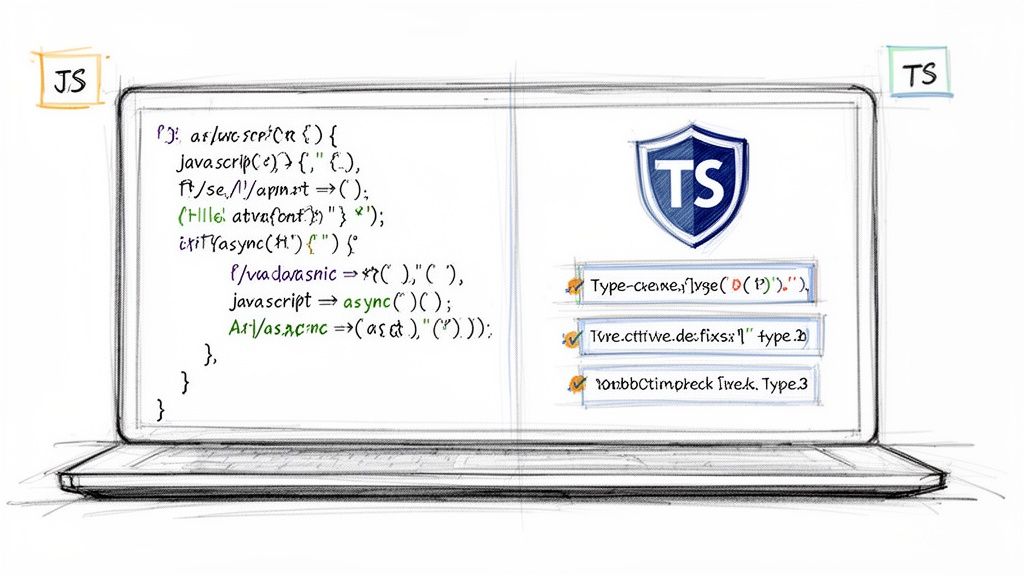
TypeScript addresses JavaScript’s dynamic nature by allowing developers to define types for variables, functions, and objects. This seemingly small addition has a massive impact: it catches potential bugs during development rather than in production, improves code autocompletion, and makes large codebases significantly easier to refactor and maintain. This reliability is why companies like Microsoft (its creator), Google (with Angular), and Airbnb have adopted it extensively.
How to Demonstrate Proficiency
To prove your mastery, move beyond basic tutorials and focus on tangible outputs. A strong portfolio should showcase your ability to handle complex state management, asynchronous operations, and DOM manipulation.
- Build Complex Projects: Create applications that consume external APIs, manage user authentication, and feature a dynamic user interface. Examples include a real-time chat application using WebSockets or an e-commerce site with a functional shopping cart.
- Contribute to Open Source: Find a JavaScript or TypeScript project on GitHub and contribute. Fixing a bug or adding a feature demonstrates your ability to understand and work within an existing, large-scale codebase.
- Showcase TypeScript’s Value: In your portfolio, include a project built with TypeScript and be prepared to explain why you chose it. Discuss how type safety prevented specific bugs or made collaboration smoother, a critical point for remote teams.
Mastering both languages ensures you can build anything from a simple interactive component with vanilla JavaScript to a robust, enterprise-scale application with TypeScript, making you a versatile and highly sought-after developer.
2. Frontend Framework Expertise (React, Vue, Angular)
While vanilla JavaScript is powerful, modern web development relies on frontend frameworks to build complex, scalable user interfaces efficiently. Frameworks like React, Vue, and Angular provide structured, component-based architectures for creating dynamic single-page applications. They handle the complexities of state management and rendering, allowing developers to focus on building features, which is why they are among the most critical web developer skills needed today.
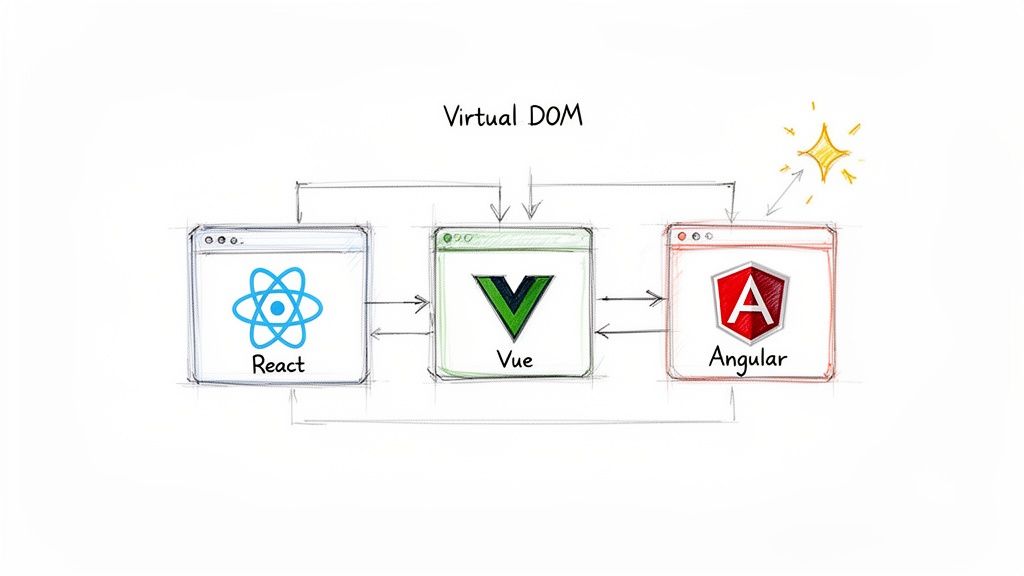
These frameworks use a Virtual DOM to minimize direct manipulation of the actual DOM, resulting in significant performance gains. This component-based approach standardizes architecture, making it easier for distributed teams to collaborate asynchronously and maintain a consistent codebase. This is why tech giants rely on them: Meta uses React across its properties (Instagram, WhatsApp Web), Google leverages Angular for its large-scale enterprise applications, and GitLab builds its remote-friendly interface with Vue.js.
How to Demonstrate Proficiency
Showing you can build more than just a “to-do” app is key. Your portfolio must reflect an understanding of framework architecture, state management, and performance optimization.
- Master Component Lifecycles and Hooks: Go deep into the core mechanics of your chosen framework. For React, demonstrate a strong command of hooks like
useState,useEffect, anduseContext. For Vue, showcase your understanding of the Composition API. - Implement Advanced State Management: Build a project that requires a global state management solution like Redux, Vuex, or NgRx. Clearly articulate in your project’s README why a global state was necessary and the architectural decisions you made.
- Build a Reusable Component Library: Create and publish a small set of reusable UI components (e.g., buttons, modals, date pickers) as an NPM package. This proves you can think in terms of design systems and build modular, maintainable code-a huge plus for any team.
Expertise in a major framework signals that you can step into a modern development environment and contribute effectively, building robust and performant applications that scale.
3. RESTful API Design & Integration
In today’s interconnected digital world, applications rarely exist in isolation. They communicate, share data, and leverage external services through APIs (Application Programming Interfaces). Understanding how to design, build, and consume RESTful APIs is therefore one of the most critical web developer skills needed for creating modern, scalable applications. REST (Representational State Transfer) is an architectural style that uses standard HTTP methods (GET, POST, PUT, DELETE) to create stateless, reliable web services.
A well-designed RESTful API acts as a clear, predictable contract between the client (like a front-end framework) and the server. It allows front-end and back-end teams, often working remotely and asynchronously, to build in parallel with minimal friction. Mastery of this skill means you can seamlessly integrate third-party services like Stripe for payments or the Google Maps API for location services. It also means you can build a robust back end that serves data efficiently to any front end, be it a web app, mobile app, or another service.
How to Demonstrate Proficiency
Showcasing your API skills requires more than just fetching data. You need to demonstrate that you can both consume and create well-structured, documented, and secure APIs. Expanding your knowledge with top API integration examples can significantly enhance your ability to build robust applications.
- Build a Full-Stack Application: Create a project where you design and build the back-end REST API from scratch and consume it with a separate front-end application. Document your API using tools like Swagger/OpenAPI to show professional-grade practices.
- Integrate Multiple Third-Party APIs: Develop an application that mashes up data from several external APIs. For example, build a travel dashboard that pulls flight data, weather information, and hotel bookings from different services into a single interface.
- Implement API Best Practices: In your projects, showcase proper use of HTTP status codes (e.g.,
201 Created,401 Unauthorized), consistent endpoint naming conventions, and secure authentication methods like JWT (JSON Web Tokens).
Proficiency in RESTful API design and integration proves you can build applications that are modular, scalable, and capable of interacting with the broader web ecosystem, a non-negotiable skill for any modern web developer.
4. Responsive & Adaptive Design
With more than half of all web traffic coming from mobile devices, creating a seamless experience across every screen size is no longer optional. Responsive and adaptive design ensures that your application looks and functions flawlessly whether on a smartphone, tablet, laptop, or large desktop monitor. This is a non-negotiable entry on any list of web developer skills needed, as it directly impacts user retention and accessibility.
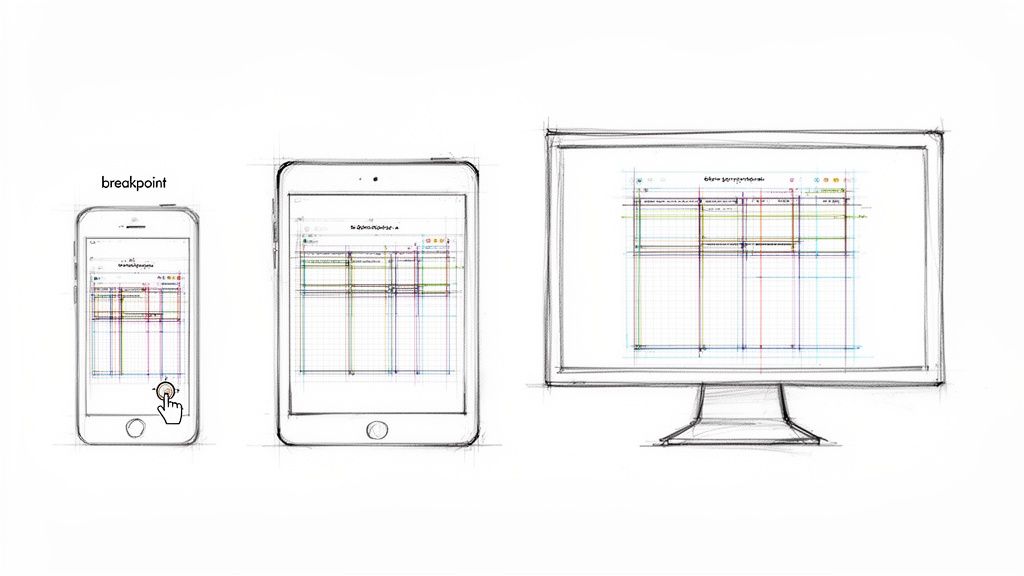
Popularized by pioneers like Ethan Marcotte, responsive design uses fluid grids and CSS media queries to allow layouts to “respond” to the size of the user’s viewport. Adaptive design takes this a step further by creating distinct layouts for specific device breakpoints. Companies like Airbnb and GitHub exemplify this by providing a consistently excellent experience, ensuring developers and travelers can perform complex tasks from any device. For remote teams using tools like Notion, a responsive interface is critical for accessing documentation on the go.
How to Demonstrate Proficiency
Simply stating you can “build responsive websites” is not enough. You must provide concrete evidence of your ability to craft user-centric, device-agnostic experiences. Your portfolio should explicitly highlight projects that prioritize cross-device compatibility and performance.
- Implement a Mobile-First Approach: Showcase a project where you designed the mobile layout first and then scaled up to larger screens. Be prepared to explain how this strategy simplified your CSS and improved performance on less powerful devices.
- Master Modern CSS Layouts: Demonstrate deep knowledge of CSS Flexbox and Grid. Build a complex, responsive component gallery or recreate a challenging layout from a well-known site to prove you can handle real-world design requirements without relying on bulky frameworks.
- Optimize for Performance and Usability: Show that you consider more than just aesthetics. Implement responsive images using
srcsetto reduce load times on mobile, and ensure all interactive elements like buttons are touch-friendly (at least 44x44px). Testing on real devices, not just browser emulators, will set you apart.
Mastering responsive and adaptive design proves you are a thoughtful developer who prioritizes user experience, a core competency that employers are actively searching for in a world where users access applications from an ever-growing variety of devices.
5. Version Control (Git & GitHub/GitLab)
Version control is the bedrock of modern software development, allowing teams to manage code changes, collaborate seamlessly, and maintain a complete project history. Git, a distributed version control system created by Linus Torvalds, is the industry standard. It enables developers to track every modification, revert to previous stages, and work on different features in parallel without conflict. Mastering this is one of the most critical web developer skills needed for any collaborative environment.
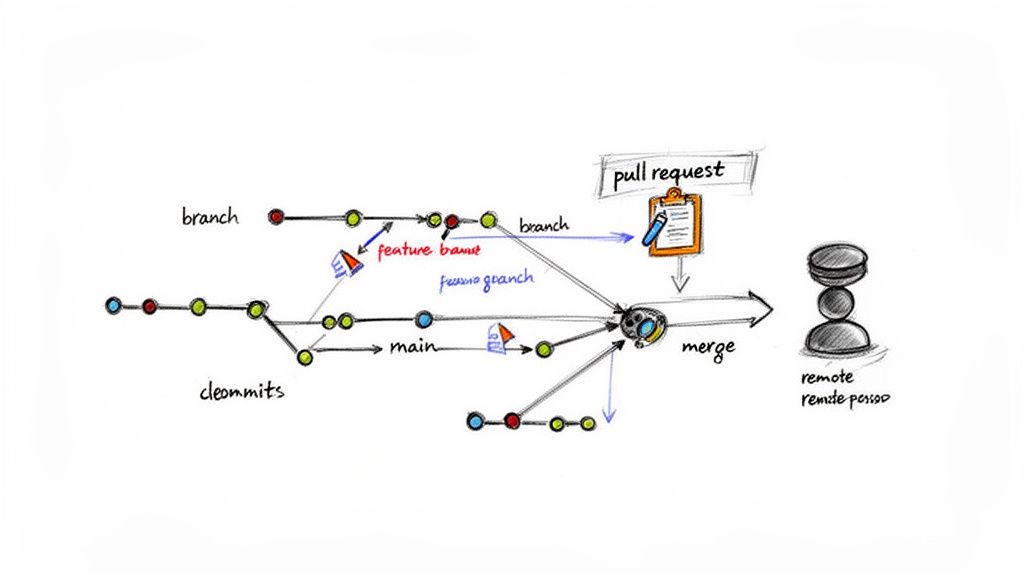
Platforms like GitHub, GitLab, and Bitbucket build on Git by providing a central, cloud-based repository, powerful collaboration tools, and project management features. They facilitate asynchronous workflows through pull/merge requests, code reviews, and issue tracking, which are indispensable for distributed and remote teams. Nearly every major tech company, from Google to Netflix, relies on Git, and it forms the backbone of countless open-source projects and DevOps CI/CD pipelines.
How to Demonstrate Proficiency
A clean and active GitHub or GitLab profile is your version control resume. It should tell a story of consistent, thoughtful, and collaborative coding practices beyond just showing lines of code.
- Showcase a Clean Commit History: Your public repositories should feature clear, descriptive commit messages. A history of atomic commits (small, focused changes) demonstrates discipline and an understanding of how to build a readable project timeline.
- Implement Branching Strategies: Create a project that uses a recognized branching strategy like Git Flow or GitHub Flow. Use meaningful branch names (e.g.,
feature/user-authenticationorbugfix/fix-login-error) and show your process of creating pull requests, conducting code reviews, and merging branches. - Contribute to Other Projects: Fork a repository, fix a bug or add a small feature, and submit a pull request. This is the ultimate proof that you can navigate an existing codebase, adhere to contribution guidelines, and collaborate effectively with others.
Proficiency in Git and its associated platforms signals that you are not just a coder but a professional developer who can integrate smoothly into a team, maintain code quality, and contribute to a structured, scalable workflow.
6. Communication & Collaboration Skills
In modern development, particularly in remote or distributed teams, technical prowess alone is insufficient. Strong communication and collaboration are not just soft skills; they are core operational requirements that prevent project misalignment, delays, and friction. The ability to articulate complex technical ideas clearly in writing, collaborate asynchronously, and actively engage with team feedback is one of the most crucial web developer skills needed to succeed.
Unlike office environments where quick questions can be asked in person, remote work relies heavily on clear, contextualized, and often asynchronous communication. Companies that excel in this area, like GitLab with its public handbook and Automattic’s robust documentation culture, prove that deliberate communication practices are the foundation of effective remote engineering. This skill set ensures that context isn’t lost across time zones and that every team member has the information they need to work autonomously.
How to Demonstrate Proficiency
Showcasing these skills requires demonstrating your processes, not just your code. Your ability to integrate into a team and enhance its workflow is a powerful selling point.
- Write Exceptional Pull Requests: A well-written pull request (PR) is a prime example of strong communication. Clearly explain the “what” and the “why” of your changes, include screenshots or GIFs for UI changes, and link to the relevant ticket or issue. This provides context and makes the review process faster and more effective.
- Contribute to Documentation: Offer to improve the documentation for an open-source project or even within your own projects. This shows you value clarity and are committed to helping others understand the codebase, a hallmark of a great team player.
- Showcase Collaborative Artifacts: In your portfolio, don’t just link to a live app. Link to a specific, well-documented PR, a project wiki you created, or a detailed architectural decision record (ADR). Explain how your communication practices led to a better outcome.
Mastering these skills signals that you are more than just a coder; you are a multiplier who can elevate the performance of the entire team, making you an invaluable asset in any development environment.
7. Problem-Solving & Debugging Skills
Beyond writing code, a developer’s true value lies in their ability to methodically dismantle problems and resolve errors. Problem-solving and debugging are the core activities of development, involving logical thinking, issue decomposition, and the skilled use of specialized tools. This is one of the most critical web developer skills needed, as it directly impacts project timelines, code quality, and application stability, especially for remote developers who often work with greater autonomy.
Effective debugging is a systematic process, not guesswork. It starts with understanding and reproducing a bug, then narrowing down its source using tools like browser developer tools or integrated debuggers in an IDE. Platforms like Sentry or New Relic extend this capability into production environments, providing real-time error tracking and performance monitoring to catch issues before users report them. This skill transforms a developer from a simple coder into a reliable software engineer.
How to Demonstrate Proficiency
Showcasing problem-solving requires more than just clean code; it requires evidence of your process. You need to demonstrate how you approach and overcome technical challenges efficiently.
- Document Your Debugging Process: In a portfolio project’s README or a blog post, detail a complex bug you encountered. Explain how you identified it, the tools you used (like Chrome DevTools’ Network or Performance tabs), the hypotheses you tested, and how you ultimately resolved it.
- Contribute to Complex Bug Fixes: Find an open-source project and tackle a reported issue. Successfully submitting a pull request that fixes a verified bug is a powerful, real-world demonstration of your debugging and collaborative skills.
- Explain Your Thought Process: During interviews, when presented with a coding challenge, talk through your problem-solving steps aloud. Explain how you’d handle potential errors, debug unexpected behavior, and test for edge cases. This reveals your systematic approach, which is often more important than the final solution.
Mastering debugging tools and adopting a structured problem-solving mindset proves you can build and, more importantly, maintain robust, high-quality applications.
8. Self-Motivation, Ownership Mentality & Continuous Learning
Beyond any specific technology, a developer’s mindset is what separates good from great. Self-motivation, an ownership mentality, and a commitment to continuous learning are the internal engines that drive success. These traits describe a developer’s ability to take initiative, remain accountable for outcomes, and proactively keep their skills sharp as the industry evolves. This trio of soft skills is among the most crucial web developer skills needed, especially in autonomous environments.
These qualities are non-negotiable in modern work settings, particularly for remote roles. Companies like GitLab and Automattic build their entire culture around attracting self-directed individuals who don’t require constant supervision. A developer with an ownership mentality doesn’t just complete tickets; they see the feature through from concept to deployment, anticipating problems and proposing improvements without being asked. This proactive approach builds trust and accelerates project timelines.
How to Demonstrate Proficiency
Since these are mindset-based skills, you must demonstrate them through your actions and the narrative you build around your work. It’s about showing, not just telling, a potential employer that you are a reliable and forward-thinking professional.
- Take Full Project Ownership: In your portfolio, don’t just list what you built. Detail a project where you took complete ownership. Explain how you managed the timeline, overcame unexpected blockers, and made key decisions that led to a successful outcome.
- Show Your Learning Process: Maintain a blog, a public GitHub repository with side projects, or even a detailed “learnings” section on your resume. Document your journey of learning a new framework or tool, showcasing your ability to adapt and grow your skillset independently.
- Contribute and Improve: Actively participate in open source projects. Fixing a bug or, even better, identifying an area for improvement and submitting a pull request is a powerful signal of your initiative and ownership. For roles emphasizing this, platforms listing remote first jobs often highlight candidates with such proven track records.
Cultivating this mindset ensures you not only keep pace with technological change but also become an invaluable, self-sufficient member of any team, capable of driving projects forward with minimal oversight.
9. Testing & Quality Assurance Knowledge
Writing code that works is only half the battle; ensuring it keeps working reliably is what separates professional developers from hobbyists. Testing and Quality Assurance (QA) is the systematic process of verifying that software meets requirements and is free of defects. This encompasses everything from unit tests that check individual functions to end-to-end (E2E) tests that simulate a full user journey. This is one of the most crucial web developer skills needed to build scalable and maintainable applications.
Modern development relies heavily on automated testing to catch bugs early, prevent regressions, and facilitate safe refactoring. Frameworks like Jest and tools like Cypress allow developers to write tests that run automatically every time code is changed. This practice is the foundation of Continuous Integration/Continuous Deployment (CI/CD), where code is automatically tested and deployed, a standard in most tech companies today. A strong testing culture builds confidence in the codebase and allows teams, especially remote ones, to collaborate asynchronously without fear of breaking the application.
How to Demonstrate Proficiency
Showcasing your testing skills requires more than just stating them on a resume. You need to provide concrete proof that you can write effective, meaningful tests that improve code quality.
- Integrate Testing in Portfolio Projects: Don’t just build an application; build a well-tested one. Include a dedicated
__tests__ortestsdirectory in your project’s repository. Use a framework like React Testing Library to test component behavior or Jest to test business logic. - Showcase Code Coverage: Use built-in tools to generate a code coverage report and include a badge on your project’s
README.md. Aim for a sensible target like 70-80% for critical parts of the application and be prepared to justify your testing strategy. - Implement a CI/CD Pipeline: Use tools like GitHub Actions or GitLab CI to set up a pipeline for one of your projects. Configure it to automatically run your test suite on every push or pull request. This demonstrates an understanding of modern, automated development workflows.
By embedding quality assurance directly into your development process, you prove that you build software that is not only functional but also robust, reliable, and ready for production.
10. Performance Optimization & Core Web Vitals
A fast, responsive website is no longer a luxury; it’s a core requirement for user engagement, retention, and search engine ranking. Performance optimization is the practice of making a website load faster and feel more responsive to user interactions. This directly ties into Google’s Core Web Vitals, a set of specific metrics that measure a page’s loading performance, interactivity, and visual stability. Mastering this is one of the most impactful web developer skills needed to create superior user experiences.
Core Web Vitals quantify the user experience, focusing on three key areas: Largest Contentful Paint (LCP) for loading, First Input Delay (FID) for interactivity, and Cumulative Layout Shift (CLS) for visual stability. A developer skilled in optimization uses techniques like image compression, code splitting to reduce initial JavaScript payloads, lazy loading off-screen assets, and effective caching strategies. Companies like Vercel build entire frameworks like Next.js around these principles, proving that performance is a foundational aspect of modern web architecture, not an afterthought.
How to Demonstrate Proficiency
Showing you can build a fast website is more convincing than just saying you can. Your ability to diagnose and fix performance bottlenecks is a highly valuable skill that can be clearly demonstrated through your projects and your process.
- Audit and Document Improvements: Take an existing project (or create a new one) and run a Lighthouse report to get baseline performance scores. Then, implement optimizations like image compression, code splitting, and browser caching. Document the “before and after” scores in your portfolio’s case study to show tangible results.
- Implement Advanced Loading Techniques: Build a project that uses lazy loading for images and components that appear below the fold. Go a step further by using a service worker to enable offline capabilities or pre-cache critical assets, demonstrating a deep understanding of the browser’s rendering path.
- Explain Your Optimization Strategy: During an interview or in a project README, explain the performance trade-offs you made. Discuss why you chose a specific image format (like WebP), how you used a Content Delivery Network (CDN) to serve assets faster, or how you profiled the app with Chrome DevTools to find and fix a rendering bottleneck.
10-Point Web Developer Skills Comparison
| Skill / Area | 🔄 Implementation complexity | ⚡ Resource requirements | ⭐ Expected outcomes | 📊 Ideal use cases | 💡 Key advantages / tips |
|---|---|---|---|---|---|
| JavaScript / TypeScript Proficiency | Moderate → High (language + TS types & tooling) | Dev tooling, transpilers, type definitions, testing | Robust, maintainable front-ends & full‑stack parity | Interactive UIs, single‑language stacks, remote teams | Gradually adopt TypeScript; master async patterns |
| Frontend Framework Expertise (React, Vue, Angular) | High (patterns, state, lifecycle, SSR) | Framework CLIs, state libs, build systems | Faster UI development, standardized architectures | SPAs, component libraries, large teams | Prefer composition; learn state management and SSR |
| RESTful API Design & Integration | Moderate (HTTP semantics, auth, versioning) | API gateways, auth systems, documentation tools | Clear service contracts; decoupled front/back ends | Multi‑client apps, microservices, third‑party integrations | Use OpenAPI; consistent naming and proper status codes |
| Responsive & Adaptive Design | Moderate (CSS, media queries, testing) | Design/dev time, device testing matrix, images | Usable across devices; better accessibility & SEO | Mobile‑first sites, global user base, varied networks | Use mobile‑first approach; master Flexbox/Grid and srcset |
| Version Control (Git & GitHub/GitLab) | Moderate (branching strategies, merge workflows) | Hosting (GitHub/GitLab), CI/CD integration | Reliable history, safe collaboration, automated pipelines | Any collaborative codebase, CI/CD pipelines | Follow branching rules; write clear commits and PRs |
| Communication & Collaboration Skills | Low → Moderate (process discipline) | Collaboration tools (Slack, Docs, issue trackers) | Efficient async workflows; fewer misunderstandings | Remote teams, distributed projects, onboarding | Over‑communicate context; document decisions and PRs |
| Problem‑Solving & Debugging Skills | Moderate → High (tools + systematic approach) | Debuggers, error tracking, profiling tools | Faster issue resolution; higher code reliability | Production incidents, complex bugs, independent work | Reproduce issues, use breakpoints, document fixes |
| Self‑Motivation, Ownership & Continuous Learning | Variable (behavioral, sustained effort) | Time investment, learning resources, side projects | Proactive contributors; faster career growth | Remote roles, small teams, evolving tech stacks | Set goals, build side projects, maintain balance |
| Testing & Quality Assurance Knowledge | Moderate → High (TDD, E2E, CI) | Testing frameworks, CI runners, test infra | Fewer regressions; safer refactors; automated QA | Critical business logic, continuous delivery pipelines | Test behavior not implementation; automate CI tests |
| Performance Optimization & Core Web Vitals | High (profiling, trade‑offs, monitoring) | CDNs, monitoring tools, build tooling, image pipelines | Faster loads, improved SEO, better conversions | High‑traffic sites, global audiences, mobile users | Monitor CWV, use lazy loading, optimize images & bundles |
Building Your Future: From Skills to Career
The journey to becoming a proficient web developer is not a checklist to be completed, but a continuous cycle of learning, applying, and evolving. Throughout this guide, we’ve explored the ten pillars that form the foundation of a modern developer’s toolkit. From the non-negotiable technical mastery of JavaScript and frontend frameworks to the career-defining power of communication and problem-solving, each skill represents a crucial piece of the puzzle.
Mastering these web developer skills needed for success is about more than just writing code; it’s about building robust, efficient, and user-centric digital experiences. The distinction between a junior and a senior developer often lies not in the number of languages they know, but in their ability to integrate these diverse skills into a cohesive workflow. It’s the difference between simply implementing a feature and architecting a scalable, performant, and maintainable solution.
Synthesizing Your Skill Set for Maximum Impact
Think of your skills as interconnected gears rather than isolated components. Your expertise in RESTful APIs is amplified by your knowledge of performance optimization. Your Git proficiency becomes invaluable when combined with strong collaboration skills, especially in a remote setting. True growth happens at the intersection of these domains.
To stand out in a competitive market, focus on creating a narrative that showcases this synthesis. A portfolio project, for instance, is far more compelling when it demonstrates not only your coding ability but also:
- A thoughtful approach to user experience: evidenced by responsive design and fast load times (Core Web Vitals).
- Professional development practices: highlighted by a clean Git history and a comprehensive test suite.
- Clear documentation and communication: shown in a well-written README file and articulate project descriptions.
The most valuable developers are not just coders; they are strategic thinkers, creative problem-solvers, and effective communicators. They understand that the “how” of building is just as important as the “what.”
Your Actionable Roadmap from Here
As you move forward, transform this knowledge into tangible progress. Don’t try to learn everything at once. Instead, adopt a structured approach to your professional development:
- Assess and Prioritize: Honestly evaluate your current proficiency in each of the ten areas. Identify your one or two weakest areas that, if improved, would have the biggest impact on your current role or future job prospects.
- Create a Learning Project: Choose a small project that forces you to engage directly with your target skills. Want to improve your API and testing knowledge? Build a simple application that consumes a third-party API and write unit and integration tests for it.
- Demonstrate and Articulate: As you build, practice explaining your technical decisions. Write a blog post, create a short video walkthrough, or simply explain the architecture to a friend. This reinforces your understanding and prepares you for technical interviews.
- Embrace Continuous Learning: The web development landscape is ever-changing. The skills that are cutting-edge today may be standard tomorrow. Cultivate a mindset of curiosity and dedicate consistent, scheduled time to learning, whether it’s reading documentation, taking a course, or contributing to an open-source project.
Ultimately, the comprehensive set of web developer skills needed today reflects the maturity of the industry. Companies are looking for well-rounded professionals who can contribute to every stage of the development lifecycle, from ideation to deployment and maintenance. By methodically building both your technical and soft skills, you are not just preparing for your next job; you are building the foundation for a resilient, rewarding, and long-lasting career in technology.
Ready to put your skills to the test? The best way to grow is by tackling real-world challenges, and Remote First Jobs specializes in connecting talented developers like you with innovative, remote-first companies. Explore opportunities that value a modern skill set and find a role where you can truly thrive. Find your next remote developer role on Remote First Jobs today.