If you’re asking yourself, “why am I not getting interviews?” let me assure you, it’s probably not what you think. The problem isn’t necessarily you—it’s the brutal reality of the remote job market. The game has changed, and the old “spray and pray” application strategy just doesn’t cut it anymore.
The Hard Truth About Today’s Remote Job Market
Sending resume after resume into a black hole is one of the most soul-crushing parts of a job search. It’s easy to start wondering if your skills are good enough or if your experience is relevant. But before you go down that rabbit hole, take a breath. You need to understand the battlefield you’re on.
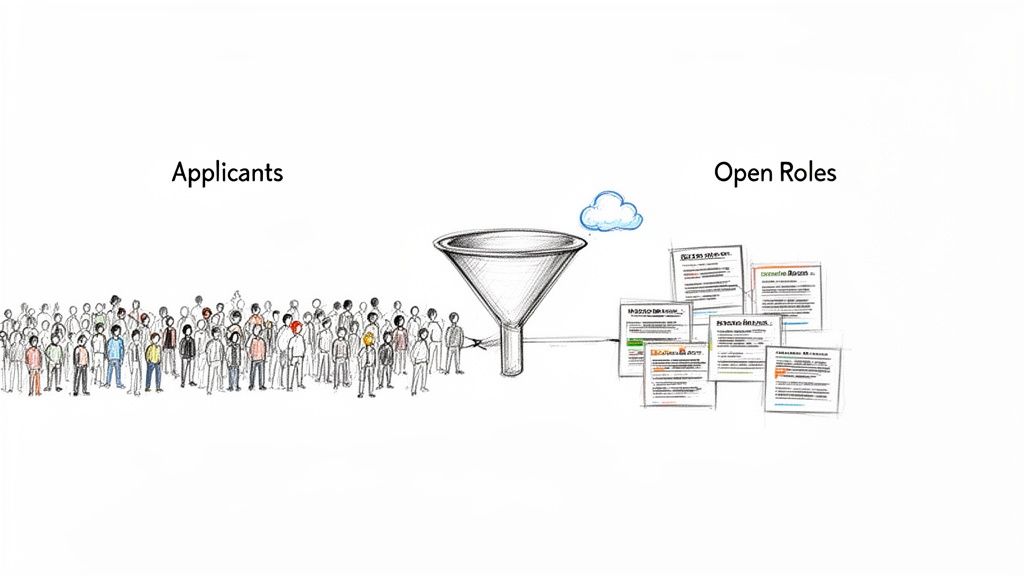
The demand for remote work has absolutely exploded. This means a single remote job posting on a major platform can get flooded with hundreds—sometimes thousands—of applicants in just a few days. Your carefully crafted application is now one tiny fish in a massive, overcrowded sea.
A Brutal Supply and Demand Mismatch
At its core, this is a simple economics problem. While 87% of U.S. job seekers are expected to want fully remote roles by 2026, a tiny 6% of all open positions actually offer that flexibility. This creates a massive bottleneck.
Because of this intense competition, even perfectly qualified candidates get lost in the shuffle. Recruiters are swamped. They rely on automated systems and split-second glances to weed people out, not to find the perfect fit. It’s no longer about just being qualified; it’s about being seen.
Your job search isn’t failing because you lack skills. It’s likely failing because your strategy hasn’t adapted to a market where everyone wants what you want, and there isn’t enough to go around.
To put this in perspective, here’s a quick look at the major roadblocks you’re up against.
The Remote Job Search Problem at a Glance
| Problem Area | Why It’s Costing You Interviews |
|---|---|
| Massive Application Volume | A single remote role can attract 1,000+ applicants, making it statistically impossible for recruiters to review every resume carefully. |
| “Ghost Job” Postings | Many listings on huge job boards are outdated or exist only to collect resumes, wasting your valuable time and effort. |
| Recruiter Overload | Hiring managers spend an average of just 7 seconds on each resume. Your application has to make an immediate impact or it gets tossed. |
| The Speed Game | Most hires come from the first handful of applicants. If you’re applying a week late, your chances plummet dramatically. |
Seeing it laid out like this can be a little disheartening, but it’s also empowering. Once you know the real problems, you can start building a strategy to overcome them.
Shifting from Self-Doubt to Strategy
Understanding this new reality is the first step. This isn’t about giving up on your dream remote job. It’s about being smarter. The old method of blasting a generic resume everywhere is officially dead.
To actually get traction, you need to shift your focus:
- Be Fast: Apply to roles before they get buried under a mountain of other applications.
- Be Selective: Focus on verified, direct-from-company listings instead of wading through the junk on massive job boards.
- Be Precise: Tailor your resume and cover letter to scream “I’m the perfect fit” for each specific role.
The goal is to stop being another number in a spreadsheet and become a standout candidate who targets the right opportunities at exactly the right time. Platforms like Remote First Jobs are built for this, sourcing jobs directly from company career pages so you can apply earlier and avoid the noise.
In the rest of this guide, we’ll break down the exact steps to overhaul your process and finally start landing the interviews you deserve.
How to Get Past the Resume Robots
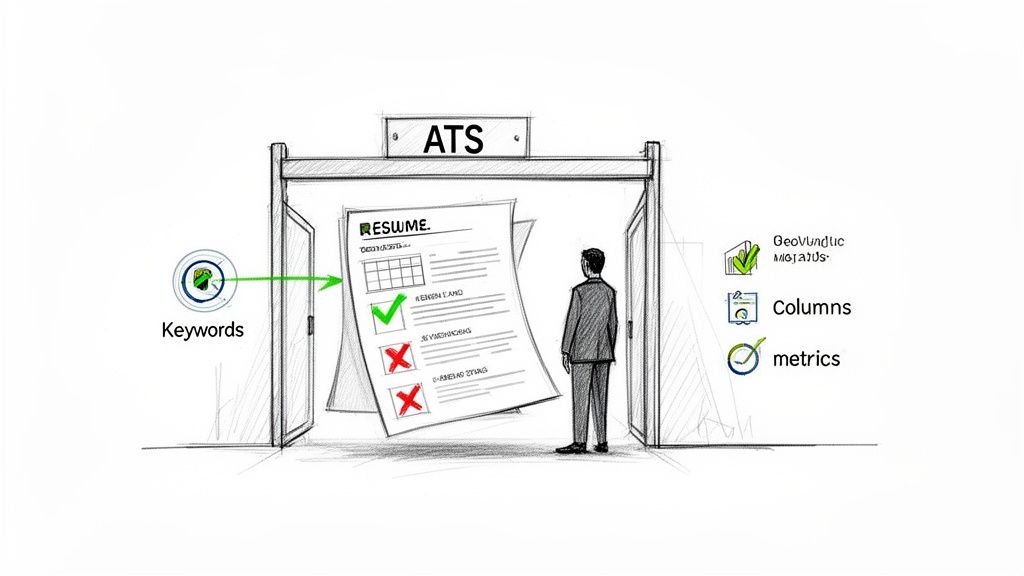
If you’re asking, “why am I not getting interviews?” the answer often lies with an invisible gatekeeper: the Applicant Tracking System (ATS). Before a human ever lays eyes on your application, this software scans it, looking for specific keywords, skills, and even the right formatting. If you don’t pass this first digital checkpoint, your resume gets sent to a virtual black hole.
The typical advice to “just add more keywords” is lazy and ineffective. It leads to a resume that sounds robotic and reads like a jumbled mess. A much smarter strategy is to play a two-part game: first, satisfy the machine’s basic rules, and second, write for the human who will actually make the hiring decision.
Nail the Formatting First
I’ve seen countless qualified candidates get rejected instantly, not because of their experience, but because the ATS simply couldn’t read their resume. These systems are powerful, but they’re not very sophisticated. They get tripped up by fancy designs and complex layouts.
To make sure your resume is machine-readable, stick to these fundamentals:
- Avoid Tables and Columns: They might look organized to you, but an ATS can read the text out of order, turning your well-crafted experience section into gibberish. A simple, single-column layout is always the safest bet.
- Use Standard Fonts: Stick to the classics like Arial, Calibri, or Times New Roman. Scripted or custom fonts can cause parsing errors that get you filtered out.
- Keep Headers and Footers Clean: Don’t put crucial information like your email or phone number in the header or footer. Some systems are programmed to ignore those sections entirely.
The goal isn’t to create a work of art. It’s to build a clean, parsable document that gets your qualifications across without a single technical glitch. Simplicity wins against the resume robots every time.
Before you send it anywhere, run the file through a free ATS resume checker like the one from OwlApply (no account needed) to see what the software actually reads.
Once your formatting is locked in, it’s time to focus on the content. You need to speak the right language—both for the software and the hiring manager.
Mirror the Job Description—Intelligently
Keyword stuffing is a dead end. The real trick is to show you truly understand the role by mirroring the language and priorities from the job description. This isn’t just about copying words; it’s about framing your experience to solve their specific problems.
Let’s look at a “before and after” example for a summary section to see what I mean.
Before (Vague and Passive): Responsible for managing marketing campaigns and social media accounts. Worked with the sales team to develop new strategies and reported on analytics to leadership.
After (Action-Oriented and Metric-Driven): Drove a 25% increase in qualified leads by executing multi-channel marketing campaigns across LinkedIn and Twitter. Collaborated with sales to align content strategy with pipeline goals, resulting in a 15% shorter sales cycle. Presented data-driven performance reports to C-level executives.
See the difference? The second version pops. It uses powerful action verbs (“Drove,” “Collaborated”) and backs them up with hard numbers that an ATS will flag as valuable and a human will find compelling.
This process of tailoring your resume for both audiences is crucial. You have to craft a document that satisfies the software’s checklist while also telling a convincing story to the person reading it.
ATS-Friendly vs. Human-Friendly Resume Checklist
To help you balance these two needs, here’s a quick-glance table breaking down how to optimize different parts of your resume for both the machine and the human reader.
| Resume Element | How to Optimize for ATS | How to Optimize for Human Readers |
|---|---|---|
| Formatting | Simple, single-column layout. Standard fonts (Arial, Calibri). No tables or graphics. | Clean, scannable layout. Use of bolding and white space to guide the eye. |
| Keywords | Include exact-match keywords and phrases from the job description (e.g., “SaaS,” “project management”). | Weave keywords into compelling bullet points that show impact, not just responsibility. |
| Summary | A concise section at the top with core skills and titles that match the role. | An engaging “professional summary” that quickly communicates your value proposition. |
| Job Titles | Use standard, recognizable job titles (e.g., “Software Engineer” not “Code Ninja”). | Standard titles are still best, but follow with a bullet point that clarifies scope. |
| Quantifiable Data | Include numbers, percentages, and dollar amounts (e.g., “managed $2M budget”). ATS often flags these. | Highlight impressive metrics in bold to draw attention to your biggest wins (e.g., “Increased revenue by 40%”). |
| File Type | Submit as a .docx or .pdf file, as specified in the application instructions. | PDF is generally preferred to preserve formatting, unless a .docx is explicitly requested. |
Ultimately, the best resumes are a hybrid—structured for the ATS, but written for the hiring manager.
To get an edge and ensure you’re hitting all the right notes, you can also look into specialized platforms. For example, there are great resources out there, like roundups of the 12 Best AI Resume Tailoring Tools, designed to help you quickly optimize your resume for each application. Getting this first step right is the single biggest thing you can do to start landing more interviews.
Stop Applying to the Wrong Jobs
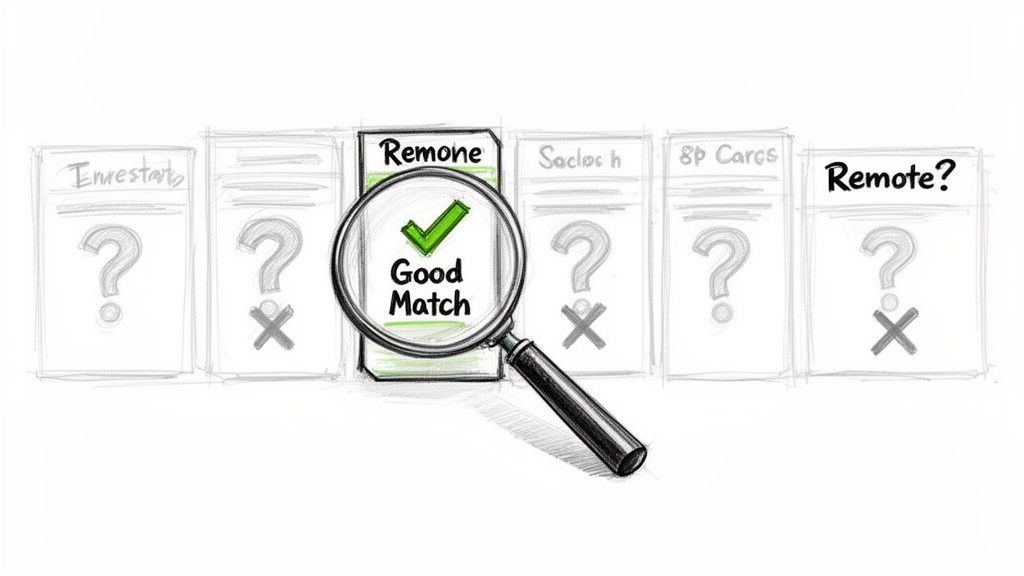
So, you’ve fine-tuned your resume to get past the robots, but you’re still hearing crickets. What gives? At this point, the problem probably isn’t your application—it’s your aim. Firing off hundreds of applications into the ether is a surefire recipe for burnout and radio silence.
It took me a while to learn this, but a highly selective strategy is so much more effective. Your time and energy are finite, so you need to invest them where they have the best chance of paying off.
The tough reality is that not every “remote” job is what it seems, and a role that sounds perfect on paper might be a complete mismatch in practice. Learning to read between the lines of a job description is a non-negotiable skill. It’s what separates a wasted hour from landing yourself in the “top contenders” pile.
Decoding the Job Description for a True Match
You need to start thinking like a job description detective. Don’t just skim the bullet points. Your goal is to figure out what the company actually needs and what problems they’re trying to solve. A winning application isn’t just a list of your skills; it’s a direct response to their specific pain points.
Here’s my process for dissecting a posting to see if it’s worth the effort:
- Pinpoint the Top 3-5 Requirements: Hunt for the skills mentioned repeatedly or listed right at the top. These are the absolute deal-breakers for the hiring manager. If you can’t confidently say you meet at least 80% of these core needs, just move on.
- Separate “Must-Haves” from “Nice-to-Haves”: Keep an eye out for phrases like “experience with X is a plus” versus “requires 5+ years of experience in Y.” The “must-haves” are your personal go/no-go filter.
- Translate Jargon into Problems: When a company asks for “experience with CRM optimization,” what they’re really saying is, “Our sales data is a mess, and it’s costing us money.” Your job is to frame your experience as the clear solution to that unspoken problem.
A job description is a wish list, not a legal document. You don’t need to be a 100% match. Your goal is to prove you’re an undeniable fit for the parts of the role that truly matter.
By concentrating on roles where your background genuinely overlaps with their most critical needs, you immediately tilt the odds in your favor. Instead of being one of 1,000 generic applicants, you become one of maybe 50 who are actually qualified.
Spotting Vague Remote Policies and Ghost Jobs
One of the biggest time-sinks in any remote job search is chasing after roles with murky remote policies. Companies love using fuzzy terms like “remote-friendly” or “hybrid” to cast the widest net possible. Then, three interviews in, they casually mention you need to be in the office three days a week.
This lack of clarity is a massive red flag. It’s not just frustrating; research shows that about 60% of candidates will bail on an interview process if the remote work policy isn’t clearly defined upfront. This vagueness also feeds the “ghost job” phenomenon—outdated or fake listings that clutter job boards and exist only to collect resumes. You can discover more insights about remote hiring statistics and see how widespread this issue is.
To steer clear of these traps:
- Hunt for Specific Language: Look for clear terms like “fully remote,” “distributed team,” or “work from anywhere.” Be skeptical of anything less concrete.
- Check the Fine Print: Does the listing say “remote (U.S. only)” or mention a specific time zone? This tells you a lot about their actual level of flexibility.
- Prioritize Direct-from-Company Listings: This is a big one. Job boards that pull directly from company career pages, like Remote First Jobs, are gold. They filter out most of the spam, recruiter-posted ghost jobs, and expired listings you’ll find on the giant aggregators.
I know it feels counterintuitive to be more selective when you’re anxious to find a job. But trust me on this: sending five highly targeted, carefully crafted applications to perfect-fit roles will get you much further than sending 50 generic ones into the void.
Why Your Timing Is Everything
So, you’ve polished your resume until it shines and you’re only applying to roles that are a perfect fit. If you’re still asking, “why am I not getting interviews?” the answer might be much simpler than you think. It often just comes down to timing.
Here’s something most job seekers don’t realize: when and where you apply can be even more important than what’s on your resume.
For a popular remote job, the first few hours after it goes live are critical. Recruiters often start reviewing applications the moment they come in, and that first wave of qualified candidates gets their full attention. If you submit your application three days later, you’re not just up against other people—you’re fighting a hiring process that’s already in motion.
The Problem with Crowded Job Boards
This timing issue gets way worse on huge job boards like LinkedIn and Indeed. The competition is just staggering. Remote jobs attract a massive flood of applicants—often over 1,000 per listing—while the actual number of remote openings is tiny, making up only 6% of all U.S. roles. You can dig into the research on these remote work trends to see just how skewed the numbers are.
And now, there’s a new problem: AI-generated fake candidates are flooding these systems, burying real, qualified professionals like you under a mountain of junk applications.
It’s the perfect storm. Your carefully written application ends up lost in an avalanche of noise. You’re no longer just competing with other qualified people; you’re battling bots, expired “ghost” jobs, and the clock.
The old strategy of casually browsing big job boards once a week is a recipe for frustration. To get ahead, you need a system that puts fresh, verified listings in front of you before everyone else sees them.
This is where finding jobs directly from the source changes the game completely. Instead of waiting for roles to show up on those crowded platforms, you need a way to spot them the moment they’re posted on a company’s own career page.
Gaining the First-Mover Advantage
This is where a service like Remote First Jobs gives you a massive leg up. It’s built on direct sourcing, constantly scanning company career pages. It finds new roles within hours of being posted, long before they get syndicated to the big boards and buried under thousands of applications.
This screenshot from Remote First Jobs shows exactly what I mean. The listings are clean and clear, showing you the company name and key details right away—no sponsored posts or recruiter spam to wade through.
What you get is a direct pipeline to real opportunities, letting you be one of the very first people to apply.
This speed is your secret weapon in the modern remote job search. By shifting your approach from reactive to proactive, you start seeing real results.
- You beat the crowd. Applying within the first 24 hours puts your resume right at the top of the pile, where a real person will see it while they’re most engaged.
- You avoid “ghost jobs.” Sourcing directly from company sites means you’re only applying to real, active openings, not expired listings that linger on big boards.
- You seriously increase your odds. Being early puts you in a much smaller, more qualified pool of candidates. That alone dramatically improves your chances of landing that first interview.
It’s a complete shift in strategy. Stop wasting your energy on stale job postings and start focusing on fresh opportunities where you can be first in line.
Your Action Plan to Start Getting Interviews
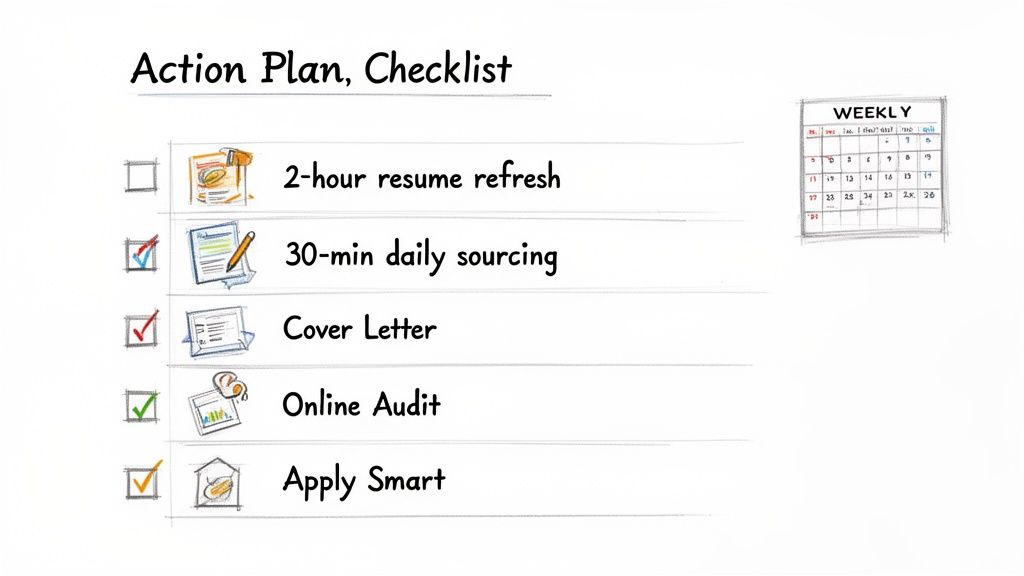
Alright, enough theory. Let’s move from figuring out the problems to actually fixing them. If you’re tired of the radio silence, this focused plan will help you turn things around and start seeing real progress this week. The whole idea is to stop the scattered, frustrating efforts and replace them with a structured approach that actually works.
We’re going to break this down into a couple of manageable time blocks. This isn’t about grinding away on your job search all day long; it’s about making every minute you spend count.
The Two-Hour Overhaul
First things first: block off a single, uninterrupted two-hour window. Think of this as a total reset for your core application materials. It’s a one-time investment, but it lays the foundation for every single application you send out from here.
- Resume Refresh (90 Mins): Grab your current resume and let’s get to work. Your only job for these 90 minutes is to build a clean, powerful, ATS-friendly template. That means stripping out any tables, columns, weird fonts, or graphics that could confuse the bots. Go through your experience and reframe every bullet point using the “Accomplished [X] as measured by [Y] by doing [Z]” formula. Every line should scream impact, not just list what you did.
- Online Presence Audit (30 Mins): Now, for the last 30 minutes, Google your name. What comes up? Head over to your LinkedIn profile and make sure your summary aligns with the new professional summary on your resume. Your profile picture should be professional, and your headline needs to clearly state your target role or area of expertise. It’s also a good time to scrub any old public posts or photos that don’t fit the professional image you want to project.
This initial overhaul is non-negotiable. Building your job search on a weak resume is like building a house on a shaky foundation—it’s bound to crumble. Get this right, and every application that follows will be stronger.
Your 30-Minute Daily Routine
With your shiny new resume and polished online presence, you can now shift into a daily rhythm that builds momentum without burning you out.
- Targeted Sourcing (20 Mins): Forget endlessly scrolling through those massive, overwhelming job boards. Instead, spend this time on a direct-sourcing platform like Remote First Jobs to find fresh, verified remote listings. The goal here isn’t quantity; it’s quality. Aim to find just one or two roles each day that feel like a perfect fit.
- Application Tailoring (10 Mins): For each role you identify, spend just ten minutes making small but critical tweaks to your new resume template. Swap in a few specific keywords from the job description and adjust your professional summary to speak directly to that company’s pain points. This quick bit of customization is what gets a recruiter’s attention.
Focusing your energy on applying early to a small number of highly relevant roles dramatically increases your chances of getting noticed.
And as you start preparing for the interviews that will come, think about all aspects of your presentation. Some candidates even explore advanced communication strategies, looking into topics like face analysis for job interviews to better understand and project confidence through non-verbal cues. A comprehensive approach ensures you’re truly ready for every stage.
Answering Those Nagging Job Search Questions
Even with a great strategy, a few persistent questions can still slow you down. Let’s clear up some of the common things that trip people up once they start applying, because getting these details right can make all the difference.
First up: the cover letter. Do you really need one, especially for remote jobs? The short answer is yes, but think of it strategically. While it’s true some recruiters might not read it, a good cover letter is your one chance to speak directly to the hiring manager. It’s where you connect the dots between your experience and their specific needs—something your resume just can’t do on its own.
Then there’s the follow-up. How do you check on your application without being a pest?
The trick is to add value, not just pressure. A week after applying, a brief, polite email works wonders. Skip the generic “just checking in.” Instead, reiterate your enthusiasm for the role and maybe highlight one key qualification that makes you a great fit. It shows you’re engaged, not just impatient.
So, How Many Jobs Should I Apply To?
This is a big one. It feels like you should be playing a numbers game, but in a modern job search, quality beats quantity every single time. If you’re constantly shotgunning your resume out, you’re doing it wrong.
Forget the daily application quotas. A much better goal is 1-3 highly targeted applications per day. That’s it. This pace gives you the breathing room to do what actually matters:
- Do Your Homework: Is this a real job? Does it truly fit your skills and career goals? You need time to spot those fake “ghost jobs.”
- Customize Your Resume: Spend a solid 10-15 minutes tweaking your resume, making sure the language mirrors what’s in the job description.
- Write a Real Cover Letter: Craft a short, powerful note that shows you understand the company and how you can help them.
This deliberate approach keeps you from burning out and makes sure every single application you send is strong enough to get noticed. Sending out hundreds of applications a week is a symptom of a broken strategy. Focus your energy on the roles where you have a genuine shot, because getting the interview is the only goal that counts.
Stop wasting your time on stale listings and beat the competition. With Remote First Jobs, you get access to verified remote roles sourced directly from company career pages, letting you apply before the crowd. Find your next remote job today.