
You’re probably in one of two places right now.
Either you already have a remote job and you’re wondering if Spain is a workable base, not just a good Instagram backdrop. Or you’re still job hunting and you’ve realized the harder question isn’t “Can I work from home in Spain?” It’s “How do I line up the right job, the right paperwork, and the right tax setup so this move doesn’t blow up six months later?”
That second question matters more.
A lot of advice about work from home in Spain gets stuck at the lifestyle layer. Beaches. Cafés. Sunshine. Cheap flights around Europe. All true, all useful, and none of it helps if your employer won’t authorize the move, your visa file is weak, or you land in Spain with the wrong income structure.
The practical version looks different. You need a remote role that clearly allows international work. You need documentation that immigration can use. You need to understand whether you’ll operate as an employee or self-employed professional. And you need a plan for your first few months on the ground, because Spain rewards preparation and punishes vagueness.
Spain is still one of the best places in Europe to build a serious remote life. But the people who make it work usually treat the move like a project, not a fantasy.
The Spanish Remote Work Dream Is Now Reality
If you’ve been picturing a quieter routine, fewer commutes, and a working day that ends with a life outside your laptop, Spain is no longer a fringe option. It’s a real operating base for remote professionals.

The shift has been fast. By Q1 2024, 37.5% of Spanish enterprises permitted telework, with 19.8% of employees teleworking regularly, compared with 8.3% of the labor force working from home in 2019. That change was also formalized by Ley 10⁄2021, Spain’s distance work law, which gave remote work a clear legal framework rather than leaving it as an informal company perk (Statista coverage of remote work in Spain).
That matters more than people think.
A country becomes viable for remote work when three things line up:
- Employers normalize remote arrangements
- The law recognizes distance work
- Foreign professionals can build a residency path around it
Spain now has all three. That’s why work from home in Spain feels different today than it did a few years ago. You’re not trying to improvise a half-legal setup. You’re stepping into a system that already expects remote workers to exist.
What the dream gets wrong
The fantasy version of Spain assumes location is the whole answer. It isn’t.
Most failed moves come from boring mistakes:
- The employer says “remote” but means domestic only
- The contract doesn’t clearly authorize work from Spain
- The tax side gets ignored until residency kicks in
- The apartment looks great but the internet setup is weak
- The move starts before the paperwork is stable
Practical rule: Spain rewards people who sort the admin first and lifestyle second.
What works
The strongest moves usually follow a clean order.
First, secure a role that supports cross-border remote work. Then build the visa file around that role. Then choose your city based on your work rhythm, not just your holiday preferences. Madrid and Barcelona suit some people. Valencia, Málaga, Alicante, and smaller cities suit others. The best choice depends on your schedule, language level, budget, and how much in-person community you need.
Spain can absolutely deliver the remote life people want. But it works best when the job search and the relocation plan are treated as one decision, not two separate ones.
Your Legal Pathway to Work Remotely in Spain
If you want to work from home in Spain legally as a non-EU remote professional, the Digital Nomad Visa is the route applicants often prioritize.
The reason is simple. It matches the reality of how you earn. You’re working remotely for a company or clients outside Spain, and you need residency that acknowledges that setup directly.
Spain’s Digital Nomad Visa has a high approval rate for well-documented applications, and the basics are clear: you need to show a minimum monthly income of €2,646 for the 2026 threshold, hold a university degree or 3+ years of experience, and provide an explicit employer authorization letter. Incomplete employer letters are one of the top rejection reasons (Dream Life Spain’s 2025 guide).
The documents that decide your outcome
Applicants typically do not lose this visa because the category is wrong. They lose it because the file is weak.
The employer letter is the biggest example. It can’t sound casual. “Employee may work remotely” is often too thin. The letter needs to make it obvious that your company knows you’ll be working from Spain and authorizes that arrangement.
Your proof should also hang together as one story:
- Your employment or client relationship is established
- Your work is remote
- Your income is stable
- Your qualifications meet the rule
- Your paperwork is internally consistent
If one document says one thing and another implies something else, that creates friction. Spanish bureaucracy can handle complexity. It doesn’t handle ambiguity well.
Don’t submit the minimum acceptable file. Submit the file that answers the next question before anyone asks it.
What I’d over-prepare
When people ask what matters most, I usually point to clarity over volume. Still, there are a few items worth over-documenting:
Employer authorization Make sure the letter explicitly permits you to work remotely from Spain.
Income proof Use documents that show regularity, not just a single snapshot. If your income varies, present it in a way that still looks stable.
Professional credentials If your degree is straightforward, fine. If not, your work history should make the case cleanly.
Company legitimacy Your employer or client company should look real, active, and established on paper.
Why the wrong visa creates future problems
A lot of people compare the Digital Nomad Visa with residency routes that were built for different situations. That usually creates unnecessary risk.
Here’s the practical distinction.
| Visa Type | Right to Work Remotely? | Minimum Income Required | Best For |
|---|---|---|---|
| Digital Nomad Visa | Yes | €2,646 monthly | Remote employees and eligible independent professionals working for non-Spanish income |
| Non-Lucrative Visa | No, not the right fit for active remote work | Varies by route and case | People living in Spain without active professional work |
| Other residency routes | Depends on category | Depends on category | People with a separate legal basis for residence |
The key point is that the Digital Nomad Visa is designed for the activity you are doing. That reduces friction later.
How to sanity-check your route
If you’re comparing Spain with other countries before committing, a broader review of Remote Work Visa Europe helps frame Spain’s place in the market. It’s useful for seeing how Spain’s pathway fits into the wider European remote residency context before you put time into one application.
A cleaner application sequence
The easiest way to keep the process under control is to build it in this order:
Confirm eligibility first
Don’t start by collecting random documents. Start by checking whether your income, work history, and employment setup fit the visa.
If your employer is hesitant about international remote work, solve that before anything else. Immigration won’t fix a weak employer position for you.
Build the employer packet second
Many applications falter at this stage.
Get the employer authorization right. Make sure your contract, role description, and remote status all tell the same story. If you’re freelance, your client structure has to do the same job.
Prepare the supporting file third
This includes the rest of the core paperwork, such as proof of insurance, identity documents, background records, and accommodation support where relevant. The important part isn’t just having the documents. It’s making sure names, dates, and job details line up across the file.
Review it like a skeptical case officer
Read every item with one question in mind: “Would a stranger understand exactly how I earn, where I work, and why this qualifies?”
If the answer is anything less than yes, tighten it.
The people who get approved most smoothly usually aren’t luckier. They’re clearer. For work from home in Spain, legal success starts long before you submit anything.
Structuring Your Employment Taxes and Finances
Once the visa path is workable, the next decision is the one that affects your day-to-day life most. How will you be engaged professionally while living in Spain?
That usually comes down to two common models. You remain a foreign employee, or you operate as an autónomo.
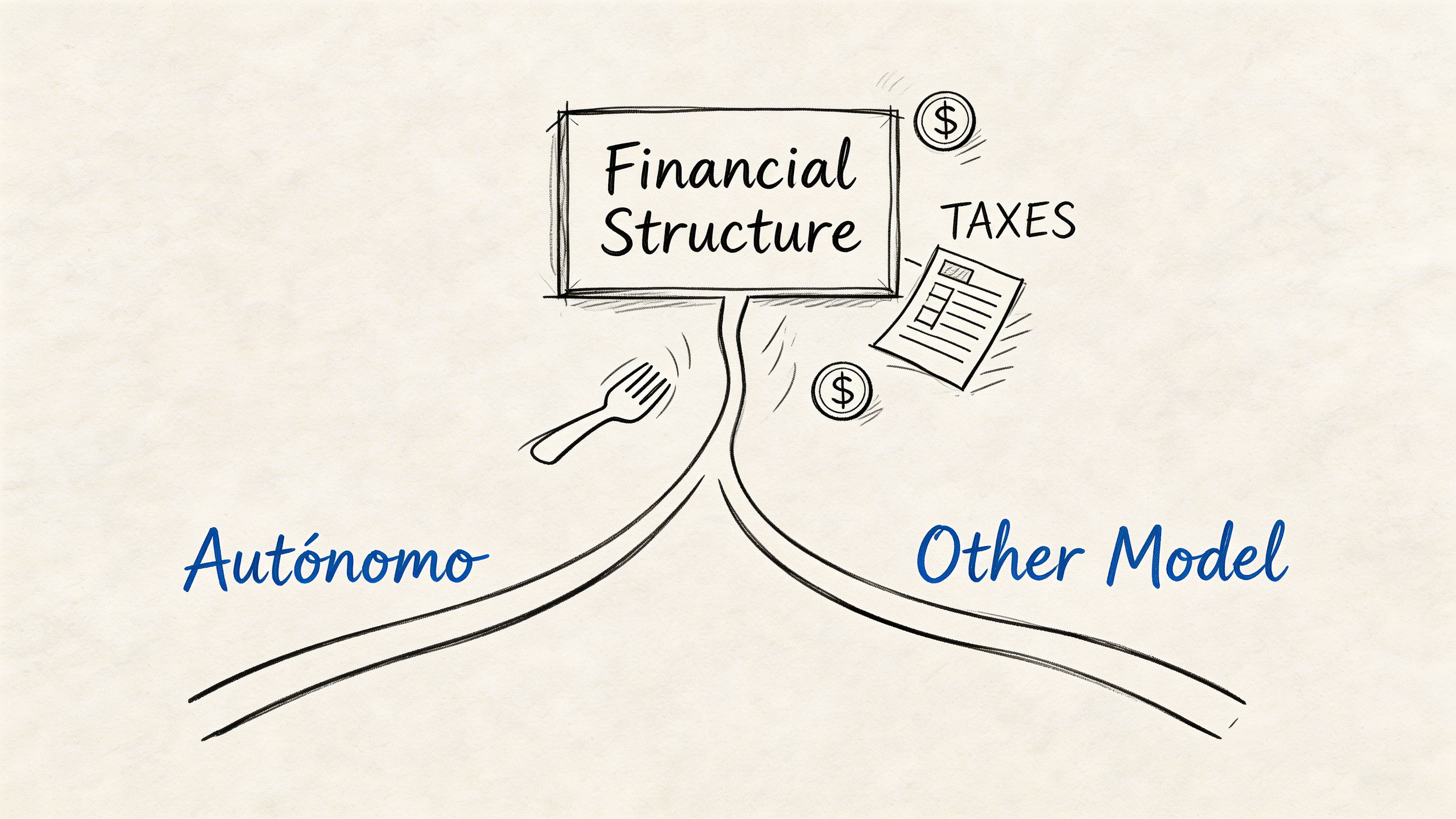
For the Digital Nomad Visa, you must earn at least €33,152 annually, and one of the biggest financial choices is whether the Beckham Law works in your favor, since it offers a flat 24% tax rate on income up to €600k. That can be useful, but it isn’t automatically the best option for every salary band or every personal situation (Moving to Spain on remote work and taxes).
The foreign employee route
This is usually the cleaner option if your employer already understands international remote work.
You keep the structure most salaried professionals prefer. One employer. One clear role. One set of deliverables. Less admin in your personal life.
That doesn’t mean zero complexity. Your company still needs to be comfortable with someone working from Spain, and your tax and compliance position still needs to be reviewed properly. But for the worker, this model often feels more stable.
It tends to suit:
- Mid-senior professionals who want predictability
- People applying for the DNV through an employer relationship
- Workers who don’t want to manage ongoing self-employed admin
- Anyone whose company can issue strong remote authorization
The autónomo route
This can work well if you already operate independently or have a client-based setup that is clearly established.
It gives you more control, but it also gives you more paperwork. You’ll likely spend more time on invoicing, declarations, bookkeeping, and administrative follow-through. Some people are fine with that. Others hate it by month two.
The upside is flexibility. The downside is management overhead.
This route tends to suit people who already think like operators, not just employees.
If you’ve never enjoyed admin in your home country, you probably won’t enjoy Spanish admin either.
A side-by-side view
| Structure | Best part | Hard part | Usually better for |
|---|---|---|---|
| Foreign employee | Cleaner routine and simpler professional identity | Employer approval and cross-border compliance questions | Salaried professionals with stable remote roles |
| Autónomo | Flexibility and control | Ongoing admin, filings, and self-management | Consultants, contractors, and established independents |
Where the tax question gets real
A lot of remote workers hear “Beckham Law” and stop thinking. That’s too shallow.
The useful question isn’t whether the regime sounds attractive. It’s whether it improves your outcome once your income, residency status, and long-term plans are considered. A flat rate can be excellent in one case and a poor fit in another.
That’s why a tax consult before the move is worth doing. Not because Spain is unusually hostile, but because changing tax residency without checking the structure first is one of the easiest ways to create expensive confusion.
What to ask before you choose a model
Before settling on employee versus autónomo, pressure-test the setup with practical questions:
Who controls your schedule and output? If one company manages you like an employee, forcing a contractor structure may create friction.
How stable is the income source? Stable salary and variable client revenue create very different planning problems.
How much admin can you realistically handle? Be honest here. Admiring flexibility is not the same as wanting bookkeeping.
Do you want optionality later? Some people arrive in Spain with one structure and shift later, but that’s easier when the first setup is sound.
A short explainer can help if you want a general overview before talking to a professional:
The non-obvious financial trade-off
The biggest mistake I see is optimizing for headline numbers and ignoring operational friction.
A setup can look better on paper and still be worse in real life if it creates constant admin, unclear reporting, or weak visa support. The best structure is usually the one that does three things at once:
- Supports your residency cleanly
- Makes tax treatment understandable
- Fits how you work
What works better in practice
For most mid-career professionals moving for work from home in Spain, a direct foreign employment relationship with clear remote authorization is usually the easiest foundation if it’s available.
For independent professionals with established clients, the autónomo path can work well, but only if they go in expecting administration to be part of the job.
The right move isn’t the most fashionable structure. It’s the one you can maintain without stress once the novelty of the move wears off.
How to Find Verified Remote Jobs That Support Your Move
The hardest part of moving to Spain for remote work usually isn’t Spain. It’s finding a role that is both real and compatible with the move.
A lot of people waste months applying to listings that were reposted everywhere, already flooded with applicants, or never serious to begin with. That’s a bad way to build a relocation plan because the job is the foundation of the rest of it.
As of 2025, 1 in 5 job ads in Spain offers remote or hybrid work. The practical advice attached to that trend is just as important: focus on high-demand fields like tech and marketing, and use direct sourcing to avoid the crowded platforms where some jobs attract 1,000+ applicants. Direct applications through company career pages can produce 3x higher response rates (Idealista on remote work trends and direct sourcing).
The job search filter that matters most
Don’t search for “Spain jobs” first.
Search for jobs that let you live in Spain.
That sounds obvious, but it changes everything. The right listing usually has some combination of these signals:
- Work from anywhere wording
- International remote policy
- Distributed team language
- Async or global collaboration norms
- Clear employer identity with direct application path
If the job says “remote” but limits hiring to one country, it’s not helping your move.
Where applicants often lose time
The broad platforms are noisy by design. They’re useful for market awareness, but poor for precision.
When you’re trying to build a visa-compatible move, noise is expensive. You need fresh listings, direct employer pages, and companies that are already comfortable with distributed hiring. That’s why many serious job seekers switch to a more targeted search flow and use tools that track direct employer listings instead of recycled board posts. A focused option for that is https://remotefirstjobs.com/, especially if you want roles pulled from company career pages rather than general aggregators.
The best remote job for a Spain move isn’t the one with the loudest listing. It’s the one whose company can clearly support your legal and operational reality.
A practical application sequence
Here’s the process I’d use if the move depends on the job.
Start with role families, not random titles
Stay close to areas where remote hiring is already mature. Tech, product, marketing, design, and sales tend to have stronger distributed norms than many location-bound roles.
That doesn’t guarantee visa support, but it improves the odds.
Check policy language before writing anything
Before tailoring a CV or sending a note, inspect the company’s careers page and hiring language. Look for signs that they hire across borders. If that information is missing, proceed carefully.
Prioritize direct applications
When you apply through a company’s own system, you reduce one major problem. You know the role is tied to a live employer page. That alone filters out a lot of dead-end effort.
Use your materials to reduce relocation anxiety
Your CV and note should make a hiring manager’s life easier. Signal that you already understand remote collaboration, time zones, documentation, and independent execution. A manager is more likely to support a Spain-based arrangement when your application reads like low operational risk.
What a visa-supportive employer usually looks like
A company doesn’t need to market itself as a “digital nomad employer.” It just needs to behave like one.
Good signs include:
- Established remote processes
- Written policy language around location
- Experience hiring internationally
- Comfort with async work
- A serious HR or operations function
Weak signs include vague answers, verbal-only promises, and “we’ll figure it out later.” That approach tends to collapse at the exact moment you need paperwork.
The salary test that matters
The right salary isn’t just “enough to live in Spain.” It also needs to support the legal side discussed earlier. That’s why the job search and relocation process should be integrated from the beginning.
If a role sounds great but sits too close to the income threshold, think carefully. You want margin. A move feels much better when your role supports the visa comfortably and leaves room for normal life, not just survival.
For work from home in Spain, the cleanest path is usually this: target distributed companies, apply directly, confirm location flexibility early, and treat employer documentation as part of the job search, not an afterthought.
Your Workspace Connectivity and Community in Spain
Remote life in Spain gets easier once your day stops feeling temporary.
That usually happens when three things click into place. Your home internet works without drama. You have a backup place to work. And you know enough people locally that the country starts feeling lived in rather than visited.

What to look for in an apartment
When you rent, don’t ask only “Is there internet?” Ask what kind, how stable it is, and whether it’s already installed.
That sounds fussy until your first week of calls depends on it.
If you’re touring places in person, test mobile signal in the apartment too. Even with solid home internet, you want a backup hotspot option for bad days or setup delays.
A few practical filters help:
Dedicated work corner Not every beautiful flat works as a full-time workspace.
Natural light and noise levels Spain has lively streets. Great for life, not always great for calls.
Café and coworking fallback nearby You don’t need to use it every day. You do need the option.
Coworking is often worth it
Even if you prefer home most of the week, a coworking membership can solve two problems fast. It gives you dependable infrastructure and a built-in social layer.
Spain’s larger cities have plenty of coworking options, and smaller hubs increasingly do too. If your work is intense or you’re new in town, having one professional environment outside your flat makes a real difference.
A good coworking space isn’t just a desk. It’s backup internet, meeting space, routine, and accidental community.
The rural option more people should consider
The obvious move is Madrid, Barcelona, or Valencia. That works for a lot of people. But there’s another angle if you want lower costs and a different pace.
Several Spanish towns offer grants up to €15,000 for remote workers willing to relocate. One notable example is the Ambroz Valley in Extremadura, which offers this support to professionals who commit to living there for at least two years (video coverage of Spain’s rural relocation incentives).
That changes the math.
For some remote workers, especially those whose role is fully distributed and not tied to a major city network, these programs can be a serious lever. You may trade some convenience and expat density for lower pressure and more financial breathing room.
The caution is obvious. Rural Spain can be wonderful, but it’s not for everyone. Check transport, community, language comfort, and healthcare access before committing.
Community starts with language effort
You can absolutely function in parts of Spain with limited Spanish, especially in bigger cities and international work circles. But daily life gets smoother fast when you put effort into the language.
You don’t need perfect grammar. You need useful repetition. Ordering, renting, asking questions at town hall, dealing with repairs, and handling admin all become less draining when you stop relying on translation for every interaction. If you want a practical place to start, this roundup of best apps for learning Spanish is useful for building enough confidence to handle everyday life.
The people who settle best usually don’t just import their old routine into Spain. They build a local one.
A Practical Checklist for Your First 90 Days
The first three months in Spain are rarely difficult because of one big issue. They’re difficult because small tasks pile up fast.
What works is sequencing. Handle the documents that establish your presence first. Then sort the systems that make daily life easier. Then clean up the loose ends you ignored while unpacking.
Your first 30 days
The first month is about becoming legible to the country.
Handle local registration early
Get your padrón done as soon as you can if your municipality requires it for other procedures. It’s one of those documents that facilitates later tasks.
Apply for your TIE if that step applies to your residency path. Don’t treat it like a casual errand. Bring organized copies, expect waiting, and keep every receipt and appointment confirmation.
Set up your financial basics
Open a Spanish bank account if your situation requires one for rent, bills, or administration. Keep your setup simple at first. You can optimize later.
If you’re working remotely full time, separate personal and work-related money flows clearly from the start. Messy account habits become annoying during tax season.
Stabilize your working environment
Your first apartment doesn’t need to be perfect. It does need to support your job.
Make sure your internet is working properly, your desk setup is viable, and you have a fallback location for meetings. Buy the boring items early: extension cords, laptop stand, proper chair if needed, and a local SIM with enough data.
Days 30 to 60
This period is usually when the adrenaline fades and real life begins.
Build your admin folder
Keep digital and physical copies of everything. Lease, registration documents, visa papers, insurance records, work documents, appointment confirmations. Spain runs on paperwork memory. You should too.
Learn your neighborhood operationally
Don’t just explore it socially. Learn where to print documents, where to buy basic office supplies, where the quieter cafés are, and how long it takes to reach any office you may need for admin.
That reduces friction more than people expect.
Create a weekly rhythm
Work from home in Spain gets much better once you stop living like you’re still in transit. Pick regular grocery days, exercise times, coworking days if useful, and at least one recurring social activity.
Routine is what turns relocation into residence.
The first version of your life in Spain won’t be the final version. Build something functional first. Improve it after.
Days 60 to 90
By this point, the urgent paperwork should be under control. Now you clean up the medium-term pieces.
Review healthcare and insurance use
Know what your policy covers in practice, not just in theory. Save contact numbers, nearby clinics, and the claims process. Do this before you need it.
Check your tax calendar
If your work structure creates filing obligations, don’t wait for a surprise email or a panicked reminder from someone online. Put deadlines into your calendar and confirm what applies to you.
Reassess your city choice
After a couple of months, you’ll know if your location fits your real work style. Some people need more community. Others need less noise. Some realize they’d be happier outside the biggest cities.
Give yourself permission to adjust.
A smooth first 90 days isn’t about doing everything at once. It’s about making sure the essential systems are in place so your job, your residency, and your daily life stop competing with each other.
Frequently Asked Questions
Can my spouse and children join me on the Digital Nomad Visa
Spain’s digital nomad framework is generally used by people relocating with family, but the exact documentation and dependency requirements can vary by case. If you’re moving with a spouse or children, treat family paperwork as part of the initial plan, not an add-on after your approval. That means reviewing passports, insurance, proof of relationship, and the financial side early.
What kind of private health insurance do I need
You need private health insurance that fits the visa requirements for your case and is accepted for residency processing. In practical terms, that means choosing a policy built for immigration use, not just travel convenience. Before buying, confirm that the policy wording, coverage level, and provider documentation are suitable for Spanish residency procedures.
Do I need to speak Spanish to work from home in Spain
For the job itself, not always. Many remote roles operate fully in English.
For life in Spain, some Spanish helps a lot. It reduces stress with landlords, utility providers, local administration, deliveries, repairs, and medical appointments. You don’t need fluency on day one, but you should expect your quality of life to improve as your Spanish improves.
How does the 183-day rule affect me
If you spend enough time in Spain, tax residency can become a real issue. The practical lesson is simple: don’t assume your old tax setup continues unchanged just because your employer is abroad.
People often get sloppy here. They think “I’m paid from outside Spain, so nothing changes.” That’s not a safe assumption. If you’re planning to stay long enough to build an actual life in Spain, get tax advice tied to your exact structure.
Can I use a tourist status while I figure things out
For a serious move, that’s usually the wrong mindset. A tourist stay may be useful for scouting cities, but it isn’t the same thing as building a legal remote work base. If your goal is stable work from home in Spain, line up the right residency path rather than improvising after arrival.
Is Spain still a good choice if I’m not in tech
Yes, but your search has to be more deliberate. Tech often has the clearest remote infrastructure, yet marketing, sales, design, operations, and other knowledge roles can also work well when the employer is distributed. The key is not your job title by itself. The key is whether the company can support remote work across borders cleanly.
If your move depends on finding a legitimate remote role fast, Remote First Jobs is one of the few tools built for that reality. It pulls jobs directly from employer career pages, not recycled board listings, which makes it useful when you’re trying to find fresh remote openings before they get buried under mass applications. For anyone planning work from home in Spain, that kind of direct, verified search is a better starting point than gambling on noisy platforms full of stale posts and ghost jobs.