
The real difference in the contract vs. full-time employment debate boils down to a classic trade-off. A full-time employee gives up a bit of autonomy in exchange for stability, benefits, and the legal safety net an employer provides. On the flip side, an independent contractor trades that stability for a whole lot more freedom, essentially running their own small business and handling their own taxes, benefits, and work processes.
Defining Your Role in the Modern Workforce
Picking a path isn’t just about a job title; it’s about understanding what each role truly means for you. This choice fundamentally shapes your legal standing, how you handle your finances, and what your day-to-day professional life actually looks like.
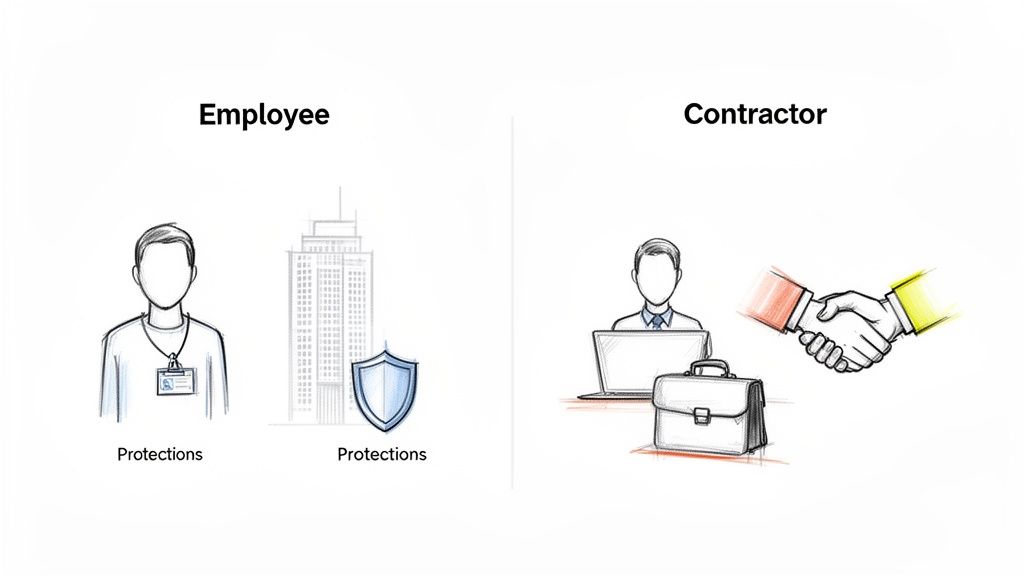
What Is a Full-Time Employee
A full-time employee, often called a W-2 employee in the U.S., is fully integrated into a company’s structure. The key thing here is that the employer has the right to control not just the final outcome of the work, but also how that work gets done. They set the hours, provide the laptop and software, and direct the day-to-day methods.
This relationship comes with some serious legal and financial scaffolding. Employees get protections under laws covering things like minimum wage, overtime, and workplace safety. Plus, their employer handles withholding taxes and pays a chunk of their Social Security and Medicare, which definitely simplifies things come tax season.
Understanding the Independent Contractor
An independent contractor, or 1099 worker, is a different beast entirely. They operate as their own separate business. The IRS makes a clear distinction here based on control: a client can direct the what (the final result), but not the how (the methods and means the contractor uses to get there).
This setup puts the contractor in the driver’s seat of their own one-person company. They bring their own tools, set their own schedule, and are on the hook for all business finances, including paying the full self-employment tax. It offers incredible flexibility but ditches the safety nets that employees take for granted.
Recent data shows full-time workers pulled in a median weekly pay of $1,132, which is a noticeable step up from the $949 for independent contractors. This gap really highlights the financial trade-off at the heart of the decision, which you can read more about in the contingent worker earnings data from the BLS.
The core legal test is about control: If the company directs how and when you work, you are likely an employee. If they only control the final deliverable, you are likely a contractor.
To make things clearer, let’s break down the fundamental differences side-by-side. This table gives you a quick snapshot of how these two roles stack up against each other.
Core Differences Contract vs Full Time Employment
| Attribute | Full-Time Employee (W-2) | Independent Contractor (1099) |
|---|---|---|
| Payment Structure | Regular salary or hourly wage with predictable paychecks. | Paid by project, milestone, or hourly rate via invoices. |
| Taxes | Employer withholds income, Social Security & Medicare taxes. | Responsible for paying self-employment tax (full SS & Medicare). |
| Benefits | Typically eligible for health insurance, retirement plans (401k), PTO. | Must source and pay for their own benefits and retirement. |
| Job Security | Greater stability with legal protections against wrongful termination. | Security is based on contract length and ability to find new clients. |
| Autonomy | Follows company schedule, processes, and uses company tools. | Sets own schedule, methods, and uses personal equipment. |
Seeing it laid out like this really drives home that neither path is inherently better—it all depends on what you value most at this stage in your career. Now, let’s dig into the details.
The Financial Reality Behind Your Paycheck
The number on your offer letter—whether it’s a big annual salary or an impressive hourly rate—is only part of the story. To really compare a contract vs a full-time role, you have to look past the headline figure and get a handle on the total financial picture. Trust me, a six-figure contract rate can easily leave you with less in your pocket than a lower-paying salaried job once you factor in all the hidden costs.
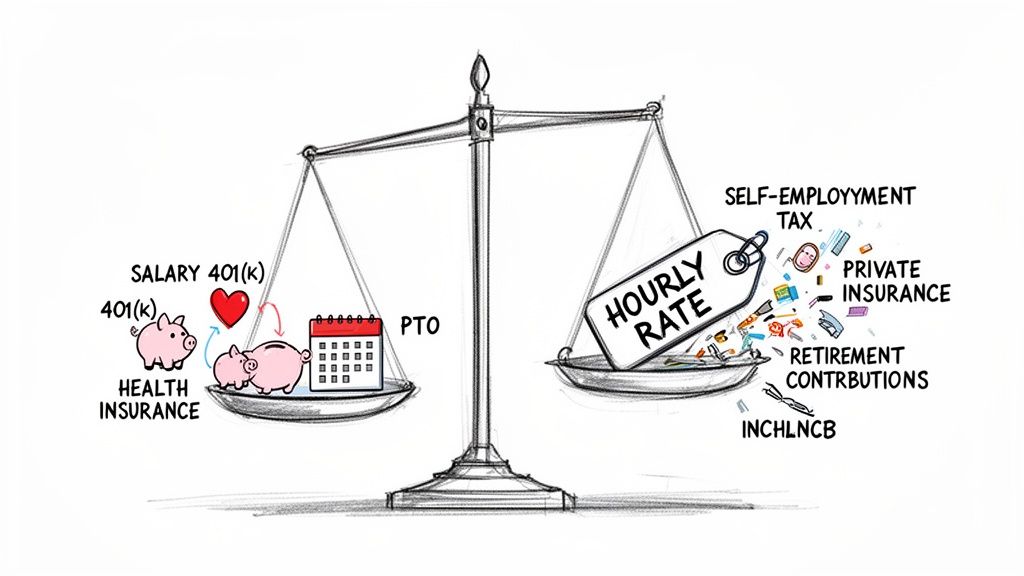
This section is all about dissecting the true value of a compensation package. We’ll pull back the curtain on the variables that dramatically change what you actually take home. Let’s run the real numbers on each path so your decision is based on financial facts, not just flashy figures.
Unpacking the Full-Time Compensation Package
A W-2 employee’s salary is just the starting point. The real value is often found in the “hidden paycheck” of benefits and employer contributions, which can be surprisingly hefty. On average, the true cost of an employee to a company is about 1.3 times their base salary, a number that perfectly illustrates the value of these perks.
Here’s a breakdown of what that includes:
- Employer-Paid Taxes: This is a big one. Your employer pays half of your Social Security and Medicare taxes, which adds up to 7.65% of your income. As a contractor, that entire bill falls on you.
- Health Insurance Subsidies: Companies typically cover a huge chunk of health insurance premiums. This subsidy alone can be worth thousands of dollars a year—a cost you’d otherwise have to shoulder entirely.
- Retirement Matching: A 401(k) match is a common benefit where your employer kicks in money to your retirement fund based on your own contributions. It’s essentially free money for your future self.
- Paid Time Off (PTO): Vacation days, sick leave, and holidays are all paid time when you aren’t working. If you have three weeks of PTO and ten paid holidays, you’re getting paid for nearly a full month of not working.
These benefits create a crucial financial safety net and opportunities for building wealth that you just don’t see in the salary number alone.
Calculating the True Cost of a Contract Role
When you’re an independent contractor, you’re running a business of one. That means you are responsible for every single expense an employer would normally cover. This requires a major mental shift away from the traditional employee mindset.
As a contractor, your hourly rate isn’t just for your time and skill; it must cover your salary, benefits, taxes, business expenses, and profit margin.
These are the primary costs you have to subtract from your gross contract income:
- Self-Employment Tax: Contractors are on the hook for the full 15.3% for Social Security and Medicare. On a $100,000 income, that’s an extra $7,650 you owe compared to an employee.
- Health Insurance Premiums: You’re in charge of finding and paying for your own health coverage. When weighing a contract, it’s critical to research and price out health insurance options specifically designed for freelancers.
- Retirement Funding: There’s no 401(k) match waiting for you. You have to fund your retirement accounts—like a SEP IRA or Solo 401(k)—all on your own.
- Unpaid Time Off: Every vacation day, sick day, or holiday is a day you’re not earning. You have to build your own financial cushion to cover any time you take away from work.
- Business Expenses: The cost of tools, software, marketing, and professional development comes right out of your revenue. The silver lining is that many of these are tax-deductible.
A Real-World Financial Scenario
Let’s compare two professionals to see exactly how these factors play out in the real world.
Scenario A: The Full-Time Employee Meet “Alex,” a remote marketing manager who accepts a full-time job with an $85,000 annual salary.
- Total Compensation Value: The company pays $6,500 in payroll taxes on her behalf, provides a $7,000 health insurance subsidy, and matches $4,250 in 401(k) contributions.
- Alex’s True Package Value: $102,750
Scenario B: The Independent Contractor Now meet “Jordan,” a freelance marketing consultant who lands a contract at $60 per hour. Assuming Jordan bills for 1,920 hours a year (40 hours/week for 48 weeks, allowing for 4 weeks of unpaid time off), the gross income is $115,200.
- Self-Employment Tax: Jordan pays an extra $8,812 in SE tax.
- Health Insurance: Jordan pays $7,000 out-of-pocket for a comparable plan.
- Retirement: To match the benefit Alex gets, Jordan has to contribute $4,250 from their own pocket.
- Jordan’s Net Earnings (Before Income Tax): After subtracting these core expenses, Jordan’s effective income drops to $95,138.
In this head-to-head comparison, the contractor with the higher gross income actually ends up with a lower effective income than the salaried employee—and that’s before accounting for any other business expenses. This is exactly why a contractor’s rate needs to be significantly higher than an employee’s equivalent pay to even begin to break even.
Navigating Autonomy and Legal Protections
Beyond the paycheck, your employment status is what really shapes your day-to-day freedom and the legal safety net you have. This decision—contractor versus full-time employee—determines who sets your schedule, whose laptop you use, and what happens if things go sideways. People often gloss over these details, but they’re the ones that truly define your working life.
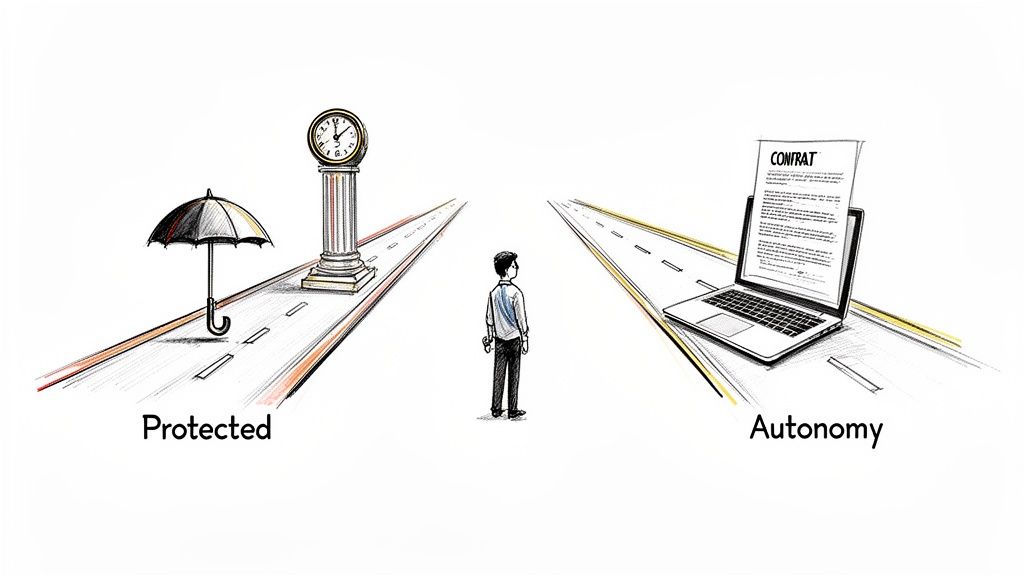
Full-time employment is a structured world where your employer acts as a legal and financial buffer. On the other hand, contract work gives you incredible freedom, but you’re on your own to build and maintain your protections. Let’s dig into what this actually looks like.
The Employee Safety Net
As a full-time employee, you’re working under a protective umbrella of federal and state labor laws. These aren’t just abstract rules; they provide real, tangible security you don’t think about until you absolutely need it.
This legal framework gives you a few key protections:
- Unemployment Insurance: If you’re laid off, your employer’s contributions to state unemployment funds provide a temporary income stream. It’s the financial cushion you need while you hunt for your next role.
- Workers’ Compensation: Get injured on the job? Workers’ comp has your back, covering medical bills and lost wages. Contractors have to source and pay for their own private insurance to cover these risks.
- Legal Recourse: Employees are protected from wrongful termination, discrimination, and harassment by laws like the Civil Rights Act. You have formal channels to seek justice if you’re treated unfairly.
On top of these legal shields, the company’s control also just simplifies things. They hand you the laptop, the software licenses, and the roadmap. While you trade some autonomy, you also offload the mental burden of managing all the operational nuts and bolts yourself.
The Contractor’s Autonomy and Liability
As an independent contractor, you’re the captain of your own ship. You call the shots on when, where, and how the work gets done, as long as you hit your deadlines and deliver what you promised. This is the number one reason professionals go the 1099 route.
You have total control over:
- Your Schedule: Feel like working 6 AM to 2 PM or taking every Tuesday afternoon off? As a contractor, that’s entirely up to you.
- Your Tools: You get to pick the hardware, software, and methods you know will get the job done right.
- Your Projects: You have the power to say “yes” or “no” to projects based on your interest, expertise, and what you have on your plate.
But all that freedom comes with a hefty dose of responsibility. You’re not just a worker; you’re a business, and you’re liable as one.
The most powerful tool for an independent contractor is not their laptop or software—it’s their contract. An ironclad agreement is your only real protection against scope creep, late payments, and disputes.
Without a rock-solid contract that clearly defines deliverables, payment terms, and who owns the intellectual property, you’re leaving yourself wide open to risk. For a deeper dive into the legal frameworks that govern this, it’s always a good idea to consult resources on general employment law.
Practical Scenarios
To really see how these differences play out, let’s look at a couple of real-world situations.
The Project Gets Canceled
- Full-Time Employee: The company axes a big project you were on. You’ll almost certainly be reassigned to another team or initiative. Your paycheck keeps coming, uninterrupted.
- Independent Contractor: The client pulls the plug on your project. Unless your contract includes a “kill fee” for early termination, your income stream just vanished. Instantly.
A Disagreement Arises
- Full-Time Employee: You and your manager are butting heads over how to approach a task. You can take the issue to HR or a higher-up to mediate and find a resolution.
- Independent Contractor: You disagree with a client’s feedback. Your only real leverage is what’s spelled out in your contract. Negotiation is your main tool, but you don’t have an HR department to back you up.
Shaping Your Career Growth and Lifestyle
The decision between contract and full-time work goes way beyond your paycheck and daily schedule. It’s a choice that fundamentally steers your career path and your life outside of work. One route offers a structured climb up the corporate ladder, while the other gives you a blank canvas to build your own professional brand from the ground up.
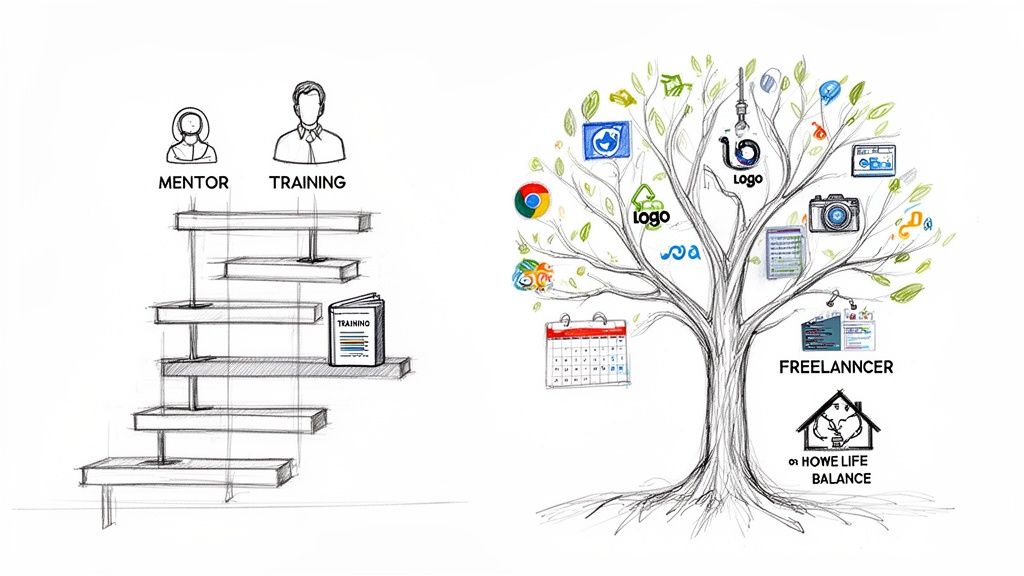
This isn’t about which option is better—it’s about which is the right fit for you. Understanding the real-world trade-offs in career development and lifestyle is key to making sure your work actually supports the life you want to live.
The Structured Growth of Full-Time Employment
Full-time roles are built for steady, predictable career advancement. Companies invest in employees because they see them as long-term assets, which naturally creates an environment where you can develop skills and move up internally. This path offers a clear, often linear, journey forward.
Here are a few of the biggest career perks in a full-time role:
- Mentorship and Guidance: You get direct access to senior leaders and experienced colleagues who can show you the ropes, offer advice, and help you navigate the corporate world.
- Company-Funded Training: Many employers will foot the bill for certifications, workshops, and even further education that makes you better at your job. You’re building your resume and expertise on their dime.
- Clear Career Ladders: Most established companies have defined pathways for promotion. You know exactly what skills you need and milestones to hit to move from a junior to a senior role and beyond.
Of course, this structured world has its trade-offs. Progress can feel slow, often tied to annual review cycles, and can sometimes be influenced more by office politics than pure merit. Your professional brand is also tied directly to your employer, which can be a huge boost but can also limit your visibility outside the company.
The full-time path offers a powerful support system for growth. Your career development is a shared responsibility between you and your employer, providing resources and a clear direction you don’t have to build from scratch.
The Dynamic Portfolio of a Contractor
Going the contract route puts you squarely in the driver’s seat of your career. There’s no corporate ladder to climb; instead, you build a diverse portfolio of projects, clients, and skills that becomes your personal brand. This path is perfect for professionals who thrive on variety, autonomy, and having direct control over their own story.
As a contractor, you shape your growth by:
- Building a Diverse Portfolio: You could be working with a tech startup one quarter and a Fortune 500 company the next. You’re tackling different challenges and gaining a breadth of experience that’s tough to find in a single job.
- Cultivating a Powerful Personal Brand: Your reputation is your business. Every project you knock out of the park adds to your credibility and helps you land bigger, more interesting work.
- Achieving True Work-Life Integration: You have the ultimate flexibility to design a work schedule that fits your life, not the other way around. This opens the door for travel, passion projects, or simply a more balanced day-to-day.
But all that freedom comes with the constant pressure to perform and line up the next gig. This reality is reflected in workforce trends; a global survey found that contract workers (55%) were far more willing to work unpaid hours to keep their jobs than direct hires (37%). It really highlights the hustle involved in maintaining a steady pipeline of work, a topic you can dive into by reading about the rise of temporary and contract work.
Ultimately, choosing between contract and full-time employment comes down to what you want to build. Are you looking to climb a well-defined mountain with a team and a guide, or are you forging your own path through a varied and exciting wilderness? Both journeys can lead to incredible destinations, but they demand very different skills, mindsets, and appetites for risk.
Choosing the Right Path for Your Goals
Figuring out whether to go contract or full-time isn’t about which one is universally “better.” It’s about what’s right for you, right now. This comes down to a serious, honest look at your professional goals, your personal life, and what you’re willing to trade off.
The core of the decision really boils down to two things: stability and autonomy. Usually, you can’t have the maximum of both. One path gives you a safety net, the other gives you the controls. Let’s break down when each makes the most sense.
When Full-Time Employment Is the Clear Winner
A full-time, salaried job is usually the best bet for anyone who puts a premium on security, structured career growth, and being part of a tight-knit team. It’s the ideal path if you just want to focus on your work without also having to run a business on the side.
You should lean towards a full-time role if you:
- Crave Stability and Predictability: You sleep better at night knowing a steady paycheck is coming, health insurance is subsidized, and you have paid vacation days. That financial peace of mind is your top priority.
- Seek Structured Career Growth: You want a clear path for promotions, access to senior mentors, and a company that invests in your training. You’re looking for an employer to be a partner in your long-term development.
- Value Team Collaboration and Culture: You get your energy from being deeply embedded in a team, working toward a shared mission, and building real relationships with colleagues.
Think about a junior software developer. They’d get a massive boost from the direct mentorship and learning opportunities that come with a full-time role. Or someone returning to the workforce after a few years off might prefer the straightforward, secure nature of a W-2 job to ease back in.
Full-time employment is an investment in stability. It provides a robust support system that allows you to focus on your core responsibilities while the company handles the operational and financial overhead.
When Contracting Is the Superior Choice
Going independent is a move for seasoned experts who are ready to operate as a business of one. It offers a level of freedom and earning potential you just can’t get in a salaried role, but it demands serious self-discipline and business sense.
A contract role is probably the right call if you:
- Prioritize Autonomy and Flexibility: You need total control over your schedule, the projects you accept, and how you get the work done. Designing your own work-life balance isn’t just a perk; it’s a must-have.
- Are an Established Expert in Your Field: Your portfolio is strong, your network is active, and you have no trouble lining up your next project. Your specialized skills are hot, and you know how to leverage that.
- Embrace the Entrepreneurial Mindset: You’re not intimidated by managing your own taxes, finding your own benefits, or handling the admin that comes with being your own boss. You see it as the price of freedom.
A senior UX designer with ten years of experience, for example, can pull in top-tier hourly rates and pick only the projects that truly excite them. Their reputation alone keeps the leads coming in. Whether you’re hunting for a quick project or a long-term engagement, you can find a huge variety of remote-first jobs that fit your expertise.
Ultimately, the best choice is the one that lets you do your best work and live the life you actually want.
Frequently Asked Questions
When you’re weighing a contract role against a full-time position, a lot of specific questions pop up. Let’s tackle some of the most common ones to give you a clearer picture.
Can I Negotiate My Employment Type With a Company?
Absolutely, but it depends on the situation. Your best bet for this kind of negotiation is in fields like tech, creative, and consulting, where project-based work is the norm and companies are often more flexible with how they build their teams.
If you have a strong preference, bring it up during the final negotiation stages. The key is to frame it around what’s in it for them.
- Pitching a Contract Role: You can highlight the advantages for the company—things like more flexibility, lower overhead since they aren’t paying for benefits, and getting your specialized skills on board without a long-term commitment.
- Pitching a Full-Time Role: Here, you’ll want to talk about your desire to commit long-term, integrate deeply with the team, and invest yourself in the company’s growth.
Just keep in mind that many companies have firm policies dictated by their budget, legal structure, or headcount plans. It’s not always on the table, so go into the conversation with a bit of flexibility.
Which Is Better for Taxes: Contract or Full-Time?
There’s no single “better” option here; it’s all about how they’re managed. The right choice really comes down to your financial discipline and how you run your business.
Full-time employment is simple. Your employer handles withholding taxes from your paychecks, deals with payroll contributions, and sends you a W-2. It’s pretty hands-off for you.
As a contractor, you’re on the hook for your own self-employment taxes, which covers both the employee and employer sides of Social Security and Medicare. While that sounds like a bigger tax hit upfront, it unlocks a huge advantage: business deductions. You can write off expenses like your home office, software, professional development, and even health insurance premiums, which can seriously lower your taxable income.
When it comes to taxes, you’re choosing between the straightforward simplicity of a W-2 job and the potential savings—and extra administrative work—of 1099 deductions.
How Do I Transition From Full-Time to Contract Work?
Jumping from a steady full-time job to the world of independent contracting is a big move that needs a solid plan, not just a leap of faith. A smooth transition means getting your finances, personal brand, and legal ducks in a row before you hand in your notice.
Here’s a practical checklist to get you started:
- Build a Financial Cushion: Seriously, aim to save at least 3-6 months of living expenses. This buffer is your safety net while you’re landing those first few clients.
- Define Your Services: Get crystal clear on what you offer, who you’re offering it to, and how you’ll charge for it (hourly, per-project, or on a retainer).
- Create a Portfolio: You need to show, not just tell. Start building a body of work, even if it means doing a small side project while you’re still employed. This is your proof.
- Consult Professionals: It’s smart to chat with a lawyer to get a standard client contract drafted and an accountant to make sure you understand your tax obligations from day one.
How Often Do Contract Roles Convert to Full-Time?
It happens all the time. The contract-to-hire model is incredibly common, especially in the remote world. Think of it as a mutual trial period where both you and the company can see if it’s a good fit without making a long-term commitment.
Typically, a company will use a 3-6 month contract to see your skills, work ethic, and how you mesh with the team culture. If a permanent spot is what you’re after, be upfront about it. Ask during the interview process if the role has the potential to convert to full-time.
Once you’re in, focus on delivering great work and becoming part of the team. As your contract winds down, voice your interest in a permanent role. A proactive approach like this makes it much more likely you’ll get a full-time offer.
Whether you’re after the freedom of a contract or the security of a full-time role, Remote First Jobs can give you an edge. We pull thousands of verified remote jobs straight from company career pages, letting you apply before they get lost on crowded job boards. Find your next opportunity at https://remotefirstjobs.com.