Landing a top-tier remote engineering role requires more than just technical prowess. The best companies are looking for candidates who excel at asynchronous communication, demonstrate deep ownership, and understand the nuances of a distributed team. These engineer interview questions are designed to test precisely those skills, separating candidates who can code from those who can thrive in a modern, distributed environment.
This guide moves beyond generic advice, providing a strategic breakdown of the most common and impactful questions you’ll face. We’ll cover everything from foundational behavioral queries to advanced, remote-specific scenarios, complete with model answers, difficulty ratings, and preparation frameworks. Our goal is to equip you with the exact strategies needed to articulate your value and prove you’re not just technically qualified, but remote-ready.
While your direct answers are crucial, it’s also important to understand the bigger picture of candidate evaluation. To truly master your interview, it’s beneficial to understand how modern companies leverage tools like psychometric testing in recruitment to evaluate candidates beyond traditional interviews. This broader awareness can help you anticipate the underlying competencies being assessed.
Ultimately, preparing for these questions is about demonstrating a specific mindset. It’s about showing you are a proactive communicator, a self-sufficient problem-solver, and a dependable teammate, regardless of physical location. This list is your blueprint for doing just that, helping you navigate the interview process with confidence and secure a role that values genuine skill and remote-work proficiency.
1. Tell Me About Yourself
This seemingly simple icebreaker is one of the most critical engineer interview questions you’ll face. It’s not an invitation to recite your resume; it’s a test of your ability to construct a concise, compelling professional narrative. Your answer sets the tone for the entire interview, demonstrating your communication skills, self-awareness, and understanding of the role’s requirements.
For engineers, this is your chance to frame your technical journey in a way that directly aligns with the company’s needs. A strong answer connects your past experiences to the future value you can provide.
How to Structure Your Answer
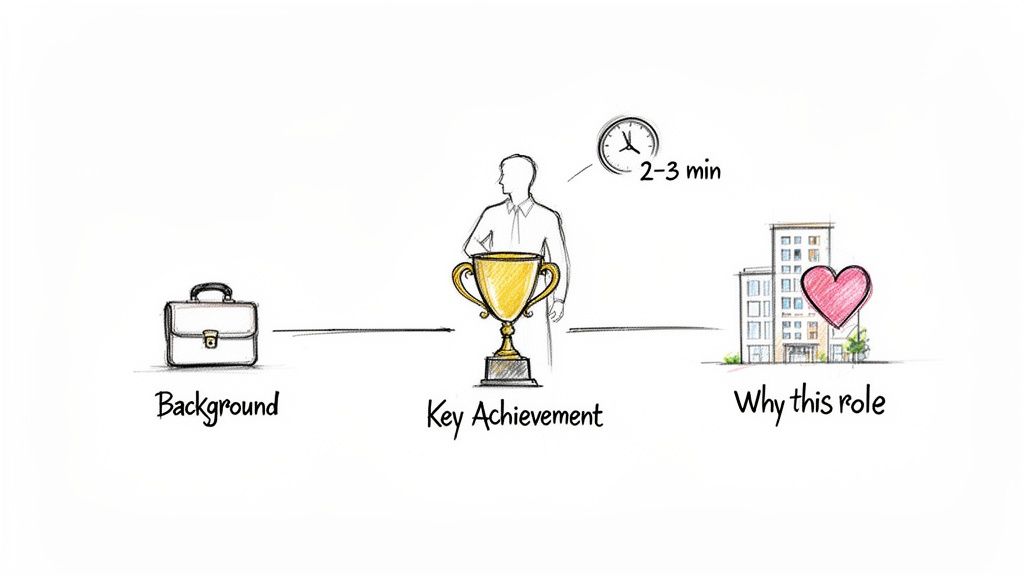
Keep your response to a tight 90-120 seconds. Use a simple three-part structure:
- Present: Briefly state your current role and a key responsibility. “I’m currently a Senior Software Engineer at X Company, where I lead the development of our real-time data processing pipeline.”
- Past: Mention one or two significant achievements that are relevant to the job description. Quantify them if possible. “In my previous role, I refactored a legacy monolithic service into microservices, which reduced latency by 40% and cut server costs by 25%.”
- Future: Connect your background to this specific opportunity. “I was drawn to this role because your team is tackling similar scaling challenges with Go, and I’m excited to apply my experience to help build out your new distributed ledger system.”
Pro Tip: For remote roles, subtly weave in your experience with asynchronous work. Mention your preference for clear documentation, your experience with distributed teams, or your skill in self-directed project management to show you’re prepared for an autonomous environment.
2. Why Do You Want to Work for Our Company?
This question goes far beyond simple flattery; it’s a direct probe into your motivations, research skills, and value alignment. Hiring managers use it to filter out candidates who are mass-applying from those who have a genuine, specific interest in their mission, technology, and culture. For an engineer, a strong answer demonstrates that you see this role as a strategic career move, not just another job.
This is a critical part of any set of engineer interview questions because it reveals whether you’ve thought deeply about how your skills can solve their specific problems. A generic answer suggests a lack of preparation and genuine interest.
How to Structure Your Answer
Your goal is to prove you made a deliberate choice to apply. Connect your personal career goals and technical interests directly to what the company is doing.
- Reference Specific Company Details: Mention 2-3 concrete, non-obvious facts. This could be a recent product launch, a technical blog post, a key hire, or even their business model. “I’ve followed your company’s blog, and the recent post on asynchronous decision-making resonated with me because that’s exactly how I work best.”
- Explain the Personal Connection: Don’t just list facts; explain why they matter to you. “Your product directly solves a problem I experienced with data integrity in my last role, which tells me I’ll understand user pain points from day one.”
- Align with Their Mission and Values: Show you understand what drives them beyond just profit. “You’ve been profitable without outside funding, which suggests an operational discipline I respect. I want to contribute to a company that runs this way, not just talks about it.”
Pro Tip: For remote-first companies, avoid the obvious answer: “I want to work remotely.” Everyone does. Instead, tie their remote model to your work style. Mention how their public commitment to clear documentation or asynchronous workflows enables you to do your best deep work, proving you understand the nuances of a distributed environment.
3. Describe a Time You Had to Work with a Difficult Team Member
This behavioral question is a direct probe into your conflict resolution, emotional intelligence, and communication skills. How you answer reveals your ability to collaborate professionally under pressure, a key competency for any high-functioning engineering team. The interviewer wants to see that you can navigate disagreements constructively without assigning blame.
For engineers, this question often surfaces scenarios around technical disagreements, code review feedback, or differing opinions on project direction. A strong answer demonstrates maturity and a focus on team goals over personal ego.
How to Structure Your Answer
The STAR method (Situation, Task, Action, Result) is your best friend here. It provides a clear, logical framework that prevents rambling and keeps your story focused.
- Situation: Briefly set the scene. “In my last role, a senior engineer and I had a strong disagreement over the choice of database for a new microservice. He favored a relational database for its structure, while I advocated for a NoSQL solution for its scalability and flexibility.”
- Task: Explain your objective. “My goal was to ensure we made a data-backed decision that aligned with the long-term performance and scaling requirements of the project, not just personal preference.”
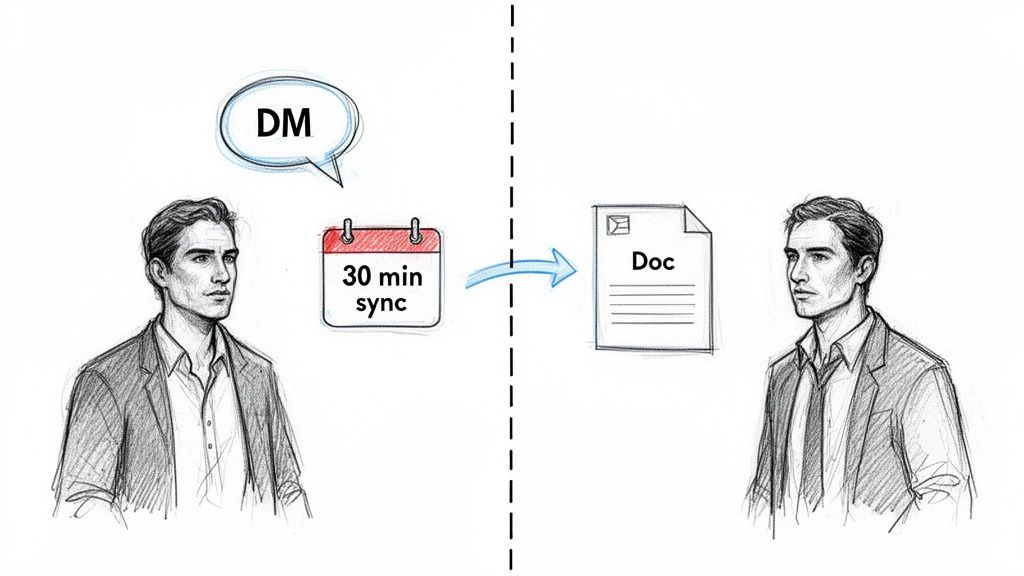
- Action: Detail the steps you took. “I scheduled a 30-minute call to move the debate out of Slack. I came prepared with performance benchmarks for similar use cases and a brief document outlining the pros and cons of each approach. During the call, I focused on listening to his concerns about data integrity first, then presented my findings.” When discussing how you’ve handled interpersonal challenges with team members, consider strategies for navigating 8 Difficult Conversations with Employees Examples.
- Result: Conclude with the positive outcome. “He acknowledged the performance benefits of the NoSQL option. We agreed to use it and implemented additional validation layers in the application logic to address his data integrity concerns. The project launched successfully, and our approach became a template for future service design.”
Pro Tip: End your story with a lesson learned. For example, “This taught me the value of de-escalating from text to a real-time conversation and grounding technical debates in objective data. We also started a practice of creating lightweight ‘decision-docs’ for major architectural choices.”
4. What Are Your Greatest Strengths?
This classic question is often seen as a softball, but it’s one of the more telling engineer interview questions, especially for remote positions. It’s an opportunity to show self-awareness and directly connect your core abilities to the company’s needs. Your answer reveals not only what you’re good at, but also what you value in a professional context.
For engineers, this isn’t about listing generic traits like “hard-working.” It’s about highlighting specific, technical, or process-oriented strengths that prove you are a high-impact team member. A great response is backed by evidence and tailored to the job description.
How to Structure Your Answer
Focus on two to three specific strengths and provide a concrete example for each. Your goal is to prove your abilities, not just state them.
- State the Strength: Start by clearly identifying a strength that is relevant to the role. “My greatest strength is my ability to create clear, maintainable documentation for complex technical concepts.”
- Provide a Concrete Example: Back it up with a specific story. Quantify the outcome if possible. “As a senior engineer on my last project, I noticed our team spent hours each week answering the same questions about our API. I took the initiative to build a comprehensive documentation site with code examples and walkthroughs, which reduced onboarding time for new developers by three weeks.”
- Connect to the Role: Tie it directly back to the company or position. “I saw that this role emphasizes mentorship, and I believe my skill in documenting and explaining systems is key to helping junior engineers get up to speed quickly.”
Pro Tip: For remote and asynchronous roles, focus on strengths that demonstrate autonomy and clear communication. Highlight your expertise in written communication, self-motivation, or deadline ownership. For example, mention how you use detailed pull request descriptions and decision documents to keep distributed teams aligned, reducing unnecessary meetings.
5. What Are Your Greatest Weaknesses?
This question is a well-known test of your self-awareness, honesty, and professional maturity. Interviewers aren’t trying to catch you in a lie; they’re evaluating your ability to identify a real area for growth and demonstrate that you take ownership of your professional development. For engineers, this reveals how you handle technical and personal shortcomings.
In a remote context, your answer is even more critical. It can signal your suitability for autonomous work. An inability to self-manage, communicate roadblocks, or ask for help are significant red flags for a hiring manager filling a remote role.
How to Structure Your Answer
The goal is to frame a real weakness as a learning opportunity. The best answers show you identified a problem, took specific actions to correct it, and can now point to tangible improvements.
- State the Weakness: Be direct and choose a genuine, manageable weakness that isn’t a deal-breaker for the job. “Early in my career, I struggled with context-switching and my deep work suffered as a result.”
- Show How You Identified It: Explain the negative impact this had. “I realized my constant jumping between Slack, emails, and code tickets was unsustainable. My productivity dropped, and I wasn’t fully present during sync meetings.”
- Detail Your Improvement Plan: Describe the concrete steps you took. “Now, I time-block my days: mornings are for focused coding with notifications off, and afternoons are for communication. This has been especially helpful in async-first environments.”
- Share the Positive Outcome: Connect your actions to a result. “My productivity improved, and my team appreciates that I’m more focused during our collaborative sessions. It’s a process, but this structure has made a huge difference.”
Pro Tip: Your choice of weakness matters. Avoid clichés like “I’m a perfectionist” unless you can back it up with a specific story of how it negatively impacted a project and the steps you took to prioritize “done” over “perfect,” like creating a rubric for what defines an MVP. Never mention a weakness that contradicts a core job requirement, such as “I’m not good with deadlines” for a project lead role.
6. Describe Your Experience with Remote Work
This is one of the most direct and telling engineer interview questions for companies built on distributed culture. It’s not just about whether you can work from home; it’s a probe into your discipline, communication habits, and self-awareness. An employer wants to see that you understand the unique demands of asynchronous work and have developed intentional systems to thrive in it, ensuring productivity and team cohesion aren’t lost.
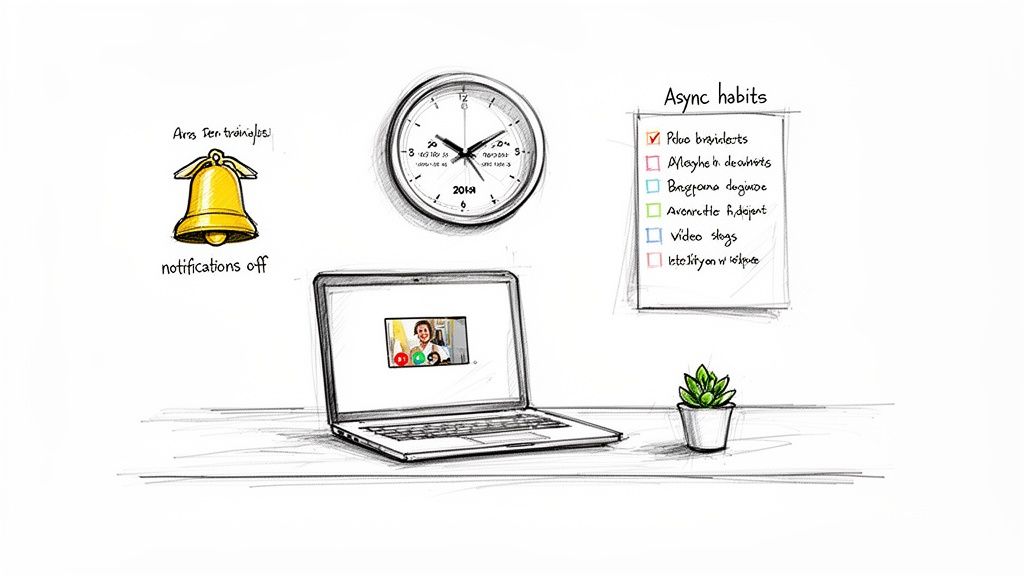
Your answer reveals whether you view remote work as a perk or a professional practice. A strong response demonstrates that you are a reliable, proactive, and effective teammate, regardless of physical location. It’s your chance to prove you’re prepared for the autonomy that comes with a remote-first job.
How to Structure Your Answer
Whether you have years of remote experience or are transitioning, focus your answer on structure, communication, and self-management.
- Experienced Remote Worker: Describe your established systems. “I’ve been a fully remote engineer for three years. I structure my day with time-blocking: deep work sessions from 9-11 AM, then an async check-in. I over-communicate in PRs and project tickets to provide context, often using short Loom videos to demonstrate complex UI changes. This async-first approach minimizes interruptions and respects different time zones.”
- Transitioning from Office: Show you’ve done your homework and are proactive. “While my last role was primarily in-office, I’ve researched and implemented practices for effective remote work. I have a dedicated office space, maintain a consistent schedule, and have become disciplined about using status updates in Slack to signal my focus. I understand clear documentation is key and have started practicing this on personal projects.”
Pro Tip: Highlight your timezone awareness and proactive boundary-setting. Mentioning that you schedule messages to send during a colleague’s working hours or that you consciously log off to maintain work-life balance shows maturity and sustainability.
7. Tell Me About a Project You Led From Start to Finish
This behavioral question is a direct test of your ownership, leadership, and execution skills. Interviewers use it to see beyond your resume and understand how you translate plans into reality. It reveals your ability to manage complexity, make decisions, and drive a project to completion, all critical traits for engineers.
For senior or remote roles, this is one of the most important engineer interview questions. It shows if you can operate autonomously and deliver value without constant supervision. Your answer should be a story that showcases your technical and organizational competence.
How to Structure Your Answer
Frame your response as a concise narrative using the STAR method (Situation, Task, Action, Result) or a similar structure. Aim for a 2-3 minute explanation.
- Problem & Ownership: Start with the business problem and why you took ownership. “Our customer onboarding flow was taking five days, leading to high drop-off rates. I volunteered to lead the project to redesign it from the ground up.”
- Approach & Obstacles: Describe your plan and how you executed it. Mention a specific challenge. “I interviewed 15 customers to gather requirements, created a spec, and managed the phased rollout. A key obstacle was getting executive buy-in for a feature that didn’t have immediate ROI, which I solved by presenting user data and a clear timeline for expected impact.”
- Results & Learnings: Quantify the outcome and share what you learned. “The new flow reduced time-to-value to 48 hours and cut related support tickets by 35%. I learned the importance of documenting decisions asynchronously to keep all stakeholders aligned, which was a huge win for team efficiency.”
Pro Tip: When discussing a project, emphasize how you managed communication and alignment, especially in a distributed team. Mentioning your use of asynchronous updates (e.g., weekly progress docs, Loom videos) and structured decision-making processes shows you’re a mature, effective remote collaborator.
8. Why Are You Leaving Your Current Job?
This question probes your motivations and professionalism. Interviewers use it to gauge whether you’re running away from a negative situation or running toward a positive opportunity. Your answer reveals your priorities, emotional intelligence, and what you value in a work environment, making it one of the most revealing behavioral engineer interview questions.
For engineers, a strong response frames the transition as a logical next step in career progression. It shows you’ve thoughtfully considered your trajectory and see this new role as the ideal place to apply and expand your skills.
How to Structure Your Answer
Frame your answer around growth, opportunity, and alignment. Avoid complaining about your current employer, boss, or salary. Instead, focus on what draws you to the new role and how it fits your career goals.
- Acknowledge the Positive: Start by mentioning something you’ve enjoyed or learned in your current role. “I’ve learned a great deal at my current company, especially about leading distributed teams.”
- Explain the ‘Push’ Factor Diplomatically: Describe what’s prompting your search in terms of a ceiling or a strategic shift. “However, I’ve reached a point where the technical challenges are no longer aligned with my growth goals. I’m keen to work on problems at a larger scale.”
- Connect to the ‘Pull’ of the New Role: End by explaining why this specific opportunity is the perfect fit. “This role is exciting because it focuses directly on building scalable, event-driven architecture, which is exactly where I want to focus my expertise.”
Pro Tip: If you were laid off, be direct and concise. State the facts without emotion: “My role was eliminated as part of a company-wide restructuring that affected 15% of the engineering department.” Frame it as an opportunity: “While unexpected, it has allowed me to be very intentional about finding my next role, which is why I was so interested in this position.”
9. How Do You Handle Working Across Multiple Time Zones?
This is one of the most practical engineer interview questions for distributed or global teams. It directly assesses your operational awareness and your ability to work effectively without constant, real-time supervision. Interviewers are looking for proof that you’ve considered the logistical and communication challenges of asynchronous work, not just a willingness to be flexible.
A strong answer moves beyond “I can take late meetings” and demonstrates a strategic, async-first mindset. This shows you respect your own focus time and the work-life balance of your colleagues, which is a sign of a mature, considerate team member.
How to Structure Your Answer
Your response should highlight specific systems and a philosophy of communication. Focus on proactivity and clarity.
- Acknowledge the Challenge and State Your Philosophy: Start by framing the core principle. “My approach is to be async-first by default. This minimizes dependencies and respects everyone’s focus time across different zones, whether they’re in Singapore or San Francisco.”
- Provide Specific Strategies and Tools: Mention concrete tactics you use to make this work. “I heavily rely on over-communicating context in pull requests and documenting decisions in our shared knowledge base. I also use Loom videos for complex code walkthroughs so my team can review them on their own time. I time-block my calendar to ensure I have dedicated deep work periods and a separate block for batching communications.”
- Address Synchronous Meetings: Explain how you handle necessary real-time collaboration. “When synchronous meetings are necessary, I advocate for rotating times to distribute the inconvenience fairly. I also ensure these meetings have a clear agenda and a stated goal, so we make the most of that valuable, shared time.”
Pro Tip: Frame your answer around team equity. Mentioning how you rotate meeting times or create documentation that benefits everyone shows you’re not just thinking about your own convenience. This is a powerful signal of a collaborative, team-oriented mindset crucial for finding success in remote-first jobs.
10. Describe Your Experience with Async Communication and Documentation
This question is a direct test of your suitability for a modern, often remote or distributed, engineering team. Interviewers want to know if you can operate effectively without constant meetings and real-time hand-holding. Your answer reveals your discipline, communication style, and ability to contribute to a scalable, self-sufficient team culture.
For engineers, strong asynchronous habits are not just a preference; they are a force multiplier. Excellent documentation and clear written communication allow teammates across different time zones to work autonomously, unblocking themselves and moving projects forward 24⁄7. This question is a key part of many engineer interview questions for companies that value efficiency.
How to Structure Your Answer
Demonstrate that you view documentation as a core engineering practice, not an afterthought. Show that you are intentional about when to communicate synchronously versus asynchronously.
- Establish the Principle: Start by stating your philosophy. “I believe in a ‘documentation-first’ approach. My goal is to create artifacts that answer questions before they are asked, which reserves synchronous time for high-value collaboration and problem-solving.”
- Provide Concrete Examples: Mention specific tools and methods you use. “Instead of daily standups, I’m a big fan of written updates in a dedicated Slack channel. For complex features, I create detailed decision docs or record a quick Loom video walking through the architecture. This allows for thoughtful feedback from the team on their own schedule.”
- Show the Impact: Connect your practices to team-level benefits. “In my last project, we maintained a central Notion spec for our API. This reduced back-and-forth questions by at least 50% and made onboarding a new engineer much faster, as they had a single source of truth for the ‘why’ behind our design choices.”
Pro Tip: When discussing your methods, frame them as a system for scaling knowledge. Explain that good documentation prevents knowledge silos and reduces the bus factor on a team. This shows you think about team health and long-term project stability, not just your individual tasks. If you’re looking for companies that prioritize these practices, you can often find them among the curated roles on Remote First Jobs.
11. Async Communication Best Practices
While not a direct question, demonstrating a strong grasp of asynchronous communication is a powerful way to show you are ready for a modern, distributed engineering team. It’s a key competency that signals you respect deep work, value clear documentation, and can operate effectively without constant meetings. Companies increasingly look for this skill among all engineer interview questions, especially for remote roles.
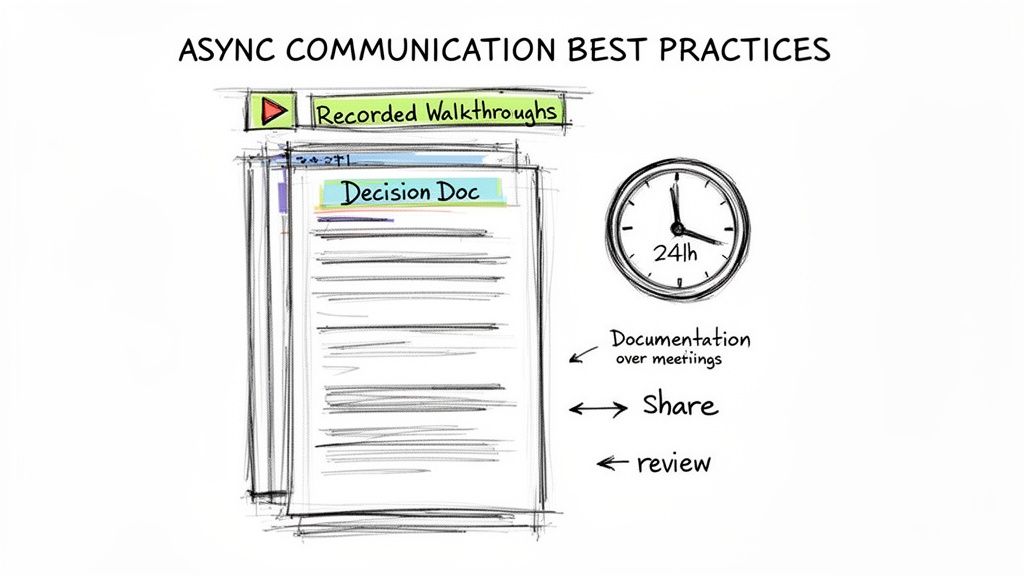
Proactively mentioning these practices shows you understand the operational mechanics of high-performing remote teams. It proves you can contribute efficiently while protecting your focus and that of your colleagues.
How to Demonstrate Your Skills
Integrate these concepts into your answers about teamwork, project management, and dealing with challenges. Show, don’t just tell.
- Mention Tools & Techniques: Talk about using Loom for 2-5 minute code walkthroughs instead of scheduling a 30-minute sync. “For a recent code review, I recorded a quick walkthrough to explain my architectural choices, which helped the team in a different time zone give feedback faster.”
- Highlight Documentation: Emphasize documenting the “why,” not just the “what.” “I always make sure my project documentation explains the context and trade-offs behind a decision, so future engineers can build on it without needing to ask me directly.”
- Discuss Process: Describe how you batch communication or respect async review windows. “I try to consolidate my non-urgent questions into a single daily update to avoid interrupting my teammates’ flow.”
Pro Tip: When discussing a group project, mention how you handled decision-making across time zones. For example, “We established a 24-hour feedback window for major architectural decisions. This ensured everyone had a chance to contribute without forcing late-night meetings.” This is a concrete example of effective async collaboration. For those specifically seeking this work style, you can explore opportunities at companies that prioritize these practices on specialized job boards.
12. Remote Work Readiness Checklist
Beyond technical engineer interview questions, hiring managers for remote roles are assessing your aptitude for autonomous work. They need to know you can thrive without the direct oversight of an in-office environment. This isn’t a single question but a series of signals you should send throughout the interview process to demonstrate your preparedness for a distributed team.
Presenting yourself as a “remote-ready” candidate is a deliberate strategy. It involves highlighting specific skills and work habits that prove you can be productive, communicative, and self-sufficient from day one.
How to Demonstrate Your Readiness
Use this checklist to prepare your examples and talking points. Weave them into your answers for other questions like “Tell me about yourself” or “What’s your preferred work style?”
- Communication Style: Mention your preference for asynchronous communication. “I’m a big proponent of well-documented pull requests and detailed project updates in tools like Asana to keep everyone in the loop without constant meetings.”
- Proactive Problem-Solving: Show you don’t wait to be told what to do. “In my last project, I noticed our CI/CD pipeline was slowing down. I independently researched a new caching strategy, prototyped it, and presented the performance gains to my lead.”
- Home Office Setup: Briefly confirm you have a dedicated, quiet workspace with a reliable internet connection. This simple assurance removes a key logistical concern for the hiring manager.
Pro Tip: Proactively manage your interview schedule. When coordinating times, explicitly mention your time zone. This small detail shows you’re already thinking like a member of a distributed team and are conscious of cross-time-zone collaboration. For those specifically seeking verified remote positions, platforms that vet their listings, like RemoteFirstJobs, can be a great resource.
Engineer Interview Questions: 12-Point Comparison
| Item | 🔄 Implementation Complexity | ⚡ Resource Requirements | 📊 Expected Outcomes | 💡 Ideal Use Cases | ⭐ Key Advantages |
|---|---|---|---|---|---|
| Tell Me About Yourself | Low — simple structure, practice required | Moderate prep time (3 versions recommended) | Sets interview tone; communicates fit and remote habits | Opening question; elevator pitch for remote roles | Control narrative; highlights async strengths |
| Why Do You Want to Work for Our Company? | Moderate — needs focused research | Time for company research (blog, posts, values) | Demonstrates genuine interest and cultural alignment | Screening for remote-first fit; differentiating applicants | Shows commitment; builds rapport with hiring team |
| Describe a Time You Had to Work with a Difficult Team Member | Moderate — needs STAR structuring | Prep of specific behavioral examples | Reveals conflict resolution and emotional intelligence | Behavioral interviews; remote conflict scenarios | Shows maturity; highlights async escalation skills |
| What Are Your Greatest Strengths? | Low — straightforward selection & examples | Low–moderate (pick 2–3 with metrics) | Aligns strengths to role; leaves memorable keywords | Early/mid interview to match JD priorities | Frames concrete strengths with measurable impact |
| What Are Your Greatest Weaknesses? | Moderate — careful framing required | Moderate prep to show improvement steps | Signals honesty, growth mindset, and mitigations | Risk assessment in interviews; remote red flags | Turns a liability into evidence of development |
| Describe Your Experience with Remote Work | Low–Moderate — factual systems & habits | Low (document routines, tools, examples) | Shows remote readiness and practical systems | Remote-role screening and onboarding discussions | Demonstrates concrete async practices and setup |
| Tell Me About a Project You Led From Start to Finish | High — detailed narrative with metrics | High (prep timeline, metrics, role clarity) | Shows ownership, execution, and measurable impact | Senior roles, leadership interviews, PM/IC evidence | Conveys leadership, autonomy, and results |
| Why Are You Leaving Your Current Job? | Moderate — diplomatic narrative needed | Low–moderate (craft positive framing) | Reveals motivation and career trajectory | Fit assessment for stability and goals | Clarifies intent and alignment with new role |
| How Do You Handle Working Across Multiple Time Zones? | Moderate — needs specific strategies | Moderate (examples of systems, scheduling) | Demonstrates timezone-aware collaboration practices | Distributed teams and global roles | Shows fairness, async-first tactics, and boundaries |
| Describe Your Experience with Async Communication and Documentation | Moderate — concrete tools and outcomes | Moderate (prepare examples, tooling) | Shows ability to replace meetings with docs and recordings | Remote engineering/product/design roles | Reduces meetings; creates reusable team knowledge |
| Async Communication Best Practices | Moderate — team adoption effort | Ongoing discipline and documentation time | Fewer unnecessary meetings; better coordination | Team norms, onboarding, scaling remote work | Scales knowledge, protects deep work, supports async decisions |
| Remote Work Readiness Checklist | Low — checklist implementation | Low (prepare workspace and examples) | Signals candidate readiness and credibility | Candidate prep before remote interviews | Compact evidence of remote reliability and systems |
Your Next Move: Find the Right Remote Role Faster
Mastering the answers to common engineer interview questions is more than just a preparation tactic; it’s a strategic demonstration of your value. The frameworks and examples we’ve explored aren’t just about passing a test. They are designed to showcase the core competencies that top-tier remote companies prioritize: clear, structured communication, proactive problem-solving, and a deep-seated sense of ownership. When you can articulate your experience with difficult team members, explain a complex project from start to finish, or detail your async communication habits, you’re not just answering a question. You are providing tangible proof that you can thrive in a distributed environment.
Think of each question as an opportunity. The “Tell Me About Yourself” prompt is your chance to frame your entire professional story around the role’s specific needs. Your response to “Why Are You Leaving Your Current Job?” becomes a positive narrative about seeking new challenges and growth, not an escape. Even describing your “Greatest Weaknesses” is a chance to display self-awareness and a commitment to continuous improvement. By moving beyond memorized answers and adopting these structured approaches, you prove you are a deliberate and thoughtful professional, a signal that hiring managers are desperate to find.
From Preparation to Application: Seizing Your Advantage
The reality of the modern job market, especially for sought-after remote engineering roles, is one of intense competition. While your polished interview skills will set you apart from other candidates, you first need to get your foot in the door. This is where the source of your job leads becomes a critical factor in your success. Applying to roles on massive, public job boards often means you are one of thousands of applicants, many of whom are equally qualified. Your meticulously crafted resume can easily get lost in the noise of an overwhelmed Applicant Tracking System (ATS).
The key is to shift your strategy from reactive to proactive. Instead of waiting for opportunities to become saturated on platforms like LinkedIn or Indeed, you need access to them at the source. This is what we call the “first-mover advantage.” Applying within the first 24-48 hours after a job is posted can dramatically increase your chances of getting noticed. It shows initiative and allows your application to be reviewed by a human before they are swamped.
Key Insight: Your ability to find low-competition, direct-from-company job listings is just as important as your ability to answer engineer interview questions. The best interview performance is useless if you can’t get the interview in the first place.
This is precisely why we built Remote First Jobs. We bypass the third-party recruiters and crowded job boards entirely. Our system continuously scans the career pages of over 21,000 verified remote-first companies, adding new roles to our platform the moment they are posted. This gives you a direct line to fresh opportunities, often before they are syndicated elsewhere. You stop competing with the masses and start engaging with hiring managers who are actively and urgently looking to fill a position. You’ve put in the work to prepare for the interview; now it’s time to apply that same strategic mindset to how you find your next role. Stop wasting time on ghost jobs and start applying to real opportunities, faster.
With your interview skills sharpened, the final step is finding the right opportunities before they’re buried under thousands of applications. Remote First Jobs delivers verified, direct-from-company remote roles to your inbox, giving you the critical head start you need. Find your next great engineering role today at Remote First Jobs.