Getting your interview skills dialed in is about more than just practicing answers. It’s a whole strategy, starting with some serious research and prep work long before you’re even in the room. This is how you build real confidence—by knowing your stuff and understanding exactly how you fit into what the company needs.
Build Your Foundation for Interview Success
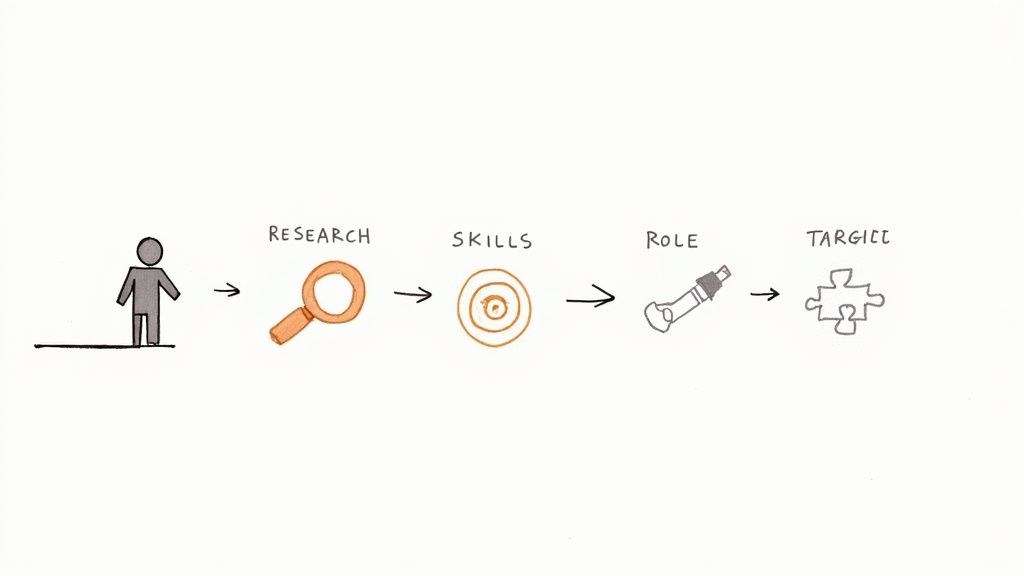
Mastering an interview doesn’t start with “tell me about yourself.” It starts way before that. It’s about laying a strategic foundation that turns nervous jitters into unshakable confidence. This isn’t just about glancing at the job description; it’s about becoming a detective, digging into the unwritten rules and figuring out what problems the company is desperately trying to solve.
This prep is absolutely essential. Today’s job market is no joke—on average, a whopping 118 candidates apply for a single job opening, but only about 20% of them will even land an interview. From there, the competition gets even fiercer. That’s why a solid foundation isn’t just nice to have; it’s everything.
Dissect the Job Description
Don’t just read the job description—take it apart. I like to break it down into three main buckets to really get what they’re after:
- Must-Have Skills: These are the dealbreakers. Think “proficiency in Python” or “5+ years of project management experience.” If you don’t have these, you’re likely not getting a call.
- Company Values and Language: Keep an eye out for words they use over and over, like “fast-paced,” “collaborative,” or “data-driven.” This is your inside look at the company culture.
- Hidden Problems: You have to read between the lines here. When a company posts for a “Marketing Manager to build our social media presence from the ground up,” they’re not just hiring for a role. They’re telling you they have a problem that needs a solution.
Research Beyond the About Page
Go deeper than the company’s “About Us” page. Your mission is to understand their recent wins, their current struggles, and where they sit in the industry. And don’t forget to consider your own online presence; understanding the impact of your digital footprint on job opportunities is more important than ever.
“Confidence comes from preparation. The more you understand the company’s pain points and can articulate how you are the solution, the more you shift from a candidate asking for a job to a professional offering a valuable service.”
This mindset shift is a game-changer. It lets you frame your entire story as the answer to their problems. Suddenly, you’re not just another applicant hoping for a chance—you’re a problem-solver who’s already done the homework.
This is also how you make sure your resume stands out. When you tailor your experience to their specific needs, you’re speaking their language. This is especially true when you’re building a resume for remote jobs, where showing initiative right from the start is key. All this groundwork sets you up for success at every stage, from the initial screening call all the way to negotiating the offer.
Tell Compelling Stories with the STAR Method
Ever get asked, “Tell me about a time when…,” and your mind goes blank? It’s a classic interview opener designed to see how you handle real-world situations. Interviewers aren’t just making small talk; they’re digging for concrete proof of your skills.
The single best way to deliver that proof is by telling a great story. And the easiest way to structure that story is with the STAR method.
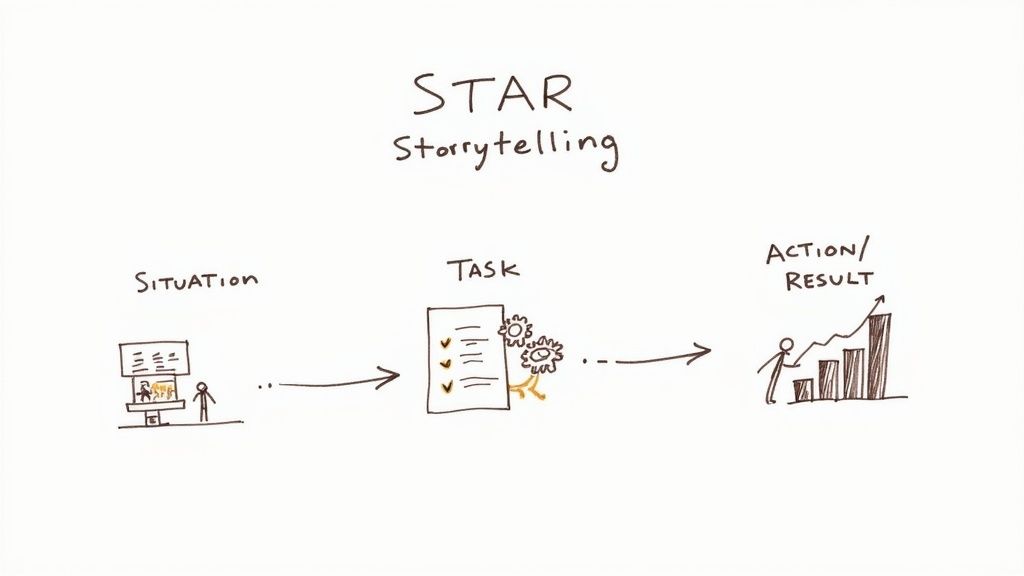
This simple framework is your secret weapon against rambling. It forces you to be clear, concise, and memorable, hitting all the key points a hiring manager is listening for. Think of it as a blueprint for a perfect answer.
Breaking Down the STAR Framework
The STAR method is just a four-part structure that helps you build a mini-case study on the fly, with you as the hero. Each letter represents a piece of the story you need to tell.
Here’s the breakdown:
- S - Situation: Quickly set the scene. What was the project? What was the general challenge? Keep it brief—just enough context so the rest of your story makes sense.
- T - Task: What was your specific goal or responsibility? This is where you clarify what you were supposed to accomplish within that broader situation.
- A - Action: This is the heart of your answer. What specific steps did you personally take? Use strong, active verbs and focus on your contributions, even if it was a team effort. What did you do?
- R - Result: Now for the grand finale. What was the outcome? What happened as a direct result of your actions? This is where you need to get specific. Use numbers, percentages, and hard data to show your impact.
The Result is everything. A powerful, quantifiable outcome proves your value far more than just listing what you did. You want to show you solved a problem, hit a target, or made a measurable improvement.
Putting STAR Into Practice
Let’s walk through a real-world example. Imagine an interviewer asks, “Tell me about a time you handled a tight deadline.”
A weak answer sounds something like, “Oh yeah, we had a huge campaign launch come up really fast, so I just worked really hard and we managed to get it done.” It’s forgettable and tells the interviewer almost nothing.
Now, let’s try it with the STAR method.
Situation: “In my last role, our biggest competitor unexpectedly launched a new product two weeks ahead of our own planned release, which put our market share at immediate risk.”
Task: “As the project lead, my job was to accelerate our entire marketing campaign launch timeline from four weeks down to just one week to counter their move and defend our customer base.”
Action: “I immediately pulled the team together for an emergency planning session. We re-prioritized every single task in our project management tool, and I implemented daily 15-minute stand-ups to eliminate communication delays. To speed things up, I personally jumped in and wrote all the final ad copy myself.”
Result: “Because of that quick pivot, we successfully launched the full campaign in just six days. Not only did we protect our market share, but the campaign generated a 25% increase in leads within the first week and beat our original launch goals by 15%.”
See the difference? The second answer is memorable, credible, and packed with evidence of leadership, problem-solving, and execution under pressure.
This framework is a lifesaver for tough behavioral questions. It’s especially useful when you need to navigate tricky topics, which is why we suggest learning how to answer conflict interview questions using a similar storytelling approach. Having a few of these STAR stories prepared in advance is one of the most effective ways to improve your interview skills overnight.
Ace Technical and Problem Solving Challenges
In today’s interviews, just saying you have a skill isn’t enough—you have to prove it. This is especially true for technical, analytical, or case-based challenges where your ability to think on your feet is the main event.
The good news is that these challenges are less about finding a single “correct” answer and more about seeing how you deconstruct a complex problem. This is a direct reflection of a massive shift toward skills-based hiring. In fact, 81% of companies now use this approach, a huge jump from just 56% in 2022.
Your goal isn’t just to solve the problem; it’s to make your thought process visible. Think of it as narrating the journey from question to solution.
Articulate Your Thought Process Aloud
The single biggest mistake I see candidates make in technical interviews is working in silence. The interviewer can’t read your mind, so if you’re quiet, they can only assume you’re stuck or confused.
Instead, you need to verbalize everything. Start by clarifying the problem, asking smart questions to define the scope and constraints. For example, in a coding challenge, you might ask, “Should I account for edge cases like empty inputs or null values?” This immediately shows you’re thorough.
Then, outline your initial approach before you start writing a single line of code or building out a model. This gives the interviewer a roadmap of your thinking and, just as importantly, a chance to offer a hint if you’re heading down a completely wrong path. For those in tech, mastering this is non-negotiable, and you can find specific guidance on how to prepare for coding interviews to really nail this technique.
To effectively prepare, it’s helpful to categorize the skills you need to develop. Here’s a breakdown of the core areas to focus on.
Key Interview Skill Development Areas
| Skill Category | Specific Skills | Common Assessment Method |
|---|---|---|
| Technical Proficiency | Coding (language fluency, data structures), System Design, Database Queries | Live coding challenges, whiteboarding system architecture, SQL tests |
| Problem-Solving | Algorithmic Thinking, Logic, Decomposition | Brain teasers, case studies, take-home assignments |
| Communication | Explaining technical concepts clearly, Articulating trade-offs | Explaining your code aloud, walking through a design diagram |
| Analytical Skills | Data Interpretation, Root Cause Analysis, Estimation | Case interviews, data analysis challenges (e.g., analyzing a dataset) |
Focusing on these distinct areas ensures you’re building a well-rounded skill set, not just cramming algorithms.
Break Down Complex Problems
When you’re hit with a difficult challenge, fight the urge to jump straight into a solution. The best problem-solvers break big, intimidating problems into smaller, more manageable pieces.
This methodical approach proves you can handle complexity without getting overwhelmed. Try using a simple framework to guide your conversation:
- Clarify: Restate the problem in your own words. Ask clarifying questions to nail down all the requirements.
- Brainstorm: Talk through 2-3 potential solutions. What are the pros and cons of each?
- Implement: Pick the best approach and start building your solution, explaining each step as you go.
- Test & Refine: Once you have a working solution, talk through how you’d test it and what improvements you might make with more time.
Let’s say you’re in a system design interview and get asked to design a social media feed. Don’t start talking about databases. Break it down. First, discuss user requirements, then API design, then data modeling, and finally, the infrastructure needed to support it all.
Communicating your logic is often more valuable than arriving at a flawless solution. An interviewer would rather hire someone who can thoughtfully navigate an unknown problem than someone who silently stumbles into a perfect answer by luck.
Ultimately, these interviews are designed to see how you’ll perform on the job when faced with a brand-new challenge. By showing your work and communicating your strategy, you demonstrate that you’re a collaborative, logical, and resilient problem-solver—exactly the kind of person they want on their team.
Refine Your Performance with Mock Interviews
All the preparation in the world builds knowledge, but it’s practice that builds real confidence. It’s one thing to know the theory behind a great answer, but it’s another thing entirely to deliver it smoothly when you’re under pressure. This is where mock interviews become your secret weapon, turning all that head knowledge into muscle memory.
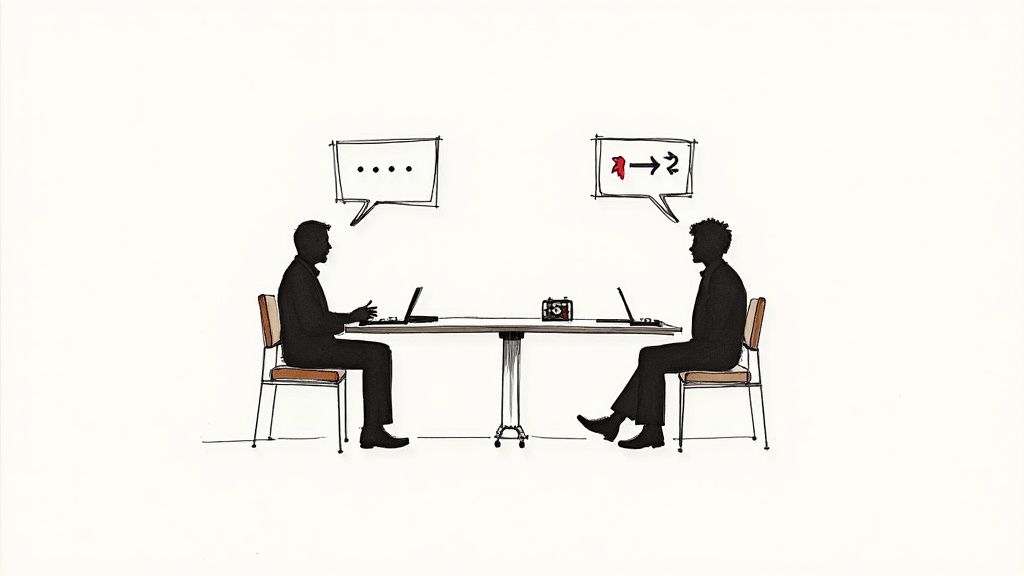
The point of a mock interview isn’t to memorize a script. Far from it. The real goal is to pressure-test your stories, catch those verbal tics we all have (like saying “um” or “like” too much), and just get comfortable with the natural back-and-forth of a real interview.
Running Effective Practice Sessions
To get the most out of your practice, you have to make it feel as real as possible. That means tracking down tough questions, setting up a realistic environment, and—most importantly—getting brutally honest feedback.
Here are a few ways you can run your mock interviews:
- Record Yourself: This is the easiest way to start. Just prop up your phone or use your webcam and record yourself answering a few common questions. Sure, watching yourself on video can be a little cringey, but it’s an incredible way to see what the interviewer sees. You’ll immediately spot issues with your body language, eye contact, and pacing.
- Ask a Peer or Mentor: Grab a trusted colleague, a mentor, or even a sharp friend to run you through the wringer. Give them the job description and a list of questions you’re nervous about. The feedback you get from a real person, especially on how clear and impactful your answers are, is pure gold.
- Use AI-Powered Platforms: Technology is becoming a bigger player here. In fact, 42% of candidates are already using AI to help them prep, from generating practice questions to fine-tuning their answers. These tools can give you instant, objective feedback on your delivery and word choice. You can dig into more of these trends in job interview statistics if you’re curious.
Whichever route you take, the mission is to practice the entire performance, not just the words.
Getting Feedback You Can Actually Use
The right kind of feedback is everything. Just asking, “So, how’d I do?” is a waste of an opportunity. You need specific, actionable advice that points you toward real improvements.
Don’t just ask for feedback on what you said, but how you said it. An evaluator can provide insights on your tone, confidence, and non-verbal cues that you can’t see yourself.
When you ask for feedback, give your reviewer some direction. Try asking pointed questions like these:
- Was my STAR story believable? Did the “Result” part really land, and did I use data to show my impact?
- How was my pacing? Did I rush through it, or did I pause at the right moments to let key points sink in?
- Did I come across as confident? How was my eye contact and body language, even over a video call?
When you treat mock interviews like serious dress rehearsals, you build the kind of resilience and composure that helps you nail any question that comes your way. This is the kind of structured practice that separates the good candidates from the ones who get the offer.
Master the Art of the Video Interview
In today’s hiring world, the webcam is the new conference room. Honestly, getting comfortable on the virtual stage is no longer optional—it’s a core part of nailing the interview process. Success isn’t just about what you say. It’s about projecting professionalism and confidence through a screen so your personality and expertise actually come through.
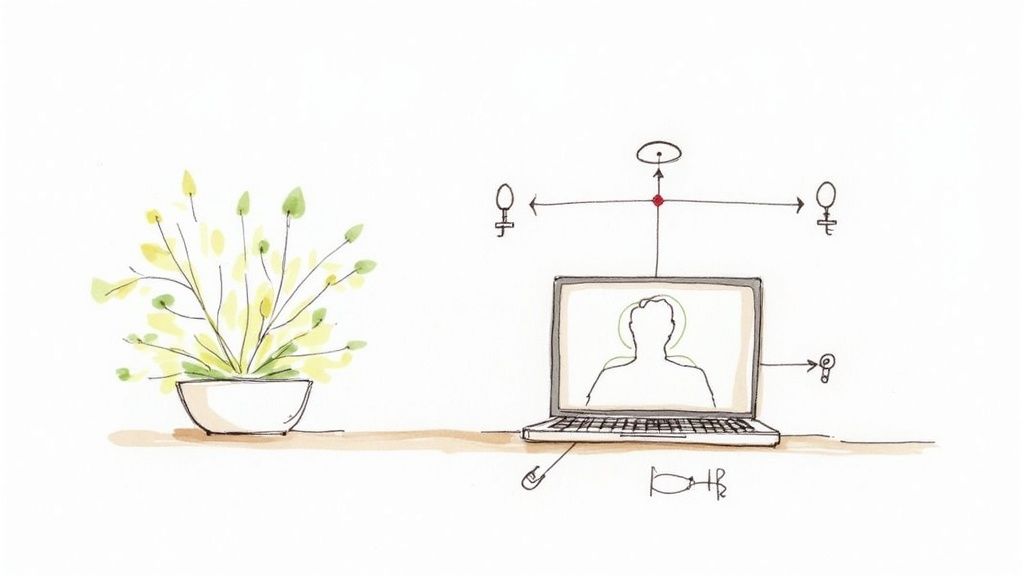
You’d be surprised how much the small technical details matter. Think of your setup as part of your professional attire. An unstable connection or terrible audio can completely distract the interviewer from your qualifications, creating a barrier you didn’t even know was there.
Optimize Your Technical Setup
Before you even think about joining the call, run a full tech rehearsal. I don’t just mean clicking the meeting link five seconds before it starts. This is a strategic check to iron out any potential kinks and present a polished, professional image from the get-go.
Here’s your pre-flight checklist:
- Lighting is Key: Always position a light source in front of you, never behind. A simple ring light or even a desk lamp placed behind your laptop can illuminate your face, making your expressions clear and helping you build a genuine connection.
- Crisp Audio: Your laptop’s built-in mic is a recipe for echo and background noise. Using a headset or an external microphone is one of the easiest wins to ensure your answers are heard clearly, without any distracting fuzz.
- A Professional Background: Your background says something about you, whether you want it to or not. Go for a simple, uncluttered space, or use a professional-looking virtual background if the platform allows it. Just avoid distracting posters, a messy room, or the kitchen where your roommate might be making lunch.
For a deeper dive, our guide on video interview preparation has even more detailed tips. It’s also worth noting that many principles for successful virtual event best practices, like optimizing your setup, apply directly here.
A seamless technical experience lets the conversation flow naturally. When the interviewer isn’t struggling to see or hear you, they can focus entirely on what matters: the quality of your answers and your potential fit for the role.
Project Confidence and Build Rapport
Connecting through a camera takes a little more conscious effort than sitting across a table from someone. Your body language and engagement have to be intentional to bridge that digital divide.
First, let’s talk about eye contact. It feels weird at first, but try to look directly into the camera lens when you’re speaking, not at the interviewer’s face on your screen. This one small shift creates the feeling of direct eye contact on their end, making you seem far more engaged and confident.
Practice active listening by nodding and offering small verbal cues like, “I see” or “That’s a great point.” It shows you’re locked in without interrupting their flow. And finally, have a plan for technical glitches. If your video freezes, don’t panic. Just calmly apologize, state the issue (“It looks like my connection is a bit unstable”), and ask if they can still hear you. Handling hiccups gracefully is a great way to show your problem-solving skills under pressure.
Common Interview Questions Answered
Even the most seasoned pros get tripped up by certain interview questions. They feel like little landmines, don’t they? But learning how to handle these common but tricky situations gives you a massive advantage, keeping you composed and confident when it matters most.
Let’s break down some of the most frequent questions I hear from candidates about the interview process itself. I’ll give you some direct, no-fluff advice you can use right away.
How Long Should I Prepare for an Interview?
There’s no magic number here, but I always tell people to aim for 5-10 hours of focused prep for any role they’re genuinely excited about. This isn’t about cramming the night before; it’s about methodically building a rock-solid foundation of confidence.
Here’s a practical way to break down that time:
- Deep Dive on the Company & Role (2-3 hours): Go way beyond the “About Us” page. Read their latest press releases, get a feel for their key products, and figure out who their main competitors are. You want to understand their world.
- Craft Your Core Stories (3-4 hours): This is where you map your biggest wins to the job description. Your goal is to build at least three solid stories using the STAR method that you can adapt to almost any behavioral question they throw at you.
- Run Mock Interviews (2-3 hours): Practice makes perfect. Grab a friend or mentor, record yourself on your phone, or even use an AI tool. This is where you iron out all the awkward pauses and refine your delivery.
What Is the Best Way to Answer the Weakness Question?
Ah, the classic “What is your greatest weakness?” question. Answering this well is a delicate dance between being authentic and strategic. Please, avoid clichés like “I’m a perfectionist.” It’s tired and everyone sees through it.
Instead, pick a genuine, minor weakness that you’ve actively worked on improving. This shows incredible self-awareness and a proactive mindset—two traits every hiring manager loves.
Frame your answer using this simple, three-part structure:
- State the Weakness Clearly: Name a real area for development. For instance, “Early in my career, I sometimes struggled with public speaking in large group settings.”
- Explain Your Action Plan: Detail the specific steps you took to get better. “To tackle this, I joined a local Toastmasters club and made a point to volunteer to present in our team meetings whenever I could.”
- Show the Positive Result: Connect your efforts to a real outcome. “Because of that, I’m now much more confident and recently led a successful presentation for our entire department.”
This formula turns a potential negative into a powerful story of professional growth. You’re not just admitting a flaw; you’re demonstrating your commitment to self-improvement.
How Do I Follow Up Without Being Annoying?
It’s simple: a single, well-crafted thank-you email sent within 24 hours of your interview is perfect. Keep it professional, keep it brief. Your goal is to leave a positive, lasting impression, not to clog their inbox.
In your email, thank them for their time and briefly reiterate how excited you are about the role. The real key to making it memorable is to reference a specific, interesting point from your conversation. Maybe you both geeked out over a certain software or a recent industry trend. This personal touch shows you were genuinely engaged and helps them place you in their mind.
After you hit send, just respect the timeline they gave you for the next steps. Patience is a virtue here. If you want to get more comfortable navigating these common hurdles, you can find more examples in our list of top remote job interview questions.