So, you’re on the hunt for a marketing intern remote position? Good news: you’ve picked the perfect time. Companies all over the world have leaned into flexible work, which means your dream internship is no longer limited by your zip code. The best opportunities are now accessible right from your home office.
The New Era of Remote Marketing Internships

The old internship model—packing your bags and commuting to a city office for the summer—has been completely upended. What started as a temporary fix during the pandemic has become a permanent fixture in how companies operate.
This shift is a game-changer for aspiring marketers. It gives you unprecedented access to companies and industries that might have been geographically impossible before.
Think about it: a student in a small town can now get hands-on experience with a fast-paced tech startup in Silicon Valley, all without the insane cost of moving there. This isn’t just a small perk; it’s a total democratization of opportunity.
A World of Opportunity (and Competition)
This new reality isn’t just about convenience; it has massively expanded the talent pool for employers. They’re no longer stuck hiring interns who happen to live within a 30-mile radius of their HQ.
The numbers don’t lie. By mid-2021, studies showed that somewhere between 60–70% of internships in marketing and similar fields were either fully remote or hybrid. This has turned the marketing intern role into a global position. A student in Brazil can now realistically compete for a US-based remote internship without needing a visa. You can dig into the specifics by checking out the latest remote marketing internship statistics.
This trend leads to two huge takeaways for you:
- Boundless Access: You can finally apply to that dream company you’ve been following, no matter where its office is.
- Heightened Competition: The flip side is you’re not just up against local students anymore. You’re competing with a global pool of sharp, ambitious candidates.
The secret isn’t to get scared off by the competition. It’s to strategically position yourself as the perfect remote candidate—someone who is proactive, self-sufficient, and knows their way around the tools of the trade.
Why You Actually Have an Advantage
Instead of seeing a global talent pool as a negative, flip the script. This is your chance to show off the exact skills that make someone thrive in a remote setting. Companies aren’t just looking for textbook marketing knowledge anymore.
They’re desperately seeking interns who can communicate clearly on Slack, manage their own deadlines using tools like Asana, and deliver solid work without someone looking over their shoulder.
That’s what this guide is all about. We’re going to skip the generic fluff and give you real, actionable strategies to find those low-competition roles, build an application that screams “remote-ready,” and crush it once you land the gig. Mastering these skills is what will make you stand out.
How to Find Opportunities Before the Crowd
If your job search strategy starts and ends on the big job boards, you’re setting yourself up for a world of frustration. Think about it: by the time a great marketing intern remote position lands on a huge platform, it’s already flooded with hundreds of applications, often within the first 48 hours.
Playing catch-up is a losing game. You need to get ahead of the curve. The goal is to find roles and get your application in before the position goes viral, giving you a massive advantage. This means going directly to the source and using smarter tools to put your search on autopilot.
Go Straight to the Source
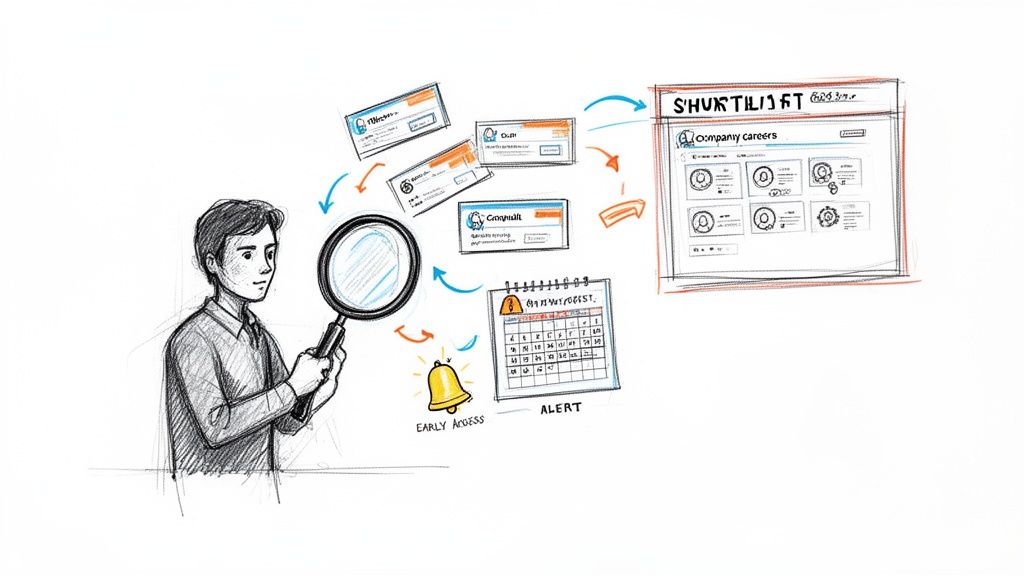
The single most underrated tactic in job hunting is targeting companies directly. Why? Most companies post new roles on their own careers page before they ever push them out to job boards. This creates a small but crucial window for anyone who’s paying attention.
Start by creating a “dream list” of 20-30 companies you’d kill to intern for. These could be businesses whose marketing campaigns you admire or whose mission just clicks with you.
Once you have your list, it’s time to get organized:
- Bookmark Their Career Pages: Make a dedicated folder in your browser and make checking these pages a daily habit. It takes maybe 15 minutes, but it can put you weeks ahead of the competition.
- Set Up Alerts: Many companies let you sign up for email notifications for new job postings. Do it. This gets fresh opportunities delivered right to your inbox.
- Follow Key People on LinkedIn: Find the marketing managers, talent acquisition specialists, and recruiters at these companies. They often share new openings on their personal feeds before a formal announcement is even made.
Use Specialized Job Aggregators
While the giant job boards are a feeding frenzy, specialized aggregators are a completely different animal. These platforms are built for one thing: giving you a speed advantage.
Instead of waiting for companies to post on their platform, they actively source listings directly from company career pages. This is a far more efficient way to monitor thousands of potential employers at once.
Platforms like Remote First Jobs, for instance, pull listings from the career pages of over 21,000 remote-first companies, scanning them around the clock. Their system often detects a new job within hours of it going live, letting you apply before it hits the mainstream. You can find a whole feed of low-competition remote jobs that are fresh and verified.
The real secret to a successful job hunt isn’t applying to more jobs; it’s applying to the right jobs at the right time. Being one of the first 10 applicants is infinitely better than being the 100th.
To help you choose the right platforms, here’s a quick breakdown of where you should be spending your time.
Where to Find Your Next Remote Marketing Internship
| Platform | Typical Applicant Volume | Listing Quality & Freshness | Best For |
|---|---|---|---|
| Direct Company Websites | Very Low | Highest (Direct Source) | Applicants with a clear list of target companies. |
| Specialized Aggregators | Low to Medium | High (Often updated hourly) | Finding fresh, low-competition roles from thousands of sources. |
| Niche Job Boards | Medium | Good (Curated) | Finding roles in a specific industry (e.g., startups, tech). |
| Large Job Boards | Extremely High | Mixed (Many stale listings) | General browsing and getting a feel for the market. |
As you can see, diversifying your search is key. Sticking to one type of platform limits your chances of finding those hidden gems.
The Power of Niche Job Boards
Finally, don’t forget about niche job boards. These are goldmines for finding a marketing intern remote role because they cater to specific industries or work styles. The applicant pool is naturally smaller and way more relevant.
Look for boards focused on areas like:
- Startups: Check out platforms like AngelList or Wellfound.
- Remote Work: Sites like We Work Remotely or Remotive are classics for a reason.
- Specific Industries: A marketing-focused job board can have incredible, tailored opportunities.
When you combine these strategies—going direct, using smart aggregators, and tapping into niche boards—you create a powerful, proactive system. You’ll spend way less time scrolling through stale listings and more time crafting amazing applications for roles where you actually have a chance to stand out.
Building an Application That Screams “Remote Ready”
For a marketing intern remote position, a generic, one-size-fits-all application is the fastest way to get ignored. Let’s be real: hiring managers are swamped. They’re not just looking for marketing knowledge; they’re scanning for solid proof that you can actually get work done without someone watching over your shoulder.
Your application needs to tell a story. It should be a highlight reel of your ability to self-manage, communicate clearly online, and drive results from anywhere. It’s time to reframe your resume and cover letter from a simple list of tasks into a showcase of your remote-friendly wins.
Frame Your Experience for Remote Success
Hiring managers are looking for specific signals that you’re cut out for remote work. This means you need to be explicit about the tools you use and the initiative you take.
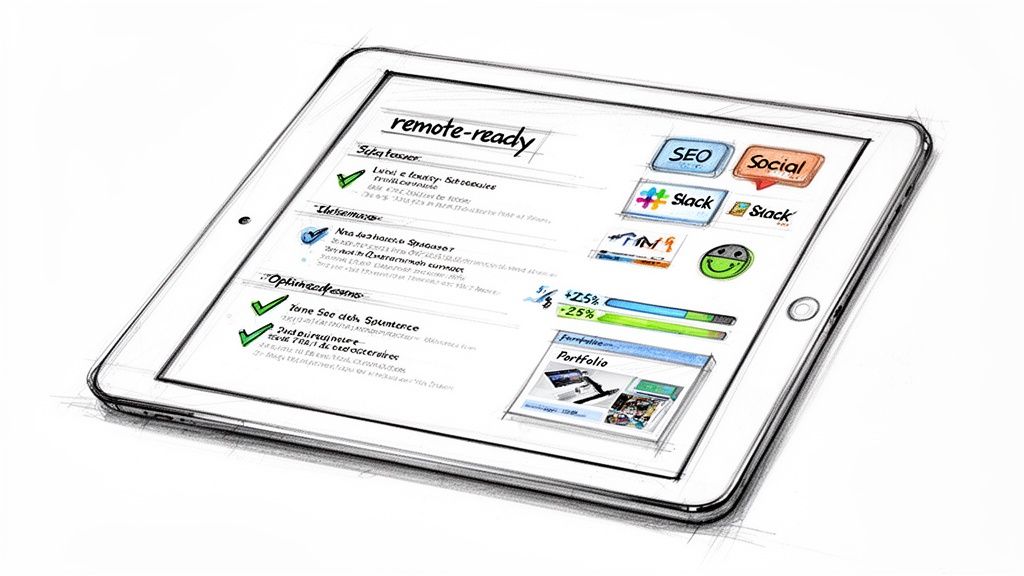
Show off your tech stack. Don’t just list “project management” as a skill. Did you use Asana to coordinate a group project? Did your team live on Slack? Name those tools. Better yet, put their logos on your resume. It’s a quick visual cue that you know your way around a modern remote workflow.
Quantify your impact. Remote work is all about results. Vague phrases like “Managed social media” are meaningless. Get specific with numbers. Try something like, “Increased post engagement by 25% over three months for my university club’s Instagram.” See the difference?
Highlight your independence. Your word choice matters. Swap out passive words like “Assisted with” for strong action verbs. “Initiated,” “Led,” “Developed,” and “Managed” paint a picture of someone who takes ownership and doesn’t need constant direction.
A remote-ready application does more than list skills; it tells a story of a proactive, resourceful candidate who can deliver tangible results with minimal hand-holding. This is your chance to prove you’re a low-risk, high-reward hire.
Beyond your resume, remember that your online presence backs up your story. A huge part of this is building a robust online presence that pulls in opportunities. Your digital footprint should reinforce everything your resume claims.
Build a Portfolio That Proves Your Skills
Honestly, a portfolio is non-negotiable for any marketing role, especially a remote one. It’s your chance to move from telling a hiring manager you have skills to showing them. It doesn’t have to be a flashy, custom-coded website either. A simple website, a well-organized PDF, or even a Notion page can do the trick.
This is your secret weapon. When you’re up against hundreds of other applicants for the top remote roles, your portfolio is what will make you stand out.
So, what do you put in it?
- A Mock Campaign: Pick a brand you love and create a detailed social media or content marketing plan for them. This shows you can think strategically.
- Writing Samples: Got blog posts, ad copy, or email newsletters you’ve written? Include them! This is direct proof of your communication skills.
- Analytics Screenshots: If you’ve ever managed a social account or even boosted a post, grab a screenshot of the performance data. It shows you’re comfortable with data and focused on results.
Your entire goal here is to make the hiring manager’s decision an easy “yes.” When you give them clear, tangible proof of your skills and your readiness for autonomous work, you make yourself the obvious choice.
Mastering the Remote Interview
A video interview for a remote marketing internship isn’t just a chat—it’s your audition for remote work. The hiring manager is watching everything. Your camera angle, your lighting, even the way you answer a question about time management tells them if you have what it takes to thrive without someone looking over your shoulder.
Think of it as your first chance to prove you’re a pro who can get things done from anywhere.
First things first, get your tech sorted. A choppy connection or muffled audio screams “unprepared.” Don’t wait until the last minute. Test your camera, microphone, and internet connection at least an hour before you’re scheduled to join the call.
Next, think about your backdrop. You don’t need a perfectly curated home office, but it absolutely must be clean, professional, and free of distractions. A simple, neutral wall with good lighting is a thousand times better than a cluttered bedroom. Oh, and silence your phone and close all those extra browser tabs. A random notification pinging in the middle of your answer is the last thing you need.
Answering Remote-Specific Questions
You’ll get the standard marketing questions, of course. But you’ll also get hit with questions designed to see if you can actually handle working remotely. The hiring manager needs to know you’re a self-starter who won’t just disappear into the ether.
Get ready for questions like:
- “How do you keep yourself motivated and on track when you’re working by yourself?”
- “What does your ideal remote work setup look like?”
- “Walk me through a time you had to manage a project with people in different locations.”
Whatever you do, don’t give a generic answer like, “I’m just a really self-motivated person.” You have to back it up with real examples. This is where a simple framework like the STAR method (Situation, Task, Action, Result) becomes your best friend.
Your goal isn’t just to say you’re a good remote worker—it’s to prove it. Show them you’ve already figured out how you’ll communicate, organize your day, and stay productive when no one’s around.
Let’s say they ask how you stay focused. Instead of winging it, structure your answer with a story.
Situation: “My final semester was entirely online, and I was juggling three major group projects at once, all with different deadlines and teammates.”
Task: “I needed to make sure I delivered quality work on time for every class without letting the lack of in-person structure derail me.”
Action: “At the start of each week, I time-blocked my entire calendar, assigning specific chunks of time to each project. I used Asana for my personal to-do list and made sure to send daily progress updates to my teammates in our shared Slack channel so we were always on the same page.”
Result: “We ended up submitting all three projects ahead of schedule, and I got an A in each class. That experience forced me to build my own structure, a system I know will be invaluable in a remote internship.”
See the difference? An answer like that shows you’re not just hoping you can succeed remotely—you’ve already built the habits to make it happen.
Making an Impact from Day One in Your Internship
You got the offer—congratulations! But landing the marketing intern remote role is really just the starting line. The real mission is to become an indispensable part of the team and turn this internship into a serious launchpad for your career.
In a remote setup, visibility is everything. You can’t just bump into your manager in the hallway or make small talk by the coffee machine to stay on their radar. Your impact comes down to your communication, your initiative, and the quality of your work. This is your shot to build a reputation as someone who’s proactive and reliable.
Establish a Foundation for Success
That first week is your golden opportunity to set the right tone. Your main goal should be to soak up information like a sponge and get your communication channels locked down. Don’t just sit around waiting for instructions; you have to actively seek out clarity.
Get a one-on-one on the books with your manager specifically to align on expectations. Think of it less like a casual chat and more like a strategy session for your success.
You’ll want to come prepared with a few key questions:
- From your perspective, what does a “successful” internship look like?
- What are the key metrics or projects I’ll be evaluated on?
- What’s the best way for me to ask questions or give updates (Slack, email, scheduled check-ins)?
A simple meeting like this shows you’re taking the role seriously and ensures you’re both working from the same playbook from the get-go. It takes the guesswork out of the equation so you can focus on what actually matters.
Since you’re remote, your written communication skills are front and center. Everything from a quick check-in to a formal project update helps define your professional image, which is why mastering workplace email etiquette can give you an immediate edge.
Your manager is busy. A well-documented summary of your progress is infinitely more valuable than a vague “everything is going well.” Make it easy for them to see your wins.
Communicate Proactively and Document Everything
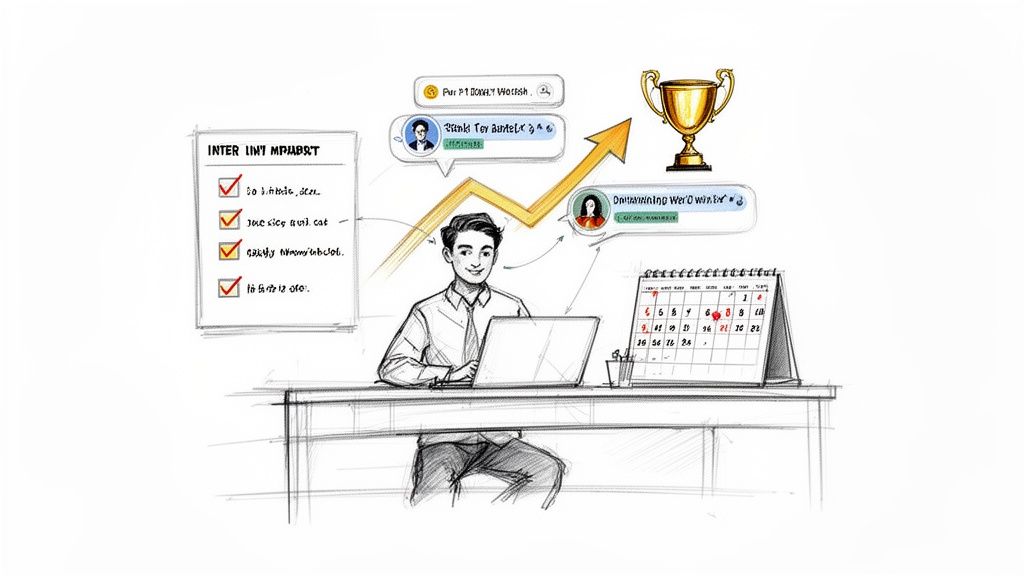
In a remote world, there’s no such thing as over-communication. You have to make your work visible, and that means giving regular updates without being asked. Even a simple end-of-day message on Slack that sums up what you accomplished and what you’re tackling tomorrow can make a huge difference.
This kind of proactive communication builds trust and keeps you top-of-mind. It proves you’re engaged and managing your own time effectively, no hand-holding required.
On top of that, keep a personal “win” journal. Seriously, document every single project you touch, the tools you learn, and any results you can quantify. Did you create a social post that got great engagement? Write it down. Did you get the hang of a new SEO tool? Document it.
This practice isn’t just for your final review. It builds a treasure chest of accomplishments you can pull from for your resume and portfolio later. It’s a strategy that over 10,000+ smart job seekers use to organize their achievements and accelerate their careers. Finding your next opportunity is a whole lot easier when you have a crystal-clear record of what you’ve achieved.
Common Questions About Remote Marketing Internships
Getting into the remote internship game can feel like you’re trying to navigate a whole new world. You’ve got questions, and you should. Let’s tackle some of the most common ones aspiring marketing interns ask.
Are Remote Marketing Internships Usually Paid?
The short answer? Yes, the good ones are. While pay can swing wildly depending on the company’s size, industry, and where they’re based, paid internships are quickly becoming the standard.
You might see stipends anywhere from $380 to over $630 a month for part-time gigs, especially with companies in the US or Europe.
A word of caution: be wary of unpaid internships. If a company is asking for a significant amount of work but isn’t offering solid mentorship, a structured learning plan, or academic credit in return, it might be a red flag. Always get clarity on compensation and the expected weekly hours during your interviews. It needs to be a fair deal for both sides.
What Skills Are Most in Demand?
Sure, knowing the basics of social media, SEO, and content writing is important. But when it comes to remote roles, companies are really looking for interns who are “remote-ready.” These are the soft skills that prove you can actually get things done without a manager standing over your shoulder.
Hiring managers are on the lookout for candidates who are:
- Amazing written communicators. Your ability to be clear and concise over Slack and email is everything.
- Proactive with their time. You have to own your schedule and hit deadlines without someone constantly checking in.
- Tech-savvy. Being comfortable with tools like Asana, Trello, or Slack is often a must-have.
- Self-disciplined. You need to prove you can stay focused and deliver quality work from your home office.
Honestly, showing you can work autonomously is just as critical as your marketing knowledge.
How Can I Stand Out With No Professional Experience?
If you’re starting from scratch, the best thing you can do is create your own experience. Don’t wait for someone to give you a shot—get proactive. Self-starter projects often catch a hiring manager’s eye more than a list of college courses.
Your portfolio is your proof. It’s tangible evidence of what you can do.
- Launch a personal blog. Pick a niche you’re nerdy about and start writing. This shows off your content creation, writing, and even basic SEO skills.
- Volunteer your marketing chops. Hit up a local nonprofit or a campus club and offer to run their social media. Make sure to track your results and ask for a testimonial.
- Build some mock projects. Choose a brand you love and create a sample content strategy or social media campaign for them. It’s a perfect portfolio piece.
These kinds of projects do more than just fill a blank space on your resume. They scream initiative, show off practical skills, and prove you have a real passion for marketing. You can’t learn that in a classroom.
How Do I Avoid Scams When Searching for Remote Internships?
With the boom in remote work, scammers have unfortunately followed. A legit company will never ask you to pay for your own training, buy equipment upfront with your own money, or hand over sensitive info like your bank password.
Your best defense is to stick to reputable job sites that actually vet their listings. Platforms that pull jobs directly from company career pages are infinitely safer than open forums where anyone can post an ad. If an offer sounds too good to be true, it probably is.
Always do your homework. Before you even think about applying, research the company. Do they have a professional website? An established social media presence? What are current or former employees saying about them online? A few minutes of digging can save you a world of trouble.
Ready to find a marketing intern remote role without all the noise and competition? Remote First Jobs sources opportunities directly from over 21,000 company career pages, giving you a first-mover advantage. Find your next internship today.