If you’re a seasoned marketer, the first rule of a successful remote job hunt is to get off the crowded, mainstream job boards. Seriously. Stop scrolling through LinkedIn and Indeed.
A much better use of your time is going straight to the source: the company’s own career page. This direct approach lets you sidestep the thousands of other applicants and find high-quality, legitimate remote roles before everyone else does.
Stop Wasting Time on Crowded Job Boards

Let’s be real for a second. The biggest mistake I see marketers make when job hunting is defaulting to the big aggregators. It feels productive, but you’re often just spinning your wheels in a sea of noise, intense competition, and those frustrating “ghost jobs” that aren’t even open anymore.
The reality of today’s market is that the best remote marketing jobs get snapped up fast—often before they even make it to the major job boards. I’ve seen great roles go from a handful of applicants to over 1,000 in less than 48 hours. If you’re only finding jobs on the big sites, you’re already behind.
The Problem with Mainstream Job Sites
Relying on sites like LinkedIn or Indeed automatically puts you in a reactive, defensive position. You’re only seeing roles after they’ve been blasted out to the masses, which means you’re diving into a hyper-competitive pool where your carefully crafted application can easily get lost. It’s a broken system for experienced pros who know their time is valuable.
Here’s what you’re really up against:
- Application Overload: Recruiters are drowning in resumes. Even a perfect fit can get buried under the sheer volume.
- Ghost Postings: You’ll waste hours applying to jobs that are already filled, on hold, or were only posted to collect resumes.
- Recruiter Spam: Your inbox fills up with irrelevant pitches from third-party recruiters who haven’t even read your profile.
The key is to shift from reactive scrolling to proactive, targeted hunting. To beat the competition and find marketing jobs worth your time, you have to adopt modern Effective Job Search Strategies.
The First-Mover Advantage in Job Hunting
A much smarter strategy is to bypass the middleman entirely. Go straight to the source. The demand for skilled marketers is undeniable; U.S. employers recently posted 376,200 marketing and creative jobs, with digital roles leading the pack.
However, with unemployment for marketing managers at a slim 3.3%, the competition for top talent is fierce. The real secret is applying within hours of a job going live, not days.
You can get this edge by using tools that scan company career pages directly. For instance, platforms like https://remotefirstjobs.com/ pull new opportunities directly from company systems—often before they hit the big boards and go viral. This gives you a critical “first-mover” advantage, letting you apply when the applicant pool is small and you can actually stand out.
Build a Remote-Optimized Professional Brand
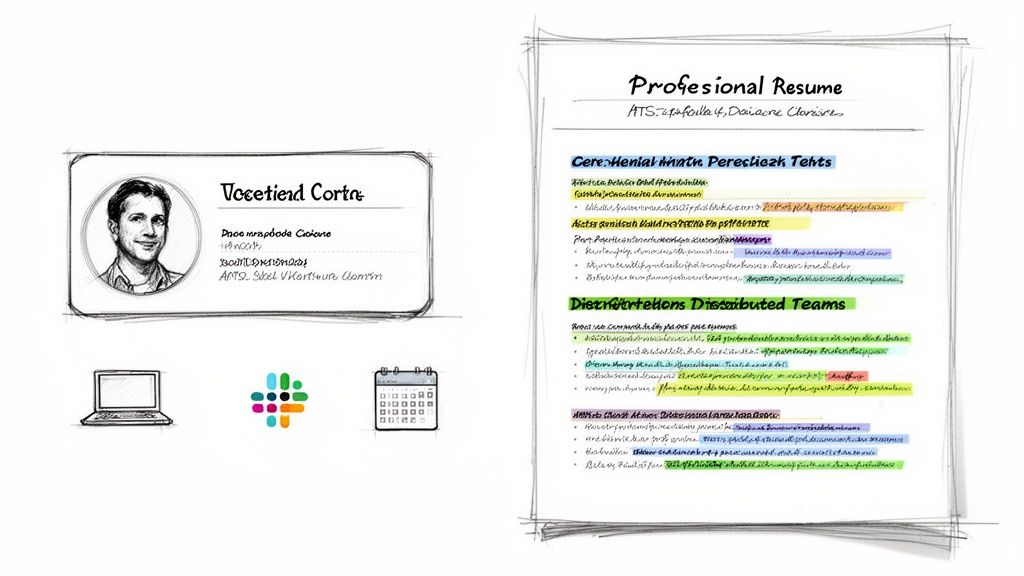
Before you even think about hitting “apply,” we need to get your professional brand in order. This isn’t just about dusting off your resume. It’s about building a clear, compelling story that tells every remote-first company: “I am a remote-ready expert.” This is what gets you past the automated filters and into the hands of a real person.
The biggest mistake I see marketers make is sending out a generic resume and LinkedIn profile for every role. For remote jobs, that’s a guaranteed way to get lost in the noise. You have to be deliberate, reframing your entire career to highlight the traits that remote employers crave: autonomy, asynchronous communication, and proven results.
Tailor Your Narrative for Remote Recruiters
Your mission is to make it painfully obvious that you excel without someone looking over your shoulder. Don’t just list what you did; frame your wins within the context of a remote environment.
For instance, instead of a vague “managed a team,” try something like: “Led a distributed team of five across three time zones using Asana and Slack, boosting campaign output by 20%.” See the difference? Small tweaks in language have a massive impact.
Focus on weaving these concepts throughout your materials:
- Autonomy: Use powerful phrases like “independently managed,” “owned the project from start to finish,” or “self-directed.”
- Communication: Mention your experience with “asynchronous communication,” “cross-functional collaboration,” and the specific tools you use, like Loom or Notion.
- Results: This is non-negotiable. Quantify everything. Show a clear line between your work and its impact on revenue, leads, or cost savings.
A critical piece of your remote brand is your digital portfolio. It’s where you go beyond bullet points and provide concrete proof of your skills and accomplishments. If you’re new to this, learning What Is a Digital Portfolio and How Do You Build One will give you a huge advantage in presenting your work.
Optimize for Applicant Tracking Systems
Let’s talk about the gatekeepers: Applicant Tracking Systems (ATS). Over 90% of large companies rely on these bots to pre-screen resumes. To have any chance of a human seeing your application, you need to get past the machine first.
This means your resume and LinkedIn profile must be loaded with the right keywords from the job descriptions you’re targeting. This isn’t about stuffing your profile with jargon; it’s about speaking the language of remote hiring managers.
Think like a bot. What terms and tools are common in remote marketing roles? Sprinkle in keywords like:
- Remote-specific terms: “distributed team,” “remote collaboration,” “asynchronous workflow.”
- Marketing software: HubSpot, Marketo, Salesforce, SEMrush, Ahrefs.
- Project management tools: Jira, Trello, Monday.com.
To help you get started, here’s a quick checklist to make sure your professional presence is ready for a remote job search.
Resume and LinkedIn Optimization Checklist for Remote Roles
This table outlines key actions to make your professional profiles stand out to remote-first employers and pass ATS scans.
| Optimization Area | Action Item | Why It Matters for Remote Jobs |
|---|---|---|
| Headline/Title | Add “Remote” or “Distributed” to your LinkedIn headline. | Instantly signals your interest and experience to recruiters searching for remote talent. |
| Summary/About | Weave a narrative about your success in autonomous environments. | Shows you thrive with less supervision and are a self-starter, a key remote trait. |
| Experience Bullets | Quantify results and mention collaboration tools (Slack, Asana, etc.). | Provides concrete proof of your impact and familiarity with the remote tech stack. |
| Skills Section | Add “Asynchronous Communication” and “Remote Collaboration” as skills. | Directly matches keywords that both ATS and human screeners look for in remote candidates. |
| Portfolio Link | Include a prominent link to your digital portfolio in your resume header and LinkedIn profile. | Offers tangible evidence of your work, going beyond what a resume can show. |
| Keyword Alignment | Scan target job descriptions for keywords and add relevant ones to your profile. | Ensures your profile passes through ATS filters for the specific roles you want. |
By building a brand that is intentionally optimized for remote work, you immediately position yourself as a low-risk, high-value candidate. You’re no longer just another marketer looking for a job—you’re a professional who is uniquely equipped for the demands of a modern, distributed workplace. This groundwork is what makes all the difference.
Master Direct and Targeted Job Sourcing
This is where you can get a serious edge in your job hunt. Forget the endless, soul-crushing scroll on massive job boards. It’s time to get surgical. A focused strategy means using tools that cut through the noise and take you straight to the source of the best remote marketing jobs.
The secret? Use job engines that pull postings directly from company career pages. Platforms like Remote First Jobs give you a backdoor to verified roles, often hours or even days before they blow up on LinkedIn. This direct line bypasses third-party recruiters, spammy listings, and those frustrating “ghost postings” that are already filled.
You’re essentially flipping the script from being a passive scroller to an active hunter. Instead of waiting for a good opportunity to float by in a sea of mediocre ones, you’re finding them before the crowd does.
Build Your Dream Company Target List
First things first, let’s get specific. Don’t just look for any remote marketing job. You need to define what your ideal role and company actually look like. Your first move is to build a curated list of 20-30 dream companies you’d genuinely be excited to work for.
When you’re putting this list together, think about:
- Industry: Do you get a buzz from fast-paced tech startups, or do you prefer the structure of an established B2B SaaS company?
- Company Size: Are you at your best in a small, tight-knit team where you wear many hats, or do you need the resources of a larger organization?
- Culture: What really matters to you? Dig into companies that match your work style—whether that’s fully asynchronous, highly collaborative, or somewhere in between.
Once you have this list, your job search transforms into a monitoring mission. You’re no longer sifting through thousands of irrelevant jobs. Instead, you’re tracking a small, highly relevant group of employers, which means every application you send is for a company you truly want to join.
The marketing industry is incredibly competitive. With a projected value of $1,189.5 billion by 2033, tech companies are hiring aggressively. To stand out, you have to ditch the lazy approach of browsing mainstream job boards. Using engines that monitor remote-first companies directly is how you find new roles before they go viral. It’s a non-negotiable strategy. You can find more current marketing industry trends on pit.edu.
Set Up Real-Time Surgical Alerts
Now, it’s time to put this strategy on autopilot. The goal is to be the very first person to know when a role opens up at one of your target companies. The key is using a platform that allows for hyper-specific, real-time alerts.
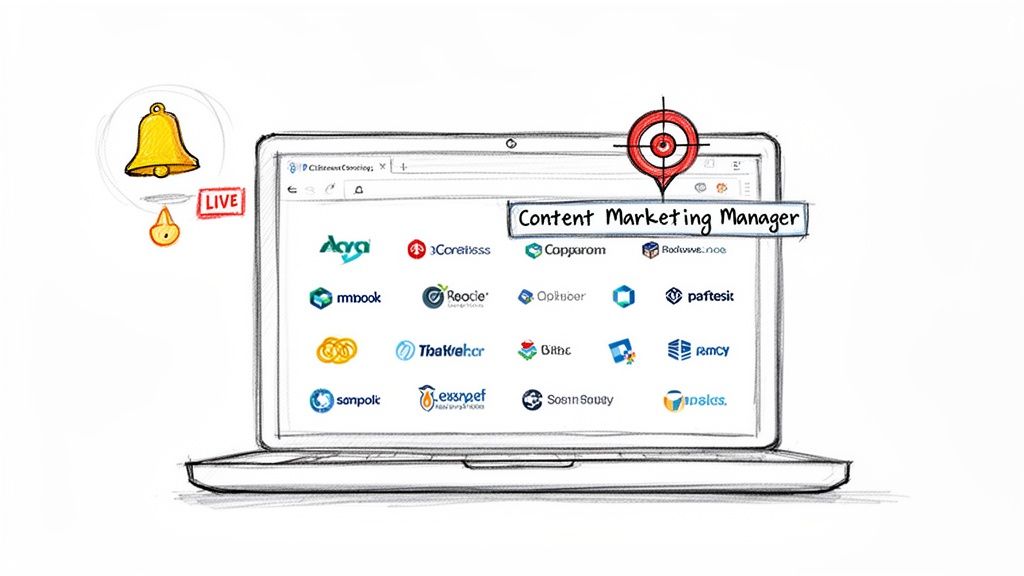
For instance, don’t set a broad alert for “marketing.” Get granular. Configure your notifications for exact titles like “Content Marketing Manager,” “SEO Specialist,” or “Product Marketing Director.” You can then layer on keywords for your preferred industry, like “fintech” or “healthtech,” to narrow the results even further.
Here’s a look at how you can set up a targeted search on a direct-sourcing platform:
As you can see, a clean interface lets you filter by specific keywords, guaranteeing you only see the most relevant, verified roles. Because this approach pulls directly from the company, every single listing is active and authentic. It allows you to apply with confidence before the competition even knows the job exists.
Craft Outreach That Actually Gets a Response
So you’ve hit “apply.” Now what? In this market, just submitting your resume is like dropping a message in a bottle into the ocean. If you want to get your application out of that digital slush pile and into the hands of a real person, you need to do some smart, strategic outreach. This is how you turn a cold submission into a warm introduction.
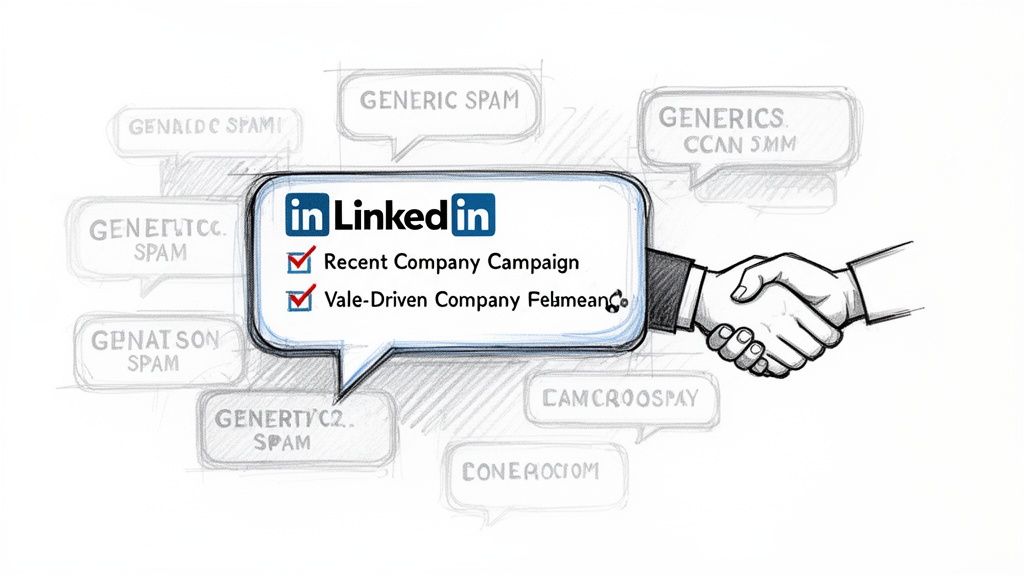
Let’s be clear: I’m not talking about those generic “Hi, I just applied for X role” messages on LinkedIn. That’s a one-way ticket to being ignored. The real secret is to show you’ve done your homework and to add some genuine value right from the start. A thoughtful message proves you’re not just another applicant—you’re a pro who gets their business.
From Generic to Memorable
The goal here isn’t just to ask for the job; it’s to start a real conversation. A truly great outreach message is hyper-personalized and connects with the company or the person you’re messaging on a specific, meaningful level. It’s what separates you from the 99% of people who send a lazy, templated note.
Before you even think about writing, spend five minutes finding a solid conversation starter. Look for one of these three things:
- A recent company initiative: Did they just launch a cool new product, publish an interesting report, or announce a big partnership?
- A specific marketing campaign: Find an ad, social media post, or piece of content that genuinely caught your eye.
- A hook from the job description: Zero in on a specific challenge or responsibility in the JD and briefly tie it back to something you’ve accomplished.
Seriously, this doesn’t need to be a deep-dive investigation. A quick scan of their blog, LinkedIn page, or the latest news is usually all it takes to find a great angle.
The best outreach isn’t about you—it’s about them. Lead with genuine curiosity and respect for what they’re building. When you start with an insightful observation, you stop being just an applicant and become a peer they want to talk to.
A Real-World Outreach Scenario
Let’s walk through an example. Say you just applied for a “Senior Content Marketing Manager” role. Instead of firing off a bland connection request, you find the Head of Marketing on LinkedIn and send a personalized note that immediately adds value. This is how you start creating your own luck.
Here’s a message framework you can adapt. It’s confident but respectful.
Subject: Quick question re: [Company Name]’s recent content
“Hi [Hiring Manager’s Name],
I noticed your team recently published the [Specific Report or Blog Post Title]—the data you shared on [Mention a Specific Insight] was fascinating. I’m really impressed with how you’re positioning the company as a leader in [Their Industry].
I just applied for the Senior Content Marketing Manager position, and it felt like a great fit, especially since my background is in scaling blog traffic and building the exact kind of content systems you mentioned in the job description.
Either way, I’m a huge fan of the work you’re doing and will be following along.
Best, [Your Name]”
See the difference? This message is short, professional, and positions you as an informed peer, not just another job seeker. It’s a simple, respectful nod that gets you on their radar. In my experience, this small extra step can be the one thing that makes all the difference.
Vet Employers and Secure the Right Remote Role
Getting the interview is a huge step, but the real evaluation starts now. Your focus needs to shift from simply getting a job to making sure you’re getting the right job. This is where you put on your detective hat and dig into what a company’s remote culture is really like before you sign any offer letter.
The difference between a company that’s genuinely remote-first and one that’s merely remote-tolerant is night and day. A remote-first organization builds its entire operational model around a distributed team, championing asynchronous communication and trust. On the other hand, a remote-tolerant company often treats remote work as a reluctant holdover from the pandemic, which usually leads to micromanagement, meeting fatigue, and eventual burnout. Your mission is to figure out which one you’re dealing with.
Distinguishing a Great Remote Culture
A truly great remote company doesn’t just allow you to work from home; it actively invests in the tools, processes, and mindset required for a distributed team to thrive. They see flexibility and autonomy as genuine assets. A remote-tolerant company? They might just be trying to cast a wider net for talent without fundamentally changing their old-school, in-office habits.
During your interviews, you need to ask pointed questions that cut through the fluff. These questions are your best tool for getting a real sense of their day-to-day operations and management philosophy.
You’re looking for clues in three main areas:
- Communication Style: Do they default to asynchronous communication—think detailed write-ups in Notion or clear tasks in Asana—or is their culture a never-ending series of back-to-back Zoom calls?
- Performance Metrics: How do they actually define success? Is it based on the hours you log and your Slack status being green, or is it tied to the quality of your work and the outcomes you deliver?
- Trust and Autonomy: Does leadership trust their people to manage their own time and projects, or is there an undercurrent of micromanagement and constant check-ins?
Questions That Reveal the Truth
To get the real story, you have to ask specific, open-ended questions. Forget vague prompts like, “What’s the company culture like?” That just invites a canned, PR-friendly response.
Instead, try these more revealing questions during your conversations with the hiring manager and potential teammates.
Questions to Uncover Their Remote DNA:
- How does your team handle communication and important decisions when working across different time zones?
- Can you walk me through how performance is measured for someone in this role? What would a successful first 90 days look like?
- What specific tools do you rely on for asynchronous collaboration, and could you share an example of a recent project that was managed that way?
- How does the team build real connection and rapport when everyone is fully distributed?
- What is the company’s official policy on using employee monitoring software?
A company’s hesitation or inability to clearly answer these questions is a major red flag. A true remote-first organization will have thoughtful, well-defined answers because these are challenges they’ve already solved.
How to Spot and Avoid Scams
The explosion in remote work has unfortunately brought a surge in fake job listings and even MLM schemes masquerading as legitimate marketing roles. This is where a curated job source like Remote First Jobs acts as a crucial first line of defense. Because it pulls listings directly from company career pages, you automatically sidestep many of the scams polluting mainstream job boards.
Still, you need to stay vigilant. This is especially true for entry-level roles, where purely remote positions are scarce, making up just 6% of all openings. That intense competition can make a sketchy offer seem more appealing than it is. As you gain experience, far more remote doors open up, but vetting every opportunity remains critical. If you’re interested in future trends, you can find more details in the 2026 job market trends analysis from mohr.uoregon.edu.
By asking the right questions and sticking to trusted platforms, you can feel confident that your next remote marketing job is not only legitimate but also a supportive and genuinely flexible environment.
Answering Your Lingering Questions
Even with the best game plan, the job hunt can stir up some nagging questions. Let’s tackle some of the most common ones I get from experienced marketers trying to find their footing in the remote world.
Is a Marketing Degree Still a Must-Have?
Honestly? No. For most companies out there—especially in the tech and startup space—what you can actually do is far more important than what’s printed on your diploma. They’re laser-focused on your track record and the results you can bring to the table.
I’ve personally worked alongside brilliant marketing VPs with degrees in history, engineering, and even music. They got to where they are because they were relentlessly curious and obsessed with learning and driving results. Unless you have your heart set on a super traditional Fortune 500 company, your time is much better spent sharpening your skills and packaging your wins.
How Do I Stand Out if I’ve Never Officially Worked Remotely?
This is a huge one, but it’s more about framing than a lack of experience. You likely already have all the skills you need; you just need to show them off in the right way.
Think about your past roles and pull out the instances where you worked with a high degree of autonomy.
- Instead of “managed a budget,” try “independently managed a $50k budget with quarterly reporting.”
- Instead of “worked with other teams,” say you “coordinated a cross-functional launch using Asana to keep international teams aligned.”
- Mentioning that you “provided project updates via detailed Loom videos” is another great way to show you’re comfortable with asynchronous communication.
The idea is to proactively answer the hiring manager’s biggest question: “Can this person thrive without someone looking over their shoulder?”
You have to show, not just tell. Demonstrate your skill with the tools and communication styles that make remote teams click. Frame your accomplishments in the language of a distributed workforce.
Is Agency Life a Good Stepping Stone?
Working at a marketing agency can feel like being thrown into the deep end, but it’s an incredible career accelerator. Think of it as a marketing boot camp. You’re forced to get smart, fast, juggling multiple clients and seeing what actually works across different industries.
That kind of pressure cooker environment builds muscle in project management, client relations, and expands your professional network like nothing else. It’s a very common and proven path: do a tour of duty at an agency, gain a ton of experience, and then jump to a fantastic in-house role. It’s not for everyone, but it’s a powerful move.
How Can I Spot a Fake Job or an MLM?
Your best defense here is a good offense. Sticking to job sources that pull roles directly from company career pages, like Remote First Jobs, cuts out most of the noise right from the start.
Still, you always need to keep your guard up. Be on the lookout for these red flags:
- The job description is incredibly vague but uses tons of hype and emotional language.
- You’re asked to pay for your own training materials or a “starter kit.” Big no.
- The conversation is all about “unlimited earning potential” with zero specifics on a base salary.
- You feel a sense of high pressure to make a decision immediately.
Always trust your gut. A real company with a legitimate opening will have a professional, transparent process. They will never ask you for money to get a job.
Stop sifting through crowded, spammy job boards. Find your next role faster on Remote First Jobs, where every single listing is pulled directly from a company’s career page. No ghost jobs, no recruiter spam. Check out the latest verified remote marketing jobs at https://remotefirstjobs.com.