Finding a remote iOS developer job has gone from a nice-to-have perk to a core expectation. While the competition is no joke, the market is stronger than ever, especially in specialized fields. Sectors like Web3 and AI are now hiring remote-first by default, which means durable, long-term career paths for developers who know where to look.
The State of Remote iOS Jobs in 2026

The world for remote iOS developers has completely changed. What used to be a small trickle of work-from-home gigs is now a powerful, steady current. Even with some big tech names trying to pull everyone back to the office, the demand for top-tier iOS talent remains a perfect fit for remote work.
The whole nature of app development—collaborative yet autonomous, digital by design, and global in reach—makes it a resilient career for anyone wanting location independence.
But here’s the catch: high demand means intense competition. Just throwing your resume onto traditional job boards like LinkedIn or Indeed feels like screaming into the abyss. You’re just one of thousands, and that old strategy is a fast track to frustration, filled with “ghost jobs” and radio silence.
To actually win, you need to start thinking differently.
A New Job Search Playbook
The secret is to act like an insider—someone who finds the best roles before they hit the mainstream. The most exciting remote iOS jobs are often filled long before they ever appear on the big aggregator sites. This guide is your new playbook, designed to give you that insider’s edge and a massive head start.
The market’s strength isn’t just a feeling; it’s backed by hard numbers. While general remote software roles leveled out at around 25-30% of all listings by early 2025, iOS-specific remote jobs have consistently outpaced that. A big reason for this is the massive global iOS ecosystem, with over 1.8 billion active Apple devices creating a relentless demand for new apps and updates. You can see more on the trends shaping Web3 salaries and remote opportunities on Web3.career.
It’s a seismic shift. By February 2026, a full 100% of iOS developer roles on major Web3 career platforms were fully remote. That’s a huge leap from just 20% in November 2025, and it’s a clear signal that emerging tech is now remote by default.
Where the Real Opportunities Are
This data tells a crucial story: the best remote iOS jobs are hiding in plain sight within specialized, forward-thinking industries. Companies in Web3, AI, and fintech aren’t just “remote-friendly”—their entire business model is built on a distributed workforce. They get it.
To take advantage of this, you have to ditch the old methods. Stop wasting time scrolling through the noise of traditional job boards and start using modern sourcing tools that give you a direct line to company career pages. For example, a direct-sourcing engine like Remote First Jobs is designed to cut right through the aggregator mess.
This direct approach isn’t just a small improvement; it’s a fundamentally better way to find a job. Think about how traditional platforms compare to modern direct-sourcing tools.
Remote vs Traditional Job Search Platform Comparison
| Feature | Remote First Jobs (Direct Sourcing) | LinkedIn/Indeed (Aggregators) |
|---|---|---|
| Job Freshness | Posts appear within hours of going live on the company’s site. | Can be days old, already buried under hundreds of applications. |
| Listing Quality | Verified, active roles. No expired or “ghost” listings. | Prone to stale listings, data-scraping posts, and recruiter spam. |
| Application Path | You apply directly on the company’s career page. | Application often goes through a third-party, adding delays and noise. |
| Signal-to-Noise | High. Curated for serious, remote-first companies. | Low. Mixed with on-site, hybrid, and low-quality roles. |
The takeaway is clear. By using a direct-sourcing strategy, you gain a massive competitive advantage. You’re simply faster, more targeted, and more visible to the companies you actually want to work for.
Sourcing Jobs Before They Go Public
If you’re spending your days endlessly scrolling through the giant job aggregators, you’re playing a losing game. Let’s be real—the best remote iOS developer jobs are often snatched up before they ever hit the mainstream. Trying to stand out among a thousand other applicants for one role isn’t a strategy; it’s a recipe for burnout.
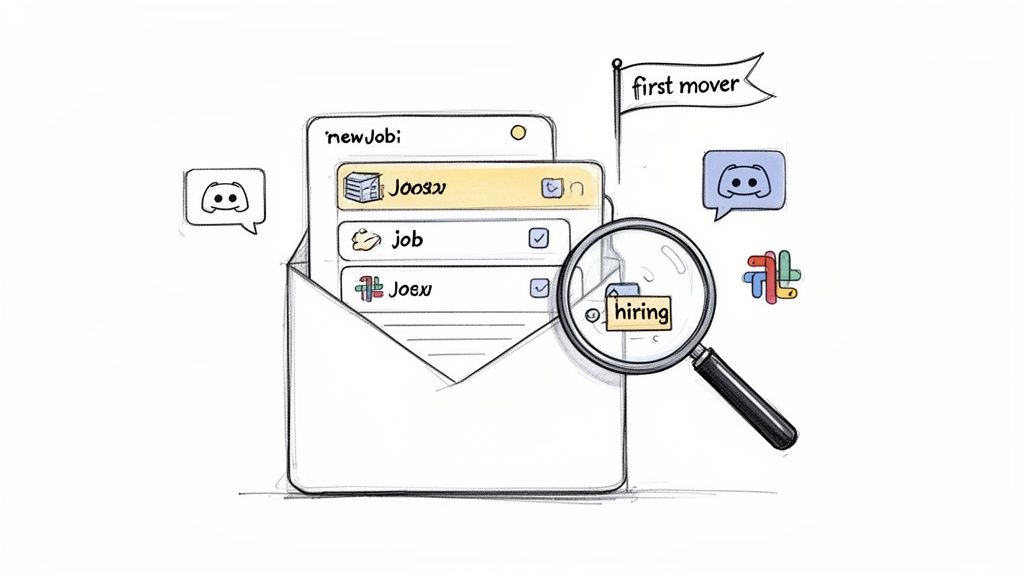
The secret is to stop being a passive applicant and start acting like a proactive sourcer. You need a system that brings fresh, low-competition opportunities straight to you. This is all about getting your resume on the hiring manager’s desk first, not 500th. That “first-mover” advantage is everything.
It all starts with using the right tools—the ones built for speed and direct access, not for casting the widest, noisiest net.
Your First-Mover Advantage with Direct Sourcing
Think about how traditional job boards work. They’re slow. They scrape and pull data from other places, which means by the time you see a job posting, it’s likely already days old and has been swamped with applications. Direct-sourcing platforms do the exact opposite. They go right to the source: the company’s own careers page.
This is where a specialized search engine becomes your best friend. For instance, a platform like Remote First Jobs is built for this exact purpose, scanning over 21,135+ remote-first companies every single day. That’s how it uncovers more than 200,000 new roles monthly, giving you the chance to apply within hours of a job going live—long before it shows up on LinkedIn and gets a thousand applicants. If you’re curious about salary data, you can see how remote work trends are shaping developer salaries on Web3.career.
This simple shift completely changes the game. You’re no longer shouting in a crowded stadium; you’re having a direct conversation.
The strategy is simple but incredibly effective: Be where the job is born, not where it goes to die. By monitoring company career pages directly, you get a timing advantage that the big aggregators can never offer.
When you make a direct-sourcing tool part of your daily check-in, you’re not just finding jobs. You’re finding the right jobs, faster, and with way less noise. You can find thousands of these fresh roles by checking out a dedicated engine like Remote First Jobs and see the difference yourself.
Go Beyond the Job Boards
Direct sourcing should be your go-to move, but you can build an even stronger job-hunting machine by adding a few other smart tactics. These will help you find opportunities that might not even be formally posted yet.
Monitor Recently Funded Startups Nothing signals “we’re hiring!” louder than a fresh round of funding.
- Follow the Money: Keep an eye on VC news sites like TechCrunch or Axios Pro. When a startup in your target space—like fintech, health tech, or AI—announces a big Series A or B round, their careers page should be your very next click.
- Set Up Alerts: A simple Google Alert for terms like
"iOS developer" + "raised funding"can drop these hot leads right into your inbox.
Become a GitHub Detective For developers, GitHub is so much more than a place to store code. It’s practically a treasure map for finding work.
- Search for “Help Wanted” Issues: Look for repositories using your tech stack (Swift, SwiftUI, Combine) and filter for issues with labels like
help-wanted,good first issue, or evenhiring. Companies often test the waters here before creating a formal job req. - Follow Target Companies: Pick a few companies you’d love to work for and “watch” their public repos. A sudden burst of activity or a new project kickoff is often a quiet signal that they’re scaling up the team.
Join Niche Developer Communities The best jobs often come from word-of-mouth referrals inside trusted circles.
- Find Your People: Forget the massive, generic programming channels. Your time is better spent in highly specific Slack or Discord groups like “SwiftUI Developers,” “iOS Devs in FinTech,” or local meetups that have gone virtual.
- Give More Than You Take: Don’t just pop into the #jobs channel and drop your resume. Actually participate. Answer questions, help someone debug a tricky problem, and share what you’re working on. Hiring managers and team leads are always in these groups, and they remember the people who add value.
By combining these strategies—direct sourcing, funding alerts, GitHub sleuthing, and genuine community involvement—you shift from being reactive to being proactive. You’ll consistently be ahead of the pack, applying to high-quality remote roles with a tiny fraction of the competition.
Get Your Resume and Portfolio Remote-Ready
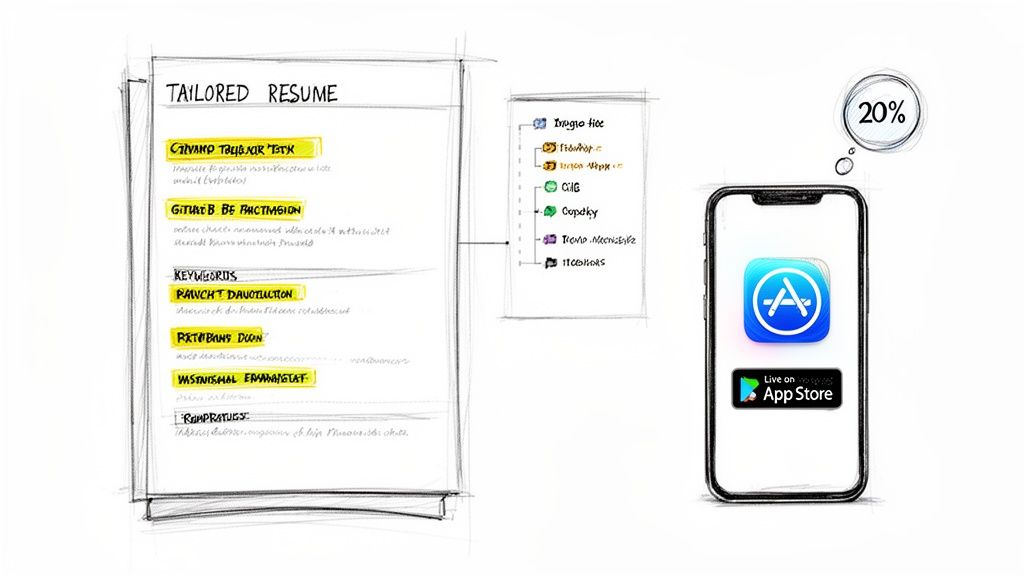
Sending out a generic resume for a competitive remote iOS role is like showing up to a coding interview without a laptop. It’s a non-starter. To even get a foot in the door, your application needs to be meticulously tailored to grab the attention of both the bots and the humans standing between you and the job.
First, you have to get past the Applicant Tracking System (ATS). Think of it as your first technical challenge. Comb through the job description and pull out all the key technologies (like SwiftUI, Combine, or Core ML), methodologies (Agile, Scrum), and tools (Jira, Bitrise). Weave these exact keywords into your experience and skills sections.
This is your ticket to getting a real person to actually see your resume. Once you’re past the machine, your story needs to shine.
Show, Don’t Tell: Quantify Your Wins
Hiring managers are tired of reading a laundry list of job duties. They want to see results. “Improved app performance” is a classic example of a statement that says almost nothing. You need to back up your claims with hard numbers that prove your impact.
Here’s what that looks like in practice:
- Instead of “made the app faster,” say “Reduced app launch time by 20% by optimizing asset loading.”
- Instead of “refactored the codebase,” try “Cut network request latency by 150ms by implementing a new caching strategy.”
- Don’t just say “added new features.” Say, “Drove a 15% increase in daily active users by shipping a revamped onboarding flow.”
- Swap “fixed bugs” for “Decreased crash rates by 40% through improved error handling and comprehensive unit testing.”
These numbers prove you’re not just a coder—you’re a problem-solver who understands how technical work translates to business value. That’s a huge green flag for remote hiring managers who need to trust you can deliver without someone looking over your shoulder.
And as you’re putting your application together, remember the small details. Following email subject line capitalization best practices shows a level of professionalism and care before they even open your email.
Spotlight Your Remote Chops
It’s not enough to be a great iOS developer. Your resume has to scream that you’re a great remote iOS developer. You need to explicitly show that you’re fluent in the language and tools of distributed work.
Your resume should scream “I am a self-sufficient, highly communicative, and productive remote professional.” It’s not just about your code; it’s about your ability to collaborate effectively from anywhere.
Add a dedicated section—call it “Remote Collaboration” or “Workflow Tools”—and list your go-to software. Be specific.
- Project Management: Jira, Asana, Trello
- Communication: Slack, Microsoft Teams, Zoom
- Documentation: Confluence, Notion, GitHub Wikis
- Version Control: Git, GitHub, GitLab
This simple addition sends a powerful message: you won’t need any hand-holding on day one. You’re ready to plug directly into their existing remote setup.
Build a Portfolio That Proves Your Point
Your portfolio is your closing argument. It’s where you provide undeniable proof for all the claims you just made on your resume. Remote hiring managers are looking for evidence of three things: clean code, real-world execution, and sharp communication.
1. A Killer GitHub Profile
Honestly, your GitHub profile is often more important than your resume. Make sure it’s pristine. Pick your best projects and give them a detailed README.md that walks the reader through the project’s purpose, the architecture you chose (MVVM, VIPER, etc.), and the tough problems you solved. This is your chance to show how you think.
2. A Live App in the Wild Nothing says “I can deliver” quite like a finished product. Having at least one app on the App Store is a massive advantage. It proves you can navigate the entire development lifecycle, from the first line of code all the way through App Store Connect submission and review.
3. Tell the Story Behind the Code For each project in your portfolio, write a short case study. Don’t just link to a repo. Explain why you built it, the hurdles you encountered, and how you overcame them. This gives a hiring manager a window into your problem-solving mind—something they desperately need to see when they can’t just walk over to your desk.
Mastering the Remote Interview Process

Let’s be real: crushing a remote interview is a totally different game than charming a hiring manager in person. It’s less about a firm handshake and more about how you handle your environment, communicate through a tiny camera, and prove you’re a high-performer from hundreds of miles away.
From the first recruiter screen to the final technical deep dive, every step is a subtle test of your remote-readiness. Companies aren’t just looking for someone who can code; they need a pro who operates with autonomy and communicates with absolute precision. Getting this right is how you land those top-tier remote iOS developer jobs.
Nailing Your Video Call Setup
Your first impression is entirely digital, so it has to be sharp. A messy background or tinny audio can scream “unprofessional” before you even say hello. Run through this quick pre-flight check before every call to make sure your setup is a green flag, not a red one.
- Light Your Face, Not Your Back: The goal is simple: your face should be the brightest thing on the screen. The easiest way is to sit facing a window. If you can’t, a cheap ring light is a game-changer. Never, ever sit with a bright window behind you—you’ll turn into a mysterious silhouette.
- Invest in Clear Audio: An external USB microphone is one of the best investments you can make for your career. It cuts out the echo and background noise, making you sound crisp and professional. Don’t rely on your laptop’s built-in mic or AirPods that could die mid-sentence. Always test it first.
- Curate Your Background: Your background shouldn’t be a distraction. A clean wall, a tidy bookshelf, or even a subtle branded virtual background works wonders. Just make sure there’s no personal clutter, open doors, or family members wandering into the frame.
- Fake Your Eye Contact: This one feels weird at first, but it’s critical. Drag the video window of the interviewer directly under your webcam. This little trick forces you to look near the camera when you look at them, creating the illusion of direct eye contact.
Think of yourself as a broadcaster for an hour. Your goal is to make the tech disappear so the only thing they remember is your expertise.
Acing the Take-Home Assignment
Many of the best companies use a take-home assignment to see how you actually code. This is your moment to shine, but just delivering code that works is the bare minimum. You have to show them how you think.
A great take-home submission is more than just code; it’s a window into your professional process. It demonstrates your ability to communicate complex technical decisions, write maintainable software, and operate with the same rigor you would on their team.
Don’t just zip up your project and hit send. You need to frame your work to tell a story.
Your Submission Checklist:
- A Killer README: This is the first thing they’ll see. Explain your architectural choices (e.g., “I chose MVVM-C here to cleanly separate concerns and manage navigation”). Be honest about any trade-offs you made and provide dead-simple instructions for building and running the app.
- Clean, Readable Code: Write code that another developer would be happy to inherit. Use clear variable names and add comments that explain the why behind your logic, not just the what.
- Show Off Your Testing Chops: Even if they don’t ask for it, including a few unit or UI tests is a massive power move. It shows you care about quality and think about long-term maintainability.
- Use Git Like a Pro: A clean Git history with small, atomic commits and descriptive messages is a huge signal. It shows you know how to work collaboratively in a professional dev environment.
Answering Behavioral Questions Like a Remote Veteran
In a remote setting, behavioral questions are where they hunt for proof of your autonomy, communication skills, and self-discipline. They need to know you can thrive without a manager hovering over your shoulder.
Instead of a generic answer like, “I’m a good communicator,” come prepared with a specific story.
For example: “In my last role, a critical bug surfaced right before a release. I immediately documented it in a shared Slack channel with steps to reproduce, created a Jira ticket with all the technical details, and spun up a quick Zoom call with the backend and QA leads. By over-communicating, we isolated and patched the issue in under two hours.”
That one story proves you can:
- Communicate proactively and clearly.
- Use async tools like Slack and Jira effectively.
- Take the initiative to solve problems.
By mastering your digital presence, your coding showcase, and your storytelling, you’re no longer just another applicant. You’re the ideal remote candidate: a highly skilled iOS developer who’s ready to contribute from day one.
Negotiating Your Salary and Benefits
That email hits your inbox. You got the offer. It feels incredible, like you’ve finally crossed the finish line. But hold on—the race isn’t over. This is actually the starting gun for the most important part: the negotiation.
This is where a good offer becomes a career-defining one. For remote jobs, this process has its own unique quirks. Your location, the company’s home base, and a whole host of non-salary perks all come into play.
Never, ever treat the first number they give you as the final word. It’s one of the costliest mistakes a developer can make. Companies have a budget range for every role, and their initial offer is almost never at the top. Your mission is to show them, professionally and with confidence, why you belong at the high end of that scale.
Benchmark Your Value with Real-Time Data
Before you even think about a counter-offer, you need data. Hard numbers. Guessing what you’re worth is a losing game. Your value needs to be anchored in market reality, which can be all over the map for remote iOS developer jobs.
To give you a clearer picture, here’s a quick look at what senior remote iOS developers are typically earning across different regions in 2026.
Global Remote iOS Developer Salary Ranges (Senior Level)
| Region | Annual Salary (USD) |
|---|---|
| North America (US & Canada) | $130,000 - $180,000+ |
| Western Europe (UK, Germany, France) | $90,000 - $140,000 |
| Eastern Europe | $55,000 - $95,000 |
| Latin America | $45,000 - $80,000+ |
| Asia-Pacific (excl. Australia/NZ) | $50,000 - $90,000 |
These numbers are just a starting point and can shift based on the company’s specific location and industry. A role based out of San Francisco or New York, for example, can easily command a 20-30% premium over these averages. For a deeper dive, check out this global breakdown of iOS developer hiring costs on contra.com.
This data is your single greatest piece of leverage. Use it to anchor your salary expectation to the company’s primary market, not your own cost of living. If they’re a US company, you benchmark against US salaries. Simple as that.
A well-researched number isn’t just a request; it’s an evidence-based argument. You’re not asking for more because you want it. You’re asking for it because your skills and the market demand it.
How to Make a Confident Counter-Offer
Once you’ve got your target number, it’s time to communicate it. The key is to start with genuine enthusiasm and gratitude before pivoting to your counter. Do it with quiet confidence, not aggression.
Here’s a simple script I’ve seen work time and time again, whether on a call or in an email:
“Thank you so much for the offer! I’m genuinely excited about the opportunity to join the team and get my hands on [Project Name]. Based on my research for senior iOS roles with deep expertise in SwiftUI and Combine at companies in [Company’s City/Region], and factoring in my experience reducing app crash rates by 40%, I was targeting a salary closer to [Your Target Number]. Is there any flexibility to get closer to that figure?”
This approach just plain works. Why?
- It’s positive. You kick things off by reaffirming how much you want the job.
- It’s data-driven. You’re not just pulling a number out of thin air.
- It’s value-focused. You immediately tie the number back to a tangible result you delivered.
- It’s collaborative. You’re not making a demand; you’re opening a conversation.
Negotiating Beyond the Paycheck
A great package is about more than just the base salary. This is especially true in remote work, where the right perks can have a massive impact on your day-to-day life and career growth. If a company can’t quite meet your salary target, this is your opportunity to get creative.
High-Value Perks to Negotiate For:
- Home Office Stipend: Ask for a one-time payment ($500-$2,000) or an annual fund to build out your perfect workspace. Think desk, ergonomic chair, and that ultra-wide monitor you’ve been eyeing.
- Professional Development Budget: This is a huge win-win. An annual allowance ($1,000-$5,000) for conferences, courses, and certifications is a direct investment in skills you’ll bring right back to their projects.
- Flexible Hours: This is the soul of remote work. Negotiating the freedom to set your own core hours outside of essential meetings is a massive quality-of-life upgrade.
- Additional Paid Time Off (PTO): Even an extra 3-5 vacation days can be a fantastic consolation prize if the salary budget is truly locked.
- Stock Options or RSUs: If it’s a startup, equity can be a powerful long-term play. The grant size is almost always negotiable.
Remember, when you negotiate, you’re doing more than just fighting for a better deal. You’re demonstrating that you know your worth, communicate like a professional, and think strategically—all the hallmarks of a senior-level developer they’ll be lucky to have.
Common Questions About Remote iOS Jobs
Switching from an office-based role to a fully remote one can feel like a big leap, especially for seasoned iOS developers. You’ve got the technical chops, but the logistics of landing and excelling in a remote job bring up a whole new set of questions. I get these all the time, so let’s clear them up.
What Are the Most In-Demand Skills for Remote iOS Jobs?
Look, knowing Swift inside and out is table stakes. A good handle on legacy Objective-C is still valuable, too. But to really stand out in 2026, companies are looking for a few specific things.
Deep experience with SwiftUI is pretty much non-negotiable now for building modern, declarative UIs. Right alongside it, they’ll want to see you’re comfortable with Combine for managing asynchronous code. If you want a real leg up, any experience with on-device machine learning using Core ML will put your resume at the top of the stack.
But it’s not all about code.
When a company hires you for a remote role, they aren’t just looking for an engineer. They’re looking for a self-sufficient partner who can communicate and execute without hand-holding.
To prove you’re that person, you need to show you understand the whole development lifecycle. Demonstrating you’ve worked within a full CI/CD pipeline using tools like GitHub Actions or Bitrise is huge. It tells them you can operate in an automated, asynchronous setup. Proficiency with project management software like Jira or Asana just confirms you can plug right into their existing workflow.
Can I Get a Remote Job Without Prior Remote Experience?
Yes, absolutely. Don’t get hung up on not having “Remote” in your past job titles. It’s all about how you frame your experience.
Comb through your resume and portfolio, but this time, look for examples that highlight remote-friendly skills. Focus on projects where you:
- Worked autonomously with minimal supervision.
- Owned your deadlines and shipped on time, every time.
- Collaborated with other teams (backend, design, QA) using tools like Slack, Zoom, or Teams.
- Used written communication to give updates, document issues, and solve problems.
When you get to the interview, have specific stories ready. Talk about the time you used a detailed Jira ticket and a well-documented Slack thread to squash a bug with a backend dev in another time zone. If you’ve ever contributed to open-source projects, make sure you mention it—that’s gold-standard proof you can collaborate effectively in a distributed environment.
How Do I Handle the Technical Setup?
For iOS development, you need a Mac. There’s no getting around it. The good news is that most remote-first companies will ship you a high-spec MacBook Pro. The potential wrinkle comes from your personal setup at home.
For instance, you might have a company-provided Mac but prefer using your own Windows machine for everything else. In this scenario, knowing how to remotely access a Mac from a Windows machine is a skill that pays dividends. It lets you create a seamless workflow, tapping into your powerful dev environment from any device without missing a beat.
How Do I Stand Out if I Don’t Live in a Tech Hub?
This is the best part about going remote: your zip code doesn’t matter nearly as much as your skills and your online presence. You can absolutely compete with (and beat) developers living in the heart of Silicon Valley.
To do that, you need to build a digital footprint that hiring managers can’t ignore.
- Polish Your GitHub: Your profile needs more than just code. Add well-documented personal projects with detailed
README.mdfiles. Explain your architectural choices (like MVVM vs. TCA) and the problems you solved. This is more valuable than you think. - Ship an App: Having an application live on the App Store is a game-changer. It proves you can see a project through from the first line of code to navigating App Store Connect.
- Build a Portfolio Website: This is your central hub. It should show off your best work, link to your live app, and point directly to your polished GitHub profile. It makes it incredibly easy for a busy hiring manager to see your value in seconds.
And when it’s time to talk salary, always benchmark against the company’s location, not your own. By using the right tools to find these global opportunities, your talent truly speaks for itself, no matter where you are.
Stop competing with a thousand other applicants. Remote First Jobs scans over 21,000+ companies daily to find you fresh, verified remote roles hours after they’re posted—before they go viral. Find your next remote iOS developer job today.