
The demand for flexible work continues to grow, but finding legitimate, high-quality remote jobs hiring now can feel like searching for a needle in a haystack. Many general job boards are cluttered with spam, outdated listings, or roles that are mislabeled as “remote” but still require a physical presence. Sifting through these platforms wastes valuable time and energy that could be spent perfecting your application. To cut through the noise, you need to focus your search on platforms that specialize in or effectively curate remote opportunities.
This guide provides a comprehensive breakdown of the 7 best platforms to find verified remote roles today. We will move beyond a simple list and dive into the specific strengths and weaknesses of each option, helping you decide where to invest your time. You will see exactly how to leverage the advanced filters on large aggregators like Indeed and LinkedIn, while also discovering niche boards like We Work Remotely that exclusively feature remote-first companies.
For each platform, we’ll provide actionable insights, screenshots to guide your navigation, and direct links to get you started immediately. We’ll analyze key features like search functionality, the quality of listings, and the availability of transparent data on salary and company culture. Whether you are an engineer, designer, marketer, or project manager, this curated roundup is designed to streamline your job hunt and connect you directly with companies that are actively hiring for remote positions. Let’s explore where to find your next great role.
1. Remote First Jobs
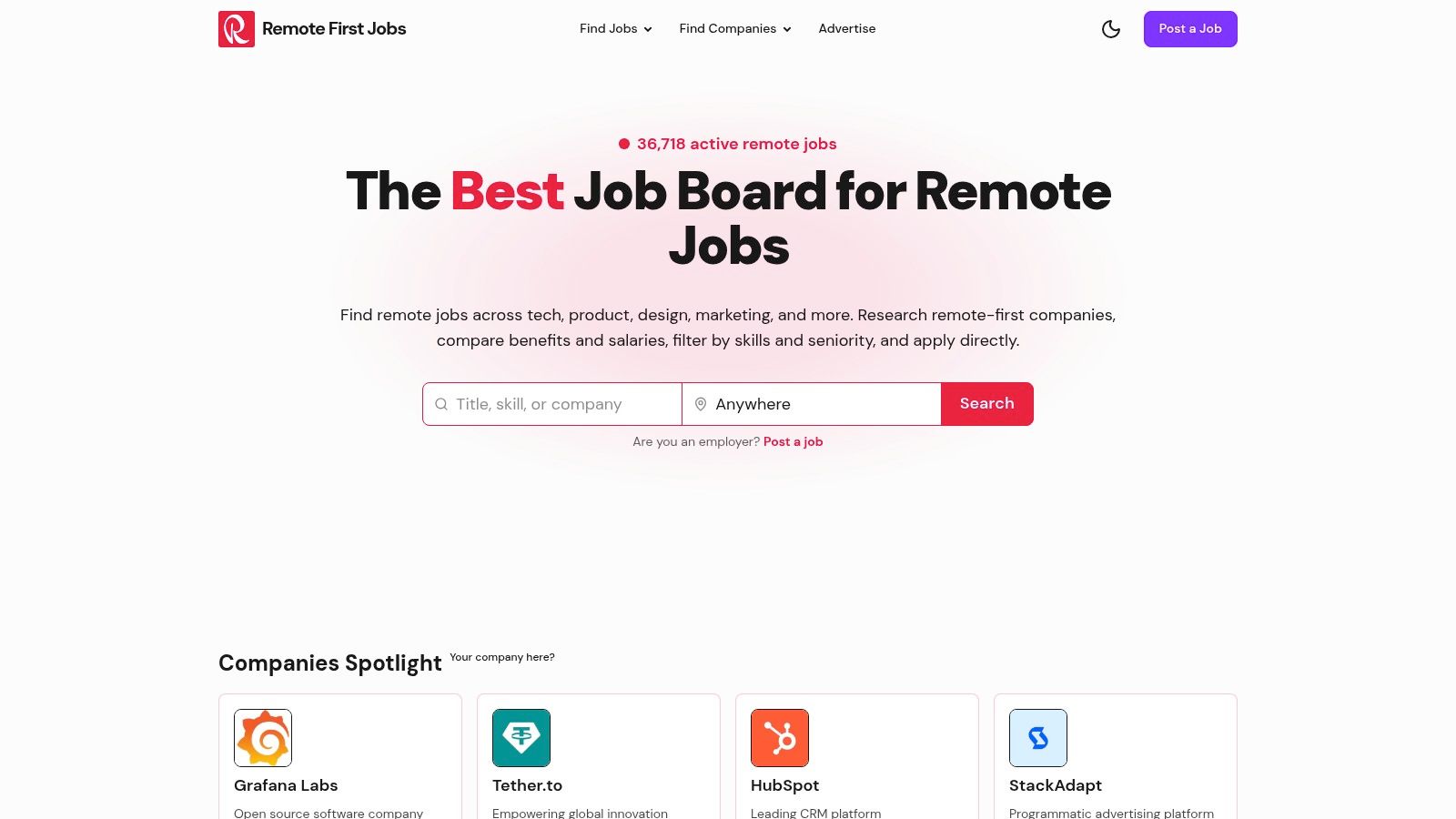
When searching for remote jobs hiring now, the sheer volume of listings can be overwhelming. Remote First Jobs distinguishes itself as a premier destination by focusing exclusively on verified, remote-first opportunities, providing a signal-rich environment for serious job seekers. The platform is engineered to eliminate the noise common on larger, more generalized job boards, making it an essential tool for professionals dedicated to a remote career path.
Its core strength lies in a massive, curated database. With over 40,000 live vacancies aggregated from more than 20,000 companies, the platform offers significant breadth and depth. Crucially, its automated system scans company career pages daily, ensuring the listings are fresh and filtering out spam, duplicate posts, and outdated roles. This commitment to quality and recency means you spend less time sifting and more time applying to high-potential openings.
Why Remote First Jobs Stands Out
The platform’s user experience is designed for efficiency and precision. Job seekers can immediately dive into searching without the friction of mandatory sign-ups. Applications are handled directly on the employer’s website, which maintains transparency and ensures your application goes straight to the source. The platform features some of the most respected names in the remote work space, including HubSpot, MongoDB, and Cloudflare, which serves as strong social proof of the quality of employers you’ll find.
For those wanting to understand the nuances of this work model, the site provides valuable resources. You can explore a detailed explanation of what truly defines a remote-first culture by checking out their guide: Learn more about the remote-first company model on remotefirstjobs.com.
Key Features and User Experience
Remote First Jobs excels with its powerful and granular search functionality. Users can filter roles far beyond simple keywords, targeting jobs by specific skills, seniority level, industry, and even time zone compatibility, a critical factor for successful global remote work.
- Advanced Filtering: Zero in on the perfect role by filtering for titles, specific tech stacks (e.g., “React,” “Python”), seniority (e.g., “Senior,” “Lead”), and required time zone overlap.
- Frictionless Access: Search, browse, and apply to jobs without creating an account. This direct-to-employer application process is streamlined and respects user privacy.
- Job Alerts & Saved Searches: While optional, you can sign up to save specific jobs and create priority alerts, ensuring you never miss a new opening that matches your precise criteria.
- Company Insights: Go beyond the job description by researching company profiles, benefit packages, and salary data directly on the platform, enabling more informed application decisions.
Employer-Side Benefits
For companies looking to hire, the platform offers a compelling value proposition. It emphasizes transparent pricing without hidden fees and provides tools designed for rapid talent acquisition. Features like automatic job importing, featured placements for higher visibility, and social media promotion help employers connect with a highly targeted audience of remote-ready professionals quickly and efficiently.
Platform Breakdown
| Feature | For Job Seekers | For Employers |
|---|---|---|
| Cost & Access | 100% Free; no sign-up required to search and apply. | Transparent pricing for job posts, featured placement, and promotion. |
| Core Functionality | Advanced search filters, direct application links, job alerts, company research. | Fast posting via automatic import, enhanced visibility options, social promotion. |
| Unique Selling Point | A massive, curated, and spam-free inventory of exclusively remote-first job openings. | Direct access to a targeted pool of candidates actively seeking remote roles. |
| Primary Drawback | No integrated application tracking system; applications are managed externally. | Premium pricing details may require direct contact with the sales team. |
By prioritizing quality over quantity and building a user-centric experience, Remote First Jobs has established itself as a top-tier resource for anyone serious about finding their next great remote role.
Website: https://remotefirstjobs.com
2. Indeed
Indeed operates as one of the largest job aggregators globally, making it a powerful tool for anyone searching for remote jobs hiring now. Its sheer volume of listings, pulled from thousands of company career pages and job boards, provides an unparalleled inventory of opportunities updated in real-time. This scale is Indeed’s primary advantage, ensuring that if a remote job is posted online, there’s a high probability it will appear in their search results.
The platform is free for job seekers and designed for efficiency. Its user interface, while comprehensive, is straightforward. You can immediately filter for remote positions, specific salary ranges, experience levels, and job types. This allows for a highly customized search experience right from the homepage.
Why It Stands Out
Indeed’s primary differentiator is its massive scale combined with robust, user-friendly tools. The “Easily Apply” feature simplifies the application process significantly, allowing users to submit a pre-saved resume and profile to multiple openings with just a few clicks. This is a crucial time-saver when applying to numerous roles.
Furthermore, Indeed integrates valuable company information directly into its listings. You can access employee reviews, salary data, and Q&A sections on company pages, providing a holistic view of a potential employer before you even apply. For a more detailed comparison of how its features stack up against other platforms, you can learn more about Indeed on remotefirstjobs.com.
Actionable Tips for Using Indeed
To maximize your success on Indeed, leverage its powerful alert system. Don’t just perform a one-time search; save your customized search queries for remote roles and activate daily email alerts. This ensures new and relevant job postings are delivered directly to your inbox as soon as they become available.
Another key tip is to refine your resume specifically for the platform. When using the “Easily Apply” feature, your Indeed Resume is often what recruiters see first. Ensure it is complete, keyword-optimized for your target roles, and highlights remote work competencies like self-management and communication skills.
Pros and Cons
| Pros | Cons |
|---|---|
| Massive volume of U.S. remote job listings. | Variable posting quality and some duplicate listings. |
| “Easily Apply” feature streamlines the application process. | Some roles redirect to external applicant tracking systems (ATS). |
| Free access with powerful saved search and alert functions. | The sheer volume can sometimes feel overwhelming to navigate. |
| Integrated company reviews and salary data for research. | Less curated than niche remote-specific job boards. |
Website: Indeed Remote Jobs
3. LinkedIn Jobs
LinkedIn Jobs transcends the traditional job board model by integrating its powerful professional networking capabilities directly into the search process. This makes it an essential destination for finding remote jobs hiring now, as it combines a massive inventory of listings with unparalleled insights into the people and companies behind them. Its platform allows you to see not just the job, but also potential connections, alumni from your school, and the hiring manager’s profile.
The platform is free for all members, though a premium subscription unlocks additional features. Its interface is clean and seamlessly integrated into the main LinkedIn experience. You can easily filter for remote, hybrid, or on-site roles, set salary expectations, and define experience levels. The sheer volume is impressive, with hundreds of thousands of remote positions in the U.S. alone at any given time.
Why It Stands Out
LinkedIn’s core differentiator is its unique blend of job discovery and professional networking. You aren’t just applying into a void; you can see if you have a first or second-degree connection at the company who could provide a referral. The platform often highlights jobs where you are a “top applicant” based on your profile skills, and the “Easy Apply” feature lets you submit your LinkedIn profile and a resume in seconds.
Additionally, LinkedIn provides valuable applicant insights, showing how you stack up against other candidates who have applied. This data, combined with direct access to recruiter profiles, empowers you to tailor your application and outreach more effectively. For a deeper dive into optimizing your presence, you can learn more about how to optimize your LinkedIn profile on remotefirstjobs.com.
Actionable Tips for Using LinkedIn Jobs
First, make your profile a powerful magnet for recruiters. Ensure it is 100% complete and set your status to “Open to Work,” specifying your interest in remote roles. This signals to recruiters using LinkedIn’s talent tools that you are an active candidate. To truly stand out, it helps to understand how recruiters actively seek candidates; explore these effective 7 Recruiter LinkedIn Tricks to Source Top Talent to see the process from their perspective.
Second, go beyond passive searching. Use the “Jobs” tab to set up multiple, specific job alerts for different remote roles and keywords. When you find a compelling opportunity, don’t just hit “Apply.” Visit the company’s page, follow them, and engage with their recent posts. If possible, identify the hiring manager or a relevant team member and send a brief, professional connection request or InMail message expressing your interest.
Pros and Cons
| Pros | Cons |
|---|---|
| Combines job search with professional networking. | Access requires a LinkedIn account sign-in. |
| “Easy Apply” functionality simplifies submissions. | Some advanced features are behind the LinkedIn Premium paywall. |
| Visibility into referrals and recruiter outreach via your network. | The high volume includes mixed-quality listings that require vetting. |
| Strong discovery through recommendations and saved search alerts. | “Easy Apply” can lead to a high volume of applicants per role. |
Website: LinkedIn Remote Jobs
4. FlexJobs
FlexJobs operates on a premium, membership-based model, positioning itself as a highly curated and secure platform for finding remote jobs hiring now. Unlike massive aggregators, its core value proposition is quality over quantity. Every single job listing is hand-screened by a human researcher to verify its legitimacy, ensuring that users encounter only professional, scam-free remote, hybrid, and flexible opportunities.
This focus on verification makes it an ideal choice for job seekers who are wary of fraudulent postings and want to save time sifting through low-quality or “scammy” ads. While it requires a subscription to view full job details and apply, the platform offers a layer of trust and provides access to well-vetted roles across more than 50 career categories.
Why It Stands Out
FlexJobs’ primary differentiator is its commitment to a scam-free experience through human vetting. This meticulous screening process eliminates the noise common on larger, free job boards. The platform isn’t just a job board; it’s a comprehensive career service. Members gain access to exclusive content, skills tests, resume reviews, and career coaching webinars designed to help them succeed in the remote job market.
Additionally, the platform’s money-back satisfaction guarantee provides a risk-free way for new users to test the service. This confidence in its own value, combined with robust support resources, sets it apart as a premium service for serious job seekers. You can learn more about how FlexJobs ensures the safety of its listings on remotefirstjobs.com.
Actionable Tips for Using FlexJobs
To get the most out of your subscription, go beyond just browsing and applying. Take full advantage of the member resources. Participate in the webinars on remote interviewing and complete the skills tests relevant to your field. These completed tests are displayed on your profile, providing tangible proof of your abilities to potential employers.
Another effective strategy is to create multiple saved search alerts with different keyword combinations and filters. For example, create one alert for “Remote Marketing Manager” and another for “Work-from-Anywhere Content Strategist.” This broadens your net and ensures you’re notified immediately when a highly relevant, hand-vetted role becomes available.
Pros and Cons
| Pros | Cons |
|---|---|
| Human-screened listings virtually eliminate scams and ads. | Requires a paid membership to view and apply for jobs. |
| High-quality, professional opportunities across many industries. | Smaller volume of listings compared to free aggregators like Indeed. |
| Access to career coaching, skills tests, and webinars. | Some users may prefer not to pay for job search access. |
| Money-back satisfaction guarantee reduces risk for new users. | The best deals often require longer-term subscription commitments. |
Website: FlexJobs
5. We Work Remotely
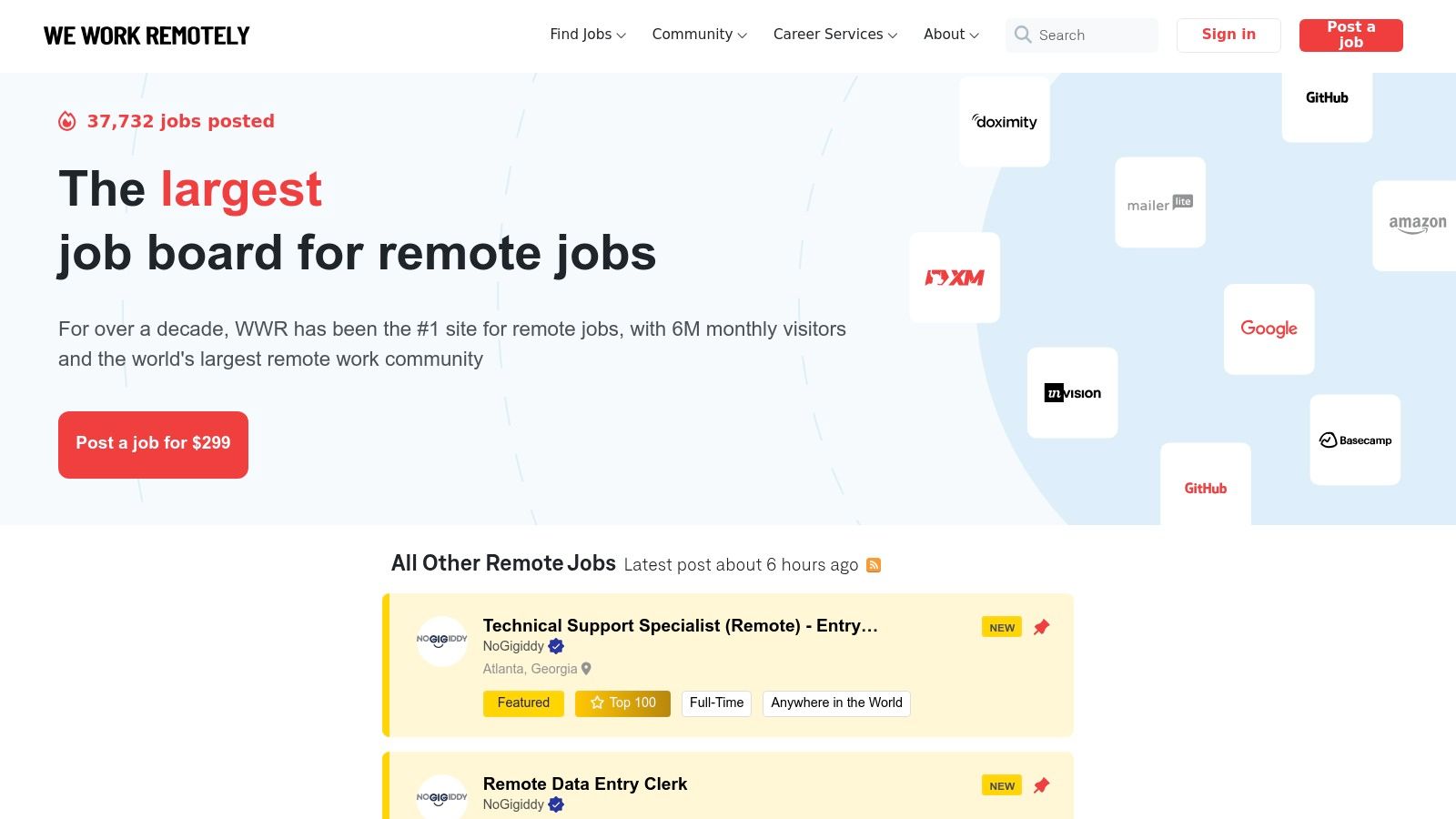
We Work Remotely (WWR) is one of the original and largest communities dedicated exclusively to remote work, making it a cornerstone for finding high-quality remote jobs hiring now. Unlike massive aggregators, WWR is a curated job board focused on roles in tech, marketing, support, product, and operations. Its remote-first ethos ensures every listing is genuinely location-independent, saving you from filtering out hybrid or location-specific positions.
The platform is designed for clarity and simplicity. Job seekers can browse for free, and the interface categorizes roles logically, such as Programming, Design, and Customer Support. This curated feed provides a high signal-to-noise ratio, connecting applicants with companies that are deeply invested in remote culture.
Why It Stands Out
We Work Remotely’s key differentiator is its strict remote-only curation combined with a direct application process. Most listings link directly to the employer’s website or an email address, bypassing the often impersonal applicant tracking systems (ATS) common on larger platforms. This direct line can lead to a more personal and effective application experience.
Additionally, WWR uses tags like “Featured” and highlights companies in their “Top 100” remote companies list, giving job seekers clear indicators of highly active and committed remote employers. For those seeking roles in the U.S., jobs are often clearly labeled, simplifying the search for eligible positions within a global marketplace.
Actionable Tips for Using We Work Remotely
To get the most out of We Work Remotely, subscribe to their daily or weekly email digests for your preferred categories. Given the curated nature of the board, new top-tier jobs can get significant attention quickly, so being among the first to see a new posting is a distinct advantage.
Pay close attention to the job descriptions and application instructions. Since you’re often applying directly, take the time to tailor your cover letter and resume specifically to the company’s stated needs and culture. Mentioning you found the role on We Work Remotely can also show you are actively engaged in the remote work community.
Pros and Cons
| Pros | Cons |
|---|---|
| Highly focused on 100% remote roles, no hybrid listings. | Not all listings are U.S.-only; requires filtering. |
| Direct application links often bypass third-party ATS. | Fewer non-tech roles compared to general job boards. |
| Good signal-to-noise ratio for tech and startup positions. | The most desirable jobs can be highly competitive. |
| Clean interface with clear categories for easy browsing. | No integrated company reviews or salary data on the platform. |
Website: We Work Remotely
6. Glassdoor
Glassdoor offers a unique, dual-purpose platform for job seekers by integrating extensive remote jobs hiring now with a massive database of user-generated company insights. This approach allows you to not only find job openings but also to thoroughly vet potential employers through salary data, company reviews, and interview feedback all in one place. Its value lies in providing the transparency needed to make informed career decisions before you even apply.
The platform is free for users who contribute content, such as a salary or a company review, and its interface is built to consolidate information efficiently. You can easily filter job searches for remote positions and then further refine them by company rating, salary range, and job type. This layered filtering helps prioritize opportunities at companies known for positive work environments.
Why It Stands Out
Glassdoor’s key differentiator is its emphasis on employer transparency. While other job boards list openings, Glassdoor enriches each listing with real employee feedback on culture, leadership, and compensation. You can see what current and former employees think about a company’s work-life balance or career growth opportunities, which is invaluable when assessing a remote role.
This consolidated view of a job posting alongside candid reviews and detailed salary reports provides a powerful research tool. You can gauge if a company’s advertised culture aligns with reality, and the “Easy Apply” option simplifies the submission process for many roles. For a deeper dive into using this kind of data, you can learn more about how to evaluate job offers on remotefirstjobs.com.
Actionable Tips for Using Glassdoor
To get the most out of Glassdoor, use its data to build a target list of companies. Instead of just searching for jobs, search for highly-rated remote-friendly companies first. Follow these companies to receive alerts when they post new remote positions that match your skills. This proactive approach ensures you’re applying to employers with a proven track record.
Additionally, leverage the interview feedback section. Before an interview, search the company’s Glassdoor page for interview questions and experiences shared by other candidates who applied for similar roles. This gives you a significant advantage by allowing you to prepare for specific technical questions, behavioral scenarios, and the overall interview format.
Pros and Cons
| Pros | Cons |
|---|---|
| Strong transparency on salary, culture, and benefits. | The recency and quality of review data can vary by company. |
| Consolidated view of a role, pay, and employer sentiment. | Some job postings redirect to external applicant tracking systems (ATS). |
| “Easy Apply” option for streamlined applications. | Access to some features requires you to contribute your own data. |
| Interview insights and questions from previous candidates. | Job listings may not be as voluminous as larger aggregators. |
Website: Glassdoor Remote Jobs
7. ZipRecruiter
ZipRecruiter operates as a powerful job marketplace known for its smart matching technology and speed, making it a strong contender for those seeking remote jobs hiring now. Its platform is engineered to connect job seekers with relevant opportunities quickly, leveraging AI to send personalized job recommendations directly to users. This focus on efficiency is ideal for job seekers who want to act fast on new remote openings.
The platform is free for job seekers and emphasizes a streamlined user experience, particularly on mobile devices. After creating a profile and uploading a resume, its algorithm starts working immediately to match your skills with employer needs. You can easily filter for remote or work-from-home positions, and the interface is designed to get you from searching to applying in as few steps as possible.
Why It Stands Out
ZipRecruiter’s key differentiator is its “1-Click Apply” feature and proactive job matching. The platform doesn’t just wait for you to search; it actively pushes curated remote jobs to you via email and mobile alerts. This is particularly valuable in a competitive market where being among the first applicants can provide a significant advantage. The system learns from the jobs you view and apply to, refining its recommendations over time.
Additionally, its broad U.S.-centric employer network means it often surfaces a high volume of domestic-eligible remote roles. While other platforms might have a more global focus, ZipRecruiter’s concentration on the U.S. market can be a benefit for job seekers who need or prefer to work for U.S.-based companies. This makes it a great tool for a high-volume, targeted application strategy.
Actionable Tips for Using ZipRecruiter
To make the most of ZipRecruiter, ensure your profile is 100% complete and rich with keywords relevant to your target remote roles. The platform’s matching algorithm relies heavily on the information in your profile and resume to send you opportunities. Include terms like “remote,” “work from home,” “distributed team,” and specific software or skills related to your field.
Take full advantage of the alert system. Set up multiple, specific alerts for different types of remote jobs (e.g., “Remote Marketing Manager,” “Work from Home Customer Support”). The platform’s instant notifications allow you to apply the moment a new role is posted, which is crucial for positions listed as “hiring now” or “urgently hiring.”
Pros and Cons
| Pros | Cons |
|---|---|
| “1-Click Apply” feature enables rapid application. | Less in-depth company review and salary data than competitors. |
| Smart matching AI sends personalized remote job alerts. | Can have duplicate listings that appear on other job boards. |
| Strong focus on U.S.-based remote jobs. | The interface is built for speed, not deep company research. |
| Excellent mobile app and instant notification system. | Quality of job descriptions can vary significantly by poster. |
Website: ZipRecruiter Remote Jobs
Top 7 Remote Job Platforms Comparison
| Platform | 🔄 Complexity & resources | ⚡ Speed/efficiency | 📊 Expected outcomes | 💡 Ideal use cases | ⭐ Key advantages |
|---|---|---|---|---|---|
| Remote First Jobs | Low — no sign-up for seekers; employer tools available | Fast discovery; daily scans and direct links | High relevance — large, de-duplicated remote inventory | Searching exclusively for remote-first roles; company research | Large vetted feed, granular filters, free for job seekers |
| Indeed | Low — simple user flow; open marketplace resources | Fast — “Easily apply” and frequent updates | High volume leads; variable quality & duplicates | Broad U.S. remote search and high-volume applying | Massive listings, strong filters, resume upload |
| LinkedIn Jobs | Medium — requires account; profile-driven features | Moderate — “Easy Apply”; networking adds speed variance | Good quality matches with referral potential | Networking-focused job hunting and recruiter outreach | Job + networking integration; applicant insights |
| FlexJobs | Medium–High — paid membership; curated screening resources | Moderate — fewer listings but vetted so less rework | Higher-quality, lower-scam results; smaller volume | Prioritizing legitimacy, coaching, and curated roles | Human-vetted listings and career support resources |
| We Work Remotely | Low — simple board; minimal friction | Fast — many direct-to-employer applications | Good match for tech/startup remote roles | Tech, product, design, ops roles at remote-first companies | Remote-only focus and high signal-to-noise for tech |
| Glassdoor | Low — free search with review data | Moderate — “Easy Apply” but external redirects occur | Better vetting with pay/reviews; variable review recency | Vetting pay and culture alongside job listings | Integrated salary, reviews, and interview insights |
| ZipRecruiter | Low — user-friendly; employer network backup | Very fast — 1-Click Apply and instant alerts | Rapid matches; fewer deep company details | Quickly respond to newly posted remote roles | Smart matching, fast apply, strong alerting system |
Your Next Remote Role Is Waiting
The landscape of work has fundamentally shifted, and the abundance of remote jobs hiring now confirms that this change is here to stay. Navigating this vast digital terrain can feel overwhelming, but as we’ve explored, the right set of tools can transform a daunting search into a targeted, strategic mission. Your journey to landing a fulfilling remote career isn’t about applying everywhere; it’s about applying smarter by leveraging platforms that align with your specific needs and career aspirations.
We’ve seen how massive aggregators like Indeed and LinkedIn Jobs offer unparalleled volume, making them essential for casting a wide net and understanding market trends. Simultaneously, specialized platforms like FlexJobs and We Work Remotely provide curated lists that cut through the noise, ensuring every listing is genuinely remote. This dual approach, combining breadth with precision, is the cornerstone of an effective modern job search.
Synthesizing Your Strategy for Success
To truly capitalize on the opportunities available, you must move beyond passive browsing. The key takeaway is to build a multi-platform strategy that leverages the unique strengths of each tool. Don’t just rely on a single source.
- For Curated Quality: Start with a dedicated remote job board like Remote First Jobs. Use its advanced filters for timezone, seniority, and tech stack to create a highly targeted list of ideal roles. This should be your primary, high-intent application hub.
- For Market Insights & Networking: Use LinkedIn not just for its job board, but as a dynamic tool for professional branding and networking. Follow target companies, connect with hiring managers, and engage with industry content. This proactive approach can uncover opportunities before they are even publicly listed.
- For Due Diligence: Before you apply, use Glassdoor to vet company culture, salary expectations, and employee satisfaction. This crucial step ensures you’re not just finding a job, but a workplace where you can thrive. A high salary means little if the work environment is toxic.
By integrating these tools, you create a powerful, self-reinforcing loop. You find a promising role on a specialized board, research the company on Glassdoor, and connect with a team member on LinkedIn. This comprehensive method demonstrates genuine interest and positions you as a standout candidate.
Actionable Next Steps to Land Your Remote Job
Information without action is just noise. To turn this guide into your next job offer, here are your immediate next steps:
- Define Your Non-Negotiables: What are your absolute must-haves? Is it a specific timezone overlap, a four-day work week, or a minimum salary? Write these down and use them as your primary filters.
- Set Up Strategic Alerts: Don’t just set one alert for “remote software engineer.” Create multiple, highly specific alerts across different platforms. For example: “Remote Senior Python Engineer, EMEA Timezone” on one platform and “Lead Product Designer, Asynchronous” on another.
- Prepare Your Application Materials: Tailor your resume and cover letter for each application, using keywords from the job description. Once you’ve identified promising opportunities, it’s crucial to prepare for phone interview questions, a common first step in remote hiring. Being ready for this stage can make a significant difference.
The search for remote jobs hiring now is an active, not a passive, process. The tools and strategies outlined in this article are your roadmap. The destination, a remote role that offers the flexibility, challenge, and fulfillment you deserve, is well within reach. It’s time to stop scrolling and start applying with intention. Your next great opportunity is just a few clicks away.
Ready to cut through the noise and find verified, high-quality remote roles? Remote First Jobs offers a curated, spam-free experience with advanced filters designed specifically for remote work. Stop wasting time on irrelevant listings and start your targeted search on Remote First Jobs today.