Ever heard someone described as “a natural leader” or “incredibly driven”? Chances are, what you’re really seeing are top-notch self-management skills in action.
At its core, self-management is your ability to take the reins—to direct your own actions, thoughts, and emotions to hit your goals, both in your career and in life, without someone constantly looking over your shoulder. It’s that powerful mix of accountability, initiative, and focus that lets you steer your own ship instead of just being a passenger.
What Are Self Management Skills Really

Think of it this way: you are the CEO of your own career. A great CEO doesn’t just sit around waiting for the board to hand them a to-do list. They set the vision, manage the company’s resources, and tackle problems head-on to drive success. That’s exactly what self-management empowers you to do for yourself—take true ownership of your work, your growth, and your professional journey.
These aren’t just fluffy “soft skills.” They’re the real, practical behaviors that dictate how you plan your day, handle unexpected stress, and push projects across the finish line. They are the operational engine that fuels high performance, especially in roles that demand a ton of autonomy, like most remote jobs today.
Self-regulation can be described as the ability to manage thoughts, feelings, and behaviors in service to one’s goals. The ability to enact these skills develops gradually and continues to develop during and after adolescence.
The great news? This means anyone can get better at it with a little intentional effort. It’s not about maintaining some rigid, perfect schedule. It’s about building the resilience and discipline to stay on track, even when distractions and setbacks inevitably pop up.
The Core Pillars of Self Management
When you break it down, self-management really stands on a few key pillars that all work together. Getting a handle on these components is the first step to mastering the entire skill set. For instance, emotional regulation is a huge piece of the puzzle. You can get a better sense of this by reading up on what is emotional intelligence at work and how it shapes your professional life.
To get started, let’s take a quick look at the fundamental skills that form the foundation of effective self-management.
The Core Pillars of Self Management
A quick look at the fundamental skills that form the foundation of effective self-management.
| Pillar | What It Means for You | Why It Matters at Work |
|---|---|---|
| Time Management | You’re the master of your clock, consciously planning how to split your time between different tasks. | This is how deadlines get met and priorities stay crystal clear, preventing last-minute chaos. |
| Accountability | You own your work—the good, the bad, and the ugly. It’s about taking responsibility for your actions and their results. | This is the bedrock of trust. When colleagues and managers know you’re reliable, collaboration becomes seamless. |
| Adaptability | You can pivot without panicking, adjusting your approach when new information or unexpected challenges arise. | In a fast-moving work world, this is crucial for navigating change and creatively solving problems on the fly. |
Each of these pillars supports the others, creating a solid framework that allows you to perform at your best, no matter where you’re working from.
Why Self-Management Is Your Career Superpower
Let’s be honest: self-management isn’t just about color-coding your calendar or making a to-do list. It’s the engine that powers your entire career. These skills are what separate the task-doers from the indispensable contributors—the people who get promoted, handed leadership roles, and genuinely love what they do.
Think of it this way: every time you demonstrate accountability and initiative, you’re depositing currency into a workplace bank account. The currency? Trust. Soon enough, managers see you as the go-to person for high-stakes projects. Your peers view you as a reliable partner, making you the obvious choice for exciting collaborations and, eventually, leadership opportunities.
The Real-World Impact on Your Career Path
Picture two employees. One waits for their manager to hand them a list, gets thrown off by unexpected problems, and struggles to meet deadlines without constant check-ins. The other proactively spots what needs doing, manages their time like a pro, and navigates challenges with a cool head.
Who do you think gets ahead? The second employee isn’t just more productive; they’re building a rock-solid reputation for reliability and resilience. That reputation is what earns them more freedom, bigger responsibilities, and a much faster climb up the ladder. They become the person everyone relies on, not because they were told to be, but because their actions proved they were capable.
When these skills are missing, the impact is huge. A Gallup study found that a staggering 13% of employees worldwide feel engaged at work. A lot of that disengagement traces back to poor self-management, both from individuals and their leaders. It shows just how much your personal discipline can ripple out and affect the entire organization. You can dive deeper into mastering self-management skills for leaders on any.do.
The single biggest difference between an employee who gets by and an employee who gets ahead is the ability to manage oneself. It’s the silent skill that speaks volumes about your potential.
From Employee to Indispensable Asset
Ultimately, developing strong self-management skills changes your entire professional identity. You stop being someone who just has a job and become someone who truly owns their role. And that sense of ownership? That’s your career superpower.
It gives you the ability to:
- Navigate ambiguity with confidence: You don’t need a step-by-step manual for everything.
- Drive results without constant oversight: Your boss knows the work will get done, and done well—a massive advantage in remote work.
- Build momentum for your whole team: Your focus and discipline are contagious.
Instead of waiting for opportunities to fall into your lap, your self-management skills put you in a position to create them. You’re building a career on the unshakeable foundation of competence and dependability, making you an invaluable asset no matter where you work.
The Seven Essential Self-Management Skills to Master

Knowing what self-management is in theory is great, but the real magic happens when you break it down into tangible skills you can actually work on. Think of self-management not as one single trait, but as a master skill built from several crucial, interconnected abilities. When you strengthen one, you strengthen them all, giving you a much firmer grip on your professional life.
Let’s dive into the seven core skills that form the bedrock of great self-management.
Time Management
This is so much more than just making a to-do list. Real time management is about learning to prioritize tasks based on their actual importance, not just how loud they’re screaming for your attention. It’s about consciously directing your most finite resource—your time—toward the things that will make the biggest impact.
Someone with solid time management skills can look at a project and give a realistic estimate of how long it will take, set firm deadlines, and fiercely protect their focus from the constant barrage of distractions. They’ve learned that being busy and being productive are two very different things. For a much deeper look, our guide on how to improve time management skills is packed with strategies you can start using today.
Emotional Intelligence
Often called EI, emotional intelligence is your ability to recognize your own feelings and keep them in check, while also understanding what makes others tick. It’s the little voice that stops you from firing off a reactive email or getting defensive when someone offers you constructive feedback.
Having a high EI helps you stay cool under pressure, handle tricky workplace dynamics with grace, and build genuinely strong connections with your colleagues. It’s a bigger blind spot than most of us realize; research from Harvard found that while 95% of people think they’re self-aware, only about 10-15% actually are. That’s a huge gap to close.
Adaptability
The modern workplace—especially a remote one—is constantly changing. Adaptability is your ability to roll with the punches when priorities shift, a project suddenly changes direction, or unexpected roadblocks pop up. It’s about seeing change as an opportunity, not a threat.
An adaptable person isn’t thrown off course by a last-minute client request. Instead, they quickly recalibrate, communicate the new plan to their team, and find a different way to get to the finish line. This kind of flexibility is absolutely essential for solving problems and keeping projects moving forward.
Stress Management
Among the essential self-management skills to master, knowing some effective workplace stress management techniques is non-negotiable for staying healthy and productive. This skill is all about pinpointing your personal stress triggers and building a toolkit of healthy coping mechanisms so you can handle pressure without burning out.
Stress management isn’t about eliminating stress—it’s about responding to it effectively. It’s the difference between feeling overwhelmed and feeling challenged.
This could mean setting firm boundaries around your workday, practicing mindfulness, or just making sure you take real breaks. When you manage stress well, you can perform at your best consistently, even when the pressure is on.
Goal Setting
You can’t manage yourself effectively if you don’t know where you’re going. Goal setting is the art and science of defining clear, specific objectives for yourself—think SMART goals (Specific, Measurable, Achievable, Relevant, and Time-bound). It gives you the “why” that fuels your daily tasks.
This isn’t just about dreaming big; it’s about breaking those huge ambitions down into small, actionable steps. By setting clear goals, you’re essentially drawing a map for yourself that guides your decisions and keeps you motivated for the long haul.
Accountability
Accountability is all about taking complete ownership of your work, your decisions, and the results—both the wins and the losses. It means you don’t point fingers or make excuses when something goes sideways. Instead, you focus on finding a solution and learning from what happened.
This one skill builds an incredible amount of trust with your team and your manager. When people know you’re accountable, they know they can depend on you to follow through. That makes you an incredibly valuable part of any team.
Initiative
Last but not least, there’s initiative. This is the inner drive to be proactive. It’s about spotting an opportunity or a potential problem and stepping up to do something about it without waiting for someone to tell you to.
Whether you’re volunteering for a tough new project, suggesting a way to improve a clunky process, or just tackling a task before it becomes an emergency, taking initiative shows that you’re invested and thinking ahead. It proves you’re a contributor, not just a follower, and it’s the engine that powers real growth.
Putting Self Management into Practice
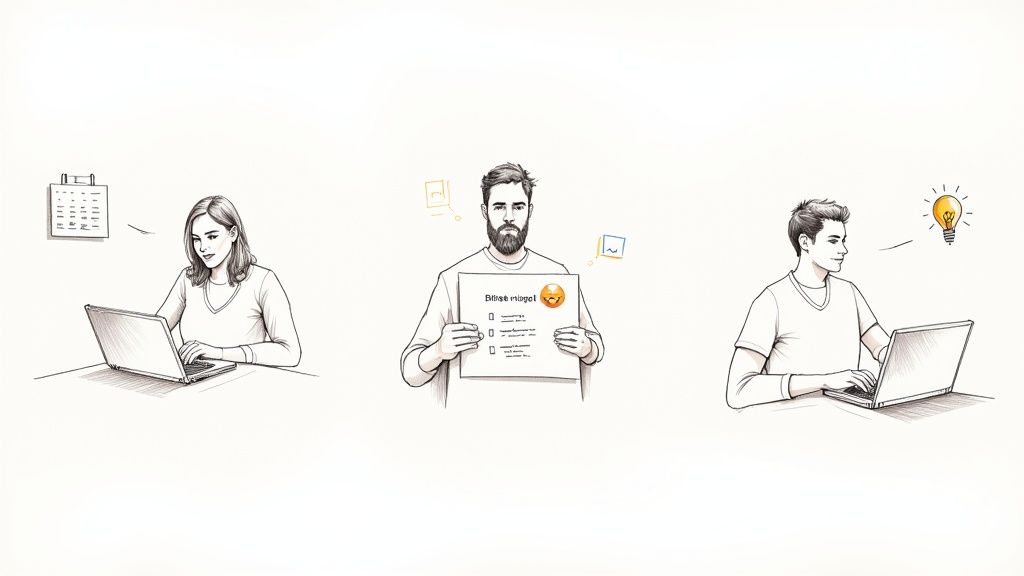
Knowing the theory is one thing, but seeing these skills play out in the real world is where it all clicks. Self-management isn’t about abstract concepts—it’s the collection of day-to-day habits that actually get things done.
Let’s look at how a few different professionals use these skills to navigate tricky situations. By seeing these principles in action, you can start to imagine how you’d handle similar challenges when the pressure is on.
And make no mistake, this isn’t some new corporate buzzword. Employers have valued these skills for decades. A review of studies from 2000 to 2009 found self-management was one of the ten most-cited employability skills globally, right up there with teamwork and problem-solving. You can dig into these long-standing employer expectations in this comprehensive review.
Scenario One The Remote Marketing Specialist
Picture Sarah, a remote marketing specialist juggling three major campaign launches at once. The deadlines are tight, and stakeholders from every corner of the company are pinging her for updates. This is where her self-management skills become her superpower.
- Time Management: Instead of getting pulled in a million directions, Sarah uses time-blocking. She carves out specific, protected chunks of time in her calendar for each campaign’s creative work, guaranteeing she has the deep focus needed to do great work.
- Initiative: She spots a potential bottleneck coming up with the graphic design approvals. Rather than waiting for it to become a fire she has to put out, she proactively creates a shared tracking doc and schedules a quick daily check-in to keep things moving. She solved a problem before anyone else even knew it existed.
This isn’t just about getting work done; it’s about taking ownership. That kind of proactive thinking is pure gold in a remote environment. If you want to sharpen your own focus, check out our guide on productivity tips for working from home.
Scenario Two The Junior Employee with a New Challenge
Now, let’s think about Alex, a junior employee who just got handed a complex project that’s way outside their comfort zone. The initial feeling? Total overwhelm.
Instead of waiting for step-by-step instructions, a self-managed employee sees this as a growth opportunity. Their actions demonstrate a commitment to learning and problem-solving.
Here’s how Alex breaks it down:
- Goal Setting: They take that big, scary project and slice it into smaller, manageable milestones. Each piece gets its own mini-deadline, turning a mountain into a series of small, climbable hills.
- Accountability: Alex inevitably hits a roadblock. Instead of hiding it and hoping for the best, they immediately flag it to their manager. They explain the problem, walk through the solutions they’ve already tried, and ask for specific guidance. This shows they own not just the task, but the entire learning process.
In both of these stories, Sarah and Alex aren’t just reacting. They’re steering. They’re anticipating needs, taking responsibility for the outcome, and driving their own work forward. That, right there, is what self-management looks like in the wild.
How to Showcase Your Self Management Skills
Putting in the work to build strong self-management skills is a huge personal win. But let’s be honest—it doesn’t do much for your career unless employers can actually see it. You have to find a way to make these abilities tangible, turning abstract ideas like “initiative” and “accountability” into solid proof of your value.
This is where you move beyond just listing skills on a resume. The real goal is to demonstrate them through powerful stories and results, both on paper and in person. You need to show, not just tell, hiring managers that you’re the kind of reliable, proactive professional who can drive their own success without needing their hand held.
Weave Your Skills into Your Resume
Your resume is your first handshake, so it’s the perfect place to start weaving in your self-management abilities. Forget the generic skills section; the real magic happens when you embed these traits directly into your professional experience bullet points.
Let’s look at a quick before-and-after.
- Before: “Responsible for managing social media campaigns.”
- After: “Independently managed three social media campaigns from concept to completion, exceeding engagement targets by 15% by proactively adjusting content strategy based on real-time analytics.”
See the difference? The second example screams initiative, accountability, and goal orientation without ever using those buzzwords. To really nail this, you need to understand what recruiters look for in resumes. And for remote roles specifically, check out our guide on crafting a killer resume for remote jobs for more tailored strategies.
Tell Compelling Stories in Interviews
An interview is your chance to bring the words on your resume to life. The absolute best way to do this is by telling a story, and the STAR method is your go-to framework for making it count.
The STAR method (Situation, Task, Action, Result) is a game-changer. It helps you turn your experiences into memorable narratives that prove your competence. Instead of just making claims, you provide a clear, structured story that shows how you solve real problems and get things done.
Here’s a breakdown of how it works:
- Situation: Quickly paint the picture. “Our team was staring down a tight deadline for a huge project when one of our key developers had to take unexpected leave.”
- Task: Explain what you were up against. “I had to absorb their critical tasks and make sure we didn’t miss our launch date.”
- Action: Describe the specific, proactive steps you took. “I immediately re-prioritized the entire task list, spent a weekend teaching myself a new software tool to fill the gap, and started daily 15-minute check-ins to keep the rest of the team in sync.”
- Result: Share the awesome, quantifiable outcome. “Because of that, we actually delivered the project two days ahead of schedule and the client was thrilled.”
This simple formula provides undeniable proof of your self-management skills. It makes you a far more convincing—and memorable—candidate than someone who just says, “I’m a good problem-solver.”
Your Action Plan for Better Self Management
Knowing what self-management skills are is one thing, but real growth happens when you start putting that knowledge to work. Developing these abilities isn’t some dramatic, overnight transformation. It’s all about making small, consistent efforts that build on each other over time.
This isn’t just a nice-to-have, either. The World Economic Forum’s Future of Jobs Report points out that skills like resilience and flexibility are quickly becoming must-haves for employers. The report also found that around 50% of workers are already jumping into skills training to keep up. The message is clear: continuous self-improvement is the new standard. You can dig into all the details in the full report on crucial future skills from the World Economic Forum.
Start With an Honest Self-Assessment
Before you can get better, you have to know where you stand. You can’t chart a course to your destination if you don’t know where you are on the map. It’s time for some honest reflection to pinpoint your strengths and the areas that could use a little more attention.
Try asking yourself a few direct questions to get the ball rolling:
- Time Management: When am I actually in the zone and getting things done? And when do I find myself scrolling or putting things off?
- Emotional Regulation: How do I react when I get unexpected feedback or a project suddenly goes sideways?
- Initiative: Am I the person who spots a problem and starts looking for a fix, or do I tend to wait for tasks to be handed to me?
This isn’t about judging yourself—it’s about collecting good data. Being truthful about where you are right now is the only way to build a plan that will actually work for you.
The goal of a self-assessment isn’t judgment; it’s clarity. Once you know which specific skills need work, you can focus your energy where it will make the biggest difference.
Implement Practical Strategies Today
Okay, you’ve done your assessment. Now it’s time to take action. The secret is to start small with a few manageable habits you can weave into your daily routine. Don’t try to overhaul your entire life at once.
Pick just one or two of these proven techniques to start with:
- Use Time Blocking: Ditch the vague to-do list. Instead, schedule specific blocks of time in your calendar for your most critical tasks. This treats your focus time like the valuable, non-renewable resource it is.
- Practice Mindfulness: Seriously, just five minutes. Sit and focus on your breath. This simple act can do wonders for your ability to manage stress and stop yourself from reacting impulsively.
- Create a Habit Journal: Want to build a new habit, like planning your next day before you log off? Track it. The simple act of marking your progress makes you far more likely to stick with it.
When you’re ready to level up, technology can be a huge help. There are tons of great tools out there to help you get organized and stay on point. If you’re a freelancer or work pretty independently, checking out some of the top time tracking apps for freelancers is a fantastic way to boost your accountability and get a real sense of where your hours are going.
Frequently Asked Questions About Self Management
Even with the best intentions, improving your professional habits can bring up some tricky questions. Let’s tackle a few of the most common ones that come up when people dig into self-management skills.
Can You Have Good Time Management but Still Have Poor Self Management Skills?
Absolutely. This is a super common misconception. Think of it this way: time management is just one slice of the self-management pie.
You might be a wizard with your calendar, never missing a deadline, but if you crumble under pressure, procrastinate on tasks you don’t enjoy, or get completely thrown off when a project suddenly changes direction, your overall self-management is on shaky ground. Real self-management is the whole package—it’s about mastering your time, focus, emotions, and actions so they all work together toward your bigger goals.
What Is the Biggest Challenge in Improving Self Management?
Hands down, the biggest roadblock is a lack of honest self-awareness. It’s incredibly difficult to fix a problem you can’t see clearly.
So many people point to external factors—a demanding boss, a chaotic project—without realizing their own emotional regulation needs work. Or they’ll say they’re just “too busy” when the root cause is actually poor prioritization.
The first and most critical step is to take a hard, honest look in the mirror. You have to pinpoint which specific skills are holding you back before you can even begin to improve them.
How Do Self Management Skills Relate to Leadership?
Self-management isn’t just related to leadership; it’s the absolute bedrock of it. You simply cannot lead other people effectively if you can’t first lead yourself.
Leaders who have their own act together model the accountability, resilience, and cool-headedness they want to see in their teams. That consistency is what builds real trust and respect. They can absorb pressure without passing it down the chain and provide clear, organized direction when things get chaotic.
In short, mastering yourself is the first non-negotiable step to inspiring anyone else.
Ready to put your self-management skills to the test in a role that values autonomy? At Remote First Jobs, we connect talented professionals like you with verified remote-first companies that are hiring right now. Find your next opportunity at https://remotefirstjobs.com.