For years, we’ve been told to chase the elusive idea of a perfectly balanced scale, with our job on one side and our personal life on the other. It’s a nice image, but in reality, it’s a flawed and stressful goal. A much more realistic—and frankly, healthier—approach is work-life harmony, which is all about integration rather than a rigid separation of who you are at work and who you are at home.
Moving Beyond Balance to True Harmony
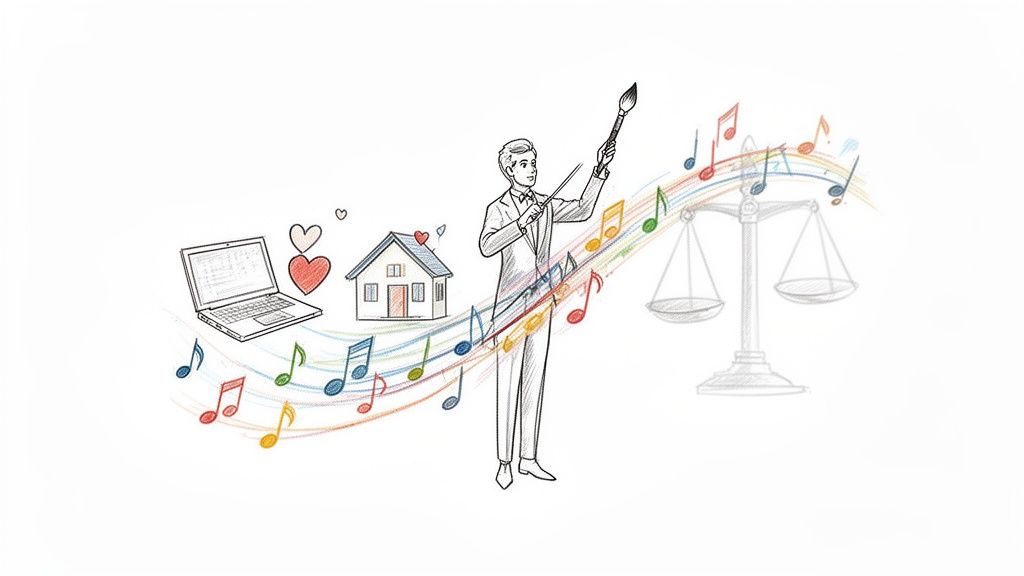
“Work-life balance” has been the gold standard for decades. The phrase conjures up a mental picture of a seesaw, where every hour dedicated to your career needs to be perfectly offset by an hour of personal time. This mindset traps you in a constant tug-of-war where one side always seems to be losing.
Work-life harmony offers a much saner alternative. Instead of a scale, think of your life as an orchestra. Each part—your career, family, hobbies, and personal growth—is a different instrument. They aren’t supposed to compete; they’re meant to play together to create a beautiful piece of music. Sometimes the strings (your family) take the lead, and other times the brass section (a big project at work) gets the spotlight. The goal isn’t equal volume but a cohesive, beautiful sound.
To really see the difference, let’s break it down. The table below compares the old way of thinking with this newer, more integrated approach.
Work-Life Balance vs Work-Life Harmony at a Glance
| Concept | Work-Life Balance (The Old Way) | Work-Life Harmony (The New Way) |
|---|---|---|
| Core Idea | Separation: Keeping work and life in their own distinct, separate boxes. | Integration: Blending work and life in a way that feels natural and complementary. |
| Metaphor | A balancing scale or a seesaw. One side goes up, the other goes down. | An orchestra or a jazz ensemble. All instruments play together to create a whole. |
| Goal | Equal distribution of time and energy between two competing priorities. | A fulfilling rhythm where all parts of your life support each other. |
| Mindset | Conflict-based. “I have to sacrifice personal time for work” (or vice-versa). | Synergy-based. “How can my work support my life, and my life support my work?” |
| In Practice | Rigid 9-to-5 schedules, strict boundaries, feeling guilty for crossover. | Flexible schedules, fluid boundaries, feeling empowered to manage your own time. |
As you can see, it’s a fundamental shift in perspective. Harmony isn’t about perfectly dividing your life into neat little slices; it’s about making the whole pie taste better.
The Problem with the Balancing Act
The old model of “balance” is a nightmare for remote professionals. When your home is your office, the physical lines have already been erased. Trying to maintain a perfect 50⁄50 split is a fast track to burnout because you’re constantly policing invisible borders.
This way of thinking just creates unnecessary friction. You feel guilty for ducking out mid-afternoon for your kid’s school play, or you feel stressed for checking an urgent email after dinner. Harmony, on the other hand, embraces this kind of fluidity. It gets that life isn’t always neat and tidy. If you’re still getting your head around this shift, this practical guide to work-life balance is a great place to start understanding the old rules before you can break them.
Why Harmony is the Future of Work
This isn’t just a trendy new phrase; it’s what people in the modern workforce are demanding. The numbers don’t lie: a massive 91% of employees say they choose remote work specifically for better work-life balance. What’s more, 81% now see it as the single most important factor when picking a job.
But here’s the kicker: despite all that, 66% of Americans still feel like they don’t have balance. That huge gap shows just how broken the traditional model is.
Harmony isn’t about working less; it’s about making work work for you. It’s about creating a sustainable rhythm where your professional ambitions support your personal well-being, and vice versa.
When you stop fighting for balance and start creating harmony, you’ll notice some pretty immediate benefits:
- Less Chronic Stress: You get to drop the constant guilt and anxiety that comes from trying to keep work and life in separate cages.
- Greater Overall Satisfaction: When your job feels like it’s on the same team as the rest of your life, everything feels more fulfilling.
- A Real Productivity Boost: Working when you’re most focused and taking breaks when you actually need them means you can get more done, often in less time.
This guide is here to give you actionable strategies to finally step off the balance beam and start composing a life that truly works for you.
The Core Principles of Harmonious Living
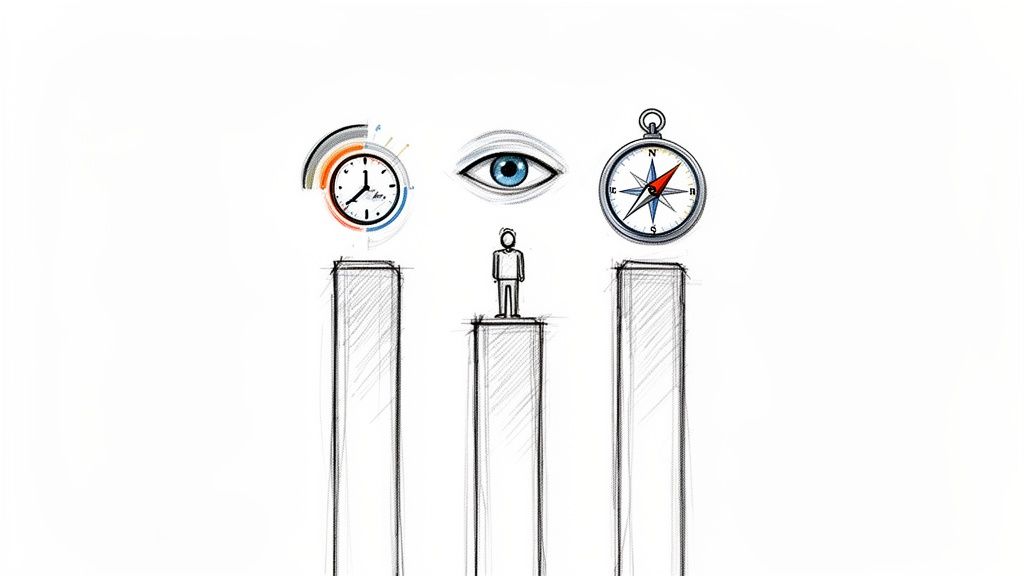
Getting to a place of true work-life harmony isn’t about discovering some secret formula. It’s more like building a house—you need a solid foundation built on a few core principles. Think of them less as rigid rules and more as pillars that support a more blended and fulfilling way of living.
These principles guide the small, everyday decisions that, over time, shape the entire picture of your life.
The three pillars that matter most are Flexibility, Presence, and Purpose. Once you get a handle on these and start applying them, you can shift from a reactive state of constantly juggling tasks to a proactive one where you’re living with intention. Let’s dig into each one with some real-world examples that bring them to life.
Flexibility: The Art of Bending Without Breaking
In the world of work-life harmony, especially for remote roles, flexibility is the absolute cornerstone. This isn’t about working less. It’s about having more say over when and where you work so it fits the natural rhythm of your life, not the other way around. This autonomy lets you line up your professional responsibilities with your personal energy levels and commitments.
For instance, a software developer might know their brain is sharpest for coding between 7 AM and 11 AM. With a flexible schedule, they can block off that time for deep, focused work. Then, they can take a long break in the afternoon to catch their kid’s school play and circle back to meetings and emails later, feeling recharged and fully there for both.
This is all about ditching the outdated, one-size-fits-all 9-to-5 mindset. It’s an admission that life happens and it’s rarely predictable.
- Proactive Flexibility: This is when you schedule work around things you already know about, like a weekly therapy appointment or your volunteer shift.
- Reactive Flexibility: This is how you adapt when the unexpected hits—a sick kid, a burst pipe—without feeling like your whole day is derailed.
A flexible schedule gives you the power to manage your energy, not just your time. When you work during your most productive hours, you often get more done in less time. That frees up mental and emotional bandwidth for everything else that matters.
Presence: Being Fully Where You Are
The second pillar is Presence—the simple, yet surprisingly difficult, skill of being completely engaged in what you’re doing right now. In a world buzzing with notifications and blurred lines between work and home, this is probably the toughest one to master. Presence means when you’re on a client call, you’re really on that call, not half-listening while scrolling Instagram.
And on the flip side, it means when you’re at the dinner table with your family, you’re fully present with them, not mentally composing an email to your boss. This mental separation is a huge factor in preventing burnout. In fact, research shows that the inability to psychologically switch off from work is a major driver of exhaustion. It’s a widespread problem, with a startling 60% of Americans reporting they struggle to disconnect from work on their own time.
Getting to a state of presence requires setting some intentional boundaries:
- Digital Boundaries: Try using separate browser profiles for work and personal stuff, or just kill work notifications after a certain hour.
- Physical Boundaries: Set up a dedicated workspace. Even a specific corner of a room can signal to your brain that it’s time to focus.
- Mental Boundaries: Create a short “end-of-day” ritual. A five-minute walk around the block or tidying your desk can act as a mental full stop to the workday.
Purpose: Your Personal North Star
The final pillar, Purpose, is the “why” behind all your choices. It’s what connects the small, daily tasks to your bigger values and goals. When your work feels connected to a larger purpose, it stops being a simple to-do list and becomes a meaningful part of your life’s story.
This doesn’t mean your job has to solve world hunger. You can find purpose in mentoring a junior teammate, contributing to a project you genuinely believe in, or simply mastering a skill that gives you a sense of accomplishment. That feeling of meaning is what helps you prioritize and decide where to invest your precious energy.
When you operate from a place of purpose, it becomes much easier to say “no” to things that don’t align with what’s important to you. This creates natural boundaries that support a more harmonious life, providing the clarity you need to blend work and life in a way that feels authentic and energizing, not draining.
Why Remote Work Redefines the Rules
The old nine-to-five was built around a simple, physical reality: the office. Your commute acted as a natural buffer, bookending your day and drawing a clear line between your professional and personal life. When you work from home, that entire structure evaporates.
When your office is also your living room, the lines don’t just get blurry—they often vanish completely. This new reality makes the old idea of work-life balance feel like a relic. You can’t really “balance” two things that are happening in the exact same space. That’s why the best remote jobs don’t just benefit from work life harmony; they demand it. The goal is no longer to build a wall between work and life, but to figure out how to weave them together intelligently.
The Remote Productivity Paradox
Here’s a strange thing that happens when people go remote: they get way more productive. Study after study confirms that remote workers are often more efficient. They deal with fewer interruptions, get to design their own focus-friendly spaces, and win back all that time once lost to traffic.
Just think about ditching the daily commute. A staggering 85% of workers used to spend up to 45 minutes each way getting to the office, time they can now use for, well, living. You can dig deeper into how this shift impacts well-being in the 2025 Global Work-Life Balance report.
But here’s the paradox: despite this huge boost in efficiency, many remote workers end up working longer hours than their office-based colleagues. Without a physical office to leave, the glowing laptop screen on the kitchen table becomes a constant temptation. This is where digital presenteeism creeps in—that nagging feeling that you have to be online and instantly responsive just to prove you’re working. It’s a subtle pressure that can quickly undo all the benefits of remote work, leading straight to burnout.
True remote work freedom isn’t just about where you work, but how you work. It’s about shifting the focus from hours logged to results delivered, a core tenet of a culture that supports genuine work life harmony.
Identifying a Culture of Harmony
The secret to avoiding this trap is finding a company with the right culture. The best remote-first companies get it. They understand that harmony isn’t a perk; it’s baked into their operational DNA. They don’t just allow remote work—they design their entire way of working around it.
As you hunt for your next role, keep an eye out for these green flags:
- Asynchronous Communication is the Default: They lean on written updates in tools like Slack or project management software instead of scheduling endless real-time meetings. This shows they respect deep work and different time zones.
- Performance is Results-Based: Their job descriptions and company values talk about outcomes and impact, not hours logged. They trust you to deliver great work on your own schedule.
- Clear Expectations on Availability: They have actual policies on response times and actively encourage people to unplug. You won’t find managers firing off “urgent” requests at 10 PM.
- Leadership Models Healthy Behavior: You see managers and executives openly taking vacations, setting boundaries, and talking about the importance of their personal lives. They practice what they preach.
On the flip side, watch out for red flags. Vague policies on working hours, a calendar jammed with back-to-back meetings, or interviewers obsessed with your immediate availability are all bad signs. These usually point to an old-school office culture that’s been awkwardly forced into a remote model—a perfect recipe for burnout.
By learning to spot these cues, you can find opportunities on platforms dedicated to verified remote-first jobs that are set up to help you thrive, not just survive.
Practical Strategies for Daily Harmony
Knowing what work life harmony is is one thing, but actually living it is another. The real magic happens when you move from theory to action. This is where you need a toolkit of concrete, practical strategies you can start using today to build a routine that feels less like a chaotic scramble and more like a day you designed on purpose.
Don’t think of this as a massive life overhaul. It’s really about making small, consistent tweaks that add up to something big. By focusing on intentional planning, smarter communication, and clear boundaries, you can start building a more harmonious daily rhythm right away.
Design Your Ideal Week
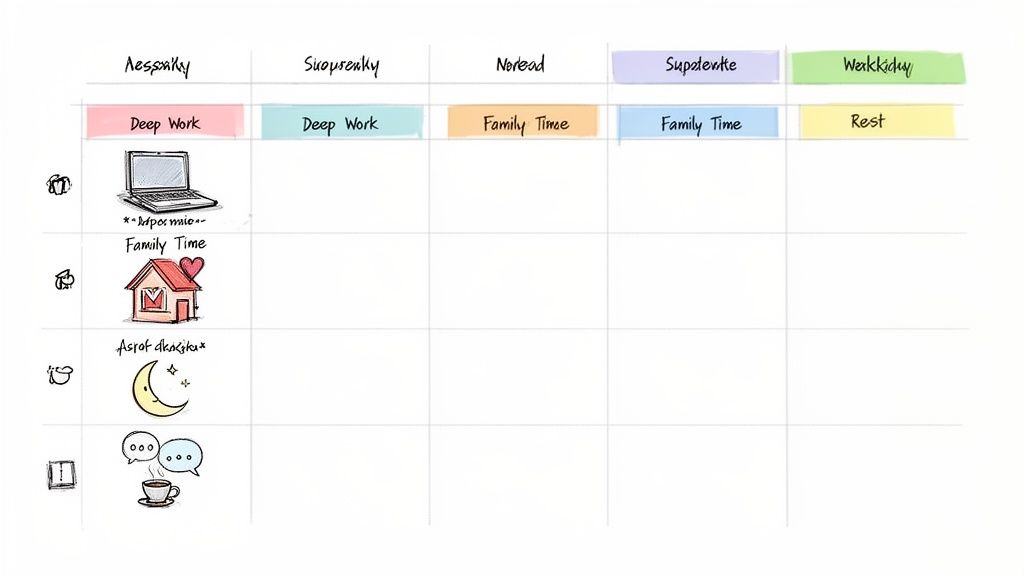
Instead of letting your calendar dictate your life, flip the script and design your week in advance. This is a powerful exercise where you create a template that blocks out time not just for work, but for everything that matters to you. Think of it as a visual commitment to your own priorities.
Your weekly template shouldn’t be a rigid prison; it’s more like a blueprint. The goal is to consciously allocate time for different activities, giving you a structure that supports focus, connection, and rest. For busy families, using a digital wall planner to streamline schedules can be a total game-changer for getting everyone on the same page.
Try blocking out time for these key categories:
- Deep Work: Uninterrupted blocks of 90-120 minutes for your most demanding, high-focus tasks. Guard this time like a hawk.
- Shallow Work: Group smaller things like answering emails or filing expenses into dedicated windows. This stops them from slicing up your day.
- Collaboration: Scheduled time for meetings, brainstorming, and team check-ins.
- Personal Time: Non-negotiable appointments with yourself—exercise, hobbies, family dinners, or even just doing nothing.
- Flex Time: An unscheduled block to handle surprises or to just take a longer break when you feel you need it.
By scheduling your priorities instead of just prioritizing your schedule, you take control of your time. This simple shift ensures that your personal well-being gets the same respect as a client meeting.
Master Asynchronous Communication
For anyone working remotely, the pressure to be constantly available is one of the biggest threats to harmony. The fix? Get really good at asynchronous communication—the art of sending a message without expecting an immediate reply. It’s the bedrock of a healthy remote culture and a crucial skill for protecting your focus.
This means defaulting to detailed written updates in tools like Slack or your project management software instead of calling a meeting for every little thing. It’s a practice that respects everyone’s time and encourages thoughtful responses over knee-jerk reactions.
Set Intentional Boundaries
Boundaries are the guardrails that protect your time, energy, and sanity. When you work remotely, the physical separation is gone, so you have to create your own. These boundaries can be digital, physical, and mental.
One of the most effective ways to do this is by creating simple rituals that signal the start and end of your workday. This creates a sort of “psychological commute” that helps your brain switch modes.
Here are a few practical rituals to try:
- The Morning Start-Up: Instead of diving straight into your inbox, start your day with a five-minute routine. Maybe it’s brewing a cup of tea, reviewing your top priorities, or doing a few quick stretches.
- The End-of-Day Shutdown: When it’s time to log off, do a consistent action. Tidy your desk, jot down your top three priorities for tomorrow, and then close your laptop completely.
- The Digital Divide: Create separate browser profiles or computer user accounts for work and personal stuff. This simple trick stops work notifications from popping up during your downtime and kills the temptation to “just quickly check” your email.
These small, consistent actions create powerful mental cues. They reinforce the idea that work has its place, but it doesn’t get to own your entire day.
Your Personal Harmony Action Plan
To put all this into practice, it helps to get specific about your own situation. A quick self-audit can show you exactly where the friction is and what small change could make the biggest difference.
Use this simple template to map out your own path to better harmony. Be honest with yourself about the challenges and realistic about the steps you can take.
Work Life Harmony Action Plan Template
| Harmony Pillar | Current Challenge | Action Step to Implement | Success Metric (How I’ll know it’s working) |
|---|---|---|---|
| Well-Being | I often skip lunch breaks and eat at my desk. | Schedule a 30-minute lunch on my calendar every day and physically step away from my computer. | I feel more energized in the afternoon and am not snacking as much. |
| Presence | I check work emails on my phone during family dinner. | I will leave my phone in another room from 6 PM to 8 PM every night. | My family members comment on me being more engaged in conversation. |
| Productivity | I get constantly distracted by notifications and can’t focus on deep work. | I will block 90 minutes of “Focus Time” on my calendar 3x per week and turn off all notifications during this block. | I complete my most important task of the day before noon. |
| Connection | I feel disconnected from my remote team. | I will schedule one virtual “coffee chat” per week with a colleague just to connect personally. | I feel more comfortable reaching out to my teammates for help or feedback. |
This isn’t about achieving a perfect, static state. It’s an ongoing process of adjustment. Review your plan every few weeks, see what’s working, and don’t be afraid to tweak it. This intentional separation and planning is the foundation of a sustainable work life, allowing you to be fully present wherever you are.
Building a Company Culture That Breathes Harmony
While your personal habits are a huge piece of the puzzle, they’re ten times more powerful when you’re in a supportive environment. Let’s be real: true work-life harmony isn’t just a personal project. It’s a cultural achievement, and the best companies build it intentionally, starting from the very top. For anyone on the hunt for a remote job, figuring out how to spot these cultures is probably the single most important skill for long-term happiness and career growth.
A company that gets harmony right goes way beyond surface-level stuff like virtual happy hours. They bake principles of trust, autonomy, and a focus on results right into their DNA. This means they’ve stopped tracking hours logged and started celebrating the actual impact you make.
What a Harmony-First Culture Actually Looks Like
So, how can you tell what a company’s culture is really like? You can see it in their policies, the way they communicate, and how their leaders behave. These are the places that understand flexibility isn’t just a “nice-to-have” perk—it’s a core business strategy for attracting and keeping amazing people by letting them do their best work.
Here’s what you’ll find in a workplace truly focused on harmony:
- Genuinely Flexible Work: This is more than just picking your start time. It’s about trusting you to weave your workday around your life—whether that means a midday gym session or picking up your kids from school—as long as the work gets done well.
- Performance Measured by Results, Not Presence: Managers care about the quality and impact of what you do, not how many hours your Slack light was green. This kills “digital presenteeism,” that nagging pressure to be online and available all the time.
- Real Mental Health Support: A culture of harmony knows that your well-being is the foundation of great work. This means easy access to mental health resources and actively encouraging people to use their time off to actually unplug and recharge.
- Asynchronous-by-Default Communication: These companies make clear, written communication the standard, saving meetings for when they’re truly necessary. This protects everyone’s time for deep work and respects that people are in different time zones and have different life schedules.
When these pieces come together, they create an ecosystem where people feel trusted, empowered, and respected. The whole game shifts from performing work to achieving results, which is the bedrock of any healthy remote company.
A company’s culture is just the sum of the behaviors it rewards. If leaders are giving shout-outs to people for answering emails at 10 PM, you don’t have a culture of harmony—you have a culture of burnout.
Spotting Red Flags vs. Green Flags as a Job Seeker
When you’re looking for a new role, remember you’re interviewing them just as much as they’re interviewing you. Learning to spot the signals of a healthy (or toxic) work culture during the hiring process is your superpower. Use this checklist to size up potential employers and find a company that will support your life, not just your work.
| Red Flags (Warning Signs) | Green Flags (Positive Indicators) |
|---|---|
| The job description uses vague clichés like “fast-paced” or “wear many hats” without any real detail. | The job description clearly mentions things like “asynchronous work,” “flexible hours,” or a “results-based environment.” |
| Your interviewer seems rushed, distracted, or keeps rescheduling on you. | The interviewer is present, engaged, and shows they respect your time throughout the process. |
| They get cagey or can’t give clear answers about performance metrics or work-life expectations. | They have confident, specific answers about how they measure success and what they do to prevent burnout. |
| You get emails or requests from the hiring team late at night or over the weekend. | All communication happens within reasonable business hours, showing they respect boundaries from day one. |
| Looking at a sample calendar shows it’s packed with back-to-back internal meetings. | They talk about protecting “maker time” or “deep work” blocks and clearly value written communication. |
Paying attention to these little cues can help you dodge a bullet. You can filter out the companies that just talk a big game about work-life harmony and focus your energy on the ones that actually live it. It’s a proactive way to find a role where you can really thrive.
Global Lessons in Work Life Integration
The push to blend work and personal life isn’t just a personal quest; it’s a global movement. If you look beyond our own borders, it becomes clear that work life harmony isn’t some far-off fantasy. It’s a reality in many countries today.
These nations offer powerful proof that a healthier, more integrated approach to work leads to happier citizens and, believe it or not, stronger economies. By digging into their policies and cultural mindsets, we can get a glimpse of what a harmony-focused world actually looks like.
What Top-Ranked Countries Get Right
The countries that consistently top global well-being lists all have one thing in common: they’ve built social and corporate structures that support the whole person, not just the employee. They’ve consciously moved away from the outdated “hustle at all costs” mentality toward sustainable, people-first policies.
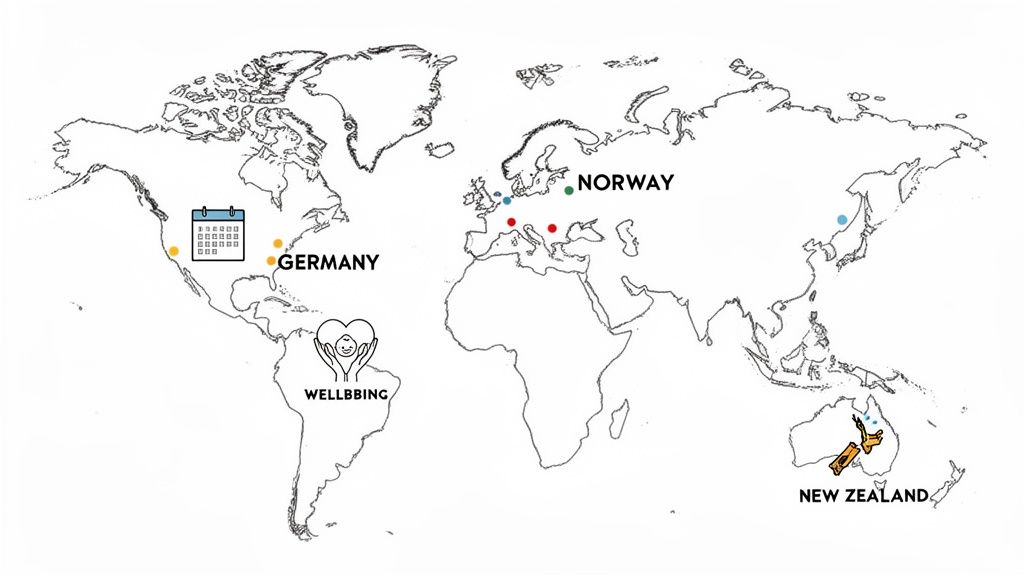
Take New Zealand, for example. It currently holds the top spot in the 2025 Global Life-Work Balance Index, rocking an impressive score of 86.59. This isn’t just by chance. It’s backed by concrete policies like 32 days of statutory annual leave and 26 weeks of fully paid maternity leave.
European countries also dominate the rankings. Nations like Italy, Denmark, and Norway are known for their strong social safety nets and a cultural vibe that genuinely values life outside of the office. You can dig into the specifics and see how different countries compare by checking out the complete global index analysis.
These aren’t just one-off success stories. They’re the result of intentional, country-wide choices:
- Generous Paid Leave: Plenty of time for parental leave, sick days, and vacation is the norm. People can care for their families and themselves without the added financial stress.
- Shorter Standard Workweeks: Countries like Germany are famous for their efficiency, often getting more done in fewer hours, which fiercely protects personal time.
- Strong Social Support: Things like universal healthcare and solid unemployment benefits reduce major life stressors, freeing up people’s mental and emotional energy.
Lessons for the Modern Job Seeker
This global perspective is more than just an interesting geography lesson; it’s a practical roadmap for your remote job search. It proves that companies can—and do—succeed by prioritizing employee well-being. A healthier, more harmonious work life isn’t a pipe dream. It’s an achievable reality.
The policies of the world’s happiest countries offer a clear blueprint for what a supportive work culture looks like. They value rest, respect family, and measure success by outcomes, not by hours clocked in a chair.
As you look at potential employers, use these global leaders as your benchmark. Hunt for companies with a modern, forward-thinking mindset. Don’t be shy about asking about their policies on PTO, flexible hours, and parental leave. The best remote-first companies are already embracing these principles, proving you don’t need to move to another country to find a better way to work.
Still Have Questions About Work-Life Harmony?
Switching your mindset from “balance” to “harmony” can feel a little strange at first, and it’s fair to be skeptical. Is this just the latest buzzword to roll out of a corporate boardroom? Let’s tackle some of the most common questions head-on.
Is This Just a Sneaky Way to Get Me to Work 24⁄7?
Not a chance. In fact, it’s the complete opposite. Real work-life harmony is built on intentional integration, not on being constantly available. It’s about consciously designing a life where your work fits in smoothly and sustainably, instead of hijacking your personal time.
This only works when you set real boundaries and, just as importantly, join a company that cares more about the results you deliver than the hours you sit at a desk. The whole point is to find a rhythm that fuels both your career and your life outside of it, dodging the burnout that comes from feeling like you’re “always on.”
How Can I Spot a Company That Genuinely Supports Harmony?
You have to look for the right signals, both in the job description and during the interview. Zero in on companies that call themselves “remote-first” and aren’t shy about discussing things like asynchronous work, flexible schedules, and performance based on outcomes.
When you get to the interview, ask them directly about their communication culture. How do they prevent burnout? A company that truly gets it will have solid, confident answers ready to go, because these ideas are baked into how they operate.
Is Harmony Even Possible in a High-Pressure Role?
Absolutely. Harmony in a demanding job has less to do with the amount of work on your plate and more to do with how much control and intention you bring to it. The secret is to shift your focus from managing your time to managing your energy.
This means protecting your deep work sessions like a hawk, grouping similar tasks together to stay in the zone, and feeling confident enough to say no to meetings that aren’t essential. It all comes down to working smarter, not longer, and being crystal clear about your boundaries so your team knows what to expect.
Of course, finding a company that actually lives by these values is half the battle. Remote First Jobs gives you a serious advantage by sourcing roles directly from over 21,000 remote-first companies. This lets you discover jobs that truly support harmony before they ever land on those crowded, generic job boards. Why not start your search at https://remotefirstjobs.com?