Navigating the digital marketing job market requires more than just a strong resume; it demands sharp, articulate answers that showcase your strategic thinking and hands-on expertise. Whether you’re a seasoned professional or just starting, preparing for common digital marketing interview questions is the key to demonstrating your value to a potential employer. This comprehensive guide moves beyond generic advice, breaking down the essential questions you’ll likely face.
We’ll provide the context behind each question, offer strategic tips for structuring your response, and give you concrete, sample answers you can adapt. You’ll gain the confidence to clearly explain complex topics and prove you have the skills to drive results.
This listicle is designed to be your ultimate preparation tool. We will cover a wide range of critical topics, including:
- SEO and SEM principles
- Campaign measurement and analytics
- Social media and content strategy
- Email marketing and segmentation
- PPC campaign optimization
- Handling campaign failures and learning from them
By understanding how to tackle these core areas, you can turn your next interview from a stressful interrogation into a conversation where your talent shines. Let’s dive into the questions that separate good candidates from great ones.
1. What is SEO and how does it differ from SEM?
This is one of the most fundamental digital marketing interview questions, designed to gauge your core understanding of search marketing. Interviewers use it to see if you can clearly articulate the relationship and distinctions between organic and paid search strategies. A strong answer demonstrates not just theoretical knowledge but also strategic thinking about how these two powerful channels work together.
To thoroughly explain SEO and its distinction from SEM, a solid understanding of What Is Search Engine Optimization? is fundamental. SEO is the practice of optimizing your website to rank higher in organic (non-paid) search engine results. This involves on-page tactics like keyword research and content creation, off-page efforts like link building, and technical improvements to your site’s health. It’s a long-term strategy aimed at building sustainable, “free” traffic.

SEM, or Search Engine Marketing, is a broader umbrella term that encompasses SEO as well as paid search activities like Pay-Per-Click (PPC) advertising. In practice, however, many marketers use “SEM” to refer specifically to the paid side. These paid ads, like those on Google Ads, appear at the top of the search results and offer immediate visibility for a price (CPC or Cost-Per-Click).
How to Structure Your Answer
A great response will be structured, clear, and supported by real-world examples.
- Define SEO: Explain it as the organic process of earning visibility through relevance and authority. Mention the three pillars: on-page, off-page, and technical SEO.
- Define SEM: Describe it as the broader discipline that includes SEO, but highlight its common association with paid advertising (PPC) for immediate results.
- Compare and Contrast: Use a table or bullet points in your explanation to highlight key differences in cost (CPC vs. investment), speed of results (immediate vs. long-term), and sustainability (traffic stops when you stop paying vs. lasting results).
Pro Tip: Go beyond definitions. Discuss how you would create a holistic search strategy. For instance, explain how you’d use SEM to quickly test keywords and messaging, then apply those learnings to your long-term SEO content strategy for maximum efficiency.
2. How do you measure the success of a digital marketing campaign?
This is a critical digital marketing interview question that separates tactical marketers from strategic ones. Interviewers ask this to assess your analytical skills and your ability to connect marketing efforts directly to business outcomes. A great answer shows you think beyond vanity metrics and can use data to justify budgets, prove ROI, and guide future strategy.
A successful marketer must clearly demonstrate how their campaigns contribute to the bottom line. This means going beyond surface-level numbers and focusing on Key Performance Indicators (KPIs) that align with overarching business goals. The ability to track, analyze, and report on these metrics is non-negotiable in a data-driven role, similar to how one might measure employee satisfaction to gauge team health and productivity. For more insights on this parallel, you can learn about different measurement frameworks.

The core of this question is about demonstrating a results-oriented mindset. You need to show that you can set up proper tracking, like conversion goals in Google Analytics 4, and use tools like Google Data Studio or Tableau to visualize performance. It’s about telling a story with data, explaining not just what happened, but why it happened and what you’ll do next.
How to Structure Your Answer
A structured response will showcase your analytical process and strategic thinking.
- Start with the Goal: Begin by stating that success metrics depend entirely on the campaign’s objective (e.g., brand awareness, lead generation, sales).
- Differentiate Metric Types: Clearly distinguish between vanity metrics (impressions, likes) and actionable metrics that drive business value (Conversion Rate, Customer Acquisition Cost (CAC), Return on Ad Spend (ROAS), Customer Lifetime Value (CLV)).
- Mention Your Toolkit: Name specific analytics platforms you are proficient in, such as Google Analytics, Adobe Analytics, or HubSpot.
- Provide a Concrete Example: Describe a past campaign. State the goal, the KPIs you tracked, how you used UTM parameters for source tracking, and how the data you collected informed your optimization decisions (e.g., reallocating budget based on A/B test results).
Pro Tip: Talk about attribution modeling. Mention that you understand the customer journey is rarely linear and discuss how you would use different models (like first-touch, last-touch, or data-driven) to assign credit across various touchpoints, giving a more holistic view of campaign performance.
3. Describe your experience with social media marketing across different platforms
This is one of the most practical digital marketing interview questions, aimed at evaluating your hands-on experience and strategic thinking across the social media landscape. Interviewers want to see that you understand that each platform is a unique ecosystem with its own audience, algorithm, and content style. A strong answer shows you can move beyond a one-size-fits-all approach and tailor campaigns to specific channel strengths.
This question tests your ability to connect platform choice to business goals, whether it’s using LinkedIn for B2B lead generation or TikTok for B2C brand awareness. Demonstrating a nuanced understanding of these differences is crucial, especially for candidates seeking remote social media jobs where strategic autonomy is key. It reveals your tactical skills in content creation and ad management as well as your strategic ability to build a cohesive, multi-channel social presence.
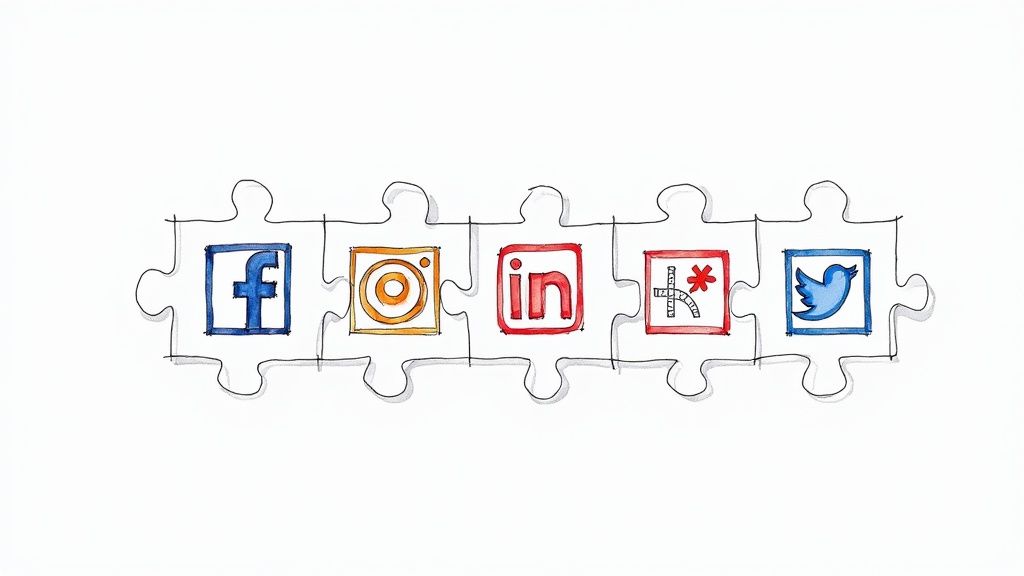
A great answer will go beyond simply listing the platforms you’ve used. It should showcase your ability to develop and execute distinct strategies for each one, supported by specific examples and measurable results.
How to Structure Your Answer
Organize your response by platform or by campaign to tell a clear and compelling story.
- Start with a High-Level Overview: Briefly summarize your philosophy on multi-platform social media strategy, emphasizing the importance of tailoring content.
- Provide Platform-Specific Examples: For 2-3 key platforms, detail a specific campaign or strategy you managed. For example, describe a LinkedIn campaign focused on B2B thought leadership versus an Instagram Reels strategy designed for brand engagement.
- Quantify Your Results: Use metrics to demonstrate success. Instead of saying “increased engagement,” say “achieved a 5x ROAS on a Facebook remarketing campaign” or “grew our Gen Z audience on TikTok by 300% in six months.”
- Mention Tools and Tactics: Briefly mention your experience with both organic and paid strategies, as well as any social media management tools you’ve used, like Sprout Social or Hootsuite.
Pro Tip: Prepare a mini case study for each major platform you have experience with. For instance: “At Company X, our goal was B2B lead generation. I developed a content strategy for LinkedIn that focused on publishing in-depth articles and targeted C-suite executives with sponsored content, resulting in a 25% increase in qualified leads.”
4. What is your approach to content marketing and content strategy?
This question moves beyond individual channels to assess your ability to create and execute a comprehensive plan that attracts, engages, and converts a target audience. Interviewers want to see if you can think strategically about how content drives business goals. A strong answer reveals your understanding of the entire content lifecycle, from ideation and creation to distribution and performance analysis.
To answer effectively, you must show you understand precisely what a content marketing strategy entails. It’s not just about writing blog posts; it’s a systematic approach to creating and distributing valuable, relevant, and consistent content to achieve specific business objectives. For instance, HubSpot’s inbound marketing blog generates millions of visitors by providing educational content tailored to its audience’s pain points.
A solid content strategy connects every piece of content to a larger goal. Red Bull is another prime example, building an entire media empire around extreme sports and lifestyle content that embodies its brand ethos, rather than directly selling its product. This demonstrates a deep understanding of audience engagement over direct promotion.
How to Structure Your Answer
A well-organized response will walk the interviewer through your strategic process, showcasing both creativity and analytical rigor.
- Start with Research: Explain how you begin with audience research, keyword analysis (using tools like SEMrush), and competitor analysis to identify content gaps and opportunities.
- Outline Your Framework: Discuss how you map content to the buyer’s journey (Awareness, Consideration, Decision). Mention using content pillars to organize topics and create a cohesive content hub.
- Detail Creation and Distribution: Talk about creating a content calendar and your process for producing different formats (blogs, videos, infographics). Then, explain how you promote that content across relevant channels like social media, email, and outreach.
- Focus on Measurement: Conclude by explaining how you measure success. Mention key metrics like organic traffic, engagement rates, and lead generation, and how you use that data to optimize future content.
Pro Tip: Bring a mini-case study. Talk about a time you developed a content hub that increased organic traffic by 250% or a video series that generated thousands of leads. Quantifiable results make your strategic thinking tangible and impressive.
5. How do you approach email marketing and list segmentation?
This is a common digital marketing interview question that assesses your expertise in one of the highest ROI channels available. Interviewers want to know if you can move beyond simple email blasts to create sophisticated, personalized campaigns. A strong answer showcases your strategic thinking about the customer journey, technical skills with email platforms, and a data-driven approach to optimization.
Your approach should demonstrate a clear understanding of best practices for email communication, showing you can build and nurture an audience effectively. Email marketing is about delivering the right message to the right person at the right time. List segmentation is the core practice that makes this possible, involving the division of your email list into smaller, targeted groups based on specific criteria like demographics, behavior, or purchase history. This allows for highly personalized and relevant communication that drives engagement and conversions.
How to Structure Your Answer
A comprehensive answer will cover your strategic framework, technical proficiency, and focus on measurable results.
- Explain Your Strategy: Start by outlining your philosophy. Emphasize that your goal is to treat subscribers as individuals, not just a monolithic list. Mention building a healthy list, applying segmentation, personalizing content, and using automation.
- Detail Your Segmentation Methods: Give specific examples of how you segment lists. Discuss demographic (age, location), psychographic (interests), and behavioral (purchase history, website activity, email engagement) segmentation. For instance, you could mention creating a segment for users who abandoned their cart.
- Discuss Key Metrics and Tools: Mention the email marketing platforms you are proficient in (e.g., Klaviyo, HubSpot, Mailchimp). Talk about the key performance indicators (KPIs) you track, such as open rates, click-through rates (CTR), conversion rates, and unsubscribe rates, and how you use them to optimize campaigns.
- Mention Compliance: Briefly touch upon the importance of adhering to regulations like GDPR and the CAN-SPAM Act, which shows professionalism and an understanding of legal responsibilities.
Pro Tip: Bring your answer to life with a specific example. Describe a re-engagement campaign you ran for dormant subscribers, explaining how you segmented the list, the A/B tests you conducted on subject lines, and how the campaign successfully reactivated a percentage of the audience, ultimately boosting revenue.
6. Explain your experience with paid advertising (PPC) and how you optimize campaigns
This is one of the most critical, hands-on digital marketing interview questions. It’s designed to separate candidates with theoretical knowledge from those with proven, in-the-trenches experience managing budgets and driving results. Interviewers want to see that you can not only set up a campaign but also strategically manage, analyze, and optimize it to meet business goals like lead generation or sales.
A strong answer moves beyond just listing platforms like Google Ads or Facebook Ads. It demonstrates a deep understanding of campaign structure, audience targeting, bidding strategies, and continuous optimization. You need to show you can handle real ad spend effectively and translate those efforts into a tangible return on investment (ROAS). It’s your chance to prove you are a performance-driven marketer who understands the direct link between ad spend and revenue.
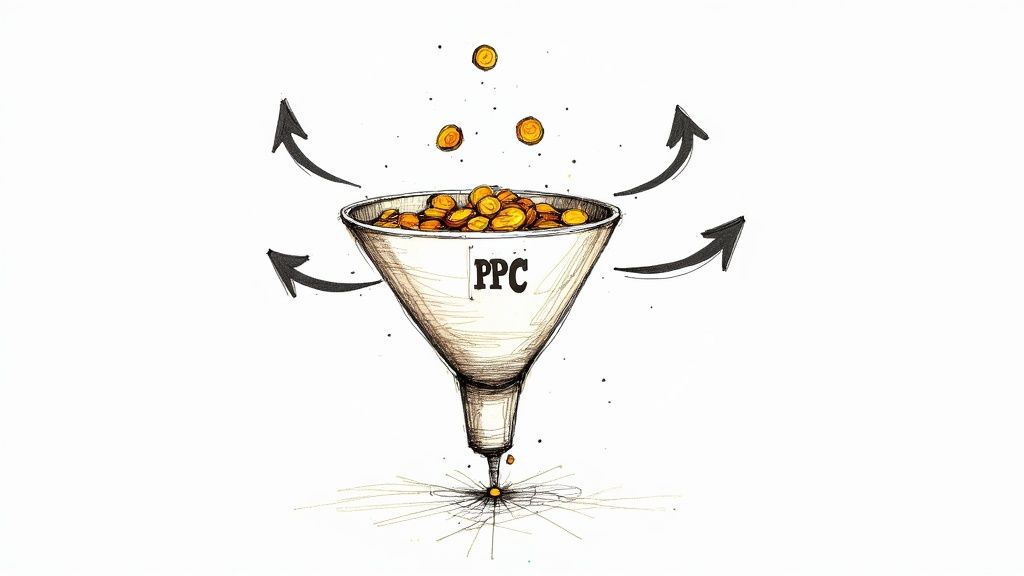
Successful PPC management is a cycle of testing, learning, and refining. You might discuss a time you scaled a Google Ads account from a small test budget to a significant monthly spend while maintaining a target CPA. Or, you could explain how you created Facebook lookalike audiences that delivered a 3x higher conversion rate than broad targeting, proving your ability to leverage platform-specific tools for maximum impact.
How to Structure Your Answer
A compelling answer will walk the interviewer through your entire campaign management process, from strategy to reporting.
- Outline Your Process: Start by describing your general workflow. Explain how you approach campaign setup, including keyword research, audience segmentation, and ad group structure.
- Detail Your Optimization Tactics: Get specific about how you improve performance. Mention A/B testing ad copy and landing pages, adjusting bids, refining targeting, and using negative keywords to eliminate wasted spend.
- Provide Concrete Examples with Metrics: This is the most important part. Share a specific example, such as “I reduced our cost-per-acquisition by 30% by improving our Quality Score from 5 to 8 through more relevant ad copy and landing page optimization.”
Pro Tip: Structure your answer using the STAR method (Situation, Task, Action, Result). For example: “The (S)ituation was a high CPA. My (T)ask was to lower it by 20%. I took (A)ction by implementing single-keyword ad groups and A/B testing ad copy. The ®esult was a 25% reduction in CPA within two months.”
7. How do you stay current with digital marketing trends and algorithm changes?
This is a critical question among digital marketing interview questions, designed to evaluate your proactivity, adaptability, and passion for the industry. Interviewers want to see that you are a dedicated, continuous learner who can navigate the field’s constant evolution, from Google’s algorithm updates to emerging social media platforms and privacy regulations. A strong answer proves you’re not just reacting to changes but anticipating them.
To answer effectively, you need to show a systematic approach to professional development. The digital landscape is always in flux, driven by technological advancements and shifting consumer behaviors, much like the evolution of workplace dynamics. For more on how these shifts impact professional life, you can explore current remote work trends. Demonstrating your commitment to staying informed assures an employer that your skills will remain relevant and effective.
Your response should highlight a mix of resources and practical applications. For example, you might mention pivoting a social media strategy when Instagram began prioritizing Reels, or preparing for cookie deprecation by focusing on first-party data collection. This shows you don’t just consume information, you apply it strategically.
How to Structure Your Answer
A compelling response will be specific and provide concrete examples of how your learning translates into action.
- List Your Sources: Mention specific industry blogs (e.g., Search Engine Journal), podcasts (e.g., Marketing School), and influencers you follow. This shows genuine engagement.
- Discuss Formal Learning: Talk about any certifications you’ve earned or are pursuing (e.g., Google Ads, HubSpot), as well as webinars or conferences you’ve attended.
- Show, Don’t Just Tell: Provide a recent example of a trend or update you learned about and how you applied that knowledge to a campaign. Did you adapt to Google’s Core Web Vitals? Did you experiment with AI for content creation?
- Mention Community Involvement: Discuss your participation in professional communities like LinkedIn groups, Slack channels, or local marketing meetups.
Pro Tip: Conclude by explaining your personal system for learning. For instance, “I dedicate 30 minutes every morning to reading industry news from Feedly and listen to two marketing podcasts during my commute each week. I then test one new insight in a small-scale campaign each month.” This demonstrates discipline and a structured approach.
8. Describe a digital marketing campaign that didn’t perform as expected. What did you learn?
This is a classic behavioral question that tests much more than your technical skills. Interviewers ask this to evaluate your self-awareness, problem-solving abilities, and capacity for growth. A great response shows you can be accountable, analyze data to find the root cause of a problem, and apply lessons to future work. It demonstrates resilience and a valuable growth mindset.
Digital marketing is full of experiments, and not all of them will be winners. The key is showing that you can turn an underperforming campaign into a powerful learning opportunity. For example, you might discuss an influencer partnership that yielded low conversions due to a mismatch in audience demographics. The failure wasn’t in the execution but in the initial vetting process, teaching you the importance of deep audience analysis over surface-level metrics.
How to Structure Your Answer
Your answer should tell a clear story of failure, analysis, and growth. Avoid blaming others and focus on your role and what you learned.
- Set the Scene: Briefly describe the campaign’s goal, your role, and the initial strategy. Be concise and clear.
- Identify the Failure: State what went wrong using specific metrics. For example, “The PPC campaign had a high click-through rate but a conversion rate of only 0.5%, far below our 2% target.”
- Explain Your Analysis: Detail the steps you took to diagnose the problem. Did you review the landing page experience, audit the ad copy, or analyze the audience targeting?
- Articulate the Lessons Learned: Clearly state what you learned from the experience. This is the most crucial part. For instance, you learned the critical importance of message matching between an ad and its landing page.
Pro Tip: Frame the experience constructively. Show how you proactively sought to understand the results and improve. Mentioning how you approached colleagues or managers for their insights can also be powerful, as knowing how to ask for feedback at work is a sign of maturity and a commitment to continuous improvement.
Digital Marketing Interview Questions Comparison
| Topic | Implementation Complexity 🔄 | Resource Requirements ⚡ | Expected Outcomes 📊 | Ideal Use Cases 💡 | Key Advantages ⭐ |
|---|---|---|---|---|---|
| What is SEO and how does it differ from SEM? | Medium - understanding concepts without coding | Moderate - requires SEO tools & ad budgets | Long-term organic growth; Immediate paid visibility | Brand building, product launches, budget allocation | Balances long-term & short-term growth, cost flexibility |
| How do you measure the success of a digital marketing campaign? | Medium - requires analytics setup and data analysis | High - analytics platforms and reporting tools | Data-driven decision making; clear ROI measurement | Campaign optimization, performance tracking | Connects marketing activities directly to business goals |
| Describe your experience with social media marketing across different platforms | Medium-High - multi-platform strategy creation | Medium to High - creative content & platform management | Increased engagement, brand awareness | B2B lead gen, viral campaigns, remarketing | Multi-channel reach, platform-tailored strategies |
| What is your approach to content marketing and content strategy? | Medium - strategic planning & SEO optimization | Moderate - content creation & distribution resources | Organic traffic growth, lead generation | Inbound marketing, brand authority building | Drives sustained traffic and customer engagement |
| How do you approach email marketing and list segmentation? | Medium - needs segmentation & automation skills | Moderate - email marketing platforms and data management | Higher open and conversion rates | Customer nurturing, retention, and personalized outreach | High ROI, targeted, personalized communication |
| Explain your experience with paid advertising (PPC) and how you optimize campaigns | High - hands-on platform and bid management | High - budget allocation, tools, and frequent adjustments | Improved CPA, scalable conversions | Direct response marketing, quick visibility | Immediate results, precise targeting, and budget control |
| How do you stay current with digital marketing trends and algorithm changes? | Low - learning & adaptation process | Low to Medium - subscriptions, courses, and community time | Adaptability to industry changes | Long-term career development, strategy updates | Maintains competitive edge, fosters continuous learning |
| Describe a digital marketing campaign that didn’t perform as expected. What did you learn? | Variable - reflective and analytical | Low - focus on analysis and learning | Improved future campaign performance | Problem-solving, process improvement | Demonstrates growth mindset and accountability |
Your Next Career Move Starts Here
Navigating the landscape of digital marketing interviews can feel daunting, but preparation is your most powerful asset. The questions we’ve explored, from the technical distinctions between SEO and SEM to the strategic nuances of content marketing, are not just tests of your knowledge. They are opportunities to tell a compelling story about your skills, your thought process, and the value you bring to a team.
Mastering these digital marketing interview questions means moving beyond textbook definitions. The most impressive candidates are those who can connect theory to tangible business outcomes. Whether you’re explaining how you segment an email list or detailing the lessons learned from a failed PPC campaign, your goal is to demonstrate a strategic, data-driven mindset.
Key Takeaways for Your Interview Preparation
To truly stand out, focus on these core principles as you refine your answers:
- Quantify Your Success: Don’t just say you “improved engagement.” Say you “increased organic social media engagement by 35% in Q2 by implementing a new video content strategy.” Concrete numbers and KPIs are your best friends.
- Showcase Your Adaptability: The digital world is in constant flux. Highlighting how you stay current with algorithm changes and emerging trends shows you’re a proactive, forward-thinking marketer who won’t be left behind.
- Emphasize Business Impact: Every marketing action should tie back to a business objective. Frame your experience in terms of how you helped generate leads, increase revenue, improve brand loyalty, or reduce customer acquisition costs.
- Embrace Failure as a Learning Tool: Being open about campaigns that didn’t go as planned reveals humility, analytical skills, and a commitment to continuous improvement. It shows you know how to pivot and optimize.
Ultimately, your preparation for these common digital marketing interview questions is an investment in your career. By articulating your expertise with clarity and confidence, you position yourself not just as a candidate, but as an indispensable strategic partner. Use the sample answers in this guide as a foundation, but infuse them with your own unique experiences and results to make a lasting impression.
Ready to put your finely-tuned interview skills to the test? Your next great opportunity is waiting. Explore the latest fully remote marketing positions on Remote First Jobs, the premier job board for professionals seeking location-independent careers. Visit Remote First Jobs to find curated roles where you can apply the expertise you’ve just sharpened.