
A digital nomad is someone who works online while moving between locations, with the practical threshold of visiting at least three non-home places a year. In 2024, 18.1 million American workers described themselves as digital nomads, up 4.7% year over year and more than 147% since 2019, according to MBO Partners’ digital nomad research.
That sounds simple until you try to apply it to your own life. You might have a remote job, a passport, and a laptop, but still wonder whether you’re a true nomad, a remote employee who travels, or just someone testing the waters.
The working definition matters because the label now sits at the intersection of work, travel, visa status, tax residency, and employer policy. A lot of people use the phrase casually, but the meaning is more specific, and the difference changes what you can do legally and practically.
What Is a Digital Nomad?
A senior marketer booking flights between client work, or a developer wondering whether a month in Lisbon still counts as “remote,” is asking the right question. The answer isn’t just whether the person uses a laptop. It’s whether work, movement, and autonomy all show up together in a real location-independent pattern.
Working definition: a digital nomad is a person who earns online, can work while moving, and chooses where to live and work rather than staying in one fixed office or home.
That definition is broader than a vacationing remote worker, but narrower than “anyone who can work from home.” A nomad’s life is built around movement, not just occasional trips. The strongest sign is whether the person can keep working from different places without needing to return to one permanent base.
A fast self-test
Ask three questions:
- Do you earn your income online? If your work depends on physical presence, you’re probably not a digital nomad.
- Can you keep working while you move? If travel interrupts the job, the lifestyle doesn’t really fit.
- Do you move by choice? If you only travel for conferences or temporary assignments, that’s usually not the same thing.
That self-test helps separate the lifestyle from the label.
The important point is that digital nomad meaning isn’t just about being online. It’s about combining online work with deliberate movement across places. That distinction is what keeps the term useful instead of turning it into a vague synonym for remote work.
Where the Term Came From and Why the Definition Tightened
The phrase didn’t start as a legal or academic category. Tsugio Makimoto and David Manners popularized the term in their 1997 book Digital Nomad, where they described people who could work anywhere as long as they had a laptop and internet access (background on Wikipedia). At that stage, the idea was aspirational. It captured a new kind of freedom, but it didn’t yet draw hard lines around who qualified.
Over time, the term got sharper because people needed a better way to distinguish a mobile worker from a person who only had a remote job. That’s why newer research uses a more rigorous definition. A 2023 academic taxonomy by Dave Cook in the World Leisure Journal defines digital nomads as workers who use digital technologies to work remotely, can work and travel at the same time, have autonomy over where and how often they move, and visit at least three non-home locations each year.
Why the tighter definition matters
That threshold changes how the label works in real life. Someone who works from a home office and takes the occasional trip may be remote, but not nomadic. Someone who spends part of the year moving between cities and keeps their job running the whole time fits the newer definition much better.
It also matters because people use the term in very different contexts. A person applying for a visa, talking to an employer, or planning taxes needs a definition that is more precise than “I work on a laptop.” The lifestyle may feel personal, but the consequences are often technical.
A fuzzy label sounds harmless until a visa officer, payroll team, or tax adviser asks you what you actually do.
That’s the reason the meaning tightened. The term had to survive contact with immigration systems, employer policies, and tax rules. Once people started using it in those settings, “digital nomad” stopped being just a lifestyle phrase and became something closer to a compliance category.
Digital Nomads vs Remote-First Employees
A remote-first employee and a digital nomad can both answer emails from a laptop in a café. That’s where the similarity ends. A remote-first company builds its whole operation around distributed work, but that still doesn’t mean its people are on the move. One person may have permission to work remotely from a stable home base, while the other organizes life around ongoing movement across countries or cities.
| Criterion | Digital Nomad | Remote-First Employee |
|---|---|---|
| Work pattern | Works online while moving between places | Works remotely, often from one main base |
| Movement | Autonomy over where and how often they move | Travel may be allowed, but isn’t central to the role |
| Identity | Mobility is part of the lifestyle and work setup | Remote work is the main work arrangement |
| Location changes | Visits at least three non-home locations per year | May not change locations often |
| Practical risk | More likely to face visa and tax questions | More likely to fit standard remote-work policies |
The difference sounds subtle, but it affects how people plan their lives. A remote-first engineer living in one apartment for most of the year is not the same as a contract designer moving between Lisbon, Mexico City, and Bali. They may share the same tools, but they don’t share the same operating model.
Why employers care about the difference
Companies usually care because work location creates compliance exposure. A manager may be happy for someone to work from anywhere in theory, but payroll, tax, and legal teams often need much clearer rules. If a company only approves “remote” work, that doesn’t automatically mean “work from any country you like.” Roles that do allow it are usually posted as work from anywhere jobs, and even those often come with a list of excluded countries.
The same distinction helps workers avoid false assumptions. Someone can be very remote and still not be nomadic. Someone can travel often and still not qualify if their movement is occasional or tied to short trips. The more your life depends on crossing borders, the more that distinction matters.
So if you’re trying to place yourself, ask whether mobility is a side effect or the structure of your work life. If the answer is that movement is built in, you’re probably in digital nomad territory. If the answer is that you just don’t commute to an office, you may be a remote worker.
Common Work Arrangements That Support Nomadic Life
The work model shapes everything else. Income stability, visa paperwork, and even time-zone stress depend on whether you freelance, contract, hold a remote employee role, or run your own business. The digital nomad label can sit on top of all four, but the day-to-day reality looks different in each case. If you’re still picking a field, our guide to digital nomad jobs covers the roles that travel well.
Freelance and contract work
Freelancers and independent contractors often have the most obvious location flexibility. They can take multiple clients, move more easily, and build schedules around travel. The trade-off is uneven cash flow, since client work can speed up or slow down without much warning.
A copywriter, developer, or designer on contract work may find this model fits nomadic life well. The challenge is that self-directed freedom also means self-directed administration. Invoices, client churn, and finding the next assignment become part of the job.
Full-time remote employment
A fully remote employee at a distributed company can also live nomadically if the employer allows it. That setup usually brings more predictable income and a clearer role, which helps with planning. The catch is that employer policy can limit where the person can stay, especially across borders.
Solo founders and online business owners
Solo founders have the most control over location, but also the most responsibility. They decide where they work, what they sell, and how they structure the business. That flexibility can be powerful, but it also means the business has to survive wherever they are.
Quick fit guide
- Freelancer: Good if you want mobility and can handle variable income.
- Long-term contractor: Good if you want some stability with room to move.
- Distributed employee: Good if you want structure and benefits with location freedom.
- Solo founder: Good if you want maximum control and can live with business risk.
The 2023 taxonomy’s focus on autonomy and movement helps here too. A nomad isn’t defined by a job title alone. They’re defined by how that job interacts with location, travel, and choice.
Visas, Taxes, and Employer Policies in Plain Language
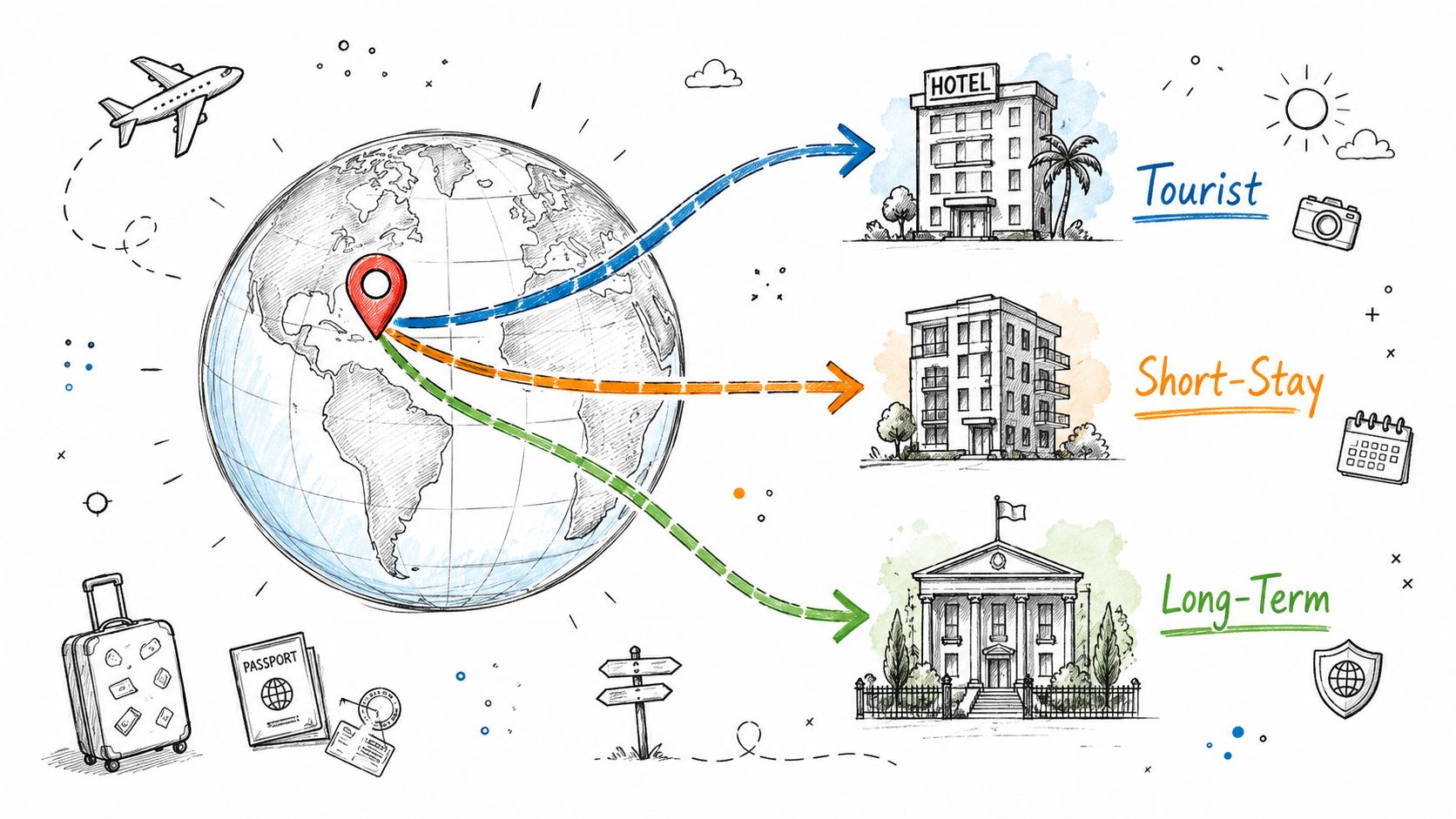
The biggest mistake is treating travel permission and work permission as the same thing. They’re not. A tourist entry may let you visit a country, but that doesn’t automatically mean you can perform remote work there, and tax residency is a separate question again.
Digital nomad visas are built for people who earn income from outside the host country. As this immigration overview from Ellis explains, they often need proof of remote employment or self-employment, plus items like minimum monthly income, health insurance, and a clean criminal record. Those programs usually last about 6 to 24 months rather than functioning like standard work visas. The structure is deliberate, because host countries want to attract mobile workers without creating direct competition with local labor markets.
The three questions to answer before you book
- Can I legally work where I’m going? Tourist status and work authorization aren’t the same.
- Does my employer allow that location? Some remote jobs still restrict countries, time zones, or tax exposure.
- Where am I tax resident? Visa status does not automatically settle tax obligations.
That separation is where many people get tripped up. A visa can allow presence without solving payroll, and a payroll policy can allow remote work without solving immigration. The safest approach is to treat each layer as its own decision. For a document checklist and the mistakes that get applications rejected, see our guide to digital nomad visa requirements.
If you’re sorting out documentation, health coverage, and timing, the practical side matters just as much as the travel plans.
What the current policy environment tells you
The EY Global Immigration Index on remote work and digital nomads shows digital nomad visas are becoming a mainstream policy tool, with more than 48 jurisdictions offering some form of digital nomad or remote work visa or permit by February 2026, and Europe holding 40% of those programs. That matters because the market is maturing. Some countries now offer longer stays, more predictable frameworks, and even dependent sponsorship in certain cases.
The takeaway is simple. Being a digital nomad is no longer just about packing light and finding good Wi-Fi. It’s about matching your work pattern to the right visa, the right tax setup, and the right employer policy before you move.
Real Benefits and Honest Pitfalls
The appeal is real. A nomadic setup can give you more control over your day, more freedom to choose where you live, and more exposure to different markets and working styles. For some professionals, that freedom sharpens judgment fast, because they have to make decisions without the cushion of one fixed office routine.
The downside is just as real. Crossing borders creates admin, and admin creates stress when people ignore it. Tax residency surprises, insurance gaps, and employer policy conflicts can turn a flexible setup into a messy one very quickly.
Practical rule: if the lifestyle only works when everything stays simple, it probably isn’t robust enough for long-term nomadic life.
Benefits and trade-offs side by side
Benefit. You can shape your schedule around your best hours instead of a commute.
Pitfall. You also have to protect that schedule from constant travel temptation and coordination overhead.
Benefit. You can choose environments that fit your work style better than one fixed office.
Pitfall. A new place means learning transportation, housing, internet reliability, and local norms from scratch.
Benefit. You get wider exposure to people, businesses, and ways of working.
Pitfall. Relationships can feel more temporary, and staying connected takes more effort.
The lifestyle works best for people who enjoy designing systems for themselves. It works worse for people who want every process to be settled in advance. That’s why the legal and practical layers matter so much. They decide whether the freedom is sustainable or just exciting for a few months.
A Practical Pre-Flight Checklist Before You Go
Start with money. Know your monthly run-rate, review your tax residency questions, and make sure you can handle a stretch of lower income or delayed payments. If your finances only work at full utilization, the margin is too thin for border-crossing life.
Then handle the legal layer. Confirm whether your destination supports your work status, whether you need a specific visa, and whether your employer has a location policy. If you’re self-employed, that usually means checking what proof of income or insurance you may need before arrival.
Your pre-flight checklist
- Finances: Write down your expected monthly costs, then note what happens if income is delayed.
- Legal status: Verify visa fit, insurance, and any employer restriction before you buy tickets.
- Work setup: Test async tools, response windows, and backup internet options.
- Trial run: Spend a month in your target region before making the move permanent.
Finish with a work test. Ask whether your timezone overlap, communication habits, and internet backup plan support your job. A beautiful apartment doesn’t help if calls keep failing or your team can’t reach you when they need to.
Your goal isn’t to become perfectly prepared. Your goal is to avoid the obvious failure points before they become expensive. For a fuller plan that covers your first 90 days on the road, read how to be a digital nomad.
Finding Verified Remote-First Roles That Support Nomadic Work
A lot of remote job boards are crowded with stale listings, vague “remote” labels, and roles that still expect one country, one timezone, or one office rhythm. That’s why nomads do better when they look for employer policies that say what they allow, not just what sounds flexible in a headline.
The best signal is a company that spells out location rules, tax handling, and whether travel is part of the arrangement. If the role says “remote” but hides the country limits, that’s a warning sign. If it names the permitted regions and clarifies benefits or compliance constraints, you can judge fit much faster.
A useful option here is Remote First Jobs, which sources listings directly from employer career pages and focuses on verified remote-first roles. That kind of direct sourcing matters for nomads because it reduces noise when you’re looking for companies that already operate with distributed work in mind.
What to look for before you apply
- Country restrictions: The posting should say where you can work.
- Tax clarity: You want to know whether the company supports cross-border employment or not.
- Benefits portability: Health coverage and time-off policy should still make sense when you travel.
- Distribution fit: The company should already be set up for remote coordination, not improvising it.
A strong next move is simple. Shortlist three companies whose policies fit the regions you want to live in, then apply with your location plan already thought through. That makes you a clearer candidate and saves time on roles that were never going to work for your situation. The current remote job listings are a good place to build that shortlist.
If you’re serious about turning this into a workable career move, start with a role that already supports location flexibility. Browse Remote First Jobs for verified remote-first listings, then match those openings against the visa, tax, and employer-policy questions in this article before you apply.