So, what does it really mean to become a digital nomad?
At its core, it’s about building a life where you can work from anywhere. This means securing a remote job or lining up freelance clients, getting your finances and legal stuff in order for travel, and figuring out how to stay productive and balanced while you’re on the move.
It’s a huge shift from the 9-to-5 grind. You’re trading a permanent desk for a lifestyle that weaves your professional life directly into the freedom of travel. The absolute key? Get your income sorted before you pack your bags.
Understanding the Digital Nomad Lifestyle

Let’s get one thing straight: forget the Instagram fantasy of typing away in a hammock on some perfect beach. The reality of being a digital nomad is far more about structure and grit than it is about a never-ending vacation.
This lifestyle is built on a foundation of discipline, serious adaptability, and top-notch planning. You’re not escaping work to travel; you’re integrating work into a life of travel. That means trading your familiar desk for a string of temporary ones—maybe a loud cafe in Lisbon one week, a quiet co-working space in Chiang Mai the next, or a rented apartment in Mexico City for a month.
The Modern Nomad Profile
The type of person hitting the road has changed dramatically. What started as a small tribe of backpacker-freelancers has exploded into a mainstream career path for professionals in almost every industry you can imagine.
Today’s nomad is just as likely to be a software developer, project manager, or marketing strategist for a well-known company as they are a freelance writer.
A few huge shifts are driving this evolution:
- Remote work is the new normal. Companies everywhere finally get that talent isn’t tied to a specific zip code.
- People want more than the 9-to-5. There’s a massive push to find a lifestyle that doesn’t force a choice between a great career and personal freedom.
- Technology makes it possible. With reliable internet, powerful laptops, and amazing collaboration tools, working from anywhere is smoother than ever. Check out our post on the compelling reasons to work from home for more on this shift.
The real pull of the digital nomad lifestyle is autonomy. It’s the power to design a life where your job funds your desire to explore the world on your own terms, instead of squeezing life into short vacation windows.
A Rapidly Growing Movement
This isn’t just a fleeting trend—it’s a massive global movement. The number of digital nomads has skyrocketed, jumping from around 7.3 million people in 2019 to a projected 50 million by 2025.
That’s an insane increase of over 580% in just six years, completely rewriting the rules of careers and travel.
What’s really interesting is that about 60% of today’s nomads hold traditional remote jobs, not just freelance gigs. This shows just how much the corporate world is embracing location independence.
Is This Lifestyle Right For You?
Before you start selling your furniture, it’s crucial to do a gut check. This lifestyle demands a certain personality and skillset. It’s not just about wanting to travel; it’s about having the resilience, self-discipline, and resourcefulness to thrive in constantly changing environments.
Use this quick checklist to see how you stack up. Be honest with yourself!
Your Digital Nomad Readiness Checklist
| Readiness Area | Key Questions to Ask Yourself | Yes/No/Maybe |
|---|---|---|
| Career & Skills | Do I have skills that are in demand for remote work? Can my current job be done 100% remotely? | |
| Financial Stability | Do I have at least 3-6 months of emergency savings? Am I comfortable managing a budget with fluctuating expenses? | |
| Self-Discipline | Can I motivate myself to work without a boss looking over my shoulder? Can I avoid distractions and meet deadlines? | |
| Adaptability | How do I handle unexpected problems (e.g., bad WiFi, travel delays)? Am I comfortable being alone in a new place? | |
| Minimalism | Am I willing to downsize my belongings and live out of a suitcase? Can I let go of sentimental items? | |
| Social Life | Am I proactive about meeting new people? Am I okay with having a more transient social circle? |
This isn’t a pass/fail test. It’s a tool to help you identify areas you might need to work on. If you see a lot of “No” or “Maybe” answers, it doesn’t mean you can’t be a nomad—it just means you have some prep work to do first.
Building Your Location-Independent Career
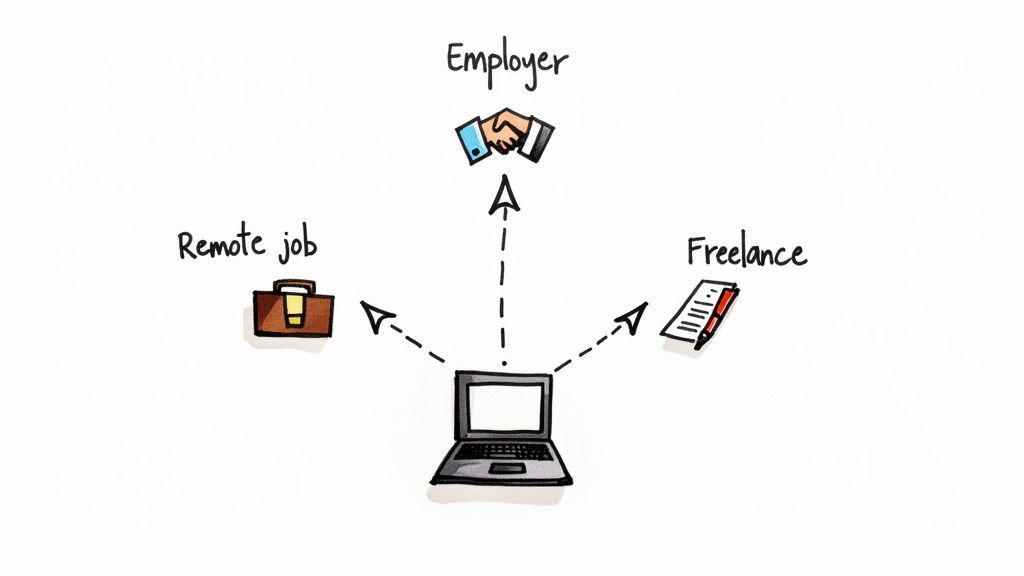
The dream of working from a cafe in Lisbon or a co-working space in Bali is fueled by one thing: a reliable, remote income. The romantic idea of figuring it all out “on the road” is a myth, and a risky one at that. The smart move? Secure your location-independent career before you even think about booking a flight.
Your professional life is the engine of this entire journey. It’s what turns an extended vacation into a sustainable lifestyle. Fortunately, there are a few proven paths to get there, each with its own pros and cons. Let’s dig into the most effective ways to build a career that travels with you.
Turning Your Current Job Remote
Believe it or not, the most direct path to a remote career might be the one you already have. Pitching your current employer on a remote arrangement can be surprisingly effective, but only if you approach it like a business proposal, not a personal favor.
You need to frame it around the benefits for the company. Think increased productivity, your proven track record, and your ability to maintain seamless communication, no matter the time zone.
Here’s how to build your case:
- Build a Track Record: For a few months, make yourself indispensable. Over-deliver on projects and become the model of clear, proactive communication. Your reliability is your best negotiation tool.
- Create a Formal Proposal: Don’t just ask in a meeting. Document exactly how your role can be done remotely without missing a beat. Address potential concerns head-on, like team collaboration, meeting attendance, and data security.
- Suggest a Trial Period: Propose a 3-month trial run. This lowers the perceived risk for your manager and gives you a chance to prove your case with cold, hard results.
Landing a New Fully Remote Job
If your current role is chained to the office, the global job market is your new playground. More and more companies are hiring the best talent they can find, regardless of zip code, opening up a world of opportunity. You just have to know where to look and how to present yourself.
There’s been a major shift in how nomads work. By 2025, it’s expected that around 60% of digital nomads will hold traditional remote jobs, with only 40% identifying as freelancers or entrepreneurs. This trend highlights the growing stability and availability of remote-first employment.
Your resume needs to scream “remote-ready.” This means highlighting skills that go beyond your technical abilities.
Hiring managers for remote roles are looking for proof that you can work autonomously, manage your own time, and communicate with crystal clarity in writing. These are the soft skills that will get you hired.
To find these jobs, skip the massive, generic job boards where your application will get lost. Instead, focus on niche platforms built specifically for remote work. For a curated list of solid opportunities, our guide on the best digital nomad jobs is a fantastic place to start. These sites cut through the noise and connect you with companies that truly get remote culture.
Launching a Freelance Business
For those who crave ultimate autonomy, freelancing is the classic digital nomad path. As a freelancer, you’re the boss. You set your hours, choose your clients, and call the shots. Of course, this route demands a strong entrepreneurial spirit and a rock-solid plan.
Your success here depends on your ability to market yourself and build a steady pipeline of clients. This isn’t about finding one-off gigs on a content mill; it’s about creating a sustainable business that supports your travels.
Here are the essentials:
- Define Your Niche: Don’t be a generalist. Specialize in something specific so you can become the go-to expert. Instead of just “writer,” be a “B2B SaaS content writer for fintech startups.” See the difference?
- Build a Portfolio: You need a professional website to showcase your best work. If you’re just starting out, offer to do a few projects at a reduced rate or for a non-profit to build up your portfolio with real-world examples.
- Set Your Rates: Research what other freelancers with your experience are charging. Don’t sell yourself short. Price your services based on the value you deliver, not just the hours you put in.
- Network Proactively: Get active on LinkedIn and join online communities in your field. Building genuine relationships is the key to long-term freelance success.
Whether you convert your current role, land a new remote job, or launch your own freelance business, the goal is the same: create a stable and fulfilling career that empowers your life of travel.
Comparing Your Remote Income Options
Feeling a bit overwhelmed by the choices? That’s completely normal. Each path offers a different blend of freedom, security, and responsibility. This table breaks down the pros and cons to help you figure out which route is the best fit for your personality and goals.
| Income Path | Pros | Cons | Best Suited For… |
|---|---|---|---|
| Convert Current Job | Keep your seniority, benefits, and established relationships. Least disruptive path. | Success depends entirely on your company’s culture and your manager. May come with location or time-zone restrictions. | People with a strong track record at a company that is open-minded or already has some remote employees. |
| Find a New Remote Job | Access to global opportunities, stable salary, and company benefits (health insurance, retirement). | Can be a competitive job market. You’re starting from scratch building relationships and proving your value. | Individuals seeking stability, structure, and the benefits of traditional employment while still being location-independent. |
| Start Freelancing | Ultimate freedom and autonomy. You control your schedule, clients, and income potential completely. | Income can be inconsistent, especially at first. You’re responsible for everything: marketing, sales, taxes, and your own benefits. | Self-starters with an entrepreneurial drive, a specific marketable skill, and a tolerance for risk. |
Take a hard look at your skills, your financial situation, and what you truly want out of this lifestyle. The right choice is the one that aligns with your personal definition of success, giving you the foundation you need to thrive on the road.
Navigating Finances, Taxes, and Visas
Your remote job is the engine, but let’s be real—your financial and legal planning is the chassis that holds this whole digital nomad adventure together. This is the stuff that makes the lifestyle sustainable long-term.
Getting a handle on your money, taxes, and visas can feel like a mountain to climb. I get it. But breaking it all down into smaller, manageable pieces is the key. Let’s get these foundations bolted down so you can travel with confidence.
Creating Your Nomad Budget
Before you can build a budget, you need to know what you’re up against. The cost of living is wildly different everywhere you go; Zurich and Chiang Mai are on opposite ends of the spectrum. Your first job is to do some homework.
Websites like Nomad List and Numbeo are your best friends here. They’re packed with real-time, user-submitted data on everything from a one-bedroom apartment to the price of a flat white.
A good way to start is by looking at what you spend now, then adjusting those numbers based on the data you find for your dream destinations.
Your budget will really have two parts:
- Fixed Monthly Costs: These are the bills that follow you no matter where you are. Think health insurance, software subscriptions, your phone plan, and any student loan payments.
- Variable Location-Based Costs: This is everything else. Your accommodation, food, local transport, and fun money. This is the part of your budget that will flex with every new stamp in your passport.
Oh, and one more thing. Always build a “life happens” buffer of 15-20% into your variable costs. Trust me, unexpected expenses are a guarantee on the road, and planning for them is the difference between a minor hiccup and a major meltdown.
The Non-Negotiable Emergency Fund
An emergency fund isn’t just a nice-to-have; it’s the most critical financial safety net for any nomad. This isn’t your travel savings. It’s a separate, sacred account for true, pull-the-ripcord emergencies—a last-minute flight home, a surprise medical bill, or the dreaded laptop-meets-concrete moment.
Your goal should be to have at least 3-6 months’ worth of essential living expenses tucked away. This fund is pure peace of mind. It’s what gives you the freedom to handle a crisis without torpedoing your entire lifestyle or racking up debt.
Once that’s solid, you can create a separate “launch fund” of around $2,000-$5,000. This covers the initial big expenses like your first flight, visa application fees, and that first month’s rent and deposit.
Demystifying Taxes for Nomads
Okay, let’s talk about the beast: taxes. This is easily the most complex part of a nomad’s financial life, and it’s one area where paying for professional advice is almost always worth it. Tax laws are incredibly specific to your citizenship and where you physically spend your time.
For U.S. citizens, the big concept to wrap your head around is tax residency. The U.S. taxes its citizens on worldwide income, no matter where they live. The good news? You might qualify for some major breaks that can slash your tax bill, like the Foreign Earned Income Exclusion (FEIE). This lets you exclude a huge chunk of your foreign-earned income from U.S. taxes, but you have to meet some strict residency tests to qualify.
It’s crucial to know your obligations. For example, spending more than 183 days in another country can sometimes trigger tax residency there, meaning you could owe taxes in two different places. Seriously, hiring a CPA who specializes in expat taxes is a brilliant investment. They’ll keep you compliant and help you save money.
Understanding Visas and Legal Status
Finally, let’s talk about how you can actually stay in the countries you want to visit. Figuring out entry requirements is a non-negotiable part of your planning. You really have two main paths.
A lot of nomads start out by hopping between countries on tourist visas. They’re usually easy to get and work perfectly for shorter stays, typically letting you hang around for 30 to 90 days. The catch? Working on a tourist visa is often a legal gray area. While tons of nomads do it without a problem, it’s technically against the rules in most places.
The second, more stable route is the digital nomad visa. More and more countries are rolling these out—think Portugal, Spain, Colombia, and Thailand. These specialized visas give you the clear legal right to live in a country for a year or more while you work remotely for your foreign company.
They offer stability and, most importantly, peace of mind. For a full rundown of which countries offer them and what you need to apply, check out our complete guide on digital nomad visa requirements.
Always, always double-check the official government immigration website for your destination. Rules can and do change fast.
Your Essential Digital Nomad Toolkit

Being a successful digital nomad is about more than just a love for travel. What really makes it work is having the right toolkit. I’m not just talking about what’s in your suitcase—it’s the combination of reliable tech, smart connectivity, and solid safety nets that lets you work from anywhere without a hitch.
Think of your gear as your mobile office and your support system all in one. Getting this right isn’t a luxury; it’s the bedrock of a sustainable, low-stress nomadic lifestyle. Let’s dig into the essential gear that will work just as hard as you do.
Core Tech The Non-Negotiables
Your tech is your direct link to your job, so it has to be rock-solid. It’s tempting to pack ultra-light, but you can’t compromise on performance.
The heart of your setup is a powerful and dependable laptop. Go for a model that’s known for being tough and having great battery life. Just picture your laptop giving up the ghost mid-project in a small town with zero tech support—that’s a nightmare scenario you want to avoid.
A few other key items can make a world of difference for your productivity:
- A Portable Monitor: This is an absolute game-changer if you’re used to two screens. A lightweight, USB-C monitor can double your digital workspace without weighing you down.
- Noise-Canceling Headphones: Perfect for creating your own focus zone in a chatty café, a busy airport, or a noisy apartment. They’re a universal sign for “I’m working” and genuinely help you concentrate.
- A Universal Power Adapter and Power Bank: Never get caught powerless. A high-capacity power bank can be a real lifesaver, charging both your laptop and phone when you’re far from an outlet.
For a super-detailed look at different gear options, check out this ultimate digital nomad packing list. It has great recommendations for all kinds of travel styles.
Staying Connected Anywhere in the World
For a digital nomad, fast and stable internet is like oxygen. Just hoping the Wi-Fi at your next Airbnb will be good enough is a risky gamble. You need a multi-layered plan to stay online.
Your smartphone is your number one tool. As soon as you land in a new country, make it a priority to grab a local SIM card with a hefty data plan. It’s almost always way cheaper and more reliable than international roaming.
Then, get familiar with your phone’s mobile hotspot. It turns your phone into a personal, secure Wi-Fi network for your laptop, meaning you can get work done from a park, a beach, or even a train.
Always have a backup plan. Before you book a place or head to a café, check recent reviews on Google Maps or sites like Workfrom for comments on the Wi-Fi. Never take the listing’s word for it.
Finally, you have to protect your digital life. Hopping on public Wi-Fi at airports and coffee shops leaves your data vulnerable. A Virtual Private Network (VPN) is non-negotiable. It encrypts your connection, keeping your work and personal info safe from anyone trying to snoop. We’ve got a whole guide on finding the best VPN for remote workers that can help you out.
The Two-Part Insurance Strategy
A lot of new nomads fall into the trap of thinking travel insurance is all they need. The reality is, you need two completely different types of insurance to be properly covered on the road.
1. Travel Insurance This is for the “travel” part of your trip. It covers things like trip cancellations, lost luggage, flight delays, and theft. It’s your financial safety net for when the logistics of moving around go wrong.
2. Global Health Insurance This is for you. It covers everything from doctor visits and emergencies to hospital stays when you’re outside your home country. Your regular health plan from back home is pretty much useless abroad, so this is a must-have.
Here’s the simple way to think about it: travel insurance protects your wallet from travel headaches, while global health insurance protects your actual well-being. Having both gives you total peace of mind, so you can focus on the adventure.
Planning Your First 90 Days on the Road

The idea of becoming a digital nomad can feel like you’re trying to solve a massive puzzle with a million moving parts. It’s easy to get overwhelmed. The trick is to stop seeing it as one giant leap and start treating it like a structured, manageable timeline.
Think of the next 90 days as your launch sequence. This roadmap breaks down everything from the big, scary decisions to the final pre-flight checks and your first month of finding your feet. By tackling these tasks in phases, you build momentum and clarity, ensuring a smooth takeoff for your new life.
Three Months Out: The Big Picture
With about three months to go, it’s all about laying the foundation. This isn’t the time to sweat the small stuff; it’s for macro-planning. Your goal right now is to set the stage for a transition that’s both exciting and financially stable.
You’ll want to concentrate on a few critical areas that have the biggest impact on your readiness. Getting these right will dictate the pace for everything else as your departure date creeps closer.
Here’s where to focus your energy:
- Lock in Your Income Stream: This is priority number one. If you haven’t already, now’s the time. Whether you’re pitching your boss on going remote or hitting “apply” on remote-first roles, get your paycheck sorted.
- Build Your Financial Runway: Your emergency fund (3-6 months of expenses) should be fully topped up. Now, start aggressively saving for a “launch fund”—this will cover your initial flight, apartment deposits, and all those unexpected setup costs.
- Start Your Destination Research: Begin exploring where you might want to land first. Dig into the cost of living, visa rules for your nationality, and—critically—internet reliability and time zone differences that could affect your work.
- Begin the Great Downsize: It’s time to start decluttering. Go room by room and sort your life into four piles: sell, donate, store, and pack. Trust me, this process always takes way longer than you think.
This early planning phase is all about reducing future stress. By handling the big, slow-moving pieces now, you create the breathing room you’ll desperately need for the last-minute tasks that will inevitably pop up later.
One Month Out: Finalizing the Details
With just 30 days on the clock, things get real. Your planning shifts from abstract ideas to concrete actions. Your focus narrows to logistics, booking travel, and gathering the actual gear you’ll need for your new mobile life.
The tasks in this phase are all about locking things in and making tangible progress. You’re moving from the “what if” stage to the “this is happening” stage.
Your checklist for the final month:
- Book That First Flight & Stay: With your destination picked, book your one-way ticket and your accommodation for the first few weeks or month. This puts a firm date on your dream.
- Get Your Banking in Order: Let your banks know you’ll be abroad. Order a travel-friendly debit card that won’t sting you with foreign transaction fees.
- Purchase Your Essential Gear: Now’s the time to buy your core tech—the laptop, a portable monitor, a solid power bank—and any specific travel items you need, like a high-quality backpack.
- Handle Medical Prep: Get in for a check-up with your doctor and dentist. Refill any prescriptions you need and grab copies of your medical records to take with you.
- Digitize Important Docs: Scan your passport, driver’s license, birth certificate, and visa paperwork. Store them securely in a cloud service you can access from anywhere.
As you get closer to leaving, comprehensive resources offering guidance on preparing for your move abroad can be a lifesaver for checklists and reminders you might have overlooked.
Your First 30 Days: Hitting the Ground Running
You’ve landed. The initial buzz is incredible, but this first month is a critical adjustment period. Your mission, should you choose to accept it, is to shift from feeling like a tourist to feeling like a temporary resident. That means establishing routines that support both your work and your well-being.
The goal isn’t to see and do everything at once. It’s to build a sustainable rhythm that will prevent burnout and help you adapt successfully. For more on this, check out our in-depth guide to creating the perfect remote work setup anywhere in the world.
Key actions for your first month abroad:
- Establish a Work Routine Immediately: Find your spot—whether it’s a local café, a coworking space, or your apartment—and stick to a consistent schedule. This creates a sense of normalcy and signals to your brain that it’s time to focus, even with a whole new world outside your window.
- Navigate the Initial Culture Shock: It’s completely normal to feel a bit overwhelmed or lonely. Go easy on yourself. Focus on small victories, like learning a few key phrases in the local language or figuring out the public transit system.
- Find Your Community: Don’t let yourself become isolated. Use apps like Meetup, jump into local expat Facebook groups, or hit up events at a coworking space to meet people. Even a small social circle can make a huge difference.
- Explore, But Pace Yourself: You have to balance work with exploration. Set aside weekends or evenings to discover your new city, but resist the urge to treat every day like a vacation. Pacing is everything if you want to make this a long-term lifestyle.
Your Biggest Digital Nomad Questions, Answered
Making the jump to a location-independent life always kicks up a storm of questions. As the dream gets closer to reality, the practical “what ifs” suddenly feel a lot more real. I get it. Let’s tackle the most common questions I hear from people just like you, with straight-up, honest answers to help you finally take that leap.
How Much Money Should I Actually Save?
There’s no magic number here, but the smartest way to think about it is by building two separate pots of money before you go: a safety net and a launchpad.
First up, your emergency fund. This is non-negotiable. You need 3-6 months of your essential living expenses from back home, tucked away. This isn’t for fun travel stuff. This is your “oh crap” fund for a last-minute flight home, a surprise medical bill, or your laptop dying a tragic death. It’s what lets you sleep at night.
Next, you’ll want a launch fund of around $2,000 to $5,000. This is the cash that gets you off the ground and covers those initial big expenses:
- That first long-haul flight.
- Visa fees (they add up!).
- The first month’s rent and a security deposit on an apartment.
- Little setup costs, like a local SIM card and stocking the fridge.
The real key isn’t just savings. Having a confirmed remote income stream before you leave is infinitely more important than the exact amount in your bank. Savings are the buffer, but your income is the engine that keeps this whole thing going.
Is This Lifestyle Possible With a Family or Pets?
Absolutely, but you have to throw the typical backpacker playbook out the window. The fast-paced, country-hopping style you see on Instagram is a recipe for disaster. Families and pet owners thrive by becoming “slowmads.”
This means settling into one place for several months, maybe even a year. It swaps frantic travel days for stability, real cultural immersion, and way less stress.
For families, your pre-trip research just looks a little different. You’ll be Googling things like:
- World-schooling options and international school programs.
- Family-friendly cities with great parks, activities, and a solid safety record.
- Comprehensive international health insurance that actually covers everyone in the family properly.
Bringing a pet along is a whole other level of planning, mostly centered on paperwork and costs. You’re looking at extensive vet records, potential quarantine periods depending on where you’re headed, and some seriously expensive transport fees for your furry friend. It’s doable, but it’s a major commitment.
What Are the Biggest Challenges Nomads Really Face?
Forget what you’ve heard about bad Wi-Fi. That’s usually the easiest problem to solve. The biggest hurdles are almost always the internal and social ones. Nailing the digital nomad life is as much about managing your own head as it is about managing your logistics.
The things that really trip people up are:
- Loneliness: This one is very real. You’re in a constant cycle of hellos and goodbyes, which can make it incredibly tough to build the kind of deep, supportive friendships you have back home.
- Self-Discipline: When there’s no office to go to and your boss is a thousand miles away, it’s all on you. You have to become the master of your own focus, fighting the urge to hit the beach when a deadline is staring you down.
- Travel Burnout: The novelty wears off. Constantly booking flights, hunting for apartments, and figuring out a new city is exhausting. The most successful nomads I know combat this by traveling slower and building solid routines.
Do I Actually Need a Digital Nomad Visa?
Not necessarily, especially not right out of the gate. A lot of new nomads get started by using standard tourist visas. These typically let you stay for 30 to 90 days and are a pretty simple way to test out the lifestyle without a massive commitment.
But—and this is a big but—it’s crucial to understand that working (even for your company back home) is often a legal gray area on a tourist visa. It’s a common practice, sure, but it’s not without its risks.
This is where official digital nomad visas are changing the game. Countries like Portugal, Spain, and Colombia are now offering these long-term permits that give you the explicit legal right to live and work remotely, often for a year or more. They offer stability, legitimacy, and a ton of peace of mind. Your first move should always be to research the specific visa rules for your passport and your dream destination.
Ready to find a job that can take you anywhere in the world? At Remote First Jobs, we connect talented professionals with verified remote-first roles from trusted companies. Cut through the noise and find your next great opportunity without ever needing to sign up. Start your search on Remote First Jobs today!