Ever heard of the hidden job market? It’s not some secret, members-only club. It’s simply where most jobs get filled—through networking and referrals before a company ever thinks about posting them online. Think of it as the inside track, where roles are secured through connections long before the general public even knows they exist.
Uncovering the Hidden Job Market

Picture a massive iceberg. That tiny tip you see sticking out of the water? That’s every job you’ll ever find on LinkedIn, Indeed, or any other public job board. Now, what about that enormous, unseen mass of ice lurking beneath the surface? That, right there, is the hidden job market.
This isn’t just a clever analogy; it’s how hiring really works. Most estimates suggest a mind-boggling 70% to 85% of all jobs are never advertised. They get filled through much smarter, more efficient channels. So, if your job search is limited to scrolling through job sites, you’re fighting for a tiny slice of the pie.
This completely changes the game. When you only apply to public listings, you’re just one of hundreds—sometimes thousands—of applicants all vying for the same role. But when you learn to tap into the unadvertised market, you’re suddenly in a much smaller, more qualified pool of candidates, often with a direct line to the person making the decision.
Why Do Companies Hire This Way?
It’s not about being secretive. It’s about being smart, efficient, and finding better people, faster. Companies have powerful reasons to avoid casting a wide, public net, and understanding them is your first step to becoming the person they find through their trusted circles.
Here’s what’s really driving this behind the scenes:
- It Saves a Ton of Money: Posting on job boards, sifting through a mountain of resumes, and holding endless interview rounds is incredibly expensive. A referral can slash hiring costs by thousands of dollars.
- It’s Way Faster: The clock is always ticking. A referred candidate can be hired in about 29 days, compared to the 39 days it takes to hire someone from a job board. That’s ten days of saved productivity.
- The Candidates are Just Better: Time and again, employee referrals lead to fantastic hires. People who come in through a referral tend to perform better, stick around longer, and fit into the company culture almost instantly.
A trusted referral is the ultimate pre-screening tool. When a current team member vouches for someone, it provides a level of credibility and a culture-fit check that a piece of paper never could.
At the end of the day, companies are hunting for the lowest-risk, highest-reward way to bring great talent on board. By building real relationships and becoming a known name in your industry, you become the solution they’re looking for—sometimes before they even realize they need to hire. You can get a deeper look at how companies think in our guide to modern talent sourcing strategies.
Why This Market Matters More Than Ever
If your job search is limited to public job boards, you’re basically playing the lottery. Every time you hit “apply,” you’re competing against thousands of other people for the same prize, and the odds are not in your favor.
With economic shifts and waves of recent layoffs, the number of applicants for every single advertised role has gone through the roof. Trying to make your application stand out in that sea of resumes is almost impossible.
This is why you have to adapt your strategy. It’s not just a nice-to-have anymore; it’s essential for your career’s survival and growth. The rules of the game have changed, and focusing your energy on the hidden job market is how you start playing to win.
The New Reality of Hiring
Companies are feeling the pressure to hire smarter, not just faster. Sifting through hundreds—sometimes thousands—of unqualified resumes for one opening is a colossal waste of time and money.
So, what are they doing instead? They’re turning inward. They’re leaning on trusted networks, internal promotions, and direct referrals to fill roles quietly and efficiently before they ever hit a job board.
This shift is picking up speed for a few key reasons:
- Overwhelming Competition: A decent remote job can easily attract over 1,000 applicants in a few days. For a hiring manager, that’s a nightmare to sort through.
- Economic Jitters: When things are uncertain, companies want low-risk hires. A referral from a trusted employee feels like a pre-vetted candidate, drastically cutting the risk of making a bad choice.
- Constant Change: Business needs are evolving so fast that new roles pop up to solve immediate problems. These jobs are often filled by someone the team already knows before a formal description is even written.
The need to access the hidden job market is more critical than ever. In the first four months of 2025 alone, over 257,000 workers in the U.S. were laid off—more than the entire total for 2023. This chaos is pushing even more people to compete for that visible 15% to 30% of jobs. The smart move is to go where the real opportunities are: the unadvertised 70% to 85% of roles. You can dig deeper into these trends in the latest Future of Jobs Report from the World Economic Forum.
Why Your Network Is Your Greatest Asset
In this kind of environment, your professional network stops being a simple list of contacts and becomes your most powerful career tool. Every single person you know is a potential bridge to an unadvertised job.
Think of it this way: a resume tells a hiring manager what you’ve done, but a referral tells them who you are. In a world saturated with qualified candidates, the human element of trust often becomes the deciding factor.
Tapping into the hidden job market is about being proactive, not reactive. It’s about building genuine relationships before you need them and positioning yourself as the solution to a company’s problem. When you do that, you stop being one of a thousand applicants and become one of a few handpicked candidates. That shift is what creates real, long-term career stability and opens doors to opportunities others will never even know existed.
Actionable Strategies to Find Unadvertised Jobs
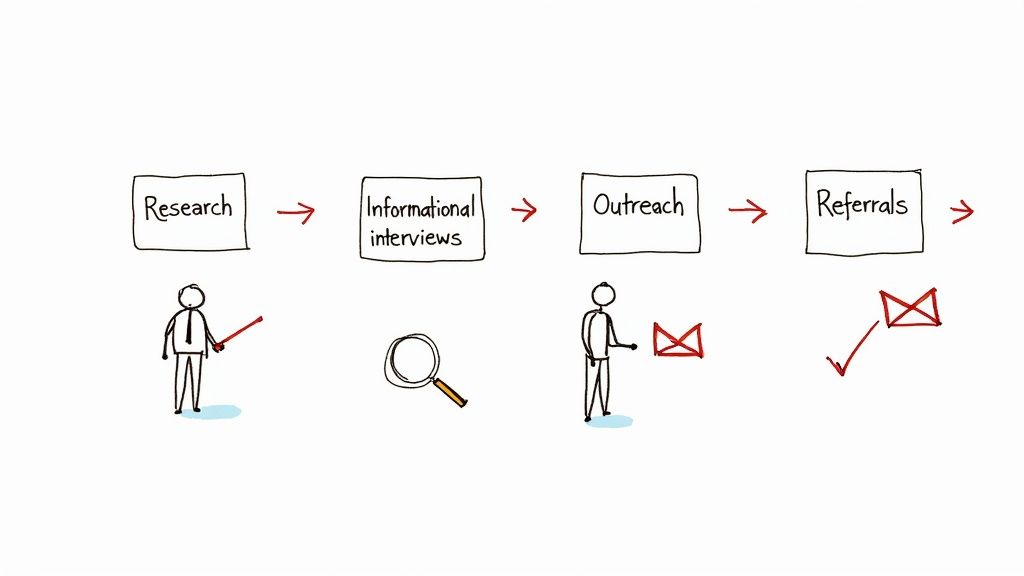
Knowing the hidden job market exists is one thing. Actually navigating it is a whole different ballgame. To make the jump from theory to practice, you have to shift your mindset—stop passively applying and start proactively creating opportunities for yourself.
This isn’t about aimless networking. It’s about building genuine, value-driven connections that put you in the right place at the right time for those unadvertised roles.
The strategies below are your playbook for uncovering these positions. Instead of waiting for a job posting to pop up, you’ll learn how to get on a company’s radar long before a role is even officially defined. This puts you in a category of one, miles away from the crowded applicant pools on public job boards.
Master the Informational Interview
One of the most powerful—and strangely underused—tools in your arsenal is the informational interview. Let’s be clear: this is not a secret job interview. It’s a genuine conversation focused on gathering advice and insights from someone in a role, company, or industry you admire. You’re there to learn, not to ask for a job.
When you do it right, these conversations build powerful allies who will have you top-of-mind when opportunities pop up.
How to Make It Work:
- Identify the Right People: Hop on LinkedIn and find professionals one or two levels above your target role at companies you’re interested in. Look for shared connections, alumni groups, or similar backgrounds to create a warmer introduction.
- Craft a Respectful Outreach Message: Keep your first message short, personalized, and focused on them. Mention something specific about their work that impressed you and state clearly that you’re just seeking advice for your own career path.
- Ask Smart Questions: Prepare thoughtful questions you can’t just find on Google. Ask about their team’s biggest challenges, the skills they see as most valuable, or what a successful first year in their department looks like.
At the end of the chat, always ask this key question: “Based on our conversation, is there anyone else you think would be valuable for me to speak with?” This simple request can turn one great conversation into a chain of powerful new connections.
Become a Proactive Company Follower
Don’t just follow job postings; follow the companies themselves. By the time a job is officially listed, you’re already behind. The real goal is to spot the signals of growth and need before the hiring process officially kicks off.
When you hear a company has secured a new round of funding, launched a major product, or is expanding into a new market, that’s your cue. These are hiring triggers, and reaching out at that moment positions you as a strategic thinker, not just another applicant.
Create a target list of 15-20 companies you’d genuinely love to work for. Then, set up alerts and follow their key executives on social media. This allows you to engage with their updates thoughtfully, making your name visible to decision-makers and showing a real interest that goes way beyond a single job opening. Many of the best unadvertised jobs exist in highly competitive industries. You can gain further insights by examining strategies to break into competitive fields like consulting, which relies heavily on this exact kind of proactive networking.
Perfect Your Direct Outreach
Reaching out to a hiring manager directly can feel intimidating, but a personalized, value-focused message can instantly set you apart from the crowd. This kind of “cold” outreach only works when it’s anything but cold. It requires solid research, empathy, and a clear value proposition.
Forget generic emails. Your message should immediately show you’ve done your homework.
A Simple Template for Success:
- Personalized Opening: “Hi [Hiring Manager Name], I was fascinated by your recent interview on the [Podcast Name] where you spoke about the challenge of [specific problem].”
- Value Proposition: “In my previous role, I tackled a similar issue by [your skill/method], which resulted in a [quantifiable achievement].”
- Gentle Call to Action: “I have a few ideas on how a similar approach could support your team’s goals. Would you be open to a brief 15-minute chat next week?”
This approach completely reframes the conversation. You’re not asking, “Can you give me a job?” You’re offering, “I can help you solve a problem.” It shows initiative and business acumen—qualities every great manager is looking for. A strong online presence is crucial for this strategy to work; our guide on how to optimize your LinkedIn profile can help you make the best possible first impression.
Building Relationships with Recruiters and Hiring Managers
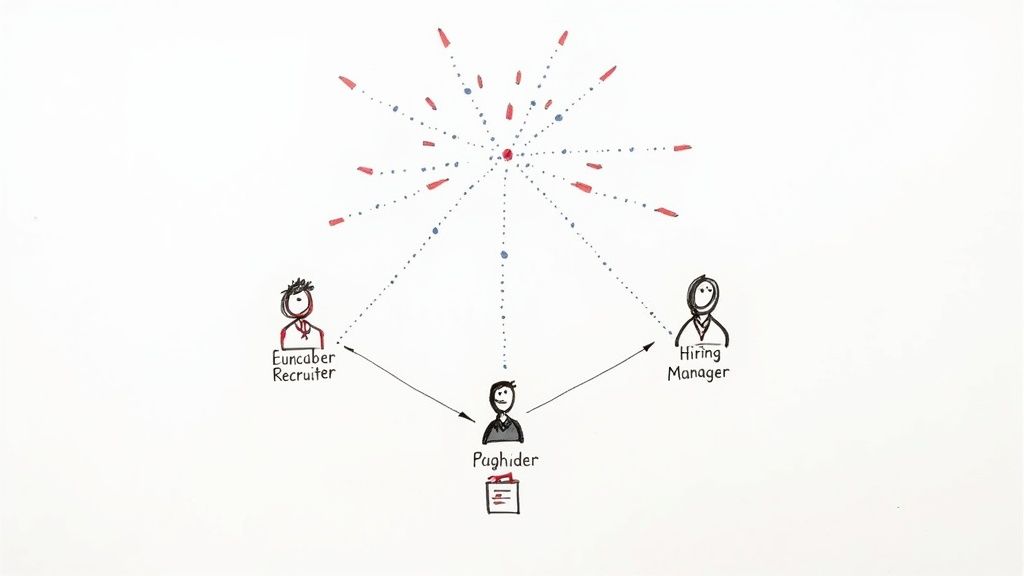
In the hidden job market, your network is everything. Forget endlessly scrolling job boards—real opportunity often comes through people. Trust is your currency, and strong relationships are your golden ticket.
Recruiters and hiring managers are the gatekeepers to the best remote-first roles, most of which never get a public job description. They’re constantly on the lookout for talent to solve their company’s problems, and getting on their radar before a role is even created is the ultimate power move.
Think of it this way:
- Internal recruiters already know the company culture inside and out. They can spot a perfect fit and fast-track candidates they trust.
- External recruiters have a massive network of contacts. A good relationship with one can open doors at several companies you’d never find on your own.
- Hiring managers are the ones with the actual problem. They appreciate people who proactively show them a solution—that solution being you.
Understanding Recruiter Roles
Not all recruiters are the same. Internal recruiters work for the company you want to join. They’re looking for candidates who don’t just have the skills, but who will also thrive in that specific corporate environment.
External recruiters, on the other hand, work for agencies. They’re juggling multiple clients and are focused on making the right match, fast.
So, how do you become their go-to person when a great role pops up?
- Keep your LinkedIn profile fresh. Add new accomplishments and skills at least once a month.
- Don’t just connect—contribute. Share articles or insights relevant to your field to show you know your stuff.
- Always follow up. A quick note after a conversation keeps you top-of-mind.
Providing Recruiters with Key Information
Recruiters are busy. Incredibly busy. Make their job easier by giving them exactly what they need, without the fluff. Long paragraphs are a no-go; clear, scannable information is your friend.
When you connect, give them a snapshot of who you are and what you’re looking for:
- Preferred roles and seniority so they know precisely what to look for.
- Your availability and time zone—critical for any remote position.
- Salary expectations, framed as a range to keep the conversation flexible.
- A link to a quick, one-minute video intro to let your personality shine through.
This simple act of preparation makes you an easy candidate to place, meaning they’ll think of you first.
Building Rapport Through Value
Want to really stand out? Stop thinking about what a recruiter can do for you, and start thinking about what you can do for them. Share a great industry report you just read. Let them know about a relevant webinar.
This isn’t about being transactional; it’s about being a valuable connection.
Value-first interactions lay the groundwork for trust and ongoing collaboration.
When you consistently provide value, you transform from just another name in their database to a trusted industry contact they want to help succeed.
Reaching Out to Hiring Managers
While recruiters are gatekeepers, hiring managers are the decision-makers. They’re the ones who lie awake at night thinking about the problems on their team. Your job is to show them you’re the solution.
Contacting them directly is a bold move, but it can pay off big time. You skip the line and put yourself right in front of the person with the power to hire you. For a deep dive into this tactic, check out how job seekers can find hiring manager emails fast.
Here’s a simple, effective game plan:
- Use LinkedIn and the company website to identify the right manager for the team you want to join.
- Shoot them a concise email. Don’t just say you’re looking for a job—briefly explain how you can solve a specific problem they likely have.
- End with a clear, low-commitment ask: a brief 15-minute chat.
Timing is everything. Watch for company news like a new funding round or a product launch—these are perfect moments to reach out. To get this outreach on a schedule, our guide to building a job search plan can help you map everything out.
Ultimately, building genuine relationships with recruiters and hiring managers isn’t just a strategy; it’s the strategy for unlocking the best opportunities in the remote job market.
Common Mistakes to Avoid in Your Search

Cracking the hidden job market isn’t like firing off applications into the void. It’s a completely different game, one built on relationships and trust. Because of that, even small missteps can quietly shut doors you didn’t even know were opening.
A lot of professionals, used to the formality of online applications, trip up when they start trying to build connections. They treat networking like a transaction instead of a long-term investment, and that mindset is the root of almost every error. Let’s make sure you don’t fall into the same traps.
Stop Being Transactional
The single biggest mistake? Transactional networking. This is when you only reach out to people when you need something—a job, an introduction, a referral. It feels insincere because, well, it is.
Think about that one friend who only calls when they need to borrow money. You start to see their name pop up on your phone and you just know what’s coming. The same thing happens in the professional world. If your first message to a new contact is, “Hi, do you have any open roles?” you’re basically shouting that you see them as a stepping stone, not a peer.
Building genuine relationships is a long-term game. The goal isn’t to ask for a job today; it’s to become the person they think of when an opportunity arises tomorrow.
Instead of asking, focus on giving. Share an article you think they’d find interesting, offer a thoughtful comment on their latest project, or make a helpful introduction if you’re in a position to do so. This is how you build real rapport and make people want to help you down the line.
Avoid Generic Outreach
In a world overflowing with automation, a little personalization goes a long, long way. Blasting out the same copy-paste message to dozens of people is the professional equivalent of junk mail. It’s lazy, it’s obvious, and it’s a surefire way to get ignored.
Hiring managers and recruiters get buried in messages every single day. The only ones that cut through the noise are the ones that show you’ve actually done your homework. Mention a specific project they led, a recent company win, or an article they wrote.
Here’s how to fix it:
- Do Your Research: Just five minutes on their LinkedIn profile or the company’s news page is all it takes.
- Find a Connection: Look for a mutual acquaintance, a shared university, or even a common interest you can mention.
- Keep It Short: Respect their time. Get to the point with a message that’s about them, not just you.
That small bit of effort shows genuine interest and sets you apart. And when they inevitably click on your profile, you need to be ready. Our guide on crafting a compelling resume for remote jobs will help you make sure your own materials are polished and prepared.
Don’t Neglect the Follow-Up
Making a great first impression is just step one. The real relationship-building happens in the follow-up. Far too many job seekers have a fantastic initial chat, then just… disappear. They let a warm, promising connection go cold.
Nurturing your network is all about consistent, light touches. After an informational call, send a thank-you note within 24 hours. Then, find natural reasons to stay in touch every few weeks. This isn’t about pestering them; it’s about staying on their radar in a positive way.
A simple check-in, a note about their company’s new product launch, or a “congrats” on their recent promotion keeps the connection alive. It’s this steady effort that ensures when a hidden opportunity finally does pop up, your name is the first one that comes to mind.
Frequently Asked Questions About The Hidden Job Market
Peeking into the hidden job market can feel like exploring a secret tunnel. We’ve gathered the most common questions so you can navigate with confidence.
Below, you’ll discover proven tactics for finding contacts, leveling up your role search, and crafting follow-up messages that stick.
How Do I Find The Right People To Network With?
Think of networking as prospecting—you need to zero in on the right veins before striking gold. Start on LinkedIn by filtering contacts by company, industry, and location. That’s how you identify second-degree connections who can offer warm introductions.
- Filter by industry, location, and job title to refine your list
- Join niche Slack or Discord channels where peers swap insights
- Attend virtual meetups where decision-makers often share candid advice
For more on uncovering unadvertised roles, check out our guide on finding remote jobs online.
Is The Hidden Job Market Only For Senior Roles?
It’s a common myth that only executives get access. In reality, entry-level candidates, mid-career professionals, and seasoned leaders all tap into this silent pool.
Referrals carry built-in credibility. A strong recommendation often outshines a glossy resume.
Referrals often tip the scales more than years on paper.
What Is The Best Way To Follow Up After Outreach?
A good follow-up feels like nurturing a relationship, not chasing a sale. Here’s a simple rhythm:
- Send a thank-you note within 24 hours
- If there’s no response, drop a polite nudge after one week
- Share a relevant article or congratulate them on an achievement monthly
These three steps keep you on their radar and show that you add value over time.
Case Study Of Networking Success
Meet Sara, a software engineer who wanted a remote role that never went public. She asked a mutual contact for an intro to the CTO of her dream company. After a 20-minute chat, the CTO invited her to apply.
Within two weeks, she accepted a senior remote position—before the job ever hit a board. Here’s her playbook:
- Leverage a mutual connection for the initial introduction
- Prepare thoughtful questions that highlight your strengths
- Follow up with a concise recap and a thank-you
Combine this approach with Remote First Jobs to scout thousands of vetted remote opportunities by skill, time zone, and more. Tackle one FAQ tactic each week and watch your network—and your prospects—grow.
Patience and persistence win in a market built on relationships.
Discover remote-first career opportunities with Remote First Jobs: https://remotefirstjobs.com