If there’s one rule I tell every job seeker, it’s this: always cross-reference a job posting with the company’s official careers page. Be deeply suspicious of any unsolicited offer that promises a huge salary for little work. And remember, a legitimate employer will never ask you to pay for a job or equipment. Period.
The New Reality of Job Hunting Safely
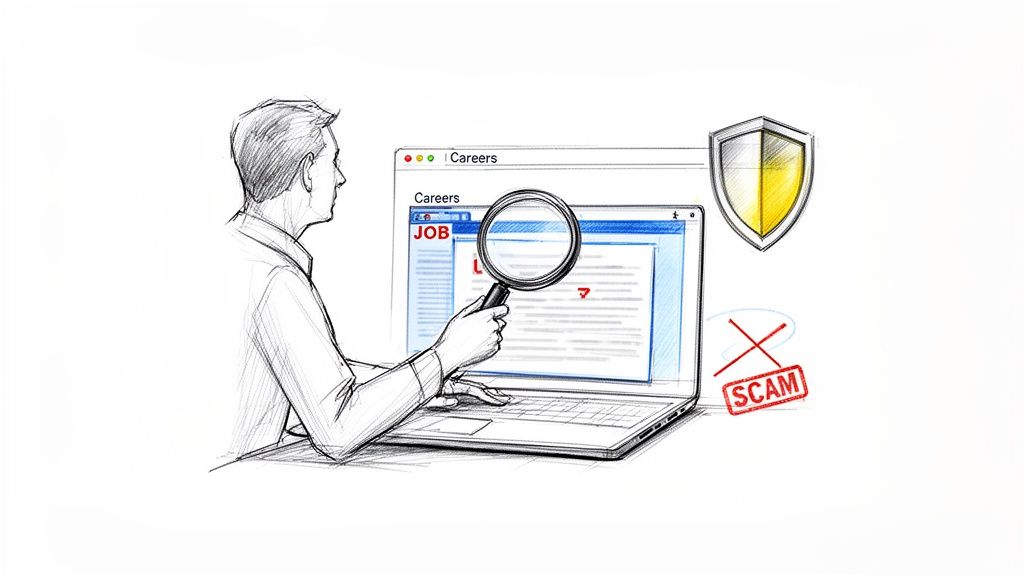
The explosion of remote work has been a game-changer for many, but it’s also thrown the doors wide open for sophisticated scammers. What used to be a rare annoyance has morphed into a full-blown criminal enterprise, preying on the hopes of job seekers everywhere.
This isn’t a small problem—it’s an industry. In the US alone, job scams resulted in over $501 million in losses in 2024. That’s a massive leap from just $90 million back in 2020, which shows just how aggressively criminals are targeting people on legitimate job platforms.
The modern job hunt requires a new level of vigilance. An offer that seems too good to be true almost always is. Your personal data is the prize, and protecting it is non-negotiable.
Being smart about your job search now includes knowing how to protect privacy online, as the two have become fundamentally linked.
Spotting Scams at a Glance
The first line of defense is learning to tell the difference between a real opportunity and a well-disguised trap. Scammers are experts at mimicking the hiring process, but they almost always slip up if you know where to look. Their entire strategy relies on creating false urgency and playing on your excitement for a great new role.
A real employer has a professional, structured process. They invest time to find the right person and are completely transparent about who they are. Scammers, on the other hand, rush you, hide their identity, and make requests no real company ever would.
To help you spot these red flags immediately, I’ve put together a quick comparison. Think of this table as your field guide for every new job opportunity that comes your way.
Legitimate Job vs Scam Job Red Flags
| Characteristic | Legitimate Job Opportunity | Job Scam Red Flag |
|---|---|---|
| Initial Contact | Professional email from a corporate domain (e.g., [email protected]). Recruiter profile is verifiable on LinkedIn. | Unsolicited text, Telegram message, or email from a generic address (e.g., [email protected]). |
| Job Description | Clear, detailed description of roles and responsibilities. Specific skill requirements are listed. | Vague language, multiple spelling/grammar errors. Promises extremely high pay for very little work or experience. |
| Interview Process | Multiple rounds, including video or phone calls with real team members. A structured and professional schedule. | Text-only or chat-based interviews. Refusal to have a video or voice call. The “hiring manager” is always unavailable. |
| Information Request | Asks for a resume and cover letter. SSN and bank details are only requested after a signed offer for onboarding. | Asks for your Social Security Number, bank account details, or a copy of your driver’s license before any offer is made. |
| Financial Requests | Never asks the candidate to pay for anything. The company covers all costs for equipment, training, and background checks. | Requires you to pay for a “starter kit,” training materials, or to purchase equipment from a “preferred vendor.” |
Keep this checklist handy. The moment you see a “red flag” characteristic, it’s time to stop and investigate further before you proceed. A few minutes of due diligence can save you from a world of trouble.
What Modern Job Scams Actually Look Like
If you want to avoid getting duped, you need to understand how these scammers operate. They’ve moved way beyond the old-school, typo-filled emails. Today’s job scams are sophisticated operations that prey on your excitement and the natural urgency of finding a great remote role.
One of the most convincing tactics is straight-up impersonation. A scammer will pretend to be a recruiter from a company you know and trust. They’ll create a polished but fake LinkedIn profile, use a spoofed email that looks almost right (think [email protected] instead of [email protected]), and even use the names of real employees to seem legitimate.
Their entire goal is to piggyback on a trusted brand name to get you to let your guard down and hand over personal information.
The Rise of the “Task Scam”
Lately, we’ve seen a huge spike in what’s known as a “task scam” or “optimization scam.” These gigs sound amazing on the surface—easy money for simple online work like writing fake product reviews or liking social media posts.
Here’s how it works: they start you off with a few small tasks and pay you quickly. That first payment is the hook. It builds your trust and convinces you the opportunity is real. But once you’re on board, the script flips.
They’ll suddenly require you to “invest” your own money to unlock bigger payouts or pay a “refundable” deposit for a premium work account. The numbers are frightening. One report found task scams shot up by 485% in just one year, with victims losing an average of $9,456.
Let this be your golden rule: You should never have to pay money to make money. A real job comes with a paycheck, not an invoice. Legitimate employers cover all business costs.
The Phishing Attack Disguised as an Interview
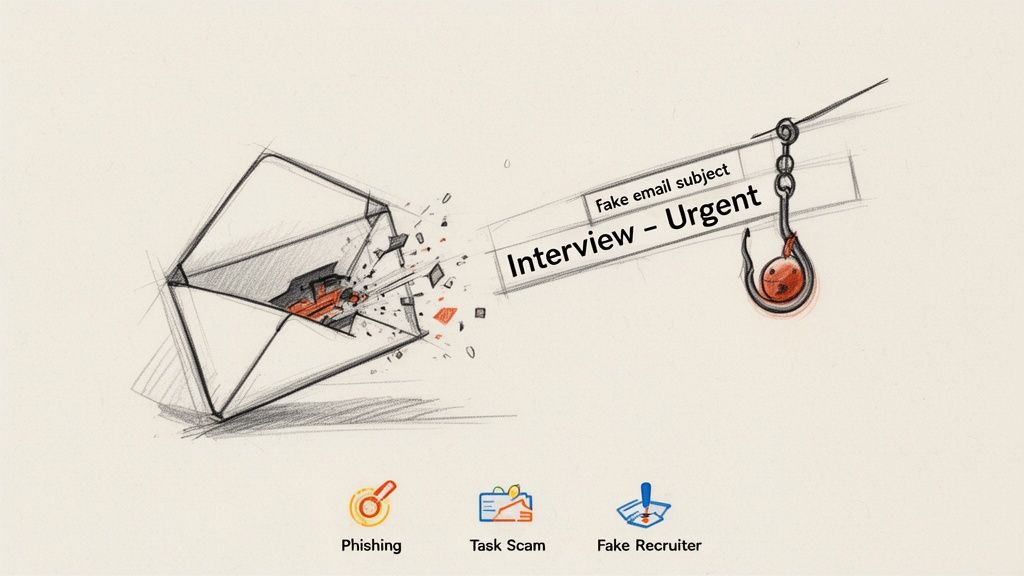
Another common trap is the phishing email that looks exactly like an interview invitation from your dream company. These are slick, professional, and designed to rush you into making a mistake.
They’re so convincing because they often include:
- Legitimate company branding: They’ll rip logos, fonts, and email footers directly from the real company.
- A manufactured sense of urgency: Subject lines like “Urgent: Your Interview” or “Final Round Selection” are designed to make you act before you think.
- Malicious links: The email will direct you to “schedule your interview” or “review the job details” on a fake website built to steal your passwords or infect your device with malware.
Learning good phishing attack prevention is non-negotiable in a remote job search. Always hover your mouse over a link to see the actual destination URL before you click. Be suspicious of any unexpected attachments, even if they look like simple PDFs.
These scammers are experts at social engineering. They know the job hunt is an emotional rollercoaster, and they use the thrill of a potential offer against you. By knowing their playbook, you can approach every opportunity with a healthy dose of skepticism and keep your personal information safe.
Your Practical Job Opportunity Verification Process
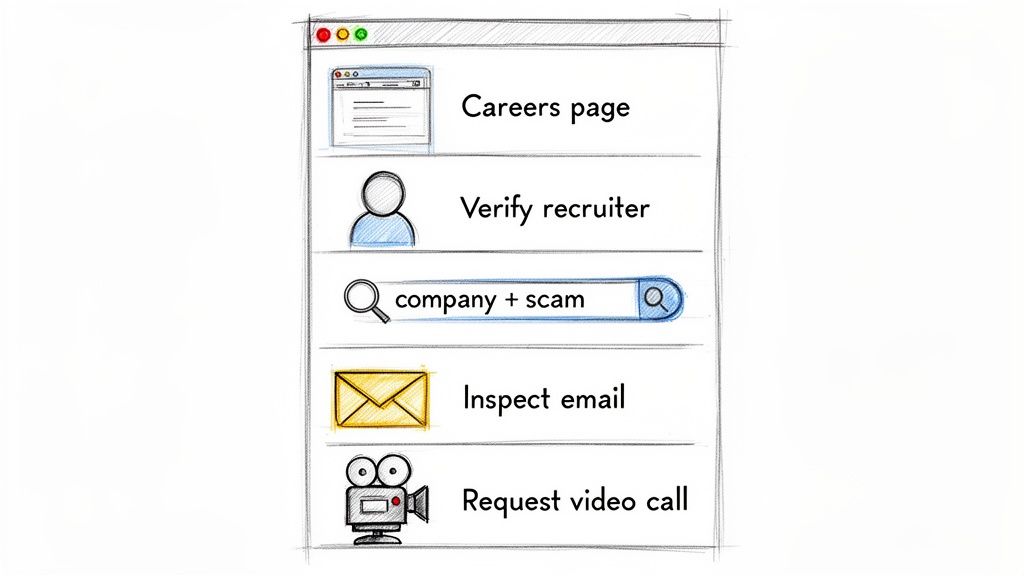 That rush of excitement when a great job opportunity lands in your inbox is fantastic. But letting that feeling take over without a healthy dose of skepticism is exactly what scammers are counting on. It’s time to build a simple verification habit—a quick, methodical checklist that can unmask a fake job in just a few minutes.
This isn’t about being paranoid; it’s about being smart. Online job scam reports shot up 19% in early 2025, costing job seekers a staggering $300 million in the first half of the year alone. With text-based scams having quadrupled since 2020 and nearly one in four scam encounters resulting in a loss, you can’t afford to just trust your gut. In fact, only 61% of people feel confident they can even spot a scam. A detailed Fortune report on recent FTC data digs into just how common—and costly—these schemes have become.
Always Start at the Source
Before you do anything else, find the company’s official careers page. And I mean find it yourself. Don’t click the link in that unsolicited email or text.
Open a fresh browser tab and search for “[Company Name] careers” or “[Company Name] jobs.” If the role is real, it will be listed on their official site. Scammers love to invent urgent, high-paying roles that don’t actually exist, banking on the fact that you won’t double-check. If you can’t find the exact job, look for something similar. A slight title variation is one thing, but if there’s nothing even close, you’ve found a huge red flag.
Dig Into Their Digital Footprint
Okay, so maybe the job is real. The next step is to verify the person who contacted you. Any legitimate recruiter will have a professional, well-established digital presence you can easily check.
- LinkedIn Investigation: Head over to LinkedIn and search for the recruiter’s name. Does their profile look complete and established? Crucially, does their work history show they are a current employee of the company they claim to represent? A sparse, brand-new profile or one with no connections is highly suspicious.
- Company Reputation Check: Do a quick Google search for phrases like “[Company Name] + scam” or “[Company Name] + reviews.” Websites like Glassdoor or the Better Business Bureau are your best friends here. People who have been burned before often post warnings, and their stories can save you a world of trouble.
Examine the Communication Details
Scammers rely on you being too excited or busy to notice the small stuff. But the small stuff is often where the entire scam falls apart. A legitimate company has professional infrastructure, and it shows.
Scammers operate on two principles: impersonation and urgency. If you slow down and check the little things, like an email address or a LinkedIn profile, you completely break their model.
Take a hard look at the sender’s email address. Is it from a free service? A real recruiter from Acme Corporation will email you from a “[email protected]” address, not [email protected] or [email protected]. These slight variations are often the most obvious giveaway that you’re dealing with a fake.
Insist on a Face-to-Face (Virtual) Meeting
Finally, here’s the litmus test: never, ever proceed with a hiring process that happens only over text or chat apps like Telegram or WhatsApp. This is a classic scammer playbook move—it keeps them anonymous and lets them read from a script.
Push for a video call. A real hiring manager will have zero issues hopping on a Zoom, Google Meet, or Microsoft Teams call. If they refuse, make excuses about a broken camera, or try to keep the conversation text-based, it’s time to walk away immediately.
This simple request is one of the most powerful tools for how to avoid job scams. A scammer’s goal is to hit as many targets as possible, as quickly as possible. They don’t have time for real interviews. By demanding a video call, you force them to either show their face or move on to an easier target. It works every time.
Communicating Safely with Recruiters
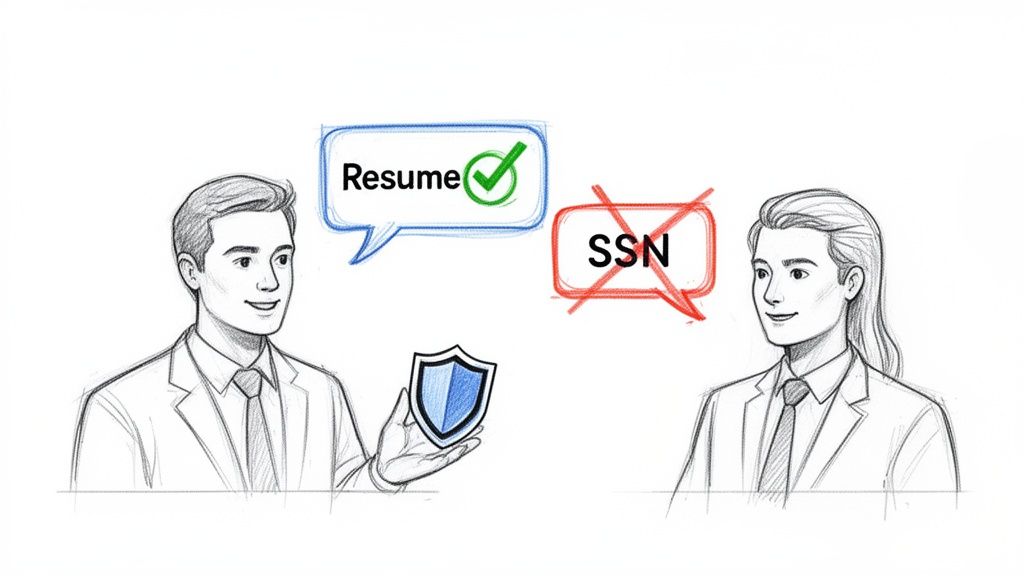
So, you’ve done your homework and the job opportunity looks legit. Great. Now comes the part where you actually have to talk to someone. This is where you need to be professional but also protect yourself, because scammers are masters at using the excitement of a new job to get you to lower your guard.
The best way to think about it is a gradual release of information. You only share more sensitive data as the company gets more serious about you. This isn’t being difficult; it’s being smart. Knowing what to share—and when—is the key to staying safe.
What Is Safe to Share Early On
In the beginning, your one and only goal is to show them you’re the right person for the job. That’s it. A legitimate company gets this and will only ask for information that helps them evaluate your skills.
It’s perfectly fine—and expected—to provide these things upfront:
- Your Resume or CV: This is your foot in the door. Just make sure it doesn’t have sensitive personal details like your full street address or your date of birth. Your city and state are all they need.
- Your Portfolio or Work Samples: If you’re in a creative or technical field, they’ll need to see your work. A link to your online portfolio or a few attachments is completely normal.
- A Cover Letter: This is your chance to talk about your skills and why you want the job. It’s all professional, no personal risk involved.
The simple rule is this: if it’s about your professional skills, it’s safe to share. If it starts creeping into personal identifiers or financial territory, that’s a huge red flag.
When Recruiters Ask for Too Much Too Soon
This is the moment to pay close attention. Scammers thrive on urgency, pushing to get your personal data under the guise of “fast-tracking your application” or “prepping for onboarding.” Don’t fall for it. Real companies have a formal, legally-required hiring process they can’t just skip.
You should never provide the following details before you have a signed, official job offer:
- Your Social Security Number (SSN)
- Bank account details or credit card numbers
- A photo of your driver’s license or passport
- Your full date of birth
- Passwords to any of your accounts
A real company only needs your SSN and bank info for two things: to run a background check and set up your payroll. Both of these happen after you’ve officially accepted a written job offer. Anyone asking for this during an interview is almost certainly trying to steal your identity.
How to Politely Push Back on Suspicious Requests
What do you do when a “recruiter” asks for something they shouldn’t? You don’t need to get into a fight. A polite but firm response is your best defense. It allows you to stay in control and see how they react.
Feel free to adapt these scripts to fit your situation:
If they ask for your SSN or bank info before an offer: “I’ll be happy to provide that information for the background check and payroll once a formal offer is signed. For now, I’d like to keep the conversation focused on my fit for the role and the team.”
If they insist on a text-only or chat-based interview: “I’m really excited about this position and want to make sure we have a productive conversation. Could we schedule a quick video or phone call instead? I find it’s a much better way to connect.”
If they ask you to download an unfamiliar app or click a strange link: “For security, I prefer to keep all our communication on email and established platforms like LinkedIn. Would you mind just sending the job details directly to my email?”
These responses are professional and put the responsibility back on them. A legitimate recruiter will understand and respect your boundaries. A scammer? They’ll likely get pushy or just disappear. Either way, you get your answer.
Finding Verified Jobs Without the Guesswork
Trying to dodge scams on massive, overcrowded job boards is exhausting. It feels like you’re constantly on the defensive. But what if you could change your strategy and sidestep the scammers altogether? The secret isn’t just about being more vigilant—it’s about changing where you look for jobs in the first place.
A much smarter approach is to use platforms that source jobs directly from a company’s own career page. This completely changes the game. It effectively cuts out the middlemen, like the giant aggregators and public job boards, which have unfortunately become breeding grounds for scams, ghost jobs, and other sketchy schemes.
When a job listing is pulled straight from a company’s own applicant tracking system (ATS), you’re not just getting a safer application experience. You’re also gaining a huge competitive edge.
The Power of Direct-Sourcing
Think of a traditional job board as a giant, open-air market. Anyone can set up a stall, and that includes bad actors disguised as legitimate employers. It’s noisy, chaotic, and forces you to constantly second-guess every interaction.
Direct-sourcing, on the other hand, is like getting an exclusive, pre-vetted guest list for a private event. These platforms bypass the open market and go straight to the source. By plugging directly into a company’s official careers page, the system ensures every single listing comes from a real, verified business with a genuine need to hire.
This gives you two massive benefits right away:
- Built-in Verification: You don’t have to waste time wondering if a company is real. If the job is on their official site, it’s legitimate. This simple fact eliminates the entire threat of company impersonation scams.
- No Third-Party Noise: Scammers often hide behind fake recruiter profiles or third-party agency names to seem credible. A direct-source model filters all that out, giving you a clean, direct line to the actual employer.
Gaining a Critical Speed Advantage
Beyond just safety, there’s a major strategic advantage to this method: speed. When a company posts a new job, it always appears on its own careers page first. It can take hours—or even days—for that same role to get picked up and published on huge job boards like LinkedIn or Indeed.
In that critical time gap, direct-sourcing platforms are already working. They continuously scan thousands of company sites, spotting new roles almost the moment they go live. For you, this means you can see and apply to a job well before the floodgates open to the masses.
Applying to a role within the first 24-48 hours can dramatically increase your odds of getting noticed. A direct-sourcing strategy puts you at the front of the line, ahead of the hundreds of applicants who will eventually find the job on bigger platforms.
This “first-mover” advantage is a powerful way to make your application stand out. Recruiters get swamped with applications; being one of the first qualified candidates they see makes a real difference. If you’re serious about finding a quality remote role, the ability to bypass the noise and apply early is invaluable. You can see how platforms like Remote First Jobs use this model to connect people with over 44,000 active, verified roles.
A Safer Ecosystem for Your Search
Ultimately, the best way to avoid job scams is to search in an environment where they simply can’t survive. The business model of enormous, open job boards unintentionally creates the perfect habitat for fraud. They rely on user-generated content and scraping from everywhere, making it far too easy for fake listings to slip through the cracks.
By choosing a platform that prioritizes verified, direct-sourced jobs, you get to go on the offensive. You can finally stop wasting energy vetting suspicious emails and spend your time where it counts: crafting great applications for real opportunities at real companies. It’s not just about protecting your bank account or identity; it’s about reclaiming your time, energy, and confidence in your job search.
Common Questions About Job Scams
That sinking feeling in your stomach when you realize a “dream job” might be a scam is awful. Suddenly, your head is spinning with questions. Let’s cut through the noise and get you some straight answers to the most common worries we see from job seekers.
What Should I Do Immediately If I Think I’ve Been Scammed?
Stop everything. Cut off all communication with the scammer immediately. Don’t reply to their last message. Block their email, phone number, and any chat profiles you’ve been using. Trying to argue or get your money back from them directly is a waste of time and only opens you up to more manipulation.
Next, it’s all about damage control. If you gave out any financial information—bank account numbers, credit card details, anything—call your bank or credit card company right now. Explain that you’ve been targeted by fraud, have them freeze your accounts, and start disputing any charges you don’t recognize. Every second counts.
Finally, report them. Your experience can give authorities the information they need to track these criminals and protect someone else from becoming a victim.
- File a report with the Federal Trade Commission (FTC) at ReportFraud.ftc.gov.
- Submit a complaint to the FBI’s Internet Crime Complaint Center (IC3) through their website at ic3.gov.
- If you lost money or your identity was compromised, filing a local police report is also a crucial step.
Will a Real Company Ask for My Social Security Number Before an Offer?
Absolutely not. A legitimate employer will only ask for highly sensitive data like your Social Security Number (SSN) after you have formally accepted a written job offer. This information is needed for payroll and the official background check, which are part of the onboarding process—something that only begins once you’re hired.
Any request for your SSN, bank details, or a copy of your driver’s license during the application or interview stage is a giant red flag. This is a classic playbook for identity theft.
A real company invests time in finding the right person. A scammer invests their energy in getting your personal data as fast as possible. The second an “employer” seems more interested in your SSN than your skills, it’s time to walk away.
Are Interviews on Telegram or WhatsApp Always Scams?
While it’s not a 100% guarantee, interviews conducted exclusively over text on apps like Telegram, Signal, or WhatsApp should be treated with extreme suspicion. Scammers flock to these encrypted platforms because they provide a layer of anonymity, making it incredibly easy to impersonate recruiters with copy-and-paste scripts.
Think about it: a real hiring manager wants to see you and talk to you. They need to gauge your personality, hear your communication style, and see if you’re a good fit for the team. A phone screen or video call is almost always part of the process.
If a company keeps making excuses to avoid a real-time conversation over video or phone, they’re hiding something. Trust your gut and end the conversation.
Is It a Scam If a Job Requires Me to Pay for Equipment?
Yes, this is one of the oldest tricks in the book. Legitimate employers will never, ever make you pay for your own equipment, training, or background checks as a condition of getting the job.
If a position requires a specific laptop or software, the company will either ship the equipment directly to your home or have you purchase it and reimburse you through a proper expense process.
Scammers use the “pay for equipment” tactic to steal your money. They’ll instruct you to wire funds for a “starter kit” or buy a computer from their “approved vendor,” which, of course, doesn’t exist. Once they have your cash, they vanish. A simple rule to remember: you should never have to pay money to get a job.
Tired of dodging scams and filtering through spam on generic job boards? Remote First Jobs provides a safer, more efficient way to find your next role. We source over 44,000 active jobs directly from the career pages of verified companies, so you can apply with confidence before the roles go viral. Find real opportunities without the guesswork at https://remotefirstjobs.com.