Job and employment-agency scam losses rose from $90 million in 2020 to more than $501 million in 2024, with reports tripling over the same period, according to FTC-linked reporting summarized by Moody’s. That’s the right place to start because it reframes fraud job offers as an operational risk, not a niche annoyance.
It’s a common misconception that job scams are easy to spot. They expect broken English, obvious fake companies, or cartoonishly bad emails. That mental model is outdated. The current wave looks closer to normal recruiting. You see polished outreach, fake interviews, realistic job descriptions, cloned career pages, and requests that arrive at the exact point where a real employer might ask for sensitive information.
Remote hiring made legitimate recruiting faster and more distributed. Scammers adapted to the same workflows. If you can interview, submit documents, and onboard without ever meeting anyone in person, a criminal can imitate that process from anywhere too. That’s why the safest approach isn’t “learn a few red flags and trust your gut.” It’s process verification. You need a repeatable way to confirm the company, the role, the recruiter, the channel, and the request before you share data or move money.
The Alarming Rise of Employment Scams
The FTC said consumers reported more than $12.5 billion in fraud losses in 2024, a sharp year-over-year increase, in its latest annual fraud reporting. Job scams sit inside that broader fraud spike, but the bigger shift is operational. Criminals have learned to copy hiring workflows closely enough that a polished scam can survive a quick gut check.
That is why a red-flag list is not enough. A safe job search needs a verification process. Check the company, the recruiter, the communication channel, the document request, and the payment flow before you share personal data.
Why remote candidates face a special risk
Remote hiring gives legitimate employers speed and reach. It gives scammers cover for the same reasons. No office visit, no front-desk staff, no paper packet, and often no live interaction beyond email, text, or chat.
That trade-off matters in practice. A fully digital process removes friction for real recruiting, but it also removes many of the cues candidates used to rely on. If every legitimate step can happen online, a fraudulent version can look normal for longer.
The risk also goes past a fake paycheck or an upfront fee. Many schemes are built to collect Social Security numbers, bank details, government IDs, and selfies used for identity verification. Once a candidate hands over that package, the incident can turn into account takeover, tax fraud, or synthetic identity abuse.
Why simple awareness breaks down
Experienced professionals still get caught. The reason is straightforward. Modern job scams do not depend on obvious mistakes. They depend on timing and process mimicry.
A fake recruiter reaches out through a plausible channel. A cloned careers page asks for standard application details. A fake onboarding step requests ID, direct-deposit information, or a background-check payment at a moment that feels familiar. Each step looks small on its own.
Use a stricter question: is this specific request arriving through the exact domain, people, system, and sequence the employer uses?
That shift changes how you review opportunities. Instead of asking whether the story feels real, confirm whether each part of the process is independently verifiable. Recruiters dealing with high-volume applicant fraud are making the same adjustment, which is why a 2026 guide for recruiters on job bots is worth reading alongside candidate-side scam prevention.
The Anatomy of Modern Job Scams
Most fraud job offers fall into a few repeatable patterns. The details vary, but the logic is usually the same. The scammer wants one of three outcomes: your identity data, your money, or your access to financial accounts.
The fastest way to spot a scam is to classify it. Once you understand the underlying model, the surface polish matters less.
The three patterns that show up most often
Identity harvesting starts with a plausible role and a realistic hiring process. The attacker pushes you toward forms, portals, or “onboarding” requests that collect your personal data. The end goal isn’t always immediate theft. Sometimes it’s reusable identity material.
Payment fraud usually appears as equipment purchases, training fees, certification costs, background-check charges, or check-based reimbursement schemes. The attacker creates a reason you need to send money or deposit funds first.
Task scams deserve special attention because they blend job language with gamified payment behavior. FTC data shows reports for task scams grew from near zero in 2020 to roughly 20,000 in just the first half of 2024, and the FTC estimated they represented nearly 40% of 2024 job-scam reports, as detailed in the FTC’s warning on game-like online job scams.
Common Job Scam Types and Their Red Flags
| Scam Type | Scammer’s Goal | Primary Red Flag |
|---|---|---|
| Identity phishing | Collect SSN, bank info, IDs, or login details | Sensitive documents requested before verified hiring |
| Equipment purchase scam | Get you to pay for fake gear, software, or setup | You’re told to buy items or send money first |
| Fake check scheme | Trick you into forwarding funds before a check fails | “Deposit this and send part to a vendor” |
| Task scam | Extract repeated payments, often through crypto | Repetitive tasks tied to wallet funding or balance top-ups |
| Recruiter impersonation | Move you off trusted channels and rush decisions | Slightly wrong email domains or off-platform chat |
What works better than a red-flag list
A lot of candidates only evaluate the message in front of them. That’s too narrow. It’s smarter to inspect the whole recruiting system around it. For recruiters trying to understand the flip side of this problem, including how automation affects application flows, this 2026 guide for recruiters on job bots is useful context.
If you can name the scam model, you can usually predict the next step before the attacker asks for it.
That’s the shift that matters. You’re no longer reacting to weird messages. You’re identifying a playbook.
Key Red Flags in Job Postings and Communications
Some warning signs are obvious only after the scam has progressed. Others appear right at first contact, if you know where to look.
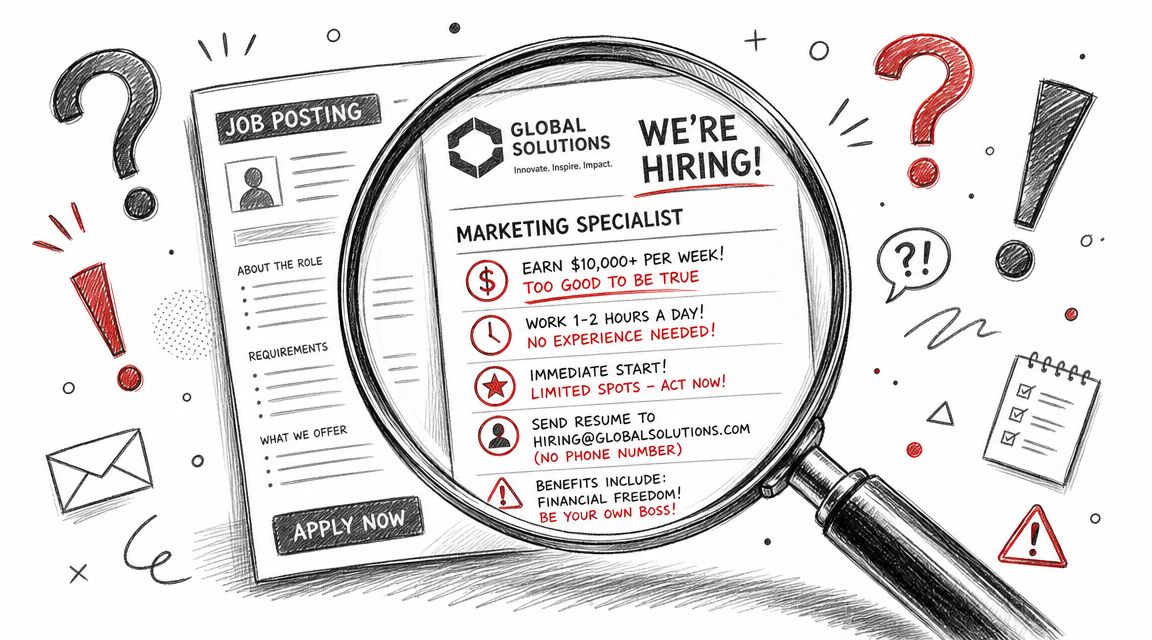
One channel deserves extra caution: text. FTC-documented reporting showed text-based recruitment fraud jumped from 4,872 reports in 2020 to 20,673 in 2024, a more than fourfold increase, according to Fortune’s coverage of FTC data on job-offer text scams. Text works for scammers because it creates urgency, bypasses formal hiring systems, and pushes people to respond before they verify anything.
Red flags in the job posting itself
A bad posting often reveals itself before anyone contacts you.
- Unclear employer identity. The company name is vague, hidden, or inconsistent across the listing and later messages.
- Compensation that ignores role reality. The pay sounds detached from the responsibilities, experience level, or market context.
- Generic responsibilities. The post reads like stitched-together corporate filler and says little about the actual team, tool stack, customers, or business model.
- No trace on the employer’s own careers page. If the role exists only on third-party platforms, treat it as unverified.
- Application flow that exits too quickly. A real employer may use Workday, Greenhouse, Lever, or another ATS. A scam often jumps straight to DM, text, form, or chat app.
Red flags in email, text, and chat
The communication pattern usually matters more than any single typo.
Never send money, buy equipment, or fund a wallet to start a job.
Look for these signals:
- Domain mismatch. The recruiter claims to represent one company but uses a different domain, a lookalike domain, or a free email account. If you need help evaluating whether a domain was created recently, NameSnag’s domain age insights can add context.
- Pressure to move platforms. Email shifts to WhatsApp, Telegram, or SMS without a clear business reason.
- Fast offer, thin interview. Little scrutiny of your experience, then a quick offer.
- Administrative urgency. “Complete this today,” “limited slots,” or “equipment order must be submitted now.”
- Early request for sensitive data. Payroll and tax details appear before a verified offer and formal onboarding.
A short explainer can help if you want to see these patterns in action:
Deal-breakers that should end the conversation
Some signs don’t deserve more analysis.
A legitimate employer may be imperfect. A legitimate employer doesn’t need your money to hire you.
If you’re offered a job without a real interview, pushed into Telegram or WhatsApp immediately, asked to cash a check, or told to purchase tools before payroll exists, stop engaging. Archive everything and verify independently before you do anything else.
Your Proactive Guide to Verifying Job Offers
The safest candidates don’t just inspect messages. They verify the hiring process from outside the conversation. That’s the only approach that holds up when scammers copy the look and tone of real employers.
Scammers increasingly use legitimate-looking hiring workflows, including fake interviews and direct messages on platforms like WhatsApp, which is why Baylor Scott & White’s fraud warning advises candidates to ask whether every step is consistent with how the company hires in the first place, especially for remote roles handled entirely online, as described in its recruitment fraud alert.

Use a verification chain, not a gut feeling
Start outside the message you received.
Find the company independently
Don’t click the link in the email or text first. Search for the company yourself and go to its official careers page. If the role isn’t there, treat the outreach as unverified until proven otherwise.Match the role details
Compare job title, location, reporting line, compensation language, and application path. Scammers often copy most of a real listing but alter key details to route you away from the company’s actual hiring system.Validate the recruiter as a real employee
Check whether the recruiter exists on LinkedIn and whether their role aligns with the company. Look for consistency, not just a profile. Does the timing make sense? Does the person interact like a person employed by the company?
Verify the channel, not just the person
A real name isn’t enough. Attackers impersonate real employees all the time.
Check whether emails come from the correct corporate domain. Then inspect whether later communication still stays aligned with that domain and company workflow. A process that starts on a corporate domain and suddenly shifts to personal email or chat apps without explanation should trigger immediate caution.
Use this internal sequence when you’re unsure:
- Company check. Official website, official careers page, official social profiles.
- Role check. Same opening listed on the employer site.
- People check. Recruiter and hiring manager appear consistent with the organization.
- Channel check. Corporate email and standard meeting tools, not ad hoc messaging apps.
- Request check. No money, no crypto, no unnecessary sensitive data before formal onboarding.
Ask questions a scammer can’t handle well
Good verification doesn’t require confrontation. Simple operational questions expose weak setups quickly.
Ask where the role is listed on the careers page. Ask which ATS the company uses. Ask who the role reports to. Ask whether equipment is shipped centrally or reimbursed through standard procurement. Ask for the recruiter to resend from the company domain if they contacted you elsewhere.
Verification works because scammers optimize for speed. They usually don’t want a careful candidate. They want a responsive one.
That’s the mindset shift. You’re not trying to detect evil. You’re checking whether the process survives normal professional scrutiny.
What to Do If You Encounter a Scam
Once you realize you’re dealing with fraud job offers, speed matters. Your priorities are simple: stop the interaction, contain damage, preserve evidence, and report it where it can help.
If you haven’t sent money or documents yet
Cut contact. Don’t argue, don’t “test” the scammer, and don’t keep chatting out of curiosity. Save screenshots, email headers, chat logs, the job posting URL, payment instructions if any were sent, and the domain names involved.
Then report the listing to the platform where you found it. If a real company was impersonated, alert that company through its official website. Security and recruiting teams often want those examples because impersonation campaigns usually hit multiple candidates.
If you sent personal information or money
Handle the financial side first.
- Contact your bank or card issuer immediately. Ask them to review recent activity and discuss protective steps.
- Change passwords on affected accounts. Start with the email account tied to your job search, then financial and identity-related accounts.
- Review your credit and identity exposure. If you shared highly sensitive information, act as if the attacker may reuse it.
- Document every action. Keep a timeline of when the contact happened, what you sent, and what institutions you notified.
If the scam exposed personal details broadly, it’s also worth reviewing a structured approach to remove personal information from the internet so you can reduce future impersonation and targeting risk.
Where to report it
Use official channels, not just social posts.
- Federal Trade Commission. Report the scam through the FTC’s fraud reporting system.
- FBI Internet Crime Complaint Center. File with IC3 if money, identity data, or online criminal activity was involved.
- Job board or social platform. Report the account, listing, or message thread directly.
- Impersonated employer. Send the evidence through the company’s official contact or fraud page.
Preserve evidence before you block. Screenshots and message history help platforms and investigators connect related reports.
Don’t assume reporting is pointless. It helps platforms remove active scams and gives investigators better pattern visibility.
How Direct Sourcing Neutralizes Job Scams
The hardest truth about fraud job offers is that many of them succeed before the candidate ever reaches the “red flag” stage. The problem starts upstream, at sourcing.
Cybersecurity experts cited in industry coverage believe AI has made it easier to generate convincing fake job postings at scale, increasing the noise on major job boards. The practical takeaway from Indeed’s guidance on job scams is straightforward: candidates need more than a checklist. They need a sourcing strategy that bypasses high-noise marketplaces.
Why noisy platforms create risk
When a search starts on broad aggregators, social feeds, repost networks, and scraped listings, the candidate inherits all the trust problems of those channels. Even when the platform is legitimate, the listing may be stale, duplicated, misattributed, impersonated, or detached from the employer’s real application path.
That doesn’t mean you should never use large platforms. It means you should treat them as discovery surfaces, not trust anchors.
What a safer sourcing model looks like
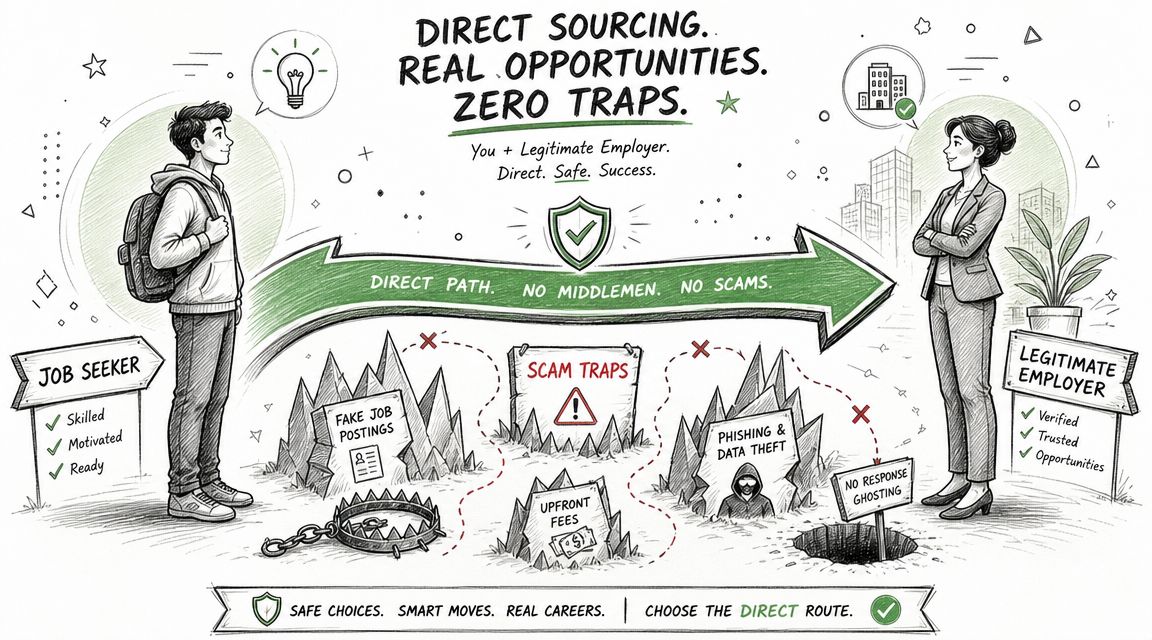
The cleaner approach is direct-from-employer sourcing. You start from the company’s actual careers page or from a platform built around that principle. That removes a large chunk of scam exposure because you’re not depending on repost chains or unverifiable middle layers.
A direct-sourcing search also improves decision quality:
- You verify the role at the source instead of trusting a copy.
- You apply through the employer’s system instead of a detour.
- You reduce impersonation risk because the job has a clear origin.
- You spend less time on dead ends and more time on roles that still exist.
That’s why a service like Remote First Jobs makes sense for scam-wary remote candidates. The security benefit isn’t just convenience. It’s structural. When your search starts closer to the employer, fraud job offers lose room to operate.
Frequently Asked Questions About Job Scams
Can a scammer fake a video interview?
Yes. A live video call lowers risk, but it does not prove the employer is real. Scammers can use a professional-looking backdrop, copied branding, a polished script, and even multiple people playing different hiring roles.
Verify the process around the interview, not just the call itself. Check whether the interviewer appears on the company website or LinkedIn, whether the meeting invite comes from the company’s real domain, and whether the role exists on the official careers page. A fake interview is usually strongest on presentation and weakest on traceable details.
What if the company is real, but the hiring process feels sloppy?
Messy does not always mean fraudulent. Early-stage startups, fast-growing teams, and understaffed companies often have inconsistent hiring operations. The key question is whether you can verify the underlying chain of trust.
A legitimate but disorganized employer should still be able to confirm the role through an official company domain, a real manager, or a careers page entry. If every proof point lives outside the company’s owned channels, treat the opportunity as unverified until that changes.
Can scammers use real recruiter names and company branding?
All the time. Impersonation works because parts of the message are real. The recruiter may exist. The company may be hiring. The logo may match. What fails is the verification path.
Check whether the recruiter’s email domain matches the company’s domain exactly, whether the outreach points to the company’s actual application system, and whether the recruiter can be confirmed through official company pages. A real name attached to an unofficial process is a significant red flag.
Is a signed offer letter enough to prove a job is legitimate?
No. Offer letters are easy to copy, forge, or assemble from real templates. I have seen scam offers that looked cleaner than genuine ones.
Treat the offer letter as one artifact, not final proof. The offer should match a role you can verify independently, come from the right domain, align with prior interview steps, and connect to a real HR or hiring manager identity you can confirm outside the email thread.
Can a real company ask for sensitive information early?
Sometimes, but timing and method matter. A legitimate employer may request background check details or payroll forms after a formal offer and through a recognized HR or onboarding system. They should not need your bank details, copies of identity documents, or payment for equipment before that process is established and verified.
If the request is premature, pause. Ask what system they use, who administers it, and whether you can complete the step through the company’s official portal.
If I’m unsure, what is the fastest verification workflow?
Use a simple sequence. Verify the company. Verify the role. Verify the person. Verify the application path. Verify the request.
That process is faster than reacting to individual red flags one by one, and it holds up even when scammers imitate a legitimate hiring process.
If you’re tired of sorting through noisy listings, ghost jobs, and scam risk, Remote First Jobs gives you a cleaner way to search. It pulls remote roles directly from employer career pages, which helps you spend less time verifying junk and more time applying to real opportunities.