Finding contract work really boils down to three things: building a solid professional foundation, searching strategically on the right job boards, and writing pitches that actually get a response. When you nail these steps, you stop playing the numbers game and start attracting the kind of high-quality clients you want to work with.
Building Your Foundation for Contract Work

Before you even think about firing off applications, you need to get your house in order. This is all about creating a professional identity that screams “expert.” It’s not just about listing your skills; it’s about positioning yourself as the go-to solution for a client’s specific problem.
Getting this foundation right makes everything that follows a whole lot easier. It provides clarity on who you are, what you offer, and why you’re the best person for the job.
This is the part where you shift your mindset from “employee” to “business owner.” As you start building this foundation, remember to think about the practical side of being independent. You’ll want to explore essentials like travel health insurance for remote workers and freelancers to make sure you’re covered.
Pinpoint Your Profitable Niche
Look, generalists have a tough time standing out. The market is just too crowded. But when you specialize, you can charge more and attract better clients. It’s the difference between offering “writing services” and offering “B2B SaaS content marketing for FinTech startups.” That specificity is your superpower.
So, how do you find your niche? Think of it as the intersection of three circles:
- What you’re good at: Look back at your projects. Where did you really knock it out of the park?
- What you enjoy: Passion shows in your work. What industries or tasks genuinely get you excited?
- What is profitable: Do some digging. Which skills and industries are in high demand and willing to pay top dollar for an expert?
For example, a developer who’s great at data visualization and has a background in healthcare could specialize in creating custom data dashboards for medical research firms. That’s a niche that immediately sets them apart from every other web developer out there.
Craft a Value-Driven Portfolio
Your portfolio is your #1 sales tool. Period. But it shouldn’t just be a gallery of your work; it needs to tell a story of success. The key is to stop showing what you did and start explaining why it mattered.
A great portfolio doesn’t just showcase skills; it demonstrates results. Frame each project around the problem you solved, the actions you took, and the measurable impact you created for the client.
Instead of a project description that just says, “Wrote five blog posts for Company X,” reframe it with results:
“Partnered with Company X to boost their organic traffic. I developed their content strategy and wrote five SEO-focused articles that led to a 35% increase in keyword rankings and a 15% lift in inbound leads in just three months.”
See the difference? That result-oriented language instantly communicates your value. Sprinkle in some client testimonials alongside these case studies, and you’ll build trust before you’ve even had a conversation.
Optimize Your LinkedIn Profile
Potential clients are going to look you up on LinkedIn. It’s often their first stop. Treat your profile less like a resume and more like a landing page built to capture leads. Your headline is prime real estate—don’t waste it.
Instead of a generic title like “Freelance Writer,” try something client-focused: “Freelance B2B Tech Writer | Helping SaaS Companies Turn Complex Ideas into Compelling Content.”
Make sure your “About” section speaks directly to your ideal client’s biggest challenges and positions you as the one to solve them. Weave keywords from your niche throughout your profile so you show up in the right searches. A well-optimized profile works like a magnet, pulling in opportunities so you don’t have to hunt for them.
Where to Find High-Quality Contract Opportunities
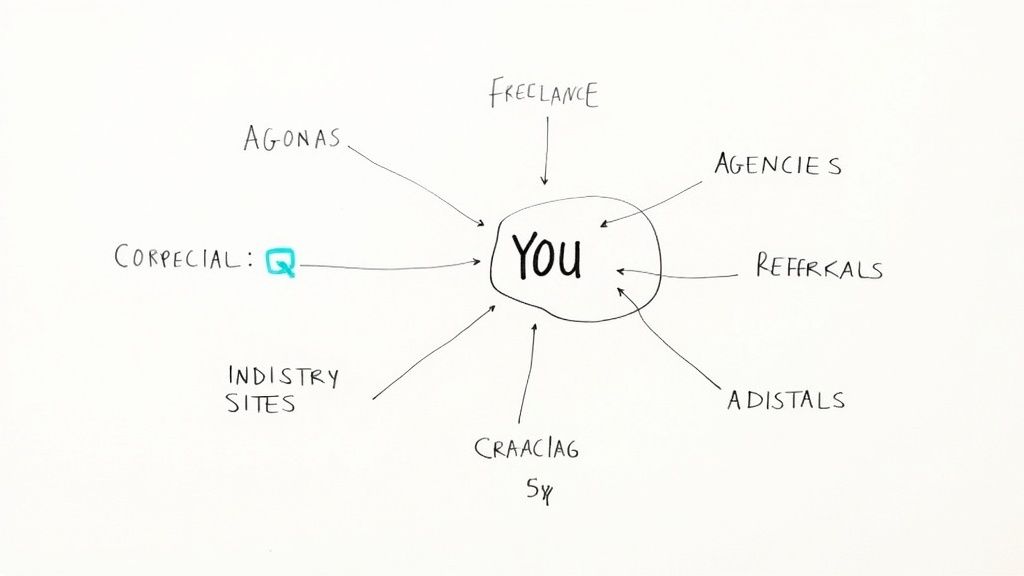
Okay, you’ve got your portfolio polished and your pitch ready to go. Now, where do you actually find the good stuff? Just endlessly scrolling through massive job sites is a fast track to burnout. The real secret is knowing exactly where to look.
Think of it like building an investment portfolio—diversification is key. Relying on a single source for your leads is a huge risk. Instead, spread your efforts across different channels like freelance marketplaces, niche job boards, and even staffing agencies. This creates a much stronger, more reliable pipeline of potential work.
Top Platforms for Finding Contract Work
Choosing the right platform can feel overwhelming, but they each serve a slightly different purpose. Some are great for getting your first few projects, while others are geared toward seasoned experts. Here’s a quick breakdown of the big players to help you decide where to focus your energy.
| Platform | Best For | Key Features | Typical Industries |
|---|---|---|---|
| Upwork | A wide range of freelancers, from beginners to experts. | Project catalog, hourly and fixed-price contracts, talent badges. | Web Development, Design, Writing, Admin Support |
| Fiverr | Project-based “gigs” and building an initial portfolio. | Tiered pricing packages, quick turnaround projects, “Fiverr Pro” for vetted talent. | Graphic Design, Video Editing, Digital Marketing |
| Toptal | Elite, pre-vetted freelance talent for high-stakes projects. | Rigorous screening process (top 3%), dedicated account managers. | Software Engineering, Finance, Project Management |
| Contra | Commission-free platform for independent professionals. | Visual profiles, project showcases, secure payment tools. | Design, Engineering, Social Media, Content |
While these platforms are powerful, remember they are just tools. Your success ultimately depends on how strategically you use them to find clients who are the right fit for you.
Nailing the Major Freelance Marketplaces
Platforms like Upwork and Fiverr get a bad rap sometimes, but don’t write them off. Sure, they have their fair share of low-paying gigs, but they’re also hiding some incredible, high-value contracts from serious companies. You just have to know how to dig for them.
The trick is to become a master of their search filters. Don’t just type “writer” and hope for the best. Get granular.
- Hunt for Client History: I always filter for clients with a solid hiring history and positive feedback. It’s a huge red flag if they have none.
- Set Your Rate Floor: Use the budget filters to weed out the projects that don’t meet your minimum rate. Stop the race to the bottom before it starts.
- Target Your Experience Level: Search for roles that explicitly ask for your level of expertise. You’ll get far more relevant results.
- Create Keyword Alerts: Set up alerts for specific terms like “B2B SaaS” or “React Native.” This way, the best opportunities land right in your inbox.
Pro Tip: Your proposal on these sites is your audition. A generic, copy-pasted message screams “I didn’t read your post.” Pull out specific details from their description to prove you understand exactly what they need.
This targeted approach lets you slice through the noise and find the real gems, turning these massive platforms into a genuinely powerful source for contract work.
Diving into Niche and Specialized Job Boards
Beyond the giants, there’s a whole universe of specialized job boards for nearly every industry you can think of. These niche sites are pure gold. Why? The listings are often curated, the quality is higher, and the competition is usually way lower because you’re among a focused group of professionals.
A marketing expert will find much better opportunities on a marketing-specific board than on a general site. It’s just common sense. The same goes for remote work. If you’re committed to the remote lifestyle, you’ll find the best, most legitimate listings on dedicated sites.
For instance, you can find thousands of vetted, spam-free listings by exploring the remote-first roles on our job board. These sites connect you with clients who already get it—they understand and value your specific skills from the get-go.
The Untapped Power of Staffing Agencies
Here’s a channel too many freelancers ignore: staffing agencies and specialized recruiters. Think of them as your personal matchmakers. They connect skilled contractors with companies that have urgent project needs, especially in high-demand fields like IT, finance, and healthcare.
This isn’t a small corner of the market. The U.S. staffing industry was a $188.73 billion market in 2024, and it’s still growing. This trend is global, with nearly 47% of the workforce now freelancing in some capacity. It’s a massive, reliable stream of contract gigs.
Working with an agency has some serious perks:
- Access to the Hidden Job Market: Many companies use agencies exclusively for contract roles that never get posted publicly.
- Someone Else Negotiates For You: Recruiters are pros at this. They use their market knowledge to secure competitive rates on your behalf.
- Pre-Vetted Gigs: Agencies usually vet their clients, which means you’re less likely to get stuck with a company that pays late or is difficult to work with.
Building a good relationship with a few recruiters in your niche is one of the smartest long-term moves you can make. They become your advocates, actively seeking out roles that are a perfect fit for you.
Crafting a Pitch That Gets You Noticed

Look, a killer portfolio is table stakes. But if your application email is generic, it’s going straight to the trash folder before anyone even bothers to click your link. This is where the real work begins—and where most people drop the ball.
The goal isn’t just to be another applicant. It’s to be the obvious choice. That means you have to stop blasting out dozens of applications and start sending thoughtful, targeted messages that scream, “I’m the solution to your problem.”
The Anatomy of a Winning Proposal
Forget every generic template you’ve ever downloaded. A pitch that actually gets a reply is all about the client, not you. It needs to show you’ve done your homework and you get what they need.
Every single one of my proposals that landed a gig followed a simple, effective structure:
- The Hook: Lead by directly mentioning a specific challenge or goal you spotted in their job description or on their website.
- The Solution: Connect the dots. Briefly explain how your skills are the perfect answer to that specific challenge.
- The Proof: Show, don’t just tell. Link to one or two hyper-relevant case studies from your portfolio that prove you’ve done this before.
- The Call to Action: Make it easy for them to say yes. Suggest a quick, no-pressure 15-minute chat to dig into their goals.
This isn’t just a list of your skills; it’s a direct response to their needs. It immediately frames you as a strategic partner, not just another person looking for a paycheck.
A great pitch isn’t a resume in paragraph form. It’s a mini-consulting proposal that shows the client you’ve already started thinking about their business and how you can add immediate value.
Personalization Is Your Secret Weapon
The single biggest mistake I see contractors make is sending the exact same pitch to everyone. Hiring managers can smell a copy-paste job from a mile away. Real personalization is so much more than just swapping out [Company Name].
Before you type a single word, spend ten minutes digging around. Look for recent company news, check out the hiring manager on LinkedIn, or even see what a competitor is doing. Find one tiny detail you can latch onto.
For instance, instead of saying, “I’m a skilled marketer,” try this:
“I saw your recent launch of the new analytics feature and noticed the announcement blog post didn’t include a case study. My experience creating data-driven case studies for SaaS clients like [Client Name] could help demonstrate the feature’s ROI and drive more sign-ups.”
See the difference? That one sentence proves you’ve done your research, you understand their product, and you’re already bringing ideas to the table. That’s how you get moved to the top of the pile.
Authentic Cold Outreach That Works
Sometimes, the absolute best gigs aren’t even listed on a job board. They’re hiding inside companies you already admire. Cold outreach gets a bad rap because most people do it poorly, but when done right, it’s incredibly powerful. The trick is to be helpful, not just hungry for a job.
This strategy is getting more effective as the workforce shifts. We’re looking at 1.57 billion freelancers globally, making up 46.6% of the workforce by 2025. That freelance market is projected to hit $9.19 billion by 2027, and last year, 78% of these opportunities were remote. To stand out, you have to be smarter. You can learn more about the independent contractor landscape and why this approach is key.
When you reach out to someone on LinkedIn, never lead with an ask. Lead with value. Share a relevant article, compliment a recent project, or offer a quick, useful insight. Build a tiny bit of rapport first. Then, after an interaction or two, you can follow up with a soft pitch that addresses a problem you think you can solve for them.
Negotiating Rates and Terms with Confidence
Let’s be honest, talking about money can be uncomfortable. But as a contractor, it’s one of the most critical skills you’ll ever learn. Nailing your negotiations is what separates a side hustle from a sustainable, long-term career.
This isn’t just about throwing out a number and hoping it sticks. It’s about confidently articulating your value and locking in an agreement that protects you and your business. The way you handle this conversation sets the tone for the entire project, establishing you as a professional partner, not just a hired hand.
Research and Set Your Rates
Guessing your rates is the fastest way to get underpaid and burnt out. Before you even think about hopping on a call with a potential client, you have to do your homework. Your pricing needs to be anchored in real-world data, not just a gut feeling.
Start by digging into what others in your niche with a similar experience level are charging. Check out freelance marketplaces, look at what agencies are billing, and—most importantly—talk to other contractors in your network. The goal is to find a realistic market range for your services.
Once you have that range, figure out where you fit. Consider a few key things:
- Your Experience: Are you a seasoned pro with a portfolio full of wins, or are you still building your reputation?
- Project Complexity: Is this a simple, one-off task or a complex engagement that requires deep strategic thinking over several months?
- Client Value: How much revenue will your work generate for the client? Or how much will it save them? Frame your price around that impact.
Confidently Communicate Your Value
When it’s time to talk numbers, state your rate clearly and without hesitation. Drop phrases like “I usually charge around…” or “Does that price work for you?” from your vocabulary. That kind of language weakens your position and practically invites them to haggle you down.
Instead, frame your rate as a direct reflection of the value you deliver. The best way to do this is to tie your price directly to their return on investment (ROI). For contract gigs, knowing how to effectively negotiate job offers is absolutely essential for getting rates that truly match your expertise.
The most powerful negotiation tactic is to shift the conversation from your cost to their gain. When a client sees your fee as an investment that will generate a 10x return, the price becomes a non-issue.
If a client pushes back, don’t immediately jump to offering a discount. First, get curious. Is this a real budget constraint, or are they just kicking the tires? If their budget is genuinely tight, offer to scale back the scope of work to meet their number. Never lower your price for the same amount of work.
Deconstruct the Contract
Think of your contract as your safety net. It’s the one document that lays out expectations, protects everyone involved, and prevents those “I thought you meant…” conversations later on. Never, ever start working without a signed agreement. It’s just not worth the risk.
Contracts can look intimidating, but you only need to master a few key clauses to protect yourself. Make sure your agreement clearly spells out the following.
Essential Contract Clauses
- Scope of Work: Get incredibly specific here. Detail exactly what you’ll deliver, how you’ll deliver it, and how many rounds of revisions are included. Vague scopes are a breeding ground for “scope creep,” where the project keeps growing but your pay doesn’t.
- Payment Schedule: Leave no room for interpretation. Outline exactly when and how you get paid. Will it be 50% upfront and 50% on completion? A monthly retainer on the 1st? Make sure to specify payment methods and what happens if a payment is late.
- Kill Fee (Termination Clause): This one is non-negotiable. A kill fee ensures you’re compensated for the work you’ve already done if the client decides to pull the plug mid-project. A standard fee is usually 25-50% of the remaining project total.
- Ownership and Rights: Clearly state who owns the final work product after it’s been paid for. This protects your intellectual property and gives the client clarity on how they can use the work.
Turning One Gig into Long-Term Success

Landing your first few contracts is a huge rush. But let’s be real—the real goal is to stop the constant hustle and build a business where high-quality gigs start coming to you. It’s all about shifting from a short-term scramble to playing the long game.
The secret isn’t some complicated growth hack. It’s about consistently delivering great work and building real, human relationships. When you solve problems and make your clients’ lives easier, you stop being just another contractor. You become a trusted partner. That’s how you turn a single project into a steady stream of repeat business and valuable referrals.
Deliver an Unforgettable Client Experience
Great work is just the price of entry. An amazing experience is what makes clients come back for more.
Think beyond just handing over the final files. The entire journey, from that first kickoff call to the project wrap-up, should be smooth, professional, and built on proactive communication.
Little things make a massive difference. Sending a quick weekly progress update without being asked, anticipating their next question, or providing a simple summary of what you accomplished can elevate you from “good” to “indispensable.” The goal is to be the easiest, most reliable contractor they’ve ever worked with.
A happy client might hire you again. But a client who felt supported, understood, and impressed at every turn will become your biggest advocate, telling their entire network about you.
From Project Completion to Lasting Partnership
The project is done, but the relationship shouldn’t be. The biggest mistake I see contractors make is vanishing the second the final invoice is paid. That’s a huge missed opportunity.
Instead of a generic “Thanks!” email, try something more personal. A few weeks after the project wraps, send a quick, no-strings-attached message. You could share an article you think they’d find interesting, congratulate them on a company milestone you saw on LinkedIn, or just ask how the project results are panning out. This simple act keeps you on their radar without being pushy.
Building these relationships is the bedrock of a sustainable contract career. With the global workforce seeing a massive jump in gig workers—projected to hit 35% by 2025—your network is your net worth. In a market where 52% of the workforce took part in the gig economy in 2023, turning connections into steady work is a proven strategy. If you want to dive deeper, check out this report on the growth of the temporary staffing market to see just how critical these relationships are becoming.
The Art of Asking for Testimonials and Referrals
If you wait for clients to offer up testimonials or referrals, you’ll be waiting a long time. You have to ask. But the timing and tone are everything. The absolute best moment to make the ask is right after they’ve told you how happy they are with your work.
When a client emails you saying, “This is fantastic, thank you so much!“—that’s your green light.
Here’s how to do it without feeling awkward:
- For Testimonials: “I’m so glad you’re happy with the results! If you have a minute, would you be open to writing a sentence or two I could share on my portfolio? No pressure at all if you’re swamped.”
- For Referrals: “It was a real pleasure working with you on this. I’m looking to take on a couple of new clients and was wondering if you know anyone in your network who might need similar help.”
Make it ridiculously easy for them. You can even offer to draft a testimonial based on their positive feedback that they just have to approve or tweak. This simple system builds powerful social proof that will fuel your client pipeline for years, helping you spend less time hunting for work and more time actually doing it.
Common Questions About Finding Contract Work
Jumping into the world of contract work can feel a bit like exploring a new city without a map. The freedom is incredible, but a ton of practical questions pop up when you’re just getting started. Let’s clear the air and tackle some of the most common ones.
Think of this as your field guide to demystifying the tricky parts, from figuring out your rates to understanding what you owe Uncle Sam. Getting these answers straight from the start helps you sidestep the usual rookie mistakes and focus on what you’re actually here to do—knock your projects out of the park.
How Do I Set My Rates with No Experience?
Ah, the classic chicken-and-egg dilemma. How do you put a price on your work when you don’t have a long list of clients to back it up? The secret is to stop thinking about “experience” and start focusing on value.
Instead of dwelling on what you haven’t done, anchor your rate to the skills you already have. Your first move should be to do a little recon. Poke around on job boards and in freelance communities to see what the low-to-mid range is for your specific skillset.
Here’s a simple way to approach it:
- Find Your Market Range: See what junior-level contractors in your field are charging. This isn’t guesswork; it’s using real data to find a realistic starting point.
- Figure Out Your “Survival Rate”: Calculate the absolute rock-bottom minimum you need to earn per hour to cover your business expenses and keep the lights on. This is your floor. Never, ever dip below it.
- Pitch an “Introductory Rate”: For your first few clients, you can frame your price as a special introductory offer. This tells them you’re a great value now and cleverly sets the expectation that your rates will go up as you build your track record.
What Are Some Red Flags in a Contract Job Post?
Learning to spot a bad gig before you even apply is a superpower. It’ll save you from endless headaches down the road. Trust me, not all opportunities are created equal, and some job postings are practically waving giant red flags in your face.
Be skeptical of vague job descriptions. If a post is fuzzy on the project scope or what you’ll actually be delivering, that’s a bad sign. It often means the client doesn’t really know what they want, which is a recipe for scope creep and never-ending revisions.
A great client knows what they need and will be clear about their expectations. If a job post feels confusing, asks for the moon on a shoestring budget, or promises “unlimited earning potential,” just walk away. Your gut is usually right.
Keep an eye out for these other warning signs:
- Asking for Free Work: “Do this quick sample project to prove your skills” is almost always a trap. Your portfolio is your proof.
- Unrealistic Demands: Phrases like “must be available 24⁄7” or a laundry list of tasks with a tiny budget are huge red flags.
- Pressure to Go Off-Platform: If you’re using a freelance site like Upwork, anyone trying to push you to communicate or get paid outside their system is bad news. They’re likely trying to dodge fees and accountability.
How Can I Land My First Gig Without a Portfolio?
When you’re starting from ground zero, you have to get a little creative to show what you can do. If you don’t have a portfolio of client work, the next best thing is to create your own proof. It shows initiative and gives a potential client something real to look at.
Think about a passion project that’s similar to the kind of work you want to land. A writer could launch a blog in their target industry. A developer could build a small but slick web app. A designer could mock up a full branding package for a company they made up.
These self-started projects prove you’ve got the chops, even if no one’s paid you for them yet. When you pitch, don’t just show the finished product. Explain the problem you wanted to solve and walk them through the process you used to get there.
What Are the Basics of Managing Contractor Taxes?
Taxes are easily one of the biggest shocks when you switch from a W-2 job to contract work. Here’s the most important thing you need to burn into your brain: you are responsible for your own taxes. The client isn’t withholding a single dime for you.
This means you absolutely have to set aside a chunk of every single payment you get. A good rule of thumb is to sock away 25-30% of your income just for taxes. It’s also a smart move to make estimated tax payments to the IRS each quarter. This helps you avoid getting slammed with a massive, terrifying bill (and potential penalties) when tax season rolls around.
Ready to find high-quality contract roles without digging through spam? Remote First Jobs lists thousands of verified remote opportunities from companies you can trust. Find your next contract gig today.