In the competitive remote job market, specific job titles and technical expertise only get you part of the way. What truly distinguishes a successful candidate from a merely qualified one are transferable skills. These are the core abilities, such as communication, self-management, and resourcefulness, that demonstrate you can perform effectively and autonomously, regardless of your physical location. For remote-first companies, these skills are not just a bonus; they are a prerequisite.
Hiring managers are actively seeking proof that you can be trusted to deliver high-quality work without constant oversight. They want to see evidence of your discipline, your ability to collaborate across time zones, and your proactive approach to solving problems. Possessing these traits signals that you are a low-risk, high-value addition to a distributed team. This article provides a definitive list of transferable skills essential for thriving in a remote environment.
We will move beyond generic definitions to give you a practical playbook. For each skill, you’ll find:
- A clear explanation of why it’s critical for remote work.
- Specific examples of how it applies in a distributed setting.
- Sample resume bullets to help you articulate your experience.
- Actionable advice for demonstrating the skill in your applications and interviews.
This guide is built to help you identify the powerful skills you already possess and showcase them effectively, ensuring you stand out to the best remote companies and land a role that respects your capabilities.
1. Communication & Written Clarity
In a remote work setting, written communication often stands in for face-to-face interaction. The ability to convey information clearly and concisely across different platforms like email, chat, and documentation is no longer just a soft skill; it’s a foundational requirement. This skill demonstrates professionalism, prevents misunderstandings that cause delays, and helps hiring managers gauge your ability to function effectively without constant in-person supervision. Asynchronous-first companies like GitLab and Zapier have built their success on this principle, proving its power. This is one of the most critical skills to master for a successful career in a distributed team.
How It Looks in Practice
- For a Developer: Clearly documenting API changes in a README file so other engineers can integrate them without needing a meeting.
- For a Product Manager: Recording a short, asynchronous Loom video to explain a new feature, saving the team from a 30-minute sync-up call.
- For a Sales Professional: Crafting a precise follow-up email that answers a prospect’s questions so thoroughly it closes the deal without more back-and-forth.
How to Demonstrate and Improve This Skill
To develop and showcase your ability to clearly convey ideas and information, consider these tips on effective communication skills in the workplace. Additionally, focus on these practical habits:
- Structure for Scannability: Use headers, bullet points, and bold text to make your writing easy to skim.
- Right-Size Your Message: A quick question is a Slack message. A formal update is an email. A complex demo might be a recorded video. Choose the right medium for the message.
- Proofread Diligently: Typos and grammar errors can signal carelessness. Use a tool like Grammarly to catch mistakes before you hit send.
On your resume, this could look like: “Redesigned project documentation, resulting in a 40% reduction in clarification-related meetings and accelerating new-hire onboarding.” This demonstrates a tangible business outcome tied directly to your communication skills, a major asset when applying for opportunities on platforms dedicated to remote-first jobs.
2. Self-Management & Discipline
Without the physical structure of an office, your capacity to manage your own time, prioritize tasks, and maintain productivity becomes a critical asset. Remote work removes the built-in accountability of a shared workspace, making self-management an essential competency. Professionals who excel at this deliver consistent results, meet deadlines independently, and require minimal supervision, a trait highly valued by remote-first companies. This idea is championed by thought leaders like Cal Newport and demonstrated by successful remote organizations that trust their teams to perform autonomously. This is a foundational skill on any modern list of transferable skills.
How It Looks in Practice
- For a Freelance Designer: Shipping client work ahead of schedule by setting and adhering to strict personal deadlines for each project phase.
- For a Remote Contractor: Documenting daily progress and challenges in a shared project management tool without being prompted by a manager.
- For a Working Parent: Structuring their workday around school pickup and drop-off times while consistently maintaining their expected output and quality.
How to Demonstrate and Improve This Skill
To build and prove your self-discipline, adopt habits that create structure and focus. Many productivity experts, including James Clear, emphasize the power of consistent routines.
- Time-Block Your Day: Schedule “focus hours” in your calendar and communicate your unavailability to the team to protect deep work sessions.
- Create Start and End Routines: A morning routine can signal the start of the workday to your brain, while a shutdown ritual helps prevent burnout by creating a clear boundary.
- Over-Communicate Progress: Proactively send weekly or daily updates to your manager. This builds trust and shows you are on top of your responsibilities.
- Use Focus Tools: Employ methods like the Pomodoro Technique or apps like Forest to maintain concentration and minimize digital distractions.
On your resume, highlight this skill with a concrete achievement: “Independently managed a 3-month project pipeline, consistently delivering all milestones 10% ahead of schedule without direct supervision.” This provides tangible proof of your ability to self-manage, which is a major advantage when seeking genuine opportunities on platforms dedicated to verified remote jobs.
3. Problem-Solving & Resourcefulness
In a remote environment, you can’t simply walk over to a senior colleague’s desk for help. The ability to independently identify obstacles, develop creative solutions, and execute with the resources you have is a superpower. This skill demonstrates autonomy and a proactive mindset, which hiring managers prize in distributed team members who must function without constant supervision. The startup ethos, popularized by figures like Paul Graham and Naval Ravikant, is built on this very principle of resourceful innovation under constraints.
How It Looks in Practice
- For a Marketer: Lacking a design budget, they use Figma tutorials to create professional-looking social media graphics for a campaign.
- For a Sales Professional: They build a lead-nurturing automation using Zapier to connect their CRM and email client, doing so without needing IT support.
- For a Customer Support Rep: After identifying a recurring product bug, they create a clear workaround guide for customers to use while engineering develops a permanent fix.
How to Demonstrate and Improve This Skill
To sharpen your resourcefulness, develop a “help-seeking hierarchy”: first, consult documentation, then Google, then community forums, and only then ask a colleague directly. This methodical approach is a core part of any good list of transferable skills. Also, consider these habits:
- Document Your Fixes: Keep a “problem-solving journal” to record issues, the steps you took to resolve them, and the final outcome.
- Embrace Smart Failures: Don’t be afraid to attempt a solution that might not work. The key is to learn from the attempt, document what happened, and iterate.
- Practice Constraint-Driven Thinking: Regularly ask yourself, “How would I solve this with one-tenth the budget or time?” This forces creative solutions.
On your resume, a strong entry might read: “Identified a critical gap in customer support, creating a temporary workaround that reduced related support tickets by 60% until a permanent engineering solution was deployed.” This shows you don’t just find problems; you actively solve them.
4. Adaptability & Learning Agility
The remote work world is defined by constant change. New tools, shifting processes, and evolving team structures are the norm. Adaptability and learning agility represent your capacity to adjust to these new realities quickly while maintaining high performance. Professionals who learn fast and embrace change are invaluable because they can move between projects, adopt new technologies, and thrive in evolving organizations without missing a beat. This skill is a core tenet of cultures at companies like Google and Netflix, which prioritize learning potential over existing knowledge. Mastering this skill makes you a future-proof asset for any distributed team.
How It Looks in Practice
- For a Designer: Quickly learning Figma and its collaborative features within a month after the team transitions away from a legacy Adobe workflow.
- For a Manager: Successfully pivoting from a synchronous, meeting-heavy management style to an asynchronous-first approach that respects team focus time.
- For a Developer: Proactively picking up a new programming language or framework required for a high-priority project, becoming productive in the new tech stack.
How to Demonstrate and Improve This Skill
To showcase your ability to grow and respond to change, focus on building and documenting your learning habits. Companies posting on platforms dedicated to verified remote positions often seek candidates who demonstrate this forward-thinking mindset.
- Create a Learning Log: Each month, document one new tool, skill, or methodology you’ve mastered. This creates a concrete record of your growth.
- Practice Deliberate Learning: Don’t just skim the surface. When you learn something new, focus on depth to become truly proficient quickly.
- Embrace Failure as Data: Frame mistakes as learning opportunities. Explain what a misstep taught you and how it improved your approach.
- Stay Ahead of the Curve: Follow industry newsletters, blogs, and online communities to anticipate upcoming changes in your field.
On your resume, this could appear as: “Transitioned team from Adobe Suite to Figma, completing the migration and full team training two weeks ahead of schedule, increasing design velocity by 25%.” This highlights a specific, quantifiable achievement tied directly to your adaptability.
5. Attention to Detail & Quality Ownership
In a remote setting, your work is your primary representative. The commitment to delivering accurate, high-quality work without constant oversight is paramount because you are judged by output, not observable effort. Quality ownership means catching errors before they reach stakeholders, delivering a polished final product, and taking genuine pride in your work, even when no one is watching your process. This ethos, seen in Toyota’s Kaizen philosophy of continuous improvement and Apple’s obsessive design focus, separates good remote employees from great ones.
How It Looks in Practice
- For a Financial Analyst: Triple-checking spreadsheet formulas and data sources before presenting financial models to executives, ensuring complete accuracy.
- For a Developer: Writing comprehensive tests for every new feature, proactively catching edge cases that could cause bugs in production.
- For a Content Marketer: Meticulously maintaining a brand style guide and applying it to ensure absolute consistency across hundreds of published articles.
How to Demonstrate and Improve This Skill
To cultivate and prove your dedication to quality, build systems that prevent mistakes rather than just relying on memory. This is a key part of any strong list of transferable skills because it shows you can be trusted with important work.
- Create Pre-Submission Checklists: Develop a personal checklist tailored to your role. Before sending anything, run it through your list to catch common oversights.
- Use Your Tools: Actively employ spell-checkers, linters, and grammar tools like Grammarly. Embrace peer code reviews not as a critique, but as a quality gate.
- Review with Fresh Eyes: Whenever possible, step away from a finished task for a few hours or even a day. Coming back to it with a fresh perspective often reveals errors you missed.
- Track Your Own Performance: Monitor your error or defect rate. Being able to say, “I’ve maintained a <1% defect rate on my projects for the past six months” is a powerful testament to your diligence.
On your resume, this could be stated as: “Implemented a new QA checklist for all marketing collateral, resulting in a 98% reduction in revision requests and a 15% faster campaign launch time.” This ties your attention to detail directly to measurable business efficiency and impact.
6. Collaboration & Empathy
In a distributed environment, collaboration is more than just working on tasks together; it’s about building connections across digital divides. The ability to work effectively with diverse teammates, understand different perspectives, and contribute to team goals despite physical distance requires intentional effort and emotional intelligence. Empathetic collaborators build the psychological safety that allows teams to innovate and thrive. This skill is a core tenet of successful remote teams, as proven by research from Google’s Project Aristotle, which found that how a team works together is more important than who is on it.
How It Looks in Practice
- For a Product Manager: Holding regular 1:1s with each designer and engineer not just for status updates, but to understand their career goals and current workload pressures.
- For a Developer: Writing detailed, thoughtful code comments and documentation, anticipating the questions a future maintainer (or their future self) might have.
- For a Marketer: Publicly celebrating a teammate’s campaign success in a shared channel while privately taking ownership of a mistake in a direct message to their manager.
How to Demonstrate and Improve This Skill
Building and showing your capacity for empathetic collaboration is a critical part of any strong list of transferable skills. Focus on these practical actions:
- Practice ‘Remote First Contact’: When joining a new team or project, schedule brief 1:1 video chats with everyone to build personal rapport before diving into work.
- Assume Good Intent: Text-based communication often lacks tone. When a message seems abrupt, resist the urge to react negatively and instead seek clarification.
- Use Video for Difficult Conversations: Don’t try to resolve sensitive issues over Slack or email. A video call allows for non-verbal cues and reduces the chance of misinterpretation.
- Invest in Team Rituals: Actively participate in or suggest virtual coffees, async “appreciation” threads, or sharing weekly wins to build team cohesion.
On your resume, this could be stated as: “Fostered a culture of psychological safety by implementing peer-led ‘show and tell’ sessions, increasing cross-functional collaboration on new features by 30%.” This shows you not only understand the skill but can create a tangible, positive impact with it.
7. Initiative & Proactivity
In a remote setting, where managers don’t see you working at a desk, initiative is your most visible asset. It’s the drive to identify opportunities, suggest improvements, and take action without waiting for direct instructions. Proactive professionals move projects forward, propose solutions before problems escalate, and don’t wait to be told what to do. This “founder mentality,” famously championed by tech leaders and embedded in Amazon’s ‘Day 1’ philosophy, proves your engagement and demonstrates impact when you aren’t physically present. This skill is a cornerstone of any successful list of transferable skills for remote work.
How It Looks in Practice
- For a Developer: Noticing a repetitive manual deployment process and building a simple script to automate it, saving the engineering team several hours each week.
- For a Customer Support Rep: Identifying a pattern in user complaints about a confusing UI element and drafting a proposal with a suggested fix for the product team.
- For a Sales Professional: Creating a comprehensive competitive analysis playbook for the team before being officially assigned the project, anticipating a future need.
How to Demonstrate and Improve This Skill
To cultivate and showcase your proactivity, move beyond simply completing assigned tasks. Focus on identifying and solving the next problem before it arrives.
- Ask “What if?”: Regularly ask yourself, “What would I do if this were my company?” This reframes your perspective from employee to owner, sparking ideas for improvement.
- Research Before Proposing: An idea is good, but a data-backed idea is powerful. Before suggesting a change, gather data, look at benchmarks, and think through potential consequences.
- Frame Suggestions Positively: Instead of saying, “The current report is confusing,” try, “I was thinking about our monthly report. Have we considered adding a summary chart to make the key takeaways clearer for the executive team?”
- Document Your Initiatives: Keep a personal log of actions you took without being asked. Note the problem you identified, the solution you implemented, and the measurable result.
On your resume, this could look like: “Took the initiative to develop a new competitive analysis playbook, which was adopted by the entire sales team and credited with a 15% increase in lead conversion rates.” This shows you don’t just do your job; you actively make the business better.
8. Time Zone Management & Async-First Thinking
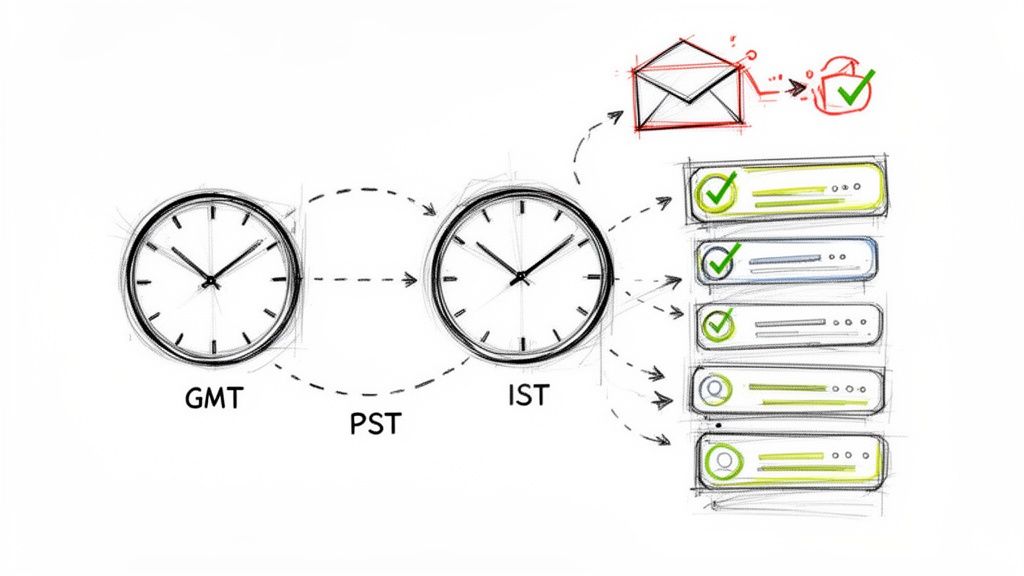
In a global, distributed workforce, the ability to work effectively across multiple time zones is a critical asset. This goes beyond knowing how to convert PST to GMT; it involves embracing an asynchronous-first mindset where real-time responses are not the default. This skill requires professionals to over-communicate context, respect colleagues’ working hours, and maintain high productivity without constant synchronous collaboration. Companies like GitLab and Basecamp have built their entire operational models on this principle, proving it’s essential for global remote success.
How It Looks in Practice
- For a Manager: Recording an asynchronous 1:1 update video for a direct report eight time zones away, allowing them to review it at the start of their day.
- For a Product Manager: Creating a detailed Notion document for a new feature, enabling teammates in different regions to review, comment, and contribute without a live meeting.
- For a Developer: Writing a thorough pull request description with all necessary context so a reviewer in another hemisphere can approve it without needing to ask clarifying questions.
How to Demonstrate and Improve This Skill
To master and showcase your async-first capabilities, focus on building habits that prioritize clarity and independence. This mindset is highly valued in companies that list on platforms dedicated to remote-first jobs.
- Front-Load Information: When you make a request, include all context, decisions, and your reasoning upfront so there is no need for follow-up questions.
- Document Decisions Publicly: Avoid siloing important information in direct messages. Use shared channels or project management tools to document key decisions for everyone to see.
- Build in Buffer Time: Don’t expect immediate replies. Assume a 24-48 hour response window for non-urgent matters, which respects different schedules and deep work blocks.
- Respect Boundaries: Honor the team’s culture around working hours. Avoid sending messages to colleagues late at night in their time zone.
On your resume, this could be phrased as: “Implemented an async-first project update system using detailed tickets and recorded videos, eliminating the need for cross-functional meetings across a 12-hour time zone spread.” This shows you can solve logistical challenges and is a key addition to any list of transferable skills you present.
9. Accountability & Ownership Mentality
Accountability is the commitment to personal responsibility for outcomes, not excuses or blame-shifting. In remote work, where direct supervision is minimal, this trait acts as the glue that holds teams together and builds trust. An ownership mentality means you don’t just complete tasks; you take responsibility for the results. People with this skill don’t say, “that’s not my job”-they ask, “how can I help solve this?” This proactive approach, popularized by Amazon’s “Ownership” leadership principle and the “Extreme Ownership” concept from Navy SEAL culture, signals to hiring managers that you are a reliable, self-driven professional who will deliver results without constant oversight. It is one of the most respected traits in a top-tier candidate.
How It Looks in Practice
- For a Team Member: Proactively identifying a failing project, taking the lead on stabilizing it, and communicating the recovery plan to stakeholders.
- For a Junior Employee: Noticing an undocumented process and volunteering to create a clear guide for the team, filling a gap no one else addressed.
- For a Contractor: Keeping a client consistently updated on progress and potential roadblocks, preventing any surprises and building a strong, trust-based relationship.
How to Demonstrate and Improve This Skill
To build and showcase a reputation for being accountable, focus on developing consistent habits. Commit to your work with clear, unambiguous language and always follow through.
- Commit Clearly: Use direct language like, “I will deliver the report by Friday at 3 PM,” instead of vague phrases like, “I’ll try to get it done.”
- Communicate Issues Early: Flag potential problems or delays as soon as you spot them, rather than waiting until the deadline is imminent. This gives the team time to adapt.
- Own Your Mistakes: If something goes wrong, address it head-on. State, “I made a mistake in the data pull. Here is my plan to correct it and prevent it from happening again.”
- Close Communication Loops: Follow up on past commitments without needing a reminder. This demonstrates that you are tracking your responsibilities independently.
On your resume, this could be stated as: “Took ownership of a stalled marketing initiative, developing a new workflow that led to a 15% increase in qualified leads within one quarter.” This directly connects your ownership mentality to a measurable business success, making you a standout applicant for roles on platforms with verified remote-first jobs.
10. Stakeholder Communication & Influence Without Authority
In distributed teams, you can’t rely on organizational hierarchy or physical proximity to get things done. The ability to persuade, inform, and align diverse stakeholders despite lacking formal authority is a powerful skill. This is where influence comes into play. It’s about building consensus asynchronously, managing expectations across departments, and driving alignment on cross-functional projects without ever needing to pull rank. For hiring managers, this signals that you are a proactive collaborator who can unite people around a common goal, a priceless trait in a remote environment where silos can easily form. This ability is a cornerstone of any effective list of transferable skills for modern professionals.
How It Looks in Practice
- For a Data Analyst: Proactively sharing a data insight with the product and marketing teams, along with a clear interpretation, to persuade them to adjust a campaign strategy.
- For a UX Designer: Presenting user research findings in a compelling story that convinces engineering leads to prioritize a critical usability fix in the next sprint.
- For a Project Manager: Creating a shared project brief that clearly outlines goals and dependencies for legal, finance, and development teams, getting their buy-in without a single mandate.
How to Demonstrate and Improve This Skill
Building influence is about establishing trust and demonstrating value consistently. It requires a blend of empathy, strategic communication, and a deep understanding of others’ motivations. To grow in this area:
- Map Your Stakeholders: Identify who needs to be informed, consulted, or involved. Understand their goals and what they care about most.
- Communicate the “Why”: Don’t just present a plan; explain the rationale behind it. Connect your proposal to shared company objectives to create a sense of common purpose.
- Over-Communicate with Clarity: In a remote setting, provide regular, transparent updates. A well-maintained project dashboard or a weekly summary email prevents confusion and builds confidence in your leadership.
On your resume, highlight outcomes you drove through collaboration: “Influenced a cross-functional team of 10+ engineers and marketers to adopt a new A/B testing framework, leading to a 15% increase in user conversion rates.” This shows you can achieve results by guiding others, not just by directing them.
10 Transferable Skills Comparison
| Skill | 🔄 Implementation Complexity | 💡 Resource Requirements | ⭐ Expected Outcomes | 📊 Ideal Use Cases | ⚡ Key Advantages |
|---|---|---|---|---|---|
| Communication & Written Clarity | Low–Medium: repeatable habits and style guidelines | Minimal: time, editing tools, peer feedback | High ⭐: fewer misunderstandings; faster decisions | Remote async updates, customer comms, documentation | ⚡ Reduces back‑and‑forth; creates accountability |
| Self-Management & Discipline | Medium: requires consistent routines and boundaries | Moderate: planning tools, time for habits | High ⭐: reliable delivery and steady output | Independent contributors, freelance, async teams | ⚡ Fewer check-ins; increased autonomy |
| Problem-Solving & Resourcefulness | Medium–High: depends on domain complexity | Moderate: access to docs, research skills, communities | High ⭐: faster issue resolution and fewer escalations | Startups, small teams, roles with limited supervision | ⚡ Lowers dependency on seniors; speeds progress |
| Adaptability & Learning Agility | Medium: continuous learning and mindset shifts | Moderate: courses, time to practice, feedback loops | High ⭐: quick onboarding; sustained performance in change | Scaling orgs, frequent-tool-change environments | ⚡ Reduces time‑to‑productivity; future‑proofs skillset |
| Attention to Detail & Quality Ownership | Medium: disciplined processes and checklists | Moderate: QA tools, peer reviews, time for checks | Very High ⭐: fewer defects; stronger reputation | Regulated industries, customer‑facing outputs, engineering | ⚡ Prevents rework; builds trust through polish |
| Collaboration & Empathy | Medium–High: interpersonal skill development | Moderate: time for 1:1s, facilitation, emotional effort | High ⭐: improved cohesion and psychological safety | Cross‑functional teams, long‑term distributed squads | ⚡ Boosts retention and team productivity |
| Initiative & Proactivity | Medium: requires judgment and alignment skills | Low–Moderate: autonomy, data for proposals | High ⭐: visible impact; accelerated outcomes | Scaling startups, product improvement, process ops | ⚡ Drives projects forward; signals leadership potential |
| Time Zone Management & Async‑First Thinking | Medium: design of workflows and expectations | Moderate: async tools (Loom, Notion), documentation | High ⭐: sustained global collaboration with fewer meetings | Global teams, remote hiring across geographies | ⚡ Enables deep work; reduces scheduling friction |
| Accountability & Ownership Mentality | Low–Medium: cultural and personal discipline | Low: tracking tools, clear commitments | High ⭐: dependable delivery; reduced oversight | Remote teams lacking close supervision | ⚡ Builds trust quickly; lowers management burden |
| Stakeholder Communication & Influence Without Authority | High: political awareness and persuasive framing | Moderate–High: evidence, tailored messaging, PoCs | High ⭐: cross‑team alignment and decision buy‑in | Matrix orgs, cross‑functional initiatives, ICs leading change | ⚡ Enables impact beyond formal role; secures alignment |
Put Your Skills Into Action and Find Your Next Remote Role
You’ve just explored a detailed list of transferable skills that are the bedrock of a successful remote career. From the clarity of your asynchronous communication to the discipline of managing your own time across different zones, these are not just nice-to-haves; they are the essential attributes that top remote-first companies actively seek. Moving beyond this article, your goal is to stop simply claiming these skills and start demonstrating them with concrete proof.
The biggest mistake job seekers make is treating these competencies like a checklist. They add “strong problem-solving” or “highly adaptable” to their resume and expect hiring managers to take their word for it. This approach fails because it lacks evidence. The modern remote job search is about storytelling. Your resume, portfolio, and interview answers are all stages where you can narrate how you’ve put these skills into practice.
From Abstract Concepts to Concrete Evidence
Translating your experience into the language of transferable skills is your next critical step. Instead of just listing what you did, explain how you did it, focusing on the underlying abilities you used. This reframing is what separates a generic application from a compelling one.
Instead of: “Managed a team project.”
Try: “Fostered collaboration within a distributed team by establishing a central project hub in Notion, conducting weekly async check-ins, and using Loom videos for complex explanations, which reduced meeting time by 40%.” This shows Collaboration, Time Zone Management, and Technical Literacy.
Instead of: “Responsible for customer support.”
Try: “Exercised Accountability & Ownership by independently resolving a complex customer issue that had been escalated three times. I documented the solution in a shared knowledge base, preventing future escalations and demonstrating Initiative.”
This shift in communication shows you understand the principles of effective remote work. You are not just a candidate who can do a job; you are a professional who can thrive in a distributed environment with high autonomy and trust.
Mastering Your Narrative
Your entire application package should become a portfolio of evidence. Every bullet point on your resume, every project in your portfolio, and every answer in your interview is an opportunity to provide a specific, quantifiable story. Think of yourself as a consultant presenting a case study. Your past achievements are the data points, and this list of transferable skills provides the framework for your analysis.
Key Insight: Don’t just tell them you have strong communication skills. Show them by writing a clear, concise, and error-free cover letter. Don’t just say you’re proactive. Show them by mentioning a process you improved without being asked. Your actions during the application process itself are part of the evaluation.
By mastering this narrative, you position yourself as a low-risk, high-reward hire. You prove that you don’t need constant supervision to deliver high-quality work. You demonstrate that you can integrate seamlessly into a team spread across continents and contribute value from day one. This is what gives you a definitive edge in a competitive market, especially when targeting high-quality roles that are not advertised on massive, noisy job boards. You are no longer just another applicant; you are the obvious solution to the company’s needs.
Ready to find companies that recognize and reward these exact skills? The best remote roles are often filled before they ever hit mainstream job sites. At Remote First Jobs, we find and verify thousands of high-quality remote positions directly from company career pages, giving you a critical head start. Start your search today and connect with companies that are looking for the proven expertise you have to offer.