The skills section of your resume is more than just a list of keywords; it’s a strategic tool to prove your value before a recruiter even reads your experience. But figuring out what to put under skills on a resume can feel like a guessing game. Do you list soft skills? How many technical proficiencies are too many? How do you stand out in a sea of applicants who are all using the same buzzwords?
This guide moves beyond generic advice. We will break down 10 critical skill categories that top remote-first companies are actively screening for. For each category, we’ll provide actionable phrasing, real-world examples, and tips on how to quantify your abilities to make them undeniable. This isn’t just about listing what you can do; it’s about showcasing the impact you can make, especially in a distributed work environment where proven skills trump office presence.
We’ll explore the hard and soft skills that matter across roles in Tech, Product, Marketing, Sales, and Design, ensuring your resume not only passes automated applicant tracking systems (ATS) but also compels a hiring manager to take action. While the skills section is a critical component, remember it’s one part of a larger story. For a more holistic approach to structuring your professional narrative, delve into a comprehensive guide on how to write a CV to ensure every part of your document works together.
Our goal is to help you transform your skills section from an afterthought into your strongest asset. Let’s get started.
1. Technical Proficiencies & Programming Languages
For technical and tech-adjacent roles, this is often the most critical part of your resume’s skills section. It’s a direct inventory of the tools and languages you can use to perform the job. Hiring managers and Applicant Tracking Systems (ATS) use this list as a primary filter, quickly scanning for specific keywords mentioned in the job description. If their required tech stack isn’t visible, your application might be discarded before a human even sees it.
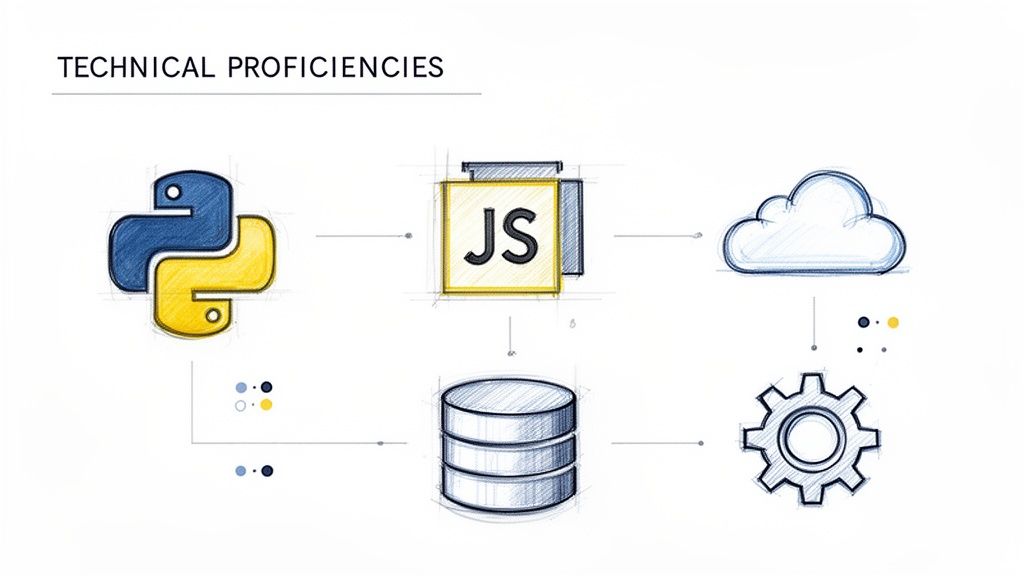
Listing these skills demonstrates your immediate value and ability to contribute with minimal ramp-up time. For a Senior Backend Engineer role at Stripe, this means showcasing expertise in Python, Go, and PostgreSQL. Similarly, a Frontend Developer applying to Figma should highlight TypeScript, React, and WebGL.
How to Implement This on Your Resume
To make your technical skills clear and impactful, focus on organization and relevance. Avoid a simple, long list of every technology you’ve ever touched. Instead, structure it to guide the reader’s eye to what matters most for the job you want.
- Group by Category: Organize your skills into logical groups like Programming Languages, Frameworks/Libraries, Databases, Cloud/DevOps, and Software. This makes your expertise easier to scan.
- Indicate Proficiency: Add a proficiency level (e.g., Expert, Proficient, Familiar) to set clear expectations. You can also quantify with years of experience, such as “Python (7+ years)” or “React (Expert, 5 years).”
- Prioritize for the Role: Mirror the language of the job description. If a posting lists “Kubernetes” as a core requirement, make sure it’s prominently featured in your skills section.
Key Takeaway: Honesty is crucial. Only list technologies you are genuinely comfortable discussing and have applied in production environments or significant portfolio projects. Be prepared to answer detailed technical questions about any skill you claim. A link to your GitHub profile or a relevant open-source contribution can serve as powerful proof of your abilities.
2. Asynchronous Communication & Documentation
The ability to communicate clearly without real-time interaction has become a non-negotiable skill, especially in remote and distributed teams. Asynchronous communication skills signal that you can maintain momentum, make decisions, and collaborate effectively across different time zones, eliminating the need for constant meetings. It’s about creating clarity through written updates, thoughtful proposals, and meticulous documentation, a practice popularized by remote-first companies like GitLab and Automattic.

Listing this skill shows you can operate independently and respect others’ focus time. A Product Manager at Notion, for instance, might highlight how they led async product decisions across eight time zones using written RFCs. A DevOps Engineer could mention how they maintained detailed runbooks that reduced incident response time by 40%. This skill proves you are a force multiplier, not a communication bottleneck.
How to Implement This on Your Resume
To effectively show your asynchronous skills, go beyond just listing “good communicator.” Provide concrete evidence of your ability to write with clarity and purpose, and mention the specific tools you use to facilitate this workflow.
- Be Specific with Tools: Instead of a generic claim, list the platforms you master. For example: “Asynchronous Communication (Slack, Notion, Loom, Asana)” or “Technical Documentation (Confluence, GitBook).”
- Quantify the Impact: Connect your documentation skills to business outcomes. Use bullet points like, “Reduced new-hire onboarding time by 30% through a comprehensive team wiki” or “Authored a public-facing API guide used by over 200 external developers.”
- Highlight Formal Processes: If you have experience with structured async workflows, call them out directly. Mentioning experience with RFCs (Request for Comments), design docs, or architectural decision records (ADRs) shows a high level of maturity in this area.
Key Takeaway: Create a “Communication Portfolio.” A link to a well-written public README on GitHub, a detailed technical blog post, or a sample design document can serve as powerful proof. Listing “Technical Writing” or “Documentation” as a distinct skill is effective if you have strong examples to back it up.
3. Self-Management & Time Zone Independence
In the expanding world of remote and distributed teams, proving you can work effectively without direct supervision is a powerful differentiator. This skill goes beyond simple “time management”; it signals to employers that you are a self-starter who takes ownership, meets deadlines without constant oversight, and collaborates fluidly across different time zones. Companies like GitLab and Basecamp have built their success on hiring individuals who operate with a high degree of autonomy, making this a critical skill for modern roles.

Listing these abilities shows you can thrive in an asynchronous environment, a core requirement for many of the best opportunities available. For an Engineer at Automattic, this could mean leading an architectural decision independently. A Marketing Manager at a company like Doist might showcase managing a campaign across four time zones with minimal hourly overlap, still achieving a 25% increase in leads. It’s a key part of what to put under skills on a resume for any high-trust, results-oriented culture.
How to Implement This on Your Resume
To demonstrate your independence and asynchronous prowess, you need to provide concrete evidence of your self-direction and its positive outcomes. Focus on framing these soft skills with hard results.
- Reframe as Ownership: Use powerful words like “ownership,” “autonomy,” and “accountability.” Instead of saying you “worked on a project,” state that you “Managed Project X with full ownership, delivering the final product two days ahead of the asynchronous deadline.”
- Highlight Time Zone Agility: Be explicit about your experience. A bullet point like, “Successfully coordinated a product launch across PST, EST, and CEST time zones with only a one-hour daily sync,” is far more impactful than a generic “works well with remote teams.” If you’re looking for roles with this level of flexibility, you can find remote-first jobs that prioritize these skills.
- Show, Don’t Just Tell: Mention the tools you use to organize your own work, such as Notion, Asana, or GitHub Projects. This serves as practical proof of your self-management systems.
Key Takeaway: Your goal is to build a case that you are a low-risk, high-impact hire who doesn’t require micromanagement. Quantify the impact of your initiative wherever possible, such as, “Proactively identified and resolved a critical API bottleneck, saving an estimated 8 engineering hours per week without waiting for team review.” This proves you create value autonomously.
4. Cross-Functional Collaboration & Communication
The ability to work effectively across different departments is no longer a “nice-to-have” skill; it’s a core competency in modern, agile workplaces. This skill demonstrates that you can navigate different team priorities, communication styles, and workflows to achieve a common goal. For remote and distributed teams, this ability prevents silos, ensures alignment, and keeps projects moving forward without constant top-down management. It shows you’re a team player who understands the bigger picture beyond your immediate role.

This concept was popularized by forward-thinking companies like Spotify with their “Squads and Tribes” model and Amazon’s “Working Backwards” process, both of which are built on deep cross-functional alignment. For example, a Product Manager at Slack might show how they led alignment between Engineering, Design, and Marketing to reduce feature shipping time. Similarly, a Data Scientist at Stripe could highlight how they built a dashboard serving Finance, Product, and Marketing teams, creating a single source of truth.
How to Implement This on Your Resume
Showcasing cross-functional skills requires moving beyond simply listing “teamwork.” You need to provide concrete evidence of your collaborative impact. Be specific about who you worked with and what you accomplished together.
- Name the Departments: Instead of a generic statement, explicitly mention the teams you partnered with. For example: “Collaborated daily with Product, Engineering, and QA teams.”
- Quantify the Impact: Tie your collaborative efforts to a measurable business outcome. A good example is: “Coordinated a 6-person project team across 4 departments, launching the new feature two weeks ahead of schedule.”
- Highlight Facilitation and Tools: Mention your role in leading meetings or discussions and the software you used. For instance: “Facilitated weekly async standups for 8 stakeholders using Loom, Notion, and Slack to maintain project momentum.”
- Show, Don’t Just Tell: Include examples of knowledge-sharing, like “Led brown bag sessions teaching basic SQL to the marketing team,” or conflict resolution, such as “Resolved a key prioritization conflict between Product and Design, creating a unified roadmap.”
Key Takeaway: When deciding what to put under skills on a resume, remember that collaboration is a story of impact. Frame it by showing how you acted as the glue between different parts of the business, resulting in faster execution, better products, or more efficient processes. Mentioning specific tools like Figma, Notion, or GitHub reinforces your ability to operate in a modern collaborative environment.
5. Data Analysis & Metrics-Driven Decision Making
The ability to interpret data and make decisions based on evidence is no longer just for data scientists. In modern companies, particularly remote-first ones where async communication is key, data literacy is a universal expectation. Product managers, marketers, and operations professionals all need to demonstrate they can move beyond intuition and justify their strategies with hard numbers. This skill shows you can measure what matters and drive business outcomes.
Showcasing data-driven decision-making proves you can operate with autonomy and intelligence. For a Marketing Manager at HubSpot, this could mean building a Looker dashboard to track Customer Acquisition Cost (CAC) by channel and using that data to find a 40% cost reduction opportunity. Similarly, an Operations Manager at Notion might create a quarterly dashboard showing team productivity trends, communicating findings via a Loom video to guide resource allocation.
How to Implement This on Your Resume
Simply listing “data analysis” is not enough. You must show how you used data to create tangible results. Contextualize your analytical skills within your achievements and list the specific tools you used to get there.
- List Specific Tools: Clearly name the software you’re proficient in. Examples include Tableau, Looker, Metabase, Google Sheets, or SQL.
- Quantify the Impact: Connect your data skills to a business outcome. Frame it as: “Used A/B testing data to improve conversion rate by 18%” or “Analyzed performance metrics to reduce API latency by 35%.”
- Highlight Dashboard Creation: Mentioning your ability to build and maintain dashboards shows you can make data accessible to others. For example: “Built and maintained a real-time dashboard for 50+ cross-functional stakeholders.”
- Showcase Analytical Methods: If you have deeper knowledge, include it. Phrases like “statistical testing,” “correlation analysis,” or “cohort analysis” signal a higher level of expertise. Even mentioning “Basic SQL for analytics and reporting” can be a powerful addition for non-technical roles.
Key Takeaway: Your goal is to prove you don’t just report on data; you use it to ask smart questions, uncover insights, and influence strategy. Frame your data skills as a tool for problem-solving, not just a technical capability. This is what separates a passive observer from an active contributor.
6. Product & Market Knowledge (Industry Expertise)
Beyond specific tools and tasks, demonstrating a deep grasp of your industry is what separates an executor from a strategic partner. This skill shows you understand the competitive landscape, customer pain points, and emerging market trends. It signals to a hiring manager that you can make informed decisions and contribute to the company’s direction without constant context-gathering.
Listing this as a skill proves you are not just a cog in the machine but a thoughtful contributor who can connect their work to the company’s bottom line. For a Product Manager, this means knowing the competitive threats from tools like Notion and Asana. For a Sales Director, it’s about having deep expertise in the SMB SaaS market to identify new opportunities. Even an engineer can showcase this by architecting a solution that addresses specific regulatory gaps in a target market like India.
How to Implement This on Your Resume
Simply stating “Industry Knowledge” is too vague. Instead, embed specific, quantifiable examples of your market expertise directly within your skills section or work experience bullet points. This provides concrete proof of your strategic value.
- Mention Competitors: Directly name competitors you have analyzed, such as “Competitive analysis of Salesforce, HubSpot, and Zoho CRM.”
- Reference Customer Insights: Show your connection to the end-user. For example, “Conducted 20+ customer interviews to identify top three pain points in the logistics workflow.”
- Show Trend Awareness: Demonstrate you are forward-thinking. You could write, “Early adopter of AI-driven personalization, informing a product pivot that increased engagement by 15%.”
- Quantify the Impact: Connect your market knowledge to business results. A powerful example is, “Market research identified a $5B TAM opportunity in an adjacent, untapped segment.”
Key Takeaway: Your goal is to show you think about the “why” behind your work, not just the “how.” Weave your market knowledge into your resume to frame your accomplishments. This tells a story of a candidate who can hit the ground running and immediately add strategic depth to the team.
7. Project Management & Delivery Execution
This skill demonstrates your ability to not just participate in work, but to drive it to completion. It’s about showing recruiters you can take a complex goal, break it down into manageable steps, and deliver a final product on time and within scope. For hiring managers, especially in remote-first companies, this skill is a signal of accountability and reliability, assuring them that projects won’t falter due to poor coordination or communication gaps.
A candidate who lists project management skills is telling a company they are an owner. For instance, a Marketing Manager at Buffer might highlight: “Owned rebrand project with 30+ stakeholders; delivered visual identity, website, and launch campaign on time and under budget.” Likewise, an Engineering Manager at GitLab could state: “Led 3-month infrastructure migration with 12-person team across 5 time zones; delivered on schedule with zero incidents.” These statements prove you can manage complexity and achieve tangible results.
How to Implement This on Your Resume
Simply listing “Project Management” is not enough. You need to provide context and evidence of your execution capabilities. Show, don’t just tell, how you’ve successfully managed work from start to finish.
- Specify Methodologies: Mention the frameworks you’re fluent in, tailored to the job description. Examples include Agile/Scrum, Kanban, Waterfall, or Shape Up. This shows you understand structured approaches to delivery.
- List Your Tools: Name the specific software you use to track progress and collaborate. Including tools like Jira, Asana, Linear, Notion, or Monday.com gives a concrete sense of your day-to-day workflow.
- Quantify Your Success: Use numbers to frame your achievements. Phrases like “Managed project scope, reducing scope creep by 40%” or “Led 15 projects with a 95% on-time delivery rate” are far more powerful than vague claims.
- Highlight Communication: Especially for remote roles, show how you keep everyone aligned. Mention “Provided weekly async updates to 20+ stakeholders” to underscore your communication skills across distributed teams.
Key Takeaway: Your ability to manage and deliver projects is one of the most transferable skills you can highlight. Frame your experience around outcomes, not just processes. Connect your skills to specific results like on-time delivery, budget adherence, or stakeholder satisfaction to prove your value as a reliable team member who gets things done.
8. Customer Success & User Empathy
More than just a soft skill, demonstrating a deep understanding of customer needs is a powerful differentiator for roles in product, design, engineering, and marketing. This skill proves you focus on user outcomes over simple feature completion. It shows employers you can connect your work directly to business goals like retention, satisfaction, and growth by solving real user problems.
This mindset, popularized by philosophies like Jeff Bezos’s “Customer Obsession” and Teresa Torres’s “Continuous Discovery,” is what separates good professionals from great ones. For a Product Manager at Intercom, this means translating direct customer feedback into roadmap decisions. For an Engineer at Slack, it involves building features with accessibility and user friction in mind.
How to Implement This on Your Resume
To effectively show your customer-centric approach, you must move beyond generic phrases like “customer-focused.” Instead, provide concrete evidence and quantify the impact of your user empathy. Connect your actions to measurable business results.
- Quantify Feedback Impact: Use numbers to show the scale and result of your efforts. For example, “Conducted 50+ customer interviews annually, with insights driving a 28% improvement in CSAT” or “Analyzed 1,000+ support tickets to identify a key pain point, leading to a feature that reduced ticket volume by 15%.”
- Specify Research Methods: Explicitly list the techniques and tools you use. Mention skills like User Interviews, Surveys, A/B Testing, Session Recordings, and Heat Mapping. Naming tools like Hotjar, Typeform, Userlytics, or FullStory adds another layer of credibility.
- Show Outcome-Focused Thinking: Frame your achievements around the customer’s success, not just your team’s output. Instead of “Shipped new dashboard,” write “Developed a new user dashboard that decreased average task completion time by 35%.”
Key Takeaway: Your ability to empathize with users is a critical asset. Prove it by showing how you gather customer insights and, more importantly, how you use that information to drive positive change. Highlight specific improvements in metrics like Net Promoter Score (NPS), Customer Satisfaction (CSAT), or retention rates to make a compelling case.
9. Continuous Learning & Adaptability
More than just a list of what you already know, a powerful skills section can show your capacity to grow. Highlighting your commitment to continuous learning and adaptability signals to employers that you are a proactive, future-proof candidate. This is especially important in fast-moving industries like tech, marketing, and design, where tools and best practices change constantly. It proves you won’t become obsolete and can evolve with the company’s needs.
Listing recent certifications, relevant coursework, or personal projects demonstrates initiative beyond your day-to-day responsibilities. For a Product Manager at Notion, this could mean mentioning a self-published newsletter on AI/ML trends that informs their product strategy. Similarly, a Data Analyst at Figma could note completing specific DataCamp courses and then applying that knowledge to automate weekly reporting, saving 10 hours of manual work.
How to Implement This on Your Resume
The goal is to provide tangible proof of your learning mindset, not just claim it as a soft skill. Integrate these proofs directly into or alongside your skills section, or even create a dedicated “Professional Development” or “Certifications” subsection.
- Show, Don’t Just Tell: Instead of listing “quick learner,” provide evidence. Link to your GitHub profile showing active contributions or a portfolio with recent projects that use new technologies.
- Connect Learning to Impact: Frame your learning within a results-oriented context. For example, “Completed AWS Solutions Architect certification, applying new knowledge to redesign our cloud infrastructure and reduce costs by 25%.”
- List Relevant Platforms and Certifications: Mention reputable learning platforms like Coursera, Udacity, or LinkedIn Learning. List only completed or in-progress certifications, not ones you simply plan to start. Be specific: “Google Analytics IQ Certification (2023).”
- Include Public Contributions: If you write technical articles, give talks, or contribute to open-source projects, feature these prominently. For instance, “Active contributor to the React Router library (20+ merged PRs)” or “Speaker at 3 industry conferences on scalable design systems.”
Key Takeaway: Your ability to learn and adapt is one of the most valuable skills you can offer. Frame your educational pursuits as direct investments in your professional capabilities. Showing how you’ve already applied what you’ve learned is the most convincing way to prove you’ll bring that same drive and value to your next role.
10. Leadership & Systems Thinking
This skill combines the ability to guide and influence people with the capacity to see and improve the larger systems they work within. It’s not just about managing a team; it’s about identifying bottlenecks, optimizing workflows, and implementing changes that scale an organization’s effectiveness. For senior, lead, and strategic roles, showcasing both people and process skills proves you can create lasting impact beyond your immediate tasks.
Listing this skill signals that you are more than just an individual contributor. For an Operations Manager at Stripe, this means showing how you analyzed and redesigned a customer onboarding workflow to reduce bottlenecks. For an Engineering Lead at Figma, it means highlighting how you mentored junior engineers into promotion while managing a distributed team across time zones. This combination is what companies look for when hiring people to solve complex, systemic challenges.
How to Implement This on Your Resume
To effectively demonstrate leadership and systems thinking, you must ground abstract concepts in concrete, quantified results. Move beyond simply stating “leadership skills” and provide evidence of how you led and what systematic improvements you drove.
- Distinguish Influence from Authority: Clearly separate formal management from informal leadership. Use phrases like “Managed an 8-person distributed team” for direct reports, and “Influenced product and engineering teams to adopt a new architecture” to show leadership without formal power.
- Quantify Process Improvements: Connect your systems thinking to measurable business outcomes. For example, instead of “improved a process,” write “Redesigned workflow, reducing customer onboarding time from 7 days to 2 days” or “Created an automated monitoring system, cutting incident response time from 45 to 10 minutes.”
- Show, Don’t Just Tell, Mentorship: Detail the results of your guidance. Instead of “mentored colleagues,” specify “Mentored 4 junior engineers, with 2 achieving promotion to senior roles within 18 months.” This proves your ability to develop talent, a key leadership metric.
Key Takeaway: Leadership and systems thinking are proven through action and results. On your resume, this means describing specific initiatives you championed, processes you redesigned, and people you developed. Mentioning specific methodologies like Lean, Six Sigma, or Kaizen can add weight, but only if you can back them up with examples of how you applied them to achieve a measurable outcome like “reduced cycle time by 35%” or “saved 20 engineering hours per week.”
Top 10 Resume Skills Comparison
| Skill / Focus Area | 🔄 Implementation complexity | ⚡ Resource requirements | 📊 Expected outcomes | 💡 Ideal use cases | ⭐ Key advantages |
|---|---|---|---|---|---|
| Technical Proficiencies & Programming Languages | High — continuous updates and versioning | Significant — dev environments, cloud, portfolios, practice time | Clear job qualification; measurable via assessments and ATS | Engineering, devops, data roles in remote-first companies | Direct proxy for performance; high market value |
| Asynchronous Communication & Documentation | Moderate — requires writing discipline and templates | Low — docs tools (Notion, GitHub), time to build samples | Strong alignment, audit trail, fewer meetings | Distributed teams, PMs, technical writers, ops | Enables async decisions; improves onboarding and leadership signals |
| Self-Management & Time Zone Independence | Moderate — habit and routine development | Low — personal tooling (task managers) and scheduling practices | Higher autonomy; reduced manager overhead; reliable delivery | Senior ICs, global teams, fully remote roles | Reduces supervision need; increases retention and ownership |
| Cross-Functional Collaboration & Communication | High — stakeholder coordination and facilitation | Moderate — collaboration tools and time for alignment | Reduced silos; faster shipping; clearer priorities | Product managers, program leads, cross-department projects | Prevents misalignment; indicates promotion readiness |
| Data Analysis & Metrics-Driven Decision Making | Moderate–High — analytical skill plus tooling | Moderate — BI tools, data access, SQL/statistics knowledge | Evidence-based decisions; visible KPIs for async choices | PMs, marketing, ops, analysts across remote teams | Creates shared truth; reduces opinion-driven conflicts |
| Product & Market Knowledge (Industry Expertise) | Moderate — research and contextual learning | Low–Moderate — market research, interviews, reports | Faster ramp-up; strategic contributions without extra context | Strategy, PM, sales leadership, senior hires | Enables independent strategic decisions; market-informed tradeoffs |
| Project Management & Delivery Execution | High — planning, risk, scope and tracking discipline | Moderate — PM tools, stakeholder time, documentation | On-time delivery; reduced surprises; clearer ownership | Project leads, PMs, engineering managers on distributed teams | Ensures accountability; critical for remote execution fidelity |
| Customer Success & User Empathy | Moderate — qualitative research and synthesis | Low–Moderate — user research tools, interview time | Better product-market fit; improved retention and CSAT | Customer-facing roles, PMs, designers, support teams | Prevents building in a vacuum; drives LTV and product improvements |
| Continuous Learning & Adaptability | Low–Moderate — self-directed habit formation | Low — courses, side projects, conferences, GitHub activity | Keeps skills current; able to pivot with tech changes | Fast-moving tech roles; teams undergoing frequent change | Signals growth mindset; sustains long-term value |
| Leadership & Systems Thinking | Very high — people leadership plus systemic design | High — time, cross-team influence, process tooling | Scales teams; reduces friction; long-term cost/quality gains | Senior leaders, org design, scaling initiatives | Multiplies organizational impact; builds resilient systems |
From Listing Skills to Demonstrating Value
Crafting the perfect resume is a strategic exercise, and the question of “what to put under skills on a resume” moves far beyond a simple checklist. As we’ve explored, the goal is not merely to list what you can do, but to build a compelling case for your value. It’s about creating a focused narrative that aligns your unique abilities with the specific needs of a potential employer, especially in the competitive remote job market.
The most effective skills sections are dynamic and context-rich. They are a curated exhibit of your professional identity, showcasing a blend of verifiable hard skills and the critical soft skills that enable success in modern workplaces. A hiring manager doesn’t just want to see “Python” or “Project Management”; they want to see evidence of how you’ve applied those skills to drive results.
Key Takeaways: From Theory to Application
To transform your skills section from a passive inventory into an active sales tool, remember these core principles:
- Relevance is Paramount: Always customize your skills list for the job description. Your resume is not a historical document of every skill you’ve ever learned; it’s a targeted marketing document. Use the job posting as your guide to highlight the most relevant technical and soft skills.
- Quantify Your Impact: Numbers speak louder than words. Instead of just listing “Data Analysis,” specify “Analyzed customer churn data to identify key drop-off points, contributing to a 15% improvement in user retention strategies.” Quantification provides concrete proof of your competence.
- Contextualize Everything: Show, don’t just tell. Weaving your skills into your work experience bullet points provides powerful context. A skill listed in isolation is a claim; a skill demonstrated through an achievement is a fact. For instance, mentioning “Asynchronous Communication” in your skills list is good, but describing how you “managed a global project across three time zones using detailed documentation in Confluence and regular updates in Slack” is far more persuasive.
Your Actionable Next Steps
With these insights, your immediate task is to audit and refine your resume.
- Analyze Your Target Roles: Pull 3-5 job descriptions for roles you’re genuinely interested in. Identify the recurring skills and keywords.
- Create Your “Master List”: Brainstorm every hard skill, software proficiency, and soft skill you possess.
- Curate and Quantify: For each target role, select the 8-12 most relevant skills from your master list. For each one, draft a corresponding bullet point for your experience section that demonstrates that skill in action with a quantifiable result.
- Integrate and Refine: Build your dedicated Skills section with the top keywords, but ensure the real substance lives within your professional experience descriptions. This shows you not only have the skill but have successfully applied it.
Mastering this approach demonstrates a high level of professionalism and self-awareness that employers notice. Even if you’re early in your career or looking for a change, mastering the art of demonstrating your capabilities can be achieved by understanding how to write a CV with no experience. The principles of showing impact and tailoring your message are universal.
Ultimately, the answer to what to put under your skills on a resume is a reflection of your professional story. It’s the proof that you can not only do the job but also thrive in the company’s environment, solve its unique challenges, and contribute to its success from day one. By moving from a simple list to a powerful demonstration of value, you create a resume that doesn’t just pass the ATS scan; it captures a hiring manager’s attention and makes a compelling argument for why you are the ideal candidate.
Ready to put your newly polished resume to the test? Stop wasting time on crowded job boards and find companies that actively seek the skills you’ve just learned to highlight. Remote First Jobs lists opportunities directly from over 21,000 verified remote-first companies, ensuring your application goes to a real team looking for top talent like you. Find your next remote role on Remote First Jobs today and connect with employers who value demonstrated expertise.