Think of transferable skills as your professional passport. They aren’t tied to one specific company or job title; they’re the core abilities you can pack up and take with you anywhere, allowing you to pivot, adapt, and thrive no matter where your career takes you.
They’re the universally valuable talents that make you a great hire, period.
Unpacking Your Professional Toolkit
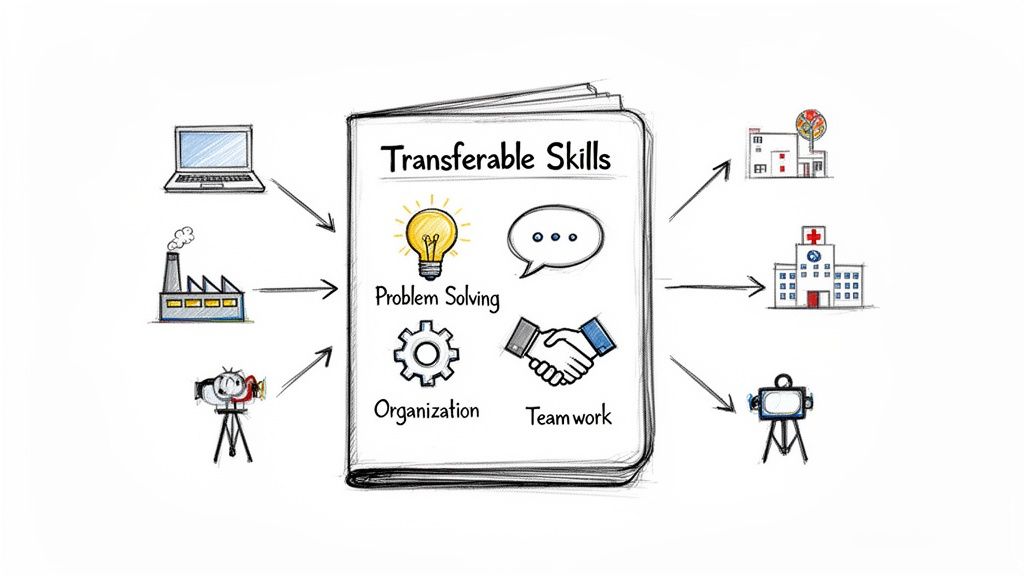
Let’s try a quick thought experiment. Imagine your career is a series of different workshops. In the first, you learn carpentry. In the next, you’re suddenly working with metal.
The materials and tools might change completely, but what stays the same? Your ability to measure accurately, read a blueprint, and manage a project from start to finish. Those are your transferable skills.
You pick them up everywhere—in previous jobs, volunteer gigs, or even that side project you’re passionate about. Because they aren’t tied to a specific industry, they’re just as crucial for a marketing agency as they are for a tech startup. Getting a handle on these skills is the first real step to understanding your value, especially if you’re eyeing a career change or a move into remote work.
The Three Core Types of Transferable Skills
To really get a grip on what transferable skills are, it helps to sort them into a few key buckets. While there are tons of individual skills out there, most of them fit neatly into three main categories. Breaking them down this way often reveals strengths you didn’t even realize you had.
The real power of transferable skills is that they prove your potential beyond your job title. They tell a hiring manager not just what you’ve done, but what you are capable of doing in a completely new environment.
Once you understand these categories, you can start auditing your own experience. For example, a retail manager who juggles inventory, staff schedules, and tricky customer complaints has rock-solid skills in logistics, time management, and conflict resolution—all of which are gold in industries far outside of retail.
This table gives you a simple framework for thinking about these powerful, portable abilities.
The Three Core Types of Transferable Skills
| Skill Category | Description | Examples |
|---|---|---|
| Work-Based Skills | These are the practical, often teachable abilities you use to get the job done. Think of them as the “how-to” of your role. | Data Analysis, Budget Management, SEO, Project Management |
| People-Based Skills | All about how you interact, communicate, and collaborate with others. These are your interpersonal superpowers. | Communication, Leadership, Empathy, Teamwork, Negotiation |
| Mindset-Based Skills | These are your internal qualities—the cognitive approaches and attitudes that shape how you think and work. | Problem-Solving, Adaptability, Creativity, Critical Thinking |
Seeing your skills laid out like this makes it much easier to connect the dots between what you’ve done in the past and what a new role—especially a remote one—will demand of you.
Why Transferable Skills Matter in a Remote World
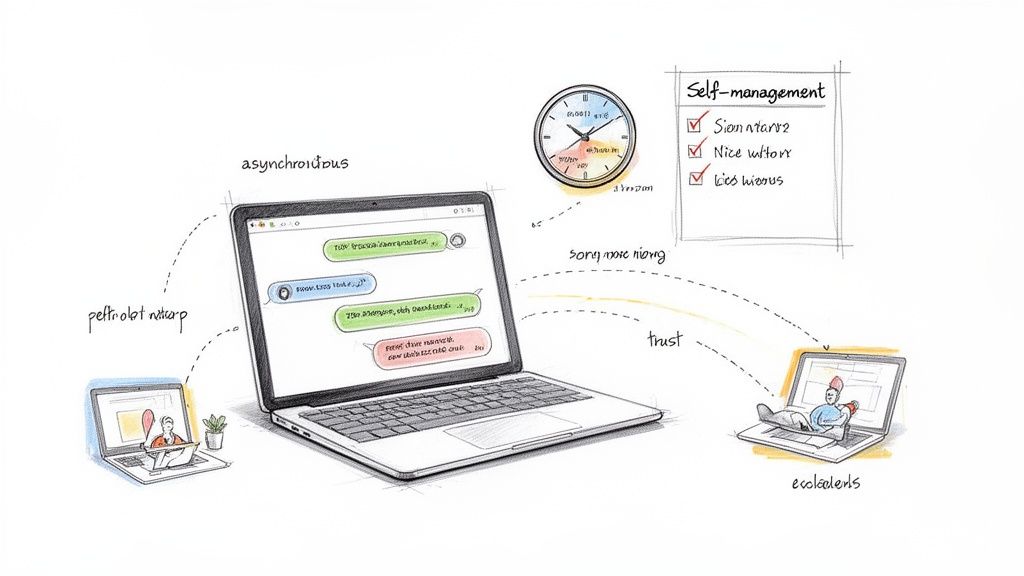
In a traditional office, your physical presence can fill in a lot of gaps. A manager can see you’re plugging away at your desk, and a quick question is just a shoulder tap away. But remote work removes this safety net, putting a massive premium on the skills that prove you can deliver results without someone looking over your shoulder.
This is why transferable skills have become the unspoken currency of the remote job market. They aren’t just “nice-to-haves” anymore; they’re the very foundation of trust between you and a company that operates without walls. An employer can’t see you working, so they need tangible proof that you’re a self-starter who can manage your own time, communicate with crystal clarity, and tackle problems on your own.
The Remote Work Litmus Test
Think of your transferable skills as a signal to hiring managers. They show you’re a low-risk, high-potential candidate who is built to thrive with autonomy. For example, a strong project management background tells a remote employer you won’t need hand-holding to hit deadlines across different time zones.
Likewise, exceptional written communication skills are completely non-negotiable. When your team is scattered across the globe, a poorly worded message can cause confusion that stalls a project for hours. Your ability to write clear, concise, and empathetic updates is a direct reflection of how well you’ll perform in an asynchronous world.
This isn’t a small trend. The World Bank estimates that around 1.1 billion workers will need significant retraining in the next decade due to digitalization. The skills proving most durable—like analytical thinking, creativity, and resilience—are overwhelmingly transferable, making them the key to long-term career stability.
Building Trust from a Distance
In a remote setting, trust isn’t built over coffee breaks in the kitchen. It’s earned through consistent, reliable execution. Every message you send and every task you complete serves as a real-time demonstration of your capabilities.
In the absence of physical presence, your work becomes your reputation. Transferable skills like proactive communication, accountability, and resourcefulness are the building blocks of that reputation, proving you can contribute effectively from anywhere.
For instance, instead of waiting for instructions, you might spot a potential bottleneck in a project and propose a solution in a shared document. This one simple act demonstrates several critical transferable skills at once:
- Proactive Problem-Solving: You didn’t wait for the issue to derail the team.
- Critical Thinking: You analyzed the situation and came up with a practical solution.
- Asynchronous Communication: You presented your idea clearly so colleagues in other time zones could understand and weigh in.
Actions like these show a hiring manager you get the unique rhythm and demands of distributed work.
Your Competitive Edge in a Global Talent Pool
When you apply for a remote job, you aren’t just up against local candidates; you’re competing with talent from all over the world. This is where truly understanding what transferable skills are and how to show them off gives you a massive advantage. While technical abilities might get your resume noticed, it’s your transferable skills that will seal the deal.
They prove you can slide right into a remote-first culture, collaborate effectively with a diverse team, and drive projects forward with minimal supervision. By highlighting these skills, you’re not just showing what you can do—you’re showing how you do it, which is exactly what the best remote companies on platforms like Remote First Jobs are looking for.
The Top Transferable Skills Remote Companies Demand
While you could probably list a hundred different transferable skills, not all of them carry the same weight when you’re working remotely. Remote companies aren’t just looking for someone who is generally competent; they’re hunting for specific abilities that prove you can not only survive but thrive with a ton of autonomy.
These skills show a hiring manager you can get things done on your own while still being a dialed-in, effective part of the team, no matter where you are.
Knowing which skills matter most is a massive advantage. It helps you skip the generic buzzwords on your resume and instead highlight the exact strengths that solve the biggest remote work headaches—like keeping projects moving across time zones or making sure nothing gets lost in translation.
We can break these crucial skills down into two core buckets: Independent Execution and Collaborative Communication.
Skills for Independent Execution
This is all about proving you’re a self-starter who doesn’t need someone looking over their shoulder to produce great work. It’s the absolute foundation of trust in a remote setup. When a hiring manager sees these skills, they feel confident you can manage your own time, jump on problems, and stay productive from anywhere.
Self-Management and Time Management: In an office, structure is built-in. When you’re remote, you have to build it yourself. This means you know how to prioritize what’s important, hit your deadlines without needing a nudge, and build a daily routine that works for you. A candidate who can explain how they juggled competing deadlines on a tough project is always going to beat someone who just lists “organized” on their resume.
Proactive Problem-Solving: Remote teams can’t afford to have work grind to a halt while someone waits for an answer. This skill is about spotting trouble before it explodes and taking the initiative to figure it out. It’s the difference between sending a message that says, “The system is down, what do I do?” versus “The system is down. I’ve already checked the status page, pinged IT in their channel, and I’m starting on task B to keep things moving.”
Adaptability and Digital Fluency: The tools and workflows in a remote company are always changing. This skill demonstrates you can get up to speed on new software fast, whether it’s a project management tool like Asana, a chat platform like Slack, or a new CRM. It tells the team you won’t be a technical roadblock.
Think of these execution skills as your proof that you’re a reliable, low-maintenance pro who can be trusted to deliver, no matter which Wi-Fi network you’re logged into.
Skills for Collaborative Communication
Of course, getting your own work done is only half the story. On a distributed team, your ability to connect and collaborate clearly through a screen is just as critical. These skills are what keep projects running smoothly and the team feeling connected, even if they’ve never shaken hands in person.
Exceptional written communication is everything. This isn’t just about good grammar—it’s about writing with enough clarity, context, and tone to prevent misunderstandings and kill the need for endless follow-up meetings. One well-written project update can save an entire team hours of confusion.
In a remote company, clear writing is not a soft skill—it is a core business function. The quality of your asynchronous communication directly impacts the speed and efficiency of the entire organization.
Beyond great writing, a few other communication skills are non-negotiable:
Asynchronous Communication: This is the art of pushing work forward without everyone needing to be online at the same time. It looks like leaving detailed, thoughtful comments in a Google Doc, recording a quick Loom video to walk through a complex idea, or posting a thorough update in a project channel so your teammates in another time zone can pick it up when they start their day.
Active Listening and Empathy: When you can’t read body language in a conference room, you have to listen harder on video calls and learn to read between the lines in Slack. Empathy shows you can understand where a colleague is coming from, which is the secret sauce for building trust and sorting out disagreements on a global team.
Analytical and Creative Thinking: The World Economic Forum’s 2023 Future of Jobs report put a spotlight on just how critical these skills have become. They found that analytical thinking is now the single most important skill for companies. At the same time, they predict creative thinking will grow in importance even faster, with demand expected to jump by 73% in the next five years. This shows that remote companies need people who can both make sense of information and come up with new ideas—a killer combo for solving problems from anywhere. You can dig into the findings on future-proof skills yourself.
Let’s break down some of these top skills and see what they actually look like in a remote role.
Top Transferable Skills for Remote Roles and Their Impact
| Skill | What It Means for Remote Work | Why Employers Value It |
|---|---|---|
| Written Communication | Crafting clear, concise, and context-rich messages, emails, and documents that prevent misunderstandings. | It’s the primary way work gets done. Clear writing reduces meetings, speeds up decisions, and keeps everyone aligned across time zones. |
| Self-Management | Independently prioritizing tasks, managing your schedule, and meeting deadlines without direct supervision. | It builds trust. Managers need to know they can count on you to deliver high-quality work on time without constant check-ins. |
| Proactive Problem-Solving | Identifying potential issues and taking the initiative to find solutions instead of waiting to be told what to do. | It keeps the team moving. Proactive employees prevent bottlenecks and demonstrate ownership, which is invaluable in a distributed team. |
| Digital Fluency | Quickly learning and adapting to new software, tools, and digital processes (e.g., Slack, Asana, Notion, CRMs). | It ensures you can hit the ground running. Companies can’t afford to spend weeks training new hires on basic tech stacks. |
| Asynchronous Collaboration | Contributing effectively to projects through comments, recorded videos, and detailed updates, not just live meetings. | It’s the key to global teamwork. It allows progress to happen 24⁄7 and respects different schedules and time zones. |
| Active Listening & Empathy | Paying close attention on calls and understanding the perspectives of colleagues from diverse backgrounds. | It builds psychological safety and strong team bonds. When people feel heard and understood, collaboration and innovation flourish. |
Mastering these skills isn’t just about being a good remote employee—it’s about becoming an indispensable part of a modern, distributed team.
How to Uncover Your Hidden Transferable Skills
Here’s a secret everyone should know: you have more valuable skills than you give yourself credit for. That’s a guarantee. The hard part isn’t getting the skills; it’s learning to see and talk about the ones you already have. Your most impressive abilities are often buried in your day-to-day tasks, hidden behind a job title or routine responsibilities.
To really get a handle on what you bring to the table, you need to become something of a career detective. This means looking past your official job description and digging into what you actually did. The mission is to build an inventory of your talents that isn’t locked into one specific role or industry.
Think of it as translating your experience into the universal language of skills. This is a game-changer for anyone trying to pivot to a new field or land a competitive remote job. In fact, if you’re looking to change careers, mapping out your existing skills is the essential first step.
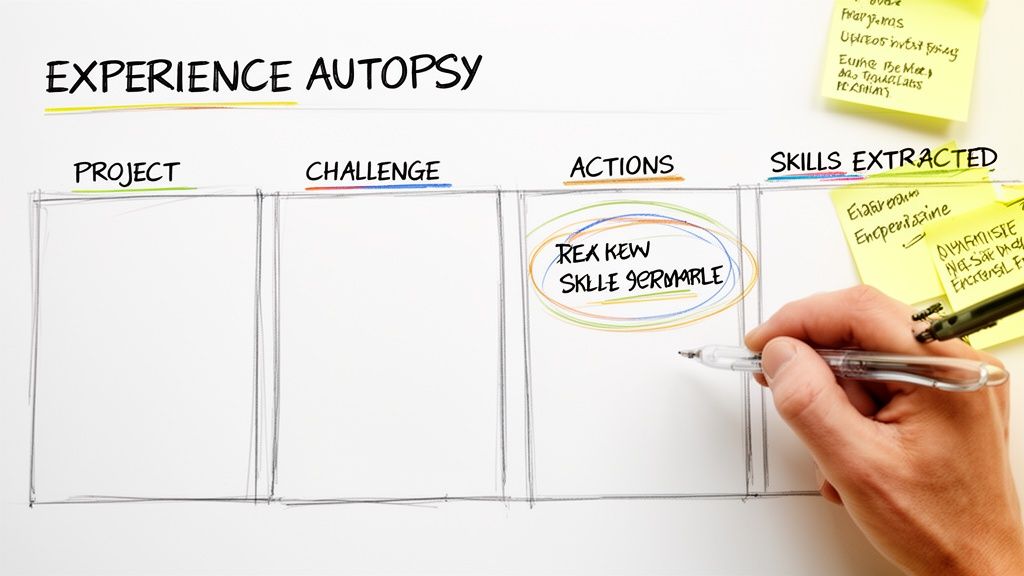
Conduct an Experience Autopsy
One of the best ways to find these hidden gems is to perform an “Experience Autopsy” on your past projects and jobs. This isn’t as grim as it sounds. You’re simply deconstructing your work history—the wins and the losses—to pull out the underlying skills you used.
Pick a big project you worked on in the last couple of years. Don’t just think about the final result. Instead, break down the entire process from start to finish, asking yourself sharp questions to see which skills you flexed at each stage.
Here’s a simple framework to guide you:
- Identify the Project or Task: Choose one specific, memorable responsibility. (e.g., “Organized the annual team offsite event.”)
- Break Down Your Actions: List the concrete steps you took. Get really granular.
- Translate Actions into Skills: For each action, name the transferable skill it demonstrates.
The point of an Experience Autopsy isn’t to judge whether a project succeeded or failed. It’s about taking inventory of the capabilities you used. Even a project that went sideways is full of transferable skills like resilience, problem-solving, and risk assessment.
Let’s walk through a real-world example.
- Task: Coordinated the launch of a new marketing campaign.
- Action: I built a timeline with key deadlines and assigned tasks to team members.
- Skill: Project Management, Strategic Planning
- Action: I researched competitor campaigns to find gaps in their messaging.
- Skill: Market Research, Competitive Analysis
- Action: I presented the campaign strategy to senior leadership to get their buy-in.
- Skill: Public Speaking, Persuasion, Stakeholder Management
- Action: The first ads underperformed, so I dug into the data and moved the budget to better-performing channels.
- Skill: Data Analysis, Adaptability, Budget Management
This simple exercise turns a basic resume bullet point into a rich portfolio of in-demand skills.
Ask the Right Guiding Questions
To dig even deeper, grab a notebook or open a blank document and answer questions that force you to think about your work in terms of skills, not just duties. This helps you connect the dots between your daily grind and your professional worth.
Try asking yourself these questions for each of your past roles:
- What was a major problem I solved, and what specific steps did I take?
- When did I have to persuade someone to see my point of view? How did I pull it off?
- Describe a time I had to manage multiple competing priorities. What system did I use?
- Was there a process that was clunky or inefficient? What did I do to make it better?
- When did I have to learn a new tool or piece of software on the fly? How did I get up to speed?
By methodically going through your career history with this mindset, you’ll start to see a pattern. You’ll stop thinking “I was a retail manager” and start thinking “I’m a professional with proven skills in inventory control, team leadership, and conflict resolution.” That shift in perspective is everything.
How to Showcase Your Skills on a Resume and Cover Letter
Just listing your transferable skills in a sidebar on your resume is a huge missed opportunity. To really grab a hiring manager’s attention, you need to weave these abilities into the very fabric of your professional story.
This means getting away from dry descriptions of your duties. Instead, you’ll want to frame your experience through the lens of what you actually achieved.
The goal here is to show, not just tell. Anyone can claim they’re a “good communicator” or a “strong leader.” Your resume and cover letter need to offer undeniable proof, turning generic responsibilities into compelling evidence of your value. This is how you prove you understand not just what transferable skills are, but how to make them count.
From Passive Duties to Powerful Achievements
The single best way to showcase your skills is by reframing your resume bullet points. Stop stating what you were responsible for and start highlighting what you accomplished—and the skills you used to make it happen.
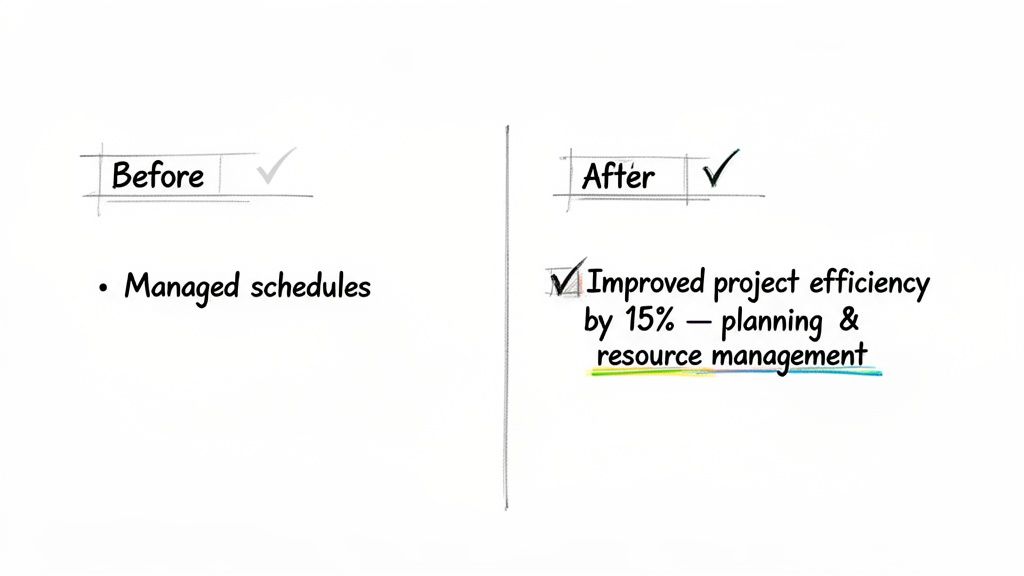
Let’s look at a couple of “before and after” examples to see this in action. Notice how the “after” version adds numbers to quantify the result and explicitly names the skills used.
Before: Responsible for the team’s weekly project schedule.
After: Improved project efficiency by 15% by using strategic planning and resource management skills to optimize team workflows and reallocate tasks based on priority.
See what a difference that makes? It shows you don’t just manage a schedule; you understand the strategy behind it. That’s a critical skill for any role, especially a remote one where efficiency is everything.
Here’s another one:
- Before: Handled customer support inquiries via email.
- After: Achieved a 95% customer satisfaction rating by applying empathetic communication and proactive problem-solving to resolve an average of 40+ technical inquiries per day.
By adding metrics and naming the specific skills, you provide solid proof of what you can do.
Crafting a Skill-Focused Professional Summary
Your professional summary is the first thing a recruiter sees, making it prime real estate for your most relevant transferable skills. This short paragraph at the top of your resume should be a concise pitch that connects your top abilities directly to the job you want.
Instead of a generic opening, lead with your strongest transferable competencies.
- Weak Summary: “Experienced marketing professional with a history of success in digital campaigns.”
- Strong Summary: “Data-driven marketing strategist with 8+ years of experience in project management, stakeholder communication, and analytical problem-solving. Proven ability to translate complex data into actionable campaigns that increased lead generation by 30%.”
The second version immediately tells a recruiter what you can do for them, using the language of skills and results. It sets the stage for the rest of your resume, which will provide the evidence to back it all up. To really make your application pop, you can boost your CV with certified training that backs up your experience with qualifications.
Writing a Compelling Cover Letter Story
Your cover letter is where you bring your skills to life through storytelling. Think of it this way: your resume provides the bullet points, but your cover letter connects them into a narrative that shows why you’re a perfect fit.
Don’t just repeat your resume. Instead, pick one or two key transferable skills from the job description and tell a brief story that shows them in action. The STAR method (Situation, Task, Action, Result) is a great framework for this.
Example for a Project Manager Role:
- Situation: “In my previous role at XYZ Corp, we faced a critical project delay due to unexpected scope changes from a key client.”
- Task: “My task was to get the project back on track without compromising quality or going over budget.”
- Action: “I immediately organized a meeting with all stakeholders to realign on priorities (stakeholder management), created a revised project plan with a clear critical path (strategic planning), and established a new daily check-in system to improve transparency (proactive communication).”
- Result: “As a result, we successfully delivered the project just one week behind the original schedule and 10% under the revised budget, strengthening our relationship with the client.”
This mini-story does more to prove your skills than a dozen adjectives ever could. It provides context, shows your thought process, and ends with a quantifiable win that makes your application impossible to forget.
Demonstrating Your Skills in a Job Interview
Your resume gets your foot in the door, but the interview is where your skills truly come alive. This is your stage. It’s where you stop listing skills and start showing them through compelling stories.
Think about it: every single interaction is a live test. Your video call setup? That’s a real-time showcase of your digital fluency and professionalism. A prompt, clear follow-up email? It’s tangible proof of your excellent written communication. When you’re interviewing for a remote role, the medium is just as important as the message.
The real meat of the interview, though, will be the behavioral questions. You know the ones—they start with “Tell me about a time when…” or “Give an example of…” These aren’t just conversation starters; they are laser-focused probes designed to see your transferable skills in action.
Using Storytelling to Prove Your Value
The absolute best way to tackle behavioral questions is with the STAR method. It’s a simple, powerful framework for structuring your answers so you tell a story that’s clear, concise, and memorable. It keeps you from rambling and makes sure you hit every point the hiring manager is listening for.
Here’s the breakdown:
- S - Situation: Quickly set the scene. What was the project, challenge, or environment?
- T - Task: What was your specific goal or responsibility in that scenario?
- A - Action: Describe the concrete steps you took. This is your chance to explicitly mention the transferable skills you used to make it happen.
- R - Result: What was the outcome? Use numbers and data whenever you can to show the real-world impact of your actions.
Let’s see how this works with a classic interview question: “Tell me about a time you faced a difficult challenge.”
Situation: “In my previous role, our team had to launch a new feature on an aggressive timeline. Things got complicated when two key engineers were suddenly pulled onto a higher-priority project.”
Task: “My main goal was to get the launch back on track. That meant reallocating our remaining resources and managing expectations with leadership, who were counting on us.”
Action: “I immediately put my project management skills to work, creating a revised timeline and re-prioritizing tasks for the remaining team. Then, I used my persuasion and communication skills to walk leadership through the new plan, explaining the trade-offs and securing their buy-in.”
Result: “Because of this, we launched the feature only one week behind the original schedule. This was 50% faster than the revised estimate, and leadership specifically praised our team’s adaptability under pressure.”
Showcasing Leadership and Influence
Companies aren’t just looking for people who can follow instructions; they want people who can guide, persuade, and influence others, even without a fancy title. This isn’t a minor trend—it’s exploding.
The World Economic Forum’s upcoming Future of Jobs Report 2025 reveals that leadership and social influence has seen a massive 22 percentage-point leap in importance since just 2023. That’s an 85% increase in only two years, signaling a huge demand for people with strong interpersonal skills, especially in remote teams where clear direction and motivation are everything. You can read more about this skill transformation directly from the WEF.
How can you demonstrate this? Tell stories where you:
- Mentored a junior team member through a tough project.
- Helped mediate a disagreement between colleagues to find a solution.
- Successfully pitched a new idea that the team ended up adopting.
Every answer you give is an opportunity. You’re not just showing what you did, but how your core transferable skills drove a great outcome. You’re proving you’re the capable, self-starting person they’ve been searching for.
Your Top Questions About Transferable Skills, Answered
I’m making a huge career change. Can I still list transferable skills?
Yes, absolutely—in fact, you should. This is exactly where transferable skills shine the brightest.
When you’re switching fields, make these skills the star of your resume summary. Instead of leading with job titles that seem irrelevant, you’ll want to highlight how your experience in project management, data analysis, or client communication directly solves the problems of the industry you’re breaking into.
Aren’t “soft skills” and “transferable skills” just the same thing?
It’s a common mix-up, but they aren’t quite the same, even though there’s a lot of overlap. Soft skills are all about your interpersonal abilities—think communication, teamwork, and empathy.
Transferable skills is a much bigger umbrella. It definitely includes those soft skills, but it also covers practical, hard skills you can take from one job to another, like budgeting, research, or knowing your way around a specific piece of software.
Here’s an easy way to remember it: Most soft skills are transferable, but not all transferable skills are soft. Technical writing, for example, is a hard skill that’s incredibly valuable across many different industries.
How can I prove I have these skills without direct experience in a specific job?
Look beyond your 9-to-5. You’ve been building these skills your whole life, often without realizing it.
Did you ever organize a community fundraiser? That’s project management. Have you ever wrangled a complicated personal budget or planned a multi-stop trip? Those are analytical skills. Maybe you led a team for a volunteer project—that’s leadership experience, plain and simple.
The trick is to frame it correctly. Use the STAR method (Situation, Task, Action, Result) to tell a quick, powerful story about what you did. This shows an employer you know how to get results with that skill, no matter where you first picked it up.
Stop competing with thousands of applicants for stale jobs. Remote First Jobs gives you first access to over 44,000+ verified remote roles sourced directly from company career pages, so you can apply before the crowds. Find your next opportunity.