A remote operations manager is the central nervous system for a modern distributed company. They are the ones orchestrating the people, processes, and tools that allow a business to run smoothly without a physical headquarters. It’s a strategic role focused on building the digital infrastructure that keeps remote teams efficient, connected, and productive.
The New Backbone of Modern Business
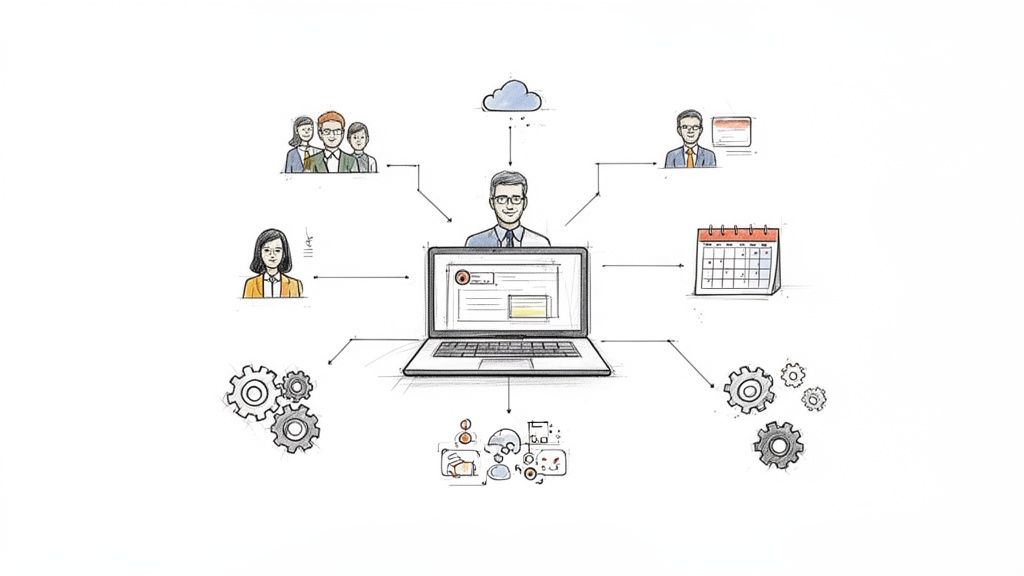
The operations manager has always been the wizard behind the curtain, making sure a company’s internal machinery runs without a hitch. In a traditional office, that meant managing physical supply chains, facility logistics, and in-person team workflows. But the game has completely changed.
The explosion of distributed teams has created a new kind of leader: the remote operations manager. Think of this person as the architect and engineer of a company’s digital headquarters. Instead of managing a building, they construct and maintain the systems that let a global workforce collaborate as if they were in the same room.
This isn’t just a passing trend; it’s a fundamental shift in how business gets done. The numbers don’t lie. According to FlexJobs’ Remote Work Index for Q1 2026, remote job postings shot up by 20% compared to the previous quarter. Operations management is a huge part of that growth as companies scramble for leaders who can orchestrate work from anywhere. This demand is for seasoned pros, with 65% of remote jobs targeting mid-career professionals and another 19% aimed at the manager level. You can dig into more remote job market trends to see just how hot this field is.
A remote operations manager doesn’t just adapt old processes for a virtual setting; they build entirely new operational models from the ground up, designed specifically for an asynchronous, distributed world.
Why This Role Is Gaining Momentum
The demand for a dedicated remote operations manager is climbing, and it’s easy to see why. As companies move away from a central office, they run into a whole new set of problems that need a specialist’s touch.
Here are the key drivers behind this career’s growth:
- The Need for Digital Cohesion: Without a shared physical space, someone needs to make sure all the digital tools, communication channels, and project management systems actually work together.
- Process Standardization Across Time Zones: A team scattered across the globe can’t rely on hallway conversations. This role establishes crystal-clear, documented processes for everything from onboarding new hires to filing expenses, making things fair and consistent for everyone.
- Optimizing the Remote Tech Stack: Companies are spending a lot of money on software. The remote operations manager is in charge of picking the right tools, getting them set up, and making sure the company is getting its money’s worth.
- Building a Remote-First Culture: A great remote culture is built on a foundation of operational excellence. When processes are smooth and transparent, it builds trust and gives people the freedom to do their best work, no matter where they are.
Ultimately, this role is the glue holding a distributed company together. They are the problem-solvers who make remote work work, turning the complex logistics of a global team into a well-oiled machine. This guide is your roadmap to landing this high-impact career.
What a Remote Operations Manager Actually Does

Let’s clear something up. When you hear “operations manager,” you might picture someone overseeing a warehouse floor or managing office logistics. That’s the old model.
A remote operations manager is a different beast entirely. Think of them as the digital architect for a company without walls. Their world isn’t about physical supply chains; it’s about making sure every digital process, tool, and workflow runs in perfect sync across a scattered team.
They’re less worried about office leases and more obsessed with standardizing asynchronous workflows, getting the most out of every software license, and ensuring a developer in Poland has the same seamless experience as a marketer in Brazil.
The Digital Architect And Process Optimizer
At its heart, this job is about building and refining the invisible structures that help a distributed team do its best work. It requires a deep understanding of how to manage remote teams and a knack for creating clarity out of chaos.
Some of their most critical responsibilities include:
- Workflow Standardization: They create, document, and enforce the standard operating procedures (SOPs) for everything—from how a new project gets started to how a new hire is onboarded. This is all about making work consistent and fair for everyone, no matter their location.
- Tech Stack Management: This person is in charge of the company’s entire suite of digital tools. They evaluate new software, implement it, and make sure platforms like Slack, Asana, and Notion actually work together to make life easier, not harder.
- Performance Monitoring: Using data, they keep a pulse on team productivity, project speed, and overall efficiency. They’re masters at spotting bottlenecks and slowdowns that you’d never see in a physical office.
- Security and Compliance: With a team logging in from home offices and coffee shops worldwide, protecting company data is huge. They implement security protocols and ensure the company stays compliant with rules like GDPR for a distributed workforce.
A great remote operations manager makes the business run so smoothly that the team barely notices the thousands of miles separating them. They build the unseen scaffolding that supports both productivity and connection.
A Day In The Life Of A Remote Ops Manager
No two days are ever the same, but they’re always a mix of data analysis, documentation, and communication.
A morning might start by looking at a dashboard and noticing that a support team’s ticket resolution times are slipping. The ops manager then dives into the team’s documented workflow to pinpoint exactly where things are breaking down.
Later, they might be in a virtual meeting with the finance team, auditing software subscriptions to cut costs on underused tools. The day could end with them updating the company’s internal wiki with a clearer process for requesting help from another department, then making sure that update gets communicated across every time zone.
On a weekly basis, they might lead a meeting to review key performance indicators (KPIs) with department leads. Quarterly, their focus shifts to bigger projects, like overhauling the remote onboarding experience or planning the logistics for the annual company retreat.
This table really drives home how different the focus is compared to a traditional role.
In-Office vs Remote Operations Manager Responsibilities
| Core Responsibility | In-Office Focus | Remote Focus |
|---|---|---|
| Team Oversight | Managing based on who’s in the office and direct observation. | Managing through data, documented results, and asynchronous check-ins. |
| Process Management | Improving workflows based on hallway conversations and in-person feedback. | Designing and documenting explicit, tool-driven digital workflows. |
| Resource Allocation | Managing physical assets like office space, furniture, and equipment. | Optimizing the digital tech stack and software license allocation. |
| Communication | Facilitating face-to-face meetings and synchronous updates. | Championing asynchronous communication and building a central source of truth. |
Ultimately, the operations manager remote role is about achieving operational excellence without borders. They are the strategic glue holding the company together, ensuring that as the team grows, its efficiency, culture, and spirit grow right along with it.
The Skills and Tools That Define Remote Success
Being a great remote operations manager isn’t just about being good at operations. It’s about mastering the art of getting things done when your team is scattered across cities, countries, and time zones.
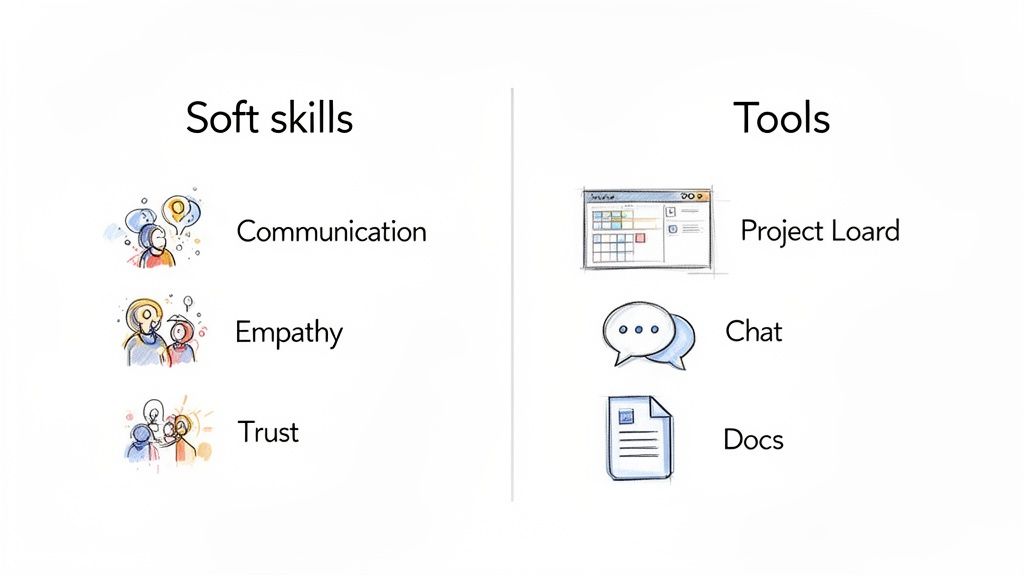
The role truly demands two sides of the same coin: the human touch to build a strong, connected culture and the technical know-how to make it all run smoothly. Nailing this combination is what separates the leaders who thrive from those who just try to copy-paste office life onto a screen.
The Essential Soft Skills for Remote Leadership
In a remote team, you can’t rely on hallway chats or coffee breaks to build trust and keep everyone on the same page. That kind of connection has to be built intentionally, with every message and every interaction. These soft skills are your real superpowers.
1. Masterful Asynchronous Communication This is, without a doubt, the most critical skill. Can you write a message so clear and packed with context that a teammate on the other side of the world can read it hours later and know exactly what to do, without a single follow-up question? That’s the gold standard.
2. Radical Transparency and Over-Communication When you can’t see your team, you have to show them everything. The best remote ops managers make information public by default, document decisions where everyone can see them, and share updates proactively. It’s the only way to make sure no one ever feels out of the loop.
3. Digital Empathy and Cross-Cultural Leadership You have to learn to read the digital room. This means spotting the signs of burnout in someone’s Slack tone, understanding that communication styles vary across cultures, and leading with extra patience when tech glitches or time zone math gets frustrating.
The most successful remote operations managers act as the human router for their company. They don’t just pass along information; they translate, contextualize, and direct it to ensure every message lands with impact and empathy, regardless of physical distance.
The Technology Stack You Must Command
While your people skills build the culture, your tool skills build the machine that keeps the business running. A modern operations manager remote professional is expected to be completely at home in the software that acts as the company’s digital headquarters.
You can’t just be a casual user of these tools; you have to be a power user who can think strategically about how they all fit together.
- Project Management Systems: Think of platforms like Asana, Trello, or ClickUp as the company’s central nervous system. You need to know how to build smart workflows, create real-time dashboards, and automate repetitive tasks to keep the entire team efficient.
- Communication Hubs: Tools like Slack and Microsoft Teams are your virtual office floor. Your job is to set clear rules for communication, integrate other apps to streamline work, and use these hubs to cut down on meetings—not add to the noise.
- Documentation and Knowledge Bases: Your company’s single source of truth lives in tools like Notion, Confluence, or an internal wiki. A huge part of your role is championing documentation and making sure all standard operating procedures (SOPs) are crystal clear, up-to-date, and easy for anyone to find.
- Data and Analytics Platforms: Whether it’s financial software or specialized tools like Electronic Data Capture (EDC) systems, you have to be comfortable diving into the data. You’ll be expected to pull reports, spot trends, and present your findings to help leadership make smarter decisions.
For a deeper look into the day-to-day work and the tools that power it, guides written for Operations Managers can be a fantastic resource. This blend of skills and tools is precisely what makes a great operations manager absolutely essential in a remote-first world.
Alright, let’s talk about the money. Planning your career path means getting a realistic handle on what a remote operations manager actually earns. The salary for this role isn’t some fixed number—it’s a wide spectrum that shifts based on your experience, the company’s size, and even where you’re located.
When you start digging into the numbers, you’ll see that range firsthand. Fresh data from March 2026 shows an average salary of $63,456 a year, but that’s just a starting point. The full range is massive, stretching from around $51,883 on the low end all the way up to $192,716 for top-tier roles. This really drives home a key point: your specific experience and skills matter. A lot. For roles that are fully flexible or remote, the midpoint sits at a much healthier $117,112.
Be careful where you get your salary info, though. Some third-party job sites can paint a misleading picture. We’ve seen listings with an average salary as low as $49,582—that’s a staggering 32% below the national average. This is exactly why it pays to go directly to company career pages. You bypass recruiters who might be undercutting the role and find opportunities that reflect your real market value. You can see a more detailed breakdown in this analysis of operations manager compensation.
Key Factors That Influence Your Pay
No two remote operations manager jobs are the same, and their paychecks reflect that. A few key variables come together to decide where you’ll land on that salary spectrum.
Here are the biggest factors to keep in mind:
- Years of Experience: It’s no surprise that entry-level or junior roles will be on the lower end. The big money comes with seniority. Positions that ask for 5-7+ years of experience, especially in multi-site or global operations, command those top-tier salaries.
- Company Size and Stage: A large, well-funded tech company simply has deeper pockets than a bootstrapped startup. On the flip side, an early-stage company might not have the cash for a huge salary but could offer a significant equity stake.
- Industry Specialization: If you’re an ops manager in a complex field like fintech or clinical research, your specialized knowledge is worth more. Familiarity with things like GDPR compliance or managing Electronic Data Capture (EDC) systems will definitely boost your earning potential.
- Geographic Location: Yes, even for remote roles, location matters. Companies based in high-cost-of-living areas like New York or California tend to offer higher base salaries to compete for talent. In fact, averages in those states can hit $165,000 and $155,170, respectively.
Your salary as a remote operations manager is a direct reflection of the complexity you can manage. The ability to orchestrate global teams, navigate regulatory hurdles, and optimize multi-million dollar tech stacks is what pushes you into the six-figure bracket.
How to Reach the Top Percentile of Earners
Want to command a salary at the highest end of the scale? You’ll need to prove you deliver strategic value, not just tactical support. The highest earners are the ones with a clear history of scaling operations, leading global teams, and making a direct, measurable impact on the company’s bottom line.
To get yourself into that top-tier bracket, focus on building these high-value skills:
- Financial Acumen: Get comfortable with budgeting, financial reporting, and managing serious operational budgets. Show you can be trusted with the company’s money.
- Vendor and Contract Management: Prove you can negotiate effectively with software vendors and manage complex contracts to get the best possible value for your company.
- Strategic Leadership: Frame your experience around big-picture initiatives. Did you overhaul a company’s entire operational process? Did you build a remote-first culture from scratch? That’s what hiring managers want to see.
When you build a track record of solving complex, high-impact problems, you stop being just a manager of processes and become a true strategic partner. That’s the real secret to unlocking the most lucrative operations manager remote opportunities out there.
How to Frame Your Experience for Remote Roles
Landing a top-tier remote operations manager job isn’t just about having the right skills—it’s about knowing how to talk about them. You already have the ops chops. The key is to reframe your experience in a way that speaks directly to the challenges and opportunities of a distributed team.
Think of it this way: your background in logistics and team leadership is the raw material. Now, you need to show how you can apply it to a digital-first world. It’s less about managing physical spaces and more about orchestrating digital ecosystems. This is your playbook for making that shift.
Translate Your Achievements into Remote-Ready Language
Your resume is your highlight reel. Its job is to convince a hiring manager, in just a few seconds, that you understand their world. That means translating your past wins into the language of remote work.
Instead of saying you “managed an office,” talk about how you “built and scaled a digital-first operational framework.” The first is tied to a place; the second is about a system that works from anywhere.
Here’s how you can rephrase your resume bullet points to catch a recruiter’s eye:
Instead of this: “Oversaw the daily operations for a 50-person office.”
Try this: “Managed a portfolio of cloud-based tools and digital workflows to support a 50-person team, ensuring seamless daily operations across multiple locations.”
Instead of this: “Led weekly in-person team meetings to track project progress.”
Try this: “Implemented a system of asynchronous check-ins and data-driven dashboards, reducing meeting time by 40% while boosting project transparency.”
Instead of this: “Managed relationships with office supply vendors.”
Try this: “Negotiated and managed contracts for our company’s SaaS stack, saving $50K annually by optimizing software licenses and eliminating redundancies.”
Prepare for Remote-Specific Interview Questions
Once your resume gets your foot in the virtual door, the interview is where you prove you can walk the walk. Expect questions that go deep into the realities of managing people and processes you can’t physically see.
The market for remote ops leaders heavily favors experience. Research shows a staggering 65% of remote postings are for seasoned professionals. Another 19% are for managers and 10% for senior managers. This isn’t an entry-level field. You’re often competing for roles at massive companies, where 63% of all operations managers work for organizations with over 10,000 employees. For a deeper dive into these numbers, check out the demographics of operations manager jobs.
When answering questions, use the STAR method (Situation, Task, Action, Result) but give it a remote twist. How did you build trust without seeing your team in person? How did you solve a problem you couldn’t physically point to?
Common Interview Questions and How to Answer Them
Don’t get caught off guard. Prepare specific, story-driven answers for these common questions. Vague responses signal inexperience; they want proof you’ve lived and breathed remote leadership.
1. “How do you build team cohesion and culture across different time zones?”
- Weak Answer: “I’d use Slack and Zoom to keep everyone connected.”
- Strong Answer: “I focus on intentional, asynchronous rituals. For example, at my last role, I launched a #wins channel for weekly shout-outs and set up a ‘virtual watercooler’ with Donut to pair teammates for non-work chats. We also co-created and documented our communication norms, which was key to respecting everyone’s time zones and preventing after-hours burnout.”
2. “Describe a time you used data to improve a process you couldn’t physically observe.”
- Weak Answer: “I looked at the numbers and told the team to work faster.”
- Strong Answer: “Our support team’s ticket response times were creeping up. I dove into our helpdesk data and found a clear bottleneck in our escalation process. I mapped out a new workflow in Miro, rewrote the SOP in Notion, and ran a quick training session. Within a month, we cut our average response time by 25%.”
The Smart Way to Find Your Next Remote Job
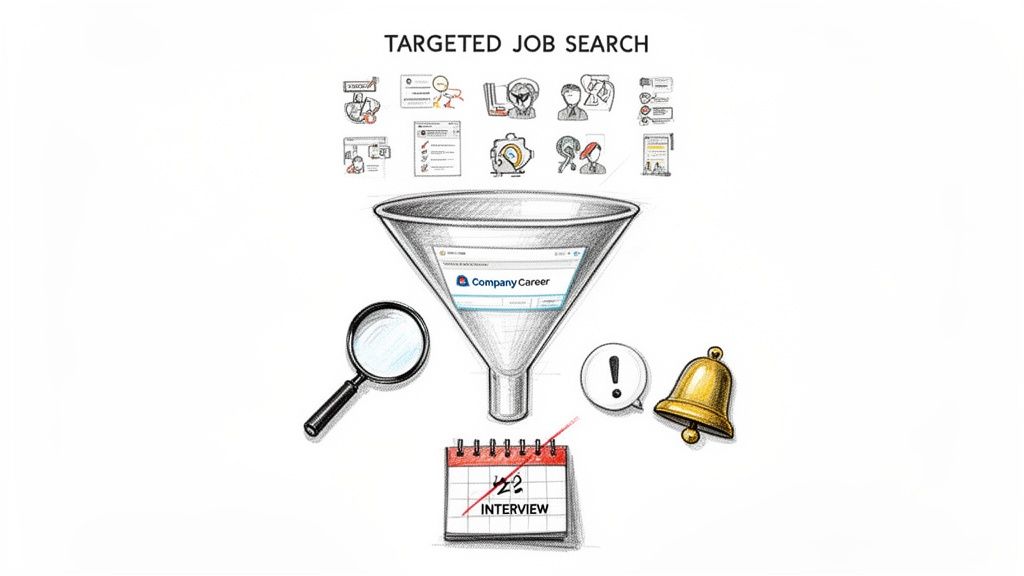
If you’ve ever felt like you’re shouting into the void on massive job boards, you’re not alone. You spend hours sifting through thousands of posts, tailoring your application for that perfect role, only to be met with complete silence. It’s the frustrating reality of the modern job hunt—a cluttered space filled with stale listings, recruiter spam, and “ghost jobs” that were filled weeks ago.
There’s a much smarter way to play the game. Instead of casting a wide, hopeful net, the real key is getting to the opportunity at the source. The very best operations manager remote roles almost always appear on a company’s own career page first, but who has time to check thousands of different sites every single day?
Go Direct to Beat the Crowd
Your biggest advantage in a job search is speed—specifically, applying before a role goes viral. Once a great remote job hits a major platform, it can get buried under hundreds of applications within the first 24 hours. By the time you find it, you’re already way behind.
This is where a different kind of job engine comes in. Unlike the big aggregators that just scrape other job boards (and all their junk), a direct-sourcing platform acts like your personal scout, monitoring company career pages around the clock. This approach gives you a massive head start.
The secret to a successful remote job search isn’t applying to more jobs; it’s applying to the right jobs, faster. Direct-sourcing platforms let you find opportunities the moment they’re posted, long before the competition even knows they exist.
When you use a targeted approach like this, you know that every application you send is for a real, verified role at a company that’s actively hiring. You get to skip the noise and present yourself as one of the first, most serious candidates.
A Step-By-Step Plan for a Targeted Search
A focused job hunt is an efficient one. Rather than endlessly scrolling, you can build a simple system that brings the best operations manager remote roles straight to you.
Here’s how to put this strategy into practice:
- Define Your Target Companies: Start by making a list of remote-first companies that you actually want to work for. Think about the industry, company size, culture, and the kind of operational challenges that genuinely get you excited.
- Use a Direct-Sourcing Job Engine: The best way to track these roles is to use a platform that does the heavy lifting for you. A site like Remote First Jobs gives you direct access to thousands of verified, direct-from-the-source listings, cutting out the usual clutter.
- Set Up Hyper-Specific Alerts: Don’t just create an alert for “operations manager.” Get granular with your filters. Set up alerts for specific titles like “Director of Operations” or “Clinical Operations Manager,” and then filter further with keywords like “asynchronous,” “SaaS,” or “global” to match your expertise.
- Tailor Your Application Materials: For every single role, customize your resume and cover letter. Weave in the exact keywords and phrases from the job description to make it immediately obvious that you’re the perfect fit for their specific operational needs.
This methodical approach turns your job search from a frustrating lottery into a strategic campaign. You’ll spend far less time hunting and much more time applying to high-quality openings where you have a real chance to stand out. Your ideal remote operations role is out there—this is how you find it.
Frequently Asked Questions
Even with a clear roadmap, you probably still have a few questions about what it really takes to land a remote operations manager role. Let’s tackle some of the most common ones to clear up any lingering uncertainties.
What Is The Typical Career Path?
The journey to becoming a remote operations leader is all about building on your experience. Most people don’t just jump into this role; they grow into it from related fields like project management, office management, or an on-site operations position. Once you’ve shown you can effectively run processes and lead teams from a distance, senior leadership roles become the natural next step.
From there, you can climb higher. Common promotions include:
- Director of Operations: Taking charge of the entire operational function for the company.
- VP of Operations: Focusing on the bigger picture, like scaling the business and long-term strategic planning.
- Chief Operating Officer (COO): The top operational seat, working side-by-side with the CEO to bring the company’s vision to life.
The skills you build are also perfect for specialized roles like Head of Remote, where your entire job is to shape the culture and infrastructure of a distributed company.
Can I Get This Job With No Prior Remote Experience?
Yes, absolutely—but you have to be smart about it. The trick is to frame your current experience in a way that proves you have what it takes to succeed in a remote setting. Hiring managers want to see that you can get things done without someone looking over your shoulder.
The key isn’t having the word “remote” on your resume. It’s showing that your past wins were driven by autonomy, crystal-clear written communication, and a process-first mindset. Those are the building blocks of any great remote leader.
Highlight accomplishments where you managed projects with people in different offices, used digital tools to get results, or created documentation so detailed that anyone could follow it without your help.
What Are The Biggest Challenges In The First 90 Days?
Your first three months in a new remote ops role come with a unique learning curve. The biggest hurdles usually aren’t about the job itself, but about plugging into a company that operates entirely online.
New managers often find it tough to build trust with a team they’ve never met face-to-face. You also have to quickly adapt to the company’s specific way of communicating asynchronously and figure out what’s broken without being able to physically see how work gets done. Getting through this critical period comes down to being incredibly proactive, over-communicating with purpose, and digging deep into the company’s existing playbooks.
Ready to find high-quality operations roles before they get crowded? Remote First Jobs gives you direct access to verified listings from over 21,000 remote-first companies, so you can apply ahead of the competition. Skip the noise and find your next opportunity at https://remotefirstjobs.com.