You’re probably seeing the same pattern every night. You search for a remote engineering role, open a promising posting, and realize you’re late again. The listing is buried under a stack of applicants, the recruiter copy is vague, and half the “remote” jobs turn out to be hybrid, contract, or old posts that should’ve been closed days ago.
That’s why most advice on engineering work at home feels useless. It tells you to polish LinkedIn, tweak your headline, and apply broadly. That strategy made sense when remote roles were rare and candidates needed visibility. It’s weaker now. The better play is speed, selectivity, and timing. You want fresher listings, less noise, and applications that look easy to work with in a distributed team.
Remote engineering is still a real market, not a leftover pandemic perk. In 2025, nearly 68% of U.S. tech jobs are performed from home, according to industry projections on remote work by sector. The opportunity exists. The bottleneck is access.
The Reality of Remote Engineering Job Hunting in 2026
You find a remote backend role at 9:10 p.m., skim the stack, confirm the team looks legitimate, and open the application. By then, the post has already traveled through LinkedIn reposts, alerts, Slack groups, and recruiter lists. The problem is not whether the role fits. The problem is whether you reached it before it became crowded.
That timing issue defines remote engineering hiring in 2026. Strong roles still exist, but broad visibility changes the odds fast. Once a listing gets picked up by major boards, applicant count stops reflecting fit and starts reflecting distribution.
What job seekers get wrong
A lot of engineers still run the same search process they used for local jobs, then add a remote filter. That misses the primary constraint. Remote hiring expands geography, shortens response windows, and attracts a high volume of applicants who are only loosely qualified.
Three patterns show up quickly:
- Listings outlive their hiring window: some roles stay public after the team has already booked final-round interviews.
- Aggregators blur the source: direct employer posts sit next to agency reposts, scraped duplicates, and stale copies.
- Visibility creates pileups: once a role appears on a large platform, timing matters more than résumé polish.
I learned this the hard way. Some of the strongest remote interviews I got came from roles that felt almost hidden at first. The jobs looked less polished, had fewer social signals, and were posted closer to the company’s own hiring system. That is usually a good sign, not a bad one.
Practical rule: If a remote role is easy for everyone to find, assume you are already late unless you can apply within hours.
The market for distributed engineering work is still active, as noted earlier. What changed is the route to the opening. Engineers who treat discovery as a sourcing problem usually outperform engineers who treat it as a branding problem.
The better mindset
The winning approach is speed plus stealth. Get closer to the employer, check fresher sources, and spend less time competing on crowded listings that have already done a full lap through the internet. A remote engineering job board that tracks openings closer to the original source is often more useful than a bigger platform that surfaces the same role after everyone else has seen it.
That shift also changes what “good job hunting” looks like in practice:
- Prioritize freshness over volume
- Bias toward lower-distribution listings
- Apply early to roles that match your background cleanly
- Save custom effort for openings where timing is still in your favor
There is a broader career lesson here too. The engineers who do well in remote hiring tend to be self-directed, tool-literate, and quick to adapt their process when the market changes. That same pattern shows up in long-term workforce planning, which is part of why Kubrio’s piece on preparing children for the AI job market resonates with so many technical families.
Find Roles Before They Go Viral
The biggest edge in remote hiring is boring. It’s not résumé design. It’s not interview tricks. It’s getting to the listing before everyone else does.
There’s still a major visibility problem in this market. According to research on remote engineering job availability and direct sourcing, there’s a significant lack of quantitative data on post-2024 remote engineering availability, while direct-sourcing engines that monitor over 21,000 remote-first companies detect 200,000+ new listings monthly. That matters because it changes where you should search.
Traditional boards versus direct sourcing
Most large boards aggregate from many places, then optimize for engagement. That creates two problems for engineers. First, listings may appear after they’ve already circulated elsewhere. Second, duplicated and low-context posts eat your time.
Direct-sourcing works differently. It watches employer career pages and ATS feeds, which gives you a cleaner signal. You’re closer to the company and earlier in the listing lifecycle.
| Metric | Traditional Job Boards (e.g., LinkedIn, Indeed) | Direct-Sourcing Engines (e.g., Remote First Jobs) |
|---|---|---|
| Listing freshness | Often delayed, reposted, or duplicated | Closer to original employer posting |
| Competition level | High visibility leads to fast pileups | Lower early competition when caught quickly |
| Signal quality | More noise from agencies and stale posts | Better fit for direct-hire searches |
| Search workflow | Broad browsing and repeated filtering | Narrow targeting around verified remote-first employers |
| Best use case | Market scanning and company discovery | Fast application on fresh roles |
The practical takeaway is simple. Use broad platforms to learn who hires remote engineers. Use direct sourcing to apply.
A useful example is a direct-sourced remote job engine that monitors employer career pages instead of scraping other job boards. The reason that model works is timing. You reduce the delay between company posting and candidate discovery.
Build a low-noise search system
Don’t browse manually for hours. Build a repeatable feed.
Try this setup:
- Choose role families narrowly: Search by functions you can win, such as backend platform, data engineering, infrastructure, developer productivity, or embedded systems with remote documentation-heavy workflows.
- Target company types, not just titles: Remote-first software companies, developer tool vendors, AI infrastructure teams, and distributed SaaS firms usually communicate better than companies that “allow remote” as an exception.
- Filter for direct-hire clues: Career-page language often tells you more than a board repost does. Look for onboarding detail, team structure, async culture, and tooling expectations.
- Check recency every day: In engineering work at home, early visibility matters more than endless refinement.
The best remote applications I’ve seen weren’t necessarily better on paper. They were simply in the queue before the role got amplified.
Where engineers waste time
A lot of experienced candidates lose weeks on avoidable work.
They do too much of this:
- Mass applying: Same résumé, same intro, same result.
- Arguing with bad filters: Trying to force job boards to show only true remote roles.
- Following vanity signals: Chasing companies with huge brand recognition and predictable applicant floods.
They do too little of this:
- Watching employer-owned listings
- Keeping a short priority company list
- Applying in the first wave
- Dropping weak leads quickly
Speed and stealth beat volume. That’s the core shift.
Craft an Application That Skips the Digital Pile
Once you find a fresh role, the application has to communicate one thing fast. You already know how to work without hand-holding.
That’s what remote hiring managers want to infer from your résumé, your short intro, and your portfolio links. They aren’t just screening for technical strength. They’re screening for execution quality when no one is physically nearby.
According to U.S. remote work statistics and distributed workflow trends, 54% already use AI tools in distributed workflows. That changes what “current” looks like in an application. If your materials read like office-era engineering, you’ll blend in.
What to show on the résumé
Strong remote applications foreground operational habits, not just technologies.
Good bullets usually highlight:
- Asynchronous execution: shipped features or resolved incidents across written handoffs, recorded updates, or distributed standups
- Tool fluency: GitHub, GitLab, Jira, Linear, Confluence, Notion, Slack, incident tooling, CI pipelines
- Ownership: designed, implemented, documented, monitored, and handed off work cleanly
- AI-assisted workflow: used coding assistants, review support, test generation, or documentation support with judgment
Here’s the difference in tone.
Weak:
- Worked on backend APIs for internal products
Better:
- Owned backend API changes from design note through rollout, documented tradeoffs, and coordinated review asynchronously across distributed teammates
Weak:
- Used AI coding tools
Better:
- Used AI-assisted coding for prototyping and test scaffolding, then validated outputs through review, debugging, and production readiness checks
Write the short intro like an engineer
Your opening note should sound like someone who reduces load for the team. Not someone asking for a chance.
Use language like this:
I’ve worked in distributed engineering environments where clear written updates, clean handoffs, and fast issue triage mattered as much as implementation speed.
Or this:
My strongest fit is with teams that rely on async communication, careful documentation, and engineers who can move tickets without constant synchronization.
That’s much stronger than “I’m passionate about remote work.”
Prepare a fast-apply kit
You want to customize quickly without sounding templated. Keep a ready folder with:
- A master résumé with remote-specific bullets already written
- Three short intro variants for platform, product, and data roles
- A project sheet with links, context, stack, and business outcome phrased qualitatively
- A proof-of-writing sample such as a design note, README, or implementation proposal
If you need help tightening written application language, tools like ParakeetAI can help draft and refine concise, role-specific messaging. The important part is judgment. Don’t let a tool flatten your voice into generic recruiter-speak.
Ace the Remote Interview and Take-Home Project
Remote interviews reward calm, structured communication. They punish candidates who assume technical skill will speak for itself.
That’s especially true because distributed work has a known coordination cost. Research on remote productivity found declines of 8-19% tied to higher communication costs and fewer deep-work blocks, as described in the University of Chicago study on work-from-home productivity. Good interviewers know this. You should address it before they ask.
What the interviewer is actually testing
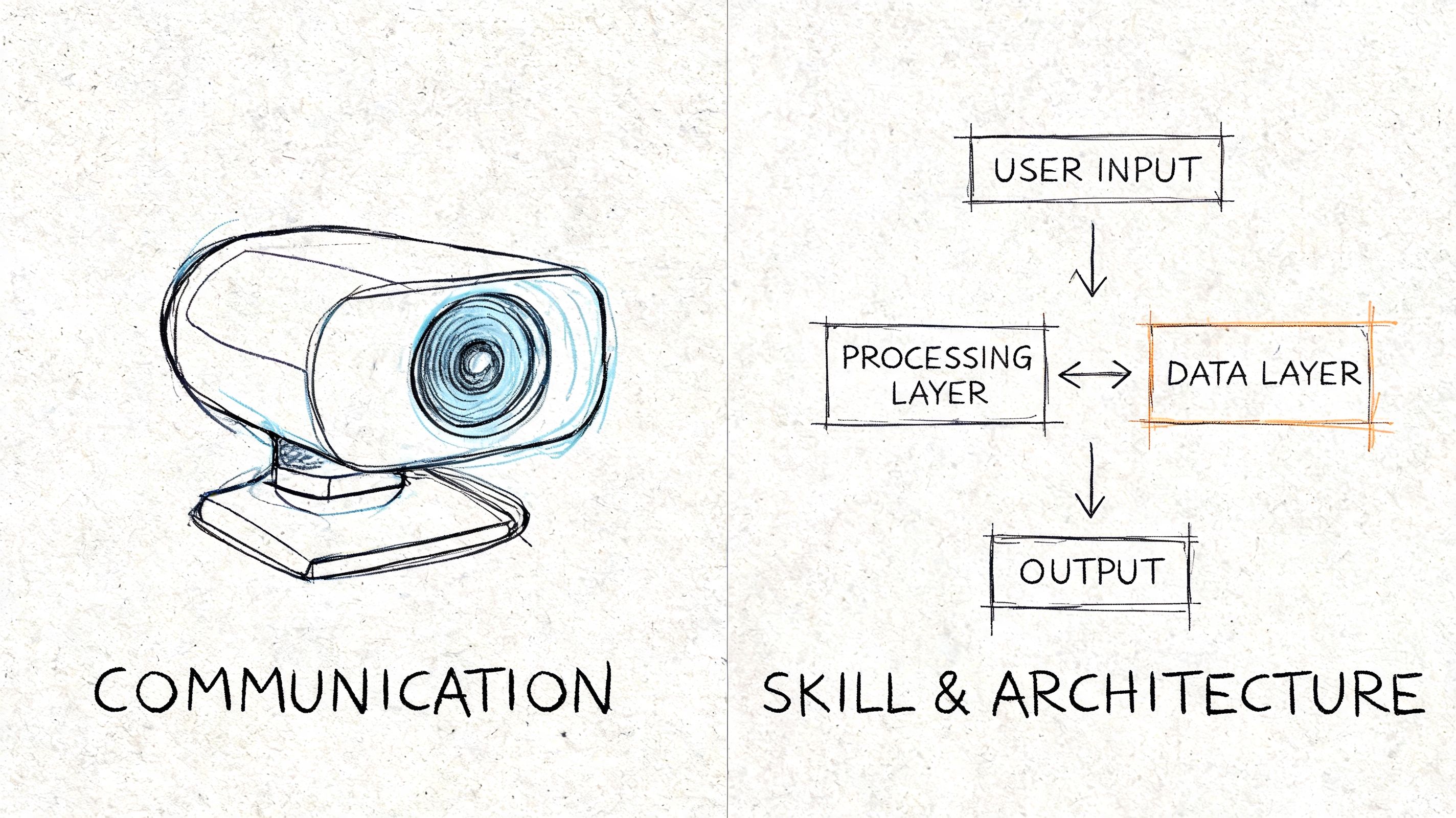
In a remote loop, every conversation doubles as a work sample. They’re watching whether you can explain tradeoffs, narrow ambiguity, and leave a clean trail of thought.
Say the quiet part out loud. If a team worries about coordination tax, give them the countermeasure:
- You document decisions
- You summarize next steps in writing
- You protect focus blocks
- You escalate blockers early instead of spinning
Remote interview success often comes from making invisible habits visible.
That applies in system design rounds too. Don’t just narrate architecture. Narrate communication. Mention assumptions. State what you’d document. Say what would go in the README, the runbook, or the handoff note.
Technical setup still matters
Candidates underrate this because it feels superficial. It isn’t. Choppy audio makes you sound uncertain even when your answer is good.
Before the interview:
- Fix your microphone path: use a headset or a reliable external mic
- Check framing: eye level camera, neutral background, stable lighting
- Close noisy apps: notifications and CPU spikes are avoidable own goals
- Keep a scratchpad ready: architecture rounds go better when you can structure before speaking
For a quick visual reset on remote interview presence and communication, this walkthrough is worth watching:
Turn the take-home into proof of remote maturity
A take-home project isn’t just code. It’s evidence of how you operate when nobody is in the room.
I’ve seen average implementations win because the candidate handled the project like a teammate would. The repo was clean. The README was thoughtful. The commits told a story. Assumptions were explicit. Tradeoffs were honest.
Use this checklist:
- README first: problem statement, setup, scope boundaries, assumptions, and next steps
- Commit hygiene: clear messages that map to decisions, not vague snapshots
- Decision notes: mention what you skipped and why
- Async empathy: write so another engineer can continue the work without a call
Answer the concern before it becomes a rejection
A remote interviewer may worry that you’ll disappear, overcommunicate, or struggle when debugging gets messy.
Address that directly:
When a problem becomes coordination-heavy, I stop trying to solve it through scattered chat. I write a concise state summary, list what I’ve tested, identify the blocker, and choose the smallest synchronous conversation needed to unblock it.
That answer does two things. It shows self-awareness, and it shows you understand where remote work breaks down.
Negotiate Terms Beyond Just Your Salary
A remote offer can look strong on paper and still create a miserable day-to-day job.
The miss usually happens because candidates negotiate compensation and ignore operating conditions. In engineering work at home, those conditions shape your performance more than people admit. Meeting density, expected response times, time-zone overlap, equipment support, and travel expectations all affect how sustainable the role feels after the excitement wears off.
What to negotiate
You don’t need a combative script. You need clarity.
Ask about these points:
Working hours and overlap Ask whether the team expects fixed core hours, broad availability, or mostly async execution. Those are very different jobs.
Home office support If the company doesn’t provide equipment directly, ask what support exists for desk setup, chair, monitor, audio, and ergonomics.
Travel cadence “Occasional offsites” can mean very different things. Get the practical expectation in writing during the offer stage.
Meeting culture Ask how design review, incident response, and planning work. A company can call itself remote-first and still run on nonstop calls.
Documentation norms Ask where decisions live. Confluence, Notion, GitHub discussions, RFC docs, or scattered Slack history all create different levels of drag.
Good questions sound operational
Skip questions that sound performative. Ask the ones a seasoned engineer would ask after joining anyway.
Examples:
- “How does the team handle design decisions when people are split across time zones?”
- “What usually triggers a meeting instead of a written thread?”
- “How much of onboarding is documented versus tribal?”
- “When someone is blocked, what’s the expected path for escalation?”
A strong remote offer gives you the conditions to produce, not just the compensation to tolerate chaos.
Sample language that works
You don’t need to frame every request as a perk. Frame it as enablement.
Try this:
“I’m excited about the role. I do my best work in distributed teams when the expectations around overlap, documentation, and workspace support are clear. Can we walk through those details so I can evaluate the full operating setup?”
Or this:
“I’m comfortable moving fast remotely, but I’ve learned that success depends a lot on how the company handles meetings, handoffs, and equipment. I’d like to understand those pieces before finalizing.”
That approach signals maturity. You’re not bargaining for comfort items. You’re reducing execution risk.
What not to accept blindly
Be careful when you hear phrases like “flexible,” “startup pace,” or “high autonomy” without concrete explanations. Sometimes that means trust. Sometimes it means no process, poor documentation, and calendar sprawl.
If the company can’t explain how remote work functions, that’s useful information. A vague remote policy becomes your problem later.
Thriving in Your First 90 Days as a Distributed Engineer
The first mistake new remote engineers make is trying to prove value through visible busyness. Fast replies, lots of meetings, constant activity. It feels safe. It’s usually counterproductive.
A better approach is measurable trust. You want your team to see that your work moves cleanly through the system, from ticket to review to deployment, and that your communication reduces friction instead of creating more of it.
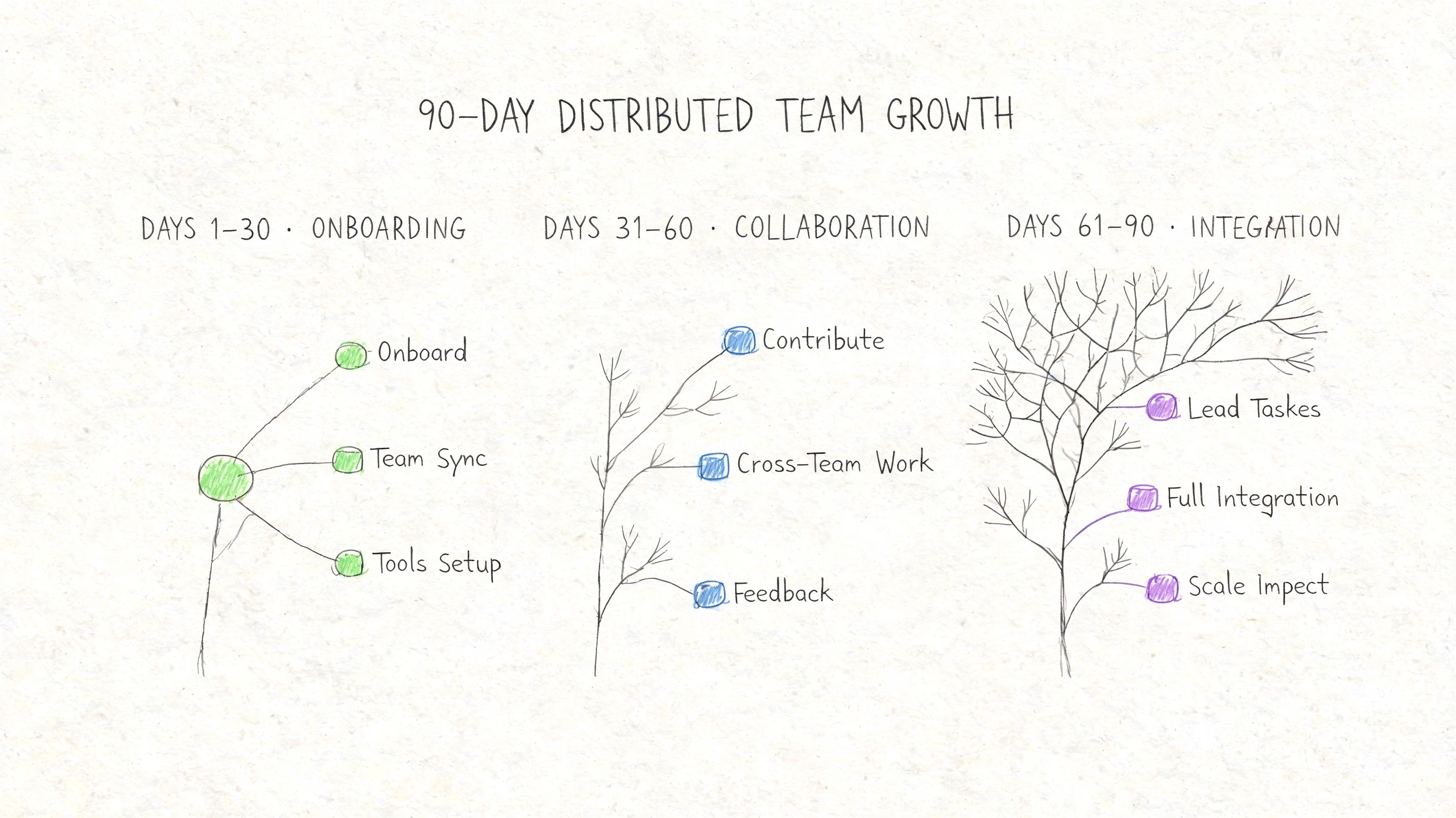
According to the DX measurement guidance on remote productivity baselines, teams should establish baseline productivity metrics within the first 1-2 months, and allow a 3-6 month ramp before drawing firm conclusions. That same source describes a case study where remote engineers using AI tools saw a 30% year-over-year increase in PR throughput.
Days 1 through 30
Don’t optimize for heroics. Optimize for map-making.
Learn these things early:
- How work enters the system: tickets, incidents, ad hoc requests, planning rituals
- What “done” means: code merged, tests passing, docs updated, rollout complete
- Where decisions live: issue tracker, docs, PR threads, chat, design notes
- Who unblocks what: tech lead, PM, EM, platform owner, reviewer pool
Your job in this phase is to become legible. Leave clean updates. Write short summaries after meetings. Ask narrow questions. Start a personal operating doc if the team doesn’t already have one.
Days 31 through 60
This is when you start measuring your own flow.
Track a few practical signals with your manager or lead:
| Focus area | What to watch |
|---|---|
| PR velocity | Are your changes moving steadily from draft to merge? |
| Cycle time | How long does work sit waiting on review, clarification, or deployment? |
| Handoff quality | Do teammates need to chase context after reading your updates? |
Don’t turn this into self-surveillance. Use it to spot friction. If your PRs stall, the issue may be scope. If deployment drags, the problem may be process. If reviewers ask the same questions repeatedly, improve your writeups.
Early remote success comes from making collaboration cheaper for everyone around you.
One habit that helps a lot is simple consistency. If you’ve struggled to keep routines stable while working from home, Pretty Progress has a practical piece on how to stay consistent with goals. The value isn’t motivational fluff. It’s building repeatable behavior when structure is mostly self-managed.
Days 61 through 90
Now you can widen your impact.
By this point, you should aim to:
- Own a medium-sized problem end to end
- Improve one piece of team documentation
- Reduce one recurring source of coordination friction
- Show reliable judgment around AI-assisted work
That last part matters. AI can accelerate drafting and scaffolding, but remote teams pay for low-quality outputs later during debugging. The productive engineers aren’t the ones who generate the most code. They’re the ones who know when to trust the tool and when to slow down.
What works and what doesn’t
What works:
- Written status updates with decisions, not just activity
- Small, reviewable pull requests
- Proactive blocker escalation
- Clear calendar boundaries that preserve focus
What doesn’t:
- Replying instantly to everything
- Hiding uncertainty until a deadline slips
- Shipping poorly explained code and expecting reviewers to decode it
- Using AI output as if review were optional
The strongest remote engineers feel easy to collaborate with. That’s the bar. Not loud. Not online all day. Reliable, readable, and low-friction.
If you’re tired of applying after the crowd arrives, use Remote First Jobs to find direct-sourced remote roles from remote-first companies before they spread across the usual boards. It’s the fastest way to cut through stale listings, recruiter noise, and ghost jobs, and get in front of real engineering opportunities while they’re still fresh.