
You’ve got a folder full of legal documents, a deadline you don’t fully understand, and a budget that won’t stretch to having a lawyer handle every administrative detail. Someone suggests hiring a paralegal. That sounds sensible, until you start wondering who checks the paperwork and whether the person preparing it can tell you what to do.
Paralegal services can be valuable when the work is clearly defined and properly supervised. The important question isn’t whether a paralegal costs less than a lawyer. It’s which parts of your matter you can delegate without handing legal decisions to someone who isn’t authorized to make them.
Table of Contents
- What Paralegal Services Actually Include
- How Paralegal Services Became a Real Profession
- Common Paralegal Services Worth Paying For
- The Legal Boundaries Paralegals Cannot Cross
- How HireParalegals Can Help
- What Paralegal Services Typically Cost
- Remote Paralegal Services and Security Considerations
- How to Decide Whether to Hire a Paralegal
- Taking the Next Step With Paralegal Services
What Paralegal Services Actually Include
Consider a hypothetical landlord-tenant dispute. You have emails, photographs, payment records, and notices scattered across different accounts. Before a lawyer can evaluate your position, someone needs to organize those materials into a usable case file.
A paralegal might assemble the records, prepare a factual timeline, research an issue the lawyer identifies, and draft documents for review. The lawyer evaluates the legal position and decides how to proceed. The paralegal does substantive work, but the lawyer retains responsibility for legal judgment.
The working relationship matters as much as the individual tasks.
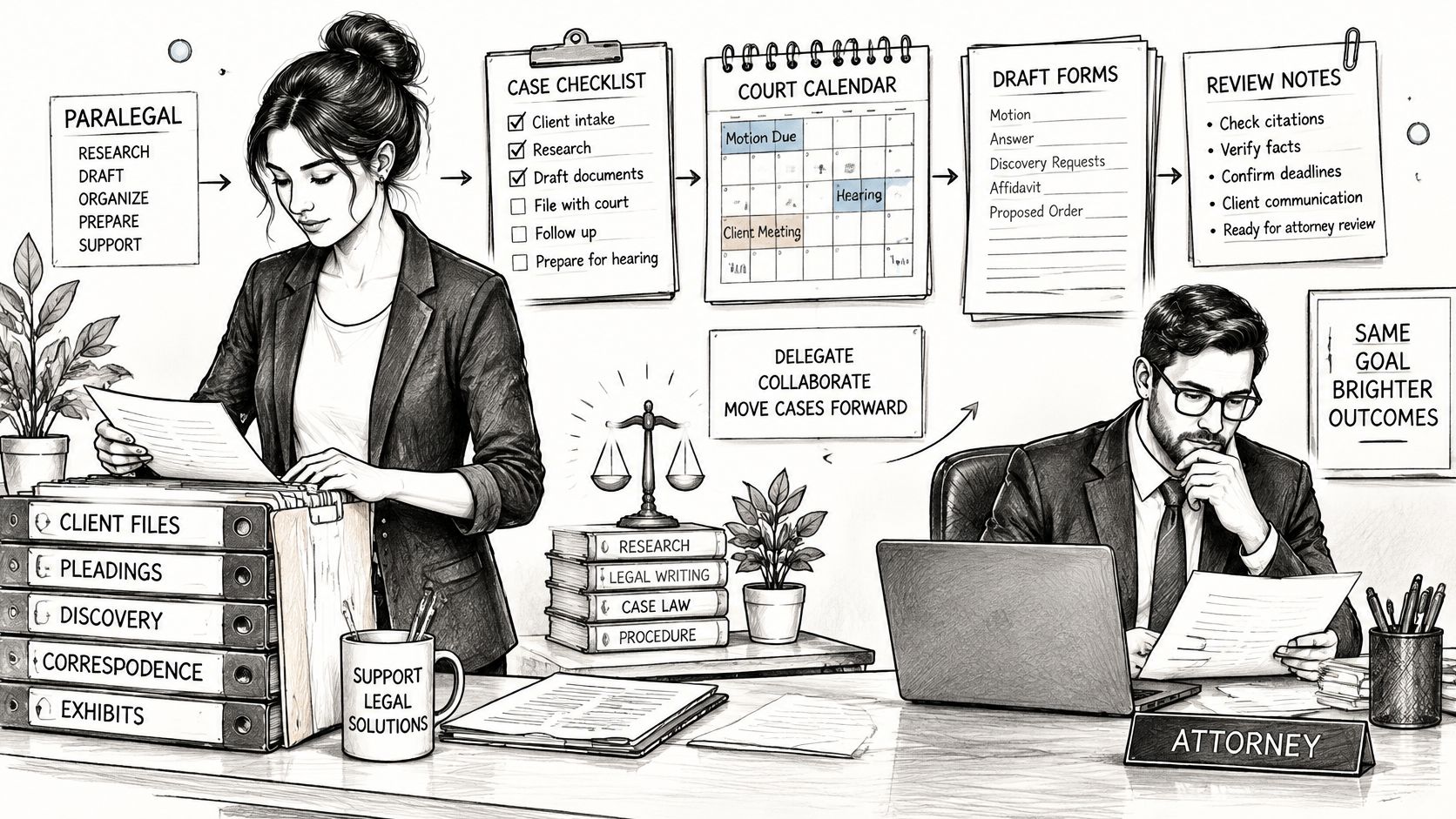
Skilled support rather than a substitute lawyer
Think of an engineering technician preparing technical drawings for an engineer’s review. The technician contributes specialized skills, rather than merely typing instructions. But preparing the work and taking professional responsibility for the design are different functions.
That’s a useful operational analogy, not a statement that the professions have identical licensing rules. In legal work, the distinction is between performing delegated tasks and independently advising or representing a client.
This isn’t a small occupational niche. The national occupational baseline reports approximately 339,700 paralegals and legal assistants employed in May 2024, according to WageLookup’s presentation of occupational-employment data attributed to the Bureau of Labor Statistics. That figure describes employed workers, not the revenue or full size of the outsourced-services market.
What a workable assignment looks like
A useful assignment tells the paralegal what to produce and tells the attorney what needs review.
- Inputs: Identify the records, templates, and instructions the paralegal should use.
- Deliverable: Specify a chronology, research summary, draft, or organized document set.
- Review point: Name the attorney who approves the result before it’s used.
- Escalation trigger: Explain which questions require the paralegal to stop and seek direction.
For example, “organize the attached records into a dated chronology and flag missing documents” is actionable. “Handle my dispute” isn’t. The latter leaves unanswered who will assess legal rights, communicate advice, and respond when the other party challenges your position.
How Paralegal Services Became a Real Profession
The profession didn’t emerge merely because lawyers needed help with paperwork. Its formal development reflected efforts to expand access to legal assistance while organizing legal work more efficiently.
A federal court account of the profession’s development traces the American Bar Association’s involvement to August 1968, records only four paralegal schools in 1970, and describes education guidelines adopted in August 1973. The same account reports approximately 37 training programs in 1973, growing to about 224 by February 1978.
Those are training-program figures, not evidence that every program held the same approval status. The distinction matters when interpreting the profession’s history or comparing credentials today.
Why formal training changed delegation
The practical shift was from assigning miscellaneous office work to developing people who could contribute to research, drafting, and case preparation within defined professional boundaries.
A lawyer could then delegate a meaningful work product rather than supervise every keystroke. That arrangement still depended on knowing what the worker had been trained to do and where attorney review belonged.
Hiring insight: A job title tells you where to begin evaluating someone. A relevant work sample tells you much more about what you can confidently assign.
Read experience as evidence of capability
When evaluating a candidate, look beyond a general claim of legal-office experience. Ask what documents they prepared, which practice areas they supported, how attorneys reviewed their work, and what they did when instructions were incomplete.
For applicants, a sample legal assistant resume can help translate that experience into concrete responsibilities. Employers can use the same perspective when reviewing applications: look for identifiable outputs and review relationships, not a list of impressive-sounding duties.
Formal preparation makes delegation possible; demonstrated competence makes a particular assignment sensible. Neither should be confused with permission to practice law independently.
Common Paralegal Services Worth Paying For
Start with the deliverable you need, not a broad request for “legal help.” The following are illustrative assignments, not reported client outcomes. Each assumes appropriate attorney direction and review.
Research and document preparation
Legal research can produce a memo identifying relevant authorities, summarizing decisions, and listing unresolved questions. For example, an attorney might ask a paralegal to locate cases addressing a defined procedural issue and check the citations in a draft brief.
The lawyer then decides which authorities support the argument and whether the analysis is sufficient. Finding a case and advising a client that the case guarantees success are very different activities.
Document preparation might involve assembling a draft from an approved template and verified client information. A useful handoff identifies missing facts and departures from the template, rather than filling gaps with assumptions.
Discovery and case organization
Litigation support becomes easier to evaluate when you specify the work product.
- Discovery support: Organize responsive materials using the attorney’s instructions, maintain an index, and flag documents needing privilege review.
- E-discovery assistance: Apply an approved review protocol and record uncertain classifications for escalation.
- Factual investigation: Compile records and prepare a source-backed chronology, separating documented facts from client recollections.
- Case-file management: Maintain consistent filenames, document versions, and a clear record of outstanding requests.
For example, a chronology should let the attorney trace an event back to the underlying email or record. A polished timeline without that traceability may create more checking work than it saves.
Contracts, compliance, and filing support
A contract-administration assignment might involve extracting renewal provisions into a tracking sheet or comparing a draft against an approved clause checklist. The paralegal flags deviations; the attorney decides whether the business should accept the legal risk.
Similarly, a compliance assignment might involve gathering records against a lawyer-defined checklist. It shouldn’t become an independent opinion that the organization has satisfied every applicable obligation.
For procedural filings, specify who approves the document, who authorizes submission, and who verifies acceptance. Uploading a document and deciding what must be filed are separate responsibilities.
The best fit depends on relevant experience. Someone skilled at organizing litigation records may still need substantial training before supporting a specialized regulatory matter.
The Legal Boundaries Paralegals Cannot Cross
A paralegal isn’t just a less expensive lawyer. You can delegate preparation, but you can’t assume that hiring support also provides access to independent legal advice.
The distinction between the roles should be explicit before work starts.
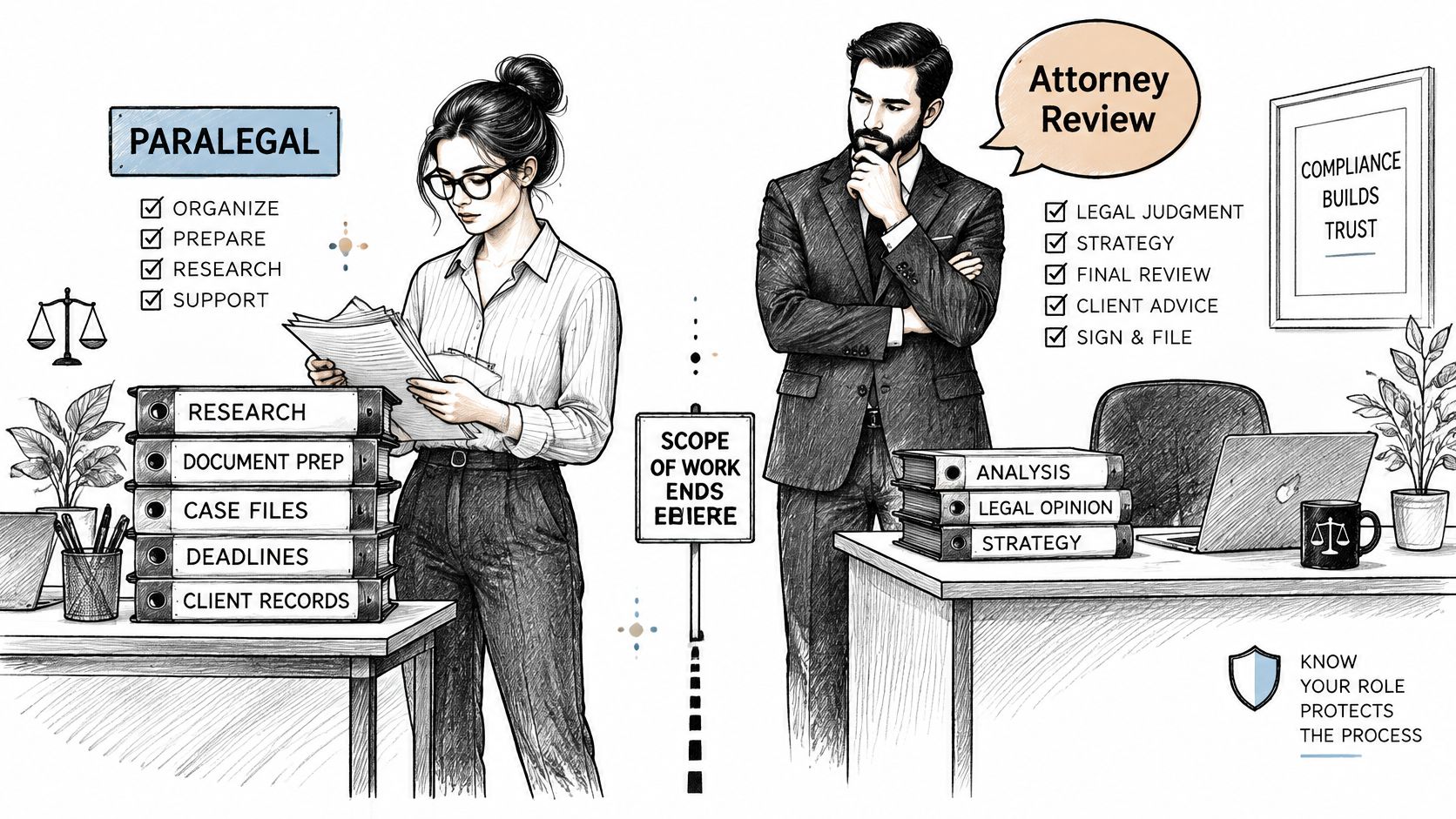
Under NALA’s Code of Ethics and Professional Responsibility, paralegals work through proper delegation and supervision. They cannot independently establish attorney-client relationships, set fees, provide legal advice or opinions, or represent clients in court unless a specific court or agency rule authorizes that activity.
Legal information isn’t personalized advice
A practical contrast helps. Identifying where a court publishes its forms is different from deciding which claim you should bring or whether signing a settlement serves your interests.
Even apparently clerical questions can contain legal judgment. A request to enter an approved date into a calendar is different from asking someone to determine which deadline applies after a disputed event.
If answering the question means choosing what you should do to protect your legal position, seek an authorized lawyer’s advice.
Jurisdiction also matters. Don’t assume that a task permitted in one forum is permitted everywhere, or that an exception allowing particular representation creates a general right to practice.
Verify the review relationship
Before engaging a provider, ask who maintains the client relationship, who controls the matter, and who accepts responsibility for the final work. A vague promise that an attorney is “available” doesn’t explain whether anyone will review your documents.
The accompanying video offers another format for considering the distinction.
- Named reviewer: Ask which attorney will review the assignment.
- Approval procedure: Establish what must be approved before delivery, filing, or communication.
- Client questions: Confirm where requests for advice will go.
- Changed circumstances: Require escalation when a routine task becomes disputed or strategically important.
If nobody can explain the supervision arrangement, don’t treat the lower price as a bargain. Clarify the arrangement before entrusting the provider with consequential work.
How HireParalegals Can Help
A firm with a defined backlog faces a different hiring problem from an individual seeking legal advice. It may know exactly what work needs doing but lack the capacity to recruit, screen, and manage additional support.
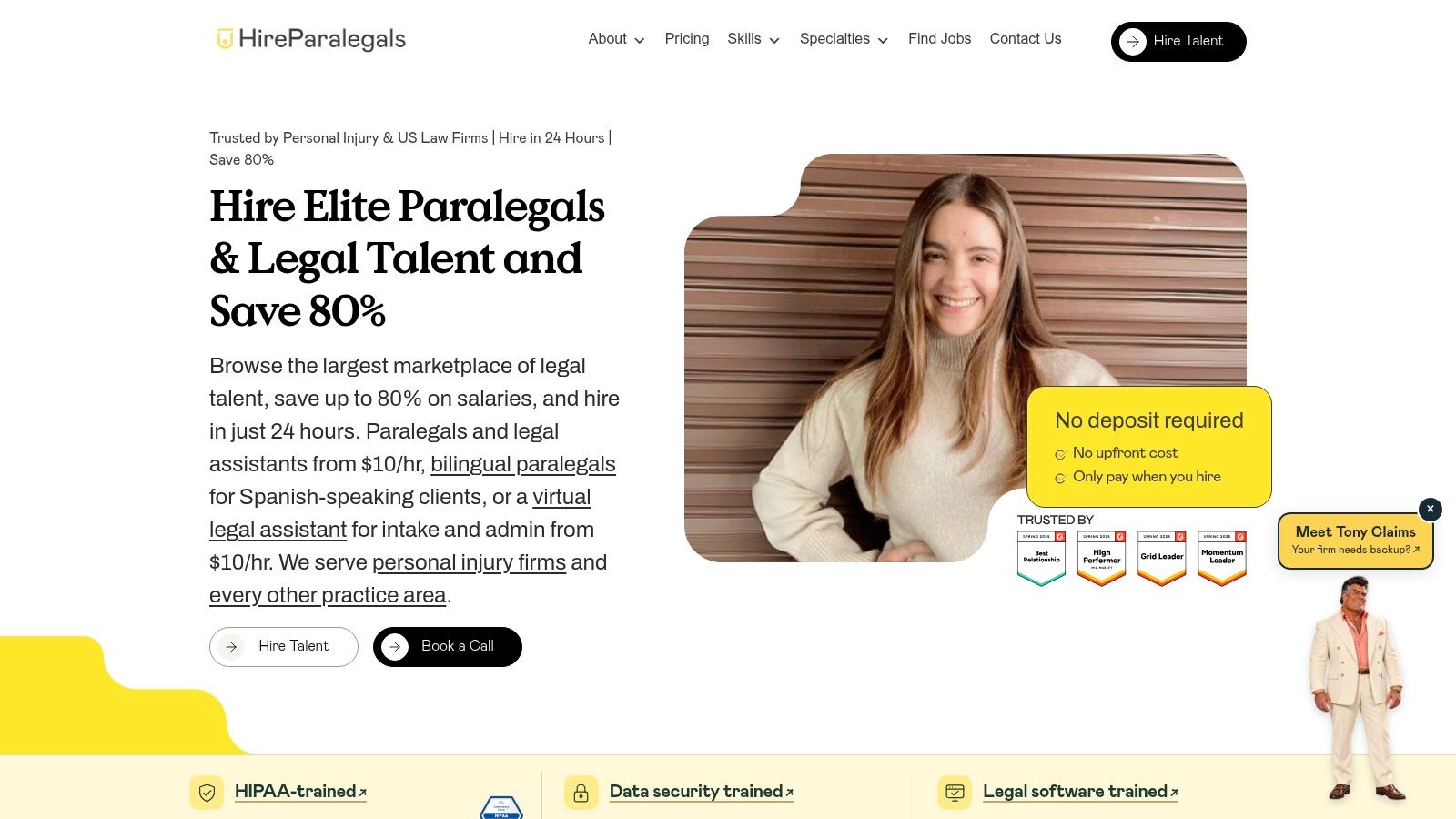
For firms considering that staffing route, HireParalegals’ virtual legal assistant resource is a starting point for evaluating remote legal support. Treat the conversation as a procurement exercise: establish what assistance is available, how candidates are assessed, and which responsibilities remain with the firm.
The platform’s presentation can help orient that discussion.
Evaluate the match, not just the introduction
Ask for evidence that the proposed candidate can perform your actual assignment. A general interview won’t establish whether someone can maintain a litigation chronology, follow a discovery protocol, or recognize when a contract issue needs escalation.
- Practice-area fit: Request examples relevant to the work you’ll assign.
- Screening details: Ask what background and skills checks cover.
- Working arrangements: Confirm availability, communication expectations, and access requirements.
- Service responsibilities: Establish who handles onboarding, payroll questions, replacement, and any cross-border employment issues.
Budget for the firm’s contribution
A staffing provider may help with the search, but your attorney still needs to define assignments and review work. Your team also needs to supply templates, permissions, and a reliable route for questions.
This route is worth evaluating when the firm has repeatable work and someone available to supervise it. It’s a weaker fit when the firm expects a new hire to resolve unclear processes without guidance.
Ask for a written proposal tied to your workload. Assess any speed, savings, or screening promises against the proposed engagement terms rather than treating them as guaranteed outcomes.
What Paralegal Services Typically Cost
There isn’t a useful universal price for paralegal services. A quote for document organization isn’t comparable to a quote for specialized litigation support, even if both use an hourly rate.
For budgeting, separate the provider’s charge from the resources your team must contribute. That gives you a more realistic comparison than choosing the lowest headline figure.
Compare the cost drivers
| Cost driver | What to clarify |
|---|---|
| Engagement model | Whether you’re paying a contractor, staffing provider, or law firm |
| Specialization | Which relevant skills the assignment requires |
| Geographic market | Where the provider works and which jurisdiction the matter concerns |
| Matter complexity | How complete the records and instructions are |
| Review workload | How much attorney checking the assignment needs |
| Engagement terms | What revisions, minimum commitments, and additional charges apply |
Attorney review is part of the operating cost, not an avoidable inconvenience. A capable paralegal may reduce preparation work, but the budget still needs room for direction, questions, and approval.
For time-based engagements, consistent records help distinguish original work from changes in scope. A guide to time-tracking apps for freelancers can support that administrative choice, provided the selected workflow doesn’t expose confidential matter details.
Make quotes comparable
My recommendation is to treat unclear scope as a major preventable cost risk. If the assignment doesn’t define its endpoint, neither party has a reliable basis for deciding whether a revision is included or additional work.
Instead of requesting “help with contracts,” specify the documents, review checklist, required output, and issues to flag. Make clear whether the deliverable is a data-extraction sheet, a draft, or a marked comparison for attorney review.
Budgeting rule: Compare the cost of an acceptable, reviewed deliverable, not just the cost of an hour.
Before signing, ask whether onboarding is billable, what happens when instructions change, and who pays for correcting errors. For remote arrangements, clarify any separate charges for secure systems, equipment, or after-hours coverage.
A slightly higher quote with explicit deliverables may be easier to control than a low rate attached to an undefined assignment. The decision should turn on the complete engagement, not an assumption that either option is automatically cheaper.
Remote Paralegal Services and Security Considerations
Research, drafting, document review, and case management can often move electronically. That doesn’t make remote legal support location-independent in every meaningful sense.
The relevant question is whether this person can work on this matter within the firm’s jurisdictional, confidentiality, and supervision requirements. A laptop and an internet connection don’t answer that question.
Remote-role listings can illustrate the range of working arrangements, but a listing alone doesn’t establish suitability for a particular client matter.
Design access around the assignment
NALA’s Model Standards address confidentiality, supervision, and safeguards for legal-support work. A defensible operating design includes conflict checks before assignment, controlled access, documented handling procedures, and clear incident escalation.
Translate those principles into permissions the firm can enforce.
- Identity controls: Use individual accounts and multi-factor authentication rather than shared credentials.
- Limited access: Give the worker access to the assigned materials, not the entire client archive.
- Protected handling: Use approved encrypted storage and transfer methods.
- Traceability: Maintain version history and audit logs where appropriate.
- Offboarding: Revoke access and address retained copies when the engagement ends.
Medical records, financial documents, and litigation strategy deserve more than an informal instruction to be careful. Specify where files may be stored and whether local downloads, personal email, or unapproved tools are prohibited.
Check location and availability separately
Cross-border work calls for an assessment of applicable data-protection and professional-conduct requirements before client information moves. Working hours also need their own agreement: geographic flexibility doesn’t guarantee availability when the supervising attorney needs a response.
Be cautious with broad claims about remote prevalence. There’s no single federal dataset tracking remote U.S. paralegals; a small survey described in Assessment.com’s paralegal career guide reported 82% working remotely in some capacity but only 32% fully remotely. Those figures shouldn’t be treated as national workforce estimates.
A practical cybersecurity guide for remote workers can help with baseline habits. The firm still needs matter-specific instructions, a named contact for incidents, and a decision about which information the worker may access.
Remote delivery is a workflow to govern, not a discount category. Evaluate it on the quality of its controls and communication, alongside the provider’s skills.
How to Decide Whether to Hire a Paralegal
Begin by separating the work you need completed from the decisions you need made. Those may sit in the same folder, but they don’t necessarily belong with the same professional.
The stakes are especially visible in everyday civil problems. The Oregon State Bar’s June 2025 report recorded 1,159 legal-help questions in the first part of the year, with family, housing, and consumer matters accounting for 33%, 17%, and 13%, respectively. Those figures describe that program’s questions, not national demand.
Deciding What a Paralegal Can Safely Handle
| Task or Situation | Safe for a Supervised Paralegal | Requires an Attorney |
|---|---|---|
| Organizing client documents | Index records and prepare a factual chronology | Decide which facts establish or undermine a claim |
| Preparing documents | Draft from approved instructions and verified facts | Choose claims, legal positions, and substantive responses |
| Legal research | Locate and summarize authorities on assigned issues | Determine strategy and advise the client |
| Procedural filing | Submit approved materials through an authorized workflow | Resolve legal questions about what and when to file |
| Discovery support | Apply an approved collection or review protocol | Decide disputed privilege and objection questions |
| Contract administration | Extract terms and flag checklist deviations | Advise whether to accept legal risk |
| Contested hearing | Organize exhibits and support preparation | Represent the client, subject to specific authorized exceptions |
| Uncertain deadline | Record an attorney-approved date and flag uncertainty | Determine the governing deadline and response |
The table is a planning aid, not permission to bypass local rules. The more an assignment requires judgment, strategy, or advocacy, the closer it sits to attorney responsibility.
Plan for a matter to change
A straightforward document-preparation assignment can become something else when the opposing party objects, new facts emerge, or the client asks whether to accept an offer. Don’t leave the paralegal to decide whether the original scope still covers that development.
Agree in advance that the worker will pause the affected task, preserve the current records, and notify the supervising attorney. The attorney can then revise the instructions or take over the issue.
For your immediate decision, write down the output you need, the unresolved legal questions, and any known time pressure. If you can’t separate preparation from advice, arrange attorney review before shopping for support.
Taking the Next Step With Paralegal Services
A sound engagement has a defined output, an appropriate reviewer, and a workable response when the matter changes. Those details tell you more about value than a low advertised rate or an impressive job title.
For an individual seeking help, begin with the legal questions you can’t answer safely yourself. Verify the attorney arrangement and request a written scope before sharing a full case file or paying for consequential document work.
For a law firm, select a bounded assignment that lets you evaluate accuracy, communication, and review effort. Use that experience to decide whether a larger engagement makes operational sense.
A useful hiring decision leaves everyone clear about what the paralegal will produce, what the attorney will decide, and what the client is paying for.
If you’re exploring remote legal-support work, use Remote First Jobs to look for roles sourced directly from employer career pages, then verify each employer’s location, practice-area, and supervision requirements. Take one concrete step this week: request a written scope if you’re hiring, or choose a suitable opening and tailor your application around the legal work you can demonstrate.