
You’ve probably done the standard react native jobs routine already. You open LinkedIn, type “React Native,” add “remote,” skim titles that all sound the same, and start sending applications into a black hole. A few listings show huge applicant counts. Others look promising until you realize they were posted through a recruiter, duplicated across platforms, or never answered by anyone.
That pattern makes good developers doubt themselves for the wrong reason.
Most of the frustration isn’t about your capability. It’s about distribution. You’re applying where everyone else applies, to jobs that are often stale, noisy, or hard to verify. Meanwhile, the remote React Native market still rewards people who can read job descriptions properly, match modern mobile expectations, and move fast on direct company openings.
The developers who land strong remote roles usually aren’t the ones clicking “Easy Apply” all day. They qualify roles faster, tailor their materials to the actual stack, and apply before a listing turns into a public pile-on. That’s the difference between acting like a passive applicant and acting like a serious operator.
Introduction Why Your React Native Job Search Is Broken
The broken part of most react native jobs searches is simple. The biggest job boards optimize for volume, not signal. That creates three problems at once: too many duplicate listings, too many low-context recruiter posts, and too many applications arriving long after a company has already started interviewing.
The result is predictable. Strong developers feel invisible, average applicants spray generic resumes, and hiring teams get buried in noise.
This gets worse in remote hiring because location filters hide important details. “Remote” can mean fully distributed, remote within a single country, or hybrid with occasional travel. Job titles also blur together. A “React Native Engineer” might be mostly mobile product work, or it might be a cross-functional role that expects backend ownership, release automation, and some platform-specific native debugging.
Practical rule: If a listing doesn’t tell you the workflow, version expectations, platform scope, or delivery environment, treat it as incomplete until proven otherwise.
There’s good news. The market itself is worth the effort. Demand for React Native talent remains strong, and companies still need engineers who can ship across iOS and Android without creating a maintenance mess. But the search method has to change.
What actually works
A productive search has three parts:
- Qualify fast: Read the posting for stack clues, ownership level, and whether the company understands mobile engineering.
- Package proof: Show shipped work, testable code, performance awareness, and release experience.
- Apply early: Fresh listings from company career pages are usually better than crowded reposts on mass-market platforms.
Lazy competition lives on public boards. Serious candidates move where the noise is lower and the signal is clearer.
The 2026 React Native Job Market Landscape
React Native hiring in 2026 rewards engineers who can ship product, not just write components. Teams are still willing to pay for cross-platform speed, but they are more selective about who reduces mobile delivery risk.
One market overview projects the React Native development market to grow from about $350 million in 2025 to $499 million by 2031, and the same source cites U.S. salary bands around $75,000 for junior roles, $115,000 for mid-level, $155,000 for senior, and up to $190,000 for lead positions, with hourly rates in North America often landing between $90 and $160 (market overview and salary summary). The exact numbers matter less than the pattern. Companies still budget real money for engineers who can own release quality across iOS and Android.
That pay spread exists for a reason.
Senior and lead compensation usually maps to operational trust. Hiring managers pay more for engineers who can diagnose native module issues, keep builds stable, work with product on scope, and prevent the kind of regressions that stall App Store or Play Store releases. Framework familiarity gets interviews. Delivery ownership gets offers.
Regional pricing still shapes the remote market, but the practical takeaway is not “target the highest-paying country and hope for the best.” It is to focus on companies where mobile revenue matters and weak execution is expensive. Those teams tend to write clearer role requirements, move faster on good applicants, and make stronger offers when they find someone who can cover the gaps.
The regional data is uneven, so a smaller table is more honest than padding it with placeholders.
| Level | USA | Europe (Western) | Asia |
|---|---|---|---|
| Junior | $75,000 | Lower than comparable U.S. roles | Lower than comparable U.S. roles |
| Mid-level | $115,000 | $70,000 | $40,000 |
| Senior | $155,000 | Lower than comparable U.S. roles | Lower than comparable U.S. roles |
| Lead | Up to $190,000 | Lower than comparable U.S. roles | Lower than comparable U.S. roles |
This also explains why direct applications beat crowded platforms. A company hiring from its own careers page often has a real opening, a budget range, and an immediate delivery need. By the time the same role gets copied onto LinkedIn or a large aggregator, the applicant pile is full of low-signal resumes and the first serious candidates already have recruiter replies.
I have seen strong React Native developers waste weeks competing in that noisy layer of the market. The better move is to watch verified company listings, apply early, and show proof that you can handle the messy parts of mobile engineering, not just the visible UI work.
Broader buyer behavior supports that pattern. Companies comparing internal hires, contractors, and specialist firms usually evaluate execution risk, delivery speed, and stack depth first. This overview of blockchain and AI development outsourcing is useful because it reflects how technical buyers assess partner capability when the work is specialized and delays are expensive.
Salary follows responsibility. Engineers who own more of the shipping process stand out faster and face less commodity-style competition.
Decoding Modern React Native Job Descriptions
A React Native job title tells you almost nothing by itself. The signal is in the nouns and verbs inside the description.
In 2026, most React Native listings expect full-stack capability, including backend API integration and CI/CD knowledge, and many pair React with Next.js, TypeScript, and AWS, according to this hiring trend analysis. That means a “mobile” job often isn’t mobile-only. It’s a product engineering role wearing a mobile label.
Read for hidden expectations
When I review react native jobs, I look for evidence that the company knows what it’s hiring for. Good descriptions usually reveal their engineering maturity in a few lines.
Watch for these clues:
- Backend ownership: If the listing mentions REST, GraphQL, auth flows, or integrations, they don’t want a UI-only developer.
- Release discipline: CI/CD, TestFlight, Play Console, and build pipelines usually signal a team that ships regularly.
- Code quality language: “Clean,” “testable,” and “maintainable” code often means you’ll be evaluated on structure, not just speed.
- Stack pairing: React plus TypeScript, Next.js, or AWS often points to a team that wants engineers who can move across app and platform boundaries.
A weak posting often does the opposite. It asks for “React Native expert” but doesn’t mention delivery environment, app complexity, or ownership expectations.
Green flags and red flags
Here’s a simple way to sort listings.
| Signal | What it usually means |
|---|---|
| Workflow or platform details are named | The team understands mobile trade-offs |
| API and CI/CD responsibilities are listed | They want an engineer, not just a screen builder |
| TypeScript and testing are mentioned | They care about maintainability |
| Vague “rockstar” wording with no stack details | The role may be immature or badly scoped |
| No platform scope is given | You may walk into unclear expectations |
| No mention of deployment or release process | The team may not have a stable shipping practice |
If a company can’t describe the app environment clearly, there’s a good chance the job will be harder than the title suggests.
How to translate titles
Different companies use different labels for the same job:
- React Native Engineer usually means cross-platform app ownership.
- Mobile Application Developer can mean native-heavy expectations plus some React Native.
- Frontend Engineer (Mobile) often hides broader product responsibilities.
- Full-Stack Engineer with React Native is often the most honest title of the bunch.
Your job isn’t to chase titles. It’s to infer scope, stack, and maturity before you spend time applying.
Core Skills for a Top-Tier Remote Role
Hiring managers are getting more precise. They care less about whether you’ve “used React Native” and more about whether you can ship the right kind of app under the right constraints.
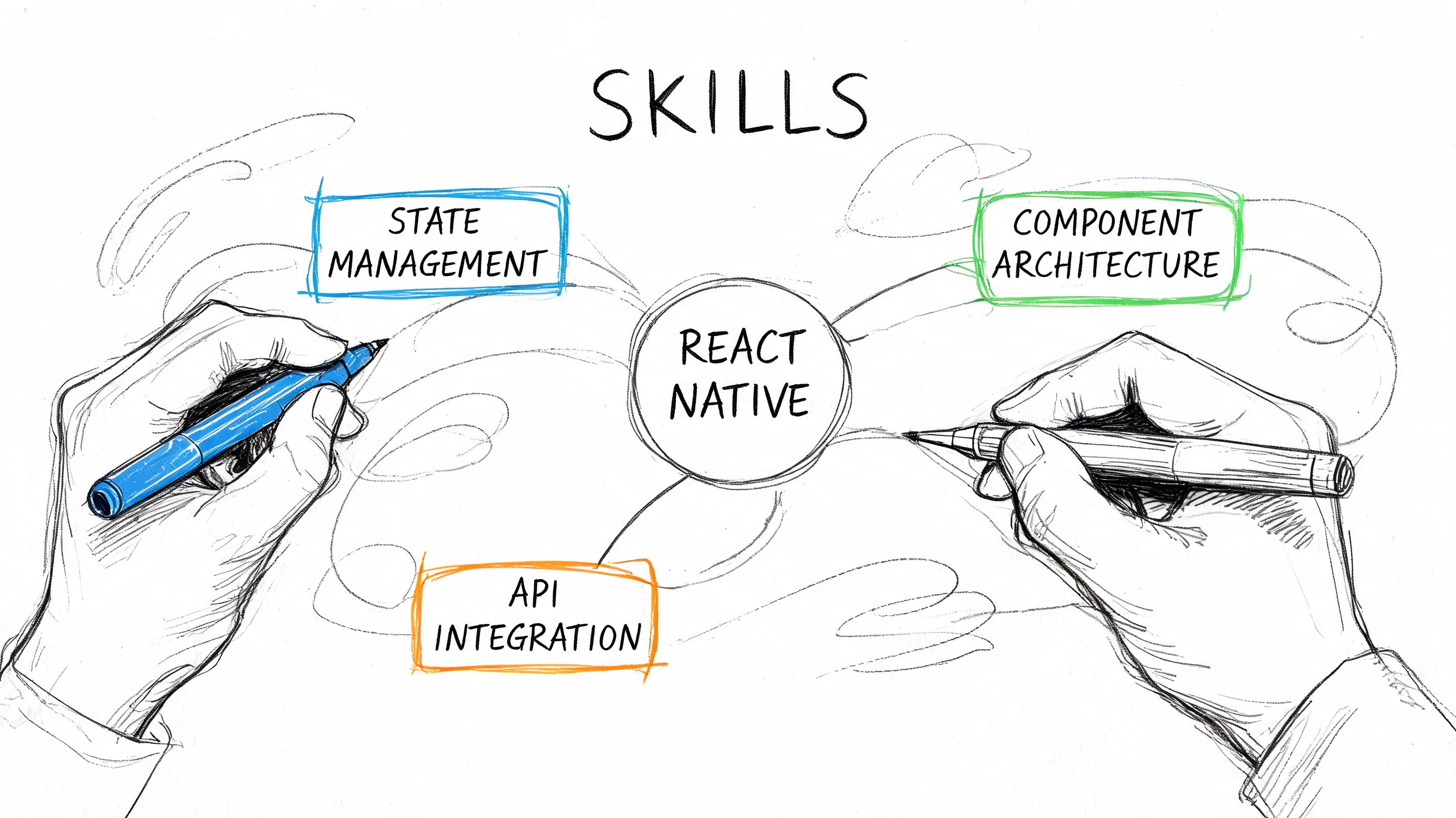
The biggest divider is workflow knowledge. According to Remote Crew’s React Native hiring guidance, hiring managers prioritize developers who can work in the Bare workflow for custom native module integration, use scalable state management like Redux Toolkit, and optimize performance with the Hermes JS engine, which can improve startup time by 2 to 3x.
Expo versus Bare
Many candidates get filtered out at this point.
Expo is great when a team wants fast setup, a smoother developer experience, and standard mobile capabilities without much native customization. It’s often enough for content apps, prototypes, internal tools, and many product teams that value speed over deep native integration.
Bare React Native matters when the app touches hardware, custom native SDKs, or platform-specific integrations that need Swift or Kotlin. If a role mentions native modules, advanced performance work, or custom device capabilities, you should assume Bare knowledge is expected.
A practical way to frame this in interviews:
- For Expo roles: talk about shipping speed, deployment flow, OTA comfort, and sensible package choices.
- For Bare roles: talk about native boundaries, dependency compatibility, build troubleshooting, and when abstraction stops helping.
New Architecture and performance
Modern teams also expect basic literacy in the newer React Native stack. If a listing mentions 0.71+, Fabric, or TurboModules, they’re signaling that they don’t want a candidate who only learned older patterns and stopped there.
Hermes belongs in the same conversation. You don’t need to pitch it as magic. You need to explain why JavaScript engine choice affects startup behavior, memory profile, debugging, and user experience on real devices.
Strong mobile engineers don’t just say “I care about performance.” They can point to concrete techniques, trade-offs, and debugging habits.
State management that scales
State management is one of the clearest signals of engineering maturity. Teams dealing with authentication, caching, multi-screen flows, offline behavior, and shared UI state need more than ad hoc Context usage.
Good choices depend on app shape:
- Redux Toolkit fits teams that value explicit patterns, predictable updates, and long-term maintainability.
- Zustand works well when the app needs simplicity and lower ceremony.
- Context API is fine for narrow concerns, but it becomes a liability when candidates use it as the answer to everything.
The hiring signal here is less about the library and more about judgment. Can you explain why one state approach fit the app better than another?
What top remote teams expect you to prove
Remote hiring raises the bar on clarity. Teams can’t rely on office proximity to patch over weak execution.
You should be ready to show competence in:
- TypeScript discipline: typed navigation, typed API contracts, and predictable component interfaces.
- API integration: real experience with REST or GraphQL, auth handling, retries, and error states.
- Testing mindset: not theoretical “I care about testing,” but a clear sense of what deserves unit, integration, or end-to-end coverage.
- Store submission experience: familiarity with builds, signing, review friction, and release notes.
- Debugging: comfort with logs, device testing, and tracing issues that aren’t obvious in a simulator.
If you want a useful benchmark for how companies think about front-end and cross-functional hiring quality, looking at how specialist teams evaluate react developers can help. The same pattern shows up repeatedly: teams reward breadth when it comes with technical depth, not when it’s just buzzword stacking.
A practical skill hierarchy
If your goal is better react native jobs, build in this order:
JavaScript and React fundamentals
Async control flow, hooks, rendering behavior, component boundaries.Core mobile app structure
Navigation, forms, API calls, error handling, loading states, persistence.State and app architecture
Redux Toolkit or Zustand, folder structure, shared logic, reusable patterns.Platform and performance awareness
Hermes, lists, gestures, images, startup behavior, device testing.Release ownership
Build pipelines, app store processes, debugging under production pressure.
That stack gets interviews. Being able to explain why you made those choices gets offers.
Crafting Your High-Impact Resume and Portfolio
Most React Native resumes fail because they read like internal task logs. They list duties, tools, and generic responsibilities, then expect the hiring manager to infer impact.
That never works well in a crowded market.
A strong resume for react native jobs should make one thing obvious within seconds: you build mobile products that ship cleanly, perform well, and hold up under real usage. Your portfolio should prove the same thing with code, screenshots, release links, and short explanations of technical decisions.
Stop writing responsibility bullets
The weakest bullet on a mobile resume is usually some version of this:
- Built React Native features
- Worked with APIs
- Collaborated with designers
- Fixed bugs
None of that separates you from anyone else.
Use proof-driven bullets instead. The verified skill guidance from Adaface’s React Native skills breakdown highlights the importance of ES6+ async programming, React hooks such as useEffect, Redux, and performance techniques such as Reanimated for 60fps animations. That gives you a better framing model for your experience.
Write bullets like this:
- Implemented async data flows with
async/await, request cancellation, and retry handling for unstable network conditions. - Refactored side effects in
useEffectto reduce stale updates and cleanup issues in screen transitions. - Introduced Redux-based state structure for authentication, feature flags, and multi-screen state consistency.
- Built gesture-heavy interactions with Reanimated and documented performance trade-offs for lower-end Android devices.
These examples work because they show judgment, not just attendance.
What a hiring manager wants to see
A good portfolio isn’t a gallery. It’s a decision log.
For each project, include:
- Product context: what the app does and who it serves
- Your ownership: screens, architecture, APIs, deployment, native fixes
- Technical choices: Expo or Bare, state approach, navigation setup, test approach
- Code evidence: a clean GitHub repository if the work is public
- Delivery proof: App Store or Play Store links if available
If the code is private, show screenshots and explain the engineering problems you solved. Don’t pad with tutorial apps. One credible production-style project beats five clones.
Your portfolio should answer the hiring manager’s silent question: “Can this person join a remote team and contribute without hand-holding?”
A better resume structure
This format works well for most mid-level and senior candidates:
| Section | What to include |
|---|---|
| Summary | One short paragraph tied to mobile delivery and stack depth |
| Core skills | React Native, TypeScript, state management, API work, testing, release tooling |
| Experience | Proof-driven bullets focused on outcomes and ownership |
| Selected projects | One to three strong projects with links and short technical context |
| Education or certifications | Keep it brief unless it’s directly relevant |
What not to do
Avoid these common mistakes:
- Tool dumping: Don’t create a giant skills block with every library you’ve touched once.
- Empty adjectives: “Passionate,” “results-driven,” and “detail-oriented” add nothing.
- Unclear ownership: If a project involved a team, say what you specifically built.
- No mobile proof: If your portfolio is all web work, don’t expect mobile-first teams to connect the dots for you.
A resume gets more interviews when it makes technical credibility easy to verify. A portfolio gets more callbacks when it shows how you think under real delivery constraints.
The First-Mover Strategy to Find Jobs Before the Crowd
Most developers search for react native jobs the same way. That’s the problem.
They wait for jobs to appear on mainstream platforms, then apply after hundreds of other people have already seen them. By that point, the company may already be screening candidates, or the post may be duplicated across several sites with no clear source of truth.

The verified data is blunt here. Major job boards are filled with outdated or unverified listings, and Glassdoor shows over 5,400 React Native jobs in the U.S. without filtering for remote or verification, while direct-sourcing engines can give job seekers a first-mover advantage before a listing pulls 1,000+ applicants on mainstream platforms, based on this job-board comparison.
Why mass-market boards make you slower
Public boards create false productivity. You can submit a lot of applications quickly, but speed of clicking isn’t the same as speed to market.
What usually goes wrong:
- Duplicate posts: the same role appears in multiple places, making the market seem larger than it is
- Recruiter layers: you apply without learning whether the company is serious, funded, or even actively hiring
- Stale inventory: posts remain visible after teams have paused or narrowed the funnel
- Delayed timing: by the time a role reaches every major board, your application is late
That’s why direct company sourcing matters. Its advantage isn’t just “verification.” It’s timing plus clarity.
What a first-mover workflow looks like
A better system is narrower and more disciplined.
Track direct company listings
Prioritize jobs published from actual career pages or ATS feeds, not reposted summaries.Apply within the early window
Fresh roles usually have less competition and a more attentive reviewer on the other side.Customize only after qualification
Don’t tailor blindly. First confirm workflow, platform scope, and ownership level.Follow up with relevance
A short note tied to the product or stack beats generic enthusiasm.
One practical option is to use a direct-sourced remote job engine such as Remote First Jobs, which focuses on remote company openings rather than the usual aggregator churn. The value is straightforward: you’re searching where fewer low-intent applicants are looking.
A short explainer is worth watching before you rebuild your process:
How to beat lazy competition
You do not need to out-apply everyone. You need to out-position them.
The strongest candidate often isn’t the person with the most applications sent. It’s the person who reaches the right listing before it becomes a public stampede.
Use this filter before applying:
- Is it direct from the employer?
- Does the listing define remote clearly?
- Can you identify the workflow and stack?
- Does the company seem to understand mobile engineering?
- Can you submit a customized application quickly?
If the answer is no on most of those, skip it. That discipline protects your time and raises your hit rate.
Frequently Asked Questions About React Native Careers
React Native is still a strong path for remote mobile engineers, but the winning profile has changed. Companies don’t just want framework familiarity anymore. They want engineers who can work across the app boundary, communicate clearly in async teams, and adapt as mobile stacks shift.

Is React Native still a good career in 2026
Yes, but “React only” is a weaker position than it used to be. Verified guidance for 2026 says developers should move beyond just React skills and adopt AI stacks, with demand rising for full-stack React Native professionals who can use AI models and agents in mobile development, according to this 2026 career-proofing note.
That doesn’t mean every mobile job suddenly becomes an AI role. It means employers increasingly value engineers who can integrate modern tooling and think beyond front-end implementation.
What should I expect in a remote interview process
Remote React Native interviews usually test four things:
- Technical fundamentals: JavaScript, hooks, architecture, state, API work
- Mobile judgment: platform differences, workflow choice, debugging, release awareness
- Communication: concise explanations, async clarity, written reasoning
- Ownership: whether you can carry work from ticket to shipped feature
Prepare with evidence, not buzzwords. Walk through one app thoroughly. Explain what you built, why you chose the stack, where things broke, and how you fixed them.
Do I need native iOS or Android experience
For some jobs, no. For stronger jobs, at least some platform awareness helps a lot. Even if you’re mainly in React Native, teams trust candidates more when they understand where JavaScript ends and platform behavior begins.
Is a portfolio still necessary if I have work experience
Yes. A portfolio gives hiring teams quick proof. For remote roles, that proof matters because you often need to earn confidence before the first call.
Keep it tight. Two or three credible projects are enough if they clearly show architecture, product sense, and code quality.
How do I future-proof my React Native career
Don’t drift into being “the person who knows a framework.” Build into being the engineer who can ship mobile product work across multiple constraints.
That means strengthening:
- Full-stack fluency
- Performance and debugging instincts
- Delivery ownership
- AI-assisted development judgment
The remote market still rewards people who combine technical range with practical execution. That combination is harder to fake, and easier to hire.
If you’re tired of noisy boards, stale listings, and applying after the crowd has already arrived, Remote First Jobs is the better move. It helps you find verified remote roles sourced directly from company career pages, so you can apply earlier, avoid recruiter clutter, and compete where serious candidates actually have an edge.