Finding a work-from-home software developer job is more doable now than ever before. Flexibility isn’t a perk anymore; for developers, it’s pretty much the default. The real trick is learning how to sidestep the chaos of huge job boards and tap into direct, quality opportunities. It’s all about understanding the market forces that put you, the developer, in the driver’s seat.
The State of Remote Software Development in 2026

Forget all the noise you hear about mandatory “return-to-office” policies. For skilled developers, the power dynamic has completely flipped. Remote work isn’t some temporary trend—it’s a core expectation that companies have been forced to meet. Top-tier companies are in a constant battle for talent, and they know that demanding a five-day office week is a losing move.
The data backs this up. Projections for the end of 2026 show that a massive 80% of software engineers will be working either fully or partially from home. This isn’t just a corporate decision; it’s driven by developer demand. One recent survey found that 21% of developers would quit on the spot if forced back to the office, with another 49% saying they’d immediately start looking for a new job.
This isn’t some far-off future, either. The numbers from mid-2024 already told a compelling story:
- 42% of developers were working in a hybrid model.
- 38% were fully remote.
- A mere 20% were still tied to a traditional office.
What this all means is that your search for a remote dev job isn’t an uphill battle. You’re moving with the current, not against it.
Why You Have All the Leverage
Your skills are hot commodities, and your desire for remote work is the norm, not the exception. When you and the majority of your peers want the same thing, it creates powerful market leverage. Companies that dig their heels in and resist this change are only shrinking their own talent pools, which is great news for the ones that actually get it.
The conversation has completely changed. It’s no longer about if a company offers remote work, but how they actually support their distributed teams. This is a crucial point to focus on when you’re vetting potential employers.
There’s a world of difference between a company that just tolerates remote work and one that is built for it. The best ones invest in asynchronous communication, build documentation-first cultures, and genuinely trust their people to get the job done without someone constantly looking over their shoulder. These are the companies you want to find.
The New Standard: Distributed-First Teams
The most forward-thinking companies are already moving past simple hybrid setups and adopting a truly distributed-first mindset. This means their entire culture, from processes to tools, is built on the assumption that the team is not in the same room.
Here’s a quick look at the current work arrangements for developers and where things are headed.
Developer Work Models The 2026 Landscape
The table below breaks down the work models based on 2024 data and shows the clear momentum toward remote-first cultures.
| Work Model | Percentage of Developers (2024 Data) | Projected Trend for 2026 |
|---|---|---|
| Fully Remote | 38% | Strongly Increasing |
| Hybrid | 42% | Stable / Slightly Increasing |
| Full-Time Office | 20% | Sharply Decreasing |
While hybrid is still a popular option, the explosive growth in fully remote roles shows the industry’s real commitment to location independence.
Of course, spending all day at a desk means you’ve got to take care of your physical setup. Finding the best office chair for back pain isn’t a luxury; it’s a critical investment in your long-term health and productivity.
Knowing these trends gives you the confidence to own your job search. You’re not asking for a special favor by wanting to work remotely—you’re looking for a role that meets the modern standard. This guide will walk you through exactly how to find and land one of those premier jobs.
Smarter Sourcing Beyond Mainstream Job Boards
If your job search consists of endlessly refreshing LinkedIn and Indeed, you’re playing a losing game. It’s a frustrating cycle. You’re up against thousands of other applicants, sifting through a sea of stale, expired, or even fake “ghost jobs” posted just to harvest resumes.
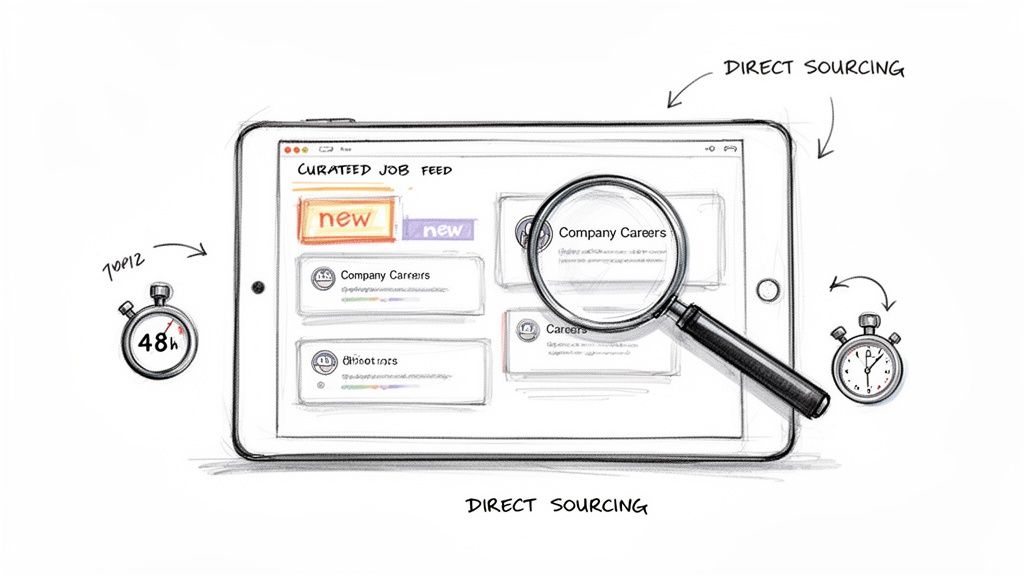
This approach pits you against a global flood of applicants for roles that might not even be real. It’s time for a smarter strategy: stop chasing the herd and start going directly to the source. The best work-from-home software developer jobs almost always show up on a company’s own career page first. That’s where you’ll find the freshest, most legitimate listings before they hit the noisy mainstream boards.
The Power of Direct Sourcing
Direct sourcing is simply the practice of monitoring the career pages of companies you actually admire—specifically, those that are remote-first or remote-friendly. By heading straight to their websites, you sidestep the overwhelming noise and competition on big job aggregators. You also get to skip the frustrating experience of applying through a third-party recruiter who might not have a real opening at all.
The biggest advantage here is time. When you spot a job on a company’s site, you’re seeing it the moment it goes live. This means you can be one of the very first to apply, giving you a massive edge. Many companies review applications as they come in, and some even pull the posting once they hit a certain number.
The first 48 hours a job is posted are absolutely critical. Applying within this window can dramatically increase your chances of getting an interview. Your application lands in a much smaller pile, ensuring it gets seen by a real person before they’re completely overwhelmed.
But this isn’t just about being fast; it’s about quality. Jobs posted directly are almost always active roles that a company is genuinely trying to fill. You’re not wasting your energy on listings that closed weeks ago or were posted by a recruiter just fishing for leads.
Curating Your Company Watchlist
So, how do you actually put direct sourcing into practice? It all starts with building a curated list of companies you genuinely want to work for. Think about the products you use every day, the open-source projects you contribute to, or the engineering blogs you can’t stop reading.
Here’s a simple way to build your direct-sourcing list:
- Identify 20-30 “Dream” Companies: These are companies whose mission, tech stack, or culture truly resonates with you. Make sure they have a known commitment to remote work.
- Bookmark Their Career Pages: Create a dedicated folder in your browser to keep these links organized and accessible.
- Set a Schedule: Make it a daily habit to check these pages for new openings. Treat it like your morning coffee routine—a quick, consistent check-in.
This manual process is incredibly effective, but let’s be honest—it can get tedious. Checking 30 different websites every single day takes time and discipline.
Luckily, there are tools designed to automate this exact process, giving you a powerful edge without all the manual clicking. Platforms now exist that are built specifically for this purpose. Instead of you manually checking thousands of company career sites, these tools do it for you around the clock.
You can learn more about how to find verified roles directly from company websites by checking out services like Remote First Jobs, which automates this entire discovery process. This gives you a curated, real-time feed of fresh software developer jobs from home without any of the clutter.
The goal is to shift your focus from quantity to quality. Instead of shotgunning hundreds of applications into the void, you’ll send a smaller number of highly-targeted applications for roles where you have a genuine, early-mover advantage. This method respects your time and dramatically increases your odds of getting a response.
How to Vet Remote Companies and Avoid Red Flags
 Let’s get one thing straight: not all software developer jobs that let you work from home are created equal. A “remote” title can mean anything from a fully-supported, distributed team to a chaotic company that just sent everyone home in a panic. Learning to spot the difference is the secret to finding a role where you can actually do great work.
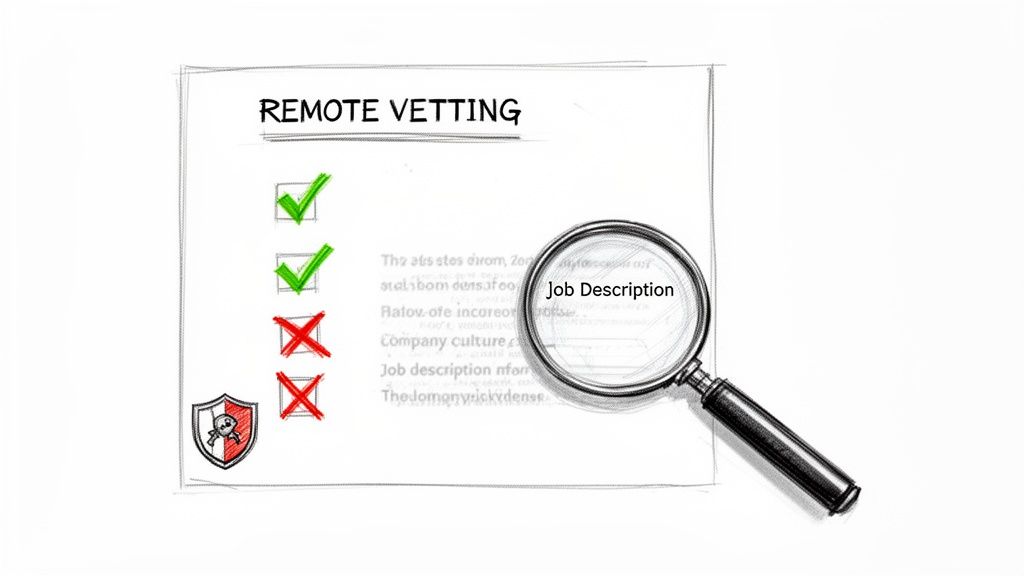
Your first clue is always the job description itself. Vague, buzzword-stuffed descriptions are a massive red flag. If a company can’t clearly explain the role, the tech stack, or how they measure success, it’s a good sign things are a mess internally. You want to see specifics.
Reading Between the Lines
A true remote-first company thinks, acts, and writes differently. You’ll see their job posts mention things like asynchronous communication, a strong documentation culture, or flexibility across time zones. These aren’t just perks; they are the bedrock of how a successful distributed team operates.
On the flip side, a company that’s merely “remote-friendly” will list remote work next to the free office snacks. They might even drop hints about a future return to the office, using phrases like “remote work available during the current climate.” This tells you remote work is a temporary patch, not a core part of their strategy.
A key differentiator is how the company views its people. A truly remote organization trusts its team to be productive without constant oversight. If the job description is filled with language about monitoring or micromanagement, consider it a significant red flag.
Initial Red Flags to Watch For
As you scan job boards, keep an eye out for these immediate warning signs. Spotting them early will save you from wasting time on low-quality or even fake opportunities.
- Vague Compensation: Listings that say “competitive salary” but won’t give you a range are usually looking to lowball candidates.
- Unprofessional Communication: Watch out for emails from personal accounts (like Gmail or Yahoo) or messages full of typos. It screams unprofessionalism.
- High-Pressure Tactics: Any recruiter or hiring manager pushing you for an immediate “yes” is a major concern. Good companies don’t need to rush you.
- Third-Party Recruiter Spam: Be wary of generic, mass-emailed job posts from recruiters who clearly haven’t even looked at your profile. Always prioritize applying directly.
Assessing a Company’s Remote Maturity
Once you get past the application, it’s time to dig deeper. The interview is your chance to turn the tables and really evaluate them. This means asking direct questions about how they handle remote work.
For example, ask, “How does your team handle collaborative problem-solving when you can’t just gather around a whiteboard?” Their answer will tell you everything. A mature remote company will talk about their specific tools (like Miro or FigJam), documentation practices in Notion or Confluence, and their established async brainstorming processes. A company that isn’t truly set up for remote work will probably stumble or give you a vague answer.
Here’s another powerful question: “What does the onboarding process look like for a new remote developer?” A great answer describes a structured, well-documented plan, often with a dedicated onboarding buddy and clear goals for your first week. A bad answer sounds something like, “We’ll ship you a laptop and you can jump on some calls.” One signals a system designed for success; the other is a recipe for isolation and confusion.
Crafting an Application for a Remote-First World
 A generic, one-size-fits-all resume is the fastest way to get your application tossed in the virtual trash. When you’re targeting software developer jobs where you work from home, your application has to do more than list skills—it needs to prove you’ll thrive without a manager peering over your shoulder. This means showing tangible proof you can communicate asynchronously, manage your time, and solve problems on your own.
This shift is more important than ever. The developer market is heating up again, with employment projected to grow by a massive 17% between 2023 and 2033. That’s an additional 327,900 jobs. With postings on the rise, optimizing your application for this new reality isn’t just a good idea; it’s essential. You can get a better sense of the landscape by reviewing the latest industry statistics for software development.
From Duties to Impact
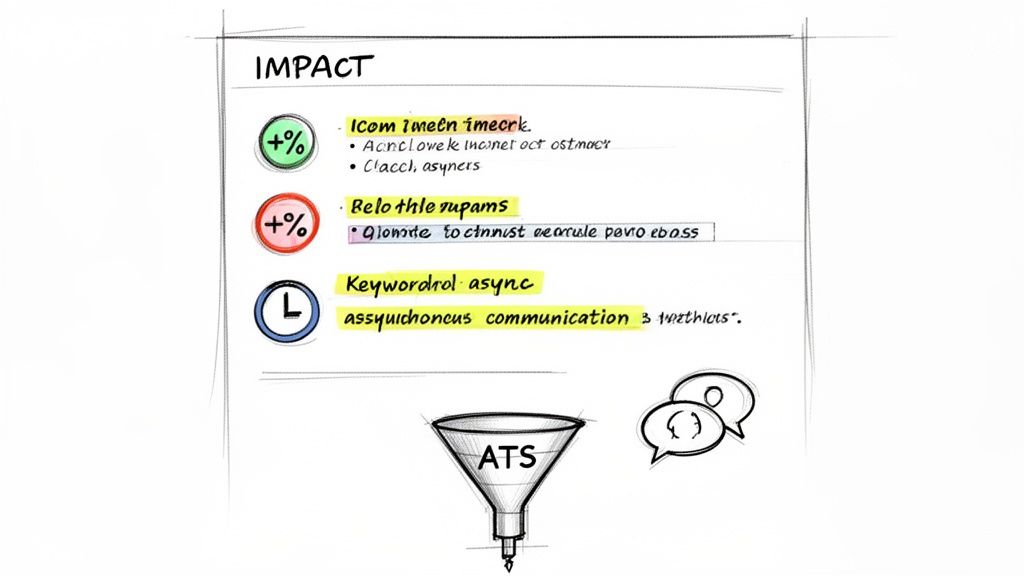
The single biggest mistake I see developers make on their resumes is just listing what they were responsible for. A hiring manager for a remote role doesn’t care what you did nearly as much as the impact you had. Your resume bullets have to read like accomplishments, not a boring task list.
Think of it this way: instead of saying you “worked on a new feature,” you need to quantify the result. Did it make things faster? Cheaper? Did it make users happier? This is how you prove you’re a results-driven professional who creates value, no hand-holding required.
Here’s a quick before-and-after to show you what I mean:
- Before: “Wrote code for the new user dashboard.” (This tells them nothing about the outcome.)
- After: “Led the development of a new user dashboard, resulting in a 30% reduction in support tickets and a 15% increase in daily active users.”
See the difference? The “after” example is powerful. It screams technical skill, ownership, and a direct, positive business outcome.
Showcasing Remote-Ready Skills
Beyond your technical wins, your resume has to scream “remote-ready.” A remote-first company is hunting for clear signals that you’re a self-starter who can communicate clearly without needing a dozen meetings.
You need to weave these skills into your resume and cover letter:
- Asynchronous Communication: Talk about your experience working with teams across time zones. Name-drop your go-to tools like Slack, Jira, and Confluence for keeping communication clear and documented.
- Proactive Problem-Solving: Share a story about a time you spotted a potential issue and squashed it before it became a five-alarm fire. This shows you take ownership and don’t just wait for instructions.
- Self-Discipline and Time Management: If you’ve ever managed your own project timelines or juggled competing priorities with little oversight, make sure that shines through in your project descriptions.
A fantastic way to put these skills on display is through open-source contributions. Pitching in on a project, even in a small way, shows you can collaborate with a distributed team, follow documentation, and communicate your work clearly in writing.
Optimizing for Applicant Tracking Systems
Before a human ever lays eyes on your resume, it’s almost guaranteed to be scanned by an Applicant Tracking System (ATS). These systems are robotic gatekeepers designed to filter out anyone who doesn’t seem like a match. To beat the bots, you have to think like one.
Start by dissecting the job description. Hunt for keywords—specific technologies (“React,” “Kubernetes,” “Python”), methodologies (“Agile,” “Scrum”), and soft skills (“asynchronous,” “distributed team”). You need to sprinkle these exact keywords naturally throughout your resume.
For instance, if a remote job ad mentions “CI/CD pipelines” three times, your resume had better reflect that experience using the exact same phrase. Don’t expect the ATS to connect the dots or understand synonyms.
Here’s a quick checklist to get you past the robot:
- Use a clean, simple resume format. Avoid columns, tables, or fancy graphics that can trip up the software.
- Mirror the language from the job description. If they say “remote work,” you say “remote work.”
- Include both full names and acronyms for technologies, like “Amazon Web Services (AWS).”
By tailoring your application to showcase impact, highlight your remote skills, and get past the ATS, you transform from just another applicant into a can’t-miss candidate. It shows you get what it really takes to succeed in modern software developer jobs from home.
Mastering The Remote Interview And Salary Negotiation
You’re almost there. Landing a remote software developer job comes down to clearing two final, critical hurdles: the interview and the salary talk. These aren’t just formalities; they’re distinct skills you need to nail.
The interview is your chance to prove you can thrive from anywhere, and the negotiation makes sure you’re paid what you’re worth for that ability.
Nailing The Virtual Interview
In a virtual interview, you’re not just being tested on your technical chops. You’re being evaluated on your ability to communicate clearly and professionally through a screen. Your entire setup—and your presence—is part of that test.
First impressions are almost entirely visual and auditory on a video call. A grainy camera, awful lighting, or a dog barking in the background sends the wrong message immediately. You don’t need a fancy studio, but you absolutely have to control your environment.
Put yourself in the interviewer’s shoes and think about your setup:
- Lighting: Always have a light source in front of you, never behind. Facing a window or even just a simple desk lamp makes a world of difference.
- Audio: Your laptop’s built-in microphone is not your friend. It picks up every keyboard clack and room echo. Use a headset or an external mic to ensure your voice is crystal clear.
- Background: Keep it clean and professional. A tidy bookshelf or a simple, neutral wall is infinitely better than a view of your unmade bed.
Beyond the tech, your on-camera presence is what seals the deal. Make a conscious effort to look at the camera, not just the person’s face on your monitor—it mimics real eye contact. Don’t be afraid to use hand gestures and nod to show you’re actively listening and engaged. For a deeper dive, reviewing some crucial virtual interview tips can give you an extra leg up.
One of the most powerful things you can do in a remote interview is ask questions that probe the company’s remote maturity. This shows you’re a serious remote professional, not just someone looking for a casual work-from-home gig.
Get specific. Ask questions like, “How does the team handle documentation?” or “What does a typical asynchronous feedback loop look like on a pull request?” A company with a truly strong remote culture will have solid, confident answers. Vague responses are a red flag.
Securing Your Top-Tier Remote Salary
Once you’ve wowed them in the interviews, it’s time to talk money. This is where so many developers accidentally leave a huge amount of cash on the table. The trick to a successful negotiation is coming to the table armed with cold, hard data.
Don’t go in with what you feel is fair. Go in with facts.
And the data is overwhelmingly on your side. Globally, remote software developers are earning an average salary of $70,877 USD per year, with those in North America averaging $82,757. Salaries have been climbing at a steady 4% year-over-year, and with nearly 8% of developers now earning over $200K, you have all the evidence you need to justify a top-tier offer.
When the offer comes in, your first move shouldn’t be to accept. Pause, take a breath, and use this data as your anchor for a counteroffer.
You can frame it professionally like this: “Thank you so much for the offer. I’m very excited about the opportunity to join the team. Based on my research into the market rates for a senior developer with my experience in distributed systems, and considering the data for fully remote roles, I was targeting a salary closer to the $X range. I’m confident my skills in building scalable backend services will bring immediate value to your projects.”
This approach works. It’s professional, data-driven, and ties your value directly to their needs. Remember, a good company fully expects you to negotiate. It shows you know your worth in the market for software developer jobs that are work from home.
Frequently Asked Questions About Remote Developer Jobs
Alright, even with the best playbook, a few questions are bound to pop up. Let’s tackle some of the most common ones I hear from developers trying to land a remote gig. These are the final pieces of the puzzle to help you move forward and start applying with confidence.
Is It Possible for Junior Developers to Find Remote Jobs?
This is probably the question I get asked most. The short answer is yes, but it’s not as straightforward as it is for seniors. Many companies are a bit hesitant, preferring the proven track record of a senior dev for remote roles. But junior opportunities are definitely out there.
The trick is to prove you’re a low-risk hire who can learn fast and work without constant supervision. You have to put in a little extra work to make their decision easy.
Here’s what you need to focus on:
- Make Your Portfolio Shine: Your GitHub profile is your new best friend. Seriously. Get active in open-source, build and deploy your own side projects, and make sure your code is clean and well-commented.
- Show Off Your Soft Skills: Don’t just say you’re a good communicator—prove it. Talk about your proactivity, how you manage your time, and any experience you have with online group projects.
- Find the Right Companies: Zero in on companies that have established mentorship programs or are openly advertising for junior remote developers. They already have the systems in place to help you succeed.
The goal is to make it an easy “yes” for the hiring manager. Show them you don’t need your hand held. A well-documented project on GitHub is infinitely more powerful than a line on your resume.
How Competitive Is the Remote Job Market Really?
It’s competitive, no doubt about it. But the game has changed. It’s no longer about being the single best developer out of a thousand applicants. It’s about being the right developer who applies at the right time.
Your biggest mistake is fighting for scraps on huge job boards where a single posting gets flooded with over a thousand applications in a couple of days. That’s a losing battle.
The real competition is for attention. When you source jobs directly from company career pages, you completely bypass that giant pile of resumes. Applying within the first 48 hours lands you in a much smaller, more manageable group of candidates.
So, while tons of developers are looking for remote work, most are using strategies that just don’t work anymore. If you’re smarter and faster, you can flip the odds in your favor.
What’s a Fair Salary for a Remote Developer?
This is the classic “it depends” question. Your salary isn’t just about your location; it’s a mix of your experience, the company’s pay structure, and the specific skills you offer.
Generally, you’ll run into one of these compensation models:
- Global Rate: Some companies, often the more progressive ones, pay the same salary for a role no matter where you live.
- Location-Based Pay: Others adjust what they offer based on the cost of living in your city or region.
- Hybrid Models: Most companies land somewhere in the middle, using salary bands with some geographic adjustments.
Your best move is to come prepared with data. Use a few different sources to research what’s fair for your role and experience level. And don’t just look at your local market, especially if the company hires nationally or globally.
When you get to the negotiation stage, anchor your salary request to the value you’ll create for the company, not just what you need to pay your bills.
How Can I Maintain a Healthy Work-Life Balance?
This is one of the trickiest parts of working from home. When your office is also your living room, the lines between professional and personal life get blurry fast. It’s incredibly easy for work to spill into your evenings and weekends.
Setting firm boundaries isn’t just a suggestion—it’s absolutely essential if you want to avoid burnout and enjoy the freedom remote work offers.
Here are a few things that actually work:
- Create a Designated Workspace: It doesn’t have to be a separate room. Even a dedicated corner of a room helps your brain “clock out” when you step away from it.
- Stick to a Routine: Start and end your day around the same time. When you’re done, you’re done. Turn off the notifications on your work apps.
- Schedule Your Breaks: Put lunch on your calendar. Block out 15-minute breaks. Treat them like real meetings you can’t miss.
It takes discipline at first, but building these habits is the only way to make sure remote work doesn’t completely take over your life.
Stop drowning in the noise of outdated job boards. Remote First Jobs gives you a critical advantage by delivering verified, direct-from-company listings before they get buried in thousands of applications. Find your next role faster.