You find a remote customer support role at 8:10 a.m. The hours fit, the company is credible, and the work matches your background. By 8:25, the post is already crowded, the same job is showing up on two other boards, and one version may already be outdated. That is a significant problem with remote customer support jobs. Competition is part of it, but delayed discovery is what knocks out strong applicants.
Public job boards reward volume. Good candidates need timing and cleaner sources. The practical goal is simple: shorten the gap between a company opening a role and you sending a customized application. That is why I rank curated boards, direct-hire company pages, and community sources above giant aggregators for this search.
The distinction is important, as remote work remains a meaningful part of hiring. Customer support roles are still widely available across remote-first SaaS companies, ecommerce brands, and service businesses, but the best openings do not stay easy to access for long. Some companies hire internal support teams. Others rely on outsourced call center solutions, which changes the kind of roles you will see and where those jobs are posted.
This guide focuses on seven sources that warrant your time. The list includes broad remote boards, specialist communities, and direct employer career paths. It also uses a strategy that gives applicants an edge: check faster-moving sources first, apply early, and start with platforms like Remote First Jobs for remote customer support roles that surface openings closer to the point of publish instead of after they have already spread across the internet.
Good jobs exist. The candidates who reach them first usually have a system.
1. Remote First Jobs
You find a remote support role at 9:30 a.m., spend 20 minutes tailoring your resume, and submit by 10:00. By lunch, the posting already has a crowded applicant pool. That is the problem Remote First Jobs for remote customer support roles is built to solve.
Its advantage is straightforward. It pulls roles directly from employer career pages and ATS systems instead of waiting for the same jobs to spread across public boards. For customer support applicants, speed changes outcomes. Strong candidates often miss good roles because they saw them after distribution, not because they lacked the skills.
Why it works better than general boards
Remote First Jobs says it tracks more than 21,000 remote-first companies, lists 44,000+ verified remote jobs, detects 200,000+ new opportunities each month, and serves 10,000+ job seekers monthly, based on company-provided platform information.
What matters in practice is how that sourcing model affects your workflow:
- Direct-sourced roles: Listings come from employer systems and career pages rather than recycled board posts.
- Earlier visibility: Frequent scanning helps you catch openings closer to the original publish time.
- Cleaner search results: You spend less time sorting through agency spam, junk listings, and expired posts.
- Better alignment for direct-hire searches: It fits applicants targeting in-house remote support roles, not mass-volume job board browsing.
That gives you a practical edge. The goal is not to see more listings. The goal is to see relevant listings before they turn into high-volume contests.
Where it is strongest
This platform is strongest for applicants who already know the kind of support work they want. If you are targeting SaaS support, technical support, customer experience, support operations, or ecommerce support inside distributed companies, the search is usually cleaner than what you get from broad boards.
It is also useful for filtering out the wrong kind of support role early. Plenty of remote customer support jobs still center on phones and strict script handling. Other roles focus on chat, email, account onboarding, knowledge base work, and product troubleshooting. Remote First Jobs makes it easier to spot that difference because many listings come straight from the employer’s own description, where channel mix and team setup are clearer.
That matters because remote customer support jobs attract fast applicant volume. As noted earlier, fully remote support roles draw heavier competition than many candidates expect. This reinforces why an early, direct-source workflow matters.
Trade-offs to know before you rely on it
Remote-first coverage is the main strength, and it also sets the boundary. If you want hybrid roles, location-flexible jobs at companies that are not fully remote-first, or state-restricted openings that show up on local boards first, you should pair this source with at least one broader board.
The other trade-off is evaluation. The public site does not spell out every feature tier or workflow detail, so serious applicants should test it directly and decide whether the speed and filtering justify making it part of a daily routine.
I would use it at the front of the search, not as the only source. Check it early in the day, shortlist roles that match your support channel and product background, then apply direct before the listing gets copied elsewhere.
One more practical point. Companies that use outsourced call center solutions often look for candidates who can handle documented processes, queue discipline, escalations, and channel-specific metrics. If you have done that work, say it plainly in your application instead of leaving it buried in a generic support summary.
2. We Work Remotely: Customer Support Jobs
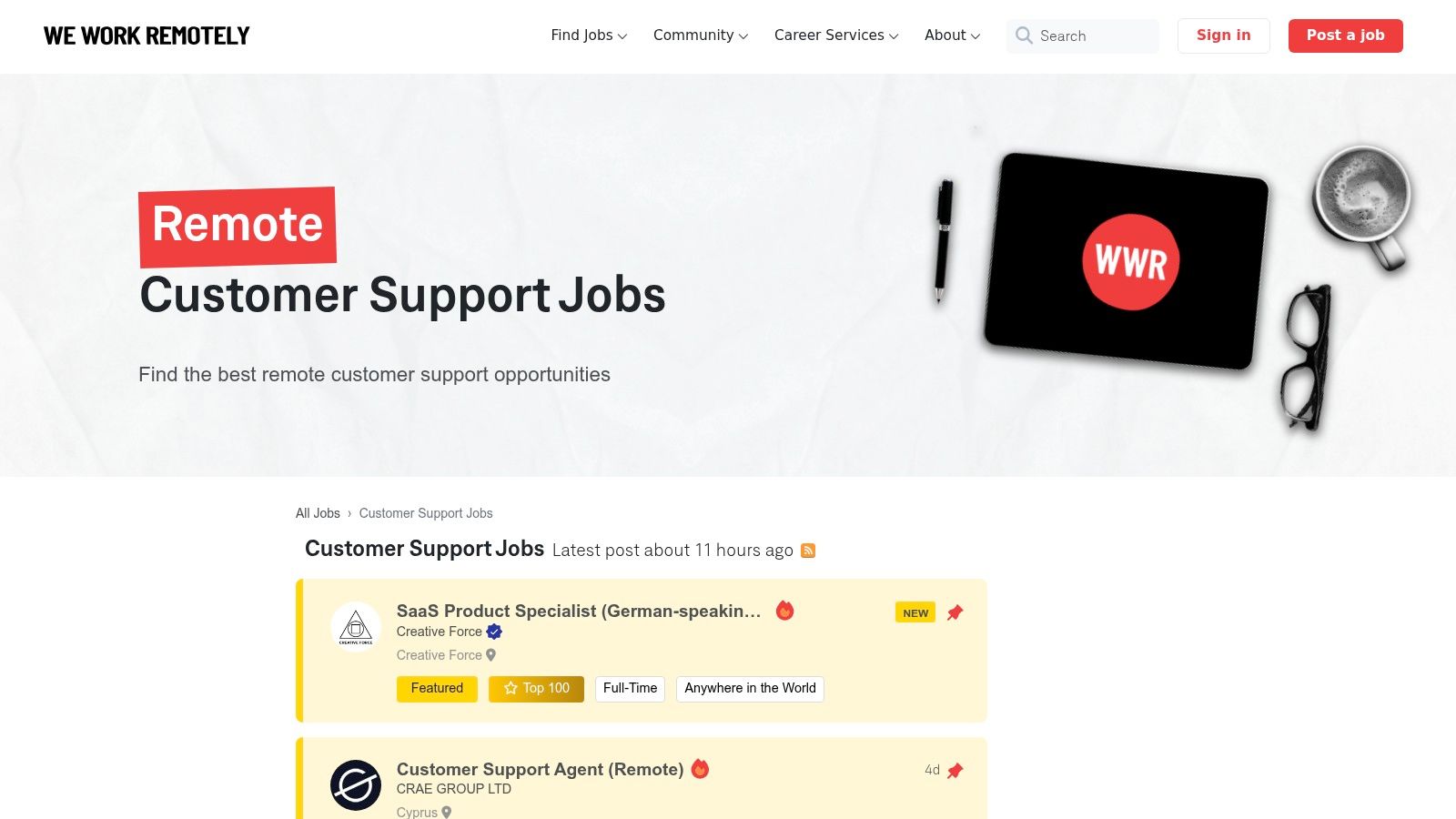
You check jobs at 8:15 a.m., see a support posting that fits your background, and by lunch it already has a crowded applicant pool. That is a core value of We Work Remotely. It helps you spot live openings fast enough to apply before the role gets copied across half the internet.
We Work Remotely is a broad remote board, but its Customer Support category is usually sharper than what you will get from giant job sites. The strongest listings tend to be SaaS support, CX, community support, and product support roles. If you want work tied to an actual product team instead of a generic call center title, this board is often worth the check.
What I like is the speed.
You can browse without creating an account, open listings quickly, and figure out within a minute whether a role is worth your time. For serious applicants, that matters more than extra features. Good support jobs do not stay undiscovered for long, especially once they appear on a board with We Work Remotely’s reach.
A few practical strengths stand out:
- Dedicated support category: You can review actual support openings instead of forcing broad keyword searches.
- Direct employer paths: Many listings send you straight to the company application page.
- Fast triage: Descriptions are usually clean enough to scan for product, shift expectations, and region limits.
- Strong startup and SaaS presence: Useful if your background is in product support, customer education, onboarding, or technical troubleshooting.
The trade-off is filtering. Location rules, timezone overlap, and pay details are not always consistent across listings. One post may say “remote anywhere,” another means U.S. only, and a third specifies European working hours. If a company is vague about geography, channels, or schedule, treat that as a warning sign and move on unless the fit is unusually strong.
I use We Work Remotely as a scouting board, not the center of the search. It is best for finding fresh opportunities and getting to the employer’s application before the listing spreads. That makes it a strong second source after a direct-source board like Remote First Jobs, where speed and earlier discovery can give you a cleaner shot at the role.
A simple workflow works well here. Check the category early. Open only the jobs that match your support channel experience, product type, and timezone. Apply to the best-fit roles first, then save the weaker matches for later. That sounds basic, but it is how you avoid spending 45 minutes reading listings you were never going to pursue.
A clean board still requires discipline. Two clear, relevant roles are worth more than ten vague ones.
As noted earlier, remote support roles attract heavy competition. We Work Remotely helps you stay in the flow of the market, but it will not protect you from volume. Your edge comes from speed, fit, and a direct application path.
Website: We Work Remotely Customer Support Jobs
3. Remote.co: Remote Customer Service Jobs
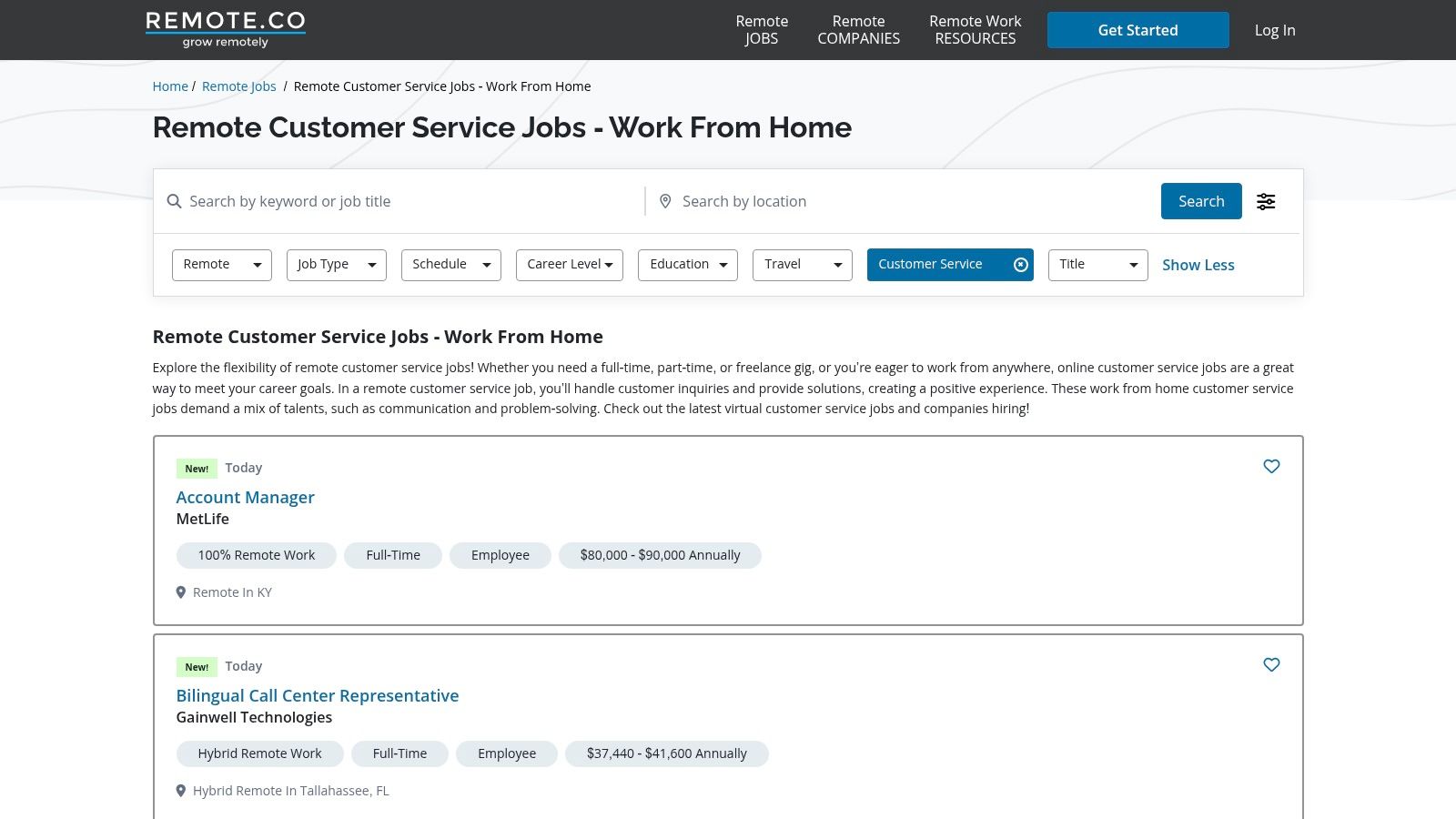
You check a remote support board before work, hoping to find something usable. Half the posts are vague, a few are stale, and several send you through a maze of reposts. Remote.co is usually a cleaner experience than that.
Its customer service section tends to pull together legitimate roles across software, ecommerce, healthcare, fintech, and other categories that do not all look like early-stage SaaS. That wider mix matters if your background comes from structured support environments where process, compliance, and documentation count for a lot.
Best use case
Remote.co is a good board for candidates who want less noise and more readable listings.
I would put it in the middle of a serious search stack, not at the top. Remote First Jobs still gives you the better speed advantage because direct-sourced listings can reach you before they spread across bigger boards. Remote.co works better as a quality filter after that first pass. It helps you spot credible openings worth a full application, especially if you are trying to move from sectors like insurance, education, healthcare administration, logistics, or payments into a remote support role.
A practical routine looks like this:
- Use it as a second-check board: Start with earlier-source listings, then use Remote.co to add cleaner matches you may have missed.
- Look for process-heavy teams: Roles here often suit candidates who can speak clearly about SLAs, escalations, QA standards, documentation, and cross-functional handoffs.
- Prioritize direct employer paths: Apply where the listing sends you straight to the company’s own hiring page, not a chain of third-party redirects.
That last point matters more than people think. A direct application path usually gives you a clearer read on whether the role is active, what the actual requirements are, and how the company frames the work.
Limitations that matter
Remote.co still requires manual review. Filters will not save you from hidden location limits, weekend coverage requirements, or timezone constraints buried near the bottom of a job description.
That makes it better for careful applicants than high-volume applicants. For this reason, Remote.co works best for people who are methodical.
Read the listing with a support operator’s eye. Check the channel mix, hours, escalation ownership, training expectations, and whether the role is closer to transactional queue work or product support. A posting can look polished and still be a poor fit if the schedule, geography, or workload assumptions do not line up with your experience.
Used that way, Remote.co earns a place in the rotation. It is not the board that gives you the earliest shot. It is the board that helps you make smarter choices after the first wave, which is often the difference between sending more applications and sending better ones.
Website: Remote.co Customer Service Jobs
4. Support Driven: Community-Sourced Customer Support Jobs
Support Driven is not just a job board. It is a professional network wrapped around customer support work.
That difference matters because remote customer support jobs are often won through context, not volume. If you can learn how a company runs support, what tools they use, how interview loops feel, or whether leadership respects support as a function, you get a better signal than any board filter can give you.
Why community changes the job search
Support Driven is strongest for mid-level and senior support professionals, support leads, CX managers, support operations people, and specialized support engineers. The weekly job roundups help, but the main value is the community layer.
Inside support communities, people share employer impressions, interview experiences, and practical advice that never appears in formal job descriptions. That is useful when a posting sounds promising but raises questions about workload, channels, escalation ownership, or expectations around nights and weekends.
A few reasons it stands out:
- Peer-shared opportunities: Roles often come from people already connected to the space.
- Professional context: You can learn how teams operate.
- Networking upside: Referrals and warm introductions are more realistic here than on giant boards.
- Better for specialization: Technical support and leadership roles show up more often than on mass-market sites.
The trade-off
If you are entry-level and want a huge stream of easy-apply listings, this is not the place to start. The flow is more selective, and some of the value sits inside the community rather than on a public board.
That is not a flaw. It is just a different model.
Remote support hiring is getting more selective anyway. SurveyMonkey data cited in the verified research shows 79% of Americans strongly prefer human agents over AI, 84% see humans as more accurate, and 63% reject AI replacement entirely (customer service statistics). Employers still need skilled human support. They just tend to hire carefully for it. Communities like Support Driven help you understand what “skilled” means at a given company before you apply.
If you want to move beyond generic support roles, spend time where support professionals talk to each other, not just where employers broadcast openings.
Website: Support Driven
5. FlexJobs: Curated, Scam-Screened Remote Listings
You find a promising remote support role, spend 20 minutes tailoring your resume, then realize the posting is vague, stale, or worse, fake. That is the problem FlexJobs is built to reduce.
FlexJobs works best for job seekers who want a cleaner search process and are willing to pay for it. In remote customer support, that can be a reasonable choice. “Remote” still gets used loosely, and large free boards often mix fully remote roles with hybrid jobs, location-restricted listings, and recycled posts.
The main benefit is time saved on filtering. FlexJobs screens listings before they go live, which gives cautious applicants a more usable pool to work from. That matters if you are applying before the rush. A smaller set of credible openings is often more useful than a giant feed full of noise.
What you are paying for is straightforward:
- Hand-screened listings: Better odds that the role is real and current.
- Search filters and alerts: Helpful if you are tracking support, customer service, or call center categories daily.
- Career resources: Resume reviews and webinars can help if your support experience is stronger than your current resume shows.
- A calmer workflow: Less junk, fewer dead ends, and fewer scam concerns.
That said, FlexJobs is not usually where top remote support candidates get their edge.
The strongest applicants still use a layered approach. They monitor curated boards like FlexJobs, but they also watch direct company career pages and faster-moving sources so they can apply early. This represents the primary trade-off here. FlexJobs improves quality control, but it does not create exclusivity. Many listings appear elsewhere, and by the time they hit a paid board, the earliest applicants may already be in the queue.
For customer support candidates, FlexJobs tends to be strongest for established employers with structured hiring processes. Healthcare organizations, insurers, universities, travel companies, and large service brands show up here more often than smaller remote-first startups. If you want predictable training, clearer policies, and a traditional support environment, that can be a plus.
If your strategy is speed and direct access, FlexJobs should be one source, not your whole system. Use it to keep your search clean. Use faster, direct-source channels to beat the crowd.
Website: FlexJobs
6. Automattic: Direct‑Hire “Happiness Engineer” (Customer Support)
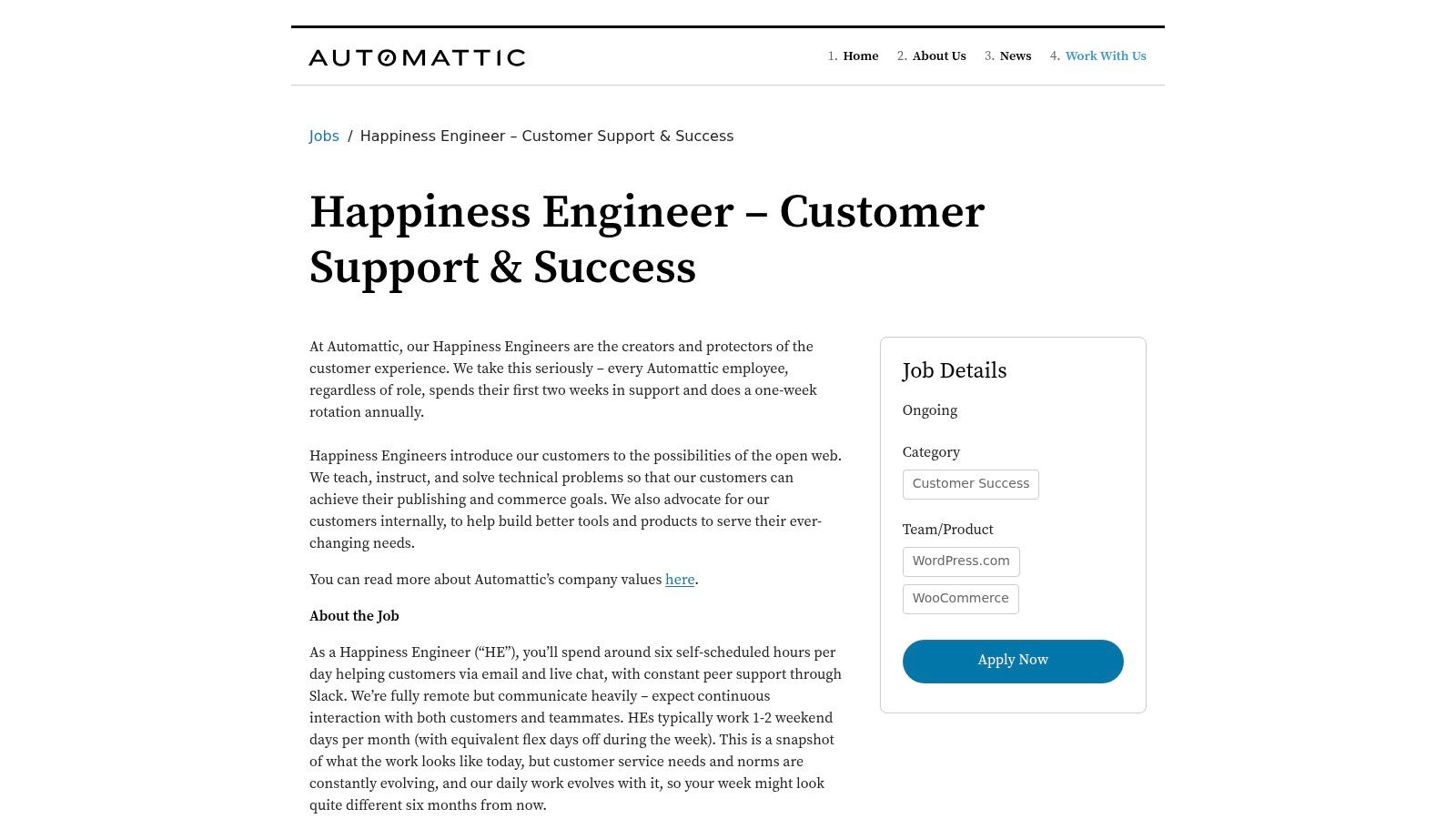
You find an Automattic support opening at 9:10 a.m. By lunch, dozens of qualified remote candidates have already seen it, and many of them know the company, the product, and the writing standard expected in the application. That is why Automattic matters in this article. It is not just a company to watch. It is a benchmark for how serious remote-first employers evaluate support talent.
Automattic’s “Happiness Engineer” role is a strong example of what higher-upside remote customer support jobs look like. The work usually sits at the intersection of support, product education, troubleshooting, and documentation. Candidates who only frame themselves as ticket closers tend to undersell their fit.
What makes this page useful is the hiring signal. A direct company posting tells you more than a recycled board listing ever will. You can study the language, the product context, and the quality bar, then adjust your resume, work samples, and application answers to match. That gives this source a different job in your search system. It is less about volume and more about calibration.
A few practical advantages stand out:
- Direct application path: You apply to the employer, not through a stack of reposts and aggregators.
- Clearer skill expectations: Strong writing, independent problem-solving, product judgment, and async communication usually matter here.
- Better career signal: Experience at a company like Automattic tends to translate well to SaaS support, success, and knowledge base roles elsewhere.
- Useful target-account strategy: Even when no role is open, this is the kind of company worth tracking closely so you can apply early when one appears.
There is a trade-off. Roles like this attract experienced support professionals, former moderators, technical support specialists, and applicants from other remote-first software companies. Competition is high, and generic applications get filtered out fast.
The best approach is specific. Show product curiosity. Show judgment in writing. Show that you can explain a fix clearly, document edge cases, and handle asynchronous communication without waiting for constant direction. If you have worked in a queue, translate that experience into outcomes: resolution quality, documentation improvements, escalation judgment, or customer education.
This is also where your source strategy matters. Large boards can help you discover companies like Automattic, but direct-source channels usually give you the timing advantage. Remote First Jobs is especially useful for that because it surfaces remote roles earlier than many candidates will find them through broader boards. Use that speed to identify strong-fit employers, then go straight to the company career page when the role is live.
If you want remote customer support work with stronger long-term upside, Automattic belongs on your watchlist whether you apply this week or not.
Website: Automattic Happiness Engineer roles
7. Help Scout: Direct‑Hire Roles at a Remote‑First CX Software Company
Help Scout is one of the best direct-hire company pages to watch if you want support work inside a company that builds customer support software.
That sounds obvious, but it matters. Companies that sell support tools usually care a great deal about support quality, internal documentation, customer communication, and process design. Those are good environments for support professionals who want to do more than clear a queue.
Why Help Scout is worth tracking
Support openings at Help Scout are periodic, so this is not a high-volume source. It is a target account.
That is exactly how you should treat it. Build a shortlist of remote-first companies whose product and support philosophy fit your strengths, then monitor them directly. Help Scout belongs on that shortlist because the company is remote-first and support-centered by design.
Strong reasons to keep it on your radar:
- Direct application path: Fewer layers between you and the hiring team.
- Support-aware culture: The company lives in the customer support world.
- Remote-first structure: Helpful if you want a company that already understands distributed collaboration.
- Good long-term positioning: A role here can be career-building because the domain itself is relevant across modern CX teams.
What applicants often miss
Candidates chase company brands but forget to customize for domain fluency. If you apply to Help Scout, show that you understand ticketing, knowledge bases, live chat, tone in written support, and the operational side of customer communication.
That is even more important in non-phone support roles. Verified data points to strong interest in written support work, including listings for chat and email-focused remote customer support jobs, plus hundreds of virtual entry-level roles in California emphasizing written skills and examples of non-phone work paying $25 per hour full-time with benefits, as summarized in the research tied to this remote customer support job reference. The takeaway is practical: if your edge is writing, clarity, and async problem-solving, say so plainly.
Help Scout is not the place for generic applications. It is the place for customized ones.
Website: Help Scout careers
Top 7 Remote Customer Support Jobs Comparison
| Item | 🔄 Complexity | ⚡ Resource requirements | 📊 Expected outcomes | 💡 Ideal use cases | ⭐ Key advantages |
|---|---|---|---|---|---|
| Remote First Jobs | Moderate: automated 24⁄7 crawling plus active curation | Low for users; membership details behind signup | High-quality, verified remote openings with first-mover advantage | Mid–senior remote roles, digital nomads, high-intent applicants | Direct-sourced listings; fast detection; reduced spam |
| We Work Remotely: Customer Support Jobs | Low: simple browsing, no account required | Minimal, free to use | Large volume of legit remote support listings; variable detail on pay | Quick scanning for entry–mid SaaS/support roles | Longstanding board with many direct-to-employer links |
| Remote.co: Remote Customer Service Jobs | Low: curated by team with clear labels | Minimal, free browsing with employer links | Consistent, curated posts with fewer spammy listings | Broad industry remote/hybrid support roles, including regulated sectors | Curated listings and explicit remote/hybrid indicators |
| Support Driven: Community-Sourced Jobs | Moderate: community participation and Slack engagement needed | Low monetary cost but time investment for networking | Higher-quality mid/senior and leadership roles; referral opportunities | Mid-to-senior CX, support leadership, specialized support engineering | Community-sourced roles, peer feedback and referrals |
| FlexJobs: Curated, Scam-Screened Listings | Moderate: account + paid subscription; human screening | Paid subscription; access to career resources and guarantees | Scam-free, hand-screened listings and improved interview readiness | Candidates valuing safety, coaching, and vetted remote roles | 100% hand-screened listings, career tools and satisfaction guarantee |
| Automattic: Direct‑Hire “Happiness Engineer” | High: competitive direct-hire process at mature company | Low monetary cost; requires product experience and schedule flexibility | Stable, career-oriented support role with growth and transparent pay | Experienced support pros seeking product-company career paths | Brand-name employer, mentorship, transparent salary bands |
| Help Scout: Direct‑Hire Roles | Moderate: company careers page; openings are periodic and competitive | Low monetary cost; domain/product experience beneficial | Career-focused support roles at a CX product company | Support professionals targeting CX-focused product companies | People-first culture, transparent compensation, direct applications |
Stop Competing, Start Connecting
The worst way to search for remote customer support jobs is a common approach. Open a giant board. Type “remote customer support.” Sort by date. Apply to whatever looks decent. Repeat until every listing looks the same.
That approach creates a lot of activity, but it does not produce much advantage.
A better approach starts with one simple assumption: the best remote jobs become crowded quickly, especially in support, where fully remote roles are limited and candidates from different backgrounds can all compete for the same opening. If you want better results, stop acting like a public-board applicant and start acting like a targeted sourcer.
That means using the right tools for different jobs.
Use Remote First Jobs when your priority is early discovery and verified direct-source listings. Use We Work Remotely and Remote.co to widen the net without diving back into the chaos of giant general boards. Use Support Driven when you need context, referrals, or a clearer picture of how support teams operate. Use FlexJobs if you want more screening and less junk. Then keep direct-hire company pages like Automattic and Help Scout on a watchlist because some of the best support jobs never need broad promotion.
The method matters as much as the source.
Apply early, but do not confuse early with sloppy. A rushed application with a generic resume still loses. A strong early application does three things well:
- It matches the channel mix: If the role is email and chat heavy, your resume should emphasize written support, documentation, and async workflow.
- It proves product thinking: Good support teams want people who can troubleshoot, explain clearly, and spot recurring issues.
- It respects the company’s setup: If a role mentions time zones, monitoring, CRM tools, or scheduling constraints, respond to that directly.
Another practical point. Human support still matters. Remote support work is changing because AI is handling more routine interactions, but that does not remove the need for people who can handle complexity, judgment calls, and emotionally loaded customer moments. If anything, it raises the bar. Employers increasingly want support professionals who can work well with tools, communicate clearly in writing, and operate without constant supervision.
That is why direct sourcing is such an advantage. You are not just trying to beat a crowd. You are trying to reach hiring teams while the role is still fresh, before application volume turns the process into a lottery.
If your search has felt frustrating, that does not mean you are unqualified. It often means your search workflow is too public, too late, and too noisy.
Fix the workflow first. Then improve the application.
A lot of support candidates also underestimate how much presentation matters. If you are changing industries, moving from phone support into chat or email, or trying to reposition yourself for a stronger remote role, sharpen your materials. A solid training video customer service program can help you tighten how you explain customer scenarios, tools, and communication style in interviews.
The goal is not to submit more applications. The goal is to submit better ones, earlier, to better companies.
If you want the cleanest path to fresh, verified remote roles, start with Remote First Jobs. It is built for applicants who are done fighting through stale listings, ghost jobs, and recruiter noise, and want direct-sourced openings from remote-first companies before the rest of the market piles in.