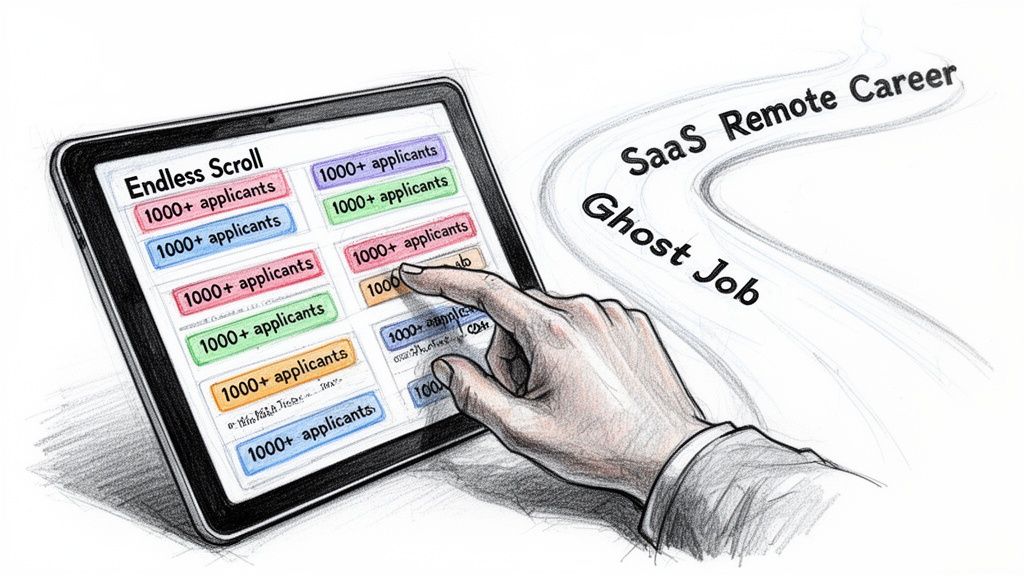
You are probably doing this right now: refreshing LinkedIn, opening the same remote filters, finding a role that looks perfect, and then seeing a pile of applicants so large you know your resume is walking into a stampede.
That burnout is rational. Mainstream job boards reward speed, but they rarely give you any. By the time a strong remote role gets pushed into the public feed, the crowd is already there. Add ghost jobs, agency reposts, and stale listings, and your search starts to feel less like strategy and more like punishment.
If you want a smarter path, focus on saas remote jobs and stop behaving like a late applicant on a mass-market platform. The people who win in this market do not just apply better. They find better openings earlier, target the right companies, and speak the language SaaS hiring teams already use internally.
Why SaaS Remote Jobs Are Your Best Bet in 2026
SaaS is still one of the cleanest bets in remote work.
The industry reached a global market value of $390.5 billion in 2025 and is projected to double by 2029, while medium-growth SaaS firms posted just 11% voluntary turnover, far lower than many other sectors, according to SellersCommerce’s SaaS industry data. That matters if you are mid-career and want something better than a flashy title at a shaky company.
A lot of industries talk about remote flexibility. SaaS tends to build around it. Software teams, product orgs, customer success groups, and revenue teams already work through systems like Slack, Jira, Notion, HubSpot, Salesforce, Intercom, and GitHub. That operating model makes distributed work easier to sustain.
Why this sector beats a generic remote search
A broad remote search creates junk. A SaaS-focused search creates relevance.
Here’s why I push clients toward SaaS first:
- Business models are easier to read. Subscription revenue, customer retention, onboarding, expansion, and product adoption create a clear story for hiring managers.
- Your impact is easier to frame. Whether you are in sales, support, operations, product, or engineering, SaaS companies usually care about measurable outcomes tied to growth and retention.
- Remote work is often built into the workflow. Async communication, documentation, and tool-based collaboration are normal, not awkward exceptions.
Who should target SaaS remote jobs
You do not need to be a software engineer.
SaaS companies hire across:
- Revenue roles like account executive, sales manager, SDR leader, partnerships, and rev ops
- Customer roles like onboarding, implementation, support, and customer success
- Operational functions like people ops, finance, recruiting, compliance, and program management
- Technical tracks like engineering, security, product, data, and design
Coach’s take: If you are exhausted by noisy job boards, do not search “remote jobs.” Search for a business model with real hiring demand and clear performance language. SaaS gives you both.
If you want a cleaner view of remote-first opportunities than the usual crowded platforms, keep https://remotefirstjobs.com/ on your shortlist while you build your target-company pipeline.
Identify High-Growth SaaS Companies Before They Post Jobs
The biggest mistake job seekers make is searching for jobs first.
Start with companies. Good SaaS hiring usually leaves clues before it leaves job listings.
In 2025, 87% of job seekers prioritized remote work, 64% wanted it for work-life balance, and 46% wanted location independence, yet fully remote US postings dropped to 11%, making structurally remote-first companies far more important to target, according to Girl Power Talk’s remote work trends roundup.
That means you cannot afford to waste energy on companies that merely tolerate remote work. You need companies that are designed for it.
Look for hiring signals, not open reqs
A SaaS company often shows its hand before posting the role you want.
Watch for signals like these:
New funding or major expansion news A fresh capital event often means hiring plans are about to follow. Check company press pages, founder posts, and investor announcements.
Leadership hires A new VP of Sales, Head of Product, or Chief Customer Officer usually means team building is next. One executive hire can create a chain of manager and IC openings.
Product launches and market expansion If a company announces a move into enterprise, healthcare, AI features, or international markets, expect demand across sales, customer success, implementation, support, product marketing, and operations.
A visible documentation culture If the company publishes thoughtful product updates, team handbooks, or async-friendly content, that is often a good sign for remote maturity.
Remote-first versus remote-friendly
These are not the same.
A remote-friendly company often has an office-centered culture with permission for some people to stay home. A remote-first company builds communication, management, promotions, and collaboration around distributed teams from the start.
Use this quick filter.
| Signal | Remote-friendly | Remote-first |
|---|---|---|
| Meetings | Office-centered | Designed for distributed participation |
| Documentation | Thin | Strong written culture |
| Hiring geography | Narrow exceptions | Broad distributed hiring |
| Promotion visibility | Often office-biased | Structured for remote advancement |
Build a target list you can use
Do not collect logos. Build a working list.
Track each company in a spreadsheet or Notion with these columns:
- Company name
- Why it fits your background
- Recent growth signal
- Remote model
- Likely roles
- Decision-maker names
- Career page URL
- Last checked date
Aim for a focused list of companies you would be happy to join. That gives you enough depth to personalize outreach and monitor career pages without turning your search into chaos.
Tip: If a company says “remote” but every executive post shows office photos, local happy hours, and city-specific hiring pushes, treat that as a warning. Culture leaks through content.
Find Openings Before the Competition with Direct Sourcing
This is a part many job seekers miss.
The standard job search is backwards. You wait for an aggregator to show you a role, then compete with everyone else who saw the same feed. By then, the listing has already aged, spread, and attracted a flood of attention.
The better move is direct sourcing. That means tracking roles from company career pages and employer ATS pages instead of relying on mass-market distribution.
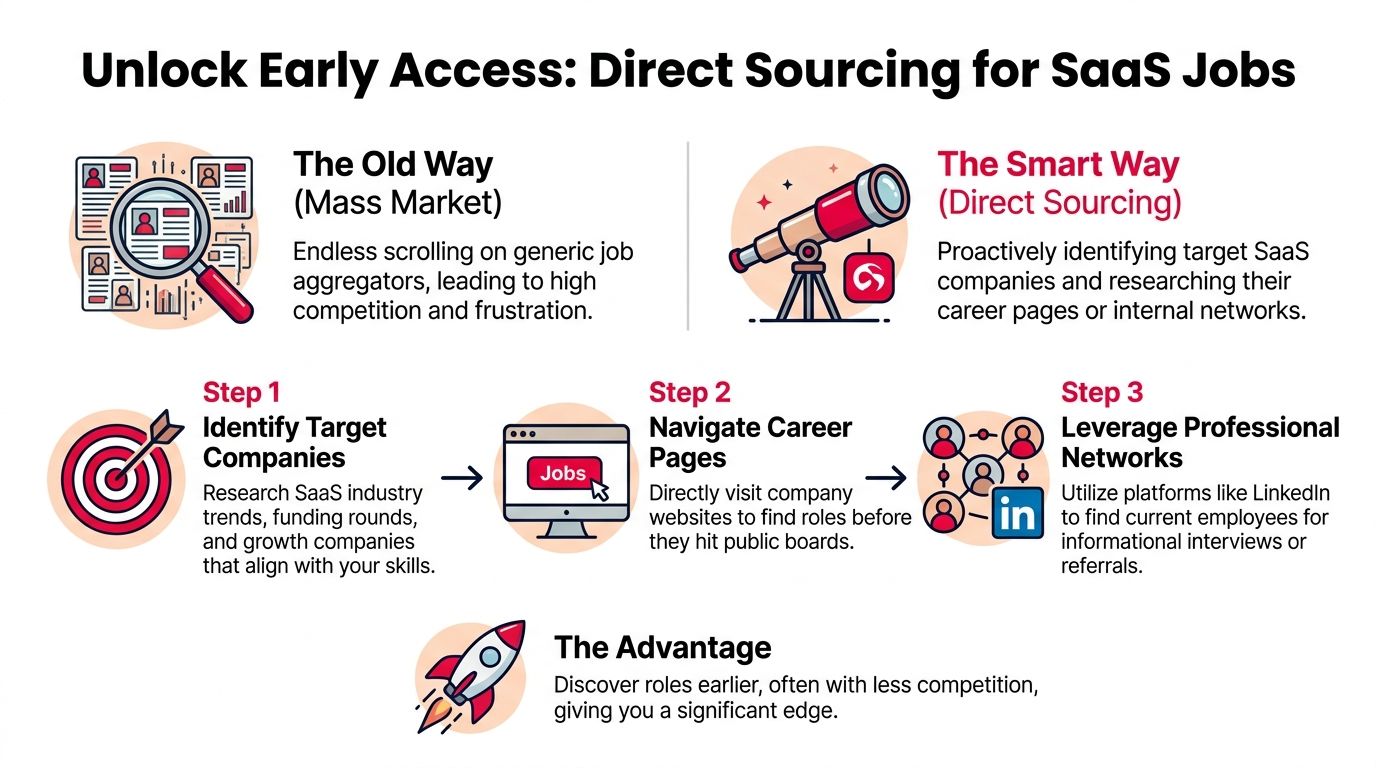
According to Cobloom’s guide to landing the best remote SaaS jobs, candidates who apply within the first 4 to 6 hours of posting often face fewer than 50 applicants, compared with the 1,000+ applicants common on major job boards for popular remote SaaS roles. That is not a small edge. That is the difference between being reviewed and being buried.
Why mainstream job boards hurt your odds
LinkedIn and Indeed are useful for market awareness. They are weak as your primary attack plan.
They create three problems:
- Delay Roles often spread after they are already live elsewhere.
- Noise You compete with reposts, agency listings, vague “pipeline” jobs, and stale openings.
- Crowding Popular remote jobs attract a public rush almost immediately.
The result is predictable. Strong candidates think they have a resume problem when they have a timing problem.
What direct sourcing looks like in practice
Use an operating rhythm.
Build a company watchlist
Start with the target companies from the previous section. Save their career pages, not just the homepage.
Check where they host jobs. Common ATS platforms include Greenhouse, Lever, Ashby, and Workable. Once you know that, you can monitor openings faster and more consistently.
Check for freshness, not volume
You do not need hundreds of listings. You need fresh listings at companies you already vetted.
When a role appears:
- Read the posting once for fit
- Save the URL
- Apply quickly if you match the core requirements
- Customize your resume to the exact language of the role
- Follow up with targeted outreach if appropriate
Add a referral layer
Direct sourcing works even better when paired with selective networking.
Use LinkedIn for one thing here: find current employees in the function you want. Ask a smart question. Mention your relevant background. Keep it short. If the conversation goes well, request a referral only after you have already applied.
Key takeaway: Stop trying to outshout the crowd on giant job boards. Arrive before the crowd forms.
My opinion on “easy apply”
For serious saas remote jobs, “easy apply” is usually a trap.
It encourages volume over relevance. It also puts your application in the same pile as everyone who clicked two buttons during lunch. Hiring teams know the difference between a direct application customized for the company and a generic blast.
Use aggregators as radar. Use direct sourcing as your real search strategy.
Optimize Your Resume for SaaS Roles and ATS Scans
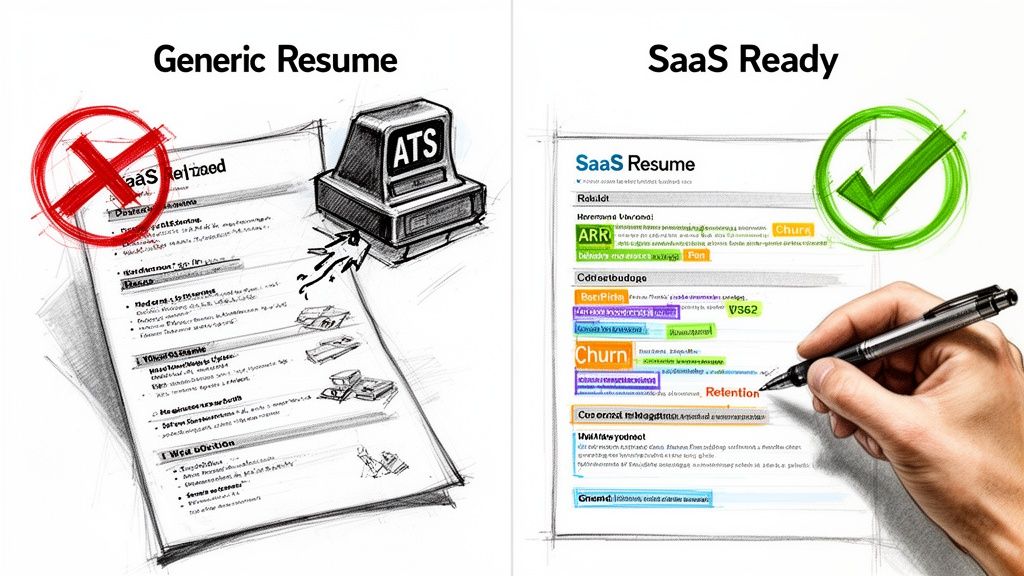
Most resumes fail in SaaS because they sound like generic corporate history.
Hiring teams do not want a diary of responsibilities. They want proof that you understand how SaaS businesses work. That means your resume should speak in terms of customer outcomes, revenue impact, retention, onboarding, implementation, adoption, expansion, and operational efficiency.
For non-technical roles, domain expertise often matters more than coding. Many of the 1,716+ healthcare SaaS remote jobs prioritize healthcare experience, while senior sales roles often want fluency in MEDDPICC, as outlined in one healthcare SaaS remote listings overview.
Translate your background into SaaS language
A weak resume says, “Managed client relationships.”
A strong SaaS resume says things like:
- Owned onboarding for strategic accounts across a subscription product
- Reduced time-to-value by improving implementation handoffs
- Partnered with product and support to resolve adoption blockers
- Built lifecycle campaigns for activation, expansion, and retention
- Managed enterprise pipeline using MEDDPICC qualification
Same person. Different language. The second version tells the company you already understand the business.
What ATS wants
ATS is not magic. It is a parsing and matching system.
If the role says “customer onboarding,” “renewals,” “pipeline management,” “product adoption,” or “API integrations,” your resume needs those exact ideas where they apply. Do not keyword-stuff. Do not paste the job description. Mirror the language of the role with proof from your own experience.
Use this framework.
Headline
Your title should align with the target role.
Examples:
- Customer Success Manager for B2B SaaS
- Product Marketing Manager for Subscription Software
- Enterprise Account Executive in Healthcare SaaS
- Technical Program Manager for Distributed Software Teams
Bullet points
Each bullet should answer one of these:
- What business problem did you solve?
- What process did you improve?
- What customer or revenue outcome did you influence?
- What cross-functional tools or workflows did you own?
Skills section
Keep it practical. Include tools, workflows, and domain language.
Examples:
- Salesforce
- HubSpot
- Intercom
- Jira
- Notion
- MEDDPICC
- Customer onboarding
- Renewal management
- SaaS implementation
- API coordination
- Healthcare workflows
Before and after thinking
Here’s the mindset shift.
| Generic wording | SaaS-ready wording |
|---|---|
| Managed accounts | Led renewals, adoption, and expansion across B2B SaaS accounts |
| Worked with teams | Partnered with product, support, and sales on onboarding and retention |
| Improved operations | Optimized implementation workflows and reduced customer friction |
| Handled campaigns | Built lifecycle campaigns tied to activation and product usage |
Resume rule: Every bullet should make a hiring manager think, “This person already knows how our business runs.”
If your experience is outside SaaS, do not apologize for it. Translate it. Healthcare, finance, ecommerce, logistics, education, and operations backgrounds can all map well when you frame them around process, customer outcomes, and domain knowledge.
Ace the Remote SaaS Interview and Asynchronous Tests
The remote SaaS interview process is designed to verify one thing: can you operate with trust, clarity, and low supervision?
That is why these interviews often feel more rigorous than old-school office hiring. The company is not just checking competence. It is checking whether you can produce without constant hand-holding.
Indeed shows only 639 entry-level SaaS remote jobs, and even those often ask for a “proven track record.” For mid-senior candidates, companies commonly validate that track record through practical assignments and deep portfolio reviews, as reflected in Indeed’s entry-level SaaS remote job market.
What the process usually feels like
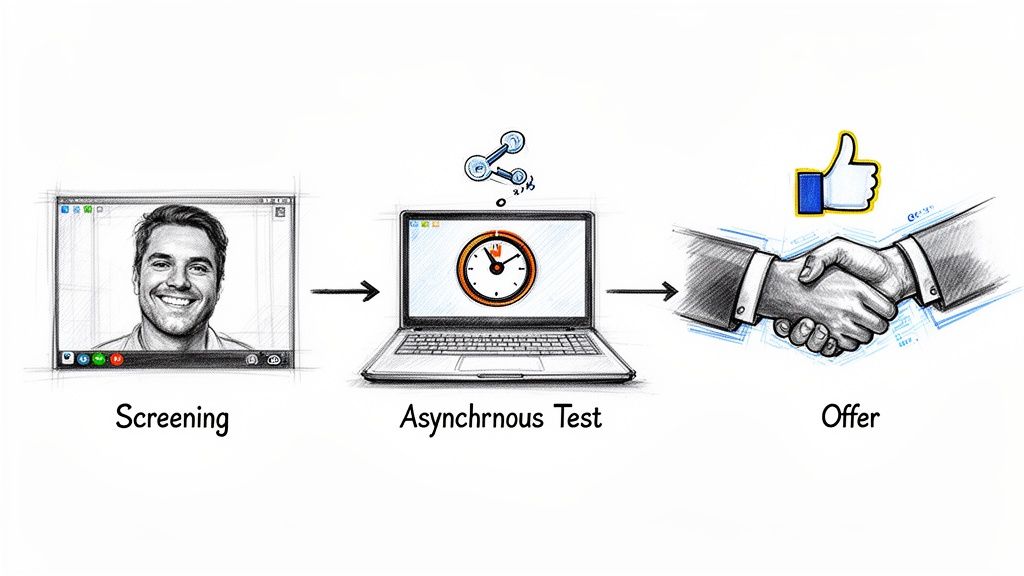
A typical flow looks something like this:
Recruiter or hiring screen They test fit, motivation, compensation alignment, and communication style.
Manager interview Your judgment gets tested here. Expect situational questions, not just resume walkthroughs.
Practical task or async assignment Common for product, marketing, operations, customer success, design, and engineering roles.
Panel or cross-functional interviews Teams want to see how you think, explain tradeoffs, and collaborate.
Final conversation This often focuses on culture, ownership, and how you work remotely.
How to handle the async test like a pro
Most candidates make one of two mistakes. They either rush the assignment and look sloppy, or they overbuild it and ignore the brief.
Do this instead:
Clarify the objective
Before you start, ask what success looks like. Not in a needy way. In a sharp way.
Good questions:
- Which audience should I optimize this for?
- Should I prioritize speed, depth, or executive clarity?
- How would your team use this deliverable in the role?
Show your reasoning
Do not just submit the artifact. Submit your thinking.
If you create a strategy deck, include a short note explaining:
- assumptions
- tradeoffs
- what you would do with more time
- where you would validate with real data or customer input
That is how remote teams work. They write decisions down.
Respect the brief
If they ask for a short plan, do not send a bloated presentation. If they ask for recommendations, do not disappear into theory.
The assignment is often a disguised communication test.
Here’s a useful primer before your next round:
What hiring teams notice in video interviews
Remote interviews reward a specific style.
They notice whether you:
- answer directly
- structure ideas clearly
- stay concise
- reference real examples
- listen well
- sound comfortable working asynchronously
A strong answer usually includes context, your action, your judgment, and the result. Keep it clean. No rambling autobiography.
Interview tip: In remote hiring, clarity reads as competence. If your answer is hard to follow, people assume your day-to-day collaboration will be hard to follow too.
Follow-up that helps
After an interview, send a short note. Do not write a generic thank-you paragraph.
Write something useful:
- one takeaway from the conversation
- one business challenge you are excited to help solve
- one sentence reinforcing why your background matches the role
That kind of follow-up sounds like a future teammate, not a nervous applicant.
Negotiate Your Salary and Spot Red Flags in an Offer
A lot of remote candidates negotiate badly because they anchor to their local market.
That is a mistake. A SaaS company is not hiring your zip code. It is hiring your ability to solve problems, own outcomes, and operate independently. Frame your compensation around the role, your track record, and the scope you will carry.
Do not apologize for negotiating. Just be specific.
How to negotiate without sounding awkward
Keep your language calm and businesslike.
Try this structure:
- Reaffirm interest in the role
- Reference the value you bring
- State the package area you want to revisit
- Ask whether there is flexibility
Example: “I’m excited about the role and the team. Given the scope of the position and the experience I bring in this area, I’d like to revisit the compensation package. Is there flexibility on base, equity, or remote support?”
You do not need a speech. You need control.
What to evaluate beyond salary
A remote SaaS offer is not just base pay.
Check for:
- equipment policy
- home office support
- travel expectations
- meeting load
- manager timezone
- promotion criteria
- written remote-work norms
- performance expectations in the first months
If the company cannot explain how remote employees grow, that is a management problem.
Remote SaaS Company Red Flag Checklist
| Red Flag | What It Might Mean |
|---|---|
| Vague answer on working hours | They may expect constant availability |
| No clear documentation culture | Decisions may live in private meetings |
| Heavy surveillance language | Low trust management |
| “We move fast” without process clarity | Chaos dressed up as ambition |
| Interviewers contradict each other | Internal misalignment |
| No specifics on onboarding | You may be set up to improvise without support |
| Promotion answers are fuzzy | Remote employees may be second-class citizens |
| Endless meetings described as collaboration | Poor async habits |
The best remote jobs give you autonomy with clarity. The worst ones give you ambiguity with pressure. Learn the difference before you sign.
Your SaaS Remote Job Search Questions Answered
Can I move into SaaS from another industry
Yes, but do not pitch yourself as a beginner if you are not one.
Reframe your experience around transferable value. If you worked in healthcare, finance, education, ecommerce, or logistics, you already understand workflows, stakeholders, customer pain, and operational constraints. SaaS companies pay for that context when it matches their buyers.
Say “I know this customer” before you say “I want to learn SaaS.”
Do I need to know how to code
No. Many saas remote jobs sit in sales, marketing, customer success, support, operations, partnerships, recruiting, finance, and implementation.
What matters is whether you understand the function, the buyer, the product motion, and the tools of the role. For some jobs, product fluency matters. Coding does not.
How many jobs should I apply to each week
Ignore arbitrary quotas.
Apply to fewer roles with better timing and sharper tailoring. A targeted application to a fresh role at a vetted SaaS company beats a batch of generic applications to crowded listings.
What if I do not have direct SaaS titles on my resume
Use the right language without faking your background.
If you handled onboarding, renewals, account growth, implementation, support workflows, technical stakeholders, or recurring client relationships, you can translate that experience into SaaS terms. The key is accurate framing.
Should I still use LinkedIn at all
Yes, but for the right jobs.
Use it to:
- research employees
- confirm leadership changes
- follow target companies
- support referral outreach
Do not depend on it as your primary source of fresh openings.
How do I know if a role is remote
Read for operating reality, not branding.
Check:
- timezone limits
- travel expectations
- office attendance language
- collaboration norms
- where the manager sits
- whether the posting says remote-first, distributed, or work from anywhere
If the company avoids specifics, ask directly.
Is entry-level SaaS remote hiring realistic right now
It is possible, but tight.
Junior candidates need a more creative route. That can include contributor work, contract projects, adjacent support roles, implementation work, portfolio building, certifications tied to tools like Salesforce or HubSpot, and strong domain positioning. The easier your value is to verify, the easier it is for a company to take the risk.
If you are tired of stale listings, ghost jobs, and showing up after the crowd, start using Remote First Jobs. It helps you find verified remote roles sourced directly from company career pages, so you can apply earlier, skip the junk, and focus on real opportunities at remote-first companies.