Turn Your Career Gap Into Your Greatest Strength
You open your resume, scroll to the gap, and feel the same hesitation every time. You know what happened in that period. Caregiving, a layoff, recovery, retraining, relocation, freelance work, or a needed reset. Hiring teams, though, only see the blank space unless you give it context and structure.
Career gaps are common. As noted earlier in the research cited in this article, many job seekers now have at least one break in their work history. The problem is not the gap itself. The problem is presenting it in a way that raises unnecessary questions.
Remote hiring changes the equation.
For strong remote roles, recruiters and hiring managers often care less about perfect chronology and more about current relevance. They look for evidence that you can communicate clearly, manage work independently, document decisions, collaborate across time zones, and stay productive without close supervision. A vague gap can create doubt. A well-framed gap can show judgment, resilience, and momentum.
That is why this guide focuses on strategy, not concealment.
You’ll see seven distinct resume frameworks for handling employment gaps effectively and intelligently, each with a different trade-off. Some formats push skills and recent capabilities to the front. Some make the timeline clearer and pair it with context. Others work best if you did freelance work, contract projects, volunteer leadership, coursework, or caregiving that built relevant strengths during the break.
You’ll also get copy-paste examples, ATS-friendly keywords for remote jobs, and practical guidance on when each format helps, and when it can hurt. The goal is simple. Present your gap as part of a credible, well-positioned career story that stands up in both applicant tracking systems and human review.
1. The Functional Resume Skills-Forward Approach
A recruiter opens your resume for a remote role and sees a two-year gap near the top. If the next thing they see is a clear record of relevant skills, tools, and outcomes, you still have a path to an interview. If they see vague claims and no structure, the gap becomes the story.
That is where the functional resume can help.
This format puts capability before chronology. It works best when you have current, job-relevant strengths that deserve the first screen of attention, especially if your recent experience includes freelance work, consulting, caregiving, coursework, volunteer leadership, or independent projects rather than a clean full-time timeline. For remote jobs, that can be a real advantage because hiring teams often screen first for execution signals such as written communication, documentation habits, autonomy, and tool fluency.
Use it carefully.
For senior roles, finance roles, and positions with strict background checks, a heavily de-emphasized timeline can create more questions than it solves. I usually recommend the functional format only when the skills section is strong enough to carry real proof, not just soft descriptors.
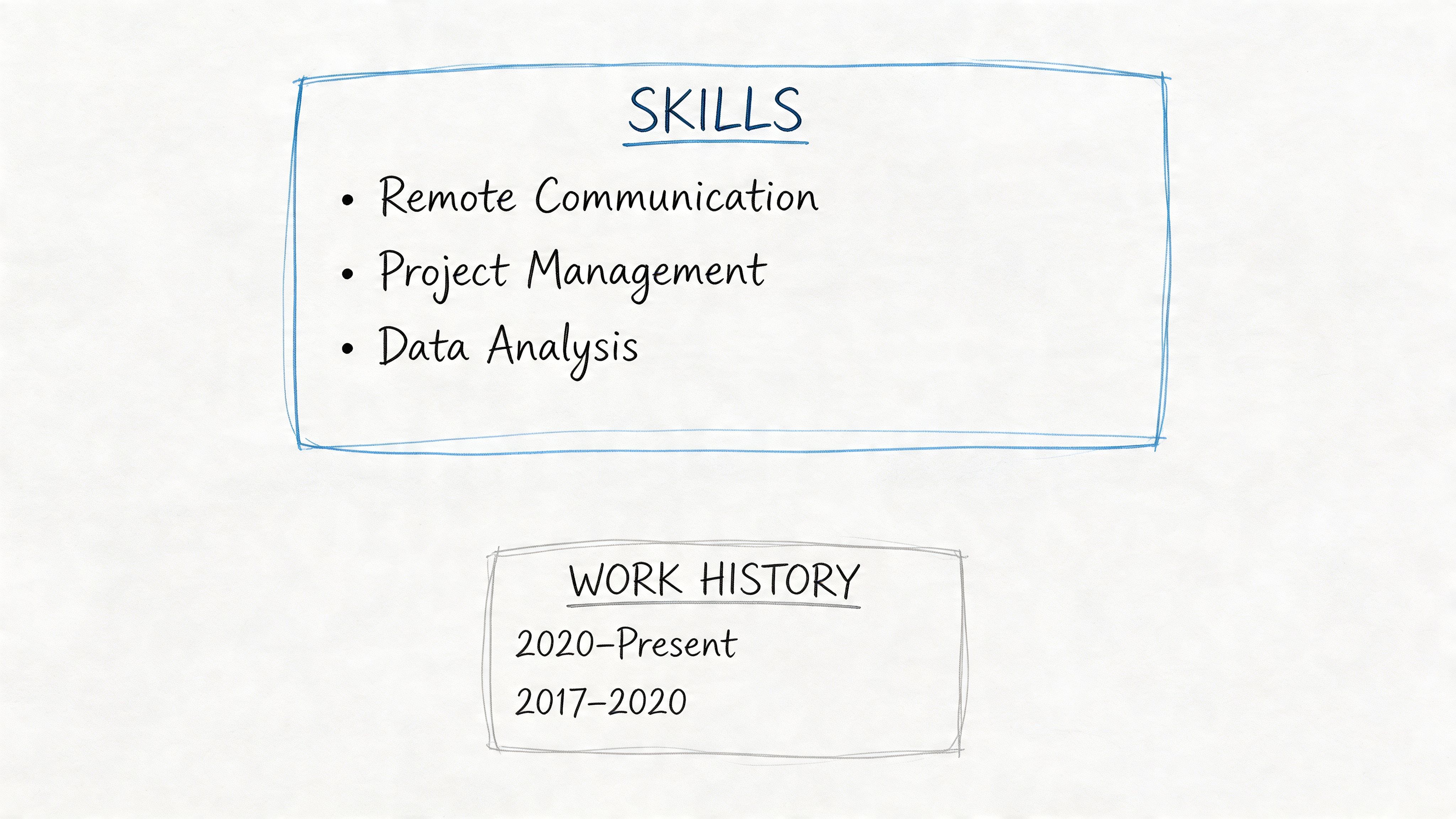
What it looks like in practice
A functional resume usually starts with a headline and short summary, followed by 3 to 5 skill categories tied to the target job. Under each category, include evidence. Then add a brief timeline near the bottom so the chronology is still visible.
For remote roles, the right keywords matter. ATS systems and recruiters often search for terms like async communication, project ownership, cross-functional collaboration, stakeholder management, documentation, CRM, SEO, SQL, Jira, Notion, Figma, HubSpot, Salesforce, Tableau, GitHub, or role-specific tools in your field.
Here is a copy-ready example for a mid-career marketer returning after a sabbatical:
Professional Summary
Remote content strategist with experience in SEO planning, editorial operations, stakeholder communication, and performance reporting. Built clear workflows for distributed teams and managed content production with limited supervision.Core Skills
Content Strategy: Created editorial calendars, keyword briefs, and content roadmaps aligned to search intent and business goals
Performance Analysis: Used GA4, Google Search Console, and HubSpot data to refine topics, update underperforming pages, and report results
Remote Collaboration: Coordinated reviews, approvals, and handoffs across distributed teams using documented processes
Project Ownership: Managed content from brief to publish, tracked deadlines, and kept stakeholders informed without constant check-insProfessional Timeline
Content Marketing Manager, BrightWave Media
Marketing Specialist, Northstar Digital
Career Break and Professional Reset
That last line matters. It keeps the format honest. The goal is not to hide the gap. The goal is to stop the gap from swallowing the rest of the resume.
When this format helps, and when it hurts
The functional approach is one of the seven strategic frameworks in this guide because it solves a specific problem. It helps candidates who have relevant skills right now but a timeline that needs less visual emphasis. It also gives you room to include ATS language near the top of the page, where both software and recruiters are more likely to catch it.
The trade-off is credibility. A weak functional resume can look defensive fast. Hiring managers know this format is sometimes used to blur dates, so every skills section needs concrete proof.
Use these guidelines:
- Match the job description closely: Mirror the posting’s language for tools, methods, and responsibilities so your resume is easier for ATS systems to classify.
- Write proof, not personality traits: “Managed approvals across distributed teams” is stronger than “excellent communicator.”
- Include remote-specific evidence: Add async communication, documentation, time-zone coordination, and self-directed execution only if you can support them with examples.
- Keep a visible timeline: A short chronology section lowers suspicion and shows you are not trying to obscure your history.
- Use this format only if the top half is strong: If you cannot show current, relevant capability quickly, a hybrid resume is usually safer.
One practical guardrail applies here. Keep the document focused on recent, relevant experience and avoid overloading the page with every past role or skill. Functional resumes become weaker when they read like a keyword dump.
2. The Hybrid Resume Timeline and Skills Blend
If the functional format feels too evasive, the hybrid resume is usually the safer choice. It gives you the benefit of a prominent skills section while preserving a readable work history.
This is the format I recommend most often for remote professionals with a moderate gap. It shows confidence. You’re not pretending the break didn’t happen, but you’re also not letting it dominate the page.
Why recruiters respond to this format
A hybrid resume works because it answers two questions fast. First, can you do the job? Second, is your timeline credible?
That combination matters because unexplained gaps still create friction. In a ResumeGo study discussed by SHRM, candidates with employment gaps of 2 to 3 years saw interview callbacks drop from 9.8% to 4.6%, a 45% reduction. The same coverage notes that candidates who explained their gaps got nearly 60% more interviews than those who left them unexplained.
That’s the core logic behind the hybrid format. Explain just enough. Then move attention back to capability.
Sample structure you can copy
For a software engineer with a health-related break, the top of the resume might look like this:
Headline
Software Engineer | Backend Systems | Remote CollaborationCore Competencies
Python, APIs, PostgreSQL, AWS, GitHub Actions, system documentation, async communication, sprint planning, incident responseSelected Highlights
Shipped backend features in Python and Django
Maintained internal documentation for cross-functional teams
Built self-directed learning projects during career break
Then keep the timeline clean:
Experience
Senior Software Engineer, Oakline Systems
Software Engineer, LayerPoint
Career Development and Recovery (brief health-related break, continued technical study and project work)
Best trade-offs for remote applications
The hybrid format gives you more credibility than a pure functional resume. It’s also easier to align with LinkedIn, which matters because recruiters often compare your profile to your resume.
Use a short parenthetical only when it helps. Something like “Career Development: self-directed learning in Python and React” is enough. You don’t need a life story.
Keep gap explanations to one or two lines. If you need a full paragraph to justify a break, save it for the cover letter or interview.
For remote-first roles, I’d place these keywords high on the page when they’re true: remote team leadership, written communication, documentation, project ownership, Slack, Zoom, Notion, Loom, Jira, Asana, customer-facing communication, and cross-time-zone coordination.
3. The Narrative Gap Explanation Resume
Sometimes the strongest move is directness. Not dramatic directness. Calm, professional directness.
A narrative gap explanation resume includes a short Career Note or Professional Journey section near the top. This works well when your break was significant, values-driven, or central to your current direction. It also fits companies that openly talk about well-being, inclusion, or sustainable work.
When honesty becomes a strength
This format is effective because it removes the recruiter’s need to guess. They see the gap, they see the reason, and they see what you did with that time.
That matters because explained career breaks perform better than silent ones. Harvard Business Review’s analysis of LinkedIn survey data reports that resumes with explained career breaks saw 35 to 50% higher shortlist rates in tech, marketing, and product roles. The same analysis notes a default rejection rate of 52% for unexplained gaps over six months.
Those numbers don’t mean every recruiter will love a narrative section. They do mean silence is often the weaker option.
Copy-paste examples
You don’t need to sound polished to the point of being fake. You need to sound settled.
Here are three examples:
Career Note
During 2022 and 2023, I stepped away from full-time work to recover from burnout and reset how I work. During that period, I completed AWS-focused learning, maintained technical practice, and became more intentional about sustainable remote collaboration.Career Note
I took an 18-month break from formal employment to support my family through a major transition. That period strengthened my time management, communication, and prioritization skills, and it clarified that I do my best work in flexible, remote-first environments.Career Note
In 2021, I shifted from finance toward software engineering through structured learning and portfolio building. That transition made me more deliberate about problem-solving, documentation, and working independently.
The line between confident and over-explained
This format breaks down when candidates sound apologetic. Avoid phrases like “unfortunately,” “due to difficult circumstances,” or “I hope this won’t count against me.” None of that helps.
Use a short note, then let the rest of the resume prove momentum. Tie the gap to something job-relevant: learning, resilience, better work habits, portfolio development, or clarity about remote work.
A narrative resume is often strongest for values-driven employers, smaller distributed teams, nonprofits, mission-led startups, and companies that write thoughtful job descriptions instead of generic ones.
4. The Skills-Based CV With Freelance and Project Work Section
A recruiter opens your resume, sees a gap, and looks for proof that you kept working at a professional level. This format gives them that proof fast. If you handled client work, built projects, contributed to open source, supported a nonprofit, or completed serious portfolio-based training, that period does not belong in a blank space.
For remote roles, this approach is especially strong because it highlights the exact signals hiring teams look for. Self-direction. Written communication. Ownership. Delivery without close supervision. Instead of trying to hide a gap, you turn it into a record of output.
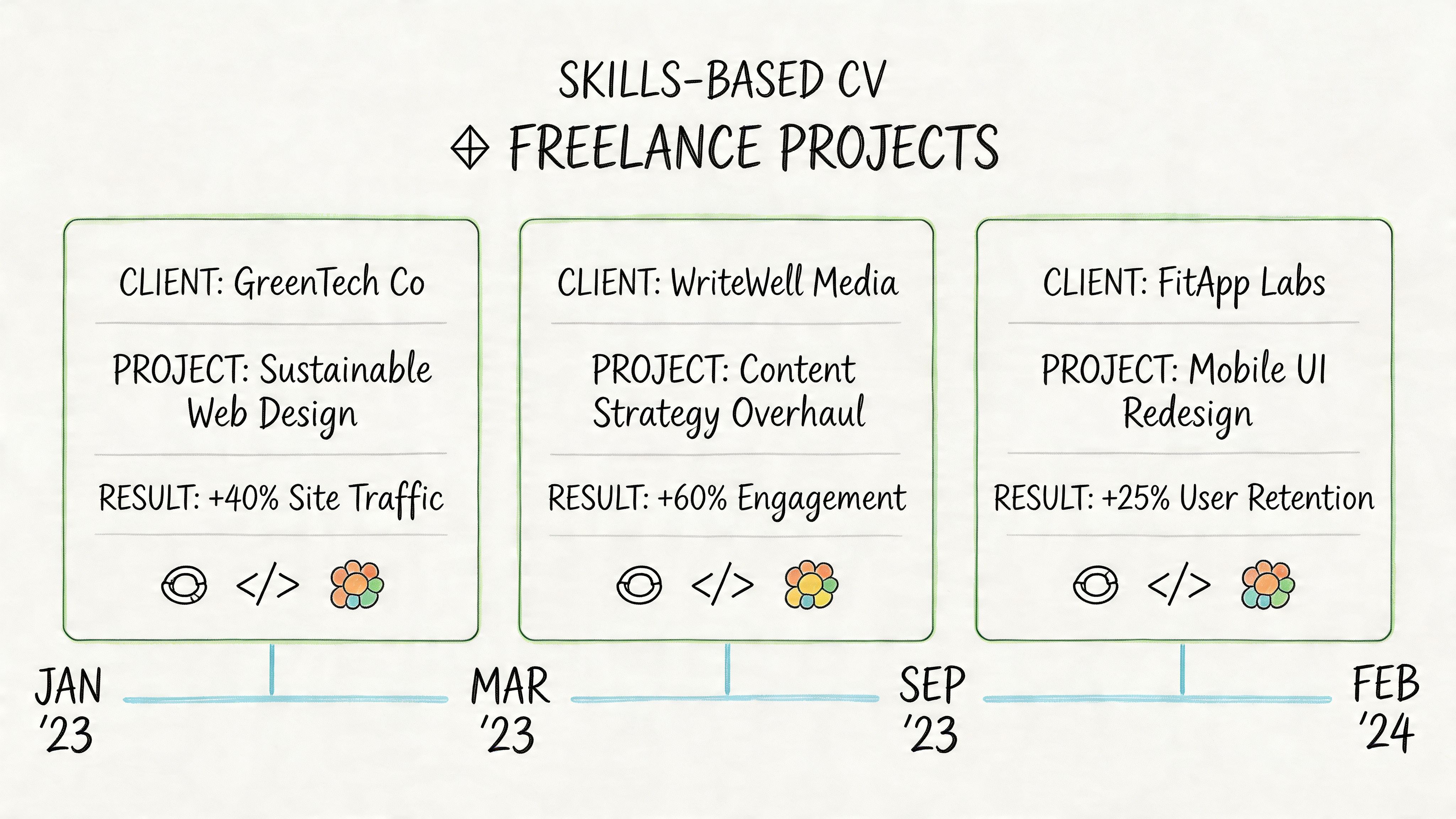
Here’s a visual example of how that section can look:
How to turn projects into legitimate experience
The strongest resumes in this format treat freelance and project work like real work history. That means clear role labels, a date range, the setting if relevant, and bullets that show scope, tools, and results. Hiring managers do not need a long explanation. They need enough detail to understand what you owned and whether it transfers to the role.
Use a structure like this:
Independent Projects and Consulting
Freelance Web Developer | Remote | 2022 to 2024
Built and launched WordPress sites for small business clients, managing revisions, QA, and handoff documentation
Created reusable React UI components for a personal design system project
Contributed bug fixes and documentation improvements to open-source GitHub repositories
ATS keywords: WordPress, React, front-end development, client communication, QA testing, documentation, remote collaboration
Or for a marketer:
Consulting and Portfolio Work
Content Consultant | Remote | 2023 to 2024
Developed messaging frameworks, content briefs, and editorial calendars for early-stage startups
Built and maintained a niche content site with a consistent publishing workflow
Completed hands-on training in GA4, SEO research, email automation, and reporting
ATS keywords: content strategy, SEO, GA4, editorial planning, email marketing, analytics, remote work
That ATS line matters more than many candidates realize. A skills-based CV only works if the language matches the job description closely enough to pass the first screen.
What belongs in this section
Use work that shows professional judgment, consistent execution, or relevant skill growth. Good options include:
- Freelance or contract work: Client projects, retainers, one-off builds, advisory work
- Volunteer operations: Nonprofit scheduling, admin systems, website updates, event support, donor communications
- Open-source contributions: Code commits, issue triage, QA, documentation, community moderation
- Structured learning with deliverables: Bootcamps, certificate programs, capstones, cohort projects
- Self-initiated projects: Portfolio sites, apps, dashboards, knowledge bases, process documentation, newsletters
I tell clients to apply one filter. Would a hiring manager understand the business value of the work in under 10 seconds? If not, rewrite it until they can.
The trade-off with this format
This structure is strong, but it asks for specificity. If the projects are vague, small, or disconnected from your target role, the section can read like filler. That is the risk.
The fix is simple. Curate hard. Choose three to five pieces of work that support the remote job you want now, then write bullets around outcomes, tools, and ownership. A capstone project can belong here if it solved a real problem, used job-relevant tools, and gave you something concrete to discuss in an interview. As noted earlier, even formal study can be framed well when it includes applied project work rather than just course titles.
Copy-paste framework
Use this template:
Projects, Consulting, and Freelance Work
Role or Project Type | Remote | Date Range
Delivered [project or service] for [client type, organization type, or audience]
Used [tools, platforms, or methods] to complete [specific scope of work]
Improved, created, launched, documented, or supported [clear outcome]
ATS keywords: [insert 5 to 8 terms from the target job description]
This is one of the most practical resume formats for candidates re-entering the market for remote work. It shows momentum. It gives interviewers something real to ask about. And it helps you control the story with evidence instead of apology.
A quick walkthrough can help if you’re building this section from scratch:
5. The Achievements-Forward Resume With Timeline Sidebar
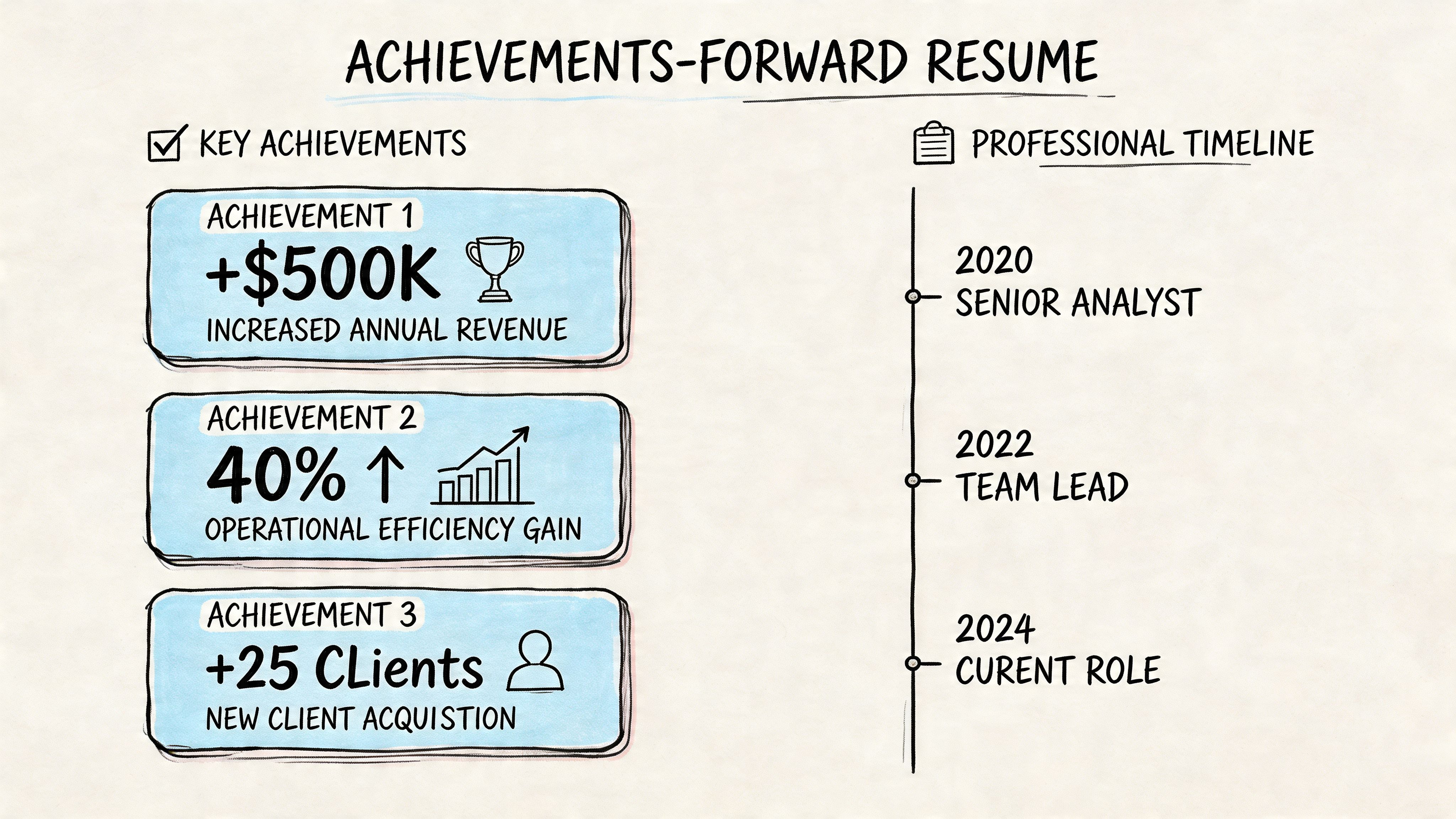
This is the strongest format for senior candidates who already have credible accomplishments and don’t want the gap to become the headline. The layout puts major wins, scope, and business impact in the main column, while the timeline sits in a side rail or compressed bottom section.
I like this format for senior marketers, product managers, operations leaders, and directors applying for remote roles where outcomes matter more than a perfectly linear path.
What this format gets right
A recruiter scanning a senior resume wants fast proof of scope. Team leadership. Operational complexity. Product launches. Revenue influence. Cross-functional execution. The achievements-forward format answers that before they get hung up on exact dates.
It also fits the reality of remote hiring. Remote-first employers often care a lot about signal density. If the top half of the resume immediately shows ownership, communication, and delivery, you buy yourself more attention.
A sample structure might look like this:
Selected Achievements
Led distributed team operations across multiple time zones
Built documentation systems that improved project handoffs
Owned cross-functional launches involving product, design, and customer teams
Standardized reporting workflows using dashboards and recurring stakeholder updates
Then the sidebar or footer contains:
Career Timeline
Head of Operations, Company A
Operations Director, Company B
Career Break and Consulting
Operations Manager, Company C
The risk to watch
This format fails when design overtakes clarity. A beautiful two-column layout that confuses ATS parsing is not helping you. Keep the file simple. Standard headings. Standard fonts. No text boxes packed with critical information if you can avoid them.
Practical rule: If a recruiter can’t understand your top achievements in ten seconds, the format is too clever.
Also, don’t invent metrics to make the achievements section look more impressive. If you have exact numbers, use them. If you don’t, describe scope qualitatively and focus on responsibility, systems, tools, and business context.
This is one of the cleanest options when your gap is real, your career story is strong, and your next role is senior enough that impact deserves top billing.
6. The Mini CV Format With Employment Gap Addendum
Sometimes the cleanest resume is the shortest one. That’s where the mini CV approach works well.
Your main resume stays tight, usually one page for a focused application or a compact two-page version for senior roles. Then, if needed, you attach a separate Career Context document that explains the gap, highlights what you did during that period, and reinforces why you’re ready now.
Why this helps in selective remote hiring
This approach is useful when you want the application to stay sharp but don’t want to dodge the issue. It’s especially effective for candidates with a long break, a sensitive reason for the gap, or a major career pivot.
It also respects the reality that resumes and interviews serve different purposes. The resume earns attention. The addendum handles context.
A Career Context page might look like this:
Career Context
Jan 2022 to Sep 2023
Professional Development and Career Reset
Completed structured learning in cloud tools and remote project workflows. Built personal projects to maintain technical fluency and returned to the market with a clear focus on distributed, documentation-heavy teams.
Or:
Career Context
2023 to 2024
Family Care and Professional Maintenance
Took time away from full-time work to provide primary family support while continuing industry reading, skills refresh, and selective project work. Seeking a remote role that values ownership, communication, and steady execution.
When to send it and when not to
Don’t attach an addendum to every application by default. Use judgment.
It helps when:
- The gap is central: The break is long enough that recruiters will notice and likely wonder.
- The role is high-trust: Leadership, client-facing, or operational roles where context matters.
- The company writes thoughtful job ads: These teams are more likely to read beyond the first page.
Skip it when:
- The ATS is rigid: Some systems handle extra documents poorly.
- The application is very high-volume: In those cases, a hybrid resume may do the job better.
- Your gap can be explained in one line: Don’t create more material than the situation needs.
A mini CV setup also works nicely when you’re switching fields. Keep the resume focused on your target direction, then use the addendum to explain why the gap and transition make strategic sense.
7. The Values-Aligned Honest Timeline Resume
A recruiter opens your resume, sees a two-year break, and keeps scanning because the timeline answers the question before doubt sets in. That is the job of this format.
The values-aligned honest timeline resume keeps a standard chronological structure and names the gap directly as part of your work history. For the right employer, that reads as judgment, stability, and self-awareness. It works especially well for remote roles because strong distributed teams care less about a flawless timeline and more about whether your story is clear, credible, and aligned with how they operate.
Use a real label for the gap period. Good options include Career Development, Family Care, Health and Recovery, Full-Time Caregiver, Professional Study, or Career Transition. Keep the title plain. Recruiters do not need clever phrasing. They need context they can process fast.
Use this when alignment matters more than spin
This format fits companies that talk openly about flexibility, caregiver support, well-being, inclusion, or nontraditional career paths. It is also a smart choice for remote roles built on trust, written communication, and autonomy. If a company says it hires adults who can manage work and life responsibly, this resume format gives them a chance to prove it.
There is a trade-off. A direct timeline will not appeal to every hiring team. Some recruiters still prefer candidates who present a more conventional work history. That is fine. This format is selective by design. It helps you target employers whose values match the kind of work life you want.
Here is the structure:
Career Development | 2022 to 2023
Completed focused professional study, maintained industry knowledge, and rebuilt work routines around sustainable remote performance.Full-Time Caregiver | 2019 to 2021
Managed scheduling, records, and daily coordination responsibilities while maintaining professional development.Career Transition | 2021
Pursued structured training and portfolio work to move into a new function.
Job-Hunt’s guidance on resume employment gaps supports the core idea behind this approach. Recent activity, relevant skills, and clear framing often matter more than a perfect sequence of dates, especially when the candidate shows continued momentum through study, projects, or industry engagement.
How to make it credible
Treat the gap entry like a real role. Include dates, a clear title, and one or two bullets that show responsibility, maintenance of skills, or deliberate preparation for your next role.
Keep the language professional and restrained.
Do not include medical detail. Do not ask for sympathy. Do not write a long explanation that turns the resume into a personal statement. A hiring manager should understand the context in seconds and move on to your fit for the role.
A practical way to write these entries is to frame the period around accountable work. “Full-Time Caregiver” or “Career Development” can work well if the bullets show structure, learning, coordination, or measurable output. As noted earlier, the strongest gap descriptions present responsibility instead of absence.
For remote jobs, add keywords that signal readiness for distributed work if they are true for your experience. Examples include async communication, documentation, remote collaboration, project coordination, stakeholder updates, self-directed learning, workflow management, and digital tools adoption.
Here is a copy-paste example:
Family Care and Professional Maintenance | 2022 to 2024
Managed full-time family care responsibilities while maintaining active engagement with industry trends, remote collaboration tools, and structured professional development.
Completed coursework in project coordination and strengthened documentation, scheduling, and async communication habits relevant to remote operations roles.
This is one of the few resume formats where the gap itself can strengthen your candidacy. Used well, it signals maturity, honesty, and fit for companies that hire for trust, not just uninterrupted chronology.
7-Format Comparison: Resumes for Employment Gaps
The right format depends on two things. How visible the gap is, and how much proof you can show for your current value in remote work.
Use this table to choose a format based on hiring reality, not resume theory. If you are applying to remote roles, the safest option is usually the one that makes your fit easy to scan, keeps the timeline credible, and gives ATS systems enough structure to read your experience correctly.
| Format | 🔄 Implementation Complexity | ⚡ Resource Requirements | 📊 Expected Outcomes | 💡 Ideal Use Cases | ⭐ Key Advantages |
|---|---|---|---|---|---|
| The Functional Resume (Skills-Forward Approach) | Medium, reorganize content into skill categories and examples | Low to Medium, time to write strong, quantified skill examples | Highlights capabilities, downplays gaps, but may create ATS parsing problems | Remote-first applicants with gaps or career switchers | Emphasizes transferable skills and job fit over dates |
| The Hybrid Resume (Timeline + Skills Blend) | Medium, balance a skills section with reverse-chronological history | Medium, needs clear gap explanations and relevant skills | ATS-friendly, shows both skills and verified history, reduces suspicion | Most modern hiring teams and remote roles that require reliability | Combines transparency with a strengths-first presentation |
| The Narrative Gap Explanation Resume | Low, add a concise 2 to 3 sentence career note | Low, requires thoughtful and honest wording, with strict brevity | Builds trust and controls the gap narrative, can reduce interview friction | Values-driven, people-focused remote companies | Directly addresses gaps and demonstrates self-awareness |
| The Skills-Based CV with Freelance/Project Work Section | Medium, structure freelance and project work like formal roles | Medium to High, document projects, links, metrics, and client details | Fills the timeline, shows continuous productivity, and adds proof of work | Freelancers, developers, designers, and portfolio-driven roles | Demonstrates initiative, continued learning, and measurable outcomes |
| The Achievements-Forward Resume with Timeline Sidebar | High, requires a two-column design and tightly quantified achievements | Medium to High, requires strong metrics and clean design | Grabs attention with impact, makes gaps less central, but can create ATS issues | Senior roles or candidates with strong measurable results | Leads with business impact and clear ROI for employers |
| The “Mini CV” Format with Employment Gap Addendum | Medium, produce a concise one-page resume plus addendum | Medium, requires two polished documents, with a short clear addendum | Keeps the main document clean, with optional transparency, though the addendum may go unread | Roles that value concise communication, or cases where the gap is significant | Keeps the resume scannable while offering full context when needed |
| The Values-Aligned “Honest Timeline” Resume | Low, chronological format with explicit gap entries | Low, write brief and consistent gap descriptions plus skills gained | Full transparency, builds trust alignment, though it may deter traditional screens | Mission-driven, culture-first remote companies | Signals integrity and aligns with teams that value honesty and well-being |
No single format wins in every case.
For example, the functional resume can help if your recent work history is uneven, but it often raises more questions in companies that want a clear timeline. The hybrid format usually performs better because it protects readability, works well with ATS, and still gives you room to frame the gap with intent. For senior candidates, the achievements-forward version can work well if the results are specific enough to dominate the page.
The practical trade-off is simple. The more creative the format, the more carefully you need to test it for ATS readability, skim value, and credibility.
If you are unsure, start with the hybrid version. It is the strongest default for remote roles because it shows skills, dates, and context without forcing the recruiter to work hard.
Your Next Step Owning Your Story
You submit a resume for a strong remote role. The recruiter scans it for 15 seconds, spots a break in employment, and asks a simple question: does this candidate have a clear story, or am I going to have to piece it together myself?
That is the standard your resume needs to meet.
A gap does not disqualify you. An unclear gap can. Remote hiring teams move fast, often across large applicant pools, so they reward resumes that reduce friction. Your job is to choose one of these seven frameworks and make the break easy to understand, easy to trust, and easy to connect to the work you want next.
As noted earlier, career breaks are common. What still matters is presentation. Recruiters and hiring managers usually want answers to three practical questions: Can you do the job now? Are the dates honest? Did you stay engaged through the gap in some relevant way?
Each format in this guide answers those questions differently. The functional resume puts attention on transferable skills. The hybrid version gives you the safest balance of context, keywords, and readability for many remote roles. The narrative and honest-timeline options work well when the reason for the break adds credibility, especially in companies that value maturity and self-awareness. The project and freelance formats are often the strongest choice when you kept producing work, even without a formal employer.
This is the trade-off I see candidates miss. A format can reduce attention on a gap, but if it also makes the timeline harder to follow, it can cost trust. For remote roles, that trade-off matters even more because employers often screen asynchronously and rely heavily on quick document review. If a recruiter has to hunt for dates, they may never get to your strongest points.
So make the gap legible.
Use plain labels. Match your resume language to LinkedIn. Add a short explanation if the break needs one. Then support that explanation with evidence: certifications, contract work, portfolio pieces, volunteer leadership, caregiving logistics, coursework, or independent projects tied to the role. That is how you turn a gap from a red flag into proof of judgment, resilience, or continued growth.
If you are changing fields at the same time, tighten the story even further. The gap period should point directly toward your target role, not sit beside it as unrelated life history. For help shaping that pivot, these crucial CV writing tips for career changers can help you sharpen the positioning.
Then be selective about where you apply. Even a well-built resume gets lost on crowded platforms filled with old listings, reposts, and high-volume noise. Better results usually come from fresh postings, direct company listings, and channels built for remote-first hiring.
Your timeline does not need to look perfect. It needs to make sense, hold up in an interview, and point clearly to the value you can deliver now.
If you’re done fighting ghost jobs, old listings, and recruiter spam, use Remote First Jobs to find verified remote roles pulled directly from the career pages of 21,135+ remote-first companies. With 44,000+ active jobs and 200,000+ new opportunities detected monthly, it gives you a real first-mover advantage over crowded platforms where strong candidates get lost in the pile.