A good resume headline is a short, punchy phrase sitting right at the top of your resume. Its job is simple: tell a recruiter exactly who you are, what you do, and why they should care—all in a single glance. It’s your professional brand condensed into one powerful line, mixing your target title with your unique value.
Your Resume Headline The Ultimate First Impression
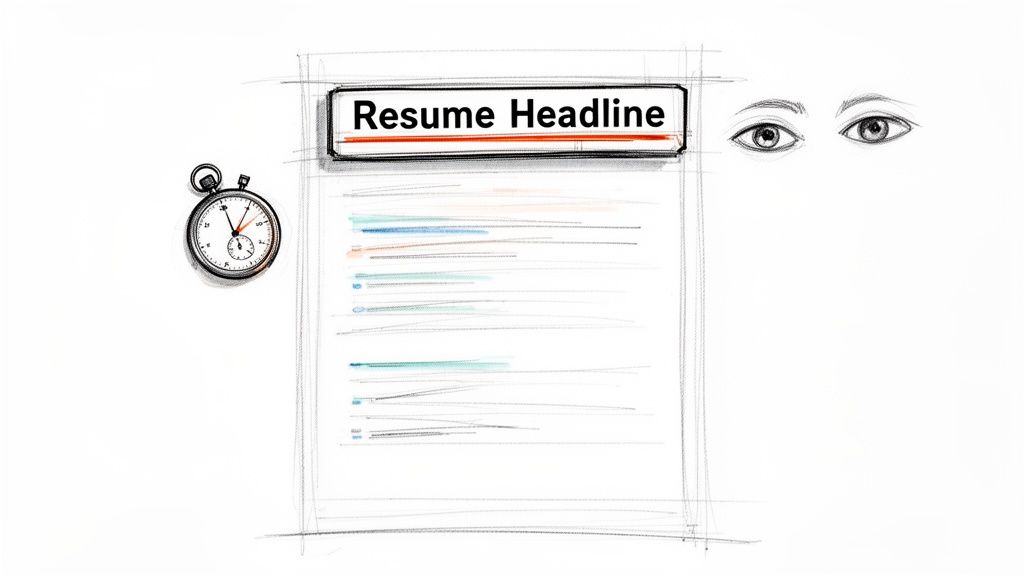
Think of your resume as your one-shot sales pitch. In the world of remote hiring, you don’t have time for a long-winded introduction. Recruiters are moving fast, and recent data for 2026 shows they spend a mere 6-8 seconds scanning a resume before making a snap judgment.
That’s where a strong headline comes in. It’s the hook that stops them from hitting “next.” It’s a bold value proposition that cuts through the noise, replacing outdated intros and instantly signaling that you’re the right fit. If you want to dive deeper into why this speed matters, you can explore more about these critical resume statistics to understand the hiring landscape.
Simply put, your headline is the most important line of text on your resume. It’s often the first—and sometimes only—thing a hiring manager reads. A great one earns your resume a closer look instead of a quick pass.
Moving Beyond Outdated Formats
For years, we were all taught to start a resume with an “Objective.” You know the one: “Seeking a challenging role in a dynamic company where I can utilize my skills for growth.” Sound familiar?
That approach is officially obsolete. Why? Because it’s all about what you want, not what the company needs. A modern resume headline completely flips that script. It’s a high-impact summary that screams, “Here’s the value I bring to you.”
It’s also not the same as a “Resume Summary,” which is typically a short paragraph. While summaries still have their place, the headline is a much sharper tool for grabbing that initial attention. It’s shorter, punchier, and built for the skim-readers and Applicant Tracking Systems (ATS) that define today’s hiring process.
Key Takeaway: Your resume headline isn’t about your career goals. It’s a strategic marketing tool designed to answer the recruiter’s primary question: “Why should I care about this applicant?”
Headline vs Summary vs Objective
It’s crucial to understand how these three elements differ so you can build a resume that actually gets noticed. Each has a specific function, but only the headline is truly optimized for speed and impact in a competitive job market.
Let’s break it down.
| Element | Purpose | Example | Best For |
|---|---|---|---|
| Headline | To provide a quick, high-impact summary of your professional identity. | Senior Product Manager | B2B SaaS | Grew MRR by 35% | All job seekers, especially in competitive fields. |
| Summary | To offer a 3-4 sentence narrative of your experience, skills, and value. | A product leader with 10+ years in B2B SaaS, skilled in… | Candidates with extensive or complex experience. |
| Objective | To state your career goals and what you are looking for in a new role. | Seeking a challenging position in marketing to grow my skills. | No one. This format is now considered outdated. |
As you can see, the headline is the most direct and powerful choice. It delivers the essential information in a format that’s easily digestible in seconds, making it perfect for the modern, remote-first job market.
Think of it as your personal brand billboard, ensuring you stand out from the hundreds of other applicants on platforms like LinkedIn or any other job board.
The Anatomy of a Powerful Remote Resume Headline
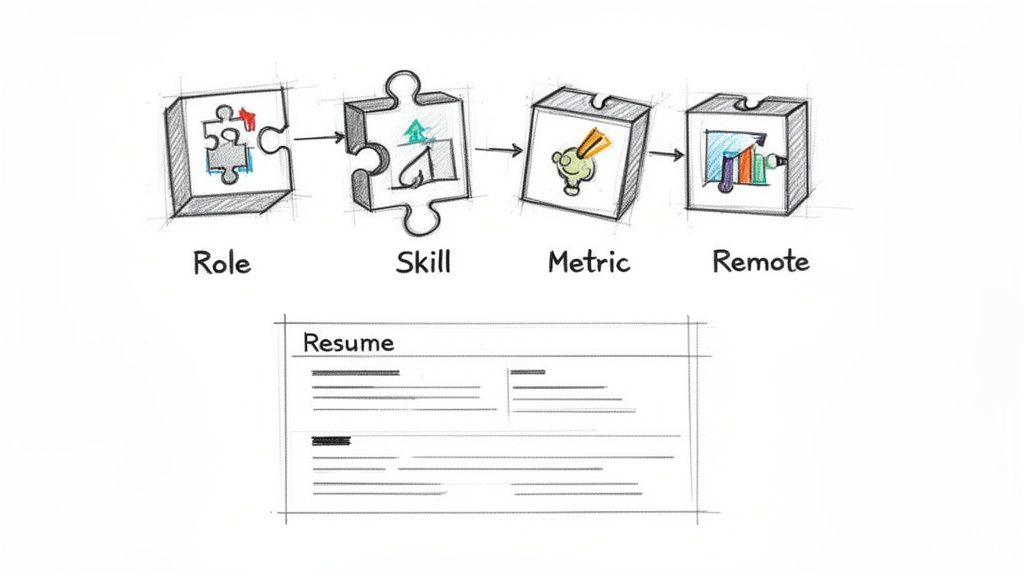
Think of your resume headline as your personal billboard. It’s the first thing a recruiter sees, and you have just a few words to make them stop scrolling. A truly great headline isn’t one big sentence; it’s a strategic combination of key ingredients that tells your story instantly.
Once you get the hang of these individual pieces, you’ll be able to mix and match them to create a headline that feels custom-built for every application. The recipe is surprisingly simple: Your Target Role + Your Core Skill + A Quantifiable Win + A Remote Signal.
Let’s break down how to put this powerful combination to work.
Start with Your Target Role
This is the most important part: Always lead with the job title you want, not necessarily the one you have now. If you’re a “Marketing Associate” aiming for a “Content Marketing Manager” role, your headline needs to say “Content Marketing Manager.” This immediately flags you as a perfect fit for the recruiter’s search.
Get specific. “Software Engineer” is okay, but “Senior Backend Engineer” or “Lead Frontend Developer” is much better. That level of precision tells the hiring manager (and the recruiting software) exactly where you fit, making their job a whole lot easier. It’s the first and most critical keyword they’re scanning for.
Add Your Core Skill or Specialty
Right after your target title, it’s time to add your secret sauce—your specific area of expertise. This is what separates you from the dozens of other applicants with the same job title. Think about the most valuable skill mentioned in the job description that you happen to be great at.
Here’s how it looks in practice:
- Target Role: Product Manager
- Core Skill:
| B2B SaaS Platforms - Target Role: Digital Marketing Specialist
- Core Skill:
| SEO & Content Strategy
This one little addition transforms you from a generic candidate into a specialist who can step in and solve the company’s exact problems.
Showcase a Quantifiable Win
Here’s where you really start to stand out. Adding a hard number or a metric provides undeniable proof of what you can do. It answers the one question every recruiter is thinking: “Can this person actually deliver results?”
Numbers speak louder than words. Look for metrics like:
- Percentage growth (
Increased lead generation by 45%) - Revenue or budget figures (
Managed a $2M annual ad budget) - Efficiency improvements (
Reduced ticket resolution time by 30%)
Even one solid number can make your headline incredibly compelling. It’s tangible evidence of the value you bring to the table.
A headline with a clear, quantifiable win instantly builds credibility. It moves beyond stating your responsibilities and starts showcasing your actual impact, making you a far more compelling candidate.
Weave in a Remote Signal
When you’re applying for a remote job, this final touch is non-negotiable. Adding a “remote signal” confirms that you have experience in a distributed setting and won’t need hand-holding. It’s a green flag for remote-first companies that you already get their culture.
You can use simple but effective phrases like:
Expert in Distributed Team LeadershipSpecialist in Asynchronous CommunicationProficient with Remote Collaboration ToolsRemote-First Team Member
This small detail can be the tiebreaker, especially for companies that only hire people with proven remote work experience. It shows you’re not just looking for any job—you’re looking for a role that fits their specific way of working.
Pulling these pieces together gives you an impactful headline, but it’s also a smart move for keyword optimization. A shocking 75% of resumes are filtered out by Applicant Tracking Systems before a human ever sees them. To beat the bots, some candidates are even using a skills-grid format with 6-9 targeted keywords to make sure they get noticed. As you fine-tune your resume, it’s worth learning more about how resume trends are evolving to stay ahead of the game.
How to Quantify Your Impact with Numbers
This is probably the single most powerful change you can make to your resume: shifting from just listing responsibilities to showcasing real, tangible results. A vague statement like “Managed social media accounts” is forgettable. But “Grew social media engagement by 75% in six months”? That’s undeniable proof you deliver value.
Numbers cut right through the fluff. They’re a universal language that every recruiter and hiring manager understands, and they immediately build your credibility. This one simple shift can take a resume headline from just okay to truly great.
The data backs this up, too. We’ve seen that resumes including hard metrics get a 40% higher interview rate—a massive advantage in today’s crowded job market. It’s surprising how few people actually do this, which leaves a huge opportunity for you to stand out. You can dig into more of these resume statistics to see just how big of a deal numbers are.
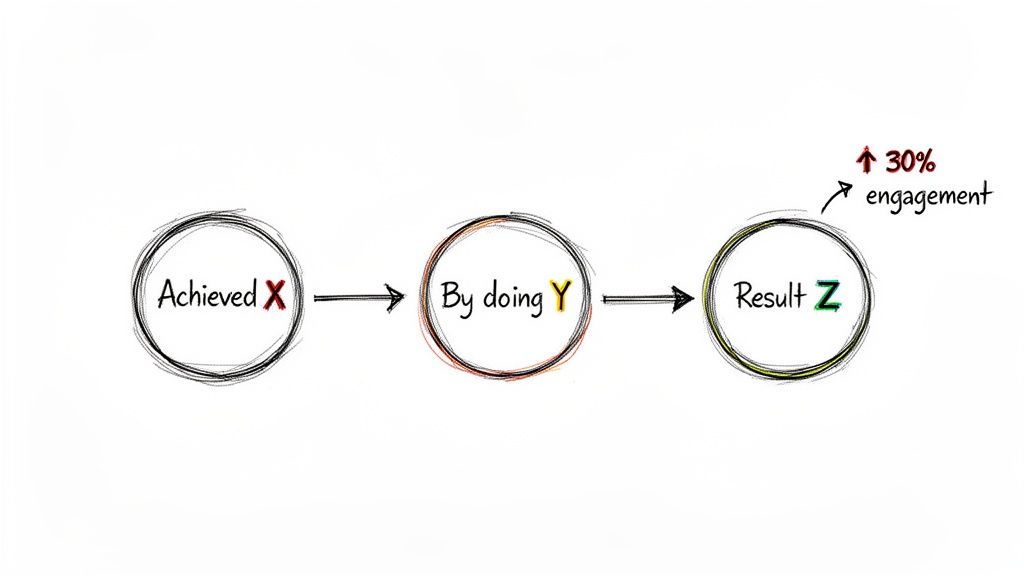
Master the X-Y-Z Formula
So, how do you consistently create these powerful, metric-driven statements? I always recommend the X-Y-Z formula. It’s a simple but incredibly effective framework for talking about what you’ve accomplished.
- X is the Result: What was the awesome thing you achieved? (e.g., Increased sales by 20%)
- Y is the Action: How did you make it happen? (e.g., by rolling out a new CRM strategy)
- Z is the Impact: What did it mean for the business? (e.g., resulting in $500k in new revenue)
This little formula forces you to connect what you did to a real business outcome, which is exactly what recruiters are looking for.
Let’s see it in action. A generic headline just says, “Sales Manager.” An X-Y-Z headline, on the other hand, tells a story: “Sales Manager Who Grew Mid-Market Revenue (X) by Optimizing the Sales Funnel (Y), Driving a 15% Increase in Closed Deals (Z).” See the difference?
Finding Your Numbers, Even in Non-Technical Roles
One of the biggest hurdles I hear is, “But I don’t have any numbers! My job is creative/support/administrative.” The truth is, every single role has quantifiable aspects. You just need to know where to find them.
Think in terms of efficiency, quality, volume, or customer satisfaction. Did you make a process faster? Did you reduce errors? Did you handle more support tickets than your peers? All of these can be turned into compelling metrics.
Key Insight: Impact isn’t always about revenue. Quantifying improvements in time saved, processes optimized, or errors reduced is just as valuable to a company’s bottom line.
For example, an Executive Assistant can go from the bland “Managed schedules” to the powerful “Coordinated schedules for 5 executives across 3 time zones, saving an estimated 10+ hours of senior leadership time per week.” That small tweak reframes the role from a task-doer to a strategic partner.
Practical Examples of Quantified Impact
Let’s bring this to life for a few common remote roles. Notice how each “after” example uses a number to tell a much more compelling story.
For a Software Engineer:
- Before: Wrote code for the new user dashboard.
- After: Shipped a new user dashboard that reduced page load time by 40%, improving the user experience for 1.5M+ active users.
For a Digital Marketer:
- Before: Ran email marketing campaigns.
- After: Directed an email marketing strategy that generated $250K in direct revenue with a 25% open rate, exceeding industry benchmarks by 10%.
For a Customer Support Specialist:
- Before: Helped customers with their problems.
- After: Maintained a 98% Customer Satisfaction (CSAT) score over 12 months while resolving an average of 50+ tickets daily.
These examples don’t just list a job duty; they tell a quick story of success. The numbers give scale and context, making your contributions feel real and significant.
And hey, if you don’t have the exact figures, it’s fine to use well-founded estimates. Using phrases like “approximately,” “over,” or “more than” is completely acceptable. For instance, “Streamlined the reporting process, saving the team over 20 hours per month” is a powerful and credible statement, even without a stopwatch calculation. The goal is to show you think in terms of impact, not just tasks.
Resume Headline Examples for Top Remote Roles
Alright, let’s move past the theory and get practical. Seeing a powerful resume headline in action is the best way to understand its impact. Think of this as your go-to library of field-tested headlines for some of today’s most popular remote jobs.
We’re going to break down examples for software engineers, product managers, digital marketers, and sales leaders. You’ll see different styles for various experience levels, and I’ll explain why each one works. This way, you can confidently adapt these ideas to fit your own career story.
Headlines for Software Engineers
Software engineering is all about specifics. Recruiters are hunting for particular languages, frameworks, and a proven ability to handle real-world projects. Your headline needs to instantly signal your tech stack and the kind of impact you deliver with it.
Senior Backend Engineer | Python & Django Expert | Scaled APIs to Handle 1M+ Daily Requests
- Why it works: This is incredibly specific. “Senior Backend Engineer” clarifies your level, while “Python & Django” are the exact keywords an ATS is looking for. But the real clincher is the metric—”Scaled APIs to 1M+ Daily Requests” proves you can handle production-level work, which is way more convincing than just saying you’re “experienced.”
Lead Frontend Developer | React & TypeScript Specialist | Led Team to Reduce Page Load Time by 40%
- Why it works: “Lead” immediately signals leadership. The keywords “React & TypeScript” will catch a recruiter’s eye. The outcome, “Reduce Page Load Time by 40%,” is a fantastic way to translate technical skill into a direct business win that improves the user experience.
Full-Stack Software Engineer | Node.js, Express, & AWS | Built & Deployed Microservices for a Distributed Team
- Why it works: Perfect for a mid-level pro. It showcases a modern tech stack that will sail through ATS filters. “Built & Deployed Microservices” shows you can see a project through from start to finish, and adding “for a Distributed Team” is a smart, direct signal that you thrive in a remote setup.
Headlines for Product Managers
For product managers, the game changes. Your headline should pivot from pure technical skills to business impact and user-focused results. You need to show that you don’t just ship features—you drive growth and solve real problems.
Key Insight: The best product manager headlines bridge the gap between what users want and what the business needs. They prove you’re focused on delivering value that moves key company metrics.
Here are a few examples of how to do it.
Senior Product Manager, B2B SaaS | Grew User Activation by 30% through Onboarding Redesign
- Why it works: It establishes your niche (“B2B SaaS”) right away. “Grew User Activation by 30%” is a classic product KPI, showing you focus on what truly matters. It also gives a peek into your process by mentioning the “Onboarding Redesign.”
Head of Product | Mobile & E-commerce | Drove $5M in New Revenue via Feature Optimization
- Why it works: This headline has executive presence. “Head of Product” is a clear leadership title, and the $5M revenue metric is a powerful number that grabs the attention of any C-suite reader.
Product Manager | Agile & Scrum Expert | Managed Roadmap for Distributed Product Team Spanning 5 Time Zones
- Why it works: This is a great angle for a PM who excels at execution. “Agile & Scrum Expert” are essential keywords. The final phrase is gold for remote companies—it shows you can handle the unique logistical challenges of managing a product with a globally distributed team.
Headlines for Digital Marketers
Digital marketing is all about results you can measure. Your headline is your first piece of ad copy for yourself, so it needs to be packed with metrics that prove you can generate traffic, leads, and, most importantly, revenue.
Here’s a quick reference table to help you craft the perfect headline for your marketing, engineering, product, or sales role.
Headline Templates by Role
| Role | Headline Formula | Example |
|---|---|---|
| Engineering | [Title] \| [Tech Stack] \| [Quantifiable Achievement] |
Lead Frontend Developer \| React & TypeScript \| Reduced Page Load Time by 40% |
| Product | [Title], [Industry] \| [Key Metric] \| [Method] |
Senior Product Manager, B2B SaaS \| Grew User Activation by 30% |
| Marketing | [Title] \| [Channel Expertise] \| [Metric-Driven Result] |
SEO Manager \| Increased Organic Traffic by 200% & MQLs by 60% |
| Sales | [Title] \| [Quota Performance] \| [Team/Revenue Impact] |
Account Executive \| 130%+ Quota Attainment \| Top 5% of Global Sales Team |
These formulas are a great starting point. Just plug in your own skills and achievements to create a headline that stands out.
Now, let’s look at more marketing examples in detail.
SEO Manager | Increased Organic Traffic by 200% & Grew MQLs by 60% in 12 Months
- Why it works: This is pure, data-driven proof. A 200% traffic increase is impressive on its own, but tying it directly to a 60% growth in MQLs shows you understand the full marketing funnel. You don’t just bring visitors; you bring potential customers.
Content Marketing Lead | Managed a team of 5 writers to produce content driving 250K+ monthly visitors
- Why it works: It showcases both leadership (“Managed a team of 5”) and direct impact (”250K+ monthly visitors”). It tells a hiring manager you’re a leader who can deliver tangible results.
Paid Acquisition Specialist | Managed $2M Annual Budget with a 3.5x ROAS
- Why it works: In paid advertising, money talks. This headline shows you can be trusted with a serious budget (”$2M Annual Budget”) and that you deliver a strong, positive return (”3.5x ROAS”). This is exactly the language a performance marketing director wants to hear.
Headlines for Sales Leaders
In sales, numbers are everything. A sales headline without a clear metric is like a sales pitch without a call to action—it just falls flat. You need to show you can hit quotas, build winning teams, and drive revenue.
Director of Sales, Enterprise SaaS | Grew ARR from $10M to $25M in 2 Years | Expert in Building Remote Sales Teams
- Why it works: This is a top-tier, executive-level headline. The ARR growth is specific and impressive. Plus, “Expert in Building Remote Sales Teams” directly addresses a huge priority for distributed companies, making you an ideal candidate.
Account Executive | Consistently Exceeded Quota by 130%+ | Top 5% of Global Sales Team
- Why it works: This is a fantastic headline for a high-performing individual contributor. Exceeding quota by 130%+ proves you’re a star, and adding “Top 5% of Global Sales Team” provides powerful context and social proof for your achievement.
If you’re hunting for roles where these kinds of headlines will get you noticed, check out the curated openings on a platform like Remote First Jobs, which pulls listings directly from company career pages.
Common Headline Mistakes That Sabotage Your Application
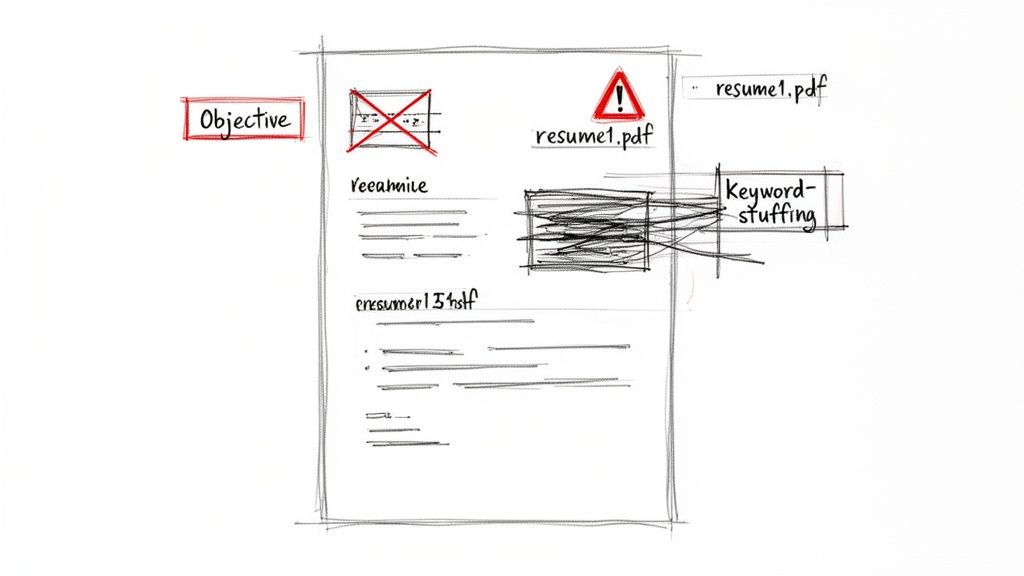
Now that you know what goes into a killer resume headline, let’s talk about what to leave out. I’ve seen some real application-killers in my time, and they almost always start with a bad headline. Even the most qualified candidates can get their resumes tossed just because of a few poorly chosen words up top.
These mistakes might seem small, but to a recruiter scanning hundreds of resumes, they’re red flags. Think of this section as a final gut check before you hit “apply.”
Using an Outdated Objective Statement
The absolute biggest mistake I still see? That old-school objective statement. Headlines like, “Objective: Seeking a challenging role…” are a relic of the past. They scream, “I haven’t updated my resume in a decade.”
Here’s the thing: recruiters don’t really care about your personal career goals right now. They care about what problems you can solve for them. An objective statement is a total waste of prime real estate that could have been used to make a powerful, value-packed first impression.
Being Vague or Generic
A headline that just says “Experienced Professional” or “Hard-Working Team Player” tells a recruiter absolutely nothing. It’s pure fluff. What kind of professional? What have you accomplished? Be specific, or don’t bother.
Here are some of the worst offenders I see all the time:
- “Marketing Professional”: This could be anything from handing out flyers to running multi-million dollar campaigns. A better version? “Digital Marketing Manager specializing in B2B SaaS.” See the difference?
- “Seeking New Opportunities”: Well, of course you are—you’re applying for a job! This adds zero value. Use that space for your target role instead.
- “Results-Driven Employee”: This is a claim with no proof. You have to show, not just tell. A quick fix would be something like: “Drove 30% increase in qualified leads.”
Your headline is the most valuable piece of real estate on your resume. Vague platitudes are the equivalent of leaving it completely blank. Every single word needs to earn its spot by communicating concrete value.
Keyword Stuffing Until It’s Unreadable
Okay, so we know keywords are important for getting past the Applicant Tracking Systems (ATS). But cramming every buzzword you can think of into your headline is a disastrous move. It looks desperate, and it’s completely unreadable to any human who eventually sees it.
I’ve seen some real train wrecks. For example:
- Bad:
Senior Sales Manager Account Executive B2B SaaS CRM Salesforce ARR Quota Leader Remote
This isn’t a headline; it’s a keyword salad. Any recruiter looking at this will immediately question your ability to communicate. You have to weave those keywords into something that makes sense.
- Good:
Senior Account Executive, B2B SaaS | Salesforce Expert | 140% Quota Attainment
This version uses the same keywords but tells a clear, compelling story. If you’re looking for more real-world ideas, browsing through a variety of LinkedIn headline examples can give you a feel for what works.
Using Confusing Jargon or Acronyms
While industry terms have their place, using obscure acronyms or internal company jargon is a huge gamble. The first person reading your resume is often a recruiter, not the senior engineer who will understand your niche tech stack. If they can’t understand your headline, your application might not go any further.
Stick to terms that are widely recognized in your field. If you’re a developer, “React” and “AWS” are perfectly fine. But an acronym for a proprietary tool from your last job—like "Expert in Project Phoenix Mgmt"—is just going to cause confusion.
When in doubt, just spell it out. The goal here is instant clarity, not to show off how much niche terminology you know. A great headline is one that anyone in the hiring process can understand at a glance.
Frequently Asked Questions About Resume Headlines
Even with the right formula, a few common questions always pop up when it’s time to write your headline. Let’s clear up any lingering confusion so you can finalize a headline that truly grabs attention. Think of this as the final polish on what you’ve already learned.
Should My Resume Headline Be a Full Sentence
Absolutely not. Your resume headline should be a powerful title, not a sentence. The whole point is to deliver a high-impact snapshot of who you are professionally. You’re aiming for scannability.
Think of it this way: a recruiter might spend only seven seconds on your resume. A punchy, broken-up phrase gets the key info across instantly.
For instance, this works beautifully: Senior Software Engineer | React & Node.js Expert | Scaled Applications to 1M+ Users. It’s clean, scannable, and packed with value.
How Do I Tailor My Headline for Each Job
This is non-negotiable if you want to get past the Applicant Tracking Systems (ATS) and make an impression. The trick is to have a strong “master” headline that you can quickly tweak for each specific job you apply for.
Start by scanning the job description for the most important keywords—usually two or three stand out (like “SaaS Sales,” “Go-to-Market Strategy,” or “B2B Growth”). Then, simply work those terms into your master headline.
- Master Headline: Director of Sales | Drove 40% ARR Growth
- Tailored for a SaaS role: Director of SaaS Sales | B2B Growth Leader | Drove 40% ARR Growth
That small change makes a massive difference in how relevant you appear for that specific opening.
What If I Am Changing Careers
If you’re switching careers, your headline needs to do some heavy lifting. The most important rule? Use the job title you’re targeting, not your old one. Your headline is about your future, not your past.
From there, focus on the transferable skills and achievements that prove you’re ready for the new role. For example, a project manager aiming for a product role could write something like this:
Aspiring Product Manager | Expert in Agile Methodologies & Stakeholder Communication | Delivered 12+ Complex Projects on Time
This frames your experience perfectly. It shows you have the ambition and, more importantly, the core skills needed to succeed, making you a far more compelling candidate.
Is a Creative or Catchy Headline a Good Idea
Honestly, for most professional roles—especially in tech, sales, or finance—clarity crushes creativity every single time.
A headline like “Marketing Wizard Who Makes Magic Happen” might seem clever, but it often comes across as unprofessional or, worse, empty. It tells recruiters and the ATS nothing concrete about your skills or accomplishments.
Stick to a professional, value-driven headline. The “wow” factor should come from your quantifiable results, not a pun. Let your numbers do the talking; they tell a much better story.
Tired of your resume getting lost in a sea of applicants on crowded job boards? The secret is applying first. At Remote First Jobs, we source thousands of fresh, verified remote jobs directly from company career pages—before they hit the mainstream platforms. Get the first-mover advantage and find your next role at Remote First Jobs.