You’ve navigated the resume filters, aced the phone screen, and made a strong impression in person or on video. But in a competitive job market where dozens of qualified candidates vie for the same role, the interview process doesn’t end when you leave the room. The final, often-overlooked step is sending a strategic thank you note for interview follow-up, a critical tool that can solidify your position and set you apart from the competition. This isn’t just about good manners; it’s your last chance to make a compelling case for your candidacy.
A well-crafted follow-up email reinforces your interest, addresses any lingering questions, and demonstrates your professionalism and communication skills. It’s a direct line to the hiring manager, allowing you to reiterate a key point, connect your skills to a specific company goal discussed during the conversation, or even clarify a response you wish you’d handled better. For many hiring managers, a thoughtful thank you note is a deciding factor between two otherwise equal candidates. It shows you are engaged, detail-oriented, and genuinely want the job.
This guide moves beyond generic templates. We will break down specific, actionable examples for every common interview scenario, from the initial recruiter screen to complex panel discussions and even after receiving a rejection. You will learn exactly what to write, why it works, and how to personalize each message to maximize its impact. We’ll cover everything from powerful subject lines to ideal timing, ensuring your follow-up email helps you close the deal.
1. Thank You Note for Initial Phone Screen with Recruiter
The phone screen thank you note is your first opportunity to make a lasting impression after the initial call. Think of it not just as a courtesy, but as a strategic follow-up that reinforces your professionalism and enthusiasm. This brief, targeted message, sent promptly after your conversation, confirms your interest and keeps you top-of-mind as the recruiter decides who moves to the next stage. In a competitive job market, especially for remote roles where asynchronous communication is standard, this small step can be a significant differentiator.
Why This Note Matters
The phone screen is a rapid-fire sorting process for recruiters. They may speak with dozens of candidates for a single role. A well-timed thank you note for this interview stage helps you stand out from the crowd of names and resumes, reminding the recruiter of your specific conversation.
Strategic Insight: The goal here isn’t to restate your entire resume. It’s to create a single, positive “ping” on the recruiter’s radar that connects your name with professionalism and genuine interest, making their decision to advance you an easier one.
Example & Breakdown
Here is a short, effective thank you note template perfect for following up on a phone screen.
Subject: Thank you - [Job Title] Conversation
Hi [Recruiter Name],
Thank you for your time this afternoon. I enjoyed our conversation and learning more about the [Job Title] role and the team structure at [Company Name].
I was particularly interested in what you mentioned about [Specific Detail, e.g., the company’s approach to asynchronous communication for its distributed team]. That directly aligns with my experience in [Your Relevant Experience].
I remain very interested in this opportunity and look forward to hearing about the next steps.
Best regards,
[Your Name]
Actionable Takeaways
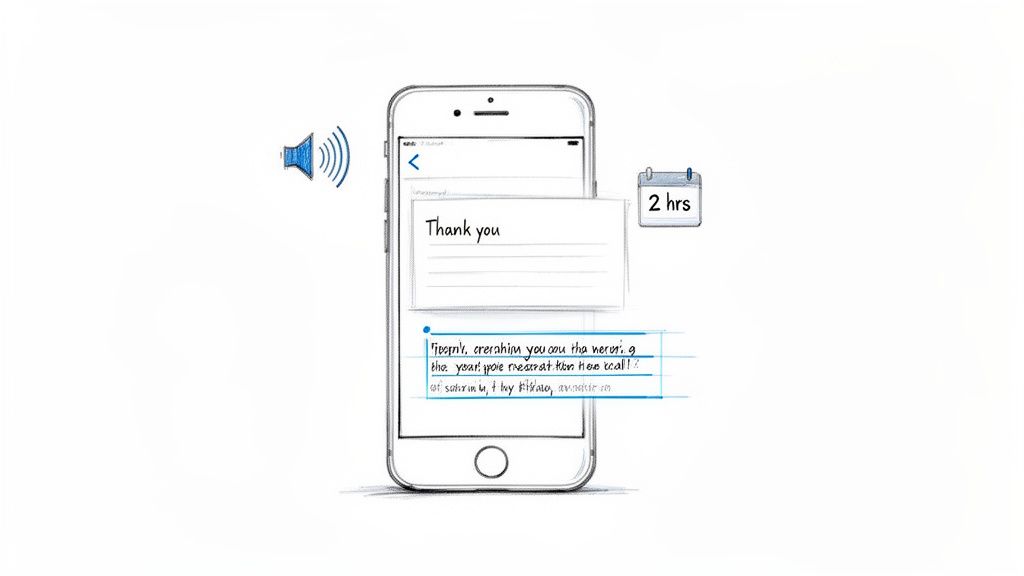
- Timing is Critical: Send this email within 2 hours of the call. Set a phone alarm if you need to. This timing shows you are organized and eager while the conversation is still fresh in the recruiter’s mind.
- Reference a Specific Point: The detail about “asynchronous communication” shows you were actively listening. Mentioning a specific point from the call-whether it’s about company culture, a project, or a team dynamic-proves your engagement.
- Keep It Concise: Recruiters are busy. Three short paragraphs are all you need. Get straight to the point, express thanks, add a specific detail, and reiterate interest. This respects their time and makes your message more effective.
2. Thank You Note After Technical Interview or Skills Assessment
Following up after a technical interview or skills assessment requires more than just a simple thank you. This is a chance to show you’re still mentally engaged with the technical challenges you discussed. This specialized thank you note for an interview allows you to subtly reinforce your technical abilities, demonstrate thoughtfulness, and show you’re passionate about the craft, whether it’s coding, design, or data analysis.
Why This Note Matters
Technical interviews are intense evaluations of your problem-solving skills. Interviewers are not just checking if you get the right answer; they’re assessing how you think, communicate your thought process, and handle complex problems under pressure. A substantive follow-up shows you continued thinking about the problem even after the interview ended, a strong indicator of a dedicated and curious engineer, designer, or analyst.
Strategic Insight: The purpose is not to “correct” your answer or show off. It’s to prove your continued engagement with the problem. Mentioning a specific technical detail or an alternative approach shows you are a reflective and passionate problem-solver, not just a candidate going through the motions.
Example & Breakdown
Here’s a template for a backend engineer role that hits the right notes after a coding challenge.
Subject: Thank you - Backend Engineer Interview
Hi [Interviewer Name],
Thank you for the engaging technical session today. I really enjoyed working through the [Specific Problem, e.g., API rate limiter algorithm] and discussing its implementation with you.
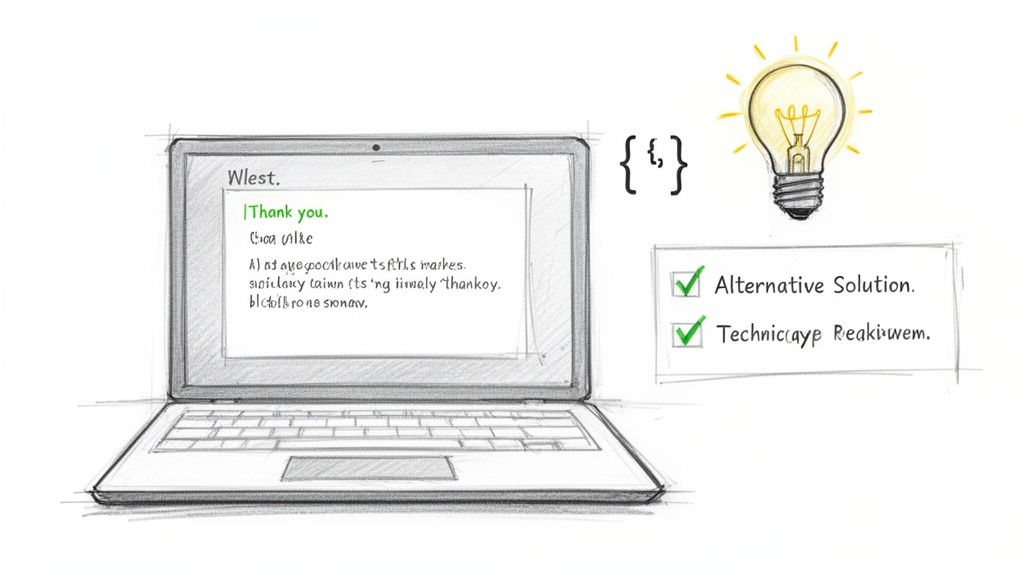
After our call, I was thinking about the scalability aspect we touched on. An alternative approach could be a token bucket algorithm for handling burst traffic more smoothly, which might be a good fit given [Company Name]’s focus on high-availability services.
I appreciate the challenging conversation and am even more excited about the possibility of joining your team. I look forward to hearing about the next steps.
Best regards,
[Your Name]
Actionable Takeaways
- Reference a Specific Problem: Mentioning the “API rate limiter algorithm” immediately grounds your email in the context of your specific conversation. It shows you were paying close attention to the details of the technical interview.
- Offer a Thoughtful Addition (Not a Correction): Suggesting an “alternative approach” without criticizing your in-interview performance is key. It adds value and shows you’re a deep thinker. Never say “I should have done this”; frame it as a continued thought.
- Connect to Company Goals: Linking your idea to the company’s “focus on high-availability services” proves you’ve done your research and are thinking about how your skills can solve their specific business problems. This elevates you from a candidate to a potential collaborator.
- Keep It Brief and Confident: Technical managers are busy. Your email should be concise and project confidence. Acknowledge the challenge positively, add your small piece of insight, and reiterate your enthusiasm.
3. Thank You Note After Behavioral or Culture Fit Interview
After a behavioral or culture-focused interview, your thank you note serves a different purpose than a technical follow-up. It’s your chance to connect on a human level, demonstrating that you not only have the skills for the job but also share the values and work style that will make you a successful part of the team. This is especially true for remote-first companies, where demonstrating an understanding of async communication, autonomy, and mission alignment is paramount.
Why This Note Matters
Behavioral interviews are designed to see if you “get” the company culture. Your thank you note for this interview is a practical test of that understanding. It proves you were listening to the subtext of the conversation, not just the questions. It shows the hiring manager that your interest goes beyond the job description and extends to the company’s mission and how the team works together, a critical factor for long-term success and retention.
Strategic Insight: The objective here is to mirror the company’s values back to them. If they emphasized their mission, connect your personal values to it. If they talked about work-life balance and flexibility, acknowledge how that aligns with your needs. This note proves you are a “culture add,” not just a “culture fit.”
Example & Breakdown
Here’s a template for a thank you note after a behavioral interview, adapted for a remote, mission-driven company.
Subject: Great connecting about the [Job Title] role
Hi [Interviewer Name],
Thank you so much for the conversation earlier today. I genuinely appreciated learning more about the team’s philosophy at [Company Name] and your focus on [Specific Company Value, e.g., ‘conscious communication’].
Our discussion about the company’s mission to [Mention Company Mission] particularly resonated with me. My experience in [Your Past Experience] was driven by a similar desire to [Connect to Their Mission], and hearing you describe the team’s passion for this was incredibly motivating.
I’m confident that my self-directed work style and experience with async-first collaboration would fit well with your distributed team’s dynamic. I am even more excited about this opportunity now and look forward to the next steps.
All the best,
[Your Name]
Actionable Takeaways
- Connect to Values: Don’t just say you’re a “great fit.” Show it. Mentioning a specific value like “conscious communication” and connecting your personal passion to the company’s mission demonstrates authentic alignment.
- Show You Understand Remote Work: For distributed companies, name-dropping concepts like “async-first” or “self-directed work” shows you understand the practical realities of remote collaboration. It signals you won’t need hand-holding.
- Be Authentic, Not Familiar: The tone should be warm and genuine but remain professional. You’re building a professional relationship, so avoid overly casual language while still showing your personality and enthusiasm. Send this note within 24 hours.
4. Thank You Note After Panel Interview with Multiple Stakeholders
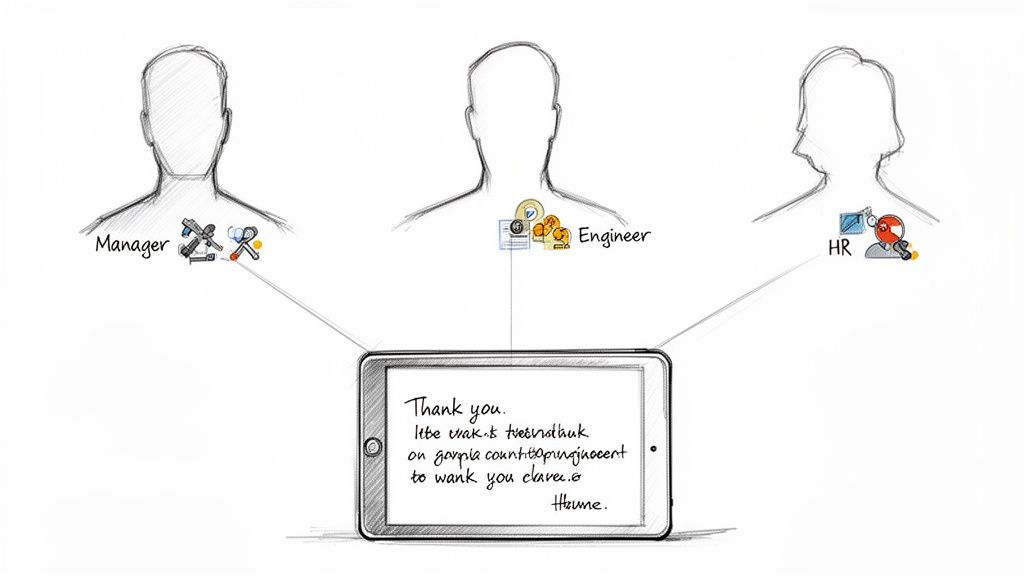
The panel interview thank you note is a complex but crucial follow-up. It addresses multiple people at once, each with a different role and perspective. Your goal is to acknowledge each person’s contribution, show you understood their unique concerns, and weave a cohesive story about why you are the right fit for the company. This is especially important in remote companies where panel interviews are a common way to gauge a candidate’s fit across a distributed team.
Why This Note Matters
A panel interview exposes you to different facets of the business, from high-level strategy to day-to-day execution. A generic thank you note for this type of interview would be a missed opportunity. Customizing your message shows you can manage complex stakeholder relationships and communicate effectively across departments, a highly valued skill in any collaborative environment.
Strategic Insight: The panel thank you note is your final pitch. It demonstrates your ability to synthesize information from multiple sources and present a unified vision of your value. Each personalized mention reinforces your connection with that specific interviewer, creating multiple advocates for your candidacy.
Example & Breakdown
Here is a template for a group thank you email that addresses each panelist personally.
Subject: Thank You - [Job Title] Interview
Hi [Hiring Manager], [Interviewer 2], and [Interviewer 3],
Thank you all for your time and the engaging conversation yesterday about the [Job Title] position. I sincerely enjoyed learning about the role from your different perspectives and left the discussion even more excited about the opportunity at [Company Name].
Hi [Hiring Manager Name], I particularly valued our discussion on [Specific Topic, e.g., the team’s upcoming goals for Q3]. Your vision for [Detail, e.g., expanding into the new market segment] aligns perfectly with my background in [Your Relevant Experience].
Hi [Interviewer 2 Name], it was great to hear about [Specific Topic, e.g., the current technical stack]. Your point about the team’s focus on [Detail, e.g., clean code and scalability] resonated with me, as I’ve seen its direct impact on product velocity.
Hi [Interviewer 3 Name], I appreciated your insights into [Specific Topic, e.g., the cross-functional collaboration with the product team]. Understanding how the role supports [Detail, e.g., the product roadmap] helped me see the direct business impact I could make.
I am confident my skills are a strong match for your needs and am very enthusiastic about the chance to join your team. I look forward to hearing from you.
Best,
[Your Name]
Actionable Takeaways
- Take Detailed Notes: During the interview, create a quick chart with each interviewer’s name, title, and one key point or question they raised. This is your raw material for personalization.
- Decide on Group vs. Individual Emails: Sending one well-structured group email is often safest and most efficient, as it ensures everyone has the same information. If you send individual notes, ensure the core message is consistent while personalizing the details.
- Create a Logical Flow: Structure your note by addressing the most senior person (usually the hiring manager) first, followed by others in a logical order (e.g., team lead, peer, cross-functional partner). This shows respect for the hierarchy.
- Acknowledge Remote Coordination: If the panel was distributed across time zones, a simple line like, “Thank you all for coordinating to meet with me,” shows you appreciate the logistical effort involved in remote work.
5. Thank You Note After Asynchronous Video or Take-Home Assignment Review
Asynchronous hiring steps, like recorded video interviews or take-home projects, are becoming standard, especially for remote roles. The thank you note for this interview stage serves a unique purpose: it re-establishes a human connection in an otherwise impersonal process. Sending a follow-up after submitting your work demonstrates professionalism and maintains momentum, ensuring you remain a person, not just a submission, in the hiring manager’s mind. It’s a small but powerful gesture that shows you’re engaged and appreciate their modern approach to hiring.
Why This Note Matters
Take-home assignments and one-way video interviews lack the real-time feedback of a conversation. This thank you email bridges that communication gap. It confirms your submission, expresses gratitude for the opportunity, and subtly reinforces your enthusiasm for the work itself. For remote-first companies that value written communication and self-motivated candidates, this follow-up is a proof point of your professional habits.
Strategic Insight: The primary goal is to close the loop and add a touch of warmth. Acknowledging and appreciating the remote-friendly format shows you understand and align with their company culture, which is a major plus for distributed teams.
Example & Breakdown
Here is an effective template for a thank you note after submitting an asynchronous assignment.
Subject: Thank you - [Job Title] Project Submission
Hi [Hiring Manager Name],
I’ve just submitted the [Name of Project, e.g., Take-Home Coding Challenge]. Thank you for the opportunity to work on it; I enjoyed the process.
I found the task of [Specific Aspect of the Project, e.g., optimizing the data query for user profiles] particularly engaging. It was a great way to see the types of challenges your team tackles, and it confirmed my excitement about the engineering work at [Company Name]. Thank you as well for a flexible, remote-friendly hiring process.
I look forward to discussing the project and the next steps with the team.
Best regards,
[Your Name]
Actionable Takeaways
- Acknowledge the Format: Explicitly thank them for the remote-friendly process. This shows you’re not just looking for any job but are specifically interested in a company that operates this way.
- Mention a Project Detail: Referencing a specific part of the assignment (like “optimizing the data query”) proves you were genuinely engaged. It moves the conversation beyond a simple “I’m done” notification.
- Time It Right: Send this note within 24 hours of submitting your project or completing the video. It acts as a polite confirmation and keeps the momentum going without being pushy.
- Keep It Brief and Professional: Asynchronous communication values efficiency. Two short paragraphs are perfect. Express thanks, add your specific insight, and close by looking ahead. Avoid making excuses or over-explaining your work.
6. Thank You Note Declining an Offer or Continuing Interview Process
Deciding to withdraw from an interview process or turn down a job offer requires a professional, gracious exit. A well-crafted thank you note for this scenario isn’t just polite; it’s a strategic move to preserve your professional network. This message acknowledges the company’s time and effort while clearly communicating your decision, leaving the door open for future opportunities. In tight-knit remote communities, where reputations travel fast, ending the process on a positive, respectful note is essential.
Why This Note Matters
How you decline an opportunity says as much about your professionalism as how you pursue one. Ghosting a company or sending a curt, one-line email can burn bridges you may need later. A thoughtful withdrawal note shows respect for the hiring team’s investment, reinforces your character, and maintains a positive connection. You never know when you might cross paths with the same recruiter, hiring manager, or team members at another company.
Strategic Insight: The primary goal is not just to say “no,” but to say it in a way that makes the hiring manager think, “I’m disappointed, but I’d be happy to hear from this person again.” This transforms a rejection into a long-term networking asset.
Example & Breakdown
Here is a professional template for gracefully declining an offer or withdrawing from consideration.
Subject: Regarding the [Job Title] Opportunity
Dear [Hiring Manager Name],
Thank you so much for offering me the [Job Title] position at [Company Name]. I sincerely appreciate you and the team taking the time to speak with me and share more about this exciting opportunity.
After careful consideration, I have decided to accept another role that is more closely aligned with my current career goals. This was a difficult decision, as I was very impressed with [Company Name]’s mission and the team culture you described.
I wish you the best of luck in finding a great candidate for the position. I hope our paths cross again in the future and would welcome the chance to stay in touch.
Best regards,
[Your Name]
Actionable Takeaways
- Communicate Promptly: As soon as you’ve made your decision, inform the company. Leaving them waiting is unprofessional and can hinder their hiring timeline. A quick, decisive response is always appreciated.
- Be Gracious and Direct: Start by expressing genuine gratitude. Then, state your decision clearly and concisely. Avoid vague language that might create confusion about whether you are still interested.
- Keep the Reason Brief and Positive: You don’t need to provide a detailed explanation. A simple statement like “accepted another role” or “pursuing an opportunity more aligned with my goals” is sufficient. Never criticize the company, the offer, or the team. The focus should be on your path forward, not on their shortcomings.
7. Thank You Note After Rejection or Not Moving Forward
Receiving a rejection is disappointing, but how you respond matters. A gracious thank you note for interview rejection is a powerful networking tool that leaves a lasting positive impression. It showcases your professionalism and resilience, turning a closed door into a potential future opportunity. This act of grace signals that you value the relationship beyond this single role, which is especially important in smaller industries or close-knit remote communities where reputations travel fast.
Why This Note Matters
Sending a thank you note after not getting the job is counterintuitive to most, which is precisely why it’s so effective. It immediately distinguishes you from other candidates who simply disappear. Hiring managers remember candidates who handle bad news with class. This final, positive interaction can place you at the top of the list for future openings or even prompt them to refer you to a colleague hiring for a different role.
Strategic Insight: The purpose of this note is not to challenge the decision or express disappointment. It is to close the loop professionally, maintain a positive connection with the hiring manager, and position yourself as a strong “silver medalist” candidate they should keep in mind for the future.
Example & Breakdown
Here is a template for a professional and forward-looking thank you note after a rejection.
Subject: Thank you - [Job Title]
Hi [Hiring Manager Name],
Thank you for letting me know your decision regarding the [Job Title] position. While I’m disappointed I won’t be moving forward, I genuinely appreciate you and the team taking the time to interview me.
I especially enjoyed learning about [Specific Aspect, e.g., the company’s commitment to employee growth] and remain impressed with the work you’re doing at [Company Name]. Please keep me in mind if another role that aligns with my background in [Your Key Skill, e.g., product marketing or Python development] opens up in the future.
I wish you and the successful candidate all the best.
Sincerely,
[Your Name]
Actionable Takeaways
- Send Within 24 Hours: Acknowledge the decision promptly while the interaction is still recent. This reinforces your professionalism and respect for their communication.
- Keep a Positive Tone: Avoid any language that suggests bitterness or sadness. Focus on appreciation for the opportunity and express genuine well-wishes for the company. Your positivity will be remembered.
- Open the Door for the Future: Explicitly state your interest in future opportunities. Mentioning a specific skill helps them categorize you correctly in their applicant system for future searches. This turns a “no for now” into a “maybe for later.”
- Brevity is Key: Keep the message short and to the point. One or two brief paragraphs show you respect their time and have accepted the decision gracefully.
8. Thank You Note After Offer Acceptance or Onboarding Confirmation
This final thank you note marks your transition from candidate to new team member. Sent after you’ve formally accepted the job offer, it’s a powerful tool to kickstart your professional relationships on a high note. More than just a courtesy, this message reaffirms your excitement, confirms logistical details, and sets a positive, collaborative tone before you even begin. It’s your first official communication as part of the team, solidifying the excellent impression you made during the interview process.
Why This Note Matters
The period between offer acceptance and your start date can feel like a quiet zone. This note bridges that gap, showing your future manager and team that you are engaged and eager to contribute. It’s also a practical way to double-check key onboarding details, especially for remote roles where clear communication about tech setup and first-day schedules is essential. This small act of organized enthusiasm demonstrates your proactivity from day one.
Strategic Insight: Your goal is to pivot from “impressing the interviewer” to “integrating with the team.” This message confirms you are organized, appreciative, and ready to hit the ground running, making your onboarding process smoother for everyone involved.
Example & Breakdown
Here is an effective template for a post-offer acceptance thank you email.
Subject: Excited to Join as [Job Title]!
Hi [Hiring Manager Name],
Thank you so much for the official offer to join [Company Name] as the new [Job Title]. I have signed the offer letter and am thrilled to accept. I am genuinely excited to be part of the team and contribute to [Mention a specific project or goal, e.g., the upcoming product launch].
I am confirming my start date is [Start Date]. As we get closer, could you let me know if there are any async onboarding documents I can review beforehand? I’d love to get a head start on understanding the team’s current workflows.
Thank you again for this incredible opportunity. I can’t wait to get started and look forward to working with you and the rest of the team.
Best regards,
[Your Name]
Actionable Takeaways
- Confirm Key Details: Clearly state that you have accepted and signed the offer. Reiterate your start date to ensure everyone is on the same page. This prevents any logistical confusion, especially with different time zones in a remote setup. After sending your note, you’ll soon be tackling onboarding tasks like setting up payroll. Make sure you know how to properly fill out a void check for direct deposit to ensure your pay is processed correctly.
- Ask a Thoughtful Onboarding Question: Asking about “async onboarding documents” or “tech setup” is specific, shows initiative, and is highly relevant for remote roles. It demonstrates you’re thinking ahead about how to integrate efficiently.
- Express Genuine Excitement: Keep the tone professional but warm. Mentioning a specific project or aspect of the role you’re looking forward to makes your enthusiasm feel authentic and reinforces why you’re a great fit for this particular thank you note for interview conclusion.
8-Scenario Interview Thank-You Note Comparison
| Thank‑you Type | 🔄 Implementation Complexity | ⚡ Resource Requirements | ⭐ Expected Outcomes | 📊 Typical Impact | 💡 Ideal Use Cases / Key Advantage |
|---|---|---|---|---|---|
| Thank You Note for Initial Phone Screen with Recruiter | Low — quick, concise personalization | Minimal — short email + call notes | ⭐⭐⭐ — boosts recall and momentum | Small uptick in next‑stage invites and visibility | Early‑stage remote roles; shows responsiveness and active listening |
| After Technical Interview or Skills Assessment | Medium — accurate technical references needed | Moderate — interview notes, possible code snippets | ⭐⭐⭐⭐ — differentiates technical competence | Clarifies answers; increases chances with technical reviewers | Dev/data/product roles; demonstrates technical depth and engagement |
| After Behavioral or Culture Fit Interview | Low–Medium — authentic cultural alignment required | Minimal — notes on values/mission discussed | ⭐⭐⭐⭐ — strengthens perceived culture fit | Influences subjective hiring decisions; builds rapport | Roles prioritizing culture, remote‑first teams, caregivers/digital nomads |
| After Panel Interview with Multiple Stakeholders | High — personalization for several panelists + cohesive narrative | Higher — detailed notes per interviewer, more writing time | ⭐⭐⭐⭐ — broad recall across stakeholders if done well | Greater cross‑functional consideration; shows synthesis skills | Senior or cross‑functional roles; leadership positions with multiple stakeholders |
| After Asynchronous Video or Take‑Home Assignment Review | Low–Medium — acknowledge format and reference the assignment | Minimal — reference to submission and brief gratitude | ⭐⭐⭐ — stands out because many candidates skip this | Maintains momentum during long async reviews; signals remote comfort | Remote‑first roles using take‑homes/recorded interviews |
| Declining an Offer or Withdrawing from Process | Medium — tactful, relationship‑preserving wording required | Minimal — clear decision statement, brief rationale | ⭐⭐⭐⭐ — preserves reputation and future opportunities | Keeps doors open; may yield referrals or future contact | Power searchers juggling offers; anyone wanting to maintain network |
| After Rejection or Not Moving Forward | Low — brief, gracious, optionally request feedback | Minimal — short message, optional feedback ask | ⭐⭐⭐ — demonstrates maturity; may prompt feedback | Keeps you top‑of‑mind for future roles; builds goodwill | Candidates seeking feedback and ongoing consideration in remote communities |
| After Offer Acceptance or Onboarding Confirmation | Low — confirm logistics and express enthusiasm | Minimal — offer details, HR/onboarding questions | ⭐⭐⭐⭐ — sets positive tone for first day | Clear logistics and smoother onboarding; energizes team | Final milestone for all audiences; starts relationship on right foot |
Your Blueprint for a Flawless Follow-Up Strategy
We’ve explored a wide range of scenarios, from the initial recruiter phone screen to the final offer acceptance. But the core lesson remains the same: a well-crafted thank you note for an interview is not just a polite gesture; it’s a powerful strategic tool that can significantly influence the hiring decision. It’s your final opportunity to demonstrate your communication skills, reinforce your value, and build a genuine connection with the people you met.
Mastering this follow-up isn’t about memorizing templates. It’s about understanding the underlying principles of effective professional communication. The most impactful notes are born from active listening during the interview itself. They capture specific details, address lingering questions, and seamlessly bridge the gap between your skills and the company’s specific needs.
Distilling Your Core Strategy
To ensure your next follow-up hits the mark, let’s consolidate the most critical takeaways from the examples we’ve analyzed. Think of these as the foundational pillars of your post-interview communication plan.
Specificity Over Generics: Vague pleasantries like “I enjoyed learning more about the role” are forgettable. Instead, reference a specific project, a unique company value, or a particular challenge discussed. For instance, mentioning “I was particularly interested in your approach to scaling the user authentication system, as discussed with Maria” is far more compelling.
The S.T.A.R. Echo: You likely used the STAR method (Situation, Task, Action, Result) in your interview. Your thank you note is the perfect place to subtly echo it. Connect a specific point from the conversation back to a quantifiable achievement.
Strategic Point: If the interviewer mentioned a need for improved project efficiency, you can write: “Our conversation about streamlining your team’s workflow resonated with me, as it reminded me of a similar initiative I led at [Previous Company] that resulted in a 15% reduction in project completion times.” This moves you from a candidate who says they can do the job to one who has proven they can.
Address and Reassure: Was there a question where you felt your answer was incomplete? Did the interviewer express a specific concern? The thank you note is your chance for a brief, confident rebuttal or clarification. It shows self-awareness and a proactive mindset.
Timing and Format are Key: The 24-hour rule still holds strong. An email is the standard, but a thoughtfully timed LinkedIn message can add a modern touch, especially if your initial contact was through the platform. The goal is promptness, not haste. A rushed, typo-filled note does more harm than good.
From Theory to Actionable Habit
Ultimately, your ability to write a great thank you note for an interview is a direct reflection of your engagement and preparation. It’s the final, polished piece of your application puzzle. By internalizing these strategies, you stop seeing the thank you note as a chore and start viewing it as a competitive advantage, especially in a crowded remote job market.
Each note is a chance to sell yourself one last time, to show enthusiasm, and to prove you are the organized, detail-oriented, and thoughtful professional they need. Don’t let that opportunity pass you by. Make every follow-up count, and you will stand out from the sea of applicants who settle for “good enough.”
Ready to put these strategies to the test? The best thank you note won’t matter without the right interview, and finding legitimate, high-quality remote roles can be a challenge. Remote First Jobs eliminates the noise by curating 100% verified, direct-to-company job listings, ensuring you connect with serious employers looking for top talent. Find your next opportunity and prepare your flawless follow-up at Remote First Jobs.