You found a remote role that looks real. The scope fits. The company looks legitimate. The hiring manager replies faster than expected, then asks for a work sample.
A lot of candidates freeze at that moment. They assume it’s extra homework, or worse, a trick.
It usually isn’t. In remote hiring, a work sample is often the clearest path to the shortlist because it lets you prove you can do the job without a live room, a whiteboard session, or a polished interview performance. If you’ve been stuck in noisy job boards and generic applications, you can separate yourself from the pile.
What Is a Work Sample and Why Does It Matter
A work sample is proof of skill in action. Sometimes it’s a past artifact, like a campaign brief, code repository, sales deck, design file, or writing sample. Sometimes it’s a live exercise that mirrors the job itself.
The important distinction is simple. A resume tells employers what you’ve done. A work sample shows how you think, how you execute, and what your output looks like.
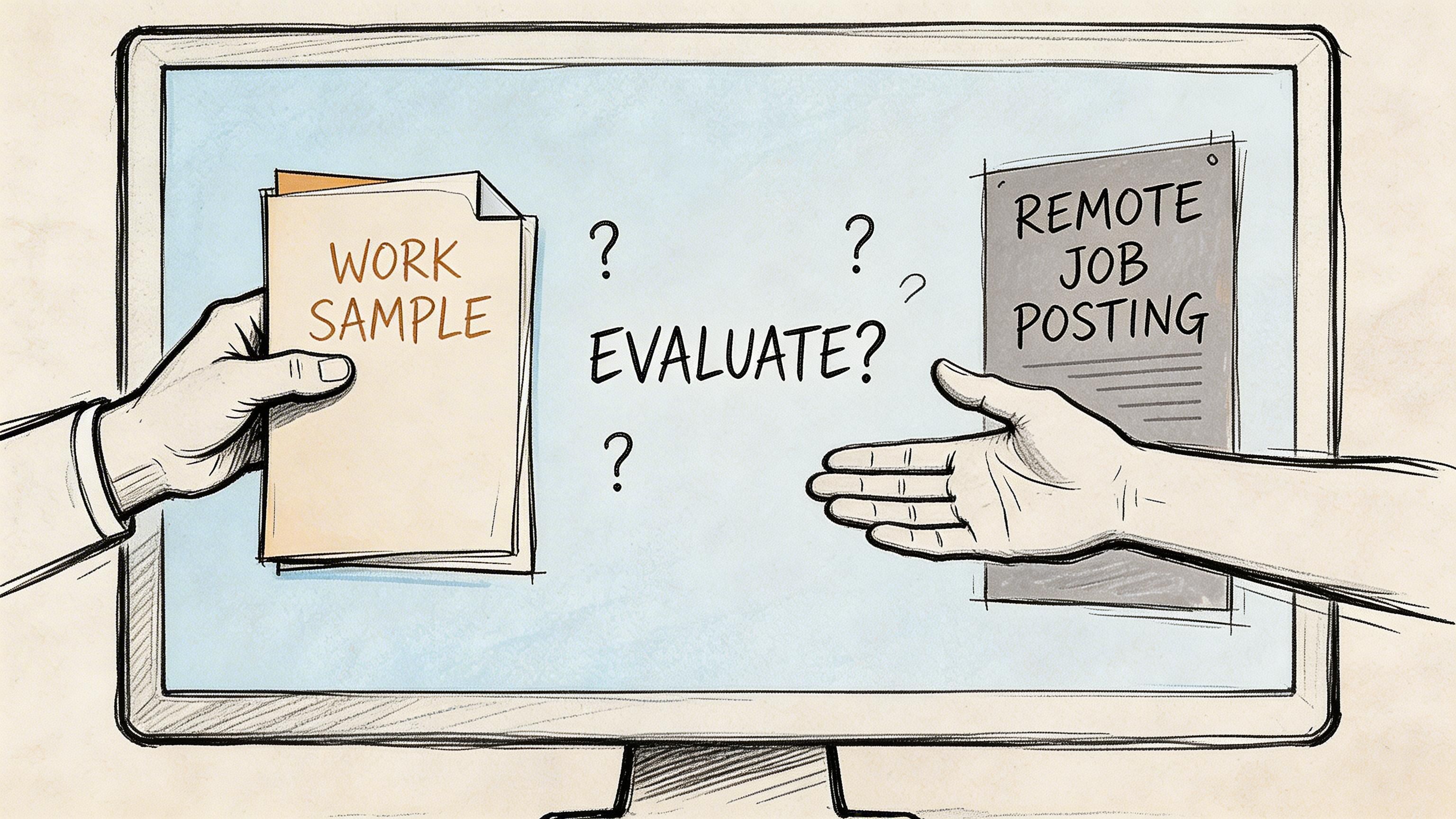
Showing beats describing
Hiring teams ask for work samples because claims are cheap. Anyone can say they’re strategic, data-driven, collaborative, or customer-obsessed. Fewer candidates can hand over something concrete that proves it.
That’s why work samples matter more than most applicants realize. Work sample tests demonstrate predictive validity of 0.54 for job performance, which places them among the strongest selection tools and makes them more reliable predictors of on-the-job success than traditional interviews, according to Candidately’s summary of the Schmidt and Hunter meta-analysis.
For job seekers, that should change your mindset. A work sample isn’t busywork. It’s your best chance to let the company evaluate something that favors substance over charm.
Practical rule: If the role matters, treat the sample like part of the job, not an attachment at the end of your application.
In remote hiring, context matters even more
In office hiring, you can sometimes rescue a weak portfolio in the room. You can narrate your decisions on a call, sketch on a whiteboard, or answer follow-up questions instantly.
In async hiring, your sample has to do that heavy lifting on its own. That’s why candidates who understand what is a digital portfolio often have an edge. They don’t just upload files. They package evidence so a stranger can understand the work quickly and trust what they’re seeing.
A strong work sample answers three silent questions hiring managers always have:
- Can this person do the core work
- Can they explain their decisions clearly
- Can they operate without hand-holding
If your sample answers all three, you don’t just look qualified. You look easy to hire.
Why Employers Value Work Samples More Than Resumes
Employers don’t ask for work samples because they enjoy creating extra steps. They ask because resumes leave too much room for interpretation.
A resume compresses years of work into a few bullets. That format is useful, but it also hides the part hiring managers care about most. They need to know what your judgment looks like when you’re doing the work.
Resumes describe. Samples reduce risk
From the employer side, every hire is a risk decision. In remote teams, that risk gets sharper because managers often can’t rely on in-person cues, office observation, or informal calibration in the first few weeks.
A work sample reduces that uncertainty in ways a resume can’t.
Here’s what employers usually get from a sample that they won’t get from a standard application:
- Actual thinking: They can see how you frame a problem, not just whether you’ve used the right keywords.
- Execution quality: They can judge whether your output is clear, useful, polished, and relevant.
- Role fit: They can compare your sample directly to the work their team already does.
- Communication style: In asynchronous companies, clarity in documents often matters as much as confidence in meetings.
That last point is where many candidates miss the signal. A messy but smart person can still get hired in a highly interactive office culture if they present well live. In remote environments, weak written thinking is harder to hide.
Serious candidates benefit from this filter
Plenty of applicants complain about work samples because they want the process to be faster. Serious candidates should want the opposite. They should want more chances to be judged on real ability.
If you’re applying to strong remote roles, you’re often competing against people with similar titles, similar logos on their resumes, and similar keyword coverage. A work sample breaks that tie.
The candidate who gives the hiring team something concrete to evaluate usually changes the conversation from “Should we interview them?” to “How would they fit with the team?”
That’s the advantage. A sample moves you out of the abstract.
Employers look for proof, not volume
More pages don’t help. More projects don’t help. More adjectives definitely don’t help.
What works is focused evidence. One sharp sample that matches the role beats a giant portfolio dump every time.
Hiring managers tend to value work samples when they do three things well:
Match the role closely
A product strategy sample for a product role. A lifecycle campaign asset for a marketing role. A call plan or account brief for sales.Make ownership visible
Teams want to know what you did, what others did, and where your judgment changed the outcome.Stand on their own
If your sample needs a long call to make sense, it’s weaker than you think.
If you understand why employers ask for work samples, you can build yours for their decision-making process instead of your own self-expression. That usually leads to a much stronger submission.
Work Sample Examples for Key Remote Roles
Different roles need different proof. A strong engineering sample would look weak for a product manager. A beautiful design file might tell a sales leader almost nothing.
The smartest move is to submit a sample that mirrors the shape of the work the team already expects from that role. If you’re browsing roles on platforms like Remote First Jobs, save a few postings in your function and compare the recurring deliverables. Those deliverables usually tell you what your sample should look like.
Work Sample Expectations by Professional Role
| Role | Common Sample Type | What It Should Demonstrate | Pro Tip |
|---|---|---|---|
| Engineering | GitHub repo, take-home implementation, architecture note | Code quality, trade-off decisions, readability, testing habits, documentation | Include a short README that explains assumptions and what you’d improve with more time |
| Product Management | PRD, prioritization memo, roadmap slice, feature critique | Decision-making, user thinking, prioritization logic, clarity in writing | Show why you rejected alternatives, not just what you chose |
| Design | Figma file, case study, prototype, UX audit | Problem framing, iteration, rationale, handoff thinking, usability judgment | Add captions inside frames so reviewers don’t need a live walkthrough |
| Marketing | Campaign brief, landing page audit, email sequence, content strategy doc | Audience understanding, messaging, channel judgment, execution detail | Tie creative choices to business goals and constraints |
| Sales | Account plan, discovery outline, outbound sequence, objection-handling doc | Research quality, messaging, qualification thinking, commercial judgment | Tailor the sample to the company’s segment instead of using a generic playbook |
What strong looks like by role
For engineering, a good sample isn’t just code that works. It shows restraint. Clean structure, sensible naming, useful comments, and a brief note on trade-offs matter more than trying to impress with cleverness. A weak sample is a repo with no setup instructions, unclear ownership, and no explanation of why certain decisions were made.
For product management, hiring teams want evidence of judgment. A strong sample might be a prioritization memo that explains user pain, constraints, sequencing, and risks. A weak sample reads like a school assignment. It repeats frameworks but never commits to a real decision.
What weak samples tend to have in common
Across functions, weak samples often fail for the same reasons:
They’re too generic
The sample could have been sent to any company in any industry.They hide the process
Reviewers can see the output but not the reasoning.They overload the reviewer
Ten files, seven tabs, and no guide. That’s friction, not proof.They confuse collaboration with ownership
“We did this” doesn’t tell the employer what your contribution was.
A quick self-check before you send
Ask yourself four questions:
- Would this sample make sense to someone reviewing it alone at night?
- Is the core skill for this role obvious in the first minute?
- Have I made my personal contribution unmistakable?
- Does this look like work from the role I want next, not the role I had before?
If the answer is no to any of those, tighten the sample before you ship it.
How to Create a Powerful Work Sample from Scratch
Sometimes your past work is stuck behind an NDA. Sometimes it’s too tied to a previous employer. Sometimes it doesn’t reflect the role you want now.
In those cases, create a new sample. That’s often the better move anyway because you can control the context, the scope, and the presentation.
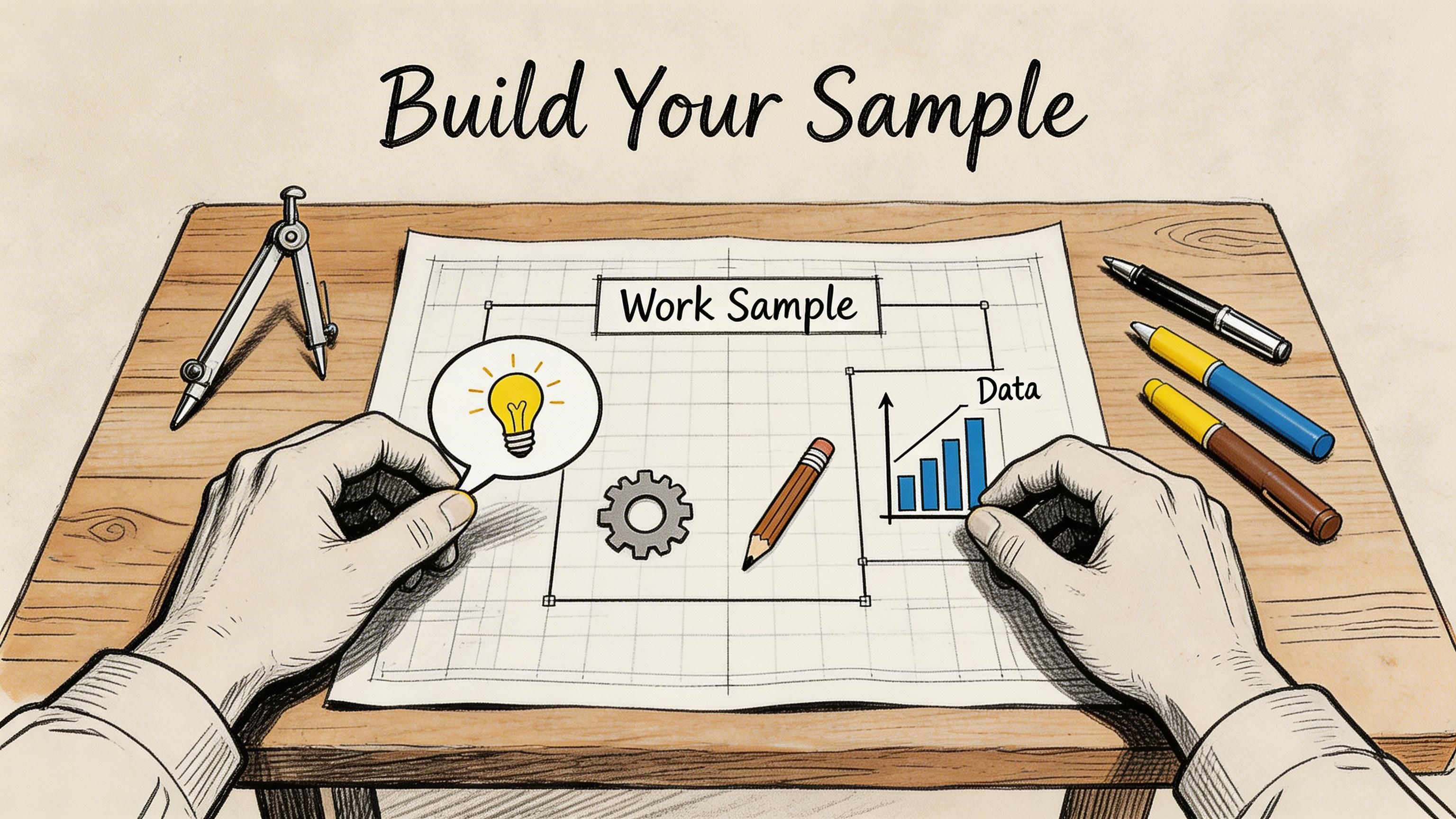
Start with the job description
Most candidates start with what they want to show. Start with what the employer is trying to verify.
Read the job description and pull out the core competencies hidden inside it. Ignore the fluff. Look for repeated responsibilities, required tools, and phrases that point to the actual work.
For example:
- A product role might reveal backlog prioritization, stakeholder communication, and written strategy.
- A lifecycle marketing role might reveal segmentation, messaging, and experimentation.
- A sales role might reveal account research, objection handling, and structured outreach.
- A design role might reveal system thinking, usability, and async collaboration.
Your sample should mirror those competencies, not your favorite project from three years ago.
Build the sample around real work conditions
The strongest work samples feel like a slice of the job. That’s not just good advice. It’s central to why the method works.
According to UC Davis guidance on work samples, work sample tests are most effective when they replicate the job environment with high fidelity, use tasks that are objectively evaluable, and focus on core competencies. Their example notes that this kind of realism has been associated with 20 to 30 percent higher first-year retention rates than resume-based hires.
That gives you a useful principle as a candidate. Don’t create a “portfolio piece.” Create a job-shaped artifact.
If the role requires async decisions in documents, submit a document. If the role requires analysis, submit analysis. If the role requires visual communication, make the visuals carry the argument.
Use a simple three-part structure
Most strong samples can be organized as a mini case study.
Problem and context
Open with the situation. Keep it tight.
State the business problem, user problem, or task prompt. Define constraints. Name the audience. If you made assumptions, list them plainly.
This part matters because remote reviewers need orientation fast.
Process and contribution
You separate yourself from candidates who only show the final file.
Explain how you approached the work. Show your reasoning, the options you considered, the tools you used, and what you personally owned.
Useful materials here include:
- Annotated screenshots
- Short decision notes
- Drafts or iterations
- A brief “why this, not that” section
A sample without process often looks thinner than it really is.
Here’s a quick explainer if you want another angle on structuring sample work:
Outcome and reflection
If the sample is based on real work, summarize the result in qualitative terms unless you have permission to share exact metrics. If it’s a created sample, explain what success would look like and what you’d test next.
Reflection is underrated. A short note about trade-offs or what you’d improve tells hiring managers you can evaluate your own work without ego.
Keep the scope tight
Candidates often ruin good samples by making them too ambitious. A focused, high-signal sample is better than a sprawling one.
Good scope means:
- One clear problem
- One role-relevant deliverable
- Enough detail to judge quality
- Little to no filler
If you’re creating from scratch, aim for something that a busy reviewer can understand quickly and remember later. Clarity wins.
Packaging and Sharing Samples for Remote Applications
A solid work sample can still fail if you package it badly. In remote hiring, delivery is part of the evaluation.
Managers often review applications in bursts, across devices, between meetings. If your sample has broken permissions, confusing file names, or zero framing, many won’t chase you for clarification. They’ll move on.
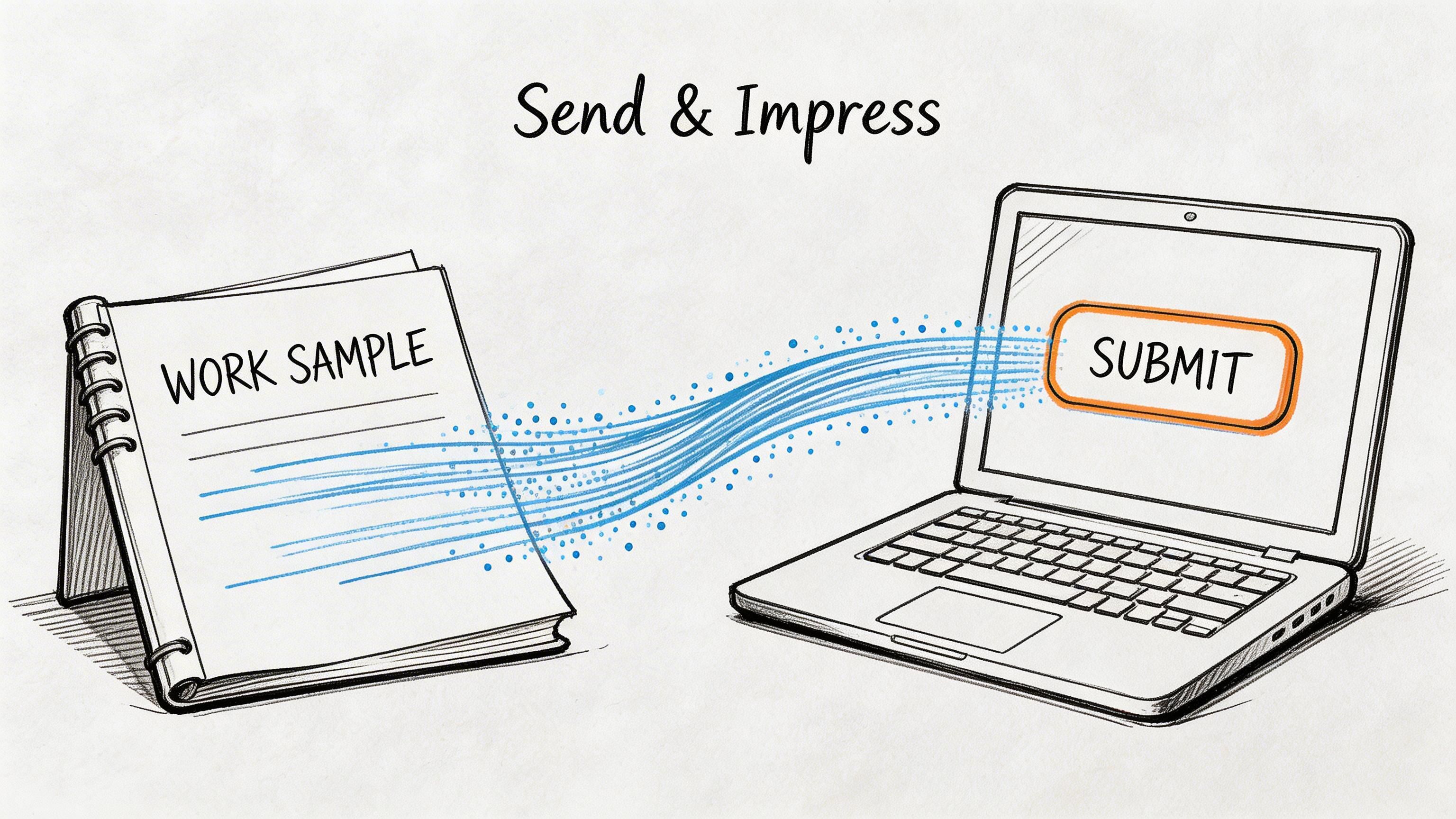
Pick a format that reduces friction
There isn’t one perfect hosting method. There is a right choice for the kind of sample you’re sending.
Here’s the practical breakdown:
Notion page
Good for case studies, PM artifacts, marketing plans, and mixed media. It’s easy to scan and lets you combine text, images, and links in one place. It can feel polished fast. The downside is that some pages get bloated or render oddly if you overdesign them.Google Drive folder or doc
Good for simple sharing and common file types. It’s familiar to most reviewers. The downside is weak presentation if you dump multiple files into a folder with no narrative.Personal portfolio site
Good when you already have a clean site and your field values presentation. It gives you the most control. It’s slower to build and can be overkill if the only thing the employer needs is one direct, role-specific sample.GitHub
Best for engineering and technical documentation. Reviewers expect it. But don’t assume everyone will hunt through commits or infer your intent from code alone.
Add context directly in the package
This is the part many candidates skip. They upload the artifact and assume the work speaks for itself.
In asynchronous review, it usually doesn’t.
Use a short intro at the top of the page or file:
- What the sample is
- Why it’s relevant to this role
- What you owned
- How to review it in under two minutes
That last line matters. Give the reviewer a path.
“Start with the summary, then review the annotated draft, then skim the final output” is far more helpful than dropping a naked link.
Use video sparingly but strategically
A short Loom can help when the sample needs motion, narration, or navigation. Product demos, design flows, dashboards, and sales messaging walkthroughs often benefit from it.
Keep it concise. The video should add context, not substitute for a readable submission.
Make the application itself look coherent
Your sample doesn’t sit in isolation. Reviewers see it alongside your LinkedIn, resume, portfolio, and often your profile photo.
If those assets feel mismatched, the whole application can read as rushed. Even small polish details matter in async review, including a clean headshot if the platform displays one. If you need a fast refresh, a tool like an AI headshot generator can help you create something more consistent with the rest of your professional materials.
Final packaging checklist
Before you submit, verify these basics:
- Permissions work: Open the link in an incognito window.
- File names are clear: “Jane-Lee-Product-Work-Sample” beats “final_v2_new.”
- Mobile view is acceptable: Some reviewers will glance from a phone.
- The first screen tells the story: Don’t make them scroll to figure out relevance.
Good packaging doesn’t make weak work strong. But it does make strong work legible.
Common Work Sample Mistakes That Get You Rejected
Most rejected work samples aren’t rejected because the candidate lacks ability. They’re rejected because the signal gets buried, distorted, or made risky.
The biggest mistake in remote hiring is simple. Candidates send past work with no context and expect the reviewer to reverse-engineer their thinking.
Mistake one is sending static work with no explanation
This hurts more in remote hiring than in live interviews because nobody is there to ask immediate follow-ups.
That gap matters. A past artifact might show quality, but it often hides process, collaboration style, and judgment. FlexJobs notes that static past samples can underperform in remote hiring because they don’t reveal process or style, and that up to 68 percent of remote hires can fail due to “style mismatch” in these contexts, as discussed in their guide to what is a work sample and how to choose one.
The fix is straightforward. Add a short note that explains the brief, your role, your constraints, and why you made the decisions you made.
A sample without context forces the hiring manager to guess. Guessing rarely favors the candidate.
Other mistakes that sink solid candidates
Irrelevant samples
Candidates sometimes send their proudest work instead of their most relevant work. Employers care less about your best-ever artifact than your clearest proof for this role.
Confidential material
Never share private data, client names, internal strategy, or anything covered by an NDA. Redact, recreate, or build a parallel sample instead.
Broken access
This sounds basic because it is. Private links, expired shares, and locked Figma files still knock candidates out of contention.
Overdesigned presentation
Fancy transitions, elaborate microsites, and clever navigation can distract from the actual work. The stronger your work is, the less decoration it needs.
The better standard
A useful work sample is easy to review, easy to trust, and easy to connect to the role.
If you remember nothing else, remember this: don’t make the reviewer do interpretation work you could have done for them in advance.
Frequently Asked Questions About Work Samples
What if all my best work is under an NDA
Don’t violate confidentiality to prove you’re professional. That backfires.
Create a sanitized version, redact identifying details, or rebuild the sample around the same problem using public or fictionalized inputs. You can also describe the decision process without exposing protected information.
Should you create a brand-new sample for every job
Not for every job. But you should tailor the framing for every serious application.
A smart approach is to build a small base library of role-relevant samples, then adjust the intro, emphasis, and supporting notes so each one aligns with the specific role.
What if you’re junior and don’t have professional work yet
That’s not fatal. Create a sample from scratch.
Use a realistic prompt. Audit a landing page. Build a small app. Write a mock customer email sequence. Draft a product brief based on a public company’s feature gap. Employers care that the sample demonstrates judgment and role fit.
How long should a work sample be
Short enough to review quickly, detailed enough to evaluate fairly.
As a rule, aim for something a hiring manager can grasp in a few minutes, with optional deeper detail if they want it. If it takes a long time just to understand what they’re looking at, it’s too long or too messy.
Should you include a Loom video
Use one when motion, walkthrough, or verbal context adds clarity. Skip it when the written or visual sample already stands on its own.
A Loom should support the artifact, not rescue it.
Can you reuse portfolio work
Yes, if it’s relevant, legally safe to share, and packaged with proper context. Reused work fails when candidates send it untouched, without explaining ownership, constraints, or why it matters for this job.
If you’re tired of applying late to crowded listings, Remote First Jobs helps you find verified remote roles sourced directly from company career pages, so you can spend less time fighting noise and more time sending sharper applications with work samples that get reviewed.