
The idea of mixing your career with your love for travel isn’t some far-off fantasy anymore. For millions of professionals, it’s the new reality. Being able to travel while working remotely means you can swap your cubicle for a Bali beachfront or a Parisian café—without putting your career on hold. It’s all about designing a life where your work enables your adventures, rather than getting in the way of them.
The Reality Of Working From Anywhere In 2026

The classic image of working from a laptop on a beach has gone from a daydream to a completely sustainable career path. Looking ahead to 2026, it’s clear the global shift toward remote work is here to stay. This isn’t just about ditching the office; it’s a total rethink of how we connect our careers, our time, and our personal freedom.
For many mid-career professionals feeling stuck or burned out, the biggest obstacles to travel are usually a lack of time and money. The remote work model tackles both head-on. By cutting out the daily commute, you instantly get back a huge chunk of your day and save a surprising amount of cash that can go straight into your travel fund.
From Commute Costs To Travel Funds
Just think about the old daily grind. The latest 2026 data shows remote workers are saving an average of 72 minutes per day by not commuting. In the US alone, that adds up to a staggering 890 million fewer miles traveled every day compared to before the pandemic.
Since this shift, Upwork estimates that remote workers have collectively saved over $90 billion in commute-related costs like gas, car maintenance, and the sheer value of their time. You can dive deeper into these remote work hiring trends to see just how significant the numbers are.
That reclaimed time and money are the fuel for your new lifestyle. Let’s put it into perspective.
Your Commute Savings Reimagined As A Travel Budget
The time and money you once spent just getting to work can now be your ticket to seeing the world. This table breaks down how those savings can add up to real travel opportunities.
| Commute Savings | Weekly Average | Monthly Average | Annual Travel Equivalent |
|---|---|---|---|
| Time Saved | 10 hours | 40 hours | One full work week per month to explore a new city or country. |
| Money Saved | $50 - $150 | $200 - $600+ | Enough for a round-trip flight or a month’s rent in an affordable location. |
Suddenly, a daily two-hour commute becomes 10 hours a week you can spend hiking, exploring a new city, or just relaxing. The money you save on gas, tolls, and parking can easily cover a flight or your accommodation for a month in a place like Mexico or Portugal.
The question is no longer if you can travel while working remotely, but how you can make it a sustainable part of your career. It’s about a strategic shift in mindset, where you see commute savings not just as a perk, but as your seed funding for a life of travel.
Finding Companies That Truly Support You
Of course, the biggest piece of the puzzle is finding a company whose policies actually align with your travel goals. Lots of “remote” jobs have hidden strings attached, like requiring you to live in a specific state or country for tax reasons. The trick is to look past the generic job boards and find companies where location independence is part of their DNA.
You’re looking for businesses that are “remote-first” or “fully distributed.” These are organizations that have built their entire culture around asynchronous communication, trust, and autonomy. They don’t just tolerate remote work; they actively champion it. Your goal is to find an opportunity where working from anywhere isn’t a temporary benefit, but a fundamental part of how the company operates.
How To Land A Truly Travel-Friendly Remote Job
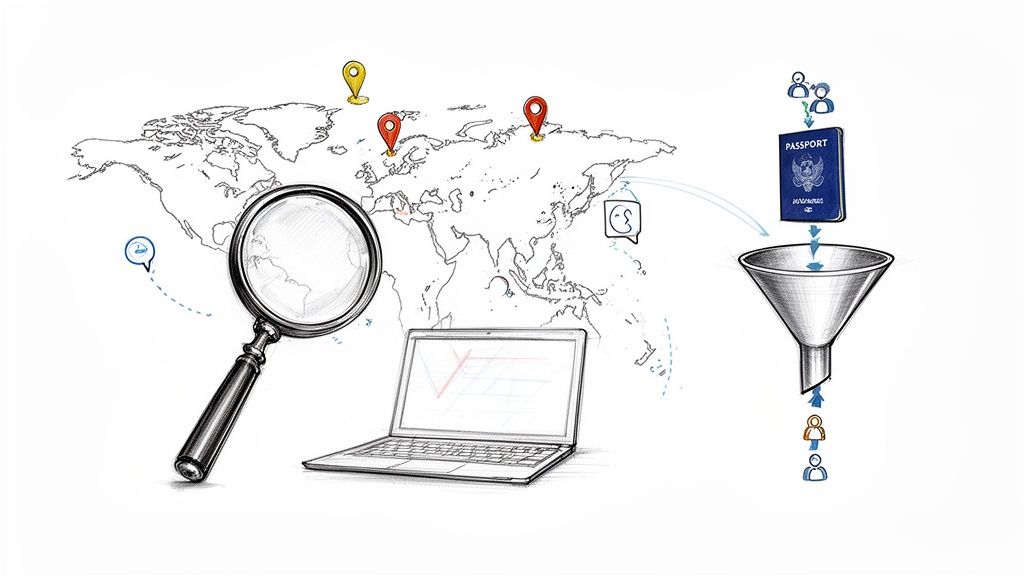
Finding a remote job is one thing. Finding one that actually lets you travel while working remotely is a whole different ballgame. You have to be smart about it. The generic “remote” tag on big job boards often hides location restrictions or a company culture that’s still stuck in a single time zone.
Your mission is to find companies where location independence isn’t just a perk; it’s baked into their DNA.
The good news? The demand for real flexibility is strong. Remote job postings saw a 3% increase in late 2025. With 10.7% of the US workforce now fully remote—that’s three times what it was before the pandemic—the competition is real. You need an edge to find the right roles before everyone else does. You can start by exploring a curated list of over 44,000 active remote jobs to get a feel for what’s out there.
Mastering Your Job Search Vocabulary
The first trick is to stop searching for “remote jobs.” That’s too broad. You need to use the specific language that signals a company is truly built for a distributed team.
Start using these keywords in your searches and on your professional profiles:
- “Fully distributed”: This tells you the company has no central office. Everyone is remote.
- “Asynchronous”: A massive green flag. It means they value deep work and results over being online for endless meetings.
- “Work from anywhere”: This is the gold standard for travelers, stating explicitly that there are no location restrictions.
- “Location-agnostic”: A more corporate way of saying your physical address doesn’t matter for the role.
Using these terms helps you cut through the noise of “remote-friendly” companies that still expect you to live in a specific state or country for tax or HR reasons.
True freedom to travel comes from companies that are not just “remote-tolerant” but “remote-first.” Their processes, from onboarding to performance reviews, are designed for a team scattered across the globe, ensuring you’re a first-class employee, not a satellite office of one.
How To Identify Genuinely Flexible Companies
Beyond the right keywords, you need to play detective. A job description is just marketing; the real clues are hidden in how the company actually operates.
Look for these cultural green flags:
- Public Documentation: Does the company have a public handbook (like GitLab) or a blog that goes deep into their remote culture? This shows they’ve put real thought into making information accessible to everyone, no matter their time zone.
- A Global Team: Check their team page. If you see employees from all over the world, that’s a fantastic sign. If everyone is clustered in one country, be skeptical—even if they call themselves “remote.”
- Focus on Outcomes: Read the job description carefully. Does it talk about “achieving results” or “managing tasks”? Companies that focus on your output rather than the hours you’re logged in are much more likely to embrace the asynchronous work that makes travel possible.
Let’s be honest, the job market can be frustrating. Professionals are tired of ghost jobs and applying into the void. With over 36 million US employees teleworking at least part-time as of March 2025, your remote skills are valuable. The best strategy in 2026 isn’t to apply everywhere, but to target verified roles with companies that get it.
To stay ahead, focus on platforms that pull jobs directly from company career pages. This helps you find high-quality opportunities and bypass the chaos. For a deeper dive, you can read the full research about remote work statistics. This targeted approach is your best bet for finding a company that will genuinely support your journey to travel while working remotely.
Negotiating Your Freedom To Travel
So you landed a remote job. Fantastic! But before you start browsing for one-way tickets, there’s a critical conversation you need to have. Just because you’re remote doesn’t automatically mean you can work from anywhere.
Many companies have a “remote-in-place” policy, expecting you to stay put in a specific city, state, or country. Getting the true freedom to work and travel requires a smart, strategic approach with your boss.
The trick is to position your request as a win-win, not just a personal vacation. You need to build an airtight case that proves you’re reliable, committed, and that your productivity won’t skip a beat.
Build Your Case With Performance Data
Before you even book a meeting, you need to arm yourself with undeniable proof of your value. Your manager’s biggest worries will likely circle back to three things: performance, availability, and security. Your job is to get ahead of these concerns.
Start digging into your own track record. Put together a simple, powerful report showcasing your wins since you went remote.
- Productivity Metrics: Pull the numbers. How many projects did you complete, tickets did you close, or sales did you make? Show them that your output has been solid, or even better, has improved since working from home.
- Reliability Record: Point out your pristine attendance at meetings and how responsive you are on Slack or Microsoft Teams. This proves you can be trusted, no matter your zip code.
- Proactive Problem-Solving: Think of a few times you took charge and solved an issue without needing your hand held. This builds confidence and shows you’re an autonomous, responsible pro.
When you walk in with this data, you’re not just asking for something. You’re presenting a business case backed by cold, hard facts.
Your past performance is the most powerful negotiation tool you have. By leading with data, you shift the conversation from a manager’s hypothetical fears to your proven track record of success.
Propose A Trial Period
Even with a stellar track record, asking to work from another country can sound like a big, scary commitment to a manager. So don’t ask for forever. Ask for a test run.
Suggesting a short-term trial period makes it so much easier for them to say yes by lowering the stakes.
You could phrase it something like this: “I’d like to propose a three-month trial where I work from Lisbon, Portugal. I’ve already checked, and the time zone is only five hours ahead, so I’ll have plenty of overlap with the team’s core hours. I’ll keep my exact same schedule and won’t miss a single meeting.”
This shows you’ve done your homework and are serious about making it seamless. A trial gives your manager a low-risk way to see for themselves that your productivity and availability won’t change one bit.
Create A Detailed Communication Plan
The final piece of your pitch is a rock-solid communication plan. This is where you show you’ve thought through all the potential hiccups and already have a solution. It’s your proof that you’ll be just as connected and effective from a café in Spain as you are from your home office.
Your plan should clearly lay out:
- Your Availability: State your working hours in both your new local time and the company’s main time zone.
- Communication Channels: Reconfirm you’ll be active and available on all the main platforms (Slack, email, etc.) during your working hours.
- Emergency Contact: Give them a reliable way to get ahold of you for anything truly urgent.
- Connectivity Strategy: Briefly explain your plan for great internet. Mention that you’ll be booking places with verified high-speed Wi-Fi and will have a mobile hotspot as a backup.
When you present a package this thorough—performance data, a trial period, and a communication plan—you’re not just asking for permission. You’re giving your manager a professional, well-researched solution that’s easy to say “yes” to.
The Essential Toolkit For Working On The Road
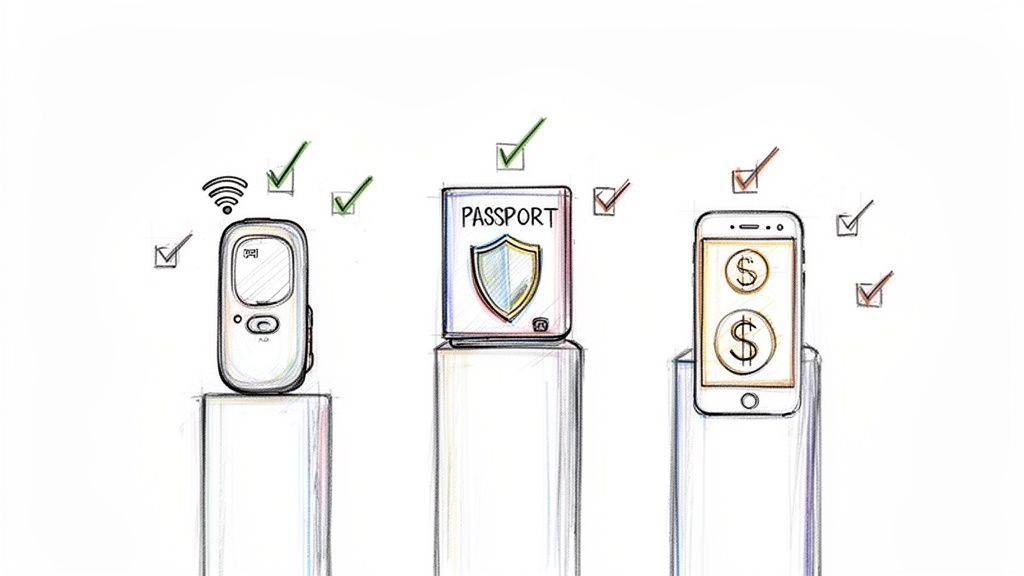
So you’ve landed a job that lets you travel. Fantastic. Now for the real work: building the infrastructure to make it a success. This isn’t just about what you pack in your suitcase; it’s about mastering the logistics of technology, legalities, and finances on the move.
Getting these three pillars right is what separates a dream-come-true adventure from a logistical nightmare. Let’s break down exactly what you need in your toolkit.
Your Technology Stack For Global Connectivity
Your ability to work from anywhere comes down to one thing: a solid internet connection. Your laptop might be your office, but the Wi-Fi is the lifeline to your team. Never, ever depend on a single source.
The golden rule is to have layers of connectivity. First, book accommodation with verified high-speed Wi-Fi—and I mean read the reviews from other remote workers. For your backup, a portable Wi-Fi hotspot with a local SIM card is non-negotiable. You can usually grab one at the airport right after you land.
Working from cafes and shared spaces means you’re on public networks, which can be risky. A Virtual Private Network (VPN) is essential. It encrypts your connection, creating a secure tunnel for your data and protecting sensitive company information.
Think of your tech stack as a three-legged stool: a primary internet source, a reliable backup, and a robust VPN. If one of those legs gives out, your entire workday can come crashing down.
And don’t forget about coworking spaces. They’re a game-changer for productivity. Apps like Coworker.com or Croissant can help you find day passes, giving you access to professional-grade internet, quiet focus zones, and a community of other remote professionals.
Navigating Visas And Legal Requirements
The legal side of working abroad can feel daunting, but a little research goes a long way. The biggest mistake you can make is assuming you can work for months on end using a standard tourist visa. In most countries, that’s technically illegal and can get you into serious trouble.
For a short workcation of just a few weeks, a tourist visa will often do the trick (but always check the rules for your specific destination). For anything longer, you need to look at your other options, which is where the digital nomad visa enters the picture.
More and more countries are rolling out these special visas, which are specifically designed for remote workers. They give you the legal right to live and work in the country for a foreign company, usually for one year or more. It provides incredible peace of mind and a stable home base.
Digital Nomad Visa Vs Tourist Visa At A Glance
Choosing the right visa depends entirely on your travel plans. This quick comparison breaks down the core differences to help you decide.
| Consideration | Tourist Visa | Digital Nomad Visa |
|---|---|---|
| Legality of Work | Working is typically forbidden. | Explicitly allows remote work for a foreign company. |
| Length of Stay | Short-term, usually 30-90 days per entry. | Long-term, often 1-2 years with renewal options. |
| Requirements | Proof of return flight and funds for tourism. | Proof of remote income, health insurance, and clean criminal record. |
| Best For | Short workcations or exploring a country before committing. | Extended stays in a single country for a stable work base. |
As you can see, for any serious attempt at living abroad while working, the digital nomad visa is the proper legal path.
Finally, another crucial legal item is international health insurance. Your plan from back home almost certainly won’t cover you abroad. Look into providers like SafetyWing or World Nomads; they offer plans built for travelers and nomads that cover medical emergencies in multiple countries.
Smart Financial Strategies For The Road
The final pillar of your toolkit is managing your money across borders. Juggling currencies, transfer fees, and new living costs can get messy fast if you don’t have the right systems in place.
First things first: stop using your traditional bank for international spending. Their foreign transaction and ATM fees are outrageous and can cost you hundreds of dollars over time. Open an account with a modern fintech service like Wise or Revolut. They provide multi-currency accounts, debit cards with great exchange rates, and nearly non-existent transfer fees.
Next, you need a solid system for managing travel expenses. Whether you use a budgeting app like YNAB (You Need A Budget) or a simple spreadsheet, tracking your spending is key to staying on budget and making your money last.
And always, always have a backup. I travel with at least two different debit or credit cards and a small stash of emergency cash in the local currency. That way, a lost or frozen card won’t leave you completely stranded.
Building Routines That Actually Work on the Road
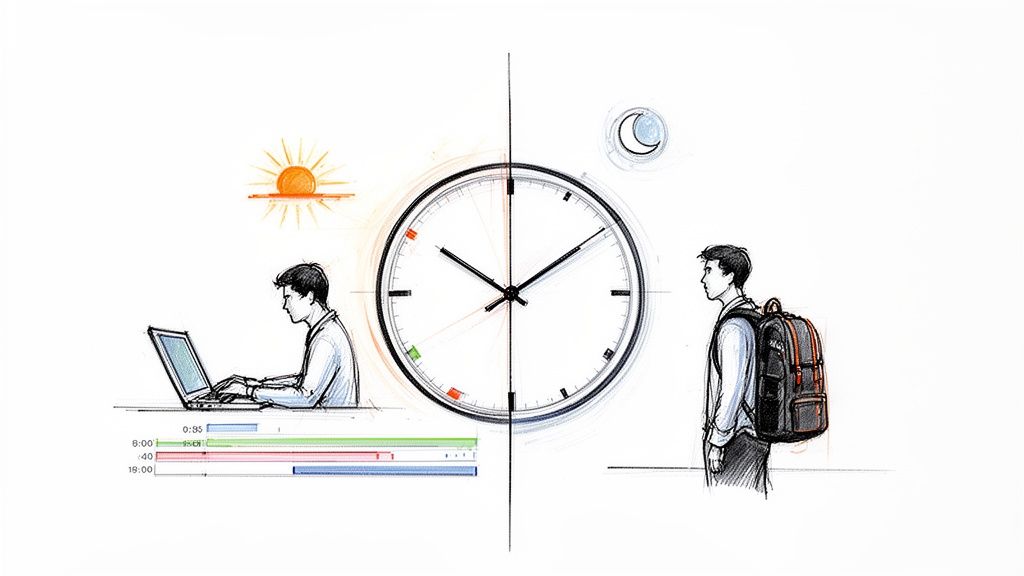
The dream of traveling while working remotely is incredible, but the reality can quickly turn into a nightmare of blurred lines. Without the familiar structure of an office, you can easily find yourself in a state of constant, low-grade stress, feeling like you’re never fully “on” or “off.”
The secret to making this lifestyle last isn’t finding the perfect cafe; it’s building routines that fiercely protect your focus and your free time. It’s all about creating your own personal system that works just as well in Lisbon as it does in Bali.
How to Structure Your Day Across Time Zones
Time zones are usually the biggest headache. Instead of fighting the clock, you have to learn to make it work for you. Many experienced digital nomads swear by a “split-day” schedule, which is an absolute game-changer when you have a big time gap between you and your team.
Here’s how it works: You split your day into two main blocks. For instance, a developer in Bali working with a team in New York might work from 8 AM to 12 PM local time to crush their solo tasks. Then, they take the entire afternoon off to surf, explore, or just relax. They’d log back on from 8 PM to 11 PM to overlap with their team.
This simple strategy is powerful for two reasons:
- You get real deep work time: Your morning is yours, free from the constant ping of messages and last-minute meeting invites.
- You guarantee time for adventure: You actually get a solid chunk of daylight to enjoy the place you traveled so far to see.
Your schedule is the most important boundary you can set. Without a clear start and stop time, you’ll fall into the “always on” trap, where you feel like you’re working constantly but not getting much done. A structured day is the bedrock of a successful work-travel life.
Sample Daily Schedules for Remote Professionals
So what does this look like in the real world? Remember, a routine isn’t a rigid cage—it’s a flexible framework you can tweak based on your location and job.
Scenario 1: Marketer in Lisbon (5-hour difference with NYC)
- 8:00 AM - 12:00 PM (Local Time): Deep Work. This is your golden time for writing copy, digging into analytics, and planning campaigns without interruption.
- 12:00 PM - 5:00 PM: Explore Lisbon. Hit up a museum, take a long, lazy lunch, or get lost in the Alfama district. This time is sacred.
- 5:00 PM - 7:00 PM: Collaborative Work. Time to log back on for team meetings and sync-ups as the NYC office gets into its afternoon groove.
Scenario 2: Developer in Bali (12-hour difference with NYC)
- 8:00 AM - 1:00 PM (Local Time): Focused Coding. Use this quiet zone for tackling complex problems and writing clean code.
- 1:00 PM - 8:00 PM: Personal Time. This huge block of time allows for bigger adventures, like a day trip to Ubud or a long afternoon unwinding at the beach.
- 8:00 PM - 10:00 PM: Team Sync. Hop on for the daily stand-up, code reviews, and to answer any urgent questions before the US team signs off.
These schedules are more than just a plan; they’re a commitment to your career and your travel experience. To really get the most out of your time, you’ll need to stay sharp. For some extra help, check out these 9 game-changing remote work productivity tips for more strategies.
Protecting Your Focus and Preventing Burnout
Beyond just scheduling your day, a few other habits make a world of difference. Time-blocking is a fantastic technique where you literally assign a job to every chunk of your day on your calendar. This stops you from multitasking and forces you to focus on one thing at a time.
Communicating your availability is also huge. Update your Slack status, set your calendar to show your working hours in both your local time and your team’s time, and don’t feel bad about declining meetings outside your planned schedule. When you set firm boundaries, you teach your colleagues to respect your time—a crucial skill for making the remote travel life sustainable.
Frequently Asked Questions About Remote Work And Travel
So you’re sold on the idea of traveling while working remotely. The excitement is building, but now the practical questions are starting to creep in. It’s that final hurdle between dreaming about this lifestyle and actually living it.
Don’t worry, everyone has these questions. Let’s tackle some of the most common ones so you can build the confidence to finally take the leap.
How Do I Handle Mail And A Permanent Address?
One of the first logistical headaches you’ll run into is your physical mail. You can’t just let it pile up, and you definitely still need a permanent address for things like banking, taxes, and other official paperwork.
The go-to solution here is a virtual mailbox service. Think of it as your digital home base. Companies like Traveling Mailbox or Earth Class Mail provide you with a real street address. Your mail gets sent there, scanned, and uploaded to a secure online account. From anywhere in the world, you can log in and decide what to do with each piece of mail—open and scan, forward, or shred.
A virtual mailbox isn’t just a convenience; it’s a critical piece of infrastructure for a location-independent life. It provides the stability of a fixed address while giving you the freedom to roam.
How Do I Stay Connected With My Team?
Staying in the loop with your team from thousands of miles away is about more than just managing time zones. The real secret is proactive and visible communication.
You can’t afford to become a ghost who just silently submits work. You need to make your presence felt in a positive way.
- Be a visible contributor: Don’t just lurk in your team’s Slack channels. Actively participate, offer help to your colleagues, and share interesting articles or thoughts related to your projects.
- Schedule casual check-ins: Put some brief, informal video calls on the calendar with teammates. These “virtual coffee chats” are incredible for maintaining the personal connections that often get lost with distance.
- Over-communicate your progress: Send regular, clear updates on what you’re working on. This isn’t about micromanaging yourself; it’s about building trust and showing your manager you’re on top of everything, no matter your location.
This consistent effort proves you’re not just a remote employee, but an engaged and essential part of the team.
What About Taxes When I Travel And Work?
Taxes are one area you absolutely cannot afford to wing it. The rules can be a minefield, and getting it wrong is a costly mistake. For the most part, you’ll owe taxes in your home country or wherever you’re an official tax resident.
The complications start when you stay in another country for a longer period. Many countries have what’s known as the “183-day rule.” This means if you spend more than 183 days there in a single year, they might consider you a tax resident, and you could owe local taxes on your income.
Because the rules vary so wildly from one country to the next, it is absolutely essential to talk to a tax professional who specializes in expatriate or digital nomad tax law. They’re the only ones who can give you accurate advice for your situation and help you avoid the nightmare of double taxation.
How Can I Make Friends And Avoid Loneliness?
The freedom of working and traveling is incredible, but let’s be real: loneliness is a genuine challenge for many people on the road. Building a community doesn’t just happen by accident—it takes intentional effort.
A great first step is to join local digital nomad groups on Facebook or other social platforms before you even land. Coworking spaces are also natural hubs for meeting other professionals. Don’t be afraid to strike up a conversation by the coffee machine or suggest a group lunch.
Beyond work, lean into your hobbies. Look up a local running club, find a language exchange meetup, or take a cooking class. Pursuing your interests is the most natural way to connect with people you already have something in common with. It all comes down to putting yourself out there, again and again.
Finding the right job is the first step to this incredible lifestyle. Remote First Jobs gives you an edge by sourcing over 44,000 active remote jobs directly from company career pages, letting you apply before the roles get flooded on other boards. Find your next opportunity at https://remotefirstjobs.com.