You’ve probably done the obvious things already. You took the ML courses, built a chatbot, maybe fine-tuned a model, and started firing applications into LinkedIn, Handshake, and company portals. Then nothing happens, or worse, you get interviews and realize the role called “AI engineer intern” is asking for data pipelines, evals, CI/CD, and model debugging you’ve never had to explain out loud.
That gap is where most candidates lose. Not because they aren’t smart, but because they optimize for skills they can list instead of signals that hiring teams trust. An ai engineer internship isn’t won by sounding interested in AI. It’s won by showing that you can contribute to a real workflow, in a real codebase, with real evaluation discipline.
The State of AI Internships in 2026
The current market feels brutal because it is. Students are applying earlier, more often, and into a smaller pool of openings. According to Handshake’s 2025 Internships Index, internship postings on its platform fell by more than 15% between January 2023 and January 2025, while applications surged. The same report notes that by January 2025, 41% of the Class of 2025 had already applied to at least one internship through Handshake, compared with 34% of the Class of 2023 by the end of their undergraduate studies.

That’s the bad news. The good news is that these internships have become more valuable, not less. The same Handshake reference cites Levels.fyi’s note that 56% of interns receive a full-time offer, which is why companies increasingly use internships as a direct hiring channel into permanent roles. Glassdoor also lists the average salary for an AI Engineer Intern in the United States at $89,697 per year in that verified data set, which tells you this isn’t treated like low-stakes shadowing work.
Why this market rewards clarity
Most candidates still approach the search like a volume game. That’s a mistake for AI roles.
Companies hiring AI interns usually aren’t asking, “Is this student generally promising?” They’re asking narrower questions:
- Can this person build and debug part of a model pipeline
- Can this person evaluate output quality in a way the team can trust
- Can this person work inside an engineering process instead of a notebook silo
That’s why generic “AI enthusiast” positioning performs badly. Teams want evidence that you fit a lane.
Practical rule: Treat an ai engineer internship like an entry point into a full-time pipeline, not like a summer experiment.
The broader AI hiring environment reinforces that. Business Insider reported that top AI companies such as OpenAI, Anthropic, Meta, and Google DeepMind were competing aggressively for talent through internships, fellowships, and residencies, with Meta research internships described as 12- to 24-week roles paying $7,650 to over $12,000 per month depending on experience and location in this report on top-paying AI internships and residencies. If you want context on where product work is heading around mobile agents, code generation, and applied AI interfaces, State of Mobile AI 2026 is a useful companion read because it helps you understand what kinds of systems companies are racing to build.
What actually follows from this
You don’t need more random coursework. You need sharper positioning.
A strong candidate in this market usually does three things well:
- Picks a sub-specialty early
- Builds projects that prove end-to-end competence
- Applies to roles that match that signal
That’s how you stop competing as “another student who knows Python” and start competing as “the candidate who already works like a junior AI engineer.”
Building Your Foundational AI Skillset
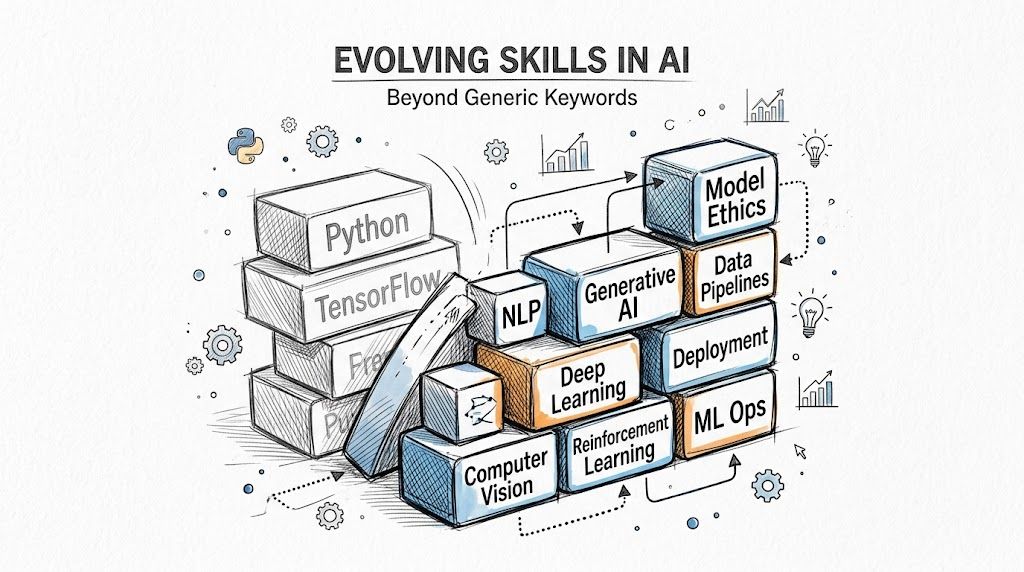
The fastest way to waste months is to study AI as one giant bucket. Hiring teams don’t think that way. They hire against work that needs to be done now.
Coursera’s overview makes this explicit. Its AI internships guide notes that AI internships can span model development, research analysis, and even AI ethics, and that employers often ask for specific stacks such as Databricks, SageMaker, and CI/CD. That means your skillset should be organized around a job family, not around whatever course platform recommends next.
Three skill clusters that matter
Most strong ai engineer internship candidates have depth in one cluster and working familiarity with the other two.
Core programming and CS fundamentals
This is still the floor. If you can’t write clean Python, reason about data structures, and debug without panicking, your ML knowledge won’t save you.
Focus here on:
- Python fluency with packages you can explain, not just import
- Data structures and algorithms at a practical interview level
- SQL and data handling because most ML work starts with ugly data
- Git and code hygiene so your work looks collaborative, not academic
This matters most for AI/ML engineering roles. Those teams care whether you can turn an idea into maintainable code.
Applied ML and experimentation
At this stage, many resumes look decent and many interviews collapse. Listing PyTorch or scikit-learn is easy. Explaining why you chose one model, one metric, or one training setup over another is harder.
Useful depth here includes:
- Training and evaluation basics
- Feature engineering and data preprocessing
- Error analysis
- Baseline selection
- Metric choice tied to task behavior
This cluster matters for research analysis and model evaluation roles. Candidates often overstate their strength here because they’ve trained models, but not compared them rigorously.
MLOps and deployment awareness
You don’t need to be a full platform engineer to win an internship. You do need to understand how models leave notebooks and survive contact with production.
That usually means exposure to:
- APIs and inference services
- Containers
- CI/CD
- Cloud environments such as AWS or SageMaker
- Data and model versioning
- Monitoring concepts
If a posting mentions Databricks, Spark, CI/CD, SageMaker, AWS, or containerization, don’t treat those as optional buzzwords. They usually reflect the actual operating environment of the team.
Choose a lane before you choose tools
A better question than “What should I learn for AI?” is “What internship am I trying to be believable for?”
Here’s a practical way to consider this:
| Internship flavor | What the team usually values | What to emphasize |
|---|---|---|
| AI/ML engineering | Implementation, pipelines, deployment awareness | Python, APIs, PyTorch, cloud, CI/CD |
| Research and analysis | Experiment design, baselines, literature awareness | Evaluation, metrics, reproducibility, ablations |
| Model evaluation | Quality measurement, edge cases, bias/failure analysis | Benchmarking, test sets, error slices, reporting |
| AI ethics and governance | Fairness, policy alignment, impact analysis | Bias testing, documentation, evaluation frameworks |
What works and what doesn’t
Candidates often build breadth too early. They chase LangChain one month, computer vision the next, then reinforcement learning, then vector databases. The result is a scattered profile.
What works better is narrower:
- Pick one target family of roles: engineer, research, eval, or governance.
- Study the job descriptions: extract recurring tools and responsibilities.
- Build around repeated patterns: if the postings keep mentioning CI/CD and SageMaker, that’s a signal.
- Keep one adjacent strength: for example, an ML engineer with strong evaluation instincts.
The best intern candidates don’t look universally interested. They look immediately useful.
That’s the difference between a resume that says “familiar with AI” and one that tells a hiring manager exactly where to place you.
Creating a Portfolio That Screams Hire Me
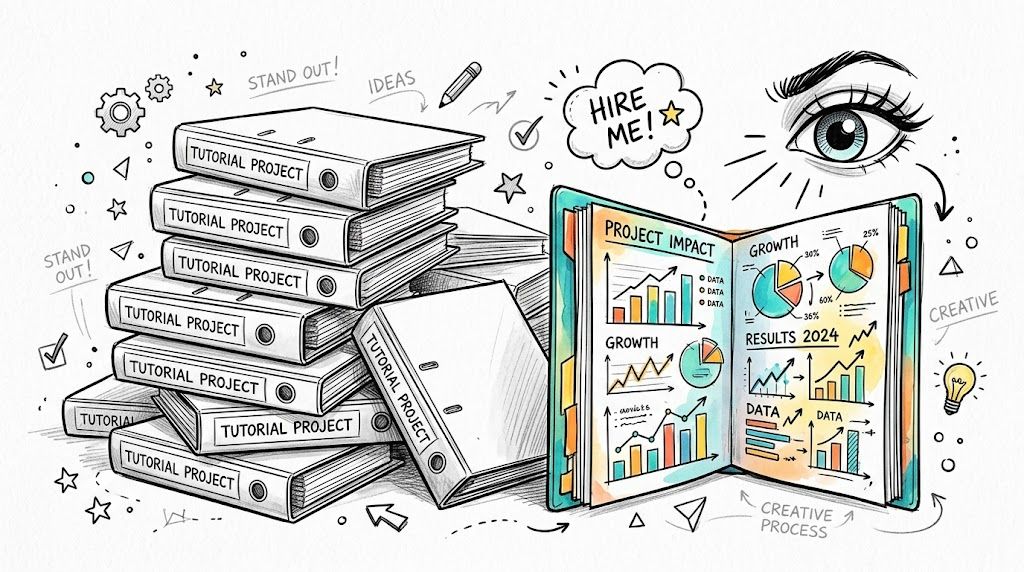
Most student portfolios fail for the same reason. They show that the candidate completed work, but not that they can judge whether the work is good.
That distinction matters a lot in AI. A notebook that fine-tunes a model is not a strong hiring signal by itself. A project that defines a problem, builds a repeatable pipeline, and proves progress with a credible evaluation setup is. The University of Michigan AI Lab internship guide makes this concrete: internship-ready projects should have a clear hypothesis, controlled experimental setup, and metric-based comparison. The guide’s example pushes beyond vague claims by benchmarking multiple models on translation to and from five languages.
Tutorial projects don’t carry much weight
Hiring teams have seen the same sentiment classifier, RAG chatbot, stock predictor, and image classifier many times. The issue isn’t that those topics are bad. The issue is that most candidates stop at “it runs.”
A weak portfolio project usually sounds like this:
- Built a chatbot using an LLM API
- Trained a model on a public dataset
- Created a dashboard for predictions
None of that tells me how you think when the model underperforms, the data shifts, or the metric conflicts with user experience.
What a hireable portfolio project looks like
A stronger project answers four questions clearly:
- What problem are you testing
- What baseline are you comparing against
- How are you measuring success
- What failed, and what changed after debugging
That’s what turns a project into evidence.
For inspiration on presenting work clearly, not just building it, it helps to look outside engineering too. Good portfolio structure matters. The examples in this guide on how to build your business portfolio are useful because they show how to frame work around outcomes, constraints, and proof rather than a pile of artifacts.
Strong project ideas for AI internship candidates
These are the kinds of projects that create hiring signal because they force you to evaluate, not just assemble.
Build a model evaluation harness
Take a real task such as summarization, retrieval, classification, or translation. Compare multiple models or prompting strategies. Track quality with a reproducible evaluation suite. Show where one model fails and another holds up.
This is strong because it mirrors real eval work on AI teams.
Build a drift or failure analysis dashboard
Train or integrate a model, then simulate changing inputs over time. Create slices by input type, language, domain, or user segment. Show where performance degrades and how you’d monitor it.
This is strong because it demonstrates operational awareness.
Build a bias or fairness testing workflow
Start with a dataset and define what “uneven behavior” might look like. Create comparisons across groups or edge cases. Document the result carefully instead of hand-waving about ethics.
This is strong because many teams now need candidates who can evaluate risk, not just optimize accuracy.
A useful walkthrough on project thinking sits well here:
Show the engineering, not just the demo
The portfolio itself should make review easy. A hiring manager should be able to open your repo and find:
- A concise README that states the problem, setup, and result
- Reproducible instructions for running experiments
- A clear data note explaining what you used and why
- Evaluation outputs such as tables, charts, or error slices
- A short write-up on trade-offs and next steps
Hiring signal: If I can’t tell how you measured success, I assume you didn’t.
The best student portfolios don’t feel like school assignments. They feel like small applied research systems. That’s the standard worth targeting.
Crafting Your Application Package
A strong application package doesn’t repeat your portfolio. It translates it into recruiter-readable evidence.
For an ai engineer internship, your resume should center on projects with proof, not on classes, clubs, or skill lists. Recruiters and hiring managers scan fast. They’re trying to match your background to the role title, stack, and expected level of ownership. If your strongest work is buried under coursework, they may never reach it.
Build the resume around evidence
Put the most relevant technical projects near the top. For each one, write bullets that answer three things: the problem, the action, and the measurable result. If you don’t have approved numeric outcomes, keep the result qualitative and specific.
A weak bullet says:
- Built an AI model for translation.
A stronger bullet says:
- Built a reproducible translation evaluation pipeline comparing multiple models across defined language pairs, documented error patterns, and used metric-based comparison to identify failure cases.
That second version signals engineering judgment. It also gives ATS more real keywords than a vague accomplishment line.
Use keywords the way teams use them
Don’t keyword-stuff. Do mirror the posting language when it accurately reflects your work.
If the role asks for PyTorch, SageMaker, CI/CD, Spark, containerization, or model evaluation, use those exact terms where appropriate in your resume, LinkedIn, and project descriptions. Many candidates lose interviews before a human ever sees them because they describe real experience in generic language.
A practical resume structure looks like this:
| Section | What to include |
|---|---|
| Summary | One short line tying your profile to the target role |
| Projects | The strongest two to four projects with technical detail |
| Experience | Research, internships, labs, or engineering work |
| Skills | Tools you can defend in an interview |
| Education | Degree, relevant coursework only if it supports the role |
Make LinkedIn useful, not decorative
Your LinkedIn headline should do more than say “student seeking opportunities.” Use it to position your lane. Something like AI/ML Engineering Student focused on model evaluation, PyTorch, and deployment workflows is far stronger than a generic aspiration.
Then make sure your featured section points to actual proof:
- GitHub repos
- Project write-ups
- Technical blog posts
- Demo videos
- A portfolio site
Your LinkedIn should help someone verify your work in one click.
Keep cover letters short and role-specific
Most cover letters fail because they’re autobiographies. The good ones are concise and targeted.
A workable structure is simple:
- State the specific role and why it matches your recent work.
- Name one or two relevant projects or technical strengths.
- Tie that work to the company’s likely problems.
- End with direct interest, not filler.
If you can’t make the cover letter feel specific, skip generic praise and shorten it further. A half-page of relevant substance beats a full page of enthusiasm every time.
Nailing the AI Engineering Interview
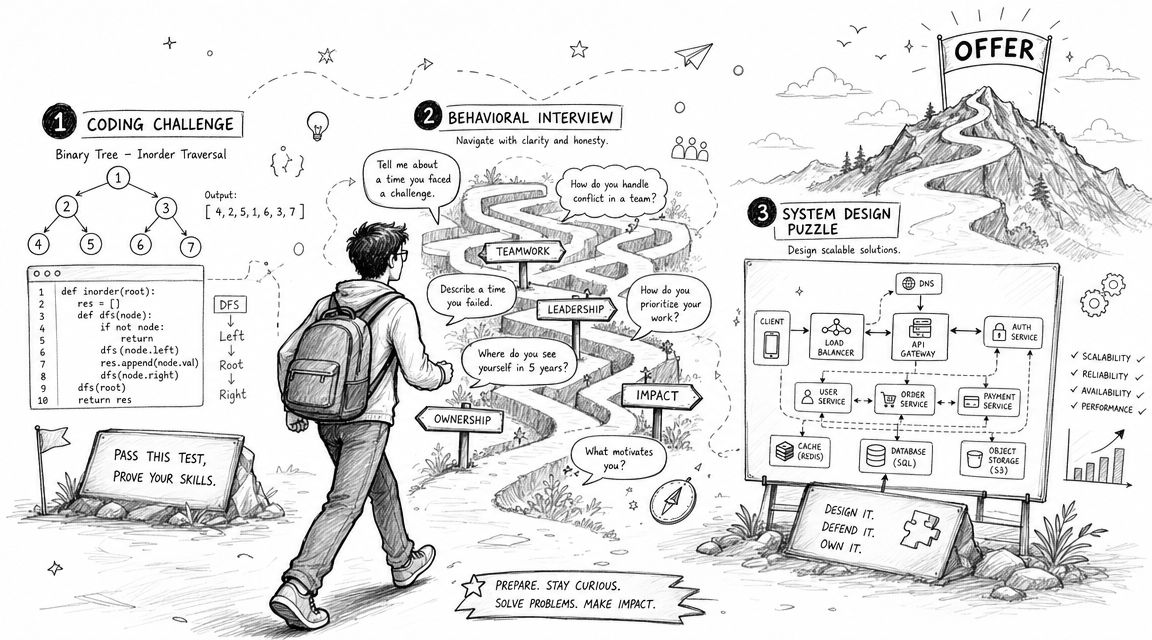
The interview loop for an ai engineer internship often reveals whether a candidate built their projects or just curated them. That’s why pure coding prep isn’t enough.
One practical framework describes AI interviews as covering coding, ML fundamentals, data modeling, system design, live data exercises, and project deep dives in this overview of AI interview frameworks and engineering strategy. The same source references MIT Sloan reporting that weekly task output rose by 26% on average after introducing a generative AI coding assistant across three technology companies, with junior or recently hired developers seeing 27% to 39% gains compared with 8% to 13% for senior developers. That means it’s reasonable to show that you use AI tooling. But you still need to defend your choices.
What interviewers are actually testing
They usually want answers to a few practical questions:
- Can you write and debug code under time pressure
- Do you understand ML fundamentals beyond API usage
- Can you reason about an end-to-end system
- Can you explain trade-offs, failure modes, and next steps
- Did you own the project you’re presenting
That last one matters more than candidates think. Project walkthroughs are often where hiring teams decide whether to move forward.
Prepare by interview type
Coding screen
You don’t need to act like you’re interviewing for a low-level systems role unless the company clearly leans that way. But you do need clean problem solving.
Practice:
- Writing correct Python without excessive prompting
- Explaining complexity at a reasonable level
- Talking while you debug
- Handling edge cases calmly
ML fundamentals round
This part often exposes shallow preparation. Review concepts you can explain out loud:
- Bias and variance
- Overfitting
- Train, validation, and test splits
- Metric selection
- Class imbalance
- Data leakage
If you used transformers, don’t stop at “I fine-tuned a model.” Be ready to explain data prep, evaluation choices, and why your setup fit the task.
System design or pipeline discussion
For interns, this usually isn’t giant-scale architecture. It’s whether you can reason through a workflow with multiple moving parts.
Expect prompts around:
- How data enters the system
- How training and serving differ
- What can go wrong in production
- How you’d monitor quality
- How you’d debug drift or skew
Good answers don’t sound grand. They sound operational.
Project deep dives win offers
You should be able to talk through three to five projects with consistency. For each project, be ready to explain:
- Why you chose the problem
- What baseline you started with
- How you evaluated progress
- What failed first
- What you changed
- What you’d do next with more time
If your answer starts and ends with the model architecture, it’s incomplete. Strong candidates narrate the whole pipeline.
Use AI tools without sounding dependent on them
Interviewers won’t be impressed just because you used Copilot, ChatGPT, or another assistant. They care whether you used it intelligently.
A good framing sounds like this:
- You used AI tools to accelerate boilerplate, test generation, refactoring, or documentation.
- You still verified outputs, understood trade-offs, and made the final technical decisions.
If you want a structured way to rehearse behavioral and technical responses, an AI interview prep tool can help you tighten delivery before the official loop.
The weak version is saying, “I used AI to build it faster.” The strong version is saying, “I used AI assistance to speed implementation, then validated the code path, checked edge cases, and revised the evaluation after spotting failure patterns.”
Finding Verified Remote Internships and Your Timeline
A lot of students assume AI work is naturally remote. It often isn’t.
Live postings regularly show location constraints, hybrid expectations, or fully onsite requirements. Indeed’s listings have included examples such as LMI’s AI Engineer Intern (USPS) - Summer 2026 in Tysons, Virginia, described as currently full-time onsite in the customer’s Washington, DC office in these undergraduate artificial intelligence internship listings. So if you need remote work, don’t rely on title searches alone. You need to verify the work arrangement at the posting and company level.
How to search without drowning in junk
The biggest problem on major job boards isn’t just competition. It’s noise. Duplicate listings, stale postings, and broad keyword matches waste time.
A better filtering approach looks like this:
- Start with company career pages: they’re usually clearer about remote, hybrid, or onsite terms.
- Search by sub-specialty: try model evaluation, ML engineer intern, applied scientist intern, AI governance intern, or data science intern.
- Screen for stack fit: if a role asks for Spark, Databricks, or CI/CD, check whether your projects support that.
- Verify location language: remote, distributed, hybrid, and onsite are not interchangeable.
- Track fresh listings in one place: using a dedicated remote search engine like Remote First Jobs helps reduce spam and surface direct-to-company remote openings.
AI Internship Application Timeline Checklist
| Month | Key Focus | Action Items |
|---|---|---|
| Late summer | Positioning | Pick your target internship lane, tighten resume, clean GitHub |
| Early fall | Portfolio proof | Finish one strong evaluation-driven project and publish write-up |
| Mid fall | Application wave | Apply to target roles, ask for referrals, tailor materials |
| Winter | Interview prep | Practice coding, ML fundamentals, and project walkthroughs |
| Spring | Final pushes | Keep applying to new openings, revisit niche and remote filters |
Remote searching works best when you treat it like verification, not hope. Don’t assume a company is remote-friendly because the work sounds digital.
If you want a cleaner way to find verified remote roles before they get buried under noise, Remote First Jobs is worth using. It pulls jobs directly from company career pages, which is a better fit for applicants who want legitimate remote openings without wasting hours on ghost listings, recruiter reposts, or dead links.