When you see a “direct hire” remote job, it means you’re applying for a full-time, permanent role directly with the company. There’s no third-party staffing agency or recruiter in the middle. Think of it as the express lane to job security, full benefits, and becoming a real part of the company culture from day one.
Why Direct Hire Is the Smarter Way to Find Remote Work
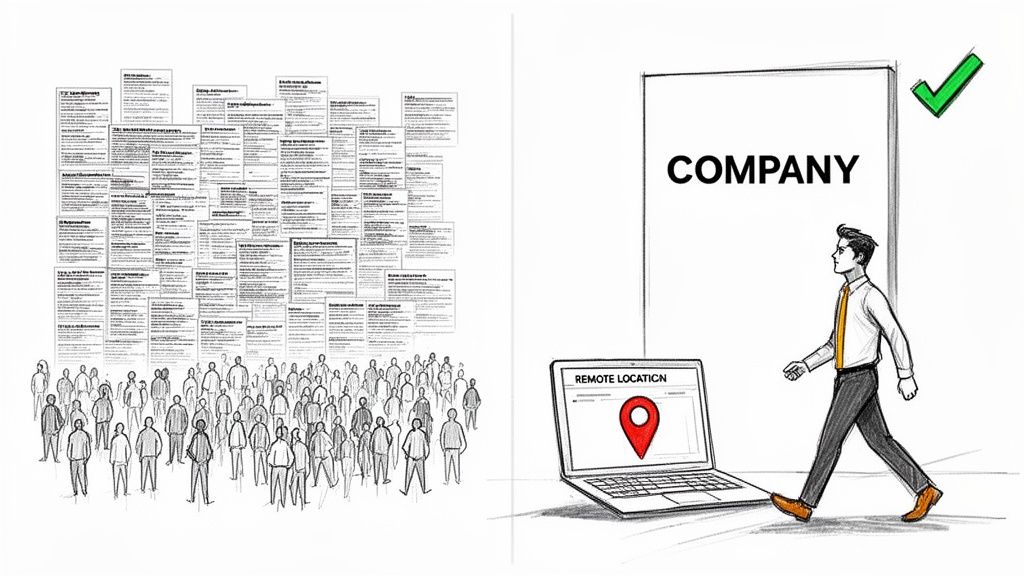
If you’ve been searching for a remote job lately, you know the drill. You spend hours on a massive job board, send out a dozen applications for what look like perfect fits, and then… crickets. That digital void is a real and frustrating place, packed with “ghost jobs” that aren’t even open, recruiter spam, and an overwhelming amount of competition.
Honestly, the problem isn’t you. It’s the old-school system. Big job aggregators are all about quantity, not quality. The moment a decent remote role goes live, it’s blasted across countless platforms, creating a digital traffic jam of thousands of applicants. Your thoughtfully written application ends up as just one more file in a massive pile, often getting weeded out by an algorithm before a person ever lays eyes on it.
The Strategic Shift to Direct Sourcing
This is where shifting your focus to direct hire remote jobs becomes a game-changer. Instead of casting a super-wide net into an overcrowded ocean, you’re zeroing in on verified openings straight from the source—the company’s own careers page.
This simple change completely flips the script on your job search. You go from being a passive applicant, reacting to stale listings that are days or weeks old, to a proactive candidate engaging with fresh, real opportunities.
Here’s why this pivot works so well:
- Verified Opportunities: A job listed on a company’s own site is a real job. You completely sidestep the risk of applying to expired posts or fake “ghost jobs” that are just there to collect resumes.
- Reduced Competition: You’re applying before the role gets syndicated to the masses on LinkedIn and Indeed. This gives you a critical head start against the thousands of other applicants who will see it days later.
- Faster Hiring Timelines: Companies naturally prioritize candidates who come through their own system. This direct line almost always leads to quicker responses and a smoother, faster interview process.
By focusing on direct-hire roles, you stop playing the numbers game and start executing a targeted search that respects your time and expertise. It’s a move from endless scrolling to intentional action that actually gets results.
To make this even clearer, let’s compare the two experiences.
The Old Way vs. The Direct Hire Approach
This table breaks down the frustrating reality of traditional job hunting versus the smarter, direct-sourcing method.
| Feature | Traditional Job Boards (LinkedIn/Indeed) | Direct-Sourcing Strategy |
|---|---|---|
| Job Quality | High volume of “ghost jobs” and recruiter spam. | Verified, active jobs direct from the company. |
| Competition | Extremely high; you apply with thousands of others. | Significantly lower; you apply before mass syndication. |
| Response Time | Slow or nonexistent; often an application “black hole.” | Faster; direct line to the hiring manager and HR. |
| Application Process | Inconsistent; often redirected to clunky third-party sites. | Streamlined process through the company’s own portal. |
| Your Role | Passive Applicant | Proactive Candidate |
The difference is stark. One path is built on volume and chance, while the other is built on strategy and timing.
The Data Backs Up a Focused Approach
The remote job market in 2026 is, without a doubt, competitive. Just look at the recent numbers: in the last quarter of 2025, a mere 11% of new professional jobs were fully remote. But here’s the kicker—those few roles attract a whopping 340% more applicants than their on-site equivalents.
Despite that fierce competition, there’s good news. Remote jobs see a 13% higher offer acceptance rate, and the hiring process is 16% faster—taking an average of just 32 days compared to 38 for in-office roles. You can find more on these remote work statistics to see the full picture.
This data tells a powerful story. While remote jobs are scarce, companies are incredibly motivated to fill them fast with top-tier talent. This is exactly where a direct-sourcing strategy gives you a massive advantage. By getting your foot in the door before the floodgates open, you position yourself to be part of that faster, more successful hiring group.
How to Find Verified Remote Openings Before Anyone Else
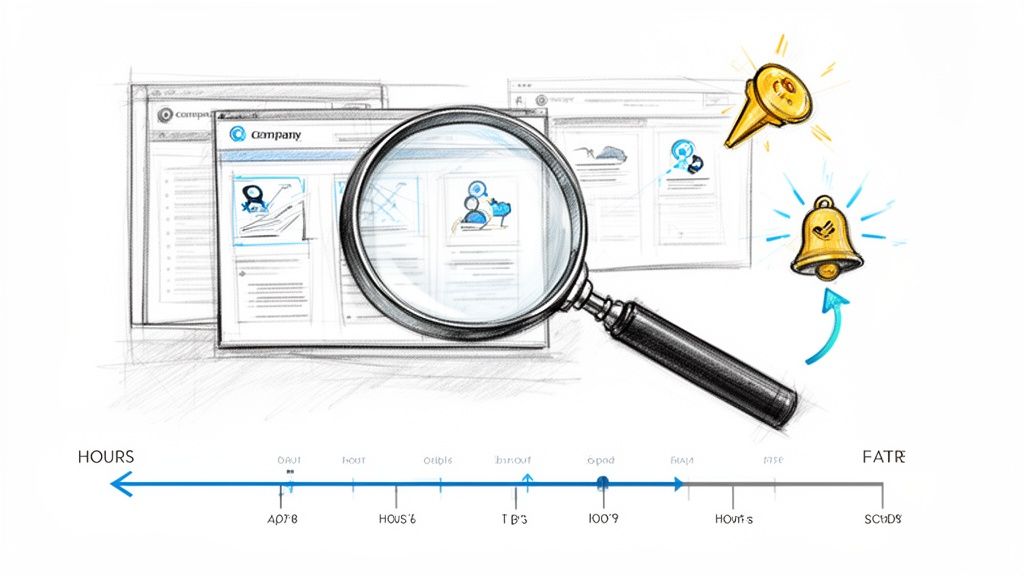
If you want to land a great direct-hire remote job, casually scrolling through the big job boards just won’t cut it. The truth is, the best roles are often snapped up before they even hit those massive platforms. To get ahead, you have to stop reacting and start hunting for opportunities at the source.
This means changing your mindset. Forget being a passive job seeker—it’s time to become a job hunter. Instead of waiting for listings to appear, you need to go directly to where the jobs are born: the company’s own careers page. That’s where you’ll find the freshest, most accurate, and least crowded openings.
Go Straight to the Source with Specialized Tools
The fastest way to beat the crowd is to find jobs the moment they get posted on a company’s website. Of course, manually checking hundreds of company sites every day is a recipe for burnout. This is where specialized tools become your secret weapon.
Platforms like Remote First Jobs were built for this exact strategy. Instead of scraping old data from other job boards, they directly monitor the career pages of thousands of remote-first companies around the clock.
This direct-sourcing method gives you a serious edge:
- Speed: You get real-time alerts, sometimes within hours of a job going live. This lets you be one of the very first applicants, which dramatically boosts your chances of getting noticed.
- Verification: Because the jobs come straight from the company’s site, you can be 100% certain they are real, active roles—no more “ghost jobs” or expired listings.
- Quality: These platforms cut through the static. You won’t have to waste time sifting through recruiter spam, multi-level marketing schemes, or irrelevant gigs.
The goal is to shrink the time between a job being posted and your application landing in the hiring manager’s inbox. When you can apply within the first 24 hours, you bypass the massive applicant pile-up that happens days later.
For anyone tired of the endless search, this is a game-changer. Imagine getting a constant stream of fresh, verified listings from over 21,135 companies posting more than 44,000 active remote jobs. This direct path helps working parents and scam-wary professionals snag high-quality remote jobs quickly, even in competitive fields like HR and administration. To see the full scope of what’s out there, check out these detailed remote work statistics.
Master Advanced Search Operator Techniques
Beyond using specialized tools, you can level up your job hunt by using advanced Google operators to peek directly into company Applicant Tracking Systems (ATS). Many companies use platforms like Greenhouse, Lever, or BambooHR for hiring, and you can search these systems directly if you know how.
The trick is to use the site: operator combined with specific keywords. This tells Google to only show you results from a particular website.
Practical Search Examples
Here are a few powerful search strings you can try. Just copy, paste, and tweak them for your specific needs:
For a remote marketing role on BambooHR:
site:*.bamboohr.com/jobs/ "remote" "marketing"For a remote software engineer role on Greenhouse:
site:*.greenhouse.io/ "remote" "software engineer"For a “work from anywhere” product manager role on Lever:
site:*.lever.co/ "product manager" "work from anywhere"
These searches take you straight to the application pages that most people only find after clicking through a dozen other links. You can bookmark these search results or even set up Google Alerts for them to automate your hunt for direct hire remote jobs.
Building Your Proactive Job Search System
When you combine these two methods, you create a seriously powerful system. Let the specialized tools do the heavy lifting by monitoring thousands of companies and sending real-time alerts to your inbox. At the same time, use your advanced search skills to do targeted deep dives into specific companies or hiring platforms.
This two-pronged attack ensures you see almost every relevant remote job before the competition even knows it exists. It’s about being smarter, not just searching harder.
Crafting a Resume That Impresses Both Robots and Recruiters
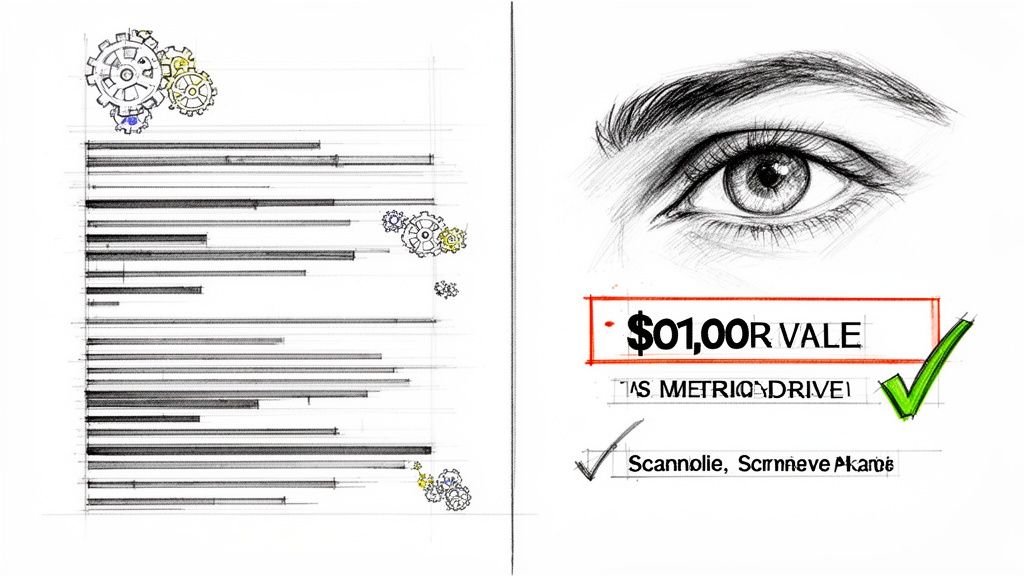
When you apply for direct hire remote jobs, your resume is fighting a war on two fronts. First, it has to get past the digital gatekeeper—the Applicant Tracking System (ATS). Only then does it need to grab the attention of a real human who’s likely to give it a six-second glance, at best.
If you fail at either step, your application disappears into a black hole. That’s why you have to build a resume that speaks to both robots and recruiters. It’s less about listing your history and more about strategically selling your skills for maximum impact.
Decoding the Job Description for ATS Dominance
Before you even think about writing, you need to play detective. The job description is your treasure map, full of clues telling you exactly what the company’s ATS is programmed to look for.
Seriously, print it out or copy it into a doc. Then, with a highlighter in hand, start pulling out the key terms and phrases.
- Hard Skills: Look for specific software like “Salesforce,” “Asana,” or “Python.” Don’t forget methodologies like “Agile” or “Scrum,” and any technical qualifications they mention, such as “Google Analytics Certified.”
- Soft Skills: What action verbs and traits pop up? Things like “cross-functional collaboration,” “stakeholder management,” or “asynchronous communication” are pure gold.
- Company Language: Pay attention to their lingo. Do they talk about a “fast-paced environment” or making “data-driven decisions”? Mirroring their language shows you get their culture.
Once you’ve got this list, your job is to sprinkle these exact keywords throughout your resume. This isn’t about keyword-stuffing; it’s about customizing your resume so the ATS sees you as a perfect match.
Structuring for the Six-Second Scan
After your resume gets the green light from the ATS, it finally lands in front of a person. Recruiters are buried in applications, so they scan for information in a predictable pattern. Your goal is to make their job easy.
Stick to a clean, single-column format with obvious headings. Skip the fancy fonts, graphics, or complex tables that can trip up both the ATS and the human eye. Your name and contact info go right at the top, followed by a sharp professional summary.
Your resume isn’t your life story. It’s a marketing document designed to get you an interview. Every bullet point should be a concise, powerful advertisement for your skills and accomplishments.
This straightforward structure lets a recruiter quickly see who you are, what you’ve done, and why you’re a great fit. They’ll usually glance at your most recent job title, company, and dates before they even decide to read more.
From Bland Responsibilities to Metric-Driven Achievements
Here’s the biggest mistake I see people make: they list job duties instead of showing their achievements. A recruiter already knows what a “Project Manager” does. They want to know how well you did it.
The secret is to quantify everything with numbers. For every point on your resume, ask yourself: How did I save time or money? How did I boost revenue or efficiency? How did I make a process better?
Let’s see what this looks like in the real world.
Before: The Responsibility
- Responsible for managing social media accounts and creating content.
This is a snoozefest. It’s a passive description of a task that tells the recruiter absolutely nothing about your impact.
After: The Achievement
- Grew organic social media engagement by 300% in 6 months by developing and executing a content strategy targeting key audience segments, resulting in a 15% increase in marketing qualified leads.
Now that gets attention. It’s packed with action verbs (“grew,” “developing”), hard numbers (300%, 15%), and connects your work directly to a business goal (more leads). This is what makes a recruiter stop scanning and start reading.
Demonstrating Your Remote-Readiness
For direct hire remote jobs, you have an extra task: proving you can thrive without someone looking over your shoulder. You can’t just claim you’re a great remote worker—you have to show it with evidence.
Weave these examples directly into your work experience:
- Asynchronous Communication: “Managed a distributed team across three time zones using Asana and Slack, ensuring project milestones were met on time.”
- Self-Management: “Independently drove a Q4 project from conception to launch, exceeding initial KPIs by 20% with minimal oversight.”
- Proactive Problem-Solving: “Identified a workflow bottleneck and implemented a new documentation process that reduced team questions by 40%.”
By embedding these specific achievements, you’re not just telling them you’re ready for remote work; you’re proving it.
How to Spot and Sidestep Job Scams and Recruiter Spam
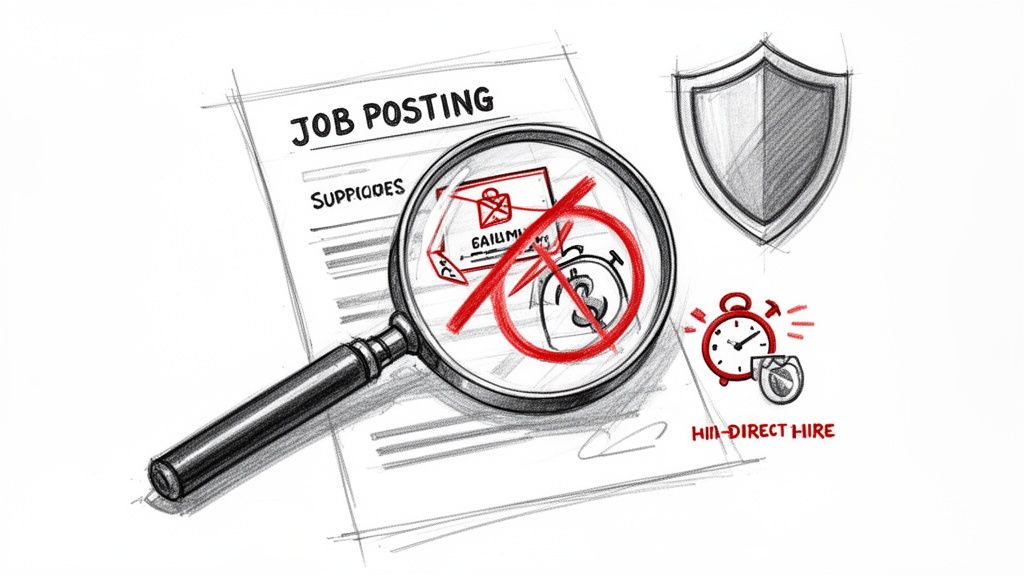
Finding a great direct hire remote job is thrilling, but the search is also filled with noise. With the boom in remote work, scammers and spammy recruiters have come out in full force. These aren’t just minor annoyances; they waste your valuable time and can even put your personal data in jeopardy.
Your best defense is a sharp eye and a healthy dose of skepticism. Real companies hiring directly have a professional, clear process. Scammers and agencies just looking to collect resumes? They almost always give themselves away with a few tell-tale signs.
Common Remote Job Scam Warning Signs
Scammers love to take advantage of the excitement and urgency of a job search. They create fake opportunities that look just real enough to trap eager applicants. The trick is learning to recognize their tactics before you even think about applying.
Keep your eyes peeled for these immediate red flags:
- Requests for Money or Financial Info: This is the loudest alarm bell. A legitimate employer will never ask you to pay for training, background checks, or equipment. Ever.
- Vague or Generic Job Descriptions: Scammers often use generic titles like “Data Entry Specialist” with poorly written descriptions. If it lacks specific details about the role, the team, or the company’s mission, be suspicious.
- Unprofessional Communication: Look out for emails coming from personal domains (like @gmail.com) instead of a corporate one. Rampant spelling mistakes and bad grammar are also massive red flags.
- High-Pressure Tactics: If an offer seems too good to be true and they’re rushing you to accept it without a proper interview, run. Phrases like “we have limited spots” are designed to make you act without thinking.
A legitimate direct-hire process is a two-way street. The company is investing time to find the right person, which means they’ll want to conduct multiple interviews and really get to know you. Any “offer” that lands in your lap after a quick text chat is not a real offer.
Distinguishing Direct Hire from Recruiter Spam
Not every sketchy posting is a full-blown scam. Some are just low-value tactics from third-party recruiters. While many recruiters are fantastic partners, others are just “resume harvesting”—posting vague or even expired jobs simply to build up their database of candidates. It’s a huge waste of your time.
Here’s how to tell a genuine direct-hire post from a recruiter’s fishing expedition:
| Signal | Genuine Direct Hire Post | Recruiter Spam / Resume Harvesting |
|---|---|---|
| Company Identity | The company’s name is front and center. | The company is called “our confidential client” or “a fast-growing tech company.” |
| Contact Info | Emails come from a corporate domain (e.g., [email protected]). |
Contact is from a generic email or a recruitment agency’s domain. |
| Job Location | The job is posted on the company’s official career page. | You see the same job on multiple boards, posted by different agencies. |
| Application Process | You apply through the company’s own system (like Greenhouse or Lever). | You’re told to email your resume to a recruiter for “future opportunities.” |
This is why sourcing your jobs directly from company career pages is the most powerful strategy. It’s the single best way to sidestep all this confusion.
When you use a tool like Remote First Jobs that aggregates listings straight from company websites, you guarantee you’re only seeing verified, active, direct-hire roles. You cut out the middleman, the guesswork, and the risk, keeping your job search clean, focused, and secure.
Applying and Following Up for Maximum Impact
Finding that perfect direct hire remote job feels like hitting the jackpot. But in reality, it’s just the first step. The best remote roles can pull in hundreds of applicants within the first 48 hours, so how you apply—and when you follow up—is what really sets you apart.
Speed is your secret weapon here. The second you spot a great opportunity, the race is on. You absolutely want to get your application in within 24 to 48 hours. After that window, you’re just one more resume in a massive pile, and your odds of getting noticed plummet.
This means you need to be ready to strike at a moment’s notice. Keep your master resume polished and have a flexible cover letter draft on hand. Being organized is what lets you customize and apply fast enough to beat the crowd.
Writing a Cover Letter That Actually Gets Read
Let’s be honest, nobody wants to read another “To Whom It May Concern” letter that just lists what’s already on your resume. Especially for remote jobs, your cover letter is your one chance to show some personality and prove you get what it takes to thrive on a distributed team.
The goal? Draw a straight line from your skills to the company’s needs. A killer cover letter needs to do a few key things:
- Answer the “Why”: Why this company? Show you’ve done your homework. Mention a project they recently launched, a company value that resonates with you, or a product feature you’re genuinely excited about. It proves you’re not just spamming applications.
- Connect Your Skills to Their Pain Points: Don’t just say you’re a great communicator. Give a quick example of how you kept a project on track with a team spread across multiple time zones.
- Prove You’re Remote-Ready: Casually mention the tools you live in—like Slack, Asana, or Miro. More importantly, highlight your knack for working independently. You need to show you’re a self-starter, not just say it.
A great cover letter isn’t a history lesson of your career. It’s an argument for why you’re the perfect fit for this company’s future. It shows you don’t just want a remote job—you want this one.
Think of it as your opening statement. A few paragraphs packed with genuine enthusiasm and a clear understanding of their culture can be way more powerful than a perfectly formatted but totally generic application.
The Art of the Warm Follow-Up
Okay, you’ve applied. Now comes the hard part: waiting. But you don’t have to just sit on your hands. A polite, well-timed follow-up can bump your name to the top of the hiring manager’s inbox without coming across as annoying.
Timing is everything. I recommend waiting about five to seven business days after you apply. This gives the team enough time to start sifting through applications, but it’s soon enough to show you’re still eager.
Your follow-up needs to be short, sweet, and to the point. This isn’t the time to ask, “Did you look at my application yet?” Instead, it’s a quick, professional nudge to remind them of your interest. Knowing the right cadence is a skill in itself; for example, data on how soon you should resend emails to non-openers shows that a brief, timed follow-up is a proven strategy.
Simple and Effective Follow-Up Template
Here’s a quick script you can adapt. It’s respectful, adds a touch of value, and doesn’t waste anyone’s time.
Subject: Following up on my application for the [Job Title] role
Body:
Hi [Hiring Manager Name, if known, otherwise “Hiring Team”],
I hope your week is off to a great start.
I’m writing to quickly follow up on my application for the [Job Title] position I sent over last [Day of the week, e.g., Tuesday]. My background in [mention a key skill, e.g., leading remote marketing campaigns] and my passion for [mention something about the company’s mission or product] make me feel I’d be a strong contributor.
I’m still very interested in this opportunity and look forward to hearing from you.
Best regards,
[Your Name] [Link to your LinkedIn profile or portfolio]
This one simple email can change the game. It takes you from being a passive name in a database to an engaged, proactive candidate who’s serious about landing one of the best direct hire remote jobs out there.
Common Questions About Direct Hire Remote Jobs
The remote job market can feel like the wild west, especially when you’re trying to figure out what’s what. A lot of questions pop up when you’re hunting for a direct-hire role, and getting straight answers is the best way to move forward with confidence.
Let’s cut through the noise and tackle some of the most common things we hear from job seekers.
Are Direct Hire Remote Jobs Better Than Contract Roles?
This is the classic “it depends” question, but the answer really hinges on what you want for your career right now. A direct-hire job means you’re a permanent, full-time employee. You’re part of the team. That usually comes with stability, benefits like health insurance and retirement plans, and a real path for growth inside the company.
If you’re looking to build a long-term career and really embed yourself in a company’s culture, direct hire is almost always the way to go. Contract roles have their perks—flexibility and sometimes higher hourly rates—but they trade that for job security and benefits. They’re a better fit if you prefer short-term projects and are comfortable running your own show.
How Can I Tell If a Job Is Truly Direct Hire?
Spotting a genuine direct-hire remote job comes down to reading the signals. The most reliable sign? Finding the job posted directly on the company’s own website, usually in their “Careers” or “Jobs” section.
Keep an eye out for these green flags, too:
- Company Branding: The company’s name and logo are front and center. No mystery boxes here.
- Corporate Email: Any communication should come from a professional email address, like
[email protected], not a generic Gmail account. - Clear Role Details: The job description feels authentic, with specifics about the role, responsibilities, and company culture.
On the flip side, be wary of posts from third-party recruiters that keep the company’s name a secret (“a fast-growing SaaS company”). If you see the same job posted by five different agencies, that’s another red flag. Your safest bet is always to go straight to the source.
The surest way to confirm a job is direct hire is to apply through the company’s own official career portal. This cuts out all middlemen and ensures you are communicating directly with the employer.
Do I Need Prior Remote Experience?
Not always, but you definitely need to prove you’re “remote-ready.” This isn’t about having “Remote” in your last job title. It’s about showing you have the skills to thrive without someone looking over your shoulder.
You need to highlight those transferable skills on your resume. Talk about your rock-solid written communication, any project management you’ve done, and your self-discipline. Mention your go-to collaboration tools, whether it’s Slack, Asana, or Trello. Honestly, proving you can handle asynchronous work is often more important than having a past remote job.
Once you land that role, one of the first things you’ll need to nail down is your home office setup. Having a solid, reliable internet connection is non-negotiable. For a deep dive, check out this guide on the best internet for remote work to make sure you’re set up for success from day one. It’s another way to show you’re serious.
The best way to find high-quality, verified opportunities is by going straight to the source. Remote First Jobs gives you a critical advantage by scanning thousands of company career pages daily, delivering fresh, direct-hire remote jobs to you before they hit the crowded mainstream boards. Stop wasting time on stale listings and start your smarter job search today at https://remotefirstjobs.com.