Let’s get straight to it: a job description is far more than a simple list of tasks. Think of it as your company’s first handshake with a future employee. In a world where top talent has plenty of options, it’s a critical piece of marketing that can make or break your hiring efforts.
What Is a Modern Job Description Anyway?

A job description is the official blueprint for a professional relationship. It’s the single source of truth that defines a role, setting clear expectations for everyone involved—the company and the candidates—right from the very beginning. Its main job is to answer one fundamental question: “What is this job really about?”
A truly effective job description does a lot more than just outline duties. It’s a versatile tool that functions as:
- A recruitment magnet to draw in the right people.
- A legal safeguard that helps ensure fair hiring practices.
- A clarity tool to get hiring teams and candidates on the same page.
In the remote-first landscape of 2026, its importance has skyrocketed. A well-written JD is your best defense against hiring headaches like “ghost jobs” (postings for roles that aren’t actually open) and the flood of applications from candidates who just aren’t a fit.
From Factory Floor to Digital Front Door
The job description has come a long way. What began as a rigid spec sheet for factory workers in the early 20th century has morphed into a sophisticated strategic asset.
Jump to today, and the hiring scene is exploding, especially for remote roles. To give you an idea, Remote First Jobs scans over 21,000 remote-first companies daily and uncovers more than 200,000 new job listings each month straight from their career pages. This direct sourcing helps smart job seekers bypass the chaos of major job boards, where a single posting can attract over 1,000 applicants.
A job description is no longer just an HR document; it’s a marketing asset. It’s the first piece of company culture a candidate interacts with, and it has the power to either attract or repel the right talent before they even click “apply.”
This evolution mirrors a huge shift in the relationship between employers and employees. Transparency, culture, and clear expectations are no longer optional—they’re essential. For a deep dive into crafting job descriptions that truly connect with candidates, check out this guide on how to write a job description that attracts top talent.
The Job Description Then Versus Now
The way we think about job descriptions has fundamentally changed. The table below illustrates just how different the approach is today compared to the past.
| Aspect | Traditional JD (Industrial Era) | Modern JD (Remote-First Era) |
|---|---|---|
| Primary Goal | Define tasks and duties for a specific role. | Attract, engage, and inform top talent. |
| Tone | Formal, rigid, and often focused on commands. | Conversational, inclusive, and culture-focused. |
| Key Focus | Listing minimum requirements and responsibilities. | Selling the role, team, and company vision. |
| Audience | Internal HR and management. | External candidates as the primary audience. |
Ultimately, to understand what a job description is today, you have to appreciate its dual purpose. It’s both a practical tool for defining work and a powerful piece of communication for building the team you’ve always wanted.
The Anatomy of a Winning Job Description
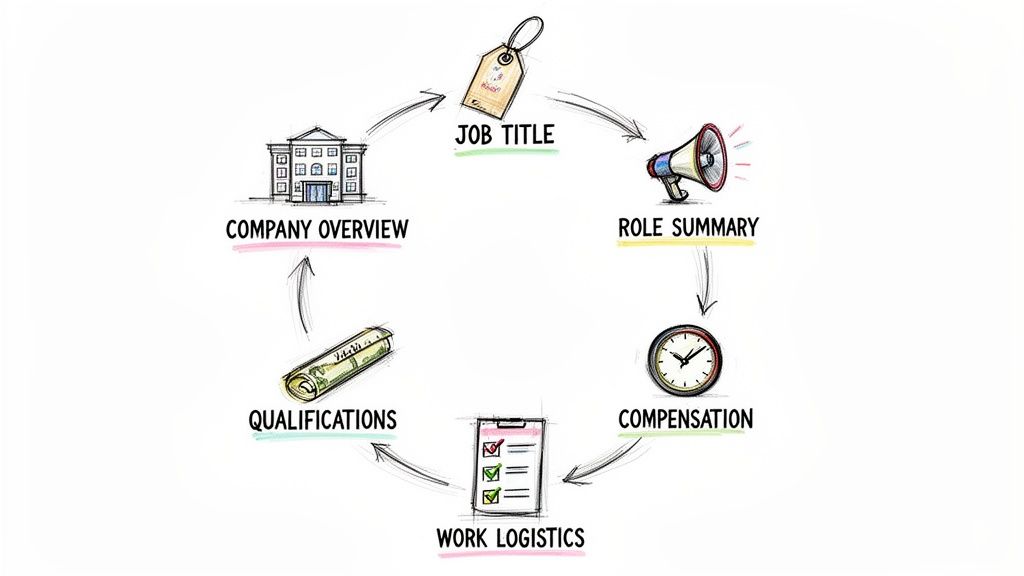
It helps to think of a great job description not as a static document, but as a collection of carefully engineered parts working together. Each piece has a specific role to play, guiding the right candidates from initial curiosity all the way to hitting “apply.” Once you understand the purpose of each component, you can stop just listing tasks and start strategically marketing a career opportunity.
In today’s competitive market, a winning job description is your secret weapon. With the remote services industry expected to explode from $20.1 billion in 2022 to $58.5 billion by 2027, making your role stand out is absolutely critical. At Remote First Jobs, we see this firsthand every day by sourcing directly from over 21,135 company career pages—this gives our users a leg up over job board scrapers that are often filled with outdated, office-based roles. To get ahead, you have to master the fundamentals. You can dive deeper into this trend and its hiring impact by exploring the latest remote work statistics.
So, let’s break down the seven core elements that make a job description truly powerful.
The Job Title: Clarity Is King
Your job title is the headline. It has one job and one job only: to be clear, searchable, and accurate. This is not the place for internal jargon or overly clever titles like “Growth Hacker” or “Marketing Ninja.”
Instead, stick to standard, industry-recognized titles that real candidates are typing into search bars, like “Product Marketing Manager” or “Senior Software Engineer.” This is your first and most crucial step in getting in front of the right audience.
The Company Overview: Your Cultural Sales Pitch
This is your chance to sell the company before you sell the job. In a few short sentences, introduce your organization’s mission, its vision for the future, and what truly makes it a unique place to work.
Zero in on the culture, the problems you’re genuinely excited to solve, and the impact your team makes. Are you a fully distributed company? Is work-life balance a core value? This is where you connect with candidates on a human level.
The Company Overview isn’t just a corporate bio; it’s a filter. It helps candidates decide if your company’s values align with their own, saving everyone time in the long run.
A tech startup, for instance, might highlight its fast-paced, innovative environment, while a non-profit would lean into its mission-driven work and community focus.
The Role Summary: The 30-Second Elevator Pitch
Immediately following the company overview, you need a concise, 2-3 sentence summary of the role itself. This is the hook that convinces a candidate to keep reading.
It should instantly answer three core questions:
- What is the primary purpose of this position?
- Who will they be working with?
- What is the key impact they will have on the company?
Think of it as the elevator pitch for the job. It needs to be compelling enough to give someone a clear, high-level snapshot of what they’ll be doing.
Key Responsibilities: The Blueprint of the Job
This section is the heart of the job description. Use a bulleted list to clearly outline the main duties and day-to-day tasks of the role.
Kick off each bullet point with a strong action verb like “Develop,” “Manage,” “Analyze,” or “Collaborate.” This makes the work feel dynamic and helps candidates picture themselves in the position. A good rule of thumb is to aim for 5-8 key responsibilities that truly define the job.
Qualifications: Must-Haves vs. Nice-to-Haves
This is a big one. Clearly separating your required qualifications from your preferred ones can dramatically improve the diversity and quality of your applicant pool. Research shows that many highly qualified candidates, particularly women, won’t apply for a job unless they meet 100% of the listed requirements.
- Must-Haves: These are the non-negotiable skills and experiences. They are absolutely essential for someone to succeed in the role. Keep this list short and focused.
- Nice-to-Haves: These are the skills that would be a fantastic bonus but aren’t deal-breakers. You can use phrases like “Bonus points for…” or “Familiarity with…” to show you’re flexible.
Compensation and Benefits: The Trust Builder
Transparency is a shortcut to building trust. In many states and countries, salary transparency is now the law. But even where it isn’t, including a clear salary range is a powerful move that attracts serious candidates and weeds out those whose expectations don’t align from the start.
List the salary range, core benefits (health insurance, retirement plans), and any unique perks that make you stand out, like a remote work stipend, a professional development budget, or a flexible vacation policy.
Work Logistics: The Remote Reality Check
For any remote or hybrid role, this section is non-negotiable. Don’t just write “remote”—define what that actually means at your company.
Be crystal clear about time zone requirements, any travel expectations, and whether the role is “fully remote” (work from anywhere) or requires the person to live in a specific state or country for tax and legal purposes. Getting this right prevents a world of confusion later on.
How to Write a Job Description for Top Remote Talent
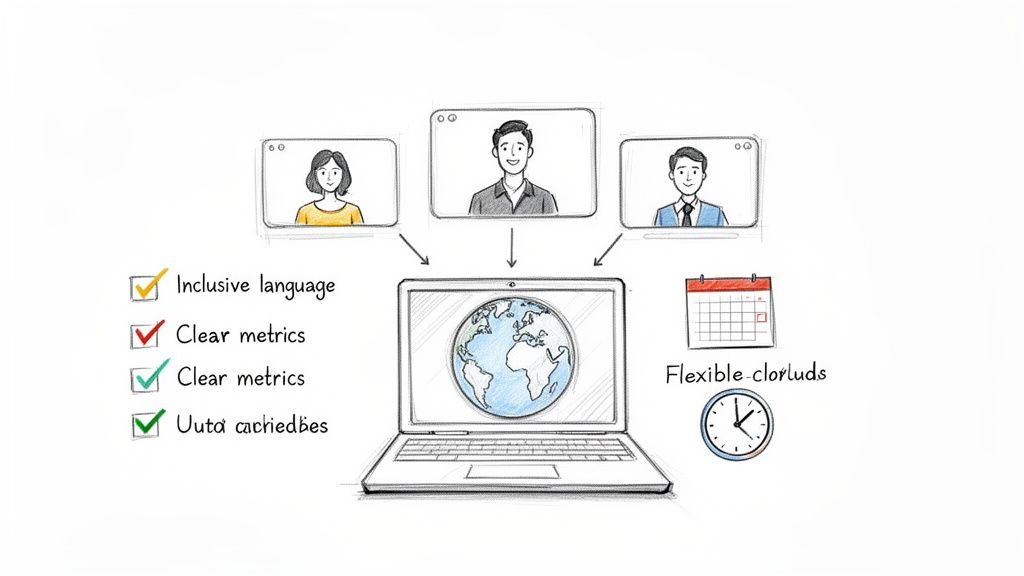
Writing a job description that catches the eye of top remote talent demands a different approach. You’re no longer just listing tasks; you’re crafting a story that convinces a skilled professional, who could work anywhere, to work for you. It’s time to stop thinking of the job description as a dry HR form and start treating it like a key piece of marketing.
Imagine your perfect candidate scrolling through hundreds of opportunities. Your job description has to be the one that stops the scroll. It needs to cut through the noise and prove that your role is the one worth their time. That means ditching the corporate jargon and focusing on what truly motivates the best remote workers.
Speak Their Language with Inclusive Phrasing
The words you choose have a direct impact on who applies. Vague, biased, or overly aggressive language can scare away highly qualified candidates before they even give your role a second thought. If you want to build a broad, diverse talent pool, you have to be intentional about your phrasing.
Even small shifts in language can make a huge difference. For example, instead of a rigid list of 10 “requirements,” try separating them into “must-haves” and “nice-to-haves.” This simple change encourages great candidates who might not check every single box but have the core skills you need to actually apply.
Inclusive language isn’t just about avoiding a few taboo words. It’s about actively creating a sense of welcome for a wide range of experiences and backgrounds. It sends a powerful signal that you value talent in all its forms, not just those who fit a narrow, predefined mold.
Here are a few practical tips to make your writing more inclusive:
- Avoid gendered language: Stick with “you” or “they/them” instead of “he/she.” Swap out titles like “craftsman” for “artisan” or “professional.”
- Remove age-related terms: Phrases like “digital native” or “seasoned veteran” can hint at age bias. Focus on specific skills and the number of years of experience instead.
- Check for ableist language: Watch out for common idioms like “stand up for” or “walk the talk,” which can unintentionally exclude people with disabilities.
This thoughtful approach shows you’re a considerate employer, which is a major selling point for the best people out there.
Define Success with Clear Performance Metrics
High-achievers don’t just want a job; they want to make an impact. They need to know what success looks like in the role and how their performance will be measured. Generic responsibilities like “manage social media” just don’t cut it. You need to define the outcomes you’re looking for.
For instance, let’s transform a vague responsibility into a clear, compelling metric:
- Vague: “Manage the company blog.”
- Clear: “Grow organic blog traffic by 20% quarter-over-quarter by creating two data-driven articles per week and optimizing existing content for SEO.”
This level of specificity accomplishes two key things: it sets crystal-clear expectations and attracts candidates who are driven by measurable goals. It proves you have a solid plan and that their work will have a real, tangible impact. If you want to see a company masterfully market a role with clear expectations, check out how Starbucks searched for its “Global Coffee Creator.”
Articulate Your Remote Work Policies Explicitly
In today’s world, saying you’re “remote friendly” is no longer enough. The best remote candidates expect—and deserve—to know exactly how your company operates. Any ambiguity here is a huge red flag, often signaling that a company hasn’t truly figured out how to support a distributed team.
Be upfront and crystal clear about the logistics of remote work at your company. Your job description should answer these questions directly:
- Location Requirements: Is this a “work from anywhere” role, or are there geographic boundaries (e.g., “U.S. only” or “must be based in the EST time zone”)?
- Work Schedule: Do you expect everyone to be online during specific core hours, or do you offer a fully flexible schedule built around asynchronous work?
- Support and Equipment: Do you offer a home office stipend? A company laptop? What resources do you provide to set your team up for success at home?
By providing this clarity right from the start, you build trust and attract candidates who are genuinely a great fit for your company’s culture. For job seekers looking for companies that are transparent about these policies, exploring a dedicated platform like Remote First Jobs can be a game-changer.
Optimizing Job Descriptions for Applicant Tracking Systems
Even the most perfectly written job description is a waste if it never gets in front of the right people. Today, most applications don’t land directly in a recruiter’s inbox. Instead, they first meet a digital gatekeeper called an Applicant Tracking System (ATS).
You can think of an ATS as a specialized search engine for recruiters. Its entire purpose is to scan, sort, and rank every application based on how well it matches the job’s requirements. An estimated 99% of Fortune 500 companies rely on an ATS, and they’re now standard for businesses of all sizes. This means that to succeed, both recruiters writing the description and candidates writing their resumes have to understand how these systems think.
Keyword Research Is Your Foundation
The first and most critical step in ATS optimization is finding the right keywords. These are the specific terms and phrases a hiring manager will type into their system to find a great candidate. Just as importantly, they are the exact same terms that qualified candidates are typing into job search sites.
To do this well, you need to sync up your job description with the common language of your industry and the specific role.
- Analyze similar roles: Take a look at job descriptions from your competitors for the same position. What common skills, tools, and qualifications pop up again and again? Note them down.
- Use standard job titles: Now is not the time for cute, internal jargon. A job title like “Senior Software Engineer” will show up in far more relevant searches than “Code Ninja.” Stick to what’s widely recognized.
- Include both hard and soft skills: A strong job description needs a healthy mix of technical skills (like “Python,” “Salesforce,” or “Adobe Creative Suite”) and crucial soft skills (like “project management,” “team collaboration,” or “client relations”).
By strategically weaving these keywords throughout your post, you dramatically improve the odds that your job will be discovered by both the ATS and the human candidates you actually want to hire.
Formatting for Robots and Humans
An ATS is powerful, but it’s not human. It can easily get tripped up by fancy formatting, weird fonts, or a disorganized layout. To make sure your job description gets read correctly, you have to keep the structure clean and simple.
An ATS reads a resume from top to bottom, much like a person does. But it depends on clear formatting cues to understand the hierarchy of information. A creative layout might look impressive, but it often causes the system to misread or even skip over essential details like skills and qualifications.
Follow these formatting rules to make your job description easy for both software and people to understand:
- Use standard section headings: Stick with clear, common headings like “Responsibilities,” “Qualifications,” and “About the Role.” This helps the ATS correctly categorize the information.
- Use simple bullet points: Standard round or square bullets are your best friend. Steer clear of arrows, checkmarks, or other custom symbols that can confuse the software.
- Choose web-safe fonts: Use common fonts like Arial, Helvetica, or Times New Roman. Never embed text inside an image, as the ATS can’t read it.
Focusing on clean, simple formatting ensures that all the effort you put into writing a great job description pays off. It gives the system—and the candidate—the best possible chance to see a perfect match.
How Job Seekers Can Decode a Job Description
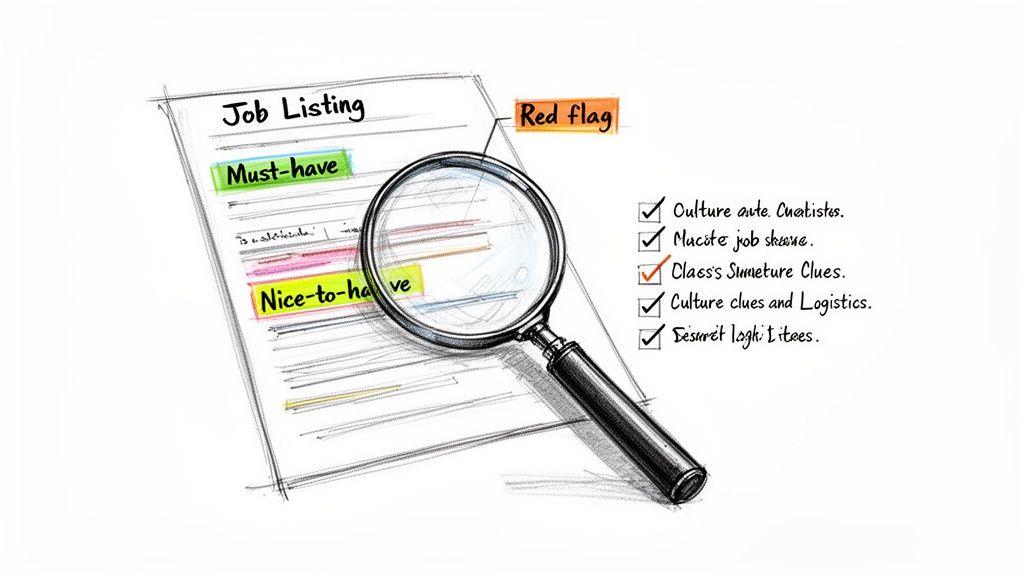
For anyone on the job hunt, just knowing what a job description is isn’t enough. The real art is learning how to read between the lines. Think of it less as a simple list of duties and more as a window into a company’s soul—revealing its culture, what it really expects, and even its hidden dysfunctions.
Your new role? Detective. Your mission is to sift through the corporate jargon and uncover the clues that tell you whether an opportunity is a golden ticket or a trap. Honing this skill helps you decide where to invest your valuable time and energy, letting you apply smarter, not just harder.
Differentiating Must-Haves From Wish Lists
Hiring managers often dream big. They can easily create a laundry list of qualifications for their ideal “purple squirrel” candidate. Your job is to tell the difference between the absolute, non-negotiable requirements and the aspirational “nice-to-haves.” This is a huge deal, as countless great candidates talk themselves out of applying because they take every single bullet point as gospel.
Must-Haves: These are the core skills, the absolute essentials for doing the job. Look for direct, commanding language like, “Requires 5+ years of experience in…” or “Proficiency in Python is mandatory.” These are almost always at the top of the qualifications list and often get repeated or emphasized.
Wish List Items: These are the bonus skills—the ones that would be great but aren’t deal-breakers. The language here is usually much softer: “Familiarity with…,” “Bonus points for…,” or “Experience with X is a plus.” If you’ve got the must-haves nailed, don’t let these scare you off.
A word of caution: if you see a job posting for a junior role with an impossibly long list of “must-haves,” that’s a red flag. It might mean the hiring manager doesn’t really understand the role, or worse, the company has completely unrealistic expectations.
Spotting Red Flags and Green Flags
The tone, language, and even the structure of a job description can tell you so much about the work environment. You can often sniff out a toxic workplace—or spot a genuinely great company culture—before you even hit “apply.”
A job description is a promise. Vague, contradictory, or overly demanding language suggests a company that may not be able to keep its promises to its employees. Pay close attention to what isn’t said as much as what is.
Potential Red Flags to Watch For:
- Vague Responsibilities: Phrases like “handle various administrative tasks” or “contribute to marketing efforts” are red flags. A lack of specific outcomes suggests the role is poorly defined, and you might be walking into chaos.
- Coded Language: Be wary of phrases like “wear many hats” or “thrive in a fast-paced environment.” While sometimes true, they can also be code for “you’ll be overworked and under-resourced.”
- Unrealistic “Unicorn” Requirements: See a listing that demands 10 years of experience in a technology that’s only existed for five? Run. It shows a disconnect from reality.
- Perks Over Substance: If the post gushes about the office ping-pong table but is mysteriously silent on health insurance or career growth, their priorities might be misplaced.
Positive Green Flags to Identify:
- Clear Success Metrics: Language like, “Your goal in the first year will be to increase user retention by 15%,” shows they’ve thought through the role and how to measure success.
- Inclusive Language: Using gender-neutral pronouns and actively avoiding biased language is a great sign of a thoughtful and respectful culture.
- Transparency: A clear salary range and a detailed breakdown of benefits or remote work policies show the company respects your time and isn’t trying to play games.
Identifying Potential Ghost Jobs
A “ghost job” is a sneaky one—it’s a posting for a role that a company isn’t actually trying to fill. Why? They might be gauging the talent market, keeping a pipeline of candidates on standby, or maybe someone just forgot to take an old posting down. With overall job postings having declined by 8% in 2025, these ghost jobs can make the market feel even more competitive than it is.
While you can never be 100% certain, here are a few warning signs:
- The job was posted months ago and is still open.
- The description is incredibly generic, with no specifics about the team or projects.
- The same company keeps reposting the exact same role every few weeks.
By approaching every job description with a critical, detective-like eye, you shift from being a passive applicant to an empowered evaluator. This little bit of investigative work helps you focus on roles that truly fit your skills and goals, saving you from dead-end applications and helping you find the right opportunity much faster.
Avoiding Bias and Legal Pitfalls in Your Writing
A job description is more than just a list of tasks; it’s a legal document. The words you choose matter—a lot. If you aren’t careful, a poorly written post can scare away great candidates or, even worse, land your company in legal hot water.
Thinking about legal compliance from the get-go is your best defense. It protects your business and, just as importantly, helps you attract and build a more talented, diverse team. This isn’t about just having good intentions; it’s about actively reviewing your language to remove hidden biases related to age, gender, disability, or anything else.
Identifying and Removing Biased Language
It’s surprisingly easy for unconscious bias to slip into a job description through phrases that seem totally harmless. But these words can send a subtle signal that you’re only looking for a specific type of person, which discourages plenty of qualified people from ever hitting “apply.” In fact, one study that analyzed 180 million job postings revealed just how much certain language can influence who is drawn to a role.
Here are a few common offenders and what to use instead:
Age Bias: Watch out for terms like “digital native” or asking for a “recent graduate.” Instead of describing an “energetic young team,” focus on what you actually mean, like a “fast-paced, collaborative environment.”
Gender Bias: Words like “rockstar,” “ninja,” or “huntsman” tend to be coded as masculine. It’s far better to use neutral, skill-focused terms like “expert,” “specialist,” or “sales executive.”
Disability Bias: Be very careful about listing physical requirements. Don’t just say “must be able to lift 50 pounds.” Only include this if it’s an essential function of the job, and even then, phrase it as “ability to move objects up to 50 pounds with or without accommodation.”
Being deliberate with your words widens your appeal and ensures you’re focused on what truly matters: a candidate’s skills, not stereotypes.
Upholding Compliance and Transparency
Beyond just choosing the right words, a solid job description meets specific compliance standards. Getting this right builds trust with applicants from the very first click and proves you’re serious about fair hiring.
Your job description is the first piece of evidence in your hiring process. Ensuring it’s fair, accurate, and compliant is your first line of defense against potential discrimination claims and helps attract a wider, more qualified talent pool.
Making sure your posts are legally sound is a non-negotiable step. For anyone wanting to dig deeper into the specifics, it’s worth learning how to write a compliant job description to ensure all your bases are covered.
On top of that, two key practices are quickly becoming the standard:
Equal Employment Opportunity (EEO) Statement: Adding a standard EEO statement (e.g., “[Company Name] is an equal opportunity employer…”) is a simple but powerful signal. It tells every applicant that you welcome people from all backgrounds.
Salary Transparency: A growing number of states and even countries now require salary ranges in job postings. But even if it’s not the law where you are, it’s a fantastic best practice. It builds instant trust and makes sure you’re only talking to candidates whose expectations align with your budget. That simple bit of transparency saves a ton of time for everyone involved.
A Few Common Questions About Job Descriptions
Once you get a handle on the basics of what a job description is, a few more specific questions usually come to mind. Whether you’re a hiring manager trying to get it right or a job seeker trying to read between the lines, here are some quick answers to the most common sticking points.
How Long Should a Job Description Be?
You’ll want to aim for the sweet spot, which is typically between 300 and 700 words.
If you go any shorter, the description often feels vague and just doesn’t have enough detail to attract the right people. Go much longer, and you risk losing a great candidate’s attention before they even finish reading. It’s a real balancing act.
A well-written description of this length gives you plenty of room to cover the essentials—like a compelling bit about your company, clear day-to-day responsibilities, and the benefits you offer—without turning into a novel. It shows you respect the applicant’s time while giving them what they need to decide if the role is for them.
Keep it concise, but complete. A job description should be long enough to cover what matters but short enough to keep someone engaged. If a detail isn’t critical for a candidate to understand the role and decide to apply, save it for the interview.
Should We Really Put a Salary Range in the Job Description?
Yes, absolutely. Putting a salary range in your job description is one of the single best things you can do to build trust and make your hiring process more efficient.
Being transparent about compensation from the start means you’re only talking to candidates whose financial expectations actually line up with your budget. Think of all the time saved—for you and for them.
Plus, in many states and cities, it’s no longer just a good idea; it’s the law. Embracing salary transparency shows you’re a fair, modern employer, which gives you a serious advantage in attracting top talent who appreciate straightforward communication.
How Often Should We Update Our Job Descriptions?
You should give your job descriptions a solid review at least once a year or any time a role changes in a big way. A job’s duties can easily drift over time because of new tools, shifts in team structure, or new company goals.
It’s also critical to review the JD every single time you post the job. This ensures it perfectly reflects what your team needs right now. An outdated job description is a recipe for mismatched expectations and, eventually, a bad hire.
What’s the Biggest Mistake Job Seekers Make When Reading a JD?
The biggest mistake is, without a doubt, treating every single qualification as a hard-and-fast rule. So many job seekers see a long list of “requirements” and immediately disqualify themselves if they don’t check every single box.
Here’s the inside scoop: many of those lists are a hiring manager’s wish list, not a set of non-negotiable demands. Your best bet is to focus on how well you match the core responsibilities and the top handful of qualifications. Don’t let the “nice-to-haves” scare you away from a role where you could truly shine.
Tired of scrolling through stale job boards crowded with thousands of other applicants? Remote First Jobs gives you a head start by sourcing jobs directly from over 21,000 company career pages, letting you apply before the competition even knows the role exists. Find your next opportunity at https://remotefirstjobs.com.