Remote work is no longer a temporary trend; it’s a permanent and competitive career path for millions. Thriving in this environment requires more than just a stable internet connection and a quiet place to work. It demands a specific, cultivated set of remote job skills that allow you to be productive, collaborative, and visible, even when separated from your team by distance and time zones. While technical expertise in your field remains paramount, the most successful remote professionals master a unique blend of soft skills, digital fluency, and self-management techniques.
This guide moves beyond generic advice to provide a blueprint of the 10 most critical skills that employers are actively seeking. For each one, we provide a clear definition, actionable steps to build it, and specific ways to showcase your expertise on your resume, in your portfolio, and during interviews. We’ll cover everything from proactive communication and asynchronous collaboration to technical proficiency and independent troubleshooting. To truly excel in a remote-first environment, understanding the latest requirements is crucial. Explore the latest insights on the top 10 in-demand skills for remote work in 2025 to align your development.
Whether you are a seasoned remote worker looking to advance, a professional transitioning from an office setting, or a hiring manager building a distributed team, mastering this framework is essential. The following list is your comprehensive roadmap to not just succeeding, but excelling in a remote-first world.
1. Self-Discipline and Time Management
In a traditional office, the environment itself provides structure: set hours, coworker presence, and direct supervision. When working remotely, that external structure vanishes, making self-discipline and effective time management foundational remote job skills. This competency is about more than just avoiding distractions; it involves proactively creating your own productive environment, managing your energy, and holding yourself accountable to deadlines without a manager looking over your shoulder. It is the internal engine that drives productivity and ensures consistent, high-quality work, making it the most critical skill for any remote professional.
Why It’s a Top-Tier Remote Skill
Companies hiring for remote roles prioritize candidates who demonstrate autonomy. They need to trust that you can manage your own schedule, prioritize tasks effectively, and deliver results without constant oversight. Strong time management signals reliability and professionalism, proving you can thrive in a high-trust, low-supervision setting. Without it, even the most talented professionals can struggle with burnout, missed deadlines, and a blurred line between work and personal life.
How to Build and Demonstrate This Skill
Mastering your time and focus is an ongoing practice. Start by implementing structured techniques to organize your day and your digital workspace.
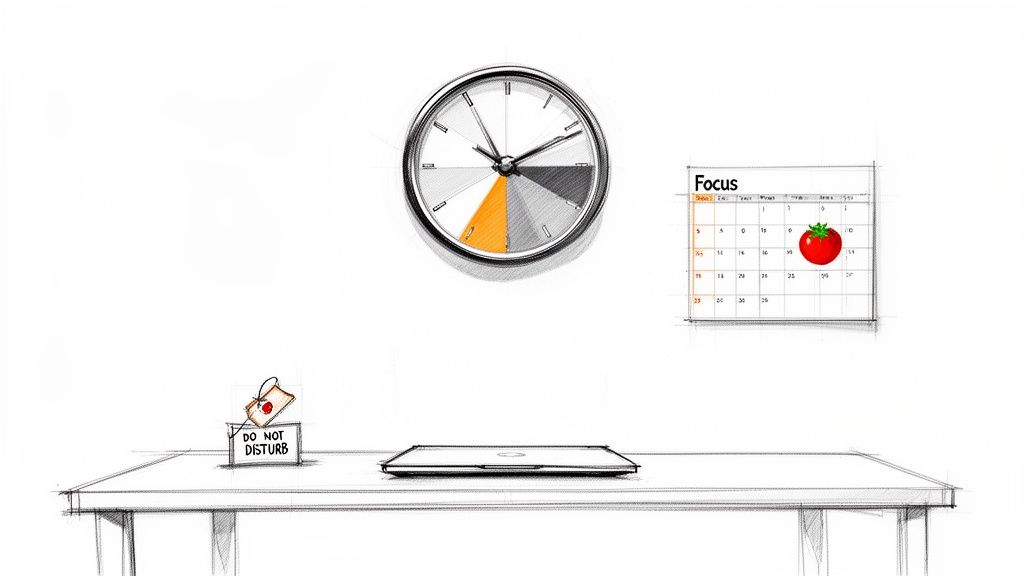
- Implement Time-Blocking: Use your calendar to schedule “deep work” sessions for complex tasks. Treat these blocks like important meetings. Techniques like the Pomodoro Method (working in focused 25-minute intervals) can also build focus.
- Create a “Work Mode” Routine: Establish clear start-of-day and end-of-day rituals. This could be as simple as changing into work clothes or taking a short walk before and after your workday to create a mental separation.
- Organize Your Digital Environment: A cluttered digital workspace is as distracting as a physical one. To effectively manage information and maintain a structured workflow, remote professionals can benefit from robust organizational systems like the P.A.R.A. method to keep files and projects in order.
On your resume: Showcase this skill by using action verbs that imply autonomy. Phrases like “Independently managed a portfolio of 15 client projects, consistently meeting all deadlines” or “Implemented a new task tracking system using Asana, improving team efficiency by 20%” provide concrete evidence. You can learn more about how to highlight self-discipline on your remote job application.
2. Written Communication
In a remote setting, text-based platforms like Slack, email, and project management tools replace the quick clarifications of an office hallway. This makes clear, concise, and professional written communication one of the most essential remote job skills. It is the backbone of asynchronous work, ensuring that context, intent, and critical information are conveyed accurately without the benefit of tone of voice or body language. Strong written skills prevent misunderstandings, reduce unnecessary back-and-forth, and build a foundation of trust and clarity across a distributed team.
Why It’s a Top-Tier Remote Skill
Remote-first companies like GitLab and Basecamp have built their success on a culture of documentation and exceptional writing. They seek candidates who can articulate complex ideas, provide thoughtful feedback, and create a clear record of decisions through text. Excellent writing demonstrates professionalism and respect for your colleagues’ time, as a well-crafted message can resolve an issue in minutes that a poorly written one could complicate for hours. It is a direct indicator of your ability to contribute effectively in an asynchronous environment.
How to Build and Demonstrate This Skill
Improving your written communication involves a conscious effort to be clear, concise, and considerate. Focus on making your messages easy to digest and act upon for the reader.
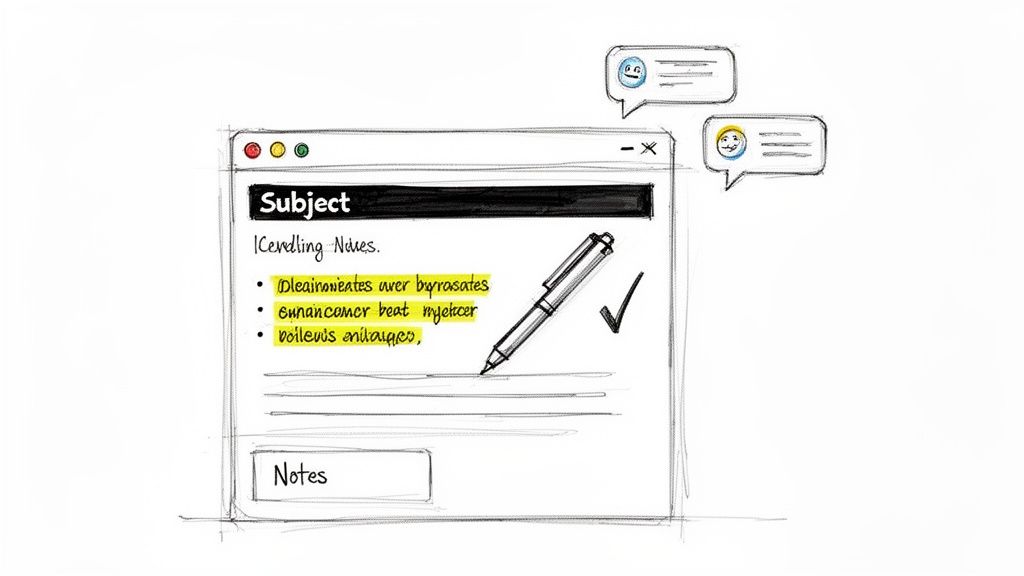
- Structure for Skimmability: Use formatting like bolding, bullet points, and short paragraphs to highlight key information. A clear, descriptive subject line in an email is a simple but powerful tool.
- Provide Full Context: Never assume the reader knows the background. Start messages with a brief summary of the topic or link to relevant documents to bring everyone up to speed quickly.
- Proofread Meticulously: Small errors can undermine your credibility. Take a moment to review your message for typos and clarity before hitting send. Tools like Grammarly can help build this habit.
On your resume: Instead of just listing “strong written communication,” prove it with tangible outcomes. Use phrases like “Authored a comprehensive knowledge base for the customer support team, reducing ticket resolution time by 15%” or “Wrote and maintained clear project briefs, resulting in a 95% on-time project completion rate.” Learn more from remote-first pioneers like GitLab and their public communication guidelines.
3. Proactive Communication and Initiative
In an office, managers can observe body language, overhear conversations, and casually check in to gauge progress. In a remote setting, this “ambient awareness” disappears, placing a premium on proactive communication and initiative. This skill is about closing information gaps before they form. It involves anticipating needs, providing unsolicited updates, asking clarifying questions early, and taking ownership of problems without waiting for direct instruction. It is the lifeblood of a healthy remote team, ensuring everyone stays aligned and projects move forward smoothly.
Why It’s a Top-Tier Remote Skill
Companies seek remote employees who are self-starters, not just task-doers. Proactive communication demonstrates a high level of engagement and ownership, proving that you are thinking strategically about your work and its impact on the team. This builds immense trust, as managers know you will flag potential risks and drive solutions independently. It reduces the need for micromanagement, a major friction point in remote work, and signals that you are a reliable, forward-thinking contributor who adds value beyond the basic job description.
How to Build and Demonstrate This Skill
Cultivating a proactive mindset involves shifting from a reactive to a forward-looking approach in your daily communication and work habits.
- Establish an Update Cadence: Don’t wait to be asked for a status report. Send a concise weekly progress summary to your manager or post a “what I’m working on” update in a shared team channel. This keeps stakeholders informed and builds visibility.
- Anticipate and Clarify: Before starting a complex task, think through potential questions a stakeholder might have and provide those answers in your initial communication. If requirements are unclear, ask specific clarifying questions like, “What does success for this deliverable look like?”
- Document and Share Learnings: When you solve a problem or discover a more efficient process, document it. Share these insights with your team in a shared knowledge base or channel to benefit everyone and showcase your initiative.
On your resume: Highlight this skill with verbs that show ownership and foresight. Phrases like “Proactively identified a critical bug and developed a patch, preventing a 15% drop in user engagement” or “Initiated and led a weekly project sync that improved cross-functional alignment” are powerful. Mastering these remote job skills is a key part of landing a great role. You can learn more about how to showcase proactive initiative in your application.
4. Technical Proficiency and Tool Fluency
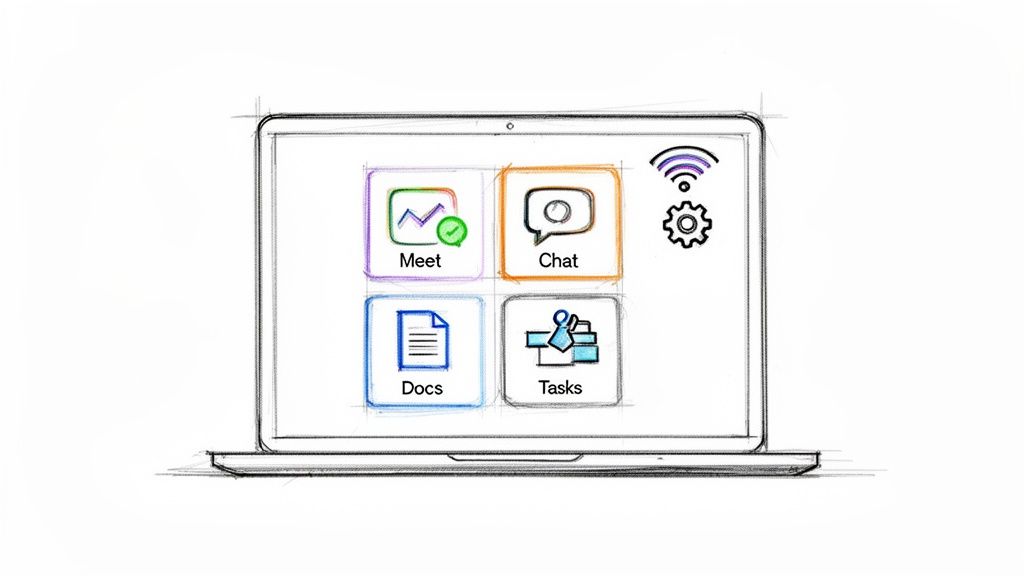
In a remote-first world, your entire office is digital, making technical proficiency and tool fluency non-negotiable remote job skills. This isn’t just about knowing how to use email; it’s the ability to quickly adapt to and master the specific software stack that powers a distributed team. From video conferencing platforms and project management systems to asynchronous communication tools, your competence with technology directly impacts your productivity, collaboration, and overall effectiveness. This skill ensures you can seamlessly integrate into a team’s workflow and contribute efficiently from day one.
Why It’s a Top-Tier Remote Skill
Companies need assurance that new hires can navigate the digital environment without extensive hand-holding. Demonstrating fluency with core remote work tools like Slack, Asana, Zoom, or Google Workspace shows that you are self-sufficient and ready to contribute immediately. It minimizes onboarding friction and proves you can handle the operational demands of a technology-dependent role. Employers see this as a sign of adaptability, a crucial trait for thriving in the ever-evolving landscape of digital work.
How to Build and Demonstrate This Skill
Proactively learning the tools of the trade shows initiative and preparedness. Focus on understanding both the features and the best practices for using them within a team context.
- Master the Core Stack: Go beyond basic functions. Learn advanced features in common tools, like setting up workflows in Slack, creating automated reports in Monday.com, or using breakout rooms and polls effectively in Zoom.
- Utilize Asynchronous Video: Become proficient with tools like Loom or Vidyard to record screen-share updates, provide feedback, or explain complex ideas. This is a powerful skill for clear, asynchronous communication.
- Create a Learning Habit: Dedicate small blocks of time to explore new software or watch official tutorials. Experiment with features in a personal project or a non-critical setting to build confidence before using them in a live work environment.
On your resume: Instead of just listing tools, describe how you used them to achieve results. For example, “Managed a cross-functional project in Asana, improving on-time task completion by 30%” or “Streamlined team communication by implementing custom Slack channel integrations.” To find out which tools are most in-demand, you can explore which technologies are most valued for your dream remote career at Remote First Jobs.
5. Active Listening and Empathy
In a remote setting, communication becomes more transactional, and the subtle non-verbal cues that build rapport and understanding are often lost. Active listening and empathy are the remote job skills that bridge this digital divide. This isn’t just about hearing words; it’s about fully concentrating on, understanding, and responding to what is being communicated, both verbally and emotionally. It means tuning into the subtext of a Slack message, recognizing a team member’s stress during a video call, and showing you genuinely care about your colleagues as people, not just as avatars on a screen.
Why It’s a Top-Tier Remote Skill
Remote teams thrive on trust and psychological safety, both of which are direct byproducts of empathy and active listening. Companies need employees who can build strong relationships with colleagues and clients they may never meet in person. Demonstrating empathy shows you can collaborate effectively, resolve conflicts constructively, and contribute to a positive and inclusive remote culture. It proves you are not just a task-doer but a thoughtful and engaged team member who strengthens the human connection essential for high-performing distributed teams.
How to Build and Demonstrate This Skill
Developing these interpersonal skills requires conscious effort to be more present and considerate in your digital interactions. Focus on demonstrating engagement and understanding at every touchpoint.
- Practice Reflective Listening: During meetings, paraphrase what you’ve heard before responding. Start with phrases like, “So, if I’m understanding correctly, you’re saying…” to confirm comprehension and show you were paying attention.
- Be Mindful of Tone: In written communication, use emojis or clear language to convey tone and avoid misinterpretation. A simple “Thanks so much for your help on this! 😊” feels very different from a curt “Thanks.”
- Proactively Check In: Don’t limit conversations to work topics. A quick message like, “Hey, how are you holding up with the big project deadline?” can show support and build rapport beyond the immediate task list.
On your resume: Highlight this skill by describing collaborative outcomes. Use phrases like “Facilitated cross-functional team meetings, ensuring all voices were heard and leading to a 15% reduction in project misunderstandings” or “Mentored junior team members by providing empathetic feedback, improving their ramp-up time by 30%.”
6. Reliability and Dependability
In a remote setting, trust is the currency of collaboration. Without the daily visibility of an office, your reputation is built almost entirely on your ability to consistently follow through on commitments. Reliability and dependability are the remote job skills that form the bedrock of that trust. This competency means your colleagues and managers can count on you to show up, deliver quality work on time, and communicate proactively, making you a predictable and invaluable team member even when you are thousands of miles away.
Why It’s a Top-Tier Remote Skill
Companies need to know their distributed teams are functioning like well-oiled machines, and that requires every part to be dependable. When a manager can’t walk over to your desk, they must trust that you are managing your workload effectively and will meet your obligations. A reliable employee reduces managerial overhead, minimizes project risks, and fosters a culture of mutual accountability. This trait is a non-negotiable for remote-first companies, as a single unreliable link can disrupt workflows for an entire team across different time zones.
How to Build and Demonstrate This Skill
Building a reputation for dependability is about consistent action over time. It’s about making promises, both large and small, and keeping them without exception.
- Under-Promise and Over-Deliver: When setting deadlines, build in a buffer for unexpected issues. Consistently delivering high-quality work slightly ahead of schedule is one of the most powerful ways to demonstrate reliability.
- Communicate Proactively and Early: If you foresee a potential delay or challenge, communicate it as soon as possible. This isn’t a sign of failure; it’s a mark of a professional who respects the team’s time and collaborative goals.
- Master Your Commitments: Use a single, reliable system like a digital calendar or task manager to track every commitment, from attending a meeting to delivering a project component. Honor everything you agree to, no matter how small.
On your resume: Frame your accomplishments to highlight consistency and follow-through. Use phrases such as “Maintained a 99.8% on-time project delivery rate over two years” or “Recognized as the go-to resource for critical, time-sensitive tasks, consistently delivering under pressure.”
7. Collaboration and Teamwork
In an office, collaboration happens organically through hallway conversations and spontaneous meetings. Remote work removes this physical proximity, making intentional collaboration and teamwork essential remote job skills. This isn’t just about joining video calls; it’s the ability to actively build connections, share knowledge, and contribute to team goals in a distributed environment. It requires proactively seeking out opportunities to work with others, maintaining positive relationships across digital channels, and ensuring the team’s collective success is prioritized over individual tasks.
Why It’s a Top-Tier Remote Skill
Companies need remote employees who are not just individual contributors but active team players. A lack of collaboration can lead to information silos, duplicated effort, and a disconnected team culture. Hiring managers look for candidates who demonstrate a commitment to being present, helpful, and engaged, proving they can integrate into a team and contribute to a positive, productive atmosphere despite the distance. Strong collaborators are seen as force multipliers who elevate the entire team’s performance.
How to Build and Demonstrate This Skill
Effective remote collaboration is a habit built through deliberate actions. Focus on creating connection points and making your contributions visible to the team.
- Schedule Deliberate Collaboration Time: Don’t wait for collaboration to happen. Use shared calendars to set up “open office hours” for informal questions or dedicated pair programming sessions to tackle complex problems together.
- Embrace Transparent Workflows: Share your work in progress early and often in team channels. Ask for feedback before a project is “perfect.” This practice invites others into your process and prevents last-minute surprises.
- Contribute to Shared Knowledge: Actively contribute to and maintain team wikis, documentation, or shared resource libraries. Answering a question in a public channel instead of a direct message helps the entire team learn.
On your resume: Highlight your collaborative impact with specific examples. Use phrases like “Mentored two junior developers remotely, leading to their successful onboarding and project contributions within 90 days” or “Co-led a cross-functional project using Miro and Slack, resulting in a unified product strategy.” You can find more tips on how to showcase teamwork in your remote job application.
8. Adaptability and Learning Agility
The remote work landscape is defined by rapid, constant change. New collaboration tools are introduced, project scopes pivot, and company priorities shift. This makes adaptability and learning agility crucial remote job skills. This competency is the ability to quickly absorb new information, master unfamiliar technologies, and adjust your approach in response to evolving circumstances. It’s about embracing a growth mindset, viewing challenges not as roadblocks but as opportunities to develop and grow, ensuring you remain a valuable asset in a dynamic digital environment.
Why It’s a Top-Tier Remote Skill
Companies need remote employees who can navigate ambiguity and thrive without a rigid, unchanging structure. An adaptable employee can learn a new software suite over a weekend, pivot to a different project role when needs change, and contribute effectively even when processes are in flux. This learning agility signals resilience and a proactive attitude, qualities that are essential for teams that are geographically distributed and must often solve problems asynchronously. It shows employers you won’t be left behind by technological or strategic evolution.
How to Build and Demonstrate This Skill
Cultivating adaptability is about intentionally stepping outside your comfort zone and reframing your perspective on challenges. It’s an active, continuous process of learning and evolving.
- Embrace a “Test and Learn” Mindset: Actively experiment with new tools or workflows in low-stakes personal projects. When a new company-wide tool is rolled out, be the first to explore its advanced features and share what you learn.
- Seek Out New Challenges: Volunteer for projects that stretch your current skill set. This could mean taking on a task that involves a new programming language, a different marketing channel, or an unfamiliar project management methodology.
- Systematize Your Learning: Dedicate a small block of time each week to professional development. Read industry news, take a short online course, or watch tutorials on emerging technologies relevant to your field.
On your resume: Highlight instances where you successfully navigated change. Use phrases like, “Quickly mastered new CRM software (HubSpot) to streamline sales data, leading to a 15% improvement in reporting accuracy” or “Adapted to a major project pivot by learning basic Python scripting, reducing manual data entry by 10 hours per week.” You can explore other ways to showcase adaptability in your remote job search.
9. Boundary Setting and Work-Life Balance
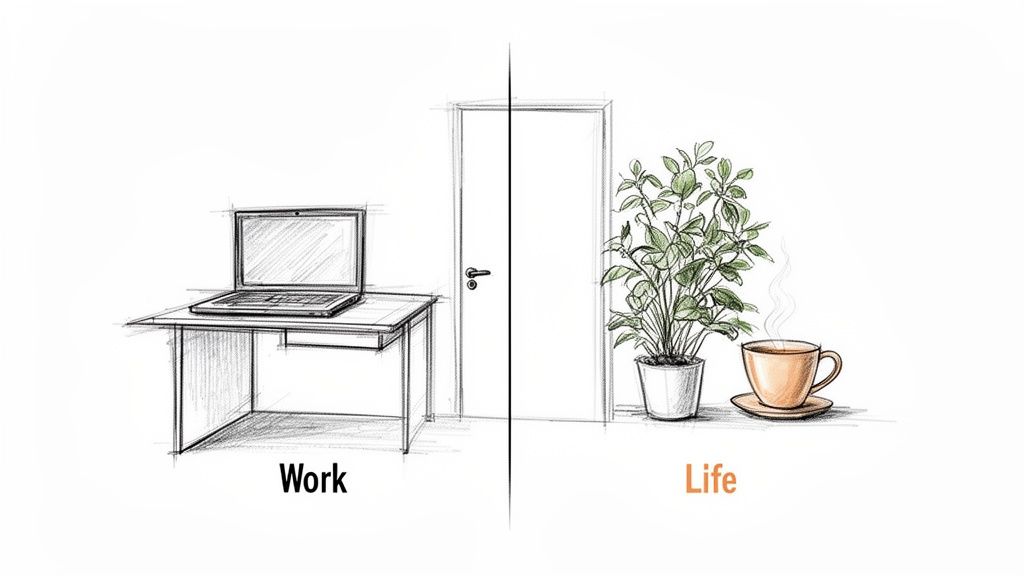
When your office is also your home, the physical separation between work and personal life disappears. Boundary setting and work-life balance are proactive remote job skills that involve creating deliberate mental and physical divides to prevent professional responsibilities from bleeding into personal time. This skill is about more than just logging off; it’s about having the discipline to truly disconnect, protect your mental health, and sustain long-term productivity and happiness. Without it, the “always-on” nature of remote work can quickly lead to exhaustion and burnout.
Why It’s a Top-Tier Remote Skill
Companies that embrace remote work understand that employee well-being is directly tied to performance. They look for candidates who can manage their own work-life integration because it signals maturity, self-awareness, and the ability to maintain consistent energy levels. A candidate who can articulate how they protect their personal time is seen as a more sustainable, long-term asset. This skill proves you can handle the autonomy of remote work without sacrificing your health, ensuring you remain engaged and effective in your role.
How to Build and Demonstrate This Skill
Developing strong boundaries requires conscious effort and consistent practice. The goal is to create clear signals for your brain and your colleagues that the workday has ended.
- Create End-of-Day Rituals: Establish a clear transition from work to personal life. This could be closing your laptop and placing it in a different room, changing your clothes, or going for a walk to mentally “commute” home.
- Use Technology to Your Advantage: Leverage “Do Not Disturb” or “Focus” modes on your devices outside of work hours. Consider using separate user profiles or even different devices for work and personal use to create a digital divide.
- Communicate Your Availability Clearly: Set your status to “offline” when you are done for the day and honor it. If a non-urgent request comes in after hours, practice responding with, “I’ve seen this and will address it first thing tomorrow.”
In an interview: When asked about how you handle remote work challenges, you can say, “To maintain a healthy work-life balance, I create a strict end-of-day routine where I close all work-related tabs and notifications. This allows me to fully recharge and return to work the next day focused and productive.” This demonstrates self-awareness and a proactive approach to well-being.
10. Problem-Solving and Independent Troubleshooting
When you’re in an office, you can often turn to a coworker for a quick answer or get immediate help from your manager. In a remote setting, that instant support system is gone, making problem-solving and independent troubleshooting essential remote job skills. This competency is about being resourceful and resilient, tackling challenges head-on by researching, experimenting, and finding solutions on your own before escalating an issue. It demonstrates initiative and an ability to maintain momentum, ensuring that small hurdles don’t bring productivity to a halt while waiting for asynchronous assistance.
Why It’s a Top-Tier Remote Skill
Companies need remote employees who are self-starters, not constant dependents. The ability to troubleshoot independently proves you can take ownership of your work and respect your colleagues’ time by not interrupting their focus with easily solvable questions. Managers value team members who can diagnose an issue, articulate what they’ve already tried, and ask specific, well-researched questions. This skill is a direct indicator of your capacity to work autonomously and efficiently in a distributed environment, making you a more reliable and valuable asset.
How to Build and Demonstrate This Skill
Cultivating a troubleshooter’s mindset involves developing a systematic approach to resolving issues. Instead of defaulting to asking for help, build a habit of proactive investigation and documentation.
- Follow a “Rule of Three”: Before reaching out for help, try to find a solution using at least three different methods. This could involve checking official documentation, searching on forums like Stack Overflow or Reddit, and experimenting with a few potential fixes on your own.
- Set a Timebox: Give yourself a dedicated block of time (e.g., 30-45 minutes) to solve a problem independently. If you haven’t made progress by the end of that period, you can then seek help with a clear summary of what you’ve already attempted.
- Ask Smarter Questions: When you do need to ask for help, be specific. Instead of saying, “My software is broken,” try: “I’m getting error code X when I try to do Y. I’ve already tried restarting the app and clearing the cache, but the issue persists. Has anyone seen this before?”
On your resume: Highlight this skill with examples that show your process and impact. Phrases like “Independently diagnosed and resolved a critical software bug, preventing project delays” or “Developed a troubleshooting guide for common technical issues, reducing support tickets by 15%” provide concrete evidence of your problem-solving capabilities.
Top 10 Remote Job Skills Comparison
| Skill | Implementation complexity 🔄 | Resource requirements 💡 | Expected outcomes 📊 | Ideal use cases | Key advantages ⭐ |
|---|---|---|---|---|---|
| Self-Discipline and Time Management | Medium — habit formation & routines 🔄 | Low — time, calendar tools, quiet workspace 💡 | Consistent productivity; fewer missed deadlines 📊 | Remote individual contributors, freelance work | Autonomy, reliable delivery, reduced micromanagement ⭐ |
| Written Communication | Low–Medium — practice and guidelines 🔄 | Low — writing tools, style guides, editors 💡 | Clear records, fewer misunderstandings 📊 | Async teams, documentation-heavy roles | Permanent trace, thoughtful responses, timezone-friendly ⭐ |
| Proactive Communication and Initiative | Medium — judgment and cadence required 🔄 | Low — PM tools, status channels, templates 💡 | Early issue detection; improved visibility 📊 | Projects with dependencies, distributed teams | Prevents escalation; shows ownership and trust ⭐ |
| Technical Proficiency and Tool Fluency | Medium–High — learning curve for platforms 🔄 | Medium — software, hardware, reliable internet 💡 | Smoother workflows; fewer tech delays 📊 | Tech-heavy roles, global collaboration | Faster problem resolution; competitive advantage ⚡⭐ |
| Active Listening and Empathy | Medium — practice and intentionality 🔄 | Low — meeting norms, time for follow-up 💡 | Stronger relationships; fewer conflicts 📊 | Customer-facing roles, team leadership | Builds psychological safety and collaboration ⭐ |
| Reliability and Dependability | Low–Medium — consistency over time 🔄 | Low — calendars, buffers, communication habits 💡 | High trust; more autonomy and opportunities 📊 | Long-term projects, roles needing accountability | Predictability, career stability, trustworthiness ⭐ |
| Collaboration and Teamwork | Medium — coordination and norms needed 🔄 | Medium — collaboration tools, shared docs, synchronous time 💡 | Better project outcomes; shared knowledge 📊 | Cross-functional projects, pair-work scenarios | Improved cohesion, knowledge transfer, shared ownership ⭐ |
| Adaptability and Learning Agility | Medium — mindset and continuous learning 🔄 | Medium — courses, time for upskilling, mentors 💡 | Faster role shifts; resilience to change 📊 | Rapidly changing products, startups | Career growth, problem-solving flexibility ⭐ |
| Boundary Setting and Work-Life Balance | Medium — requires firm habits & culture 🔄 | Low — schedules, device separation, DND settings 💡 | Reduced burnout; sustained long-term productivity 📊 | High-pressure roles, always-on cultures | Better wellbeing, sustained performance ⭐ |
| Problem-Solving and Independent Troubleshooting | Medium — methodical practice & escalation judgment 🔄 | Low–Medium — access to docs, forums, time to test 💡 | Faster resolutions; reduced dependency on others 📊 | Roles with frequent unknowns, engineering/support | Resourcefulness, confidence, quicker fixes ⚡⭐ |
Turning Your Skills into Your Next Opportunity
Navigating the landscape of remote work is no longer just about having the right technical qualifications for a specific role. As we’ve explored, success in a distributed environment is built upon a foundation of interconnected, non-negotiable skills. From the bedrock of self-discipline and time management to the nuanced art of proactive, empathetic communication, these competencies are what separate a competent remote employee from a truly indispensable one. The journey from aspiring remote worker to thriving professional is paved with intentional practice in these crucial areas.
The core takeaway is this: your professional expertise gets you in the door, but your mastery of these 10 remote job skills is what ensures you excel once you are inside. They are the invisible architecture supporting a productive and sustainable remote career. Think of them not as a checklist to be completed, but as a holistic system. Strong written communication is amplified by technical fluency in the right tools. Adaptability is made possible by a commitment to independent problem-solving. And all of these skills are underpinned by the personal discipline required to set boundaries and maintain a healthy work-life balance.
From Theory to Action: Your Next Steps
Reading about these skills is the first step, but tangible progress comes from deliberate action. To bridge the gap between understanding and mastery, focus on a structured approach to skill development. Don’t try to tackle everything at once; this will only lead to burnout. Instead, create a personalized development plan.
Here is a simple, actionable framework to get you started:
- Conduct a Self-Audit: Review the 10 skills discussed in this article. On a scale of 1 to 5, honestly rate your current proficiency in each area. Where are your strengths? Which two skills present the most significant opportunity for growth? This focused self-assessment is your starting point.
- Gather Evidence: For your top-rated skills, start documenting concrete examples. How did your proactive communication prevent a project delay? Can you point to a time when your independent troubleshooting saved the team hours of work? These stories are gold for your resume and interviews.
- Create a Micro-Goal: For your two lowest-rated skills, set one small, achievable goal for the next 30 days. For example, if written communication is a challenge, your goal might be to “spend an extra five minutes proofreading every significant email or Slack message before sending.” If it’s tool fluency, your goal could be to “complete one tutorial on an advanced feature in Asana or Jira this month.”
- Translate Skills into Resume Language: Go beyond simply listing “strong communicator.” Use your gathered evidence to craft powerful, results-oriented bullet points. Instead of “Good at time management,” write “Managed a pipeline of 15 simultaneous client projects using Trello, consistently meeting 98% of deadlines over six months.”
Why This Investment Matters
Investing time in honing these specific remote job skills offers a return that extends far beyond your next job application. It positions you as a low-risk, high-impact candidate in the eyes of hiring managers. Companies that embrace remote work are actively seeking individuals who don’t need constant oversight, who can integrate seamlessly into a digital-first workflow, and who contribute positively to a culture of trust and autonomy.
By demonstrating proficiency in these areas, you are communicating that you understand the unique demands and dynamics of a distributed team. You are showing them you are not just capable of doing the job, but capable of thriving in their specific work environment. This proactive skill development is the ultimate differentiator in a competitive global talent pool. It transforms you from a candidate who can work remotely to one who is built to work remotely.
Ready to prove your new and improved remote job skills to top companies? Remote First Jobs connects talented professionals like you with legitimate, hand-vetted remote opportunities, cutting through the noise and spam. Find a role where your dedication to mastering the art of remote work is truly valued by exploring listings on Remote First Jobs today.