Think of a contract-to-hire position as the ultimate career test drive. You get to work for a company on a temporary basis, usually for a few months, with the shared goal of transitioning to a permanent employee if everything clicks. It’s a “try before you buy” scenario that lets both you and the employer see if there’s a real long-term match.
This approach strips away the guesswork and replaces it with real-world experience, creating a clear path from a temporary gig to a lasting career move.
The Ultimate Career Test Drive
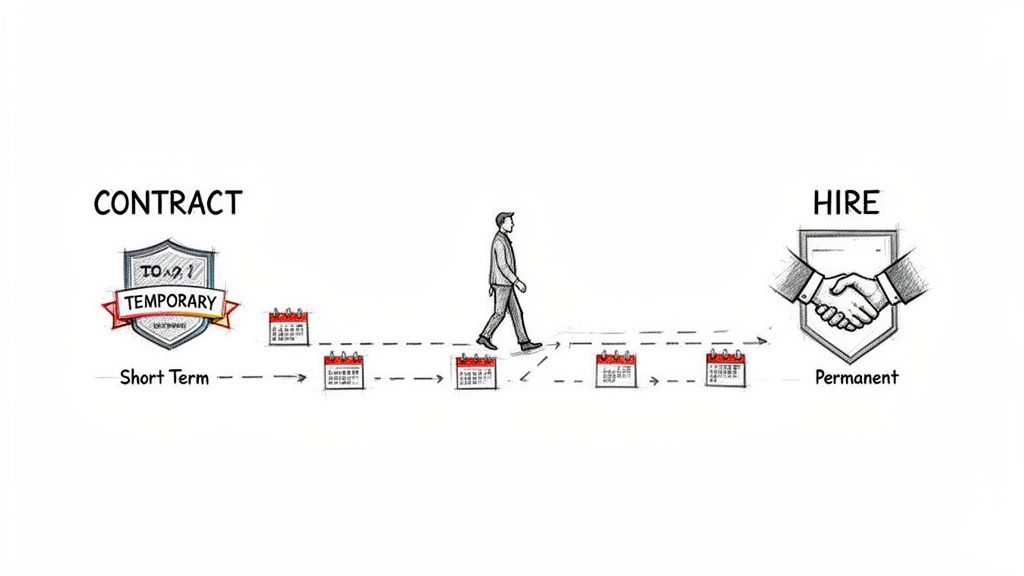
You wouldn’t buy a car without taking it for a spin first, right? That would be a huge gamble. The same logic applies to a new job. A contract-to-hire arrangement is that crucial test drive, giving everyone involved a low-risk way to ensure it’s a perfect fit before signing on the dotted line for the long haul.
During the initial contract period, you’re not actually an employee of the company you’re working at day-to-day. Instead, you’re technically employed by a staffing agency or a third-party payroll provider. They handle your paycheck, taxes, and any benefits you might get. Meanwhile, the company gets to evaluate your performance on real projects, and you get a front-row seat to the company culture, team dynamics, and day-to-day responsibilities.
Key Characteristics of This Model
The contract-to-hire model isn’t new; it emerged as a smart middle ground between traditional temp work and jumping straight into a permanent role. It became especially popular in fields like IT, product, design, and marketing, where projects and team needs can change every 6–18 months. You can dig deeper into this hiring trend and its history to see how it has grown over the years.
For companies, this setup dramatically reduces the risk of a bad hire, which can be a massive drain on time and money. For you, the candidate, it’s a chance to make sure the job actually lines up with your career goals and that the company is a place where you can genuinely see yourself thriving.
A contract-to-hire role removes the guesswork. Instead of relying solely on interviews, it allows performance and cultural alignment to be the ultimate deciding factors for a long-term career move.
Contract to Hire At a Glance
To boil it all down, here’s a quick snapshot of what a contract-to-hire agreement typically looks like. This table breaks down the core components so you know what to expect.
| Characteristic | Typical Setup |
|---|---|
| Initial Employment | You are an employee of a staffing agency or third-party firm. |
| Contract Duration | Commonly ranges from 3 to 12 months. |
| Pay Structure | You receive an hourly wage paid by the agency. |
| Benefits | Health insurance and other benefits are usually offered through the agency. |
| Goal | Conversion to a permanent, full-time employee of the client company. |
| Decision Point | At the end of the contract, a mutual decision is made on permanent hiring. |
Ultimately, this structure is designed to lead to a confident, well-informed decision for both sides at the end of the contract period.
How the Contract to Hire Process Really Works
So, what does this whole arrangement actually look like from the inside? It’s not as complicated as it might sound. Think of it less as a single event and more like a structured journey with clear phases, each designed to see if you and the company are a great long-term match.
The whole thing usually kicks off just like any other job search. You’ll find a role, send in your application, and go through a few rounds of interviews. The key difference is that the conversation will be framed around an initial contract period that could lead to a permanent spot. This means you should be ready to talk about both your excitement for the immediate project and where you see yourself down the road.
The Initial Contract Phase
Once you get the offer and accept, you’re officially in the contract phase—this is the extended “test drive.” This is the heart of the what is contract to hire model and it typically runs for 3 to 12 months.
Here’s the most important thing to understand: during this time, you are not a direct employee of the company you’re doing the work for.
Instead, a third party handles all the HR stuff. This is almost always one of two players:
- A Staffing Agency: They’re the ones who likely found you the job, and they’ll manage your contract, cut your checks, and often provide a benefits package.
- An Employer of Record (EOR): This is a service the company hires to manage all the HR, compliance, and payroll functions for its contract workers.
What this means for you is that your paycheck, tax withholdings, and any health insurance will come from this third-party agency, not the company whose Slack channels you’re in every day. It’s a crucial legal and administrative distinction during this initial period.
The Path to Permanent Conversion
As your contract nears its end, the conversion process gets started. This isn’t an automatic switch that gets flipped. It’s a series of performance reviews and honest conversations about your future with the company. Your manager will look at your contributions, how well you’ve clicked with the team, and if you’re a good fit for the company’s culture.
The conversion decision is a two-way street. The company evaluates if you are the right long-term fit, and you must decide if the company culture, workload, and career path align with your personal and professional goals.
If everyone is on board, the company will extend a formal offer for a permanent, full-time position. This is a major transition. You’ll officially become a direct employee, moving from the agency’s payroll to the company’s internal systems. It’s also your chance to negotiate your permanent salary, benefits, and title, just like you would with any other job offer.
Comparing Contract-to-Hire, Direct Hire, and Freelance
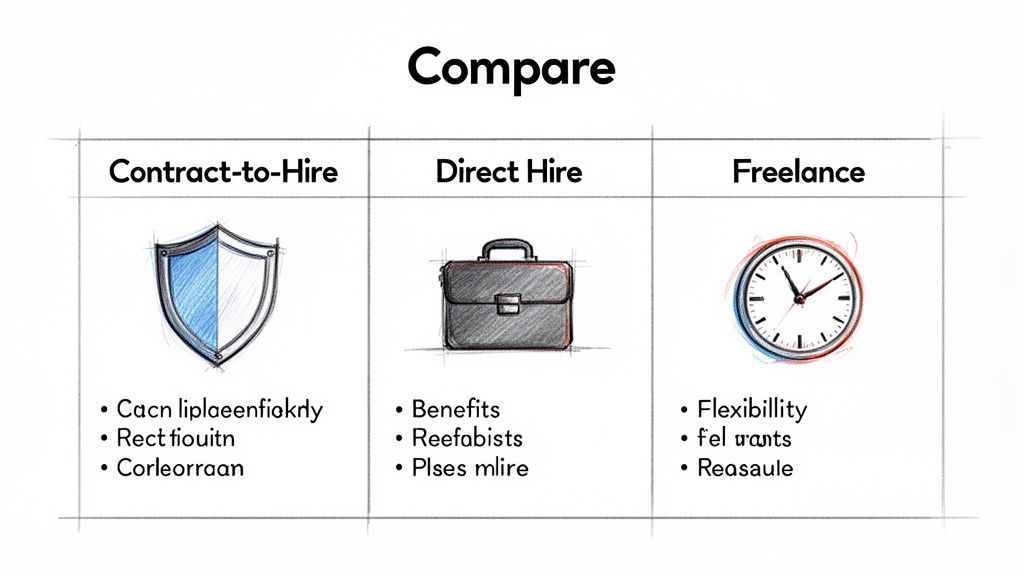
Trying to figure out which type of job to take can feel like you’re standing at a career crossroads. Each path—contract-to-hire, direct hire, or freelance—is a completely different journey with its own set of risks and rewards. Getting a handle on these differences is the first step to making a smart move that aligns with your goals.
The Lay of the Land: Three Core Models
Think of it this way: you have three main flavors of employment to choose from.
Direct hire is the classic, most traditional route. You’re a full-fledged employee from day one, which means you get immediate access to all the company perks: health insurance, retirement plans, paid time off, the whole nine yards. This is the path for anyone who prioritizes stability and wants to dive deep into a company’s culture right away.
At the complete opposite end is freelancing, or standard contract work. Here, you are your own boss. You’re brought on for specific projects with clear end dates, giving you maximum flexibility. The trade-off? You’re on the hook for your own taxes, insurance, and the constant hustle of lining up your next gig.
The contract-to-hire model lands right in the middle, borrowing a little from both worlds. It offers a clear, structured path toward a permanent job but starts with a trial period. It’s your chance to test-drive the company, and their chance to see you in action.
This hybrid approach is becoming more common. In fact, contingent workers—a group that includes independent contractors and temp agency staff—now make up roughly 14.5% of the U.S. workforce. For tech and product roles especially, companies are leaning on contract-to-hire to evaluate talent on real-world projects before making that long-term commitment.
Each employment type serves a different purpose. Direct hire prioritizes long-term stability, freelance prioritizes short-term flexibility, and contract-to-hire acts as a bridge between the two.
Before making a choice, it’s worth understanding the legal nuances that separate these roles. This article on At-Will Employment vs. Contract Employment offers a great breakdown of the fundamental differences.
Comparing Hiring Models
To really see what makes each model tick, let’s put them side-by-side. The table below breaks down the key factors you should be thinking about, from job security and benefits to your potential for career growth.
| Feature | Contract to Hire | Direct Hire | Standard Contract (Freelance) |
|---|---|---|---|
| Job Security | Moderate; depends on performance and conversion. | High; you are a permanent employee from the start. | Low; security is tied to the current project’s length. |
| Benefits | Initially provided by the staffing agency, not the company. | Provided directly by the company (health, 401k, PTO). | None; you are responsible for your own benefits. |
| Pay Structure | Hourly wage paid by the agency during the contract. | Annual salary with potential bonuses. | Project-based fee or hourly rate, paid via invoices. |
| Career Growth | Clear path to a permanent role with internal growth. | Established path for promotions and advancement. | Growth comes from building a client portfolio. |
| Flexibility | Less flexible than freelancing; follows company hours. | Structured; follows standard company policies. | High; you control your schedule and projects. |
Ultimately, the “best” option isn’t universal—it’s personal. What works for a freelancer seeking ultimate freedom won’t be the right fit for someone who needs the stability and benefits of a direct-hire role. By understanding these distinctions, you can choose the path that truly works for you.
Negotiating Your Contract to Hire Agreement

Think of your contract as the official game plan for your journey to a permanent role. Every single detail matters. When you get this document, don’t just skim it—treat it like your first real assignment, a chance to show your professional diligence and secure terms that work for you.
A good agreement shouldn’t feel temporary. It should lay out a clear, mutually understood trial period. For many people sick of endless interview loops, the speed of contract-to-hire is a huge plus. Some data shows that filling contract roles can be up to 2x faster than traditional permanent jobs, simply because companies are motivated to move quickly. You can dig deeper into why this staffing model makes business sense to understand what it means from both sides of the table.
Key Terms to Scrutinize
When that contract lands in your inbox, zero in on a few critical areas. These are the terms that define your pay, your timeline, and exactly what it takes to lock in that full-time offer.
- Hourly Rate: This number needs to be right. Remember, you’re likely covering your own taxes or getting limited benefits for a while, so your rate should reflect that. Do your homework on market rates for contractors in your industry to make sure you’re getting paid what you’re worth.
- Contract Duration: The agreement has to state the exact length of the contract, which is usually somewhere between three to six months. This should be a firm timeline, giving you a clear date for when you’ll be talking about converting to a permanent employee.
- Conversion Criteria: This might just be the most important part of the whole document. The contract needs to spell out the specific performance goals or metrics you have to hit to be eligible for a full-time offer. If this section is vague, consider it a major red flag.
- Conversion Salary Range: This isn’t always included, but it’s a huge win if you can get it. Negotiating a pre-agreed salary range for the permanent position avoids awkward surprises down the road and makes sure everyone’s expectations are aligned from the get-go.
Red Flags to Watch Out For
A solid contract creates clarity. A bad one creates confusion. Be on high alert for any fuzzy language that could be interpreted in more than one way—that ambiguity almost always benefits the employer, not you.
A well-structured contract-to-hire agreement is a sign of a transparent employer. Ambiguity in the contract often signals ambiguity in the company’s commitment to converting the role.
Keep an eye out for overly aggressive non-compete clauses that could tie your hands if the role doesn’t work out. You should also be cautious if the contract is missing a clear “right to convert” clause, which is the company’s formal statement of intent to hire you if you meet the criteria. Your mission is to sign a document that lays out a fair and transparent path to a permanent job.
How to Find Remote Contract-to-Hire Opportunities
Knowing what a contract-to-hire role is and actually finding a good one are two totally different things. You need a real strategy to uncover quality remote opportunities without drowning in the noise of those massive, overcrowded job boards. The secret? Look where others aren’t, and get laser-focused with your search.
This means stepping away from generic job sites that are often littered with spam listings and “ghost jobs.” Instead, focus on platforms that pull their listings directly from company career pages. This gives you a massive head start. For example, you can browse thousands of verified listings on Remote First Jobs and find opportunities before they hit the mainstream and become hyper-competitive.
Using Smart Search Filters
To really zero in on the right roles, you’ve got to think like a recruiter. Using specific keywords and filters is the fastest way to slice through the clutter and bring the best-fit positions to the surface.
Start with these search terms:
- “Contract to hire”
- “Contract-to-hire”
- “C2H” or “CTH”
- “Temp to perm”
The screenshot below shows just how effective this is. By using these specific terms on a direct-sourcing job board, you can instantly filter for relevant contract-to-hire roles.
This targeted approach makes sure every result is a potential match, saving you from the headache of sifting through hundreds of irrelevant direct-hire or pure freelance gigs.
When you’re on the hunt for these roles, always prioritize platforms that let you clearly filter by employment type. It’s a simple step, but it can dramatically boost the quality of your search and help you focus your energy only on the most promising leads.
By combining the right keywords with a high-quality, direct-sourcing job platform, you’re not just searching smarter—you’re effectively bypassing the competition and connecting directly with companies that are actively looking for talent in a contract-to-hire setup.
Making a Successful Transition from Contractor to Employee
Landing the contract is a fantastic first step, but the real work starts now. Think of the contract period as your ultimate audition for the full-time role. This is your chance to show them you’re not just a temporary fix, but an essential part of the team’s future.
From day one, act like you’re already a permanent team member. Dive into the company culture headfirst, make genuine connections with your colleagues, and get involved. When decision-makers can already see you fitting in seamlessly, it makes the final choice to hire you that much easier.
Go Beyond the Job Description
To really lock in that full-time offer, you have to deliver more than what’s spelled out in your contract. The contractors who successfully make the leap are the ones who become proactive problem-solvers. Don’t just sit back and wait for tasks to land on your plate.
Look for areas where you can make an impact. Identify a clunky process or a recurring challenge and take the initiative to fix it. This shows you have a sense of ownership—that you’re invested in the team’s success, not just collecting an hourly rate. Consistently turning in top-notch work while actively looking for ways to contribute more sends a powerful message.
Here are a few simple ways to add that extra value:
- Mentor a Teammate: Got a skill someone else is learning? Offer to help them out.
- Improve a Process: Notice a workflow bottleneck? Sketch out a more efficient way to get things done.
- Volunteer for Projects: See a tough assignment that everyone else is avoiding? Raise your hand.
Build Relationships and Communicate Your Intent
Your skills got you through the door, but your relationships will be what keeps you there. Put real effort into building solid connections, especially with your direct manager and other key leaders. These are the people who will be in the room when your name comes up for a permanent position.
Set up regular check-ins to talk about your progress, get feedback, and make sure you’re aligned with their expectations. When performance review time comes, treat it like gold. It’s not just a time to hear what they think—it’s your best opportunity to express your own enthusiasm for the company and your desire to stick around for the long haul.
Proving your value is a mix of excellent work and excellent communication. Make it clear through both your actions and your words that you are committed to the team’s long-term goals.
You don’t have to be shy about what you want. A simple, professional comment like, “I’m really enjoying the work here and am very interested in a permanent role if the opportunity arises,” can work wonders. It removes any guesswork for your manager and clearly flags you as a motivated candidate who wants to stay. Nailing this conversation is one of the biggest keys to turning that temporary gig into a lasting career.
Frequently Asked Questions About Contract to Hire Roles
Even with a solid understanding of how contract-to-hire works, you probably still have a few questions rattling around. Let’s tackle some of the most common ones that come up when you’re navigating one of these unique opportunities.
How Do I Figure Out My Hourly Rate?
This is the big one, right? Your hourly rate during the contract phase is a critical number to get right. It needs to be higher than what you’d make in a salaried role, and for good reason: you’re covering your own benefits, paid time off, and potentially self-employment taxes.
A good rule of thumb is to find the average full-time salary for that same role and then add a 25-50% markup. This isn’t just about getting paid more; it’s about making sure you’re financially whole while you’re in the “try-out” phase.
What If a Permanent Offer Never Comes?
It’s a valid concern. Sometimes, for reasons that have absolutely nothing to do with you or your performance, a company decides not to extend a permanent offer. Budgets get cut, strategies pivot, and priorities change. It happens.
The end of a contract without a conversion isn’t a failure. It’s a data point. You’ve gained real-world experience, expanded your professional network, and learned a ton about what you do—or don’t—want in your next role.
If a permanent offer doesn’t materialize, the contract simply concludes on its planned end date. If you worked with a staffing agency, they’ll usually start looking for your next placement right away, armed with fresh feedback on your skills.
Can I Actually Negotiate When They Offer Me the Full-Time Job?
Yes, you absolutely can—and you should! When the company decides they want to bring you on board permanently, they’ll give you a formal job offer. Treat this moment just like any other job negotiation.
Think about it: you have incredible leverage. You’re not an unknown quantity. You’ve spent the last few months proving your skills, integrating with the team, and showing them exactly what you can do. You’re in a far stronger position than any outside candidate.
So, when that offer comes, be ready. Go in prepared to talk about your contributions and advocate for the salary, title, and benefits package that reflects the value you’ve already brought to the table.
Ready to find a role that lets you test the waters first? Remote First Jobs sources thousands of verified contract-to-hire opportunities directly from company career pages, helping you find your next great role before the competition does. Start your search on Remote First Jobs today.