In a remote-first hiring environment, interviewers need to know how a candidate will perform without direct, in-person supervision. The classic “what would you do if…” hypothetical question falls short because anyone can theorize a perfect response. Instead, hiring managers have turned to a more powerful and predictive tool: situational interview questions. These questions demand real, concrete examples from your past, making them the gold standard for assessing genuine skills and behaviors.
This guide provides a comprehensive breakdown of the most common situational interview questions tailored for remote work. We will dissect each question, offering a framework for both job seekers looking to craft compelling answers and for recruiters aiming to identify top-tier distributed talent. You will learn not just what to say, but how to structure your responses using the proven STAR method (Situation, Task, Action, Result) to demonstrate autonomy, proactive communication, and the self-discipline required to excel in a remote setting.
While situational questions are about past performance, they share a common goal with behavioral questions, which focus on how you’ve handled specific work scenarios. To further explore effective examples of questions designed to elicit real-world experience, particularly in consulting, you can find a comprehensive guide to these: Top Behavioral Interview Questions for Consulting. This article, however, will focus specifically on the situational prompts you’ll face when interviewing for a remote role. From managing deadlines across time zones to solving problems independently, we’ll equip you with the strategic insights needed to turn your professional history into your next remote job offer.
1. Tell me about a time you had to manage a deadline while working remotely
This situational interview question directly assesses a candidate’s autonomy, time management, and communication skills in a remote setting. Recruiters use it to gauge whether an individual can maintain productivity and accountability without the structure of a physical office. It uncovers their personal systems for task prioritization, progress tracking, and proactive stakeholder communication, all of which are essential for successful remote work.
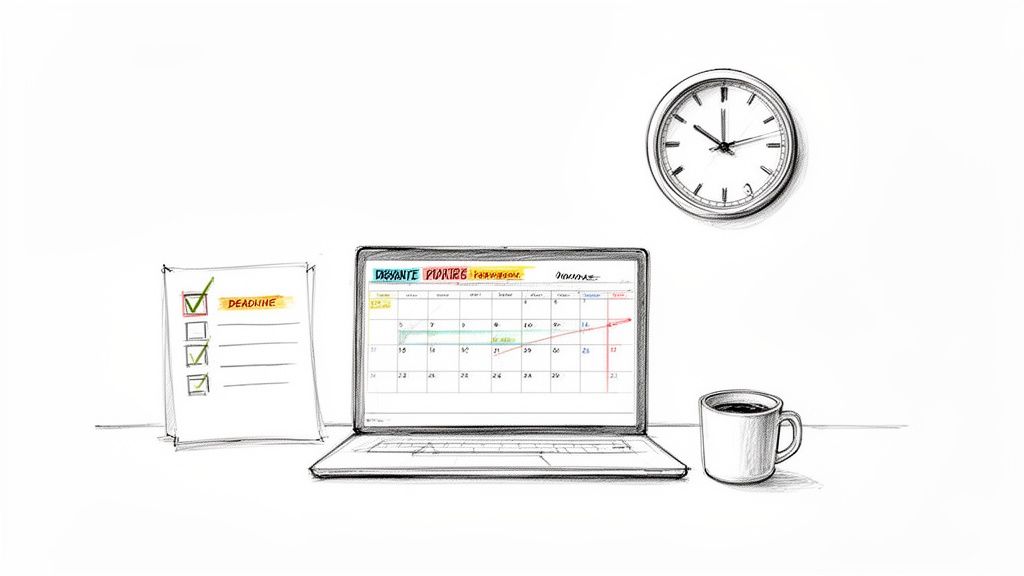
A strong answer moves beyond simply stating, “I met the deadline.” It details the specific strategies and tools used to stay on track.
Sample Answer & Breakdown (STAR Method)
A marketing professional might answer:
(S)ituation: “In my previous role, I was tasked with launching a new social media campaign for a product update, with a hard deadline in two weeks. My team was fully remote and spread across three different time zones.”
(T)ask: “My responsibility was to coordinate the creation of all assets, including graphics, copy, and a video, ensuring everything was approved and scheduled before the launch date.”
(A)ction: “I immediately created a shared project board in Asana, breaking down the entire project into smaller, daily tasks assigned to each team member. I scheduled a brief 15-minute sync-up call at the start of each week and used a dedicated Slack channel for daily asynchronous check-ins. When our graphic designer was at risk of a delay due to conflicting priorities, I proactively communicated with their manager to realign their workload, which prevented a bottleneck.”
®esult: “As a result, we delivered all assets two days ahead of schedule. The organized workflow and clear communication channels allowed the campaign to launch smoothly, and it exceeded its initial engagement targets by 15% in the first week.”
Why This Answer Works
- Proactive System: The candidate didn’t just work hard; they implemented a clear system (Asana, Slack, check-ins) to manage complexity.
- Problem-Solving: They identified a potential bottleneck (the designer’s delay) and took specific, proactive steps to resolve it instead of waiting for it to become a crisis.
- Quantifiable Success: The result is tied to a measurable business outcome (15% higher engagement), demonstrating the impact of their organizational skills.
2. Describe a situation where you had to collaborate with team members across different time zones
This is one of the most critical situational interview questions for global or remote-first companies. It assesses a candidate’s ability to overcome asynchronous communication hurdles, their flexibility, and their strategic use of collaboration tools. Recruiters use this to determine if an individual can foster team cohesion and maintain project momentum when real-time interaction is limited. It reveals their aptitude for clear documentation, inclusive meeting practices, and empathy for colleagues’ work-life balance.
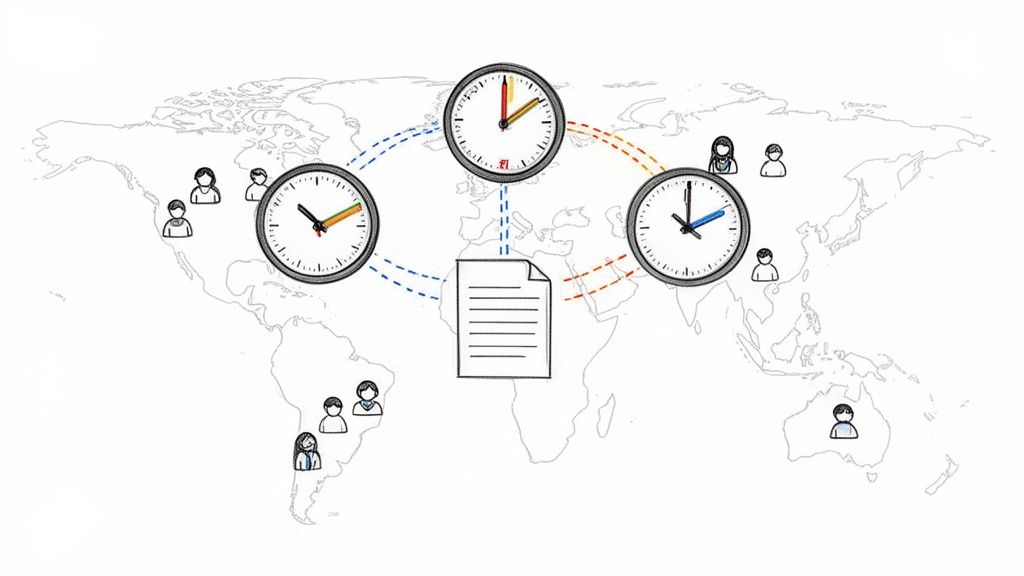
A great response highlights specific, intentional strategies for bridging geographical and temporal divides, rather than just stating that they worked with an international team.
Sample Answer & Breakdown (STAR Method)
A product manager might answer:
(S)ituation: “We were developing a new feature that required close collaboration between our engineering team in San Francisco, the UX/UI team in Berlin, and our QA specialists in Bangalore. This created a significant 12.5-hour time zone gap, making synchronous meetings almost impossible.”
(T)ask: “My responsibility was to ensure seamless communication and alignment on requirements, designs, and bug fixes, preventing delays so we could meet our quarterly launch target.”
(A)ction: “I established a ‘single source of truth’ in our Confluence space, with meticulously detailed project briefs and decision logs. Instead of relying on live meetings, I implemented a system of daily, structured asynchronous updates via Slack threads. For critical decisions, I would post a proposal at the end of my day, allowing the other teams to comment during their work hours. I also recorded short Loom videos to walk through complex mockups, which prevented misinterpretation.”
®esult: “This asynchronous-first approach eliminated communication bottlenecks. We successfully launched the feature on schedule with 90% fewer bugs in the initial release compared to previous cross-zone projects. The detailed documentation also became a valuable resource for onboarding new team members later on.”
Why This Answer Works
- Asynchronous-First Mindset: The candidate demonstrates a sophisticated understanding of remote work by prioritizing documentation (Confluence, Slack threads) over forcing inconvenient meetings.
- Strategic Tool Usage: They mention specific tools (Confluence, Slack, Loom) and explain how they were used to solve the time zone problem, showing tactical proficiency.
- Measurable Impact: The result is tied to concrete business metrics (on-schedule launch, 90% fewer bugs), proving the effectiveness of their collaboration strategy.
3. Tell me about a time when you had to solve a problem without being able to immediately ask your manager or colleague for help
This situational interview question is a direct test of a candidate’s resourcefulness, initiative, and decision-making capabilities. Recruiters use it to see how individuals perform under pressure without direct supervision, a common scenario in remote and asynchronous work environments. It reveals whether a candidate defaults to inaction when stuck or proactively seeks solutions using available resources.
A strong answer showcases a clear, logical thought process and a bias for action, rather than simply stating, “I figured it out.”
Sample Answer & Breakdown (STAR Method)
A software developer might answer:
(S)ituation: “During a critical deployment on a Friday evening, a sudden, unexpected bug appeared in the production environment that was impacting user logins. My direct manager and the senior developer on the project were both offline and unreachable.”
(T)ask: “My responsibility was to diagnose the source of the authentication error and implement a fix as quickly as possible to minimize user disruption, without having access to my usual support system.”
(A)ction: “First, I immediately checked the error logs and monitoring dashboards to isolate the problem, which pointed to a recent microservice update. I then consulted our internal technical documentation for that service and searched our company’s past incident reports for similar issues. Finding nothing specific, I researched the error on Stack Overflow, which suggested a potential misconfiguration in a new library. I developed a small, targeted hotfix based on that hypothesis, tested it in a staging environment, and confirmed it resolved the login issue.”
®esult: “I successfully deployed the hotfix within 45 minutes, restoring full functionality for users. The following Monday, I documented the entire incident, my diagnostic steps, and the solution in our knowledge base. I also briefed my manager on the issue and the resolution, and he confirmed my approach was correct and praised my initiative.”
Why This Answer Works
- Logical Process: The candidate details a step-by-step diagnostic process (logs, documentation, external research) that demonstrates critical thinking, not just guessing.
- Calculated Risk: They didn’t make a reckless change; they tested the fix in a safe environment before pushing it to production, showing good judgment.
- Closing the Loop: The candidate shows accountability by documenting the solution and informing their manager afterward, which is crucial for team alignment.
4. Describe a time when you had to maintain focus and avoid distractions while working from home
This situational interview question probes a candidate’s self-discipline, personal accountability, and ability to create a productive environment outside a traditional office. Recruiters use it to determine if a candidate has developed concrete strategies to manage common remote work challenges like household interruptions, digital notifications, and blurred work-life boundaries. It reveals a person’s self-awareness and the practical systems they use to deliver results consistently.

A weak answer is vague, like “I just ignore distractions.” A strong answer details the specific, repeatable methods and tools the candidate employs to consciously manage their attention and work environment.
Sample Answer & Breakdown (STAR Method)
An engineer might answer:
(S)ituation: “In my previous role, our team transitioned to a fully remote model. I found that household noise and a constant influx of non-urgent pings on Slack were significantly breaking my concentration, especially during complex coding tasks that required deep focus.”
(T)ask: “I needed to create a system that would allow me to carve out dedicated, uninterrupted time for deep work while still being available for my team for urgent matters.”
(A)ction: “First, I designated a specific room as my home office and communicated with my family that when the door is closed, I am in a ‘focus block’ and shouldn’t be disturbed unless it’s an emergency. Second, I adopted the Pomodoro Technique, using a timer to work in 90-minute focused sprints with short breaks. During these sprints, I use a website blocker to prevent access to social media, put on noise-canceling headphones, and set my Slack status to ‘Focusing’ to manage team expectations.”
®esult: “By implementing this structured approach, I was able to reduce my average time to complete complex coding tickets by about 20%. My code quality also improved, with fewer bugs reported during peer reviews, because I could maintain focus for longer, more productive periods.”
Why This Answer Works
- Specific Strategies: The candidate names specific techniques (Pomodoro), tools (noise-canceling headphones, website blockers), and boundary-setting actions (dedicated space, family communication).
- Proactive Environmental Control: It shows they take ownership of their work environment rather than being a passive victim of distractions.
- Demonstrates Self-Awareness: The answer clearly identifies the problem (interruptions) and its impact (broken concentration), showing an understanding of their own work patterns.
- Measurable Outcome: The result is linked to tangible improvements in performance metrics (20% faster ticket completion, better code quality), proving the effectiveness of their system.
5. Tell me about a time when you had to communicate complex information to someone asynchronously
This situational interview question is a crucial test of a candidate’s written communication, clarity of thought, and empathy for their audience. In remote-first environments, asynchronous communication is the default, and recruiters use this prompt to see if a candidate can build understanding and drive decisions without the benefit of real-time conversation. It reveals their ability to structure information logically, anticipate questions, and choose the right medium for the message.
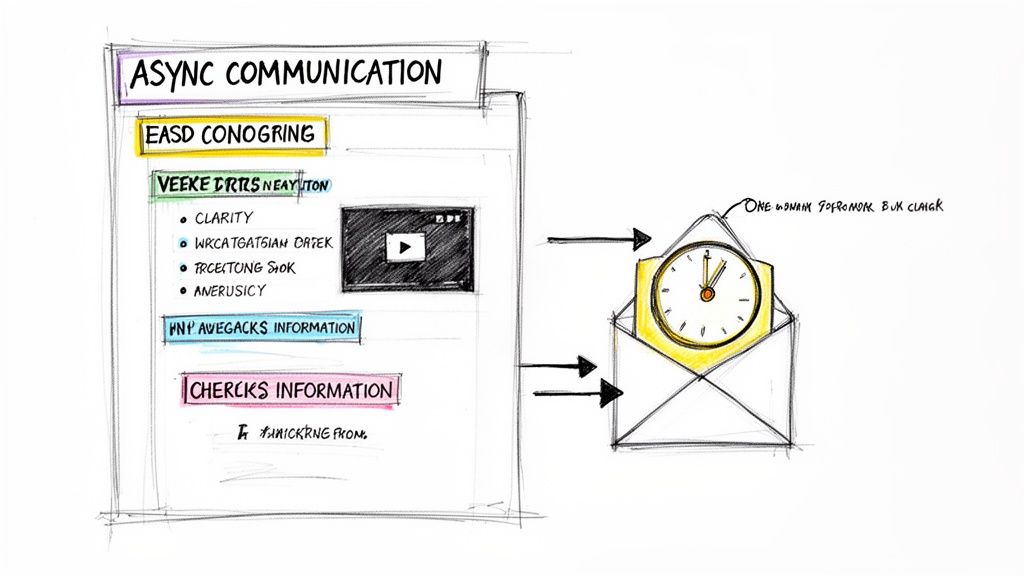
A great answer demonstrates a thoughtful process that goes beyond just sending an email. It highlights how the candidate made complex information digestible and actionable for a distributed audience.
Sample Answer & Breakdown (STAR Method)
A data analyst might answer:
(S)ituation: “Our executive team, based in Europe, needed to understand the performance drivers behind a 10% dip in user retention last quarter. The data was complex, involving multiple user segments and product interaction points, and I needed to deliver the findings async due to the significant time zone difference.”
(T)ask: “My task was to create a self-contained, comprehensive report that not only explained what happened but also clearly outlined the ‘so what’ for the leadership team, enabling them to make a data-informed decision on where to focus engineering resources.”
(A)ction: “I created a shareable report in Notion. I started with a one-paragraph executive summary at the very top with the three key takeaways. I then used clear headings to break down the analysis by user segment, embedding charts with concise annotations to explain each visual. I also recorded a five-minute Loom video where I walked through the report, highlighting the most critical findings and my recommendations. I included a link to the video at the top of the doc and explicitly asked for feedback and questions in the comments by a specific date.”
®esult: “The leadership team was able to fully digest the information on their own time. The head of product left comments directly in the document, which we resolved asynchronously. They used my analysis to prioritize two key product initiatives for the next quarter, and I received positive feedback on the clarity and actionability of the report.”
Why This Answer Works
- Multi-Format Approach: The candidate used a combination of text, visuals (charts), and video (Loom) to cater to different learning styles and make the information more engaging.
- Audience-Centric: They anticipated the needs of a busy executive team by providing a TL;DR summary upfront and making the report easy to navigate.
- Action-Oriented: The communication had a clear purpose: to drive a decision. The candidate concluded with specific recommendations and a clear call to action for feedback.
6. Describe a situation where you had to onboard yourself or learn something new without much direct training
This situational interview question tests a candidate’s initiative, resourcefulness, and ability to learn autonomously. Recruiters use it to identify self-starters who can thrive in environments with less structured support, a common trait in fast-paced startups and remote-first companies. It reveals how a candidate navigates ambiguity and takes ownership of their professional development.
A great answer showcases a methodical approach to self-directed learning, not just a passive absorption of information. It highlights a structured process for acquiring and validating new skills.
Sample Answer & Breakdown (STAR Method)
A software developer might answer:
(S)ituation: “In my last role, my team decided to adopt a new JavaScript framework, Svelte, for a client-facing dashboard project to improve performance. No one on the team had prior experience with it, and there was no budget for formal training.”
(T)ask: “I was responsible for building the initial data visualization components and needed to get up to speed on Svelte quickly to avoid project delays. My goal was to become proficient enough to build production-ready code within three weeks.”
(A)ction: “I dedicated the first week to immersive learning. I went through the official Svelte documentation, completed a few popular online tutorials, and built a small personal project to experiment with its core concepts. To validate my understanding, I sought feedback on my code from a senior developer in another department who had experience with the framework. I also joined the Svelte community on Discord to ask specific questions and learn from others’ challenges.”
®esult: “Within two weeks, I was confidently building the required components. My proactive learning not only kept the project on schedule but also allowed me to create a ‘quick-start’ guide and a set of best practices for the rest of my team. This internal resource reduced their onboarding time by an estimated 40%.”
Why This Answer Works
- Structured Process: The candidate outlines a clear, multi-step learning plan (documentation, tutorials, practice project) rather than just “winging it.”
- Proactive Validation: They didn’t assume their learning was correct; they actively sought feedback from an expert and engaged with a community to confirm their approach.
- Team-Oriented Outcome: The result goes beyond personal achievement. They created a reusable asset (the quick-start guide) that provided value to the entire team, demonstrating a collaborative mindset.
7. Tell me about a time when you had to give or receive feedback remotely and it was challenging
This question evaluates a candidate’s emotional intelligence, communication skills, and professionalism when navigating sensitive conversations in a remote environment. Recruiters use this to understand how an individual gives and receives constructive criticism without the benefit of in-person cues. It reveals their ability to prepare for difficult talks, choose the right communication channels, and maintain positive working relationships despite the distance.
A strong response highlights self-awareness and a structured approach to communication, focusing on empathy and clarity to overcome the inherent challenges of remote feedback.
Sample Answer & Breakdown (STAR Method)
A team lead might answer:
(S)ituation: “In my previous role, a junior developer on my team, who was based in a different country, consistently submitted code that required significant revisions. This was impacting our project timelines, and I needed to provide direct, constructive feedback.”
(T)ask: “My goal was to address the quality issues and provide actionable guidance without discouraging them, which can be particularly challenging over a video call where it’s harder to gauge emotional reactions.”
(A)ction: “I scheduled a private video call, starting the conversation by acknowledging their hard work and positive contributions first. I then shared my screen to review specific code examples, framing the feedback around team coding standards and best practices, not personal criticism. I used phrases like, ‘Here’s an opportunity to make this more efficient,’ and asked open-ended questions like, ‘What was your thought process here?’ to understand their perspective. We ended the call by co-creating a checklist for their future code submissions and scheduling a follow-up pairing session.”
®esult: “The developer was receptive and appreciated the specific, non-confrontational approach. Their code quality improved dramatically over the next two sprints, reducing revision time by over 50%. The experience also strengthened our working relationship, as they felt supported rather than criticized.”
Why This Answer Works
- Empathy and Preparation: The candidate didn’t just jump into the criticism; they prepared by scheduling a private video call and structuring the conversation positively.
- Actionable and Specific: They used concrete examples (screen sharing code) and focused on objective standards, making the feedback clear and actionable.
- Collaborative Solution: The candidate turned a one-way critique into a two-way dialogue by asking questions and co-creating a solution (the checklist), which fosters ownership.
- Measurable Improvement: The result is tied to a clear business metric (50% reduction in revision time), demonstrating the effectiveness of their communication strategy.
8. Describe a time when you had to balance multiple projects or priorities without a manager micromanaging you
This situational interview question is a direct test of a candidate’s autonomy, prioritization skills, and sense of ownership. Recruiters use it to see if an individual can independently manage their workload and make sound judgments about competing demands, which is critical in hands-off or remote environments. It reveals how they structure their work, communicate their capacity, and ensure nothing gets dropped when juggling multiple responsibilities.
A great answer showcases a deliberate system for prioritization, not just an ability to work hard under pressure.
Sample Answer & Breakdown (STAR Method)
An engineer might answer:
(S)ituation: “In my previous role, our team adopted a more autonomous structure. I was simultaneously responsible for developing a new user authentication feature, fixing high-priority bugs from the previous sprint, and addressing a backlog of technical debt.”
(T)ask: “My core task was to make meaningful progress on all three fronts without direct oversight on my day-to-day priorities, ensuring the new feature stayed on its development timeline while keeping the platform stable.”
(A)ction: “I used a personal Kanban board to visualize all my tasks, categorizing them by ‘Feature Development,’ ‘Bug Fixes,’ and ‘Tech Debt.’ I time-boxed my week, dedicating Mondays and Tuesdays to the new feature, Wednesdays to tech debt, and Thursdays to bug fixes, leaving Friday for overflow and planning. When an urgent, production-level bug appeared, I immediately paused my feature work, notified my manager of the priority shift via a quick Slack message, and resolved the bug. This involved giving direct, timely updates to my manager.”
®esult: “This structured approach allowed me to successfully complete the authentication feature on schedule. I also closed out 15% more bug tickets than the previous quarter and reduced a key area of technical debt, which improved system performance. My manager noted in my performance review that my proactive communication and self-management were highly effective.”
Why This Answer Works
- Demonstrates a System: The candidate describes a clear, replicable system (Kanban board, time-boxing) for managing competing priorities.
- Proactive Communication: They didn’t wait to be asked for an update; they proactively informed their manager about a necessary priority shift, showing high accountability.
- Adaptability: They showed they could pivot from their plan to address an urgent business need, a key skill in dynamic work environments.
- Quantifiable Impact: The answer connects their actions to measurable outcomes (completing the feature, closing more tickets, and positive performance feedback).
9. Tell me about a time when you had to make a decision that affected your team without being able to discuss it in person first
This situational interview question is crucial for remote roles, as it tests a candidate’s judgment, accountability, and communication skills when immediate, in-person consensus isn’t an option. Recruiters use it to see if a candidate can act decisively and thoughtfully, considering the team’s welfare and project goals even when isolated. It reveals their ability to weigh information, anticipate consequences, and transparently communicate their reasoning after the fact.
A strong answer demonstrates a clear, logical process for making an independent decision and a structured approach to communicating it to the team.
Sample Answer & Breakdown (STAR Method)
A tech lead might answer:
(S)ituation: “We discovered a critical security vulnerability in a third-party library just hours before a scheduled production release. Our key stakeholders and the security team were in a different time zone and unavailable for an immediate sync call.”
(T)ask: “I had to decide whether to proceed with the release as planned, risking a security breach, or to delay the launch, which would impact our marketing commitments and customer expectations.”
(A)ction: “I first documented all available information: the vulnerability’s severity score, the potential impact, and the complexity of a patch. Based on the principle of ‘security over features,’ I made the executive decision to halt the release. I immediately communicated this via our emergency Slack channel and a detailed email, explaining the risk, my rationale, and a proposed plan for remediation. I then began working on a patch so we had a solution ready for discussion when the team came online.”
®esult: “When the team logged on, they had a full picture of the situation and the rationale behind the delay. They agreed with the decision, and my proactive work on the patch allowed us to resolve the issue and deploy the release securely the very next day. This reinforced our team’s commitment to security and built trust in my judgment under pressure.”
Why This Answer Works
- Clear Rationale: The candidate didn’t just make a call; they based it on a core principle (“security over features”) and available data, showing sound judgment.
- Proactive Communication: They didn’t just delay and wait. They immediately communicated the “what” and the “why” asynchronously, preventing confusion and demonstrating accountability.
- Solution-Oriented: Instead of just stopping the problem, they took the next step by starting work on a solution, turning a crisis into a productive action.
10. Describe a situation where you had to maintain professional boundaries between work and personal life while working from home
This situational interview question probes a candidate’s self-awareness and strategies for long-term sustainability in a remote environment. Recruiters ask this to determine if a candidate can proactively manage their own well-being, prevent burnout, and maintain focus without the physical separation of an office. It reveals whether they have developed healthy habits or if they are prone to overworking, which can lead to decreased productivity over time.
A strong answer demonstrates intentionality and a clear system for creating a mental and physical divide between professional duties and personal time.
Sample Answer & Breakdown (STAR Method)
A software engineer might answer:
(S)ituation: “When my team transitioned to a fully remote model, I initially found myself answering Slack messages and reviewing code late into the evening. My home office was also my living room, making it difficult to mentally ‘clock out’ and recharge.”
(T)ask: “I recognized this was unsustainable and could lead to burnout. My goal was to establish clear, enforceable boundaries to protect my personal time and improve my focus during work hours.”
(A)ction: “First, I created a strict end-of-day routine. At 5:30 PM, I would post a sign-off message in our team channel, close my laptop, and put it away in a drawer. I reconfigured my notification settings to snooze all work-related apps on my phone after hours. I also communicated these boundaries to my manager during our one-on-one, explaining that it helped me stay more productive and engaged during the workday.”
®esult: “As a result, my stress levels significantly decreased, and my productivity during working hours actually increased because I was better rested. My manager was supportive, and it even encouraged a few teammates to adopt similar practices, leading to a healthier team-wide approach to work-life balance.”
Why This Answer Works
- Self-Awareness: The candidate identified the problem (blurring lines) and its potential consequence (burnout) on their own.
- Specific Actions: They detail concrete, replicable steps (sign-off routine, snoozing notifications, putting the laptop away) rather than vague statements.
- Proactive Communication: They didn’t just set boundaries in a silo; they communicated them to their manager, showing maturity and professionalism. For more insights on thriving in remote roles, you can explore resources on finding sustainable remote-first jobs.
- Positive Impact: The result is tied to both personal well-being (less stress) and professional benefit (increased productivity), demonstrating the value of their actions.
Remote Situational Interview Questions — 10-Point Comparison
| Scenario | Complexity 🔄 | Resources / Tools ⚡ | Expected Outcomes ⭐ / 📊 | Ideal Use Cases 💡 | Key Advantages |
|---|---|---|---|---|---|
| Tell me about a time you had to manage a deadline while working remotely | 🔄 Medium — planning + coordination | ⚡ Calendar, Asana/Notion, async updates | ⭐ On-time delivery; 📊 clear accountability and timelines | 💡 Independent contributor roles with fixed deliverables | Reveals planning, remote experience, time-zone handling |
| Describe a situation where you had to collaborate with team members across different time zones | 🔄 High — scheduling + async alignment | ⚡ World clocks, shared docs, recorded meetings, Slack | ⭐ Improved cross-region coordination; 📊 stronger documentation | 💡 Global teams, product launches, distributed ops | Shows cultural awareness, async communication skills |
| Tell me about a time when you had to solve a problem without being able to immediately ask your manager or colleague for help | 🔄 Medium‑High — judgment under ambiguity | ⚡ Docs, internal wiki, Stack Overflow, monitoring tools | ⭐ Fast autonomous resolution; 📊 reduces blocker duration | 💡 On-call incidents, production/debugging scenarios | Demonstrates initiative, research methods, escalation sense |
| Describe a time when you had to maintain focus and avoid distractions while working from home | 🔄 Low‑Medium — routine + environment control | ⚡ Pomodoro, noise‑cancelling, RescueTime, site blockers | ⭐ Sustained concentration; 📊 fewer interruptions, higher output | 💡 Deep‑work tasks (engineering, design, analysis) | Reveals self-regulation, environmental setup, rituals |
| Tell me about a time when you had to communicate complex information to someone asynchronously | 🔄 Medium‑High — structuring for clarity | ⚡ Google Docs, Loom, visuals, templates, threads | ⭐ Clear understanding without real‑time meetings; 📊 fewer follow-ups | 💡 Architecture decisions, project briefings, reports | Shows written clarity, audience adaptation, use of visuals |
| Describe a situation where you had to onboard yourself or learn something new without much direct training | 🔄 Medium — self‑directed ramp-up | ⚡ Docs, tutorials, courses, open‑source, mentors | ⭐ Rapid competency gain; 📊 increased independence and skills | 💡 Fast‑moving startups, new tech stacks, role transitions | Demonstrates resourcefulness, learning methodology, persistence |
| Tell me about a time when you had to give or receive feedback remotely and it was challenging | 🔄 Medium — emotional nuance + delivery | ⚡ Video calls, structured feedback templates, async notes | ⭐ Relationship repair/growth; 📊 improved performance or clarity | 💡 Performance reviews, sensitive coaching, remote conflict | Reveals emotional intelligence, preparation, follow‑up actions |
| Describe a time when you had to balance multiple projects or priorities without a manager micromanaging you | 🔄 High — ongoing prioritization decisions | ⚡ Task trackers, prioritization frameworks, capacity updates | ⭐ Timely delivery across commitments; 📊 transparent workload | 💡 Roles with concurrent responsibilities or tight timelines | Shows autonomy, prioritization criteria, proactive communication |
| Tell me about a time when you had to make a decision that affected your team without being able to discuss it in person first | 🔄 High — high stakes + accountability | ⚡ Data, decision logs, async announcements, impact analysis | ⭐ Timely, accountable decisions; 📊 measurable team impact | 💡 Team leads, PMs, tech leads making operational calls | Demonstrates judgment, communication of impact, ownership |
| Describe a situation where you had to maintain professional boundaries between work and personal life while working from home | 🔄 Low‑Medium — habit formation + consistency | ⚡ Time blocking, separate workspace, notification rules | ⭐ Sustainable work‑life balance; 📊 lower burnout risk | 💡 Long‑term remote roles, high‑load positions | Shows boundary‑setting, long‑term productivity, team respect |
Turn Your Answers into Offers: Key Takeaways for Your Next Interview
You’ve now explored a comprehensive set of situational interview questions specifically tailored for the modern, often remote, workplace. Moving beyond theoretical knowledge, you’ve seen how to deconstruct these questions, structure compelling narratives using the STAR method, and showcase the specific competencies that define a successful professional in any environment. The journey from a good candidate to an offered candidate often hinges on the ability to translate past experiences into a clear vision of future success for a potential employer.
Mastering your responses is not about memorizing scripts. It’s about building a versatile toolkit of your own professional stories, each one polished and ready to demonstrate a key attribute. These questions are a direct window into your problem-solving abilities, communication style, and professional maturity. They reveal not just what you did, but how and why you did it.
Recapping the Core Strategy: Beyond the Story
The true power of answering situational interview questions effectively lies in the strategic layer beneath your narrative. Every example you share should be a deliberate showcase of a desirable trait.
- Proactive Communication: As we saw in questions about asynchronous updates and cross-time-zone collaboration, the best answers highlight a commitment to preventing information silos. You don’t just communicate; you over-communicate strategically.
- Structured Autonomy: Questions about managing deadlines and solving problems independently are tests of your self-management. Strong answers demonstrate an internal framework for prioritization, resourcefulness, and knowing when to escalate an issue.
- Adaptability and Resilience: Your ability to handle feedback, navigate conflict, or onboard yourself in a remote setting speaks volumes about your resilience. These stories prove you can thrive amidst ambiguity and are committed to continuous improvement.
Remember, the interviewer isn’t just listening to a story. They are actively mapping your experience onto their team’s needs and challenges. Each answer is a data point they use to assess your potential contribution and cultural fit.
Strategic Insight: Treat every situational question as a mini case study where you are the protagonist. The goal is to present a clear problem, a thoughtful action plan, and a quantifiable, positive result that the interviewer can easily envision happening on their own team.
Your Action Plan: From Preparation to Performance
Knowledge without action is merely potential. To truly benefit from this guide, you must actively apply these principles. Here are your immediate next steps, whether you’re a job seeker or a hiring manager.
For Job Seekers:
- Inventory Your Experiences: Don’t wait for the interview. Brainstorm at least two specific examples for each key theme we’ve discussed: conflict, deadlines, collaboration, autonomy, and communication.
- Structure with STAR: Write out each of your top stories using the STAR (Situation, Task, Action, Result) framework. This forces clarity and ensures you don’t miss any critical components.
- Practice Aloud: Rehearse your answers with a friend, a mentor, or even by recording yourself. This will help you refine your delivery, trim unnecessary details, and ensure your key points land with impact.
For Recruiters and Hiring Managers:
- Define Your Core Competencies: Before the interview, identify the top 3-5 non-negotiable skills for the role (e.g., asynchronous communication, independent problem-solving).
- Tailor Your Questions: Select or adapt situational interview questions from this list that directly probe for those specific competencies.
- Develop a Rubric: Create a simple scoring guide for what a weak, average, and strong answer looks like. This standardizes your evaluation process and helps mitigate bias, ensuring you identify candidates who truly possess the skills to succeed.
By preparing with this level of intention, you transform the interview from a nerve-wracking test into a confident conversation. You are no longer just answering questions; you are strategically demonstrating your value and proving, with concrete evidence, that you are the right person for the job.
Ready to put your finely-tuned interview skills to the test? The best way to master situational interview questions is by applying for roles that value the very competencies you’re highlighting. Explore thousands of verified, spam-free listings from trusted remote-first companies on Remote First Jobs. Find your next opportunity and start turning your powerful answers into compelling offers today.