You’re in an interview for a remote role, and the hiring manager asks, “What achievements are you most proud of?” The short answer: pick one recent achievement that matters for the role, explain your part with STAR, give one measurable result, and close with what you learned. Your strongest example may not be a dramatic launch or a headline revenue win. It may be the incident process you rebuilt, the documentation that stopped repeated confusion, or the cross-functional decision you moved forward without a meeting.
That distinction matters. Guidance such as Indeed’s interview advice on choosing a proud achievement is useful as a starting point, but experienced candidates need a sharper standard. Remote-first companies want evidence that you can create progress, communicate clearly, and remain dependable when nobody is watching your screen.
Choosing the Right Achievement for the Question
The question isn’t an invitation to recite your loudest professional victory. It’s a test of judgment. The interviewer is listening for what you choose to highlight, how clearly you understand your contribution, and whether the achievement connects to the work they need done.
Start with five filters.
Relevance comes before prestige
Choose an achievement that mirrors the target role’s central problem. A product candidate should prioritize a decision that improved user behavior, not a prestigious internal award. An operations candidate should discuss a system that made execution more dependable, even if it never attracted executive attention.
The failure mode is choosing a win that sounds impressive but gives the interviewer no reason to believe you’ll succeed in this role.
Recency keeps the story credible
For an experienced candidate, an old achievement can create an awkward signal. A five-year-old success may still matter, but it shouldn’t be your automatic answer when you have more current evidence. Favor work from the recent part of your career, especially when it shows how you operate in distributed environments.
The failure mode is sounding as though you peaked early or haven’t developed since your biggest historical win.
Impact needs a defensible scale
Use a measurable result when you have one, but don’t force a number that you can’t explain. A reduction in support requests, faster approvals, improved adoption, fewer incidents, or a shorter handoff cycle can all make the story concrete.
The failure mode is repeating a team metric you didn’t influence directly. If the interviewer asks how the result was calculated, you need to answer without retreating into “we.”
Your contribution must be visible
Team achievements are valid. Remote work is collaborative by design. The problem comes when your personal role disappears inside a collective result.
Name the decision, artifact, process, or intervention you owned. You might have designed the escalation workflow, wrote the decision record, introduced the review practice, or coordinated the handoff across time zones.
The lesson should reveal growth
A strong achievement includes a lesson about how you work now. Maybe you learned to document decisions before implementation, involve support earlier, or test assumptions with customers instead of relying on internal confidence.
Avoid choosing volume over judgment. Completing more tasks isn’t automatically more persuasive than making one consequential decision well.
Practical rule: Pick the achievement that best proves how you think, not the one that sounds most impressive in isolation.
Use this quick exercise before an interview. Write down six proud moments from your career. Score each one for relevance, recency, impact, ownership, and learning. Keep the top two, then prepare a third example that demonstrates a different strength, such as resilience or collaboration.

Structuring Your Answer With STAR and Metrics
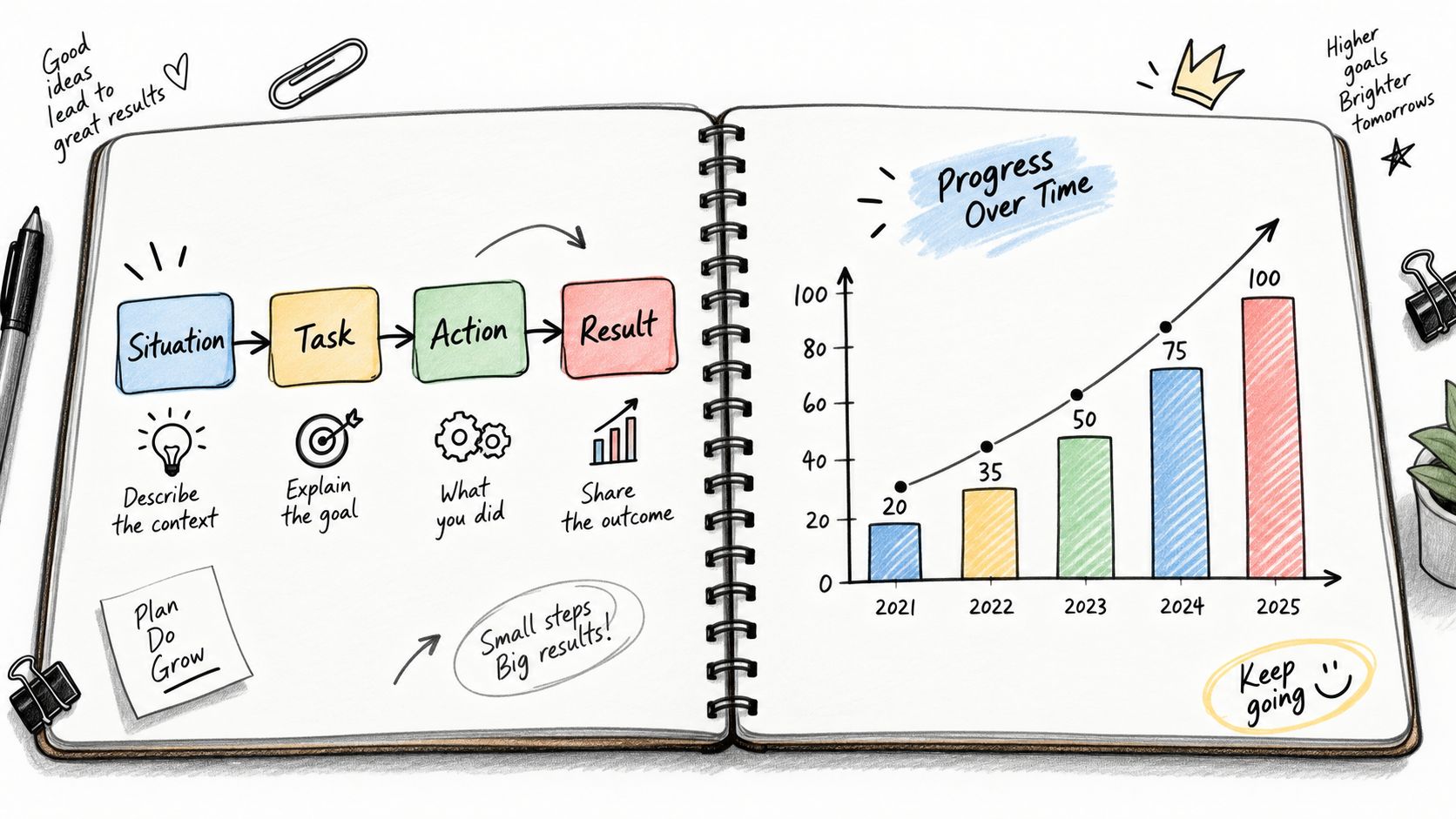
STAR gives your answer a reliable narrative shape: Situation, Task, Action, Result. It prevents you from dumping background details before explaining what you did. Use it when the interviewer wants to understand complexity, judgment, or collaboration. The same shape works for other behavioral prompts, including conflict interview questions.
Remote-first hiring often rewards a more compressed version. Lead with the result, then provide enough context to make it believable.
The two structures serve different purposes
Classic STAR works like this:
- Situation: Explain the business or team context.
- Task: State the responsibility or problem.
- Action: Describe the choices you made and the work you personally led.
- Result: Close with the outcome and what you learned.
A metrics-first answer reverses the emphasis:
- Start with the outcome in one sentence.
- Add one or two meaningful numbers, only when you can defend them.
- Compress the situation and task into one line.
- Spend most of the answer on your actions.
- Finish with the lesson or relevance to the role.
Compare the difference.
Vague STAR version: “Our onboarding process was inconsistent, so I worked with the team to improve it. We updated some documentation and made the process smoother. The feedback was positive.”
Metrics-first version: “I cut new-hire onboarding from 14 days to 4 by replacing scattered instructions with a documented sequence, ownership map, and async check-ins. The problem was that new employees waited for answers across several time zones. I audited the repeated questions, consolidated the source material, and created a written handoff system that managers could update without scheduling meetings. The biggest lesson was that onboarding quality depends as much on information ownership as on the training itself.”
The second answer gives the listener a clear result, a specific action, and a remote-work signal. It doesn’t ask the interviewer to excavate the point.
Keep the story contained
Aim to finish within 90 seconds. That gives you room to explain the decision without turning the answer into a career autobiography. If the interviewer wants more detail, they’ll ask.
Don’t stack three results into one response. Result-stacking makes candidates sound unfocused and forces the listener to decide which achievement matters. Choose one headline outcome and use supporting details only when they clarify your role.
If the interviewer can’t repeat your number or outcome to a colleague, you buried the lede.
Tailoring Stories for Remote and Direct-Hire Roles
A feature launch, campaign, account expansion, or workflow redesign will not carry your answer by itself. Tie the achievement to the signal the role rewards, then show how you operated when colleagues were not sitting beside you.
Remote-first hiring teams look for written communication, self-direction, and visible async collaboration. Those qualities appear differently by function:
| Role | Primary Signal | Secondary Signal | Remote-Specific Proof |
|---|---|---|---|
| Tech | Reliability and technical ownership | Incident response and review quality | Runbooks, async handoffs, documented decisions |
| Product | Outcome ownership | Stakeholder alignment | Written product decisions, experiment updates, timezone-aware collaboration |
| Marketing | Attributed business contribution | Audience judgment | Campaign documentation, clear channel reporting, reusable content systems |
| Sales | Commercial execution | Account judgment | CRM hygiene, written deal plans, disciplined handoffs |
| Ops | Scalable systems | Process improvement | Standard operating procedures, ownership maps, cross-functional tooling |
Your answer should make the remote-work evidence explicit. Name the document, handoff, operating routine, or decision record that kept work moving without a live meeting.
Tech and Product
Engineers should describe the operational result behind a shipment. Explain how you improved reliability, reduced recurring incidents, strengthened on-call coverage, or made code review easier across locations. A hiring manager needs evidence that you considered maintenance after launch, not only delivery before it.
Product candidates should connect the achievement to user behavior or a business outcome. Show the tradeoff you made, the stakeholders you aligned, and the written decision that kept the team moving. That detail demonstrates judgment under distributed conditions, where hallway conversations cannot carry the work.
Marketing and Sales
Marketing stories require attribution discipline. Identify the audience, channel, creative choice, and business result without assigning every conversion to your campaign. A content system that consistently supports sales, or a campaign that generated qualified demand, is stronger evidence than a broad claim about “brand awareness.” Include the reporting or documentation that let distributed teammates understand what worked and what changed.
Sales candidates applying for remote sales jobs should focus on deal judgment, cycle management, expansion, and account strategy. Remote sales teams depend on accurate CRM notes and precise handoffs. Show how you preserved momentum when buyers, partners, or internal specialists were working from different locations.
Ops
Operations candidates often have the strongest behind-the-scenes achievements. Discuss the system you built, the process debt you removed, or the tooling that reduced friction for other teams. A reliable operating mechanism reveals how you improve work at scale, while a one-time rescue mainly proves that you can handle a crisis.
If you designed repeatable workflows, explain the difference between personally doing more and building capacity for others. Focus on ownership, maintenance, and the evidence that the system continued working after you stepped away.
Sample Answers for Tech, Product, Marketing, Sales, and Ops
The strongest answers sound spoken, not memorized. Each example below uses a clear context, one main action, a measurable outcome, and a remote-work signal. Replace the details with your own evidence, and never borrow a number you can’t verify.
Tech
“I’m most proud of reducing repeat production incidents in a service my team supported. We kept seeing similar failures surface during different shifts, so I reviewed the incident history, grouped the recurring causes, and created a short runbook with clear escalation ownership. I also moved the key decisions into written incident notes so engineers in other time zones could act without waiting for a live handoff. The result was a more predictable response process and fewer cases where the next engineer had to rediscover the same context. What I’m proud of is that I didn’t just fix individual bugs. I improved how the team learned from operational problems.”
[Strongest line: “I improved how the team learned from operational problems.”]
Product
“I’m proud of leading a product change that improved how users completed a core workflow. The original experience created uncertainty at a key step, so I combined customer feedback with usage data, documented the tradeoffs, and aligned design and engineering through written decision records. We shipped a focused experiment instead of trying to solve every adjacent issue at once. After launch, the target behavior improved, and the team had a clearer basis for deciding what to build next. The remote-work part mattered because stakeholders were spread across time zones, so the written rationale kept the project moving between meetings.”
[Strongest line: “We shipped a focused experiment instead of trying to solve every adjacent issue at once.”]
Marketing
“I’m most proud of a campaign where I connected content activity to qualified pipeline instead of reporting reach alone. I worked with sales to define the target audience and handoff criteria, built the campaign around a specific buyer problem, and documented the attribution method before launch. That made it easier to distinguish useful engagement from surface-level traffic. The campaign produced measurable contribution to qualified opportunities, and the team reused the messaging in follow-up materials without adding paid amplification. I’m proud of the operating discipline as much as the campaign result because everyone could see what worked and why.”
[Strongest line: “I connected content activity to qualified pipeline instead of reporting reach alone.”]
Sales
“I’m proud of improving a complex deal process that had been losing momentum between discovery, technical review, and procurement. I created a written mutual action plan, clarified decision owners, and summarized each call so the buyer and our internal specialists had the same next steps. That reduced ambiguity across the deal team and helped us move the opportunity forward with fewer stalled handoffs. The commercial result was a successful close and a process the team could reuse on similar accounts. My contribution wasn’t just persuasion. It was creating enough structure for everyone to make decisions at the right time.”
[Strongest line: “My contribution wasn’t just persuasion. It was creating enough structure for everyone to make decisions at the right time.”]
Ops
“I’m most proud of replacing a fragile manual workflow with a documented operating system. The process depended on individual memory, which made coverage difficult whenever someone was unavailable. I mapped the steps, assigned clear ownership, created a shared tracker, and wrote instructions that a new teammate could follow without a live walkthrough. The team gained more consistent execution, and managers had better visibility into exceptions before they became urgent. That achievement matters to me because it scaled reliability rather than depending on one person working harder.”
[Strongest line: “It scaled reliability rather than depending on one person working harder.”]
Common Pitfalls and How to Avoid Them
A solid achievement can still fail if your delivery makes the evidence hard to find. These mistakes are common among experienced candidates because they’re trying to sound collaborative, precise, or modest. The result is often an answer that hides the very judgment the interviewer wants to assess.
The humble-brag makes ownership sound accidental. “I was lucky to be involved” or “the team did most of the work” may be honest, but it leaves the interviewer unsure what you contributed. Collaboration doesn’t require erasing your role.
Remedy: State your specific responsibility in the first sentence.
Metric-dumping creates a spreadsheet instead of a story. Several percentages, totals, conversion figures, and efficiency measures won’t help if the listener can’t identify the central outcome. Use one headline metric, then explain the decision that produced it.
Remedy: Tie one clear before-and-after result to one meaningful action.
A stale achievement can signal that your current capabilities are unproven. You don’t need to discard an older career milestone, but don’t rely on a win from the distant past when you have newer evidence. The best answer usually reflects the level, tools, constraints, and collaboration style of the role you’re pursuing now.
Remedy: Lead with a recent achievement that matches the target role.
The team-only answer says, “We launched,” “we improved,” or “we solved it,” without showing your decision. Interviewers hire individuals, even when those individuals work in teams.
Remedy: Name the choice, artifact, or intervention you personally owned.
A generic answer could fit any company. If you could deliver the same story to a startup, a global enterprise, or a nonprofit without changing a word, it probably isn’t specific enough.
Remedy: Anchor the achievement to the company’s problem or the role’s core competency.
Quick Templates and a Pre-Interview Checklist
Templates should create fluency, not turn you into a performer reciting lines. Write the structure, practice the logic, and keep the wording flexible enough to sound like you.
STAR template
- Situation: “The team was facing [specific problem] in [relevant context].”
- Task: “I was responsible for [your ownership and expected outcome].”
- Action: “I [decision or action one], then [decision or action two]. I coordinated with [relevant partners] through [written process, async update, or documented handoff].”
- Result: “That led to [measurable or observable result]. I learned [specific lesson], which I now apply by [current behavior].”
Metrics-first template
“I improved [headline outcome] from [starting point] to [result]. The context was [one-line problem]. I did that by [main action], [supporting action], and [remote-specific collaboration behavior]. The result mattered because [business, customer, or team consequence]. If I did it again, I’d [lesson or refinement].”
Before the interview, run this short worksheet from your laptop.
| Prep Step | Your Answer |
|---|---|
| Scan the job post for core competencies | ______________________________ |
| Select two recent achievements that match | ______________________________ |
| Write the first sentence of each answer | ______________________________ |
| Write the final lesson or relevance sentence | ______________________________ |
| Add one remote signal to each story | ______________________________ |
| Rehearse each answer aloud once | ______________________________ |
Review the job post for two or three capabilities the hiring team repeats. Match each capability to an achievement, then write the opening and closing sentences before filling in the middle. Confirm that every story contains a remote-relevant signal, such as async coordination, written communication, self-management, or distributed execution.
Finally, swap in the company name and one concrete detail from the role description. That small change makes the answer feel considered rather than canned.
Putting It All Together in Your Remote Job Search
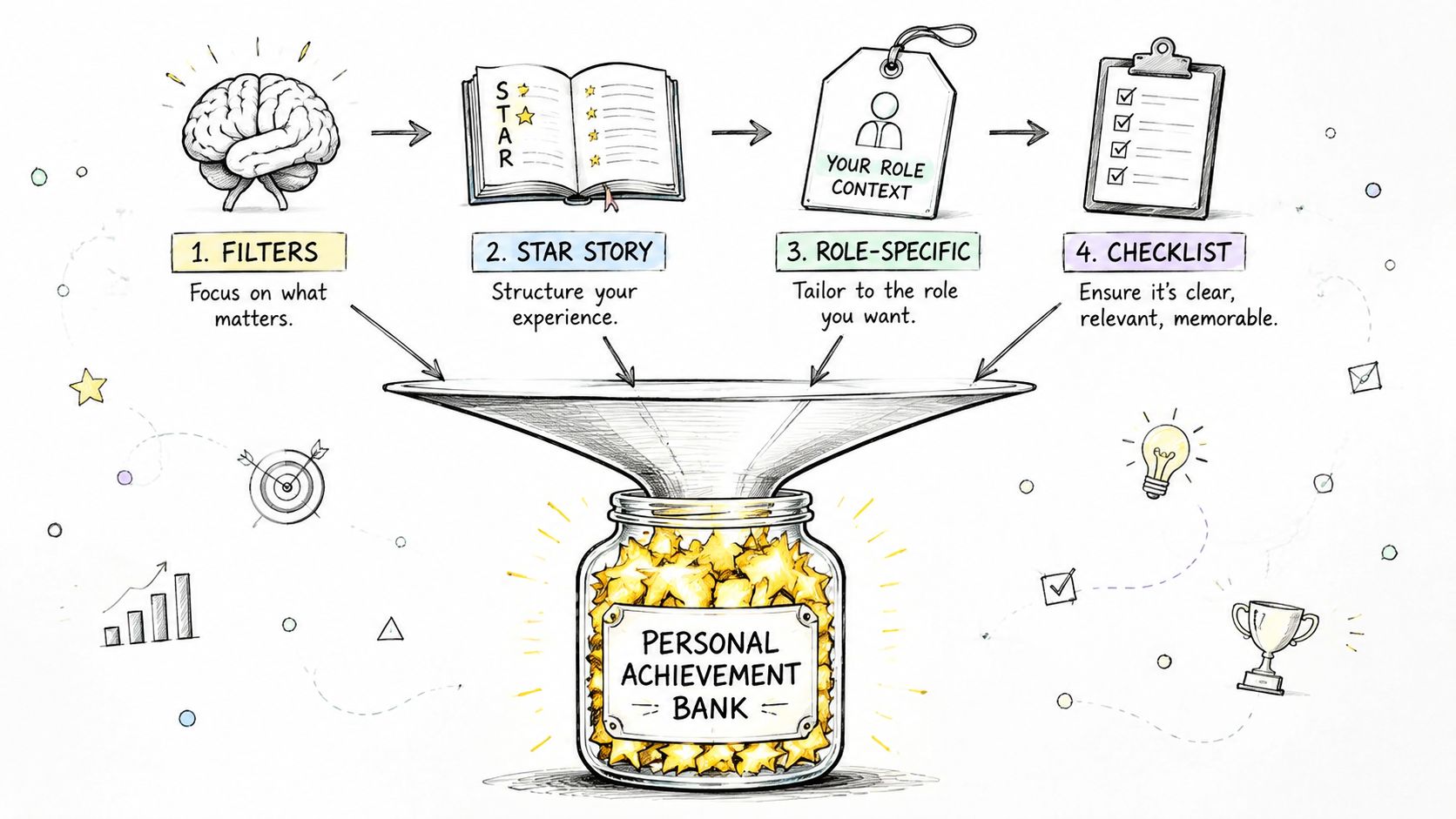
Build an achievement bank with five to seven stories, then tag each by its strongest signal: async collaboration, written communication, self-management, reliability, or distributed impact. Match the story to the job description instead of forcing one favorite example into every interview. A good bank also covers most of the remote job interview questions that ask for proof of how you work.
Review the bank weekly. Update outcomes, remove achievements that no longer reflect your level, and keep a STAR version of each story in a shared document. Practice aloud, too, and go through these remote interview tips before a video interview.
Remote hiring rewards evidence of independent execution. Your answer should show how you created a result, kept work moving across time zones, or improved an operating process. Participation alone will not distinguish you.
In remote hiring, the achievement worth telling is the one that proves you can deliver without being watched.
Choose one story today. Write its result-first opening, identify your individual action, and practice it aloud before your next application. Use direct-hire remote opportunities to find roles where that evidence can reach a real hiring team.
Remote First Jobs helps you find verified remote roles sourced directly from employer career pages. Spend less time sorting stale listings and more time preparing a persuasive achievement story. Visit Remote First Jobs to find a relevant role and present your strongest evidence.