TL;DR: A flexible work schedule is a work arrangement that lets employees change their start and end times and, in many roles, their work location. The most common forms are flextime, compressed workweeks, staggered hours, and remote or asynchronous work. In the U.S., 57% of wage and salary workers had flexible schedules in 2017-18, according to U.S. Bureau of Labor Statistics data.
You’re probably not searching for “what is a flexible work schedule” because you love workplace theory. You’re searching because you’re tired of structuring your life around a calendar that doesn’t fit your reality.
Maybe your day starts with a long commute, a rigid clock-in culture, and meetings booked at the worst possible times for focused work. Maybe you’re trying to manage school pickup, deep work, caregiving, or your own energy without feeling like you need permission to be an adult. That frustration is exactly why flexible work matters.
A flexible schedule isn’t code for working less. It’s a different agreement about how work gets done. The strongest versions give you more control over hours, location, or both, while still making expectations clear.
Beyond the 9-to-5 Understanding Flexible Work
You accept a job that promises “flexibility,” then find out it still expects everyone online from 8 to 5, schedules meetings across your focus blocks, and treats every appointment like a special exception. Job seekers run into this all the time. A flexible schedule only counts if it changes how your workday is structured.
At its best, flexible work shifts the agreement from visible attendance to clear output, coordination, and trust. The question is no longer, “Were you at your desk at the standard hours?” It becomes, “Do you know your responsibilities, your overlap windows, and how your team stays aligned?” That distinction separates a modern schedule from old rules with better branding.
As noted earlier, flexible scheduling is common enough that candidates should treat it as a concrete job feature, not a vague perk. This shift is significant because flexibility now affects hiring, retention, and day-to-day quality of life. It also affects whether a role is sustainable once the novelty wears off.
What flexibility actually changes
A flexible schedule usually changes one or more parts of the work agreement:
- Start and end times, so your day is not locked to one standard window
- Work location, through remote or hybrid arrangements
- Workweek structure, such as longer days in exchange for fewer days worked
- Coordination rules, so everyone knows when overlap is required and when independent work is expected
Practical rule: Genuine flexibility comes with structure. If a company says it offers flexibility but cannot explain core hours, meeting expectations, approval rules, or response-time norms, the policy is usually informal and manager-dependent.
That last point matters more than job ads admit. I have seen candidates accept “flexible” roles that gave them freedom on paper and very little control in practice. The problem was not the concept. The problem was the lack of clear operating rules.
Why job seekers should care
This topic is not academic. It is a screening tool.
Candidates who understand flexible schedules can spot the difference between a role with real autonomy and one with hidden attendance requirements. They ask better interview questions, read job descriptions more carefully, and catch red flags before accepting an offer. They also negotiate better, because they know whether to ask about core hours, meeting load, timezone expectations, or how often “optional” office days become required.
That is the edge in a crowded search. “Hybrid” can mean two set office days, or it can mean full freedom with occasional team planning sessions. “Flexible environment” can mean trust, or it can mean you are expected to be available all the time. The candidate who knows how to decode that language saves time, avoids bad-fit roles, and has a better shot at getting a schedule that works in real life.
Exploring the Four Main Types of Flexible Schedules
Not all flexible schedules offer the same freedom. Some give you control over when you work. Some change how many days you work. Some give you control over where you work. Some require frequent overlap, while others are built for async execution.
Here’s a clean way to compare them.
Flexible Work Models Compared
| Model | Core Concept | Typical Schedule | Best For |
|---|---|---|---|
| Flextime | Employees choose start and end times within set limits | Earlier or later workday with shared overlap | Professionals who want autonomy without losing team coordination |
| Compressed workweek | Full-time hours fit into fewer days | Four longer days instead of five standard ones | Caregivers, project-based roles, people who value full days off |
| Staggered hours | Team members work different shifts for coverage | Different start windows across the same team | Support, operations, global teams, roles needing longer daily coverage |
| Fully asynchronous work | Work is organized around outcomes, not simultaneous hours | Limited live meetings, written updates, independent execution | Deep workers, distributed teams, experienced self-managers |
Flextime works best when overlap is explicit
Flextime is the most misunderstood model because it sounds looser than it is. In practice, good flextime has boundaries.
Many employers use core hours, often something like 11am to 3pm, when everyone is available for meetings and quick decisions. Outside that window, people can shift their workday earlier or later. Think of core hours as team huddle time. They protect collaboration without forcing everyone into the same full-day template.
According to verified data from Deputy’s glossary on flexible schedules, flextime policies with core hours can produce a 22-35% productivity increase, and job satisfaction rises by 28% when coordination is handled well. The same source notes that team effectiveness can drop when companies remove shared overlap completely.
This model fits marketing, product, design, engineering, and many knowledge roles where not every task needs instant response.
Compressed workweeks trade longer days for fewer of them
A compressed schedule condenses full-time hours into fewer days. The classic example is four longer days with one extra day off each week.
This works well for people who want uninterrupted non-work time. It’s also useful in roles where project milestones matter more than daily face time. The catch is simple. You need the stamina for longer workdays, and your team needs a coverage plan.
Some professionals love compressed weeks because the extra day off feels like actual recovery time, not just catching up on errands squeezed into evenings.
Staggered hours help teams, not just individuals
Staggered hours are common in companies that need wider service coverage without forcing everyone onto the same shift. One person may start early, another later. The point isn’t unlimited freedom. The point is matching staffing to workflow.
This can be excellent for global teams and client-facing functions. It’s less ideal if your role depends on constant same-time collaboration with a fixed group.
Fully asynchronous schedules require discipline
Async work is where many candidates overestimate their comfort level. It sounds ideal until you realize it relies on written communication, documented decisions, and personal accountability.
In a strong async environment, people use tools like Slack, Asana, Jira, Notion, or Loom to move work forward without waiting for meetings. That can be liberating if you’re a focused, organized worker. It can be rough if you need constant live feedback or if the company hasn’t built clear operating habits.
The biggest mistake employers make here is calling a role async when it’s really just chaotic. True async work has rules. Loose expectations plus endless pings is not flexibility. It’s confusion.
The Real-World Impact on Productivity and Well-Being
Flexible work gets oversold in one direction and dismissed in the other. The truth sits in the middle. Done well, it improves output and quality of life. Done badly, it creates communication gaps, isolation, and an always-on culture.
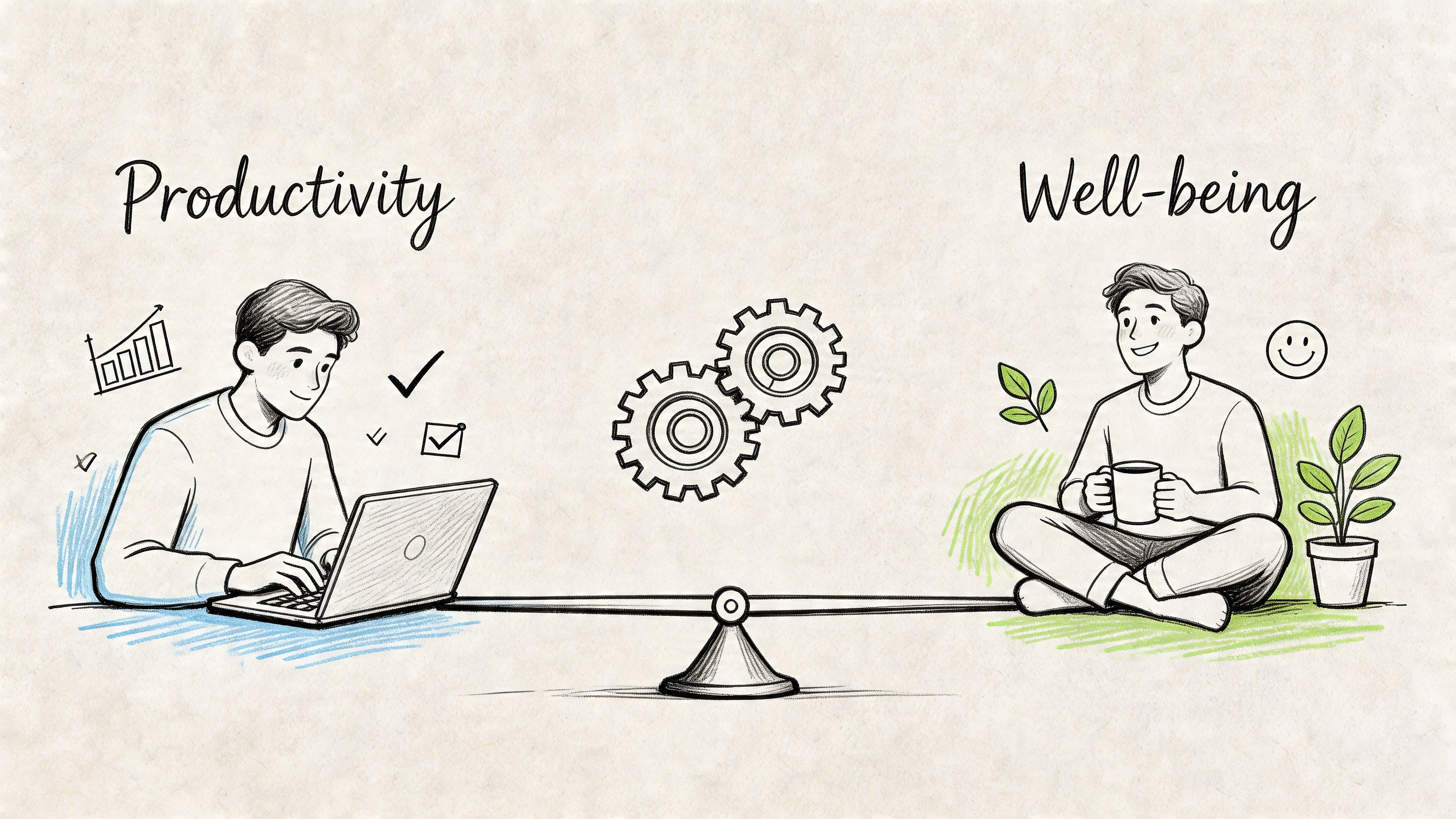
A verified summary of recent survey data in Memtime’s write-up on flexible hours and productivity reports that a 2023 Gallup study found remote and hybrid employees were more engaged and productive, that remote workers worked 1.4 more days per month, and that they lost 10 fewer minutes daily to distractions than office workers. The same verified data states that 80% of employees prioritize flexibility in job offers and 75% of hybrid workers report improved mental well-being.
Why productivity often improves
The practical reasons are straightforward.
- Better focus windows because people can work when their energy is strongest
- Fewer commute-related drains that eat into attention before work even starts
- More control over environment for tasks that require concentration
- Less performative busyness and more emphasis on completed work
When managers shift from “Are you at your desk?” to “Did the work move forward?”, strong performers usually benefit.
Why well-being improves, and when it doesn’t
The mental health side is real, but it isn’t automatic.
For many professionals, flexibility lowers background stress because life stops colliding with work at every turn. Parents can handle pickups. People with long commutes recover time. Workers with different energy patterns can stop forcing high-focus tasks into low-focus hours. People navigating attention differences may also find flexible structures useful, especially when paired with better planning systems and work design. If that’s relevant to you, this guide on thriving professionally with ADHD offers a practical lens on what support and structure can look like at work.
The trade-offs you should expect
Flexible work fails when companies confuse freedom with missing process.
Watch for these friction points:
- Communication lag when teams don’t define response expectations
- Meeting sprawl when “flexible” still means everyone must be available all day
- Blurred boundaries when remote workers feel pressure to prove they’re online
- Isolation if the company has weak culture and poor documentation
The healthiest setup is not total freedom. It’s clear autonomy. You know when you must be available, when you can disappear into focus mode, and how performance is judged.
What Flexible Work Looks Like A Week in the Life
Definitions help. A weekly rhythm helps more.
The easiest way to judge whether a schedule suits you is to picture an ordinary Tuesday, not the employer’s polished careers page. How do meetings happen? When do you do focused work? What gives when life interrupts?
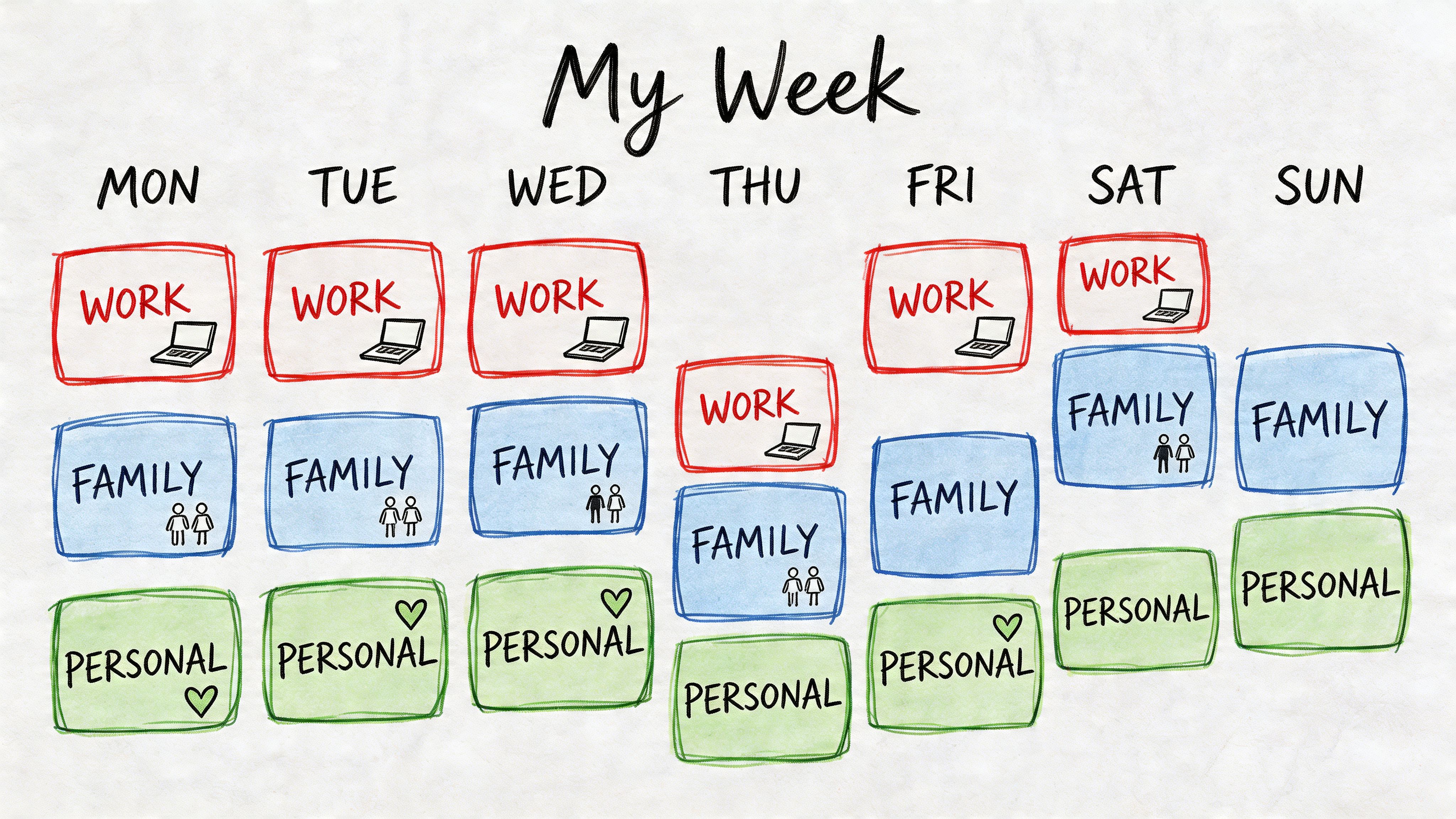
Sample week for a marketing manager on a compressed workweek
A compressed week often works best in outcome-driven roles where campaigns, launches, and reporting cycles can be planned in advance. Verified data from Cornell’s overview of flexible work arrangements states that compressed workweeks can deliver 25% higher retention, an 18% reduction in stress, and a 15% cut in absenteeism in some implementations.
Monday to Thursday
7:30 to 9:00 campaign planning and writing
9:00 to 12:00 team collaboration and approvals
1:00 to 3:00 stakeholder meetings
3:00 to 5:30 execution, reporting, handoff notes
Friday off
Why this works: the longer days are deliberate. Meetings are clustered. High-focus work happens before the calendar gets noisy. The day off is protected because deadlines and approvals were structured around the four-day rhythm.
Sample week for a software developer on flextime
A flextime setup usually feels less dramatic. The total week looks familiar, but the daily timing shifts around energy and team overlap.
Monday to Friday
7:00 to 10:30 coding and code review
11:00 to 3:00 core overlap for standups, pairing, and unblockers
3:00 to 4:00 documentation or bug triage
Early finish when the day started early
Why this works: meetings live inside overlap hours, while complex technical work happens in a protected block. The developer still collaborates, but not at the cost of turning their most productive hours into back-to-back calls.
What to borrow from these examples
Even if your exact role looks different, good flexible schedules share a few traits:
- They separate focus work from collaboration
- They make overlap intentional instead of constant
- They protect recovery time instead of filling every gap
- They rely on planning tools, not hallway visibility, to keep work moving
If a company can’t describe a normal week in practical terms, the schedule probably isn’t mature yet.
Your Checklist for Finding Genuinely Flexible Jobs
Job descriptions are full of soft language that sounds flexible without promising anything. Your job is to decode the difference between real autonomy and polished ambiguity.
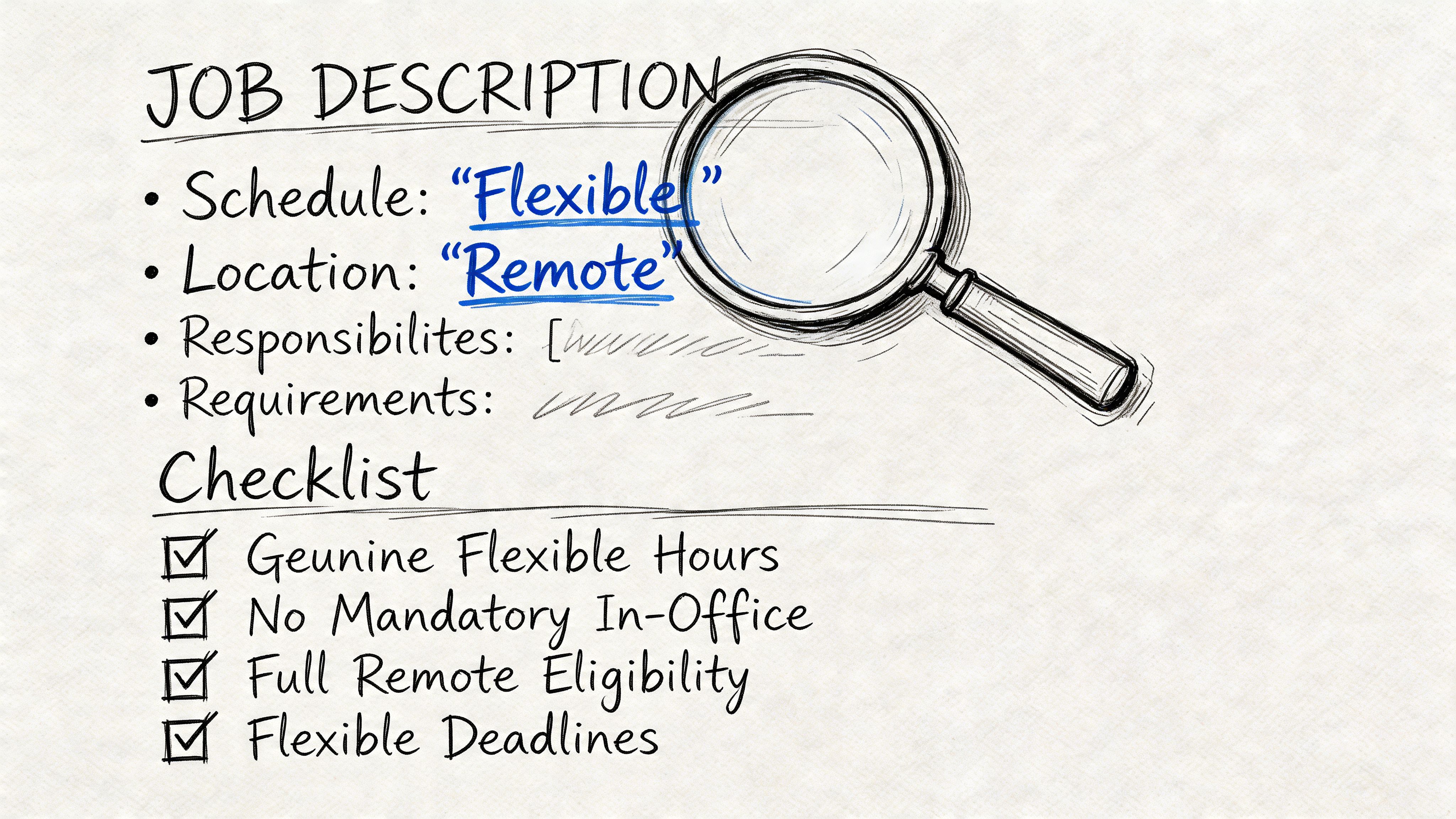
Green flags that usually indicate real flexibility
Some phrases signal that the company has thought through how flexible work operates.
- “Core hours” means the team likely has a defined overlap window instead of expecting all-day availability.
- “Asynchronous” usually suggests written updates, documented decisions, and fewer live meetings.
- “Distributed team” often points to people working across locations by design, not as an exception.
- “Remote-first” is stronger than “remote-friendly.” It usually means systems were built for remote work from the start.
- “Outcome-based” or “results-oriented” can be positive when paired with specifics about planning, communication, and deliverables.
- “Work from anywhere” can be excellent, but only if the description clarifies time zone or legal limits.
Red flags that often mean fake flexibility
Some postings advertise freedom while still maintaining total control.
- “Must be available as needed” often translates to unpredictable hours.
- “Fast-paced environment” isn’t automatically bad, but paired with vague scheduling language it can mean constant interruption.
- “Hybrid” with no details is often a warning sign. Ask how many days, which days, and who decides.
- “Flexible schedule” with no examples may mean overtime when demand spikes.
- “Strong team player, always responsive” can mask an expectation of instant replies.
If a job post uses the word “flexible” but never defines location rules, overlap hours, meeting cadence, or manager expectations, assume the policy is informal until proven otherwise.
Questions to ask before you apply
A power searcher doesn’t wait until the final round to test for fit.
Use this checklist:
- What does a normal week look like? Ask for a real example, not policy language.
- Are there core hours? If yes, what are they?
- Who controls schedule changes? The team, the manager, or company policy?
- How are meetings handled? Clustered, optional, documented, or constant?
- How is performance measured? Output, responsiveness, online presence, or some mix?
- What tools run the workflow? Slack, Asana, Jira, Notion, Google Calendar, Loom, and similar tools usually reveal whether flexibility is operational or just aspirational.
A broader guide on how to find remote jobs can help you sharpen the search process itself, especially if you’re trying to escape noisy job boards and stop wasting time on vague listings.
Check the company outside the job post
Career pages, employee reviews, and interview process details often tell the truth the job ad avoids.
Look for signs like:
- Written remote policies instead of casual manager discretion
- Calendar-friendly interview scheduling that respects time zones
- Clear language about communication tools and documentation
- Evidence that leaders also work flexibly, not just individual contributors
For candidates who want direct-to-company listings instead of recycled board noise, a curated remote search engine like Remote First Jobs can make that vetting easier because it focuses on remote-first employers rather than generic volume.
A short walkthrough can help you spot the patterns faster:
How to Negotiate the Flexible Schedule You Deserve
Negotiating flexibility goes better when you stop framing it as a personal preference and start presenting it as a work design decision.
Managers worry about coverage, communication, and fairness. Answer those concerns before they raise them. Show that you’ve thought about the team, not just your ideal day.
Script for the interview stage
This works when the role sounds promising but the posting is vague.
“I do my best work in environments with clear goals and some schedule autonomy. How does your team handle working hours, meeting overlap, and focus time during a normal week?”
That question is calm, professional, and hard to dodge. It also reveals whether the hiring manager has a real answer or just a slogan.
If the team sounds partly flexible, follow with this:
“I’m comfortable being fully available during shared collaboration windows. Outside those windows, I’m most effective when I can structure deep work around deliverables. Is that consistent with how your team operates?”
Script for the offer stage
The offer stage is where you can be more direct because the company has already decided they want you.
Try this:
“I’m excited about the role. I’d like to align on the work pattern that will let me perform at my best. My preference is a flexible schedule with defined overlap hours and protected focus blocks. I’m confident that setup helps me deliver consistently and stay committed long term.”
Then make it concrete:
- State the model clearly such as flextime, hybrid with set in-office days, or a compressed week
- Define your availability so they aren’t guessing
- Tie it to output by naming how you plan, communicate, and deliver
- Invite a trial period if the employer seems cautious
Script for changing an existing role
Internal negotiations succeed when you bring evidence from your own work.
“I’d like to propose a more flexible schedule. My goal is better alignment between focused work and collaboration time, not less accountability. I’d suggest shared availability from 11 to 3, with the rest of my schedule structured around deliverables, response expectations, and planned handoffs.”
Then support it with specifics:
- Mention work that requires uninterrupted focus
- Show how meetings could still happen smoothly
- Clarify response windows
- Offer to document the arrangement
What not to say
Avoid language that sounds casual or purely lifestyle-driven.
Don’t lead with “I just work better at home” or “I need more freedom.” Even if those things are true, they don’t answer the employer’s operational concerns. Strong negotiation language sounds like this: planned, measurable, collaborative, low-risk.
The best flexible arrangements are usually negotiated by people who sound easy to manage because they’ve already thought through the details.
Answering Your Top Questions About Flexible Work
Flexible work gets more complicated once you cross borders, different managers, and promotion paths.
Is flexibility the same everywhere
No. Verified guidance summarized in the U.S. Department of Labor page on flexible schedules notes significant global variation. The same verified data states that EU “right to disconnect” laws mandate flexibility without after-hours contact in some contexts, Australia’s Fair Work Act has specific rules for compressed weeks, and a Gartner report found that 55% of multinational firms struggle with flex equity, with cultural bias contributing to 25% lower satisfaction for non-Western remote workers.
If you’re applying across countries, don’t assume “remote” means the same legal or cultural reality everywhere. Ask how the company handles after-hours communication, schedule fairness across regions, and local compliance.
Will flexible work hurt my career progression
It can, if the company rewards visibility more than results.
That’s the proximity bias problem. People who are seen more often can get more informal access to managers, faster context, and stronger sponsorship. The fix is not “go back to the office.” It’s choosing teams that document work well, evaluate output clearly, and don’t reserve influence for the people nearest headquarters.
What if my manager supports flexibility but the culture doesn’t
That happens a lot.
A supportive manager can help, but informal flexibility is fragile. It often disappears during reorgs, leadership changes, or busy periods. If a company’s flexibility depends on individual goodwill rather than team norms, policy, and workflow design, treat it as temporary.
Ask one question in every late-stage interview: “How does the company protect flexible work when business pressure increases?” The answer tells you whether flexibility is cultural or conditional.
Making Flexibility Your New Career Standard
Flexible work isn’t a reward for seniority or a nice extra for lucky employees. In many professional roles, it’s a smarter way to work.
The right schedule lets you protect focus, reduce friction, and build a career that doesn’t force your life into a rigid template. The wrong one hides control behind feel-good language. That’s why the job-search skill matters as much as the concept itself. You need to recognize the model, test the details, and negotiate with clarity.
A strong flexible role should answer simple questions clearly. When do people overlap? How is work measured? What happens when life gets messy? If the employer can’t answer those questions, keep looking.
Professionals who understand flexible work have an advantage. They don’t just search for remote titles. They search for operating models that match how they deliver great work.
If you want a faster path to legitimate remote roles, Remote First Jobs helps you search verified openings sourced directly from company career pages, so you can spend less time sorting through noise and more time applying to flexible, genuine jobs.