A remote job is any role where you don’t have to come to a central office every day. The work is judged by what you produce rather than where you produce it, so you can do it from a home office, a local coffee shop or anywhere with a reliable internet connection.
Defining What a Remote Job Actually Is
A remote job breaks the link between your work and a specific address. Think of a cloud app compared with old desktop software: the work happens wherever you are, not on one machine in one building. That flexibility is the main appeal of remote work.
“Remote” is no longer one fixed arrangement, though. What used to be a rare perk is now a normal way for many companies to operate, and it comes in several forms, which we cover below. It has changed how people think about productivity and what a career can look like.
Remote Work at a Glance
This table sums up the main parts of a remote job as it works today.
| Core Component | What It Means in Practice |
|---|---|
| Location Independence | Your work isn’t tied to a specific office building. |
| Digital-First Communication | Teams rely on tools like Slack, Zoom and email. |
| Autonomy and Trust | Managers focus on results, not the hours you’re logged in. |
| Flexible Scheduling | You often have more control over when you start and end your day. |
Together these separate a real remote job from the occasional day of working from home. They describe a deliberate, structured way of working outside a traditional office.
The Rise of the Distributed Workplace
Before 2020, remote work was mostly a perk for a few roles. Since then it has become a standard option in many fields, from software and design to customer service, sales and finance. For many companies it is now part of how the business is built, and for many people it is part of how they plan a career.
A good remote job isn’t only permission to work from home. It means joining a team that is set up to work well without a shared office. That takes new ways of communicating and a real focus on asynchronous collaboration, so everyone stays in sync wherever they are and whatever their time zone.
This is where a job board that focuses on remote work helps. Remote First Jobs collects remote and hybrid listings from company career pages, so you can see which employers hire remotely and for which roles. A distributed workplace also needs the right processes and tools, and that foundation is what makes remote work hold together.
Understanding the Different Remote Work Models
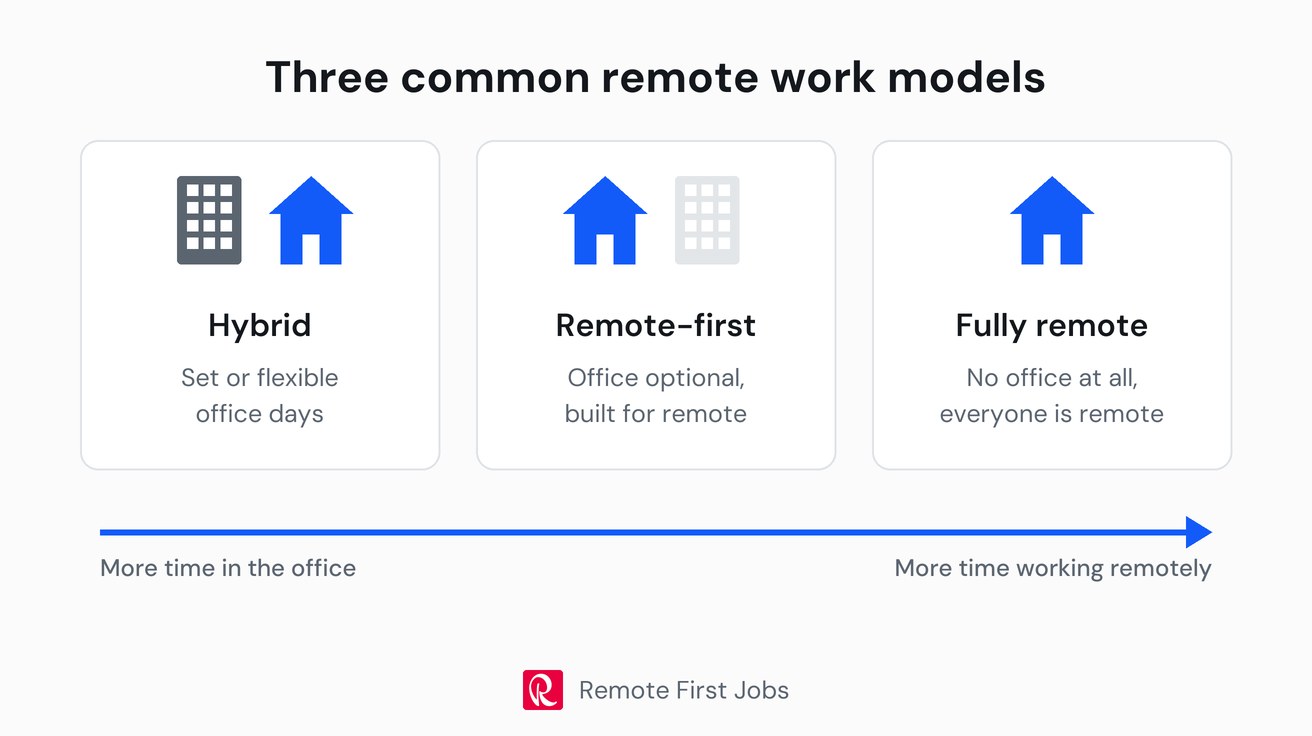
You learn quickly that remote jobs differ. “Remote” isn’t a one-size-fits-all label but a range of ways of working. How a company handles remote work says a lot about its culture, how it communicates and what it values.
Each model mixes office time and remote time in its own way. Here are the arrangements you’ll come across most often.
Fully Remote: The No-Office Model
This is remote work in its purest form. A fully remote (or 100% remote) company has no physical headquarters at all. Everyone, from the CEO down, works from a place they choose.
This setup needs a firm commitment to digital-first work and good asynchronous communication. With no office to fall back on, the whole company is built to support a team spread across many places.
Remote-First: A Mindset Over a Location
A remote-first company may still have an office, but its culture and key processes are designed for remote employees first. Think of an online shop that also has a physical store: the online experience comes first, and the store is extra.
In a remote-first culture, every big decision, every meeting and all documentation assume that people aren’t in the same room. That matters because remote team members never end up as second-class colleagues.
This approach is meant to prevent the “us vs. them” split that can hurt companies with both office and remote staff. It shows the company is committed to making remote work succeed for everyone, not offering it as a side perk. For more on this model, read our guide to what a remote-first company is.
Hybrid: Office and Home
The hybrid remote model is a mix of working in the office and working from home. Usually employees come into a central office a few days a week or month and work remotely the rest of the time. Many companies now offer it.
“Hybrid” can mean different things, so ask for details:
- Fixed Hybrid: the company sets the office days. For example, everyone has to be in the office on Tuesdays and Thursdays.
- Flexible Hybrid: you and your team choose which days to come in, which gives you more control over your schedule.
- Office as a Hub: the office is there if you want it, for brainstorming, big meetings or a change of scenery, but going in is optional.
This model suits people who like working from home but still want face-to-face time with colleagues. When you look at jobs, ask about the specific hybrid policy to make sure it gives you the mix of freedom and structure you want.
The Real Benefits and Challenges of Remote Work
People often picture remote work as a laptop on a beach. The day-to-day reality is more complicated. Like any way of working, it has real upsides and real hurdles, for the people doing the work and for the companies that hire them.
For employees, the benefits can change daily life. Dropping the commute is the most obvious one: it gives you back hours each week and saves money. That time, plus more control over your schedule, can make a healthy balance between work and life much easier.
That freedom has its challenges. It’s easy to feel cut off when you don’t run into colleagues in the hallway. The line between your living room and your office can blur quickly if you don’t set clear boundaries. And you need self-discipline to stay on task without a manager nearby.
A Look From the Employer Side
For businesses, the case for remote jobs is just as strong. You’re no longer limited to people who live near an office, so you can hire from a much wider talent pool. That is a real advantage, and it often comes with lower costs because you need less office space.
Managing a team spread across many places brings its own problems. How do you build a close company culture when people rarely meet in person? It takes deliberate effort. Leaders have to keep communication clear, manage performance fairly and make sure everyone feels connected. How well a company solves these problems decides whether it works as a remote-first organization.
A Stanford-led study at Trip.com, published in the journal Nature in 2024, followed more than 1,600 employees. Those who worked from home two days a week were just as productive and as likely to be promoted as their fully office-based peers, and resignations among them fell by 33%. When the structure is right, flexibility doesn’t have to cost you career growth.
The Employee vs. Employer Pros and Cons of Remote Work
It helps to see the trade-offs side by side. Here is how remote work looks from the employee’s chair and the employer’s.
| Perspective | Key Benefits | Common Challenges |
|---|---|---|
| Employee | More flexibility and autonomy, no commute time or costs, better work-life balance, the option to live where you want. | Risk of isolation and loneliness, blurred work-life boundaries, needs strong self-discipline. |
| Employer | Access to a wider talent pool, lower overhead (less office space), often better morale and retention. | Building and keeping a company culture, making communication fair for everyone, managing performance remotely. |
The gains on both sides are real, but they come with responsibilities. Success depends on everyone adapting to a new way of working together and staying connected.
Why People Want Remote Work
Surveys of remote workers keep pointing to the same reasons: more time for focused work, less stress from commuting and more control over the day. That is why many people now look for jobs that are fully or mostly remote.
In the end, understanding what a remote job really means requires looking at both sides. For you, it means deciding honestly whether the flexibility is worth the effort of staying motivated and connected. For companies, it means weighing access to a wider talent pool against the work of building a strong culture at a distance.
The Tools Remote Teams Rely On
Doing well in a remote job takes more than a decent laptop and a Wi-Fi signal. You need to be comfortable with a set of digital tools that act as your virtual office and keep everyone on the same page wherever they are. These tools are how remote teams get work done.
Good remote teams don’t use a random collection of apps. They choose a set of tools where each one solves a specific problem. Think of a well-organized workbench rather than a messy toolbox.
The Four Parts of a Remote Tool Stack
A remote toolkit usually covers four needs. Each one solves a problem that appears when you can’t walk over to a coworker’s desk.
- Communication Hubs: your virtual water cooler, hallway and meeting room in one. Tools like Slack and Microsoft Teams handle quick live questions as well as asynchronous updates that respect different time zones.
- Project Management Platforms: how do you know who is doing what? Platforms like Asana and Trello give everyone an overview of tasks, deadlines and progress, which keeps projects on track.
- Creative Collaboration Spaces: for brainstorming, you need a digital whiteboard. Tools such as Miro and Figma let teams sketch ideas, design mockups and work together as if they were in the same room.
- Knowledge Management Systems: the team’s shared memory. A platform like Notion or Confluence gives the team one place for important documents, how-to guides and company policies, so nobody is left guessing.
For a team to work well, it needs communication tools that fit how it works, whether that’s async chat, video calls or short voice messages. These tools hold everything together.
The goal isn’t just to have the tools but to build good habits around them. For example, a well-kept knowledge base in Notion means a new hire can find project briefs and company policies on their own, which builds independence from day one.
Getting comfortable with these tools is a must if you’re serious about remote work. It shows you understand not just the idea of a remote job but how distributed teams actually work day to day.
How to Find and Land a Remote Job
Knowing you want a remote job is the easy part. Turning that wish into an offer is harder. You have to work through a crowded online job market, tell real openings from fake ones and present yourself as a strong remote candidate.
You can’t just wing it. It takes a plan, from knowing where to look to talking about your skills in a way that makes sense to a remote hiring manager.
The first hurdle is finding real openings. If you’ve ever scrolled through a large general job board, you know it mixes office, hybrid and a few truly remote jobs. That’s why boards that focus on remote work save so much time.
On Remote First Jobs, listings are collected from 21,000+ company career pages and the applicant tracking systems behind them, as explained on our methodology page. You can browse remote jobs by category and filter by seniority, salary, date posted and remote or hybrid type. You can also start from the employer side: browse companies hiring remotely or our list of top remote companies, then read each listing to check where the company hires and what “remote” means for that role.
Tailoring Your Application for Remote Roles
Once you’ve found a few promising roles, your resume and cover letter need to show that you work well remotely. Listing technical qualifications isn’t enough. You also have to show the soft skills that make someone a good remote teammate.
Show that you can work independently and manage your own time without a manager checking on you. Stress your communication skills, especially your writing. When much of the work is asynchronous, clear and concise writing matters a great deal.
Highlight these skills:
- Asynchronous Communication: describe your experience using tools like Slack or Asana to move projects forward without constant meetings.
- Self-Management: give concrete examples of projects you owned from start to finish with little supervision. Think of a time you took the lead and saw it through.
- Proactive Problem-Solving: describe a time you spotted a potential problem and fixed it yourself before it affected everyone else.
The Video Interview and Red Flags
The video interview is often the last step. Hiring managers want more than the right answers; they want to see whether you’re ready for remote work. Use a professional, quiet background. Test your camera and microphone beforehand. And look at the camera, which is the remote version of eye contact.
It’s also your chance to interview them. A good remote job depends on a healthy remote culture.
Pay close attention to how the company operates. Are processes documented? Are there clear rules for communication? A company that struggles to answer these questions may be less remote-friendly than its job description suggests.
Finally, watch out for scams. A legitimate employer will never ask you for money, bank details or other sensitive personal information during the hiring process. Fake job offers are a common form of fraud, so do your homework. Check the company and apply through its official channels.
A focused search and an application written for remote work will help you find a role that fits your career and your life.
Common Questions About Remote Jobs
Even after reading this far, you may still have a few questions. Here are answers to the most common ones people have when they consider switching to remote work.
Are Remote Jobs Lower Paying Than Office Jobs?
Not necessarily, but it’s a fair question. The answer depends on each company’s pay policy.
Some companies adjust salaries to the local cost of living. If you live somewhere affordable, that can mean a smaller paycheck. Others, especially in tech, use location-agnostic pay and pay the same for a role wherever you live, often benchmarked to a high-cost city. The best move is to ask about the company’s pay approach during the interview process so you know what to expect.
Do I Need a Special Home Office to Work Remotely?
A separate room with a door is ideal, but it isn’t required. What you really need is a quiet, comfortable place where you can focus without the dog, the kids or deliveries constantly interrupting you.
Some employers offer a stipend to help you set up. You can use it for a good ergonomic chair, a second monitor or a decent headset. The goal is a professional, productive setup, whether that’s a full home office or a tidy corner of your living room.
How Do I Stay Connected With Colleagues?
Building real relationships without a shared coffee machine takes deliberate effort, from you and from your company.
Good remote companies know this. They build connection into their culture with regular video meetings, casual chat channels on platforms like Slack and virtual social events such as online games or coffee chats.
It’s also up to you. Schedule one-on-one video calls just to get to know your teammates. Join team discussions and share your ideas. That extra effort helps you feel like part of the team, not just a name on a screen.
Ready to find a role that fits your life? As of 9 November 2026, Remote First Jobs offers about 23,000 active jobs, collected straight from company career pages. Start your search today.