Think of asynchronous remote jobs as work that happens on your own time. Team members collaborate and move projects forward without needing to be online at the same exact moment. It’s a work style built around deep, focused work and personal autonomy, using tools like shared documents and project management software to keep everyone in sync, no matter their time zone.
Decoding Asynchronous Remote Jobs
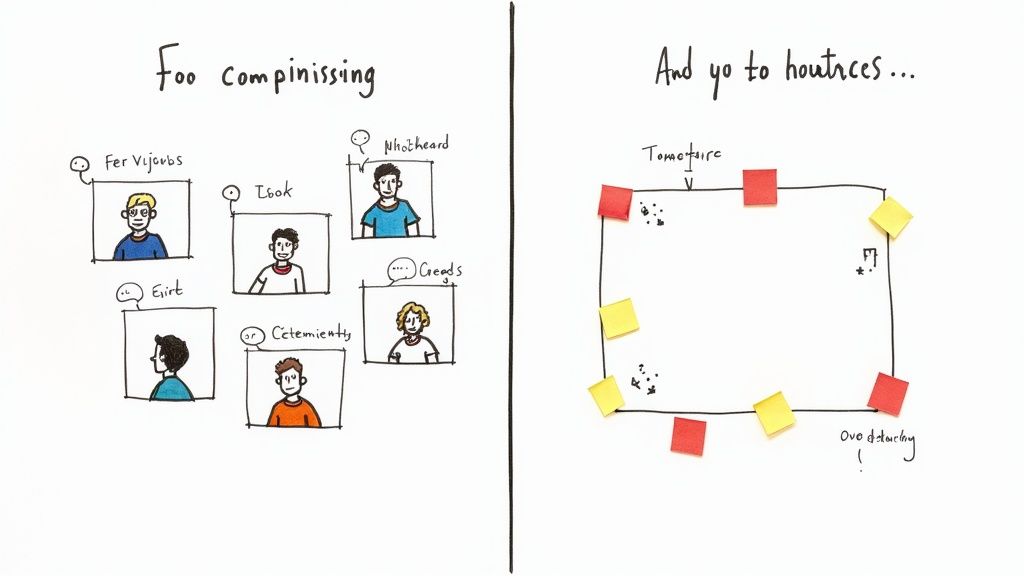
Let’s break this down with an analogy. Imagine traditional, synchronous work is a conference call. Everyone has to be in the same virtual room at the same time to get anything done. If one key person can’t make it, the whole process grinds to a halt. Progress is immediate but often disruptive, pulling everyone away from their actual work.
Now, picture asynchronous work as a shared digital whiteboard. A team member in Tokyo can add an idea at the end of their day. Hours later, their colleague in New York can wake up, review it, and build on it. The project keeps moving forward continuously, without anyone’s schedule needing to overlap perfectly.
To see how these two styles stack up, here’s a quick comparison.
Synchronous vs Asynchronous Work At a Glance
| Characteristic | Synchronous Work (The Conference Call) | Asynchronous Work (The Shared Whiteboard) |
|---|---|---|
| Pacing | Immediate, real-time | Deliberate, on your own schedule |
| Communication | Spoken, spontaneous | Written, documented, thoughtful |
| Productivity | Measured by presence and activity | Measured by outcomes and quality |
| Meetings | The default way to collaborate | The exception, for high-stakes issues |
| Flexibility | Low; tied to a shared schedule | High; work when you’re most effective |
This table really highlights the shift in mindset—from being present to being productive.
Meetings as the Exception, Not the Rule
A common myth is that “asynchronous” means zero meetings, ever. Not quite. It’s about being incredibly intentional with everyone’s time. Real-time meetings are reserved for situations that genuinely need that immediate back-and-forth.
Think of it this way—async teams save live meetings for things like:
- Complex brainstorming where you need that rapid-fire energy.
- Sensitive personnel conversations that require human nuance.
- Urgent crisis management when you need instant alignment.
Everything else—status updates, routine feedback, general questions—is handled through clear documentation, detailed comments, or quick video recordings. This protects the team’s most valuable asset: long stretches of uninterrupted time to do meaningful work.
The Foundation of Asynchronous Work
This entire model hinges on a culture of trust and autonomy. Companies that nail asynchronous work don’t track productivity by how many hours someone is logged in or how fast they reply on Slack. Instead, they measure success by outcomes and the quality of the work delivered. It’s about empowering people to structure their days in a way that works best for them.
Asynchronous work isn’t just a logistical choice; it’s a cultural philosophy that values documented progress and thoughtful contribution over performative presence. It treats employees as responsible owners of their work, trusting them to deliver without constant supervision.
This shift is already reshaping how we think about the office. By 2025, it’s estimated that 28% of jobs worldwide will be fully remote, a staggering 300% increase from pre-pandemic figures. Asynchronous communication is the engine making this sustainable growth possible. This philosophy is also a cornerstone for building a successful distributed team.
The Benefits and Challenges of Working Asynchronously
Jumping into an asynchronous remote job is a massive shift in how we think about work. It’s less about clocking hours and more about the quality of what you produce. But like any big change, it comes with its own set of incredible perks and frustrating hurdles.
Let’s break down both sides of the coin. Knowing what you’re getting into is the only way to figure out if this style of work is actually right for you.

The biggest win, hands down, is the ability to do real deep work. When you cut out the constant pings, notifications, and back-to-back meetings, you can finally dedicate solid, uninterrupted chunks of time to tough problems. It’s in that state of “flow” where the magic happens—creativity sparks and you actually get to solve things.
This isn’t just a feeling; the numbers back it up. Some studies suggest remote workers can see productivity jump by 35% to 40%. Why? Because async workflows slash context-switching and fiercely protect the focus time needed to deliver high-quality work.
The Upside of Time Zone Independence
Then there’s the beautiful reality of true schedule flexibility. Asynchronous teams are scattered all over the world, so a rigid 9-to-5 just doesn’t work. Instead, you’re trusted to build your workday around your life and your own peak energy levels, not the other way around.
This kind of autonomy unlocks some pretty great things:
- Improved Work-Life Balance: Need to go to a doctor’s appointment or pick up your kids? You just do it. No need to ask for permission.
- Global Talent Pools: Companies aren’t limited to a 30-mile radius. They can hire the absolute best person for the job, whether they’re in Boise or Bangalore.
- Inclusive Environments: It’s a game-changer for different communication styles. If you’re someone who needs time to think before you speak, you can contribute just as powerfully in writing as the person who shines in live meetings.
The independent vibe of async work is a perfect match for certain personalities. If you do your best work when left to your own devices, you might want to check out some of the best careers for introverts.
The core promise of asynchronous work is shifting the measure of success from presence to progress. It values thoughtful, well-documented contributions over quick, real-time reactions, creating a more deliberate and inclusive work environment.
Navigating the Potential Downsides
But let’s be real—it’s not all sunshine and productivity gains. The very independence that makes async so attractive can create some serious roadblocks if you’re not careful. When you lose those spontaneous, real-time chats, you have to get much more intentional about how you work together.
One of the toughest parts can be social isolation. Without the casual “water cooler” moments or grabbing lunch with the team, it’s easy to feel like you’re on an island. Building real connections with your colleagues takes deliberate effort, like setting up virtual coffee chats or having dedicated Slack channels for non-work stuff.
Miscommunication is another huge risk. When you’re only using text, you lose all the context from tone of voice and body language. A simple message can easily be misinterpreted. This puts a ton of pressure on everyone to become excellent writers—clarity, context, and empathy are no longer soft skills; they’re essential.
Finally, async work requires an incredible amount of self-discipline. There’s no manager peering over your shoulder. Your success hinges entirely on your ability to manage your own schedule, prioritize your tasks, and stay motivated. It’s a lot of responsibility, and it takes serious organizational skills to pull it off. If you want to dig deeper, it’s worth reading up on common remote team challenges.
How to Find Genuine Asynchronous Remote Jobs
Trying to find a remote job can feel like searching for a needle in a haystack. The real challenge? A lot of companies slap a “remote” label on a job that’s actually just “remote-friendly,” meaning you’re still chained to a rigid 9-to-5 schedule, just from your home office. Finding a truly asynchronous role requires a different, more strategic approach. You have to look past the location tag and focus on the company’s culture.
Think of yourself as a detective. Your mission is to sift through the clues in job descriptions to figure out how a company really operates. The goal is to filter out the generic “remote” listings and zero in on the organizations that have truly built their entire culture around autonomy and clear, written communication.
Sharpen Your Search With the Right Keywords
First things first: you need to upgrade your search vocabulary. Throwing generic terms into a job board will just bury you under thousands of roles that don’t fit the async model. You need to treat that search bar like a precision tool, using the same language that async-first companies use to describe themselves.
Try combining your dream role (like “Software Engineer” or “Content Marketer”) with these powerhouse keywords:
- “Timezone agnostic” or “no fixed hours”: These are the golden tickets. They’re a direct signal that a company doesn’t care when you work, just that the work gets done well.
- “Distributed team”: This phrase often points to a more intentional remote setup than just “remote.” It suggests the company was built from the ground up to operate across dozens of locations and time zones.
- “Written communication”: When a company specifically calls this out as a key skill, it’s a huge tell. It means they likely depend on detailed, crystal-clear documentation—the absolute bedrock of async work.
- “Handbook-first” or “public handbook”: This is a massive green flag. It signals a deep commitment to transparency and documentation, allowing anyone on the team to work effectively without having to tap someone on the shoulder for information.
Using these targeted phrases helps you cut through all the noise and pulls the genuine asynchronous jobs right to the top. These aren’t just trendy buzzwords; they’re clear signs of a company’s core philosophy.
How to Decode a Job Description
Once you’ve got a shortlist of potential jobs, the real detective work begins. The language a company uses in its job description is packed with clues about its day-to-day culture. You have to learn to read between the lines to spot the difference between a truly flexible role and a traditional office job that just happens to be done from home.
A truly asynchronous job description focuses on outcomes, skills, and communication style. A synchronous “remote” job description often still emphasizes availability, team calls, and collaboration within specific time blocks.
Keep an eye out for these green flags that scream “strong async culture”:
- Emphasis on Outcomes, Not Hours: Descriptions that focus on what you’ll achieve (“You will own the product roadmap…”) instead of what you’ll do (“You will attend daily standups…”) are a fantastic sign.
- Mentions of Specific Tools: See references to tools like Notion, Asana, Loom, or Twist? That shows the company has actually invested in the tech needed for async collaboration.
- Value Placed on Autonomy: Look for phrases like “self-starter,” “proactive communicator,” and “highly independent.” These are the traits you absolutely need to thrive in an async environment, and companies who value them will say so.
Here’s an example of what filtering for these types of jobs might look like on a platform like LinkedIn.
Notice how using specific filters and keywords can dramatically narrow down the results to more relevant, async-focused opportunities.
Leveraging the Best Remote Job Boards
While the big, general job sites have their place, niche platforms are usually where you’ll strike gold. Many job boards now specialize in remote work, and some of the best ones even let you filter specifically for asynchronous roles. These platforms are brilliant because they curate listings from companies that are already all-in on the remote-first lifestyle.
For a handpicked list, you should explore some of the best job boards for remote work to make your search way more efficient. These sites do a lot of the initial legwork for you, connecting you directly with companies that get—and embrace—asynchronous principles from the very beginning.
Mastering the Tools for Asynchronous Success
Thriving in an asynchronous role isn’t just about good time management; it’s about mastering the digital ecosystem that holds everything together. The right technology becomes your virtual office, your filing cabinet, and your conference room, all rolled into one. Without a solid handle on these platforms, even the sharpest professional will struggle to keep pace.
Think of it like this: a synchronous team is a live orchestra, where everyone has to play in perfect time to create music. An asynchronous team, on the other hand, is more like a recording studio. Each musician lays down their track when it works for them, and the technology is what expertly layers it all together into a finished song.
The goal isn’t just to use the tools. It’s to embrace the philosophy behind them—enabling communication that is clear, documented, and accessible across any time zone.

Building Your Asynchronous Tech Stack
Your async toolkit usually boils down to three core categories. Each one serves a specific purpose, keeping work moving forward without needing everyone to be online at the same time. Getting this digital infrastructure right is non-negotiable. You can find a great list of top remote collaboration tools to see what might fit your team’s workflow.
Project Management Hubs: This is your team’s single source of truth for tasks, deadlines, and progress. Platforms like Asana or Trello let everyone see who’s doing what and when it’s due, which kills the need for those endless “just checking in” meetings.
Documentation and Knowledge Bases: Think of this as the team’s shared brain. Tools such as Notion or Confluence become the home for everything from project briefs and meeting notes to company policies. When documentation is a priority, anyone can find the answers they need without interrupting a colleague.
Thoughtful Communication Channels: While Slack is everywhere, truly async-first companies often lean towards tools like Twist. It organizes conversations into threads, preventing crucial information from getting buried in a fast-moving, real-time chat stream.
Essential Communication Habits to Master
Having the right tools is only half the battle. The other half is building the habits that make them powerful. To really excel in an asynchronous job, you have to become an exceptional communicator, particularly in writing.
The golden rule of asynchronous communication is to provide maximum context with every single message. Your goal is to give the reader everything they need to understand and act on your message without a single follow-up question.
Here are a few practical skills to start developing:
Write Effective Project Updates: Don’t just write “Done.” A great update explains what was completed, includes links to the work, flags any roadblocks you hit, and clarifies the next steps. This creates a clear, documented trail of progress for everyone to see.
Use Video Messages to Replace Calls: A five-minute screen recording using Loom can easily replace a 30-minute meeting. It lets you walk a coworker through a design, explain a complex idea, or give feedback with the nuance of your voice and visuals—all on their own time. Check out our detailed guide on asynchronous communication tools for more ideas.
Provide Rich, Actionable Feedback: When you leave comments on a document, avoid vague notes like “This needs work.” Be specific. Try something like, “Could we add a statistic here to back this claim up?” or “This paragraph feels a bit fuzzy; maybe we can rephrase it to focus on the customer benefit?”
As these digital collaboration tools continue to evolve, they’re paving the way for even more async work. Looking ahead to 2025, platforms integrating AI for things like automated meeting summaries and smart scheduling will only further change how distributed teams operate.
What Employers Look For in Asynchronous Roles
When you’re applying for an asynchronous job, the hiring process feels different. It has to. Companies aren’t just looking at your technical skills on paper; they’re trying to figure out if you can truly thrive in an environment built on trust, autonomy, and incredible written communication.
They need to know you can deliver amazing work without someone looking over your shoulder or a calendar packed with check-in meetings. To find that out, they ditch the standard interview playbook and lean on practical assessments that show, not just tell, them what you can do.
How Companies Test for Asynchronous Skills
Hiring managers at async-first companies have developed some smart ways to see if you have what it takes. Expect a more hands-on, multi-step process that might feel more intense, but it also gives you a real chance to shine.
You’ll likely run into one of these:
- Written Communication Tests: Forget brain teasers. You might get asked to write a project proposal, handle a tricky customer email, or document a process from scratch. They’re looking for clarity, precision, and whether you can give enough context to avoid a dozen follow-up questions.
- Take-Home Projects: This is your chance to tackle a small, real-world assignment that’s a slice of the actual job. It could be coding a small feature, outlining a marketing campaign, or whipping up a design mockup. It tests your craft, sure, but it also reveals how you organize your work and communicate your thought process.
- Paid Trial Periods: This is the ultimate “try before you buy.” Some companies will bring you on for a short, paid contract—maybe a week or two—to work on real projects with the team. It’s a fantastic, low-risk way for both you and the company to make sure it’s a perfect match before going all in.
The Core Traits of a Successful Candidate
While your hard skills get you in the door, it’s the soft skills that truly make or break your success in an async role. These are the non-negotiables that make the whole system work. When you’re polishing your resume or prepping for an interview, you need to show you’ve got these covered with concrete examples.
The ideal asynchronous candidate is a “manager of one.” They don’t wait for instructions. They proactively find what needs to be done, figure out the next step, and take ownership from start to finish.
Employers are always on the hunt for these key skills.
Here’s a breakdown of what they’re looking for and how you can prove you’ve got it.
Key Skills for Asynchronous Roles and How to Demonstrate Them
| Essential Skill | Why It’s Critical | How to Demonstrate It |
|---|---|---|
| Exceptional Written Communication | It’s the foundation of everything. Ambiguity in writing can halt a project for hours or days. | In Your Application: A clear, concise, and typo-free cover letter and resume. In the Interview: Respond to emails promptly and professionally. In a Test: Provide well-structured documentation or project updates. |
| Proactive Self-Motivation | There’s no manager tapping you on the shoulder. You are the engine. You have to own your deadlines and drive your work forward. | In Your Application: Highlight projects you initiated and led. In the Interview: Talk about a time you identified a problem and solved it without being asked. |
| Strong Problem-Solving | When you get stuck, your first move should be to find a solution, not a person. This means digging into documentation and experimenting. | In Your Application: Use the STAR method to describe complex challenges you’ve overcome. In the Interview: Explain your process for tackling a roadblock when you can’t get an immediate answer. |
| High Degree of Accountability | In async work, trust is everything. Your team needs to know that when you say you’ll do something, it gets done. | In Your Application: Mention roles where you had significant autonomy and responsibility. In the Interview: Share an example of a time you made a mistake, owned it, and communicated the fix clearly. |
Mastering these skills is what separates a good remote worker from a great asynchronous one. And if you want to dig even deeper, our guide on the best skills for remote work offers a broader look at the qualities top companies value.
Ultimately, by proving you have this unique mix of independence, ownership, and communication genius, you’ll show any async team that you’re exactly who they’ve been looking for.
Companies That Champion Asynchronous Work

Asynchronous work sounds great on paper, but seeing it in action is what really makes it click. A few forward-thinking companies haven’t just dipped their toes in the water; they’ve dived in headfirst and become the biggest cheerleaders for this way of working.
These are the companies that provide a living blueprint for what a successful, thriving async culture actually looks like. They prove you can build a highly productive global team that’s deeply engaged and remarkably flexible.
By looking at how they operate, you can spot the real deal when you’re searching for genuine asynchronous remote jobs. Let’s check out a few of the trailblazers who built their entire company around these principles.
GitLab: The Handbook-First Pioneer
If there’s one company that’s become the poster child for async work, it’s GitLab. With a team of over 2,000 people spread across more than 65 countries, they’ve mastered the art of distributed collaboration. Their secret weapon? A massive, publicly available company handbook.
This isn’t just a dusty HR document. It’s a living, breathing guide that details everything from communication protocols to their entire business strategy. This radical commitment to documentation is the absolute bedrock of their async culture, ensuring every team member has access to the exact same information, no matter their time zone.
At GitLab, the handbook is the central source of truth. This transparency minimizes the need for real-time meetings and empowers employees to find answers independently, fostering a culture of autonomy and efficiency.
Their “handbook-first” approach means decisions are made out in the open and processes are crystal clear. It’s the ultimate proof that world-class documentation can replace endless sync-up meetings, making them a gold standard for async operations.
Doist: A Focus on Calm Productivity
Doist, the company behind the much-loved productivity apps Todoist and Twist, has been remote and async-first since they started back in 2010. Their whole philosophy is built around a single idea: creating a calm, focused work environment, free from the constant pings and interruptions that plague most offices.
So, how do they pull it off?
- Ditching real-time chat: They got so fed up with the chaos of typical chat apps that they built their own. Twist prioritizes threaded, topic-based conversations that don’t demand an instant reply.
- Making deep work a priority: The entire culture is engineered to protect long, uninterrupted blocks of time so people can actually get meaningful work done.
- Valuing great writing: Just like GitLab, they believe clear, thoughtful writing is the most important skill for effective collaboration.
Zapier: Automation and Trust
Zapier, the workflow automation powerhouse, has a team of around 800 employees in over 38 countries and has been all-in on async work from day one. Their culture is built on a foundation of trust and a simple belief: hire great people and empower them to do their best work, whenever and wherever that happens to be.
It’s no surprise that Zapier uses its own product to automate tons of routine tasks, which cuts down on the need for manual check-ins and boring status updates. This focus on process and automation allows their team to stay perfectly aligned without being bogged down by meetings. They’re a fantastic example of a company that truly lives its own values.
Got Questions About Asynchronous Jobs? We’ve Got Answers.
Jumping into the world of asynchronous remote jobs can feel like a huge leap from the typical office grind. It’s a completely different way of working, so it’s totally normal to have a few questions buzzing around. Let’s tackle some of the most common ones to help you figure out if this is the right move for you.
Think of this as the final piece of the puzzle—getting these details clear will help you confidently chase down an async role and crush it when you land one.
Is Asynchronous Work Just Another Name for Remote Work?
Not at all, though they often go hand-in-hand.
Remote work is about where you work—anywhere outside a central office. But plenty of remote jobs are still synchronous, meaning you’re expected to be online for meetings and quick chats during a standard 9-to-5 schedule.
Asynchronous work is about when you work. It’s a philosophy built on the idea that great work doesn’t need everyone to be online at the same time. You can be remote and synchronous, but the real magic happens when you’re remote and asynchronous.
So… Asynchronous Teams Never Have Meetings?
They do, but they treat them like a precious, limited resource. Meetings are reserved for the big stuff, the really important conversations that genuinely need that real-time, back-and-forth energy.
You might hop on a call for things like:
- Kicking off a complex project with a brainstorming session.
- Handling a sensitive topic that needs empathy and direct conversation.
- Dealing with an urgent crisis or getting the whole team together for a virtual celebration.
Day-to-day status updates, questions, and feedback? That’s all handled in writing or through quick pre-recorded videos. This simple shift protects everyone’s ability to get into deep, uninterrupted work.
How Do You Even Build a Team Culture Without an Office?
You have to be intentional about it. Since you can’t bump into colleagues at the coffee machine, asynchronous companies create deliberate spaces for connection.
It’s not about forced fun; it’s about creating genuine opportunities to connect. This usually looks like:
- Dedicated non-work channels in Slack for everything from pet photos and vacation stories to book recommendations.
- Virtual coffee chats (sometimes called “donut calls”) that randomly pair up teammates for a casual, no-agenda conversation.
- Annual or semi-annual in-person retreats that let everyone bond, strategize, and put faces to names.
The culture isn’t built on proximity; it’s built on trust, clear communication, and incredible work. Strong professional bonds form naturally when everyone respects each other’s expertise and is aligned on the same goals.
The heart of an asynchronous culture isn’t trying to recreate the office online. It’s about building an entirely new environment founded on clear documentation, individual autonomy, and a deep-seated trust that everyone will deliver.
This thoughtful approach is what makes globally distributed teams feel tight-knit and focused on a shared mission.
Ready to find a role that values your output over your hours? Remote First Jobs is the premier job board for professionals seeking genuine remote-first opportunities. We verify every listing to ensure you’re applying to companies that truly embrace flexibility and trust. Start your search and discover thousands of verified asynchronous remote jobs today.
Find your next role on https://remotefirstjobs.com.