Remote engineering roles aren’t just a niche perk anymore; they’ve become a mainstream career path. This shift is giving engineers incredible flexibility and access to opportunities all over the world. Why? Because companies are finally realizing they need the best talent, no matter where that talent lives, and engineers are demanding a better work-life balance.
To land one of these jobs, though, you have to completely rethink your job search strategy for this new reality.
The Unstoppable Rise of Remote Engineering

The world of work has been fundamentally reshaped, and the tech industry is leading the charge. What started as a temporary fix for many companies has now cemented itself as a permanent feature of the engineering landscape. The old way of thinking—restricting the talent pool to a specific city—just isn’t a winning strategy anymore.
This massive transformation allows businesses to bring on top-tier engineers from literally anywhere. It fosters diverse, innovative teams that can tackle problems from all sorts of different perspectives. And for engineers like us? It blows the doors wide open. You can now work for that hot Silicon Valley startup from a quiet town in the Midwest or collaborate with a major European tech company without ever leaving your home office.
Why Remote Is the New Standard
The momentum behind remote engineering is fueled by a simple fact: it’s a win-win. Companies get access to a much wider talent pool and can seriously cut down on the overhead that comes with maintaining a physical office. In turn, engineers get huge advantages that directly improve both their careers and their personal lives.
So, what’s really driving this shift?
- Access to Global Talent: Companies are no longer stuck hiring within a 30-mile radius. They can now find the absolute perfect person for highly specialized roles, regardless of zip code.
- Improved Work-Life Balance: Killing the daily commute gives engineers hours back in their day. That means less stress, more time for family and hobbies, and just better overall well-being.
- Increased Productivity: Let’s be honest—offices can be distracting. Many engineers find they can focus better and ship higher-quality code from a comfortable home environment, free from constant interruptions.
This isn’t just a hunch; the data shows it’s a full-blown movement. The U.S. telework rate shot up to 22.9% by early 2024—a massive leap from just 6.5% in 2019. For software engineers, flexibility is the new currency. A staggering 63% now prioritize remote work options over a bigger salary, and almost half would start looking for a new job if they were forced back into the office full-time. You can dig into more remote work statistics and see the full research on this powerful shift.
How to Find Remote Engineering Jobs Worth Applying For
Let’s be honest, trying to find a great remote engineering job can feel like searching for a needle in a digital haystack. The massive, generic job boards are flooded with listings. Half of them are mislabeled as “remote,” and the other half are from companies whose remote culture is questionable at best.
To find the opportunities that are actually worth your time, you have to get strategic. It’s time to ditch the all-purpose platforms.
Instead, your first move should be to focus on job boards built specifically for remote work. These sites do the heavy lifting for you by actually vetting the companies and verifying the roles are legitimately remote. This simple shift in strategy will save you hours of pointless scrolling.
Use Niche Platforms and Smart Filters
Specialized platforms are your secret weapon. They get the nuances of remote work and give you the tools you need to zero in on the perfect role. You can usually filter by criteria that general job boards just don’t offer.
Look for filters that let you dial in on what really matters:
- Time Zone Overlap: This is a big one. Find roles that actually sync with your working hours so you can avoid the slow creep of burnout from endless late-night meetings.
- Tech Stack: Don’t waste time on a Java role if you’re a Python expert. Drill down to jobs that match your specific skills, whether it’s Go, React, or a particular cloud platform.
- Company Culture: Look for tags like “asynchronous-first.” This is a huge green flag that a company truly understands and embraces remote principles.
A great place to start is a platform like Remote First Jobs. It’s packed with verified remote engineering jobs and lets you filter with the precision you need.
By using targeted tools like this, you immediately raise the quality of your entire job search.
Go Beyond Job Boards
While specialized boards are a huge step up, the most successful job seekers I know don’t just wait for listings to appear. They get proactive.
Start by identifying the companies you genuinely want to work for. Think about organizations with a strong, public remote-first philosophy.
So, how do you spot a truly remote-first company? Look for the signals. Do they have a public handbook detailing their remote policies? Do their leaders openly talk about asynchronous work and distributed teams on social media? These are the clues.
Building real connections in your field can unlock doors that a cold application never will. Get active in niche engineering communities—whether on Slack, Discord, or contributing to open-source projects. This puts you in direct contact with people who can refer you for roles that aren’t even public yet.
A warm referral from a current employee is often the single most effective way to land an interview. This approach shifts you from being a passive applicant to someone who is actively shaping their career, connecting you with opportunities that align with what you actually want.
Building an Application That Shouts “Remote Ready”
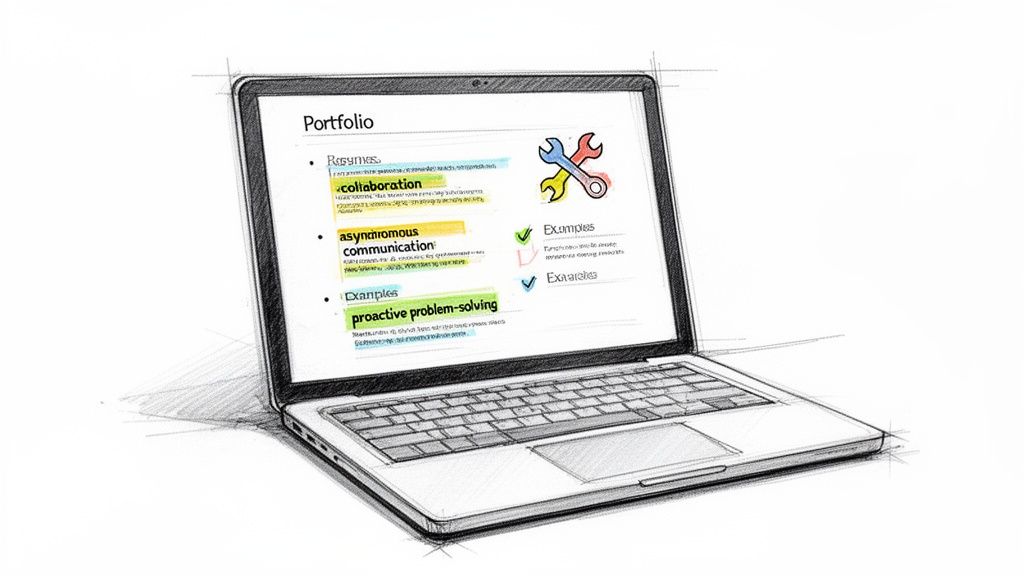
Your application is the first—and sometimes only—shot you get to prove you can deliver incredible results from anywhere on the planet. A standard-issue resume just listing your tech stack won’t cut it anymore. You’re up against a global talent pool where autonomy and stellar communication are just as valuable as your coding chops.
Hiring managers for remote roles aren’t just looking for another engineer. They’re searching for a reliable, proactive, and self-sufficient partner who can plug into a distributed team and start contributing without constant hand-holding. Every single piece of your application, from your resume to your portfolio, needs to be meticulously crafted to scream “I’m built for this.”
This means you have to reframe your experience. Stop just listing what you built and start explaining how you built it.
Weave Remote-Centric Skills into Your Resume
Your resume has to do more than just pass a vibe check; it needs to explicitly show you’ve got the goods for remote work. Don’t just claim “strong communication skills”—prove it with concrete examples. Talk about how you managed projects, collaborated with distant colleagues, and crushed problems with minimal direct oversight.
Let’s look at a real-world example.
Before (The Standard Bullet Point):
- Developed a new user authentication feature.
After (The Remote-Ready Bullet Point):
- Independently led the development of a new user authentication feature, coordinating with a distributed team across three time zones via asynchronous communication in Jira and Slack.
See the difference? The second version instantly signals autonomy, a knack for asynchronous collaboration, and fluency with the tools of the trade. These are massive green flags for a remote hiring manager.
Don’t just name-drop tools like Miro, Jira, or Slack. Context is everything. Describe an outcome. For instance, explain how you used Miro to map out a complex project roadmap that eliminated ambiguity for stakeholders, saving an estimated five hours of meeting time each week. Now that’s a story.
Before you send anything off, make sure your resume can get past the gatekeepers—the Applicant Tracking Systems (ATS). Run it through some free ATS CV checker tools to ensure it’s optimized to be seen by human eyes.
Your Portfolio Is Your Proof of Autonomy
If your resume is the trailer, your portfolio is the main feature. This is where you provide undeniable proof that you can work independently and deliver. It should be a curated showcase of projects that don’t just display your technical skill but tell a compelling story about your work process.
For every project, include a mini-case study that answers a few critical questions:
- What was the problem? Get straight to the point. What challenge were you hired to solve?
- What was your role and process? Walk them through your thought process. What architectural decisions did you make? How did you break down the work and manage your time?
- How did you collaborate? Explain the mechanics of your teamwork. Did you live in pull requests for code reviews? Did you create exhaustive documentation in Confluence to keep everyone aligned?
- What was the outcome? Use hard numbers whenever you can. Did you boost performance by 20%? Did you slash server costs? Metrics make your impact real.
This strategy transforms your portfolio from a static gallery into a powerful narrative. It demonstrates your problem-solving abilities and proves you can thrive in any environment, making you a standout candidate for those top-tier remote engineering jobs.
Winning the Remote Interview
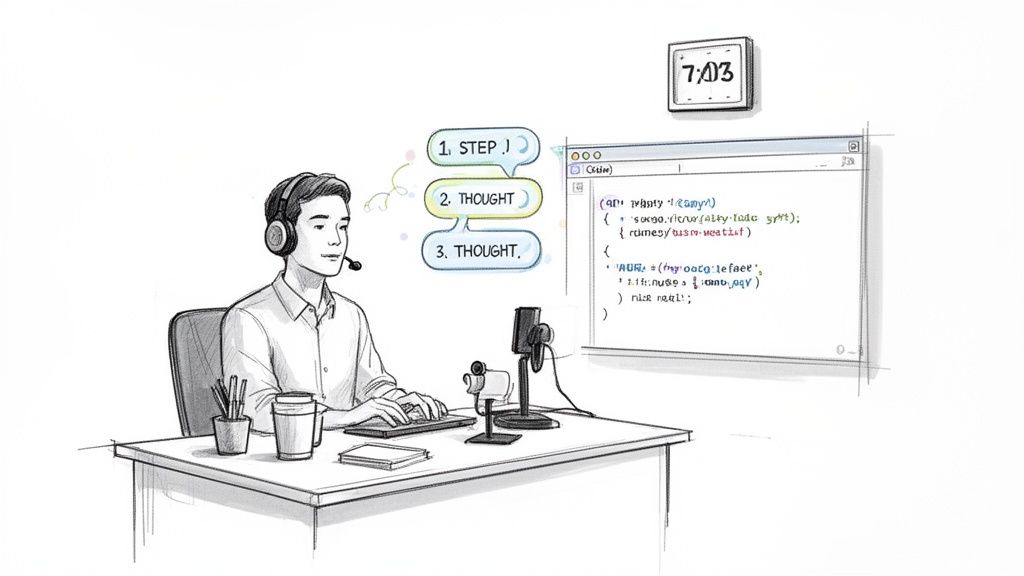
A remote interview is a completely different arena. Sure, the fundamentals of proving your technical chops still apply, but the medium itself adds a whole new layer of complexity. Success isn’t just about what you say—it’s about how you navigate the virtual space to build real rapport and show you can crush it autonomously.
From the very first video call, the interviewer is gauging your remote readiness. A blurry camera, choppy audio, or a chaotic background can be a red flag, signaling a lack of preparation. These details matter. They’re a direct reflection of your ability to set up a professional, effective work environment for yourself, which is a non-negotiable for any remote role.
Setting the Stage for Success
Your interview setup is your first impression. It needs to look professional, work flawlessly, and be completely free of distractions. Before you even start thinking about coding challenges, you need to dial in your tech so nothing gets in the way of a smooth conversation.
Get these basics right every single time:
- Test Your Tech: At least 30 minutes before the call, check your camera, mic, and internet connection. A last-minute scramble is stressful and looks unprofessional.
- Create a Neutral Backdrop: A clean, simple background is always the best bet. Think blank wall or a tidy bookshelf. Whatever you do, avoid sitting with your back to a window—you’ll turn into a distracting silhouette.
- Eliminate Distractions: Close every unnecessary tab on your computer to stop notifications from popping up. Give your family or roommates a heads-up that you can’t be disturbed. Put your phone on silent and stick it somewhere out of sight.
Your ability to present yourself clearly and professionally over video is a direct demonstration of your communication skills. In a distributed team, this is everything. Think of it as your first test of remote competence.
Communicating Through the Screen
When you can’t read the room physically, you have to be much more intentional with how you communicate. This is especially true during the technical parts of the interview. It’s not enough to just quietly solve the problem; you have to articulate your entire thought process.
Get in the habit of thinking out loud. Explain your initial assumptions, walk through the different approaches you’re considering, and state why you’re choosing one path over another. This running commentary gives the interviewer a window into how you solve problems, which is exactly what they’re there to see.
Beyond the technical side, you also need to prove you have the soft skills to thrive. Don’t forget to prepare for the common behavioural interview questions software developers face. Have specific examples ready from your past that show off your autonomy, proactive communication style, and your knack for resolving conflicts with remote colleagues.
Asking the Right Questions
Remember, the interview is a two-way street. This is your shot to vet the company’s remote culture and make sure it’s actually a good fit for you. Asking sharp, insightful questions shows you’re serious about finding the right long-term role, not just taking any job that comes along.
Come armed with questions that dig into the reality of their day-to-day:
- How does the team balance asynchronous communication versus real-time meetings?
- What does the onboarding process actually look like for a new remote engineer?
- How do you measure success and productivity for folks on the distributed team?
- What kind of opportunities are there for professional growth and mentorship in a remote setup?
The answers you get will tell you whether a company just allows remote work or if they’ve intentionally built a thriving, remote-first culture. That distinction is critical for your long-term success and happiness.
Navigating Offers and Remote Compensation
Alright, you’ve landed the remote offer. That’s a huge win, but don’t pop the champagne just yet. Now comes the tricky part: negotiating a compensation package that truly reflects your value, which gets a little more complex when your office is wherever you open your laptop. The core question is no longer just about your experience; it’s about where you log in from.
Companies tend to handle remote pay in one of two ways. Some have a flat rate for a role, period. Doesn’t matter if you’re in San Francisco or St. Louis. Others adjust salaries based on the cost of living in your specific city or region. Neither way is right or wrong, but you absolutely need to know which philosophy a company follows before you even think about negotiating.
Understanding Location-Based Pay
Many of the big tech players lean on a location-based pay model. This means your salary offer might be adjusted down if you live in a lower-cost-of-living area compared to a major tech hub. It can feel like a pay cut on paper, but in reality, it often maintains—or even improves—your actual purchasing power.
This model is also a huge piece of the puzzle for global hiring. A senior engineer in the U.S. might command a $100,000 salary, while a similarly skilled engineer in Argentina could cost the company just $60,000. On the flip side, an engineer moving from San Francisco to Austin could pocket over $64,000 in savings annually, even with a comparable salary. As you can see from these software engineering market trends, geography plays a massive role in what you can earn.
Before you jump on that call with the hiring manager, do your homework. Dig into salary benchmarks for your role, experience, and—most importantly—your location. Use sites like Levels.fyi and Glassdoor, but make sure to filter specifically for remote positions to get the most accurate data.
Negotiating Beyond the Base Salary
A great remote package is about so much more than the number on your paycheck. This is your opportunity to negotiate for the benefits that will actually make your remote work life productive and sustainable. Think bigger.
Don’t be afraid to ask for what you need to be successful. A company that is truly invested in its remote workforce will understand that a well-equipped home office is essential for productivity and long-term employee satisfaction.
Here are a few valuable perks you should definitely consider pushing for:
- Home Office Stipend: A one-time payment is perfect for getting a quality desk, a truly ergonomic chair, and a couple of decent monitors.
- Monthly Allowances: Think about recurring funds to cover essentials like high-speed internet or even a co-working space membership for when you need a change of scenery.
- Equipment Provision: Get clarity on this. Does the company provide a high-performance laptop and any other tech you need to do your job well?
- Flexible Hours: This is huge. Confirm the expectations around core working hours, especially if your team is scattered across multiple time zones.
Getting these details locked down ensures you won’t have any unwelcome surprises on day one. A comprehensive package that includes these elements isn’t just nice to have; it’s a strong signal of a healthy remote-first culture that’s genuinely set up to help you succeed.
Got Questions About Remote Engineering Jobs? We’ve Got Answers.
Even with a solid plan, jumping into the remote engineering world can feel like you’re missing a few pages of the manual. It’s totally normal to wonder how to prove you’ve got the right stuff without ever meeting the team in person, or how much tougher the competition really is.
Let’s clear the air on some of the most common questions that pop up. Think of this as the final confidence boost you need to go after that remote role with everything you’ve got.
How Can I Prove My Remote Skills Without Prior Remote Experience?
This is the classic chicken-and-egg problem, but trust me, it’s easier to crack than you think. You don’t need “Remote-Certified” stamped on your resume. What you need to do is show off the transferable skills you already have.
Dig into your past projects and pull out examples where you:
- Owned a feature or a bug fix from start to finish with minimal hand-holding.
- Juggled your own deadlines and shipped on time, every time.
- Worked with designers, PMs, or QA folks in other departments using tools like Slack, Jira, or Teams.
Your secret weapon here is your ability to communicate asynchronously. Did you write the Confluence doc that became the team’s source of truth? Resolved a gnarly technical debate over a long Slack thread? Left incredibly detailed and helpful code reviews on GitHub? Those aren’t just work tasks; they’re hard evidence that you can thrive remotely.
Pro tip: Contributing to an open-source project is one of the strongest signals you can send. It’s a real-world, public demonstration of your ability to collaborate, communicate, and ship quality code in a distributed environment. No one can argue with that.
Are Remote Engineering Jobs More Competitive?
Yeah, they often are. Let’s be real about it. When a job is open to engineers anywhere, the number of applicants skyrockets. You’re not just up against the best talent in your city anymore; you’re competing with skilled engineers from across the country or even the globe.
But here’s the flip side: there are way more opportunities for you, too. The trick is to stop trying to be the perfect candidate for every single job posting. Get specific. Differentiate yourself by going deep into a high-demand niche like AI/ML, cybersecurity, or a specific cloud platform like AWS or Azure. When you specialize, you become a big fish in a smaller, much more relevant pond.
What Are the Biggest Challenges of Working Remotely?
It almost always comes down to two things: communication and connection. Without the casual “Hey, got a sec?” moments by the coffee machine, you have to be so much more intentional. Crystal-clear writing isn’t a nice-to-have; it’s a must-have to prevent small misunderstandings from blowing up into project-derailing problems.
Navigating time zones is another huge one. This takes serious discipline—planning your work, respecting your colleagues’ offline hours, and truly embracing asynchronous communication. And finally, the feeling of isolation is very real. You have to actively fight it by joining virtual coffees, participating in team-building events, and making a genuine effort to connect with your coworkers as people, not just avatars on a screen.
How Do Companies Handle Equipment and Home Office Setup?
This is all over the map. Many established remote-first companies will give you a generous stipend—often a one-time payment of $1,000 to $2,500—to buy your own high-quality laptop, monitor, ergonomic chair, and whatever else you need to be comfortable and productive.
Others prefer to keep things standard and will ship you a pre-configured package with all the company-approved gear. There’s no right or wrong way, which is why this is a fantastic question to ask during your interviews. Make sure you ask specifically about their policies on equipment, internet reimbursement, and co-working space stipends. Their answer will tell you a lot about how seriously they invest in their remote team.
Ready to stop scrolling through generic job boards and find opportunities that are actually remote-first? Remote First Jobs verifies every single listing, so you can connect with trusted companies looking for top engineering talent.